
Hong Kong retains its top position by a huge margin, with 72.4% of transactions in offshore Renminbi, as Yuan volatility picks up and demand for FX clearing services keeps rising in South-East Asia.
The race for second spot dates from a while back - in June 2012 London overtook the Asia-Pacific center only to lose this spot 20 months later due to a rather abrupt rise in clearing deals in Singapore. The rate has almost quadrupled on a year-on-year basis due to increased acceptance of Chinese yuan transactions by businesses in the region.
This transition from a dollar-based trade has been coming for a long while, however with increasing efforts by the Chinese government to increase the Chinese yuan’s convertibility and the increasing dependence of Asia-Pacific economies on China for exports, the surge in renminbi demand in the region is well-founded.
The renminbi is strengthening its position as a global payment currency by marking a new record high in activity share among currencies worldwide - it is now 7th with 1.62%, catching up to the Canadian and the Australian dollars which are almost certain to be overcome during the second quarter of 2014 with shares of 1.83 and 1.84%. The growth picture on a monthly basis from February to March tells us that renminbi payments increased in value by 29.0%. Provided this trend persists, most likely by the end of May, the Chinese currency will have surpassed the Australian and Canadian dollars to become the fifth most actively traded currency in the world.
Last month the assistant managing director of the Monetary Authority of Singapore stated, "The interest that we are seeing in renminbi stands in stark contrast to the situation two to three years ago, when there was much less interest or familiarity with renminbi opportunities.”
Regional Businesses Switch to the Chinese Yuan for Trade
The development should come as no surprise considering that businesses in the region which are dealing with Chinese companies have started to settle trade and transactions in yuan in order to save the costs associated with translating deals in US dollar terms. The stage for the yuan to become a trade currency has been set for the past several years.
Some massive risks for the Chinese economy are still lurking around the corner with the government taking charge of deleveraging and rebalancing, a process that will greatly impact local South-East Asian economies which are not ready for a China that is growing at 3 to 4% over the next several years. Should this process materialize, it could lead to a substantial adjustment in various businesses and governments in the region.
With the vast majority of market participants betting on a one-way appreciation of the renminbi over the past couple of years, the latest introduction of a two-way volatility is stoking some pressures for investors who have been flocking to China for the past decade. The Chinese government is now on the opposite side of the carry trade and it appears that it has a lot to gain by helping the unwinding process – for every 10% devaluation in the CNY/USD, China could be gaining close to $200 billion. Staying in the currency war and devaluing to boost exports is the most likely (and the easiest) step chosen by the People’s Bank of China and the Chinese leadership to support growth in a deleveraging environment.
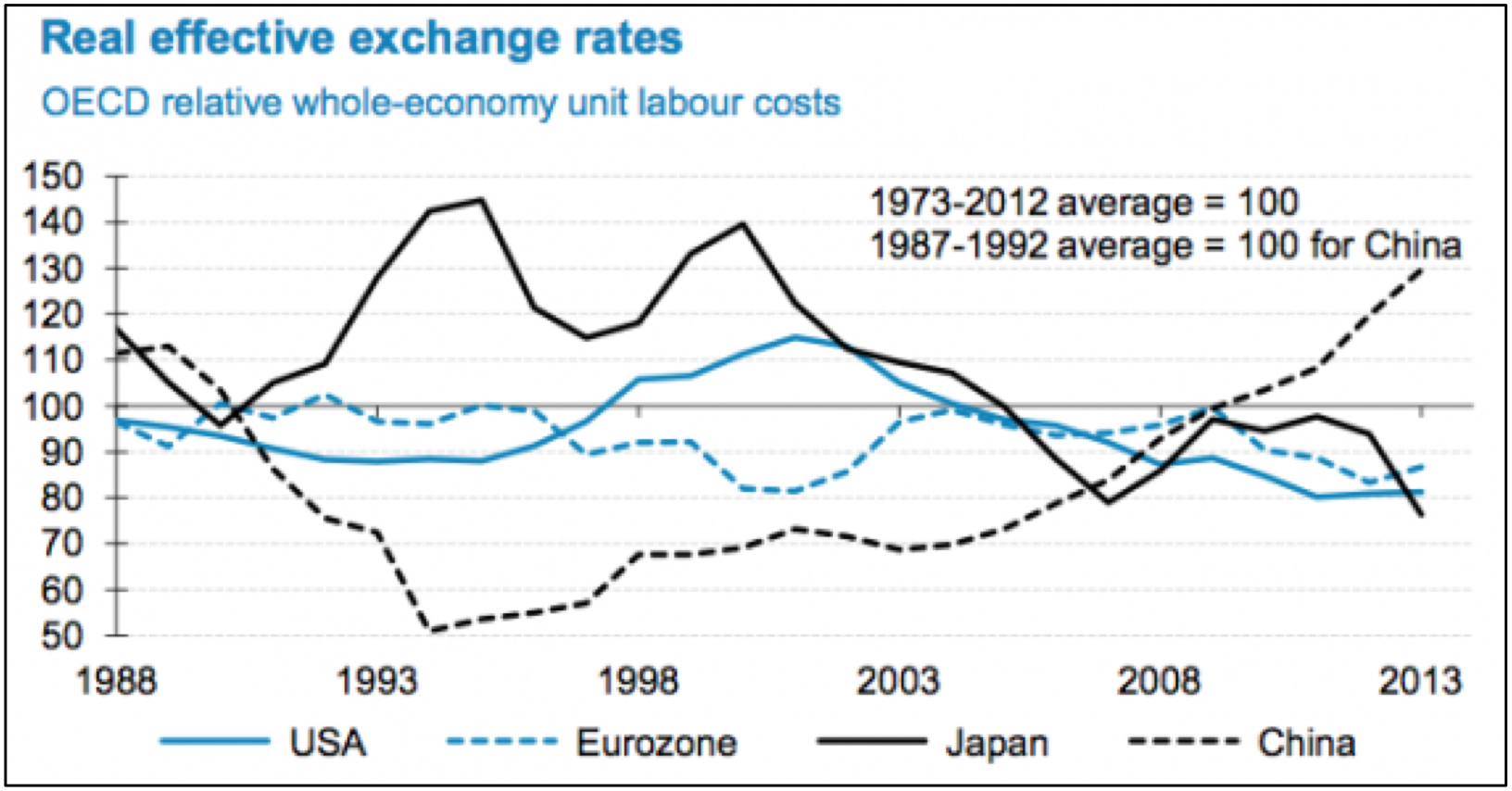
OECD data
Contrary to popular belief and global allegations by Western leaders of the Chinese currency being grossly overvalued, the Chinese yuan’s real effective exchange rate has risen substantially in recent years according to OECD data.
This dynamic is precisely the same as the one which moved South-European economies, Ireland and France to become uncompetitive in the years precluding the European sovereign debt crisis.
After many years of worldwide complaints that the Chinese yuan must be free floated, Chinese policymakers might just allow that to happen. However, the direction of the trend after that happens might turn to be quite the surprise - for those of you who remember the Asian financial crisis of 1997, the average currency devaluation in the region was close to 60%. China needs time to rebalance its growth and policymakers would easily use the exchange rate tool to achieve political goals.
Despite the fact that many economists believe that China’s massive reserves can prevent the effects of capital flight, nobody is even mentioning that a vast portion of these reserves are already used for loans to foreign governments. With all of this information at hand, the Chinese yuan might become even more prudent for trading after the unavoidable exchange rates liberalization.
The race for second spot dates from a while back - in June 2012 London overtook the Asia-Pacific center only to lose this spot 20 months later due to a rather abrupt rise in clearing deals in Singapore. The rate has almost quadrupled on a year-on-year basis due to increased acceptance of Chinese yuan transactions by businesses in the region.
This transition from a dollar-based trade has been coming for a long while, however with increasing efforts by the Chinese government to increase the Chinese yuan’s convertibility and the increasing dependence of Asia-Pacific economies on China for exports, the surge in renminbi demand in the region is well-founded.
The renminbi is strengthening its position as a global payment currency by marking a new record high in activity share among currencies worldwide - it is now 7th with 1.62%, catching up to the Canadian and the Australian dollars which are almost certain to be overcome during the second quarter of 2014 with shares of 1.83 and 1.84%. The growth picture on a monthly basis from February to March tells us that renminbi payments increased in value by 29.0%. Provided this trend persists, most likely by the end of May, the Chinese currency will have surpassed the Australian and Canadian dollars to become the fifth most actively traded currency in the world.
Last month the assistant managing director of the Monetary Authority of Singapore stated, "The interest that we are seeing in renminbi stands in stark contrast to the situation two to three years ago, when there was much less interest or familiarity with renminbi opportunities.”
Regional Businesses Switch to the Chinese Yuan for Trade
The development should come as no surprise considering that businesses in the region which are dealing with Chinese companies have started to settle trade and transactions in yuan in order to save the costs associated with translating deals in US dollar terms. The stage for the yuan to become a trade currency has been set for the past several years.
Some massive risks for the Chinese economy are still lurking around the corner with the government taking charge of deleveraging and rebalancing, a process that will greatly impact local South-East Asian economies which are not ready for a China that is growing at 3 to 4% over the next several years. Should this process materialize, it could lead to a substantial adjustment in various businesses and governments in the region.
With the vast majority of market participants betting on a one-way appreciation of the renminbi over the past couple of years, the latest introduction of a two-way volatility is stoking some pressures for investors who have been flocking to China for the past decade. The Chinese government is now on the opposite side of the carry trade and it appears that it has a lot to gain by helping the unwinding process – for every 10% devaluation in the CNY/USD, China could be gaining close to $200 billion. Staying in the currency war and devaluing to boost exports is the most likely (and the easiest) step chosen by the People’s Bank of China and the Chinese leadership to support growth in a deleveraging environment.
OECD data
Contrary to popular belief and global allegations by Western leaders of the Chinese currency being grossly overvalued, the Chinese yuan’s real effective exchange rate has risen substantially in recent years according to OECD data.
This dynamic is precisely the same as the one which moved South-European economies, Ireland and France to become uncompetitive in the years precluding the European sovereign debt crisis.
After many years of worldwide complaints that the Chinese yuan must be free floated, Chinese policymakers might just allow that to happen. However, the direction of the trend after that happens might turn to be quite the surprise - for those of you who remember the Asian financial crisis of 1997, the average currency devaluation in the region was close to 60%. China needs time to rebalance its growth and policymakers would easily use the exchange rate tool to achieve political goals.
Despite the fact that many economists believe that China’s massive reserves can prevent the effects of capital flight, nobody is even mentioning that a vast portion of these reserves are already used for loans to foreign governments. With all of this information at hand, the Chinese yuan might become even more prudent for trading after the unavoidable exchange rates liberalization.
OnePrime’s Jerry Khargi on Infrastructure, Liquidity & Trust | Executive Interview
Recorded live at FMLS:25 London, this exclusive executive interview features Jerry Khargi, Executive Director at OnePrime, in conversation with Andrea Badiola Mateos from Finance Magnates.
In this in-depth discussion, Jerry shares:
- OnePrime’s journey from a retail-focused business to a global institutional liquidity provider
- What truly sets award-winning trading infrastructure apart
- Key trends shaping institutional trading, including technology and AI
- The importance of transparency, ethics, and reputation in long-term success
- OnePrime’s vision for growth over the next 12–24 months
Fresh from winning Finance Magnates’ Best Trading Infrastructure Broker, Jerry explains how experience, mentorship, and real-world problem solving form the “special sauce” behind OnePrime’s institutional offering.
🏆 Award Highlight: Best Trading Infrastructure Broker
👉 Subscribe to Finance Magnates for more executive interviews, market insights, and exclusive coverage from the world’s leading financial events.
#FMLS25 #FinanceMagnates #OnePrime #InstitutionalTrading #Liquidity #TradingInfrastructure #ExecutiveInterview
Recorded live at FMLS:25 London, this exclusive executive interview features Jerry Khargi, Executive Director at OnePrime, in conversation with Andrea Badiola Mateos from Finance Magnates.
In this in-depth discussion, Jerry shares:
- OnePrime’s journey from a retail-focused business to a global institutional liquidity provider
- What truly sets award-winning trading infrastructure apart
- Key trends shaping institutional trading, including technology and AI
- The importance of transparency, ethics, and reputation in long-term success
- OnePrime’s vision for growth over the next 12–24 months
Fresh from winning Finance Magnates’ Best Trading Infrastructure Broker, Jerry explains how experience, mentorship, and real-world problem solving form the “special sauce” behind OnePrime’s institutional offering.
🏆 Award Highlight: Best Trading Infrastructure Broker
👉 Subscribe to Finance Magnates for more executive interviews, market insights, and exclusive coverage from the world’s leading financial events.
#FMLS25 #FinanceMagnates #OnePrime #InstitutionalTrading #Liquidity #TradingInfrastructure #ExecutiveInterview
Recorded live at FMLS:25 London, this exclusive executive interview features Jerry Khargi, Executive Director at OnePrime, in conversation with Andrea Badiola Mateos from Finance Magnates.
In this in-depth discussion, Jerry shares:
- OnePrime’s journey from a retail-focused business to a global institutional liquidity provider
- What truly sets award-winning trading infrastructure apart
- Key trends shaping institutional trading, including technology and AI
- The importance of transparency, ethics, and reputation in long-term success
- OnePrime’s vision for growth over the next 12–24 months
Fresh from winning Finance Magnates’ Best Trading Infrastructure Broker, Jerry explains how experience, mentorship, and real-world problem solving form the “special sauce” behind OnePrime’s institutional offering.
🏆 Award Highlight: Best Trading Infrastructure Broker
👉 Subscribe to Finance Magnates for more executive interviews, market insights, and exclusive coverage from the world’s leading financial events.
#FMLS25 #FinanceMagnates #OnePrime #InstitutionalTrading #Liquidity #TradingInfrastructure #ExecutiveInterview
Recorded live at FMLS:25 London, this exclusive executive interview features Jerry Khargi, Executive Director at OnePrime, in conversation with Andrea Badiola Mateos from Finance Magnates.
In this in-depth discussion, Jerry shares:
- OnePrime’s journey from a retail-focused business to a global institutional liquidity provider
- What truly sets award-winning trading infrastructure apart
- Key trends shaping institutional trading, including technology and AI
- The importance of transparency, ethics, and reputation in long-term success
- OnePrime’s vision for growth over the next 12–24 months
Fresh from winning Finance Magnates’ Best Trading Infrastructure Broker, Jerry explains how experience, mentorship, and real-world problem solving form the “special sauce” behind OnePrime’s institutional offering.
🏆 Award Highlight: Best Trading Infrastructure Broker
👉 Subscribe to Finance Magnates for more executive interviews, market insights, and exclusive coverage from the world’s leading financial events.
#FMLS25 #FinanceMagnates #OnePrime #InstitutionalTrading #Liquidity #TradingInfrastructure #ExecutiveInterview
How does the Finance Magnates newsroom decide which updates are worth covering? #financenews
What makes an update worth covering in financial media?
According to Yam Yehoshua, Editor-in-Chief at Finance Magnates, editorial focus starts with relevance: stories that serve the industry, support brokers and technology providers, and help decision-makers navigate their businesses.
A reminder that strong financial journalism is built on value, not volume.
What makes an update worth covering in financial media?
According to Yam Yehoshua, Editor-in-Chief at Finance Magnates, editorial focus starts with relevance: stories that serve the industry, support brokers and technology providers, and help decision-makers navigate their businesses.
A reminder that strong financial journalism is built on value, not volume.
What makes an update worth covering in financial media?
According to Yam Yehoshua, Editor-in-Chief at Finance Magnates, editorial focus starts with relevance: stories that serve the industry, support brokers and technology providers, and help decision-makers navigate their businesses.
A reminder that strong financial journalism is built on value, not volume.
What makes an update worth covering in financial media?
According to Yam Yehoshua, Editor-in-Chief at Finance Magnates, editorial focus starts with relevance: stories that serve the industry, support brokers and technology providers, and help decision-makers navigate their businesses.
A reminder that strong financial journalism is built on value, not volume.
What makes an update worth covering in financial media?
According to Yam Yehoshua, Editor-in-Chief at Finance Magnates, editorial focus starts with relevance: stories that serve the industry, support brokers and technology providers, and help decision-makers navigate their businesses.
A reminder that strong financial journalism is built on value, not volume.
What makes an update worth covering in financial media?
According to Yam Yehoshua, Editor-in-Chief at Finance Magnates, editorial focus starts with relevance: stories that serve the industry, support brokers and technology providers, and help decision-makers navigate their businesses.
A reminder that strong financial journalism is built on value, not volume.
Liquidity as a Business: How Brokers Can Earn More
This webinar will focuses on how brokers can create new revenue streams by launching or enhancing their liquidity business.
John Murillo, Chief Dealing Officer of the B2BROKER group, covers how:
- Retail brokers can launch their own B2B arm to distribute liquidity and boost profitability.
- Institutional brokers can upgrade their liquidity offering and strengthen their market position.
- New entrants can start from scratch and become liquidity providers through a ready-made turnkey solution.
Hosted by B2BROKER, a global fintech provider of liquidity and technology solutions, the session will reveal how to monetize liquidity, accelerate business growth, and increase profitability using the Liquidity Provider Turnkey solution.
📣 Stay updated with the latest in finance and trading! Follow Finance Magnates across our social media platforms for news, insights, and event updates.
Connect with us today:
🔗 LinkedIn: / https://www.linkedin.com/company/financemagnates/
👍 Facebook: / https://www.facebook.com/financemagnates/
📸 Instagram: / https://www.instagram.com/financemagnates_official/?hl=en
🐦 X: https://x.com/financemagnates?
🎥 TikTok: https://www.tiktok.com/tag/financemag...
▶️ YouTube: / @financemagnates_official
This webinar will focuses on how brokers can create new revenue streams by launching or enhancing their liquidity business.
John Murillo, Chief Dealing Officer of the B2BROKER group, covers how:
- Retail brokers can launch their own B2B arm to distribute liquidity and boost profitability.
- Institutional brokers can upgrade their liquidity offering and strengthen their market position.
- New entrants can start from scratch and become liquidity providers through a ready-made turnkey solution.
Hosted by B2BROKER, a global fintech provider of liquidity and technology solutions, the session will reveal how to monetize liquidity, accelerate business growth, and increase profitability using the Liquidity Provider Turnkey solution.
📣 Stay updated with the latest in finance and trading! Follow Finance Magnates across our social media platforms for news, insights, and event updates.
Connect with us today:
🔗 LinkedIn: / https://www.linkedin.com/company/financemagnates/
👍 Facebook: / https://www.facebook.com/financemagnates/
📸 Instagram: / https://www.instagram.com/financemagnates_official/?hl=en
🐦 X: https://x.com/financemagnates?
🎥 TikTok: https://www.tiktok.com/tag/financemag...
▶️ YouTube: / @financemagnates_official
This webinar will focuses on how brokers can create new revenue streams by launching or enhancing their liquidity business.
John Murillo, Chief Dealing Officer of the B2BROKER group, covers how:
- Retail brokers can launch their own B2B arm to distribute liquidity and boost profitability.
- Institutional brokers can upgrade their liquidity offering and strengthen their market position.
- New entrants can start from scratch and become liquidity providers through a ready-made turnkey solution.
Hosted by B2BROKER, a global fintech provider of liquidity and technology solutions, the session will reveal how to monetize liquidity, accelerate business growth, and increase profitability using the Liquidity Provider Turnkey solution.
📣 Stay updated with the latest in finance and trading! Follow Finance Magnates across our social media platforms for news, insights, and event updates.
Connect with us today:
🔗 LinkedIn: / https://www.linkedin.com/company/financemagnates/
👍 Facebook: / https://www.facebook.com/financemagnates/
📸 Instagram: / https://www.instagram.com/financemagnates_official/?hl=en
🐦 X: https://x.com/financemagnates?
🎥 TikTok: https://www.tiktok.com/tag/financemag...
▶️ YouTube: / @financemagnates_official
This webinar will focuses on how brokers can create new revenue streams by launching or enhancing their liquidity business.
John Murillo, Chief Dealing Officer of the B2BROKER group, covers how:
- Retail brokers can launch their own B2B arm to distribute liquidity and boost profitability.
- Institutional brokers can upgrade their liquidity offering and strengthen their market position.
- New entrants can start from scratch and become liquidity providers through a ready-made turnkey solution.
Hosted by B2BROKER, a global fintech provider of liquidity and technology solutions, the session will reveal how to monetize liquidity, accelerate business growth, and increase profitability using the Liquidity Provider Turnkey solution.
📣 Stay updated with the latest in finance and trading! Follow Finance Magnates across our social media platforms for news, insights, and event updates.
Connect with us today:
🔗 LinkedIn: / https://www.linkedin.com/company/financemagnates/
👍 Facebook: / https://www.facebook.com/financemagnates/
📸 Instagram: / https://www.instagram.com/financemagnates_official/?hl=en
🐦 X: https://x.com/financemagnates?
🎥 TikTok: https://www.tiktok.com/tag/financemag...
▶️ YouTube: / @financemagnates_official
This webinar will focuses on how brokers can create new revenue streams by launching or enhancing their liquidity business.
John Murillo, Chief Dealing Officer of the B2BROKER group, covers how:
- Retail brokers can launch their own B2B arm to distribute liquidity and boost profitability.
- Institutional brokers can upgrade their liquidity offering and strengthen their market position.
- New entrants can start from scratch and become liquidity providers through a ready-made turnkey solution.
Hosted by B2BROKER, a global fintech provider of liquidity and technology solutions, the session will reveal how to monetize liquidity, accelerate business growth, and increase profitability using the Liquidity Provider Turnkey solution.
📣 Stay updated with the latest in finance and trading! Follow Finance Magnates across our social media platforms for news, insights, and event updates.
Connect with us today:
🔗 LinkedIn: / https://www.linkedin.com/company/financemagnates/
👍 Facebook: / https://www.facebook.com/financemagnates/
📸 Instagram: / https://www.instagram.com/financemagnates_official/?hl=en
🐦 X: https://x.com/financemagnates?
🎥 TikTok: https://www.tiktok.com/tag/financemag...
▶️ YouTube: / @financemagnates_official
This webinar will focuses on how brokers can create new revenue streams by launching or enhancing their liquidity business.
John Murillo, Chief Dealing Officer of the B2BROKER group, covers how:
- Retail brokers can launch their own B2B arm to distribute liquidity and boost profitability.
- Institutional brokers can upgrade their liquidity offering and strengthen their market position.
- New entrants can start from scratch and become liquidity providers through a ready-made turnkey solution.
Hosted by B2BROKER, a global fintech provider of liquidity and technology solutions, the session will reveal how to monetize liquidity, accelerate business growth, and increase profitability using the Liquidity Provider Turnkey solution.
📣 Stay updated with the latest in finance and trading! Follow Finance Magnates across our social media platforms for news, insights, and event updates.
Connect with us today:
🔗 LinkedIn: / https://www.linkedin.com/company/financemagnates/
👍 Facebook: / https://www.facebook.com/financemagnates/
📸 Instagram: / https://www.instagram.com/financemagnates_official/?hl=en
🐦 X: https://x.com/financemagnates?
🎥 TikTok: https://www.tiktok.com/tag/financemag...
▶️ YouTube: / @financemagnates_official
How FYNXT is Transforming Brokerages with Modular Tech | Executive Interview with Stephen Miles
Join us for an exclusive interview with Stephen Miles, Chief Revenue Officer at FYNXT, recorded live at FMLS:25. In this conversation, Stephen breaks down how modular brokerage technology is driving growth, retention, and efficiency across the brokerage industry.
Learn how FYNXT's unified yet modular platform is giving brokers a competitive edge—powering faster onboarding, increased trading volumes, and dramatically improved IB performance.
🔑 What You'll Learn in This Video:
- The biggest challenges brokerages face going into 2026
- Why FYNXT’s modular platform is outperforming in-house builds
- How automation is transforming IB channels
- The real ROI: 11x LTV increases and reduced acquisition costs
👉 Don’t forget to like, comment, and subscribe.
#FYNXT #StephenMiles #FMLS2025 #BrokerageTechnology #ModularTech #FintechInterview #DigitalTransformation #FinancialMarkets #CROInterview #FintechInnovation #TradingTechnology #IndependentBrokers #FinanceLeaders
Join us for an exclusive interview with Stephen Miles, Chief Revenue Officer at FYNXT, recorded live at FMLS:25. In this conversation, Stephen breaks down how modular brokerage technology is driving growth, retention, and efficiency across the brokerage industry.
Learn how FYNXT's unified yet modular platform is giving brokers a competitive edge—powering faster onboarding, increased trading volumes, and dramatically improved IB performance.
🔑 What You'll Learn in This Video:
- The biggest challenges brokerages face going into 2026
- Why FYNXT’s modular platform is outperforming in-house builds
- How automation is transforming IB channels
- The real ROI: 11x LTV increases and reduced acquisition costs
👉 Don’t forget to like, comment, and subscribe.
#FYNXT #StephenMiles #FMLS2025 #BrokerageTechnology #ModularTech #FintechInterview #DigitalTransformation #FinancialMarkets #CROInterview #FintechInnovation #TradingTechnology #IndependentBrokers #FinanceLeaders
Join us for an exclusive interview with Stephen Miles, Chief Revenue Officer at FYNXT, recorded live at FMLS:25. In this conversation, Stephen breaks down how modular brokerage technology is driving growth, retention, and efficiency across the brokerage industry.
Learn how FYNXT's unified yet modular platform is giving brokers a competitive edge—powering faster onboarding, increased trading volumes, and dramatically improved IB performance.
🔑 What You'll Learn in This Video:
- The biggest challenges brokerages face going into 2026
- Why FYNXT’s modular platform is outperforming in-house builds
- How automation is transforming IB channels
- The real ROI: 11x LTV increases and reduced acquisition costs
👉 Don’t forget to like, comment, and subscribe.
#FYNXT #StephenMiles #FMLS2025 #BrokerageTechnology #ModularTech #FintechInterview #DigitalTransformation #FinancialMarkets #CROInterview #FintechInnovation #TradingTechnology #IndependentBrokers #FinanceLeaders
Join us for an exclusive interview with Stephen Miles, Chief Revenue Officer at FYNXT, recorded live at FMLS:25. In this conversation, Stephen breaks down how modular brokerage technology is driving growth, retention, and efficiency across the brokerage industry.
Learn how FYNXT's unified yet modular platform is giving brokers a competitive edge—powering faster onboarding, increased trading volumes, and dramatically improved IB performance.
🔑 What You'll Learn in This Video:
- The biggest challenges brokerages face going into 2026
- Why FYNXT’s modular platform is outperforming in-house builds
- How automation is transforming IB channels
- The real ROI: 11x LTV increases and reduced acquisition costs
👉 Don’t forget to like, comment, and subscribe.
#FYNXT #StephenMiles #FMLS2025 #BrokerageTechnology #ModularTech #FintechInterview #DigitalTransformation #FinancialMarkets #CROInterview #FintechInnovation #TradingTechnology #IndependentBrokers #FinanceLeaders
Join us for an exclusive interview with Stephen Miles, Chief Revenue Officer at FYNXT, recorded live at FMLS:25. In this conversation, Stephen breaks down how modular brokerage technology is driving growth, retention, and efficiency across the brokerage industry.
Learn how FYNXT's unified yet modular platform is giving brokers a competitive edge—powering faster onboarding, increased trading volumes, and dramatically improved IB performance.
🔑 What You'll Learn in This Video:
- The biggest challenges brokerages face going into 2026
- Why FYNXT’s modular platform is outperforming in-house builds
- How automation is transforming IB channels
- The real ROI: 11x LTV increases and reduced acquisition costs
👉 Don’t forget to like, comment, and subscribe.
#FYNXT #StephenMiles #FMLS2025 #BrokerageTechnology #ModularTech #FintechInterview #DigitalTransformation #FinancialMarkets #CROInterview #FintechInnovation #TradingTechnology #IndependentBrokers #FinanceLeaders
Join us for an exclusive interview with Stephen Miles, Chief Revenue Officer at FYNXT, recorded live at FMLS:25. In this conversation, Stephen breaks down how modular brokerage technology is driving growth, retention, and efficiency across the brokerage industry.
Learn how FYNXT's unified yet modular platform is giving brokers a competitive edge—powering faster onboarding, increased trading volumes, and dramatically improved IB performance.
🔑 What You'll Learn in This Video:
- The biggest challenges brokerages face going into 2026
- Why FYNXT’s modular platform is outperforming in-house builds
- How automation is transforming IB channels
- The real ROI: 11x LTV increases and reduced acquisition costs
👉 Don’t forget to like, comment, and subscribe.
#FYNXT #StephenMiles #FMLS2025 #BrokerageTechnology #ModularTech #FintechInterview #DigitalTransformation #FinancialMarkets #CROInterview #FintechInnovation #TradingTechnology #IndependentBrokers #FinanceLeaders
Executive Interview | Charlotte Bullock | Chief Product Officer, Bank of London | FMLS:25
In this interview, we sat down with Charlotte Bullock, Head of Product at The Bank of London, previously at SAP and now shaping product at one of the sector’s most ambitious new banking players.
Charlotte reflects on the Summit so far and talks about the culture inside fintech banks today. We look at the pressures that come with scaling, and how firms can hold onto the nimble approach that made them stand out early on.
We also cover the state of payments ahead of her appearance on the payments roundtable: the blockages financial firms face, the areas that still need fixing, and what a realistic solution looks like in 2026.
In this interview, we sat down with Charlotte Bullock, Head of Product at The Bank of London, previously at SAP and now shaping product at one of the sector’s most ambitious new banking players.
Charlotte reflects on the Summit so far and talks about the culture inside fintech banks today. We look at the pressures that come with scaling, and how firms can hold onto the nimble approach that made them stand out early on.
We also cover the state of payments ahead of her appearance on the payments roundtable: the blockages financial firms face, the areas that still need fixing, and what a realistic solution looks like in 2026.
In this interview, we sat down with Charlotte Bullock, Head of Product at The Bank of London, previously at SAP and now shaping product at one of the sector’s most ambitious new banking players.
Charlotte reflects on the Summit so far and talks about the culture inside fintech banks today. We look at the pressures that come with scaling, and how firms can hold onto the nimble approach that made them stand out early on.
We also cover the state of payments ahead of her appearance on the payments roundtable: the blockages financial firms face, the areas that still need fixing, and what a realistic solution looks like in 2026.
In this interview, we sat down with Charlotte Bullock, Head of Product at The Bank of London, previously at SAP and now shaping product at one of the sector’s most ambitious new banking players.
Charlotte reflects on the Summit so far and talks about the culture inside fintech banks today. We look at the pressures that come with scaling, and how firms can hold onto the nimble approach that made them stand out early on.
We also cover the state of payments ahead of her appearance on the payments roundtable: the blockages financial firms face, the areas that still need fixing, and what a realistic solution looks like in 2026.
In this interview, we sat down with Charlotte Bullock, Head of Product at The Bank of London, previously at SAP and now shaping product at one of the sector’s most ambitious new banking players.
Charlotte reflects on the Summit so far and talks about the culture inside fintech banks today. We look at the pressures that come with scaling, and how firms can hold onto the nimble approach that made them stand out early on.
We also cover the state of payments ahead of her appearance on the payments roundtable: the blockages financial firms face, the areas that still need fixing, and what a realistic solution looks like in 2026.
In this interview, we sat down with Charlotte Bullock, Head of Product at The Bank of London, previously at SAP and now shaping product at one of the sector’s most ambitious new banking players.
Charlotte reflects on the Summit so far and talks about the culture inside fintech banks today. We look at the pressures that come with scaling, and how firms can hold onto the nimble approach that made them stand out early on.
We also cover the state of payments ahead of her appearance on the payments roundtable: the blockages financial firms face, the areas that still need fixing, and what a realistic solution looks like in 2026.