


Risk management has overtaken every other operational concern among global brokerages heading into 2026, according to a new industry report from technology provider Tools for Brokers (TFB).
The timing is notable. Retail trading demand hit record highs in early 2026, surging 25% above the previous peak set during the 2021 pandemic surge, with FMIntel data suggesting monthly CFD volumes could exceed $37 trillion this year. That kind of volume puts every operational weakness under a microscope.
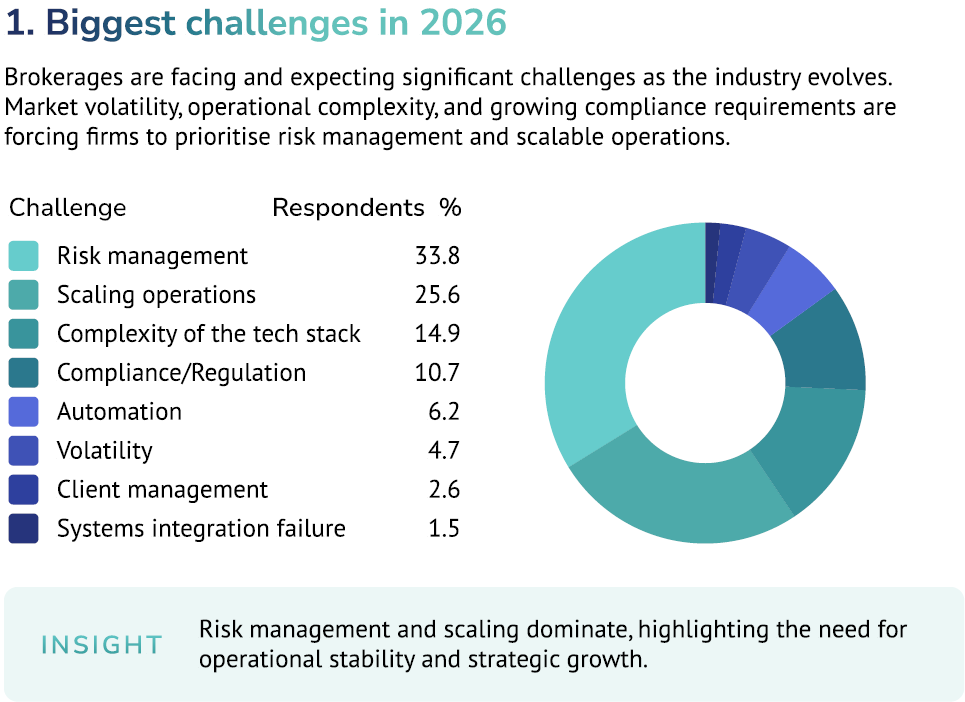
Some 34% of respondents named risk management as their primary challenge for the year ahead, placing it comfortably above the second-ranked concern, scaling operations, cited by 26% of firms. Technology stack complexity followed at 15%, with compliance and regulation accounting for 11%.
Risk Is No Longer a Back-Office Problem
For years, risk oversight sat somewhere between a compliance checkbox and a back-office function at many retail brokerages. That appears to be changing fast. Faster execution environments, higher market volatility , and growing client protection requirements are pushing firms to build risk controls directly into their core infrastructure - not bolt them on after the fact.

Alexey Kutsenko, CEO at TFB, said the findings track closely with what the company has observed across its own client base.
- TFB Aims to Be an All-in-One “Operating System” for Brokers with Integrated Risk Analytics
- TFB Partners with TRAction Allowing Brokers to Auto-Report Through Their Trading Platform
- Tools for Brokers Adds Order Splitting to Trade Processor in Latest Update
"Over the past decade, the brokerage landscape has become materially more complex," he said. "Risk management is no longer a back-office function, but a... priority tied to scalability and long-term resilience. Firms moving ahead are investing in tighter execution, real-time client visibility, AI integration, and greater automation across risk workflows."
The report argues that the most resilient brokerages now run risk management as a continuous system - think real-time alerting, predefined thresholds, and automated responses to abnormal trading behavior - rather than relying on periodic manual reviews. The distinction matters. During volatile market conditions, the firms that break first are typically those whose systems fail under pressure, not those with bad products.
Scaling Up Without Blowing Up
Growth is creating its own set of problems. One in four brokers surveyed said scaling operations was their biggest challenge, a figure that reflects how rapidly rising transaction volumes are stressing infrastructure built for a smaller, simpler business.
The report notes that firms successfully navigating this pressure typically share a few common threads: flexible infrastructure, advanced liquidity aggregation, and automated risk controls. The ability to absorb volume spikes without compromising pricing quality or execution speed is increasingly what separates firms that can expand into new markets from those that get stuck firefighting.
The scaling challenge is especially sharp for brokers pushing into regions such as Southeast Asia, Africa, and Latin America, where infrastructure limitations and regulatory fragmentation add layers of complexity that more established markets don't face to the same degree.
AI and Liquidity Bridges Lead Tech Spending
When brokerages were asked where they planned to invest in technology for 2026, artificial intelligence came out on top at 28%, followed by liquidity bridges at 20%. AI-driven risk management tools, automation , social trading, mobile applications, and big data analytics made up the rest of the top priorities.
On the operational side, AI-driven tools are also increasingly being used to support account management, help sales teams prioritize high-risk accounts, and improve the consistency of internal decision-making.
Liquidity bridges ranked second in spending intentions. As TFB detailed last November, the push toward consolidated platforms that combine execution, analytics, and risk management in a single environment has been gathering momentum, with major tech providers racing to build what amounts to an all-in-one operating system for brokers.
Earlier this month, Alchemy Markets integrated TFB's Trade Processor into its trading infrastructure to automate liquidity management, risk controls, and regulatory reporting simultaneously .
Compliance Hardens Into an Operational Function

"Regulatory readiness ensures both client trust and operational sustainability,” TFB's COO Vladimir Viuchejskiy, added. “Advanced tech combined with skilled teams mitigates risk and positions firms as market leaders."
Regulatory compliance ranked fourth among broker concerns, but the tone in the report around this topic suggests it deserves more attention than the raw percentage implies. Brokerages are under rising pressure from regulators, banking partners, and liquidity providers to demonstrate structured reporting, clear audit trails, and documented risk controls, regardless of whether local regulation formally requires it.
The automated reporting angle is gaining traction as a practical fix: last July, TFB partnered with TRAction to let brokers auto-report directly through their trading platform, covering major regulatory frameworks including EMIR, MiFIR, and ASIC rules. Kutsenko noted at the time that "reporting and compliance remain among the most important challenges our clients face.”


