Trade the Event, Protect the Position

Wednesday, 25/02/2026 | 05:11 GMT by Leon Okon
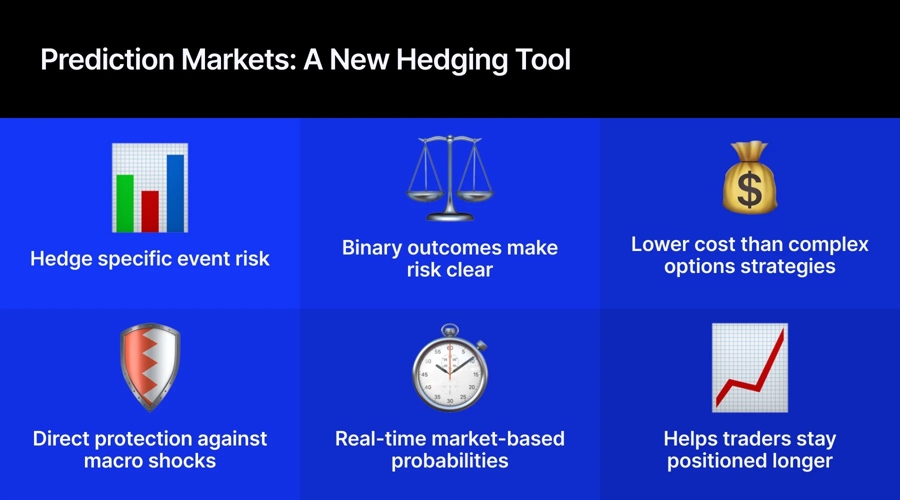
  • Prediction markets allow a trader to hedge specific, binary risks with surgical precision. If a client has a heavy long position on the euro, they can hedge the specific risk of political upheaval by taking a position in a prediction market focused on that event.
  • In the near future, a brokerage that does not offer prediction markets will be seen as an incomplete platform.
prediction markets

In the world of online brokerages, the need to integrate "the next big thing" is constant. We’ve seen the industry pivot from spot FX to CFDs, then to the democratisation of equities, and most recently, the wild frontier of digital assets. Each wave was met with initial scepticism by incumbents, only to eventually become a standard requirement for any brokerage hoping to maintain market share.

Today, we are standing at the edge of the next great shift: the institutionalisation and integration of prediction markets.

Recently, prediction markets have been primarily associated with hype around political polling and sports. But that perception is undergoing a radical transformation. We are seeing first-hand that prediction markets are no longer a niche curiosity; they are becoming a fundamental macroeconomic tool.

Related: Plus500 Launches Predictions Markets in the US, Offering Kalshi's 'Regulated' Products

If you are running a brokerage, a CFD platform, or a fintech operation, here is why prediction markets need to be on your 2026 product roadmap.

The New "Source of Truth"

The most significant validation for this asset class didn't come from a tech blog, but from the halls of the Federal Reserve. A recent post from the Fed highlighted the rise of "macro markets", noting that platforms like Kalshi are providing real-time, high-fidelity data on how the market perceives future economic events.

Traditional markets are often "noisy", influenced by a million variables, from liquidity crunches to unrelated geopolitical tremors. Prediction markets, however, are laser-focused on specific outcomes: Will the Fed hike rates in June? Will the CPI exceed 3.2%? When thousands of participants put capital behind a specific outcome, the resulting price is often a more accurate forecast than expert consensus or lagging indicators. For brokers, offering these markets isn't just about providing a tradable instrument; it’s about providing your users with the ultimate "source of truth" to guide their entire portfolio strategy.

The Ultimate Hedging Tool

For the typical CFD or Forex trader on your platform, event risk is the greatest enemy. A sudden central bank decision or a surprise election result can wipe out a leveraged position in seconds. Historically, traders have tried to hedge these risks using complex options structures or inverse correlations – methods that are often inefficient or too expensive for the retail trader.

Prediction markets solve this. They allow a trader to hedge specific, binary risks with surgical precision. If a client has a heavy long position on the euro, they can hedge the specific risk of political upheaval by taking a position in a prediction market focused on that event. By integrating these markets, you aren't just giving your clients a new way to trade; you are giving them the tools to stay in the game longer, manage their downside, and trade with more confidence.

The "New, Expected, Lagging" Lifecycle

We are currently in the "New" phase of prediction markets. Early adopters are capturing the headlines, the "early-in" liquidity, and the SEO dominance.

Very soon, likely within the next 12 to 18 months, prediction markets will move to the "Expected" phase. Just as a modern broker wouldn't dream of launching without gold, oil, or major tech stocks, users will expect to be able to trade the outcomes of the events that move those markets.

The final phase is the most dangerous for incumbents: the "Lagging" strategy. In the near future, a brokerage that does not offer prediction markets will be seen as an incomplete platform. You will be asking your users to look elsewhere for their macro-hedging and event trading. And as we know, once a user moves their capital to a competitor for one asset class, the risk of losing them is high.

The Opportunity for Operators

We know the infrastructure is ready for prime time. The US is leading the way with regulatory clarity, and prediction markets are thriving in 100+ other jurisdictions. Liquidity is deepening, and the technology to integrate these markets is seamless.

The question for operators is no longer if prediction markets will go mainstream, but rather who will take them there. The data is clear, the Fed is watching, and the traders are ready.

It is time to move beyond the chart and start trading the event. The future isn't just something that happens to us – it’s the next great market.

In the world of online brokerages, the need to integrate "the next big thing" is constant. We’ve seen the industry pivot from spot FX to CFDs, then to the democratisation of equities, and most recently, the wild frontier of digital assets. Each wave was met with initial scepticism by incumbents, only to eventually become a standard requirement for any brokerage hoping to maintain market share.

Today, we are standing at the edge of the next great shift: the institutionalisation and integration of prediction markets.

Recently, prediction markets have been primarily associated with hype around political polling and sports. But that perception is undergoing a radical transformation. We are seeing first-hand that prediction markets are no longer a niche curiosity; they are becoming a fundamental macroeconomic tool.

Related: Plus500 Launches Predictions Markets in the US, Offering Kalshi's 'Regulated' Products

If you are running a brokerage, a CFD platform, or a fintech operation, here is why prediction markets need to be on your 2026 product roadmap.

The New "Source of Truth"

The most significant validation for this asset class didn't come from a tech blog, but from the halls of the Federal Reserve. A recent post from the Fed highlighted the rise of "macro markets", noting that platforms like Kalshi are providing real-time, high-fidelity data on how the market perceives future economic events.

Traditional markets are often "noisy", influenced by a million variables, from liquidity crunches to unrelated geopolitical tremors. Prediction markets, however, are laser-focused on specific outcomes: Will the Fed hike rates in June? Will the CPI exceed 3.2%? When thousands of participants put capital behind a specific outcome, the resulting price is often a more accurate forecast than expert consensus or lagging indicators. For brokers, offering these markets isn't just about providing a tradable instrument; it’s about providing your users with the ultimate "source of truth" to guide their entire portfolio strategy.

The Ultimate Hedging Tool

For the typical CFD or Forex trader on your platform, event risk is the greatest enemy. A sudden central bank decision or a surprise election result can wipe out a leveraged position in seconds. Historically, traders have tried to hedge these risks using complex options structures or inverse correlations – methods that are often inefficient or too expensive for the retail trader.

Prediction markets solve this. They allow a trader to hedge specific, binary risks with surgical precision. If a client has a heavy long position on the euro, they can hedge the specific risk of political upheaval by taking a position in a prediction market focused on that event. By integrating these markets, you aren't just giving your clients a new way to trade; you are giving them the tools to stay in the game longer, manage their downside, and trade with more confidence.

The "New, Expected, Lagging" Lifecycle

We are currently in the "New" phase of prediction markets. Early adopters are capturing the headlines, the "early-in" liquidity, and the SEO dominance.

Very soon, likely within the next 12 to 18 months, prediction markets will move to the "Expected" phase. Just as a modern broker wouldn't dream of launching without gold, oil, or major tech stocks, users will expect to be able to trade the outcomes of the events that move those markets.

The final phase is the most dangerous for incumbents: the "Lagging" strategy. In the near future, a brokerage that does not offer prediction markets will be seen as an incomplete platform. You will be asking your users to look elsewhere for their macro-hedging and event trading. And as we know, once a user moves their capital to a competitor for one asset class, the risk of losing them is high.

The Opportunity for Operators

We know the infrastructure is ready for prime time. The US is leading the way with regulatory clarity, and prediction markets are thriving in 100+ other jurisdictions. Liquidity is deepening, and the technology to integrate these markets is seamless.

The question for operators is no longer if prediction markets will go mainstream, but rather who will take them there. The data is clear, the Fed is watching, and the traders are ready.

It is time to move beyond the chart and start trading the event. The future isn't just something that happens to us – it’s the next great market.

About the Author: Leon Okon
Leon Okon
  • 1 Article
About the Author: Leon Okon
Founder of Plaee, building the infrastructure for high-performance prediction markets. We provide the institutional-grade technology and regulatory pathways required to launch liquid trading platforms for politics, economics, and global events. Our core strength lies in a personalized engagement backoffice—a data-driven command center that empowers operators to maximize user retention and drive volume through tailored experiences. This sophisticated engagement engine also powers our end-to-end social gaming platform, including fully integrated sweepstakes solutions.
  • 1 Article

Retail FX

!"#$%&'()*+,-./0123456789:;<=>?@ABCDEFGHIJKLMNOPQRSTUVWXYZ[\]^_`abcdefghijklmnopqrstuvwxyz{|} !"#$%&'()*+,-./0123456789:;<=>?@ABCDEFGHIJKLMNOPQRSTUVWXYZ[\]^_`abcdefghijklmnopqrstuvwxyz{|}