The platform outpaces rival crypto-based Polymarket despite the competitor's U.S. expansion push.
The higher turnover rates suggest different trading behaviors between the two platforms.
Kalshi has
emerged as the dominant player in prediction market and event-based contract trading,
capturing nearly two-thirds of sector volume as regulated platforms gain ground
over offshore competitors.
Kalshi Captures 62% Market
Share as Prediction Trading Volumes Surge
The CFTC-authorized
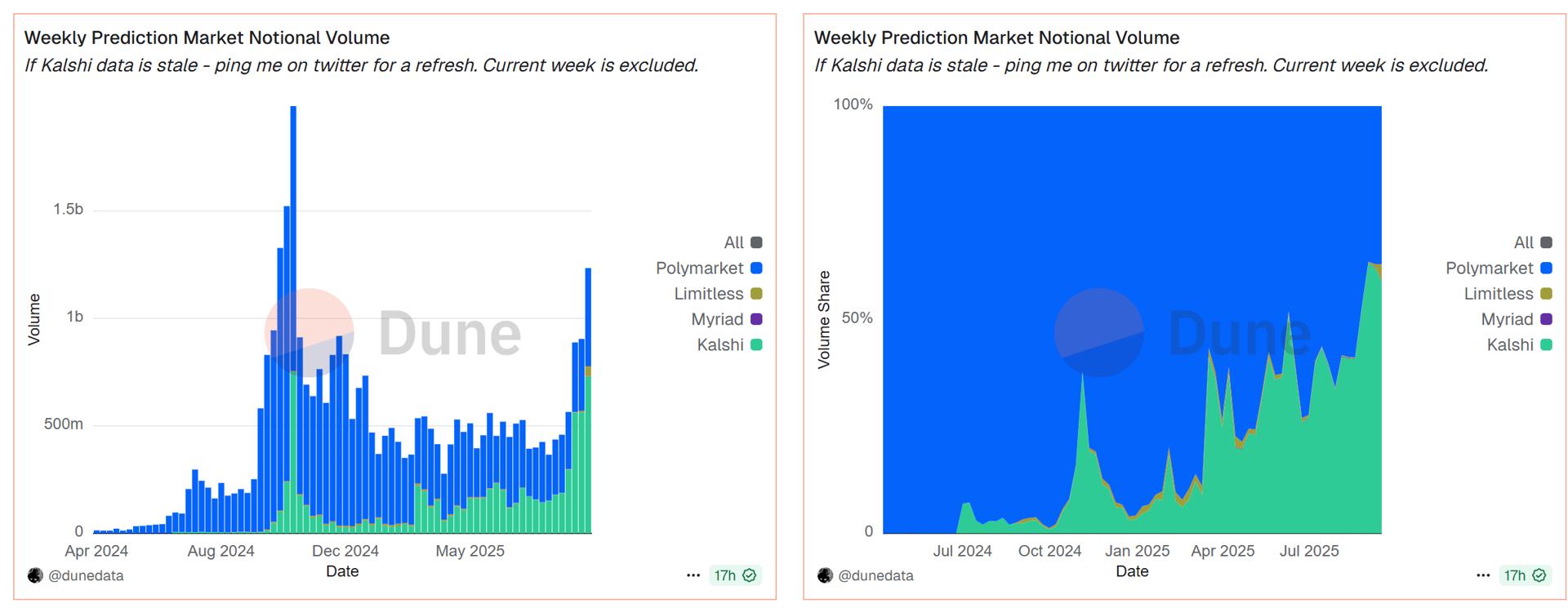
company accounted for 62% of total prediction market volume from September
11-17, compared to Polymarket's 37% share, according
to Dune Analytics data. Kalshi processed over $500 million in weekly
trading volume while maintaining average open interest of $189 million.
Polymarket,
despite generating $430 million in volume during the same period, showed
different trading patterns with an average open interest of $164 million. The
disparity points to what analysts describe as "sticker positions on
Polymarket and faster turnover on Kalshi."
In recent
days, Kalshi’s lead over Polymarket has grown even larger, reaching 65% of the
total market share. By comparison, as recently as December 2024, Polymarket
accounted for 95% of the market.
Source: Dune Analytics
“Event
contracts have generated high demand because they provide a maximally direct
way to get exposure to events that affect businesses, people, and the economy,
and they provide the most accurate signal on what the likelihood of future
events are,” commented Jack Such from Kalshi, responsible for Business &
Media Development, to FinanceMagnates.com.
Such is
also confident that “prediction markets will become a trillion dollar asset
class.”
Different Trading
Behaviors Emerge Between Platforms
The
platforms' distinct approaches have created different user behaviors.
Polymarket's longer-term markets, often spanning weeks or months, keep user
funds locked in for extended periods. This creates higher open interest
relative to volume.
Kalshi
averaged an open interest-to-volume ratio of 0.29, while Polymarket's ratio hit
0.38. The lower ratio suggests Kalshi users trade more frequently, while
Polymarket positions tend to remain static for longer periods.
The trading
pattern differences reflect each platform's regulatory environment and market
structure. Kalshi
operates under U.S. regulatory oversight, while Polymarket has historically
served international users through blockchain-based contracts.
Kalshi,
however, is also facing
lawsuits and controversies in several U.S. states. Allegations of gambling
have been further fueled by the fact that Poker
legend Daniel Negreanu was recently named the face of the platform.
Polymarket Pushes Back
Into U.S. Market
Polymarket
isn't conceding ground easily. The platform completed
its acquisition of QCX, a regulated derivatives exchange, clearing the path
for re-entry into the U.S. market after resolving regulatory issues.
The company
has also launched earnings-based prediction markets in
partnership with social investing platform Stocktwits. The collaboration
allows stockholders to hedge earnings risk while providing analysts real-time
market sentiment data.
These moves
represent Polymarket's attempt to compete directly with Kalshi's regulatory
advantage in the lucrative U.S. prediction market space. The platform had
previously operated in regulatory gray areas before reaching settlements with
U.S. authorities.
Kalshi has
emerged as the dominant player in prediction market and event-based contract trading,
capturing nearly two-thirds of sector volume as regulated platforms gain ground
over offshore competitors.
Kalshi Captures 62% Market
Share as Prediction Trading Volumes Surge
The CFTC-authorized
company accounted for 62% of total prediction market volume from September
11-17, compared to Polymarket's 37% share, according
to Dune Analytics data. Kalshi processed over $500 million in weekly
trading volume while maintaining average open interest of $189 million.
Polymarket,
despite generating $430 million in volume during the same period, showed
different trading patterns with an average open interest of $164 million. The
disparity points to what analysts describe as "sticker positions on
Polymarket and faster turnover on Kalshi."
In recent
days, Kalshi’s lead over Polymarket has grown even larger, reaching 65% of the
total market share. By comparison, as recently as December 2024, Polymarket
accounted for 95% of the market.
Source: Dune Analytics
“Event
contracts have generated high demand because they provide a maximally direct
way to get exposure to events that affect businesses, people, and the economy,
and they provide the most accurate signal on what the likelihood of future
events are,” commented Jack Such from Kalshi, responsible for Business &
Media Development, to FinanceMagnates.com.
Such is
also confident that “prediction markets will become a trillion dollar asset
class.”
Different Trading
Behaviors Emerge Between Platforms
The
platforms' distinct approaches have created different user behaviors.
Polymarket's longer-term markets, often spanning weeks or months, keep user
funds locked in for extended periods. This creates higher open interest
relative to volume.
Kalshi
averaged an open interest-to-volume ratio of 0.29, while Polymarket's ratio hit
0.38. The lower ratio suggests Kalshi users trade more frequently, while
Polymarket positions tend to remain static for longer periods.
The trading
pattern differences reflect each platform's regulatory environment and market
structure. Kalshi
operates under U.S. regulatory oversight, while Polymarket has historically
served international users through blockchain-based contracts.
Kalshi,
however, is also facing
lawsuits and controversies in several U.S. states. Allegations of gambling
have been further fueled by the fact that Poker
legend Daniel Negreanu was recently named the face of the platform.
Polymarket Pushes Back
Into U.S. Market
Polymarket
isn't conceding ground easily. The platform completed
its acquisition of QCX, a regulated derivatives exchange, clearing the path
for re-entry into the U.S. market after resolving regulatory issues.
The company
has also launched earnings-based prediction markets in
partnership with social investing platform Stocktwits. The collaboration
allows stockholders to hedge earnings risk while providing analysts real-time
market sentiment data.
These moves
represent Polymarket's attempt to compete directly with Kalshi's regulatory
advantage in the lucrative U.S. prediction market space. The platform had
previously operated in regulatory gray areas before reaching settlements with
U.S. authorities.
Damian Chmiel is a Senior Analyst & Editor at Finance Magnates with more than 15 years of experience in the CFD and online trading industry. Active as both a trader and journalist since 2010, he focuses on broker coverage, fintech innovation, and regulatory developments across Europe, the Middle East, and Asia.
His work includes interviews with C-level leaders at major brokerages and fintech platforms, as well as co-authoring Finance Magnates’ quarterly industry benchmarking reports. Damian’s reporting is data-driven, market-aware, and grounded in direct industry engagement. His analysis and commentary have also been cited by external media outlets, including Investing.com, Binance, The Asset, Stockhead, and Dispatch.
Education:
MA in Finance and Accounting, Cracow University of Economics
Retail Traders Can Now Access Prediction Markets Through Binance Wallet
FP Markets Winner Spotlight 🏆 | Global Broker of the Year 2025 #Trading #Broker #Innovation #Shorts
FP Markets Winner Spotlight 🏆 | Global Broker of the Year 2025 #Trading #Broker #Innovation #Shorts
FP Markets takes the spotlight as Global Broker of the Year 2025 at the Finance Magnates Awards.
Martin Stoilov, Head of Client Experience, shares that trust, innovation, and people played a key role in the company’s success, supported by a strong foundation of integrity and client-centricity.
Following this milestone, FP Markets continues to focus on growth, technology investment, and its core values of transparency and excellence.
👉 Be part of FM Awards 2026: https://awards.financemagnates.com/#nominate
FP Markets takes the spotlight as Global Broker of the Year 2025 at the Finance Magnates Awards.
Martin Stoilov, Head of Client Experience, shares that trust, innovation, and people played a key role in the company’s success, supported by a strong foundation of integrity and client-centricity.
Following this milestone, FP Markets continues to focus on growth, technology investment, and its core values of transparency and excellence.
👉 Be part of FM Awards 2026: https://awards.financemagnates.com/#nominate
In this video, we review @HolaPrimeMarketsOfficial, a multi-asset forex and CFDs broker offering different account types, trading platforms, and flexible trading conditions.
We cover the broker’s overall offering, including account options, trading environment, platforms like MT4 and MT5, and additional services such as managed accounts and fast withdrawals.
Watch the full video to see if Hola Prime Markets fits your trading needs.
📣 Stay up to date with the latest in finance and trading. Follow Finance Magnates for industry news, insights, and global event coverage.
Connect with us:
🔗 LinkedIn: /financemagnates
👍 Facebook: /financemagnates
📸 Instagram: https://www.instagram.com/financemagnates
🐦 X: https://x.com/financemagnates
🎥 TikTok: https://www.tiktok.com/tag/financemagnates
▶️ YouTube: /@financemagnates_official
#HolaPrime #ForexBroker #CFDTrading #FinanceMagnates #Trading #Forex #BrokerReview
In this video, we review @HolaPrimeMarketsOfficial, a multi-asset forex and CFDs broker offering different account types, trading platforms, and flexible trading conditions.
We cover the broker’s overall offering, including account options, trading environment, platforms like MT4 and MT5, and additional services such as managed accounts and fast withdrawals.
Watch the full video to see if Hola Prime Markets fits your trading needs.
📣 Stay up to date with the latest in finance and trading. Follow Finance Magnates for industry news, insights, and global event coverage.
Connect with us:
🔗 LinkedIn: /financemagnates
👍 Facebook: /financemagnates
📸 Instagram: https://www.instagram.com/financemagnates
🐦 X: https://x.com/financemagnates
🎥 TikTok: https://www.tiktok.com/tag/financemagnates
▶️ YouTube: /@financemagnates_official
#HolaPrime #ForexBroker #CFDTrading #FinanceMagnates #Trading #Forex #BrokerReview
Hola Prime Review: What You Need to Know | Full Breakdown by Finance Magnates
Hola Prime Review: What You Need to Know | Full Breakdown by Finance Magnates
In this video, we review @HolaPrime_Global, a proprietary trading firm offering evaluation programs and performance-based payouts in simulated market environments.
We cover how the challenge model works, including account types, profit splits (up to 95%), trading rules, and what it takes to reach a funded account. You’ll also learn about available platforms like MT4, MT5, cTrader, and more, along with insights into payouts, support, and trading conditions.
Watch the full video to see if Hola Prime fits your trading style.
📣 Stay up to date with the latest in finance and trading. Follow Finance Magnates for industry news, insights, and global event coverage.
Connect with us:
🔗 LinkedIn: /financemagnates
👍 Facebook: /financemagnates
📸 Instagram: https://www.instagram.com/financemagnates
🐦 X: https://x.com/financemagnates
🎥 TikTok: https://www.tiktok.com/tag/financemagnates
▶️ YouTube: /@financemagnates_official
#HolaPrime #PropFirm #Trading #FinanceMagnates #Forex #FuturesTrading #TradingReview #PropFirmReview
In this video, we review @HolaPrime_Global, a proprietary trading firm offering evaluation programs and performance-based payouts in simulated market environments.
We cover how the challenge model works, including account types, profit splits (up to 95%), trading rules, and what it takes to reach a funded account. You’ll also learn about available platforms like MT4, MT5, cTrader, and more, along with insights into payouts, support, and trading conditions.
Watch the full video to see if Hola Prime fits your trading style.
📣 Stay up to date with the latest in finance and trading. Follow Finance Magnates for industry news, insights, and global event coverage.
Connect with us:
🔗 LinkedIn: /financemagnates
👍 Facebook: /financemagnates
📸 Instagram: https://www.instagram.com/financemagnates
🐦 X: https://x.com/financemagnates
🎥 TikTok: https://www.tiktok.com/tag/financemagnates
▶️ YouTube: /@financemagnates_official
#HolaPrime #PropFirm #Trading #FinanceMagnates #Forex #FuturesTrading #TradingReview #PropFirmReview
Axi Winner Spotlight 🏆 | Global Most Innovative Broker 2025 #Innovation #Trading #Fintech #Broker
Axi Winner Spotlight 🏆 | Global Most Innovative Broker 2025 #Innovation #Trading #Fintech #Broker
Axi takes the spotlight at the Finance Magnates Awards, winning Global Most Innovative Broker 2025.
Olivia Xenofontos and Ivanna Openko share how the team will feel: proud, motivated, and ready to keep delivering.
They also describe the night as well-organized, focused, and enjoyable for all.
👉 Be part of FM Awards 2026.
Axi takes the spotlight at the Finance Magnates Awards, winning Global Most Innovative Broker 2025.
Olivia Xenofontos and Ivanna Openko share how the team will feel: proud, motivated, and ready to keep delivering.
They also describe the night as well-organized, focused, and enjoyable for all.
👉 Be part of FM Awards 2026.
Recognition that matters.
Built on transparency.
Driven by the industry.
The Finance Magnates Awards 2026.
Nominations are now open.
🔗 https://awards.financemagnates.com/?utm_source=SM&utm_medium=social&utm_campaign=recognition-matters
Recognition that matters.
Built on transparency.
Driven by the industry.
The Finance Magnates Awards 2026.
Nominations are now open.
🔗 https://awards.financemagnates.com/?utm_source=SM&utm_medium=social&utm_campaign=recognition-matters