Polish broker's stock falls 6.4% despite record client growth and projections to reach 2 million customers this year.
The main reason for the decline is net profit, which grew in Q2 but still came in below analysts’ expectations.
Moreover, operating costs surged 48% as the company prioritizes market expansion over short-term profitability.
XTB shares (WSE:
XTB) tumbled over 6% this
morning (Friday) after the Polish fintech broker published preliminary results
that disappointed investors, despite setting new records for client acquisition
and revenue growth. Although
quarterly earnings appear satisfactory, they declined on a half-year basis by
11%. Nevertheless, analysts believe this may be only a short-term correction.
XTB Reports Net Income
Below Analyst Consensus
XTB
reported net
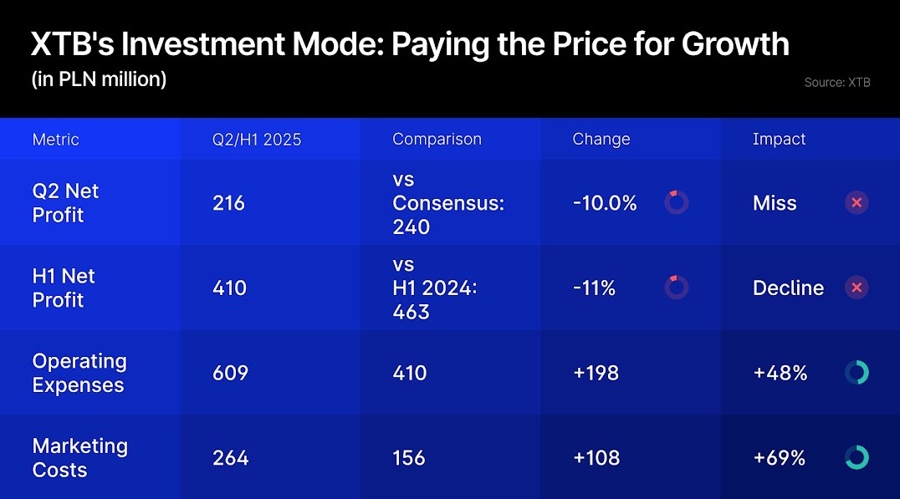
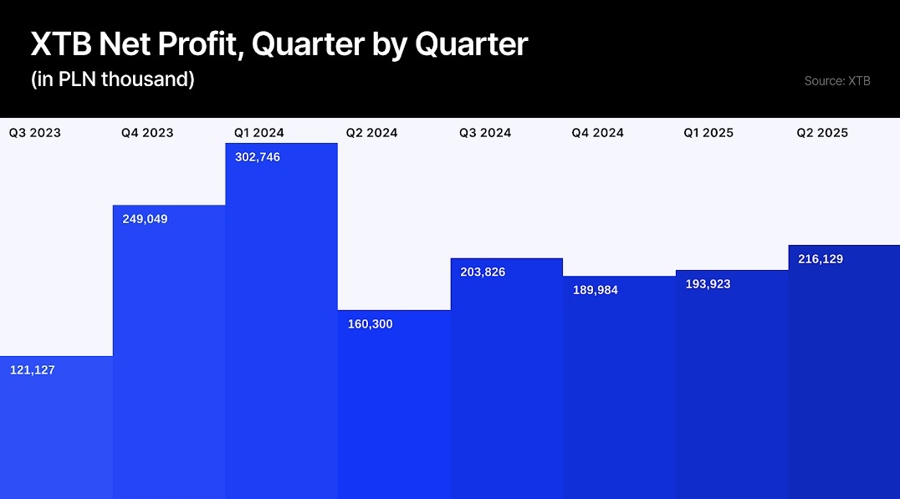
profit of 216.1 million PLN for the second quarter, higher than 160 million PLN in the same period last year; however, it fell short of
analyst consensus estimates of around 240–250 million PLN. While quarterly
profits increased compared to Q1 2025, the first-half results showed a 11.4% decline compared to H1 2024.
For the
six-month period, consolidated net profit reached 410.1 million PLN, down from 463.0 million PLN in the first half of 2024. This drop occurred despite record operating
revenues climbing 23.8% year-over-year to 1.16 billion PLN.
The
broker's cost structure tells the story behind the profit decline. Operating
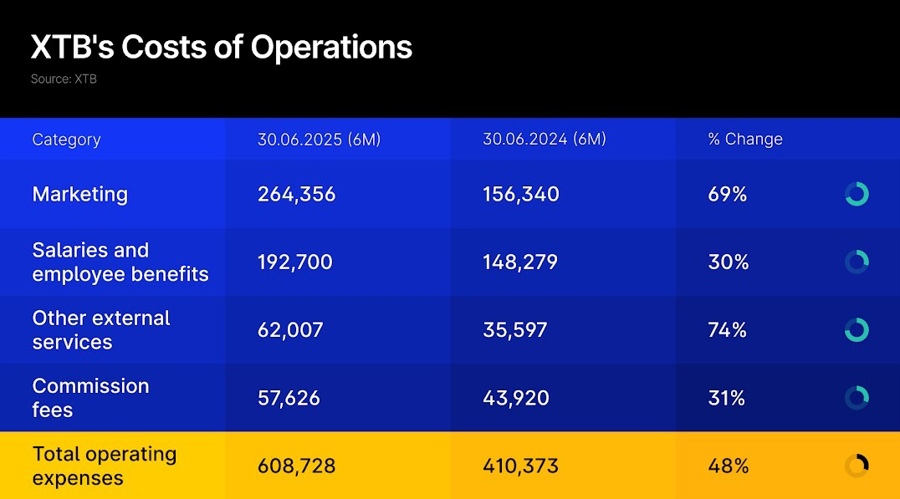
expenses surged 48% to 608.7 million PLN in the first half, driven primarily by
marketing investments that jumped 69% to 264.4 million PLN as XTB pursued
aggressive client acquisition campaigns.
Record Client Growth Fails
to Impress
Despite
missing profit targets, XTB delivered impressive client metrics that might
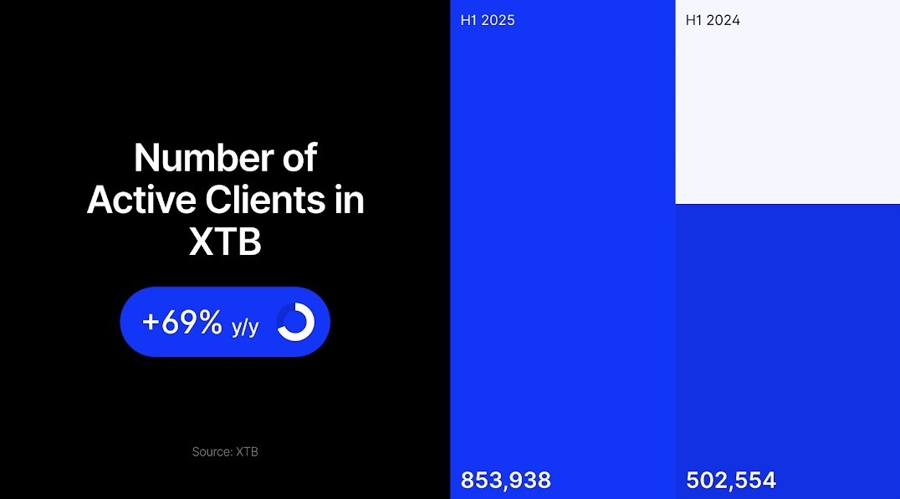
normally excite investors. The company added 361,643 new clients in the first
half – a 55.7% increase from the previous year. Active clients reached a record
853,938, up nearly 70% year-over-year.
Maciej Marcinowski, Deputy Head of Research Department at Trigon DM
However, Maciej
Marcinowski, analyst of the Polish brokerage house Trigon, noted that client
acquisition slightly disappointed relative to expectations, with some
suggesting XTB should return to adding 180,000–190,000 new clients per quarter
in Q3.
“On one
hand, our net profit forecast for 2025 needs to be revised down by 3–4 percent.
However, if our assumption about a negative contribution from market making
this quarter proves correct, our model indicates an upward revision of
forecasts for the coming years,” Marcinowski commented on the preliminary
results.
Market Making Margins
Under Pressure
The revenue
story also may reveal why investors remain concerned despite strong topline
growth. Profitability per lot – a key metric for CFD brokers – declined to 251
PLN from 289 PLN in H1 2024, reflecting challenging market conditions for the
company's market-making operations.
Marcinowski
suggested that market-making revenues may have actually turned negative in Q2,
a significant shift for XTB's business model. “We would risk saying that
market-making revenues were even slightly negative this quarter versus our
expectation of 58 million PLN,” he noted.
The decline
in per-lot profitability occurred despite trading volumes surging 41.5% to 4.23
million lots, highlighting how market conditions can compress margins even as
activity increases.
“Operating
results are 7 percent below forecasts, while net profit deviates more
significantly due to PLN 40 million in negative exchange rate differences (we
had assumed PLN 20 million),” added Marcinowski.
This forex
impact was roughly double what analysts had anticipated, contributing to the
larger-than-expected miss on bottom-line results.
Investment Mode Continues
Omar Arnaout, CEO of XTB, Source: LinkedIn
CEO Omar
Arnaout emphasized that XTB remains in investment mode, prioritizing market
share growth over short-term profitability. He is thus maintaining the strategy
he mentioned during the interview I conducted when I visited XTB's headquarters
last year. The company expects total operating costs could rise 40% in 2025
compared to 2024, with marketing expenses potentially increasing 80%.
“Despite
significantly higher marketing expenditures both in Poland and foreign markets,
we maintain the average cost of client acquisition at a similar level,”
Arnaout said. “I am also convinced that we will exceed the threshold of
two million clients this calendar year.”
Technical Picture Weakens
and Mixed Analyst Reactions
From a
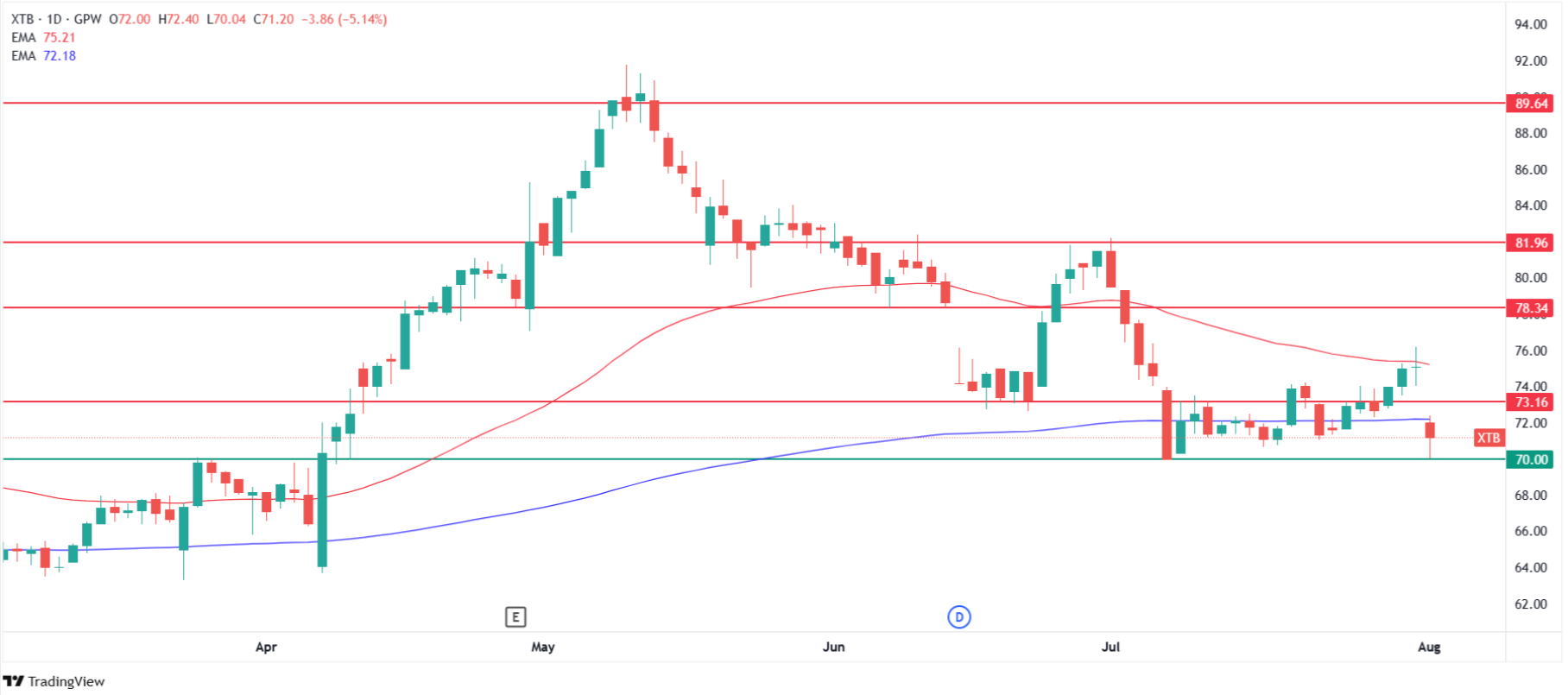
technical perspective, Friday's decline pushed XTB shares toward support at the
70 PLN level, representing the lower boundary of an uptrend channel that has
contained the stock since May 2024. It created a visible downward gap on the
chart as shares fell below the 200-day exponential moving average.
XTB shares fall below the 200 EMA, testing 70 PLN mark. Source: Tradingview.com
Analyst
sentiment remains divided. While some view the results as neutral and see the
selloff as a buying opportunity, others express concern about the trajectory of
profitability metrics.
Arkadiusz Jóżwiak, Editor-in-Chief at Comparic.pl
According to Arkadiusz Jóźwiak, a Polish financial journalist and analyst, investors tend to react negatively to XTB’s earnings reports, although the company usually rebounds shortly afterward.
“XTB has effectively reset all of this year's gains. However, if the stock doesn’t fall below the current level of around 70 złoty, it could present a buying opportunity at far more attractive prices than the over-90 złoty seen in May. Especially when we look at the company’s price history over recent years. Since the pandemic lows, its value has increased by more than 2,500%, with nearly uninterrupted growth,” Jóźwiak commented.
Mikołaj Lemańczyk, Analyst at mBank
Mikołaj
Lemańczyk from mBank noted that while client KPIs remained strong, “the
results remind us that sometimes there are weaker quarters in terms of
profitability per lot, and this must be taken into account in long-term company
analysis.”
XTB's
transformation from a traditional CFD broker to a comprehensive fintech
platform continues, but Friday's market reaction suggests investors want to see
this evolution translate into sustained profit growth alongside the impressive
client metrics.
XTB shares (WSE:
XTB) tumbled over 6% this
morning (Friday) after the Polish fintech broker published preliminary results
that disappointed investors, despite setting new records for client acquisition
and revenue growth. Although
quarterly earnings appear satisfactory, they declined on a half-year basis by
11%. Nevertheless, analysts believe this may be only a short-term correction.
XTB Reports Net Income
Below Analyst Consensus
XTB
reported net
profit of 216.1 million PLN for the second quarter, higher than 160 million PLN in the same period last year; however, it fell short of
analyst consensus estimates of around 240–250 million PLN. While quarterly
profits increased compared to Q1 2025, the first-half results showed a 11.4% decline compared to H1 2024.
For the
six-month period, consolidated net profit reached 410.1 million PLN, down from 463.0 million PLN in the first half of 2024. This drop occurred despite record operating
revenues climbing 23.8% year-over-year to 1.16 billion PLN.
The
broker's cost structure tells the story behind the profit decline. Operating
expenses surged 48% to 608.7 million PLN in the first half, driven primarily by
marketing investments that jumped 69% to 264.4 million PLN as XTB pursued
aggressive client acquisition campaigns.
Record Client Growth Fails
to Impress
Despite
missing profit targets, XTB delivered impressive client metrics that might
normally excite investors. The company added 361,643 new clients in the first
half – a 55.7% increase from the previous year. Active clients reached a record
853,938, up nearly 70% year-over-year.
Maciej Marcinowski, Deputy Head of Research Department at Trigon DM
However, Maciej
Marcinowski, analyst of the Polish brokerage house Trigon, noted that client
acquisition slightly disappointed relative to expectations, with some
suggesting XTB should return to adding 180,000–190,000 new clients per quarter
in Q3.
“On one
hand, our net profit forecast for 2025 needs to be revised down by 3–4 percent.
However, if our assumption about a negative contribution from market making
this quarter proves correct, our model indicates an upward revision of
forecasts for the coming years,” Marcinowski commented on the preliminary
results.
Market Making Margins
Under Pressure
The revenue
story also may reveal why investors remain concerned despite strong topline
growth. Profitability per lot – a key metric for CFD brokers – declined to 251
PLN from 289 PLN in H1 2024, reflecting challenging market conditions for the
company's market-making operations.
Marcinowski
suggested that market-making revenues may have actually turned negative in Q2,
a significant shift for XTB's business model. “We would risk saying that
market-making revenues were even slightly negative this quarter versus our
expectation of 58 million PLN,” he noted.
The decline
in per-lot profitability occurred despite trading volumes surging 41.5% to 4.23
million lots, highlighting how market conditions can compress margins even as
activity increases.
“Operating
results are 7 percent below forecasts, while net profit deviates more
significantly due to PLN 40 million in negative exchange rate differences (we
had assumed PLN 20 million),” added Marcinowski.
This forex
impact was roughly double what analysts had anticipated, contributing to the
larger-than-expected miss on bottom-line results.
Investment Mode Continues
Omar Arnaout, CEO of XTB, Source: LinkedIn
CEO Omar
Arnaout emphasized that XTB remains in investment mode, prioritizing market
share growth over short-term profitability. He is thus maintaining the strategy
he mentioned during the interview I conducted when I visited XTB's headquarters
last year. The company expects total operating costs could rise 40% in 2025
compared to 2024, with marketing expenses potentially increasing 80%.
“Despite
significantly higher marketing expenditures both in Poland and foreign markets,
we maintain the average cost of client acquisition at a similar level,”
Arnaout said. “I am also convinced that we will exceed the threshold of
two million clients this calendar year.”
Technical Picture Weakens
and Mixed Analyst Reactions
From a
technical perspective, Friday's decline pushed XTB shares toward support at the
70 PLN level, representing the lower boundary of an uptrend channel that has
contained the stock since May 2024. It created a visible downward gap on the
chart as shares fell below the 200-day exponential moving average.
XTB shares fall below the 200 EMA, testing 70 PLN mark. Source: Tradingview.com
Analyst
sentiment remains divided. While some view the results as neutral and see the
selloff as a buying opportunity, others express concern about the trajectory of
profitability metrics.
Arkadiusz Jóżwiak, Editor-in-Chief at Comparic.pl
According to Arkadiusz Jóźwiak, a Polish financial journalist and analyst, investors tend to react negatively to XTB’s earnings reports, although the company usually rebounds shortly afterward.
“XTB has effectively reset all of this year's gains. However, if the stock doesn’t fall below the current level of around 70 złoty, it could present a buying opportunity at far more attractive prices than the over-90 złoty seen in May. Especially when we look at the company’s price history over recent years. Since the pandemic lows, its value has increased by more than 2,500%, with nearly uninterrupted growth,” Jóźwiak commented.
Mikołaj Lemańczyk, Analyst at mBank
Mikołaj
Lemańczyk from mBank noted that while client KPIs remained strong, “the
results remind us that sometimes there are weaker quarters in terms of
profitability per lot, and this must be taken into account in long-term company
analysis.”
XTB's
transformation from a traditional CFD broker to a comprehensive fintech
platform continues, but Friday's market reaction suggests investors want to see
this evolution translate into sustained profit growth alongside the impressive
client metrics.
Damian Chmiel is a Senior Analyst & Editor at Finance Magnates with more than 15 years of experience in the CFD and online trading industry. Active as both a trader and journalist since 2010, he focuses on broker coverage, fintech innovation, and regulatory developments across Europe, the Middle East, and Asia.
His work includes interviews with C-level leaders at major brokerages and fintech platforms, as well as co-authoring Finance Magnates’ quarterly industry benchmarking reports. Damian’s reporting is data-driven, market-aware, and grounded in direct industry engagement. His analysis and commentary have also been cited by external media outlets, including Investing.com, Binance, The Asset, Stockhead, and Dispatch.
Education:
MA in Finance and Accounting, Cracow University of Economics
Italy’s Consob Tightens Net on AI-Fueled Scams With Fresh Website Bans
Featured Videos
FP Markets Winner Spotlight 🏆 | Global Broker of the Year 2025 #Trading #Broker #Innovation #Shorts
FP Markets Winner Spotlight 🏆 | Global Broker of the Year 2025 #Trading #Broker #Innovation #Shorts
FP Markets Winner Spotlight 🏆 | Global Broker of the Year 2025 #Trading #Broker #Innovation #Shorts
FP Markets Winner Spotlight 🏆 | Global Broker of the Year 2025 #Trading #Broker #Innovation #Shorts
FP Markets takes the spotlight as Global Broker of the Year 2025 at the Finance Magnates Awards.
Martin Stoilov, Head of Client Experience, shares that trust, innovation, and people played a key role in the company’s success, supported by a strong foundation of integrity and client-centricity.
Following this milestone, FP Markets continues to focus on growth, technology investment, and its core values of transparency and excellence.
👉 Be part of FM Awards 2026: https://awards.financemagnates.com/#nominate
FP Markets takes the spotlight as Global Broker of the Year 2025 at the Finance Magnates Awards.
Martin Stoilov, Head of Client Experience, shares that trust, innovation, and people played a key role in the company’s success, supported by a strong foundation of integrity and client-centricity.
Following this milestone, FP Markets continues to focus on growth, technology investment, and its core values of transparency and excellence.
👉 Be part of FM Awards 2026: https://awards.financemagnates.com/#nominate
FP Markets takes the spotlight as Global Broker of the Year 2025 at the Finance Magnates Awards.
Martin Stoilov, Head of Client Experience, shares that trust, innovation, and people played a key role in the company’s success, supported by a strong foundation of integrity and client-centricity.
Following this milestone, FP Markets continues to focus on growth, technology investment, and its core values of transparency and excellence.
👉 Be part of FM Awards 2026: https://awards.financemagnates.com/#nominate
FP Markets takes the spotlight as Global Broker of the Year 2025 at the Finance Magnates Awards.
Martin Stoilov, Head of Client Experience, shares that trust, innovation, and people played a key role in the company’s success, supported by a strong foundation of integrity and client-centricity.
Following this milestone, FP Markets continues to focus on growth, technology investment, and its core values of transparency and excellence.
👉 Be part of FM Awards 2026: https://awards.financemagnates.com/#nominate
In this video, we review @HolaPrimeMarketsOfficial, a multi-asset forex and CFDs broker offering different account types, trading platforms, and flexible trading conditions.
We cover the broker’s overall offering, including account options, trading environment, platforms like MT4 and MT5, and additional services such as managed accounts and fast withdrawals.
Watch the full video to see if Hola Prime Markets fits your trading needs.
📣 Stay up to date with the latest in finance and trading. Follow Finance Magnates for industry news, insights, and global event coverage.
Connect with us:
🔗 LinkedIn: /financemagnates
👍 Facebook: /financemagnates
📸 Instagram: https://www.instagram.com/financemagnates
🐦 X: https://x.com/financemagnates
🎥 TikTok: https://www.tiktok.com/tag/financemagnates
▶️ YouTube: /@financemagnates_official
#HolaPrime #ForexBroker #CFDTrading #FinanceMagnates #Trading #Forex #BrokerReview
In this video, we review @HolaPrimeMarketsOfficial, a multi-asset forex and CFDs broker offering different account types, trading platforms, and flexible trading conditions.
We cover the broker’s overall offering, including account options, trading environment, platforms like MT4 and MT5, and additional services such as managed accounts and fast withdrawals.
Watch the full video to see if Hola Prime Markets fits your trading needs.
📣 Stay up to date with the latest in finance and trading. Follow Finance Magnates for industry news, insights, and global event coverage.
Connect with us:
🔗 LinkedIn: /financemagnates
👍 Facebook: /financemagnates
📸 Instagram: https://www.instagram.com/financemagnates
🐦 X: https://x.com/financemagnates
🎥 TikTok: https://www.tiktok.com/tag/financemagnates
▶️ YouTube: /@financemagnates_official
#HolaPrime #ForexBroker #CFDTrading #FinanceMagnates #Trading #Forex #BrokerReview
In this video, we review @HolaPrimeMarketsOfficial, a multi-asset forex and CFDs broker offering different account types, trading platforms, and flexible trading conditions.
We cover the broker’s overall offering, including account options, trading environment, platforms like MT4 and MT5, and additional services such as managed accounts and fast withdrawals.
Watch the full video to see if Hola Prime Markets fits your trading needs.
📣 Stay up to date with the latest in finance and trading. Follow Finance Magnates for industry news, insights, and global event coverage.
Connect with us:
🔗 LinkedIn: /financemagnates
👍 Facebook: /financemagnates
📸 Instagram: https://www.instagram.com/financemagnates
🐦 X: https://x.com/financemagnates
🎥 TikTok: https://www.tiktok.com/tag/financemagnates
▶️ YouTube: /@financemagnates_official
#HolaPrime #ForexBroker #CFDTrading #FinanceMagnates #Trading #Forex #BrokerReview
In this video, we review @HolaPrimeMarketsOfficial, a multi-asset forex and CFDs broker offering different account types, trading platforms, and flexible trading conditions.
We cover the broker’s overall offering, including account options, trading environment, platforms like MT4 and MT5, and additional services such as managed accounts and fast withdrawals.
Watch the full video to see if Hola Prime Markets fits your trading needs.
📣 Stay up to date with the latest in finance and trading. Follow Finance Magnates for industry news, insights, and global event coverage.
Connect with us:
🔗 LinkedIn: /financemagnates
👍 Facebook: /financemagnates
📸 Instagram: https://www.instagram.com/financemagnates
🐦 X: https://x.com/financemagnates
🎥 TikTok: https://www.tiktok.com/tag/financemagnates
▶️ YouTube: /@financemagnates_official
#HolaPrime #ForexBroker #CFDTrading #FinanceMagnates #Trading #Forex #BrokerReview
In this video, we review @HolaPrimeMarketsOfficial, a multi-asset forex and CFDs broker offering different account types, trading platforms, and flexible trading conditions.
We cover the broker’s overall offering, including account options, trading environment, platforms like MT4 and MT5, and additional services such as managed accounts and fast withdrawals.
Watch the full video to see if Hola Prime Markets fits your trading needs.
📣 Stay up to date with the latest in finance and trading. Follow Finance Magnates for industry news, insights, and global event coverage.
Connect with us:
🔗 LinkedIn: /financemagnates
👍 Facebook: /financemagnates
📸 Instagram: https://www.instagram.com/financemagnates
🐦 X: https://x.com/financemagnates
🎥 TikTok: https://www.tiktok.com/tag/financemagnates
▶️ YouTube: /@financemagnates_official
#HolaPrime #ForexBroker #CFDTrading #FinanceMagnates #Trading #Forex #BrokerReview
In this video, we review @HolaPrimeMarketsOfficial, a multi-asset forex and CFDs broker offering different account types, trading platforms, and flexible trading conditions.
We cover the broker’s overall offering, including account options, trading environment, platforms like MT4 and MT5, and additional services such as managed accounts and fast withdrawals.
Watch the full video to see if Hola Prime Markets fits your trading needs.
📣 Stay up to date with the latest in finance and trading. Follow Finance Magnates for industry news, insights, and global event coverage.
Connect with us:
🔗 LinkedIn: /financemagnates
👍 Facebook: /financemagnates
📸 Instagram: https://www.instagram.com/financemagnates
🐦 X: https://x.com/financemagnates
🎥 TikTok: https://www.tiktok.com/tag/financemagnates
▶️ YouTube: /@financemagnates_official
#HolaPrime #ForexBroker #CFDTrading #FinanceMagnates #Trading #Forex #BrokerReview
Hola Prime Review: What You Need to Know | Full Breakdown by Finance Magnates
Hola Prime Review: What You Need to Know | Full Breakdown by Finance Magnates
Hola Prime Review: What You Need to Know | Full Breakdown by Finance Magnates
Hola Prime Review: What You Need to Know | Full Breakdown by Finance Magnates
Hola Prime Review: What You Need to Know | Full Breakdown by Finance Magnates
Hola Prime Review: What You Need to Know | Full Breakdown by Finance Magnates
In this video, we review @HolaPrime_Global, a proprietary trading firm offering evaluation programs and performance-based payouts in simulated market environments.
We cover how the challenge model works, including account types, profit splits (up to 95%), trading rules, and what it takes to reach a funded account. You’ll also learn about available platforms like MT4, MT5, cTrader, and more, along with insights into payouts, support, and trading conditions.
Watch the full video to see if Hola Prime fits your trading style.
📣 Stay up to date with the latest in finance and trading. Follow Finance Magnates for industry news, insights, and global event coverage.
Connect with us:
🔗 LinkedIn: /financemagnates
👍 Facebook: /financemagnates
📸 Instagram: https://www.instagram.com/financemagnates
🐦 X: https://x.com/financemagnates
🎥 TikTok: https://www.tiktok.com/tag/financemagnates
▶️ YouTube: /@financemagnates_official
#HolaPrime #PropFirm #Trading #FinanceMagnates #Forex #FuturesTrading #TradingReview #PropFirmReview
In this video, we review @HolaPrime_Global, a proprietary trading firm offering evaluation programs and performance-based payouts in simulated market environments.
We cover how the challenge model works, including account types, profit splits (up to 95%), trading rules, and what it takes to reach a funded account. You’ll also learn about available platforms like MT4, MT5, cTrader, and more, along with insights into payouts, support, and trading conditions.
Watch the full video to see if Hola Prime fits your trading style.
📣 Stay up to date with the latest in finance and trading. Follow Finance Magnates for industry news, insights, and global event coverage.
Connect with us:
🔗 LinkedIn: /financemagnates
👍 Facebook: /financemagnates
📸 Instagram: https://www.instagram.com/financemagnates
🐦 X: https://x.com/financemagnates
🎥 TikTok: https://www.tiktok.com/tag/financemagnates
▶️ YouTube: /@financemagnates_official
#HolaPrime #PropFirm #Trading #FinanceMagnates #Forex #FuturesTrading #TradingReview #PropFirmReview
In this video, we review @HolaPrime_Global, a proprietary trading firm offering evaluation programs and performance-based payouts in simulated market environments.
We cover how the challenge model works, including account types, profit splits (up to 95%), trading rules, and what it takes to reach a funded account. You’ll also learn about available platforms like MT4, MT5, cTrader, and more, along with insights into payouts, support, and trading conditions.
Watch the full video to see if Hola Prime fits your trading style.
📣 Stay up to date with the latest in finance and trading. Follow Finance Magnates for industry news, insights, and global event coverage.
Connect with us:
🔗 LinkedIn: /financemagnates
👍 Facebook: /financemagnates
📸 Instagram: https://www.instagram.com/financemagnates
🐦 X: https://x.com/financemagnates
🎥 TikTok: https://www.tiktok.com/tag/financemagnates
▶️ YouTube: /@financemagnates_official
#HolaPrime #PropFirm #Trading #FinanceMagnates #Forex #FuturesTrading #TradingReview #PropFirmReview
In this video, we review @HolaPrime_Global, a proprietary trading firm offering evaluation programs and performance-based payouts in simulated market environments.
We cover how the challenge model works, including account types, profit splits (up to 95%), trading rules, and what it takes to reach a funded account. You’ll also learn about available platforms like MT4, MT5, cTrader, and more, along with insights into payouts, support, and trading conditions.
Watch the full video to see if Hola Prime fits your trading style.
📣 Stay up to date with the latest in finance and trading. Follow Finance Magnates for industry news, insights, and global event coverage.
Connect with us:
🔗 LinkedIn: /financemagnates
👍 Facebook: /financemagnates
📸 Instagram: https://www.instagram.com/financemagnates
🐦 X: https://x.com/financemagnates
🎥 TikTok: https://www.tiktok.com/tag/financemagnates
▶️ YouTube: /@financemagnates_official
#HolaPrime #PropFirm #Trading #FinanceMagnates #Forex #FuturesTrading #TradingReview #PropFirmReview
In this video, we review @HolaPrime_Global, a proprietary trading firm offering evaluation programs and performance-based payouts in simulated market environments.
We cover how the challenge model works, including account types, profit splits (up to 95%), trading rules, and what it takes to reach a funded account. You’ll also learn about available platforms like MT4, MT5, cTrader, and more, along with insights into payouts, support, and trading conditions.
Watch the full video to see if Hola Prime fits your trading style.
📣 Stay up to date with the latest in finance and trading. Follow Finance Magnates for industry news, insights, and global event coverage.
Connect with us:
🔗 LinkedIn: /financemagnates
👍 Facebook: /financemagnates
📸 Instagram: https://www.instagram.com/financemagnates
🐦 X: https://x.com/financemagnates
🎥 TikTok: https://www.tiktok.com/tag/financemagnates
▶️ YouTube: /@financemagnates_official
#HolaPrime #PropFirm #Trading #FinanceMagnates #Forex #FuturesTrading #TradingReview #PropFirmReview
In this video, we review @HolaPrime_Global, a proprietary trading firm offering evaluation programs and performance-based payouts in simulated market environments.
We cover how the challenge model works, including account types, profit splits (up to 95%), trading rules, and what it takes to reach a funded account. You’ll also learn about available platforms like MT4, MT5, cTrader, and more, along with insights into payouts, support, and trading conditions.
Watch the full video to see if Hola Prime fits your trading style.
📣 Stay up to date with the latest in finance and trading. Follow Finance Magnates for industry news, insights, and global event coverage.
Connect with us:
🔗 LinkedIn: /financemagnates
👍 Facebook: /financemagnates
📸 Instagram: https://www.instagram.com/financemagnates
🐦 X: https://x.com/financemagnates
🎥 TikTok: https://www.tiktok.com/tag/financemagnates
▶️ YouTube: /@financemagnates_official
#HolaPrime #PropFirm #Trading #FinanceMagnates #Forex #FuturesTrading #TradingReview #PropFirmReview
Axi Winner Spotlight 🏆 | Global Most Innovative Broker 2025 #Innovation #Trading #Fintech #Broker
Axi Winner Spotlight 🏆 | Global Most Innovative Broker 2025 #Innovation #Trading #Fintech #Broker
Axi Winner Spotlight 🏆 | Global Most Innovative Broker 2025 #Innovation #Trading #Fintech #Broker
Axi Winner Spotlight 🏆 | Global Most Innovative Broker 2025 #Innovation #Trading #Fintech #Broker
Axi Winner Spotlight 🏆 | Global Most Innovative Broker 2025 #Innovation #Trading #Fintech #Broker
Axi Winner Spotlight 🏆 | Global Most Innovative Broker 2025 #Innovation #Trading #Fintech #Broker
Axi takes the spotlight at the Finance Magnates Awards, winning Global Most Innovative Broker 2025.
Olivia Xenofontos and Ivanna Openko share how the team will feel: proud, motivated, and ready to keep delivering.
They also describe the night as well-organized, focused, and enjoyable for all.
👉 Be part of FM Awards 2026.
Axi takes the spotlight at the Finance Magnates Awards, winning Global Most Innovative Broker 2025.
Olivia Xenofontos and Ivanna Openko share how the team will feel: proud, motivated, and ready to keep delivering.
They also describe the night as well-organized, focused, and enjoyable for all.
👉 Be part of FM Awards 2026.
Axi takes the spotlight at the Finance Magnates Awards, winning Global Most Innovative Broker 2025.
Olivia Xenofontos and Ivanna Openko share how the team will feel: proud, motivated, and ready to keep delivering.
They also describe the night as well-organized, focused, and enjoyable for all.
👉 Be part of FM Awards 2026.
Axi takes the spotlight at the Finance Magnates Awards, winning Global Most Innovative Broker 2025.
Olivia Xenofontos and Ivanna Openko share how the team will feel: proud, motivated, and ready to keep delivering.
They also describe the night as well-organized, focused, and enjoyable for all.
👉 Be part of FM Awards 2026.
Axi takes the spotlight at the Finance Magnates Awards, winning Global Most Innovative Broker 2025.
Olivia Xenofontos and Ivanna Openko share how the team will feel: proud, motivated, and ready to keep delivering.
They also describe the night as well-organized, focused, and enjoyable for all.
👉 Be part of FM Awards 2026.
Axi takes the spotlight at the Finance Magnates Awards, winning Global Most Innovative Broker 2025.
Olivia Xenofontos and Ivanna Openko share how the team will feel: proud, motivated, and ready to keep delivering.
They also describe the night as well-organized, focused, and enjoyable for all.
👉 Be part of FM Awards 2026.
Recognition that matters.
Built on transparency.
Driven by the industry.
The Finance Magnates Awards 2026.
Nominations are now open.
🔗 https://awards.financemagnates.com/?utm_source=SM&utm_medium=social&utm_campaign=recognition-matters
Recognition that matters.
Built on transparency.
Driven by the industry.
The Finance Magnates Awards 2026.
Nominations are now open.
🔗 https://awards.financemagnates.com/?utm_source=SM&utm_medium=social&utm_campaign=recognition-matters
Recognition that matters.
Built on transparency.
Driven by the industry.
The Finance Magnates Awards 2026.
Nominations are now open.
🔗 https://awards.financemagnates.com/?utm_source=SM&utm_medium=social&utm_campaign=recognition-matters
Recognition that matters.
Built on transparency.
Driven by the industry.
The Finance Magnates Awards 2026.
Nominations are now open.
🔗 https://awards.financemagnates.com/?utm_source=SM&utm_medium=social&utm_campaign=recognition-matters
Recognition that matters.
Built on transparency.
Driven by the industry.
The Finance Magnates Awards 2026.
Nominations are now open.
🔗 https://awards.financemagnates.com/?utm_source=SM&utm_medium=social&utm_campaign=recognition-matters
Recognition that matters.
Built on transparency.
Driven by the industry.
The Finance Magnates Awards 2026.
Nominations are now open.
🔗 https://awards.financemagnates.com/?utm_source=SM&utm_medium=social&utm_campaign=recognition-matters