
Interest in stock CFDs dropped significantly in 2022.
Brokers’ profits from this business line have fallen too.
Source: Ron Finberg
Although 2023 started on a solid foot, the stock market’s collapse in 2022 was
impossible not to notice. Substantial discounts on leading indices and a
continuously strengthening dollar have reduced retail investor activity on Wall
Street and almost every other stock trading floor worldwide.
After over a decade of almost uninterrupted gains, global stock markets finished 2022
with the steepest declines since the Great Financial Crisis of 2008. The
S&P 500 index lost nearly 20%, the Nasdaq 100 technology index gave back as
much as 33%, and the MSCI World equity index was down 18%.
Filippo Ucchino, the Founder and CEO at InvestinGoal
Filippo
Ucchino, the Founder and CEO at InvestinGoal, a trading research platform for
retail traders, states that Google Trends shows a visible slump in the popularity
of shares trading amongst CFD traders.
“The
decline in Big Tech stock prices in 2022 was indeed directly related to a loss
of user interest in Equity CFD trading. A keyword analysis on Google Trends
shows that interest in stock CFDs has dropped in a very similar way,” Ucchino
commented.
“While
interest in Big Tech stock price movements remained more or less in line, even
experiencing some spikes (for example, as a result of the various layoff news),
interest in stock CFD trading dropped about 50%, very similar to the -46%
decline by the Big Techs overall,” Ucchino added.
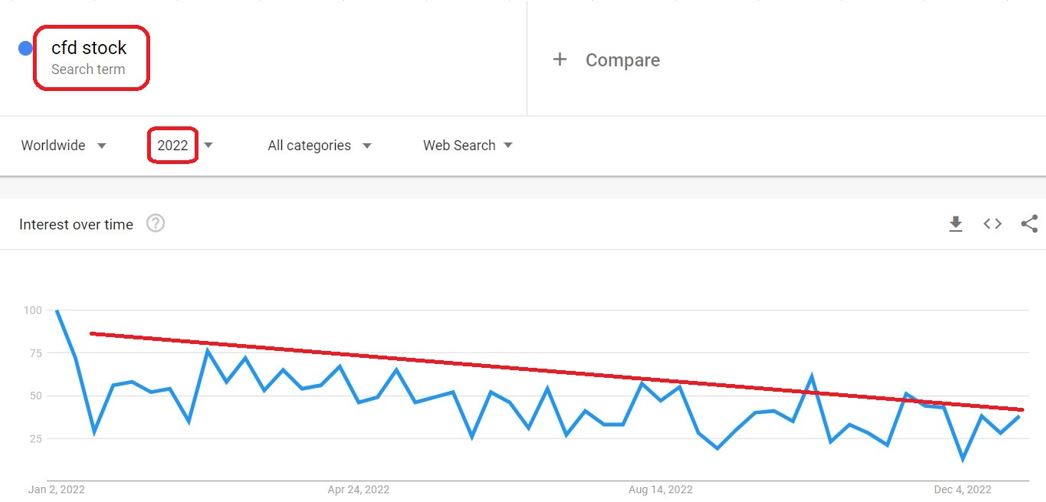
A decline in interest in CFDs in Google Search. Source: Google Trends
Publicly Listed Brokers
Show Lower Shares Trading Revenues
Looking at
the financial reports of IG Group, CMC Markets and XTB, there is an apparent
slowdown in revenue resulting from trading equities. According to the IG
Groups’ interim results report for the six months ended 30 November 2022, “Stock
trading and investments” accounted for the smallest share of the broker’s revenue,
recording a decline of 30% compared to the same period a year earlier. Total
revenue in H1 FY23 was £11.3 million, which is down from £15.9 million in 2021.
Net trading revenue in stock trading and investment per client also fell 29%
to £122.
The CMC
Markets report, published in November and covering the six months ended 30
September 2022, reached similar conclusions. The broker showed an overall
increase in net operating income of 21% YoY, to £153.5 million, but a 14% fall
in investing net revenue over the same period, to £20.8 million from £24.2
million.
Watch the recent FMLS22 panel discussion on: "What CFDs Traders Value Most & How They Choose Their Brokers."
We can look
for the most up-to-date information regarding the popularity of shares trading
amongst CFD traders in XTB’s 2022 initial financial report, published
in early February. The turnover of equity CFDs amounted to PLN 1.1 million in
the last quarter of 2022, falling by more than 90% compared to the PLN 11.5
million reported in the same period a year earlier. Thus, it is evident that
the trading activity bottomed out with the market itself.
After the Storm, the Sun Comes Out
In 2022,
equities were no longer the favorite instruments of retail investors, including
in the CFD industry. Commodities or currency pairs became way more popular due
to the almost continuously rising dollar.
However,
according to experts interviewed by Finance Magnates, the market storm should
calm down, and the first rays of sunshine will appear again in 2023.
To get
the full article and the bigger picture on equity market valuation and its
influence on CFDs trading popularity, get our Latest Quarterly
Intelligence Report.
Although 2023 started on a solid foot, the stock market’s collapse in 2022 was
impossible not to notice. Substantial discounts on leading indices and a
continuously strengthening dollar have reduced retail investor activity on Wall
Street and almost every other stock trading floor worldwide.
After over a decade of almost uninterrupted gains, global stock markets finished 2022
with the steepest declines since the Great Financial Crisis of 2008. The
S&P 500 index lost nearly 20%, the Nasdaq 100 technology index gave back as
much as 33%, and the MSCI World equity index was down 18%.
Filippo Ucchino, the Founder and CEO at InvestinGoal
Filippo
Ucchino, the Founder and CEO at InvestinGoal, a trading research platform for
retail traders, states that Google Trends shows a visible slump in the popularity
of shares trading amongst CFD traders.
“The
decline in Big Tech stock prices in 2022 was indeed directly related to a loss
of user interest in Equity CFD trading. A keyword analysis on Google Trends
shows that interest in stock CFDs has dropped in a very similar way,” Ucchino
commented.
“While
interest in Big Tech stock price movements remained more or less in line, even
experiencing some spikes (for example, as a result of the various layoff news),
interest in stock CFD trading dropped about 50%, very similar to the -46%
decline by the Big Techs overall,” Ucchino added.
A decline in interest in CFDs in Google Search. Source: Google Trends
Publicly Listed Brokers
Show Lower Shares Trading Revenues
Looking at
the financial reports of IG Group, CMC Markets and XTB, there is an apparent
slowdown in revenue resulting from trading equities. According to the IG
Groups’ interim results report for the six months ended 30 November 2022, “Stock
trading and investments” accounted for the smallest share of the broker’s revenue,
recording a decline of 30% compared to the same period a year earlier. Total
revenue in H1 FY23 was £11.3 million, which is down from £15.9 million in 2021.
Net trading revenue in stock trading and investment per client also fell 29%
to £122.
The CMC
Markets report, published in November and covering the six months ended 30
September 2022, reached similar conclusions. The broker showed an overall
increase in net operating income of 21% YoY, to £153.5 million, but a 14% fall
in investing net revenue over the same period, to £20.8 million from £24.2
million.
Watch the recent FMLS22 panel discussion on: "What CFDs Traders Value Most & How They Choose Their Brokers."
We can look
for the most up-to-date information regarding the popularity of shares trading
amongst CFD traders in XTB’s 2022 initial financial report, published
in early February. The turnover of equity CFDs amounted to PLN 1.1 million in
the last quarter of 2022, falling by more than 90% compared to the PLN 11.5
million reported in the same period a year earlier. Thus, it is evident that
the trading activity bottomed out with the market itself.
After the Storm, the Sun Comes Out
In 2022,
equities were no longer the favorite instruments of retail investors, including
in the CFD industry. Commodities or currency pairs became way more popular due
to the almost continuously rising dollar.
However,
according to experts interviewed by Finance Magnates, the market storm should
calm down, and the first rays of sunshine will appear again in 2023.
To get
the full article and the bigger picture on equity market valuation and its
influence on CFDs trading popularity, get our Latest Quarterly
Intelligence Report.
Damian Chmiel is a Senior Analyst & Editor at Finance Magnates with more than 15 years of experience in the CFD and online trading industry. Active as both a trader and journalist since 2010, he focuses on broker coverage, fintech innovation, and regulatory developments across Europe, the Middle East, and Asia.
His work includes interviews with C-level leaders at major brokerages and fintech platforms, as well as co-authoring Finance Magnates’ quarterly industry benchmarking reports. Damian’s reporting is data-driven, market-aware, and grounded in direct industry engagement. His analysis and commentary have also been cited by external media outlets, including Investing.com, Binance, The Asset, Stockhead, and Dispatch.
Education:
MA in Finance and Accounting, Cracow University of Economics
As event contracts are set for ‘super-cycle’ growth in volumes and recognition, retail brokers simply can’t stay behind. But can regulated entities integrate a product that is awfully similar to betting?
Join builders across the ecosystemto gain insight into the industry's current and future stance on prediction markets.
Attendees will walk away with:
Better understanding of how the CME, Plus500, and prediction platforms collaborate
Assessment of 2026’s expected volumes and new ‘event’ areas ripe for contracts
Cross-industry understanding of different strategies by brokers (co-opt, partner, buy)
As event contracts are set for ‘super-cycle’ growth in volumes and recognition, retail brokers simply can’t stay behind. But can regulated entities integrate a product that is awfully similar to betting?
Join builders across the ecosystemto gain insight into the industry's current and future stance on prediction markets.
Attendees will walk away with:
Better understanding of how the CME, Plus500, and prediction platforms collaborate
Assessment of 2026’s expected volumes and new ‘event’ areas ripe for contracts
Cross-industry understanding of different strategies by brokers (co-opt, partner, buy)
As event contracts are set for ‘super-cycle’ growth in volumes and recognition, retail brokers simply can’t stay behind. But can regulated entities integrate a product that is awfully similar to betting?
Join builders across the ecosystemto gain insight into the industry's current and future stance on prediction markets.
Attendees will walk away with:
Better understanding of how the CME, Plus500, and prediction platforms collaborate
Assessment of 2026’s expected volumes and new ‘event’ areas ripe for contracts
Cross-industry understanding of different strategies by brokers (co-opt, partner, buy)
As event contracts are set for ‘super-cycle’ growth in volumes and recognition, retail brokers simply can’t stay behind. But can regulated entities integrate a product that is awfully similar to betting?
Join builders across the ecosystemto gain insight into the industry's current and future stance on prediction markets.
Attendees will walk away with:
Better understanding of how the CME, Plus500, and prediction platforms collaborate
Assessment of 2026’s expected volumes and new ‘event’ areas ripe for contracts
Cross-industry understanding of different strategies by brokers (co-opt, partner, buy)
Precious Insights: APAC's Bullion Market amid Record Volatility
The precious metals rally has challenged how brokers and LPs think about hedging, pricing, and physical delivery. But with regional banks eyeing physical gold retail and bullion brokers across Southeast Asia harnessing new tech, volatility is not only in 'safe havens'.
This session gathers practitioners from across the bullion ecosystem to unpack what the rally means on the ground in APAC.
Attendees will walk away with:
Insight into the physical market dynamics driving retail demand across Southeast Asia, from central bank buying to store-of-value purchases
Understanding of Singapore's distinct role as APAC's bullion gateway, and competition near and far
Perspective on operational challenges unique to APAC: kilogram pricing, local delivery, and bridging CFD and physical bullion infrastructure
The precious metals rally has challenged how brokers and LPs think about hedging, pricing, and physical delivery. But with regional banks eyeing physical gold retail and bullion brokers across Southeast Asia harnessing new tech, volatility is not only in 'safe havens'.
This session gathers practitioners from across the bullion ecosystem to unpack what the rally means on the ground in APAC.
Attendees will walk away with:
Insight into the physical market dynamics driving retail demand across Southeast Asia, from central bank buying to store-of-value purchases
Understanding of Singapore's distinct role as APAC's bullion gateway, and competition near and far
Perspective on operational challenges unique to APAC: kilogram pricing, local delivery, and bridging CFD and physical bullion infrastructure
The precious metals rally has challenged how brokers and LPs think about hedging, pricing, and physical delivery. But with regional banks eyeing physical gold retail and bullion brokers across Southeast Asia harnessing new tech, volatility is not only in 'safe havens'.
This session gathers practitioners from across the bullion ecosystem to unpack what the rally means on the ground in APAC.
Attendees will walk away with:
Insight into the physical market dynamics driving retail demand across Southeast Asia, from central bank buying to store-of-value purchases
Understanding of Singapore's distinct role as APAC's bullion gateway, and competition near and far
Perspective on operational challenges unique to APAC: kilogram pricing, local delivery, and bridging CFD and physical bullion infrastructure
The precious metals rally has challenged how brokers and LPs think about hedging, pricing, and physical delivery. But with regional banks eyeing physical gold retail and bullion brokers across Southeast Asia harnessing new tech, volatility is not only in 'safe havens'.
This session gathers practitioners from across the bullion ecosystem to unpack what the rally means on the ground in APAC.
Attendees will walk away with:
Insight into the physical market dynamics driving retail demand across Southeast Asia, from central bank buying to store-of-value purchases
Understanding of Singapore's distinct role as APAC's bullion gateway, and competition near and far
Perspective on operational challenges unique to APAC: kilogram pricing, local delivery, and bridging CFD and physical bullion infrastructure
The precious metals rally has challenged how brokers and LPs think about hedging, pricing, and physical delivery. But with regional banks eyeing physical gold retail and bullion brokers across Southeast Asia harnessing new tech, volatility is not only in 'safe havens'.
This session gathers practitioners from across the bullion ecosystem to unpack what the rally means on the ground in APAC.
Attendees will walk away with:
Insight into the physical market dynamics driving retail demand across Southeast Asia, from central bank buying to store-of-value purchases
Understanding of Singapore's distinct role as APAC's bullion gateway, and competition near and far
Perspective on operational challenges unique to APAC: kilogram pricing, local delivery, and bridging CFD and physical bullion infrastructure
The precious metals rally has challenged how brokers and LPs think about hedging, pricing, and physical delivery. But with regional banks eyeing physical gold retail and bullion brokers across Southeast Asia harnessing new tech, volatility is not only in 'safe havens'.
This session gathers practitioners from across the bullion ecosystem to unpack what the rally means on the ground in APAC.
Attendees will walk away with:
Insight into the physical market dynamics driving retail demand across Southeast Asia, from central bank buying to store-of-value purchases
Understanding of Singapore's distinct role as APAC's bullion gateway, and competition near and far
Perspective on operational challenges unique to APAC: kilogram pricing, local delivery, and bridging CFD and physical bullion infrastructure
License to Fill: Market Liquidity amid Global Turmoil
Asian markets bear unique characteristics, from connectivity to asset preference. The Singapore Summit will connect global executives and local experts across the liquidity chain to discuss volatility fluctuations, diversification vs over-reliance on single assets, and the role of trust and liquidity relationships in an increasingly automated sphere.
Regional Focus: Thailand, Vietnam
Bangkok is consolidating as Southeast Asia's broker hub for CLMV access, while Vietnam's trading volumes have made it harder to ignore from any regional headquarters. Most brokers know both exist. Fewer have tested what operating there actually requires.
This session gathers practitioners with on-the-ground experience in both markets to examine what it takes to build and run operations in Thailand and Vietnam.
Attendees will walk away with:
A clear view of setup requirements in both markets: entity structures, timelines, and what first-time operators tend to get wrong
Understanding of the offshore broker model and how compliant operators work within domestic restrictions in each jurisdiction
Insight into talent acquisition, client onboarding, and distribution in markets where language, culture, and acquisition channels don't follow standard APAC assumptions
Perspective on adjacent Southeast Asian markets worth monitoring for the next regional move
Bangkok is consolidating as Southeast Asia's broker hub for CLMV access, while Vietnam's trading volumes have made it harder to ignore from any regional headquarters. Most brokers know both exist. Fewer have tested what operating there actually requires.
This session gathers practitioners with on-the-ground experience in both markets to examine what it takes to build and run operations in Thailand and Vietnam.
Attendees will walk away with:
A clear view of setup requirements in both markets: entity structures, timelines, and what first-time operators tend to get wrong
Understanding of the offshore broker model and how compliant operators work within domestic restrictions in each jurisdiction
Insight into talent acquisition, client onboarding, and distribution in markets where language, culture, and acquisition channels don't follow standard APAC assumptions
Perspective on adjacent Southeast Asian markets worth monitoring for the next regional move
Bangkok is consolidating as Southeast Asia's broker hub for CLMV access, while Vietnam's trading volumes have made it harder to ignore from any regional headquarters. Most brokers know both exist. Fewer have tested what operating there actually requires.
This session gathers practitioners with on-the-ground experience in both markets to examine what it takes to build and run operations in Thailand and Vietnam.
Attendees will walk away with:
A clear view of setup requirements in both markets: entity structures, timelines, and what first-time operators tend to get wrong
Understanding of the offshore broker model and how compliant operators work within domestic restrictions in each jurisdiction
Insight into talent acquisition, client onboarding, and distribution in markets where language, culture, and acquisition channels don't follow standard APAC assumptions
Perspective on adjacent Southeast Asian markets worth monitoring for the next regional move
Bangkok is consolidating as Southeast Asia's broker hub for CLMV access, while Vietnam's trading volumes have made it harder to ignore from any regional headquarters. Most brokers know both exist. Fewer have tested what operating there actually requires.
This session gathers practitioners with on-the-ground experience in both markets to examine what it takes to build and run operations in Thailand and Vietnam.
Attendees will walk away with:
A clear view of setup requirements in both markets: entity structures, timelines, and what first-time operators tend to get wrong
Understanding of the offshore broker model and how compliant operators work within domestic restrictions in each jurisdiction
Insight into talent acquisition, client onboarding, and distribution in markets where language, culture, and acquisition channels don't follow standard APAC assumptions
Perspective on adjacent Southeast Asian markets worth monitoring for the next regional move
Bangkok is consolidating as Southeast Asia's broker hub for CLMV access, while Vietnam's trading volumes have made it harder to ignore from any regional headquarters. Most brokers know both exist. Fewer have tested what operating there actually requires.
This session gathers practitioners with on-the-ground experience in both markets to examine what it takes to build and run operations in Thailand and Vietnam.
Attendees will walk away with:
A clear view of setup requirements in both markets: entity structures, timelines, and what first-time operators tend to get wrong
Understanding of the offshore broker model and how compliant operators work within domestic restrictions in each jurisdiction
Insight into talent acquisition, client onboarding, and distribution in markets where language, culture, and acquisition channels don't follow standard APAC assumptions
Perspective on adjacent Southeast Asian markets worth monitoring for the next regional move
Bangkok is consolidating as Southeast Asia's broker hub for CLMV access, while Vietnam's trading volumes have made it harder to ignore from any regional headquarters. Most brokers know both exist. Fewer have tested what operating there actually requires.
This session gathers practitioners with on-the-ground experience in both markets to examine what it takes to build and run operations in Thailand and Vietnam.
Attendees will walk away with:
A clear view of setup requirements in both markets: entity structures, timelines, and what first-time operators tend to get wrong
Understanding of the offshore broker model and how compliant operators work within domestic restrictions in each jurisdiction
Insight into talent acquisition, client onboarding, and distribution in markets where language, culture, and acquisition channels don't follow standard APAC assumptions
Perspective on adjacent Southeast Asian markets worth monitoring for the next regional move
Join The Club: What Premium Clients Want
High-net-worth traders account for an outsized portion of revenues for various retail brokers.
This session will gather heads of premium, acquisition, and product experts to reveal how they build their client base in Asia.
Attendees will walk away with:
Understanding of how brokers view premium clients (beyond deposit size).
Insight into which services, products, and benefits increase trust and LTV.
Examples of offerings that scale without inflating cost or operational burden.
Lessons from leading brokers on growing premium segments and what’s next.
High-net-worth traders account for an outsized portion of revenues for various retail brokers.
This session will gather heads of premium, acquisition, and product experts to reveal how they build their client base in Asia.
Attendees will walk away with:
Understanding of how brokers view premium clients (beyond deposit size).
Insight into which services, products, and benefits increase trust and LTV.
Examples of offerings that scale without inflating cost or operational burden.
Lessons from leading brokers on growing premium segments and what’s next.
High-net-worth traders account for an outsized portion of revenues for various retail brokers.
This session will gather heads of premium, acquisition, and product experts to reveal how they build their client base in Asia.
Attendees will walk away with:
Understanding of how brokers view premium clients (beyond deposit size).
Insight into which services, products, and benefits increase trust and LTV.
Examples of offerings that scale without inflating cost or operational burden.
Lessons from leading brokers on growing premium segments and what’s next.
High-net-worth traders account for an outsized portion of revenues for various retail brokers.
This session will gather heads of premium, acquisition, and product experts to reveal how they build their client base in Asia.
Attendees will walk away with:
Understanding of how brokers view premium clients (beyond deposit size).
Insight into which services, products, and benefits increase trust and LTV.
Examples of offerings that scale without inflating cost or operational burden.
Lessons from leading brokers on growing premium segments and what’s next.
High-net-worth traders account for an outsized portion of revenues for various retail brokers.
This session will gather heads of premium, acquisition, and product experts to reveal how they build their client base in Asia.
Attendees will walk away with:
Understanding of how brokers view premium clients (beyond deposit size).
Insight into which services, products, and benefits increase trust and LTV.
Examples of offerings that scale without inflating cost or operational burden.
Lessons from leading brokers on growing premium segments and what’s next.
High-net-worth traders account for an outsized portion of revenues for various retail brokers.
This session will gather heads of premium, acquisition, and product experts to reveal how they build their client base in Asia.
Attendees will walk away with:
Understanding of how brokers view premium clients (beyond deposit size).
Insight into which services, products, and benefits increase trust and LTV.
Examples of offerings that scale without inflating cost or operational burden.
Lessons from leading brokers on growing premium segments and what’s next.