FCA wants to see more competition in the open banking services industry.
Seven million Britons currently use the UK’s open banking products.
Bloomberg
The Joint
Regulatory Oversight Committee (JROC), which is co-led by the Financial Conduct
Authority (FCA) and the Payment Systems Regulator (PSR), has released its
proposed guidelines for the upcoming stage of open banking in the United
Kingdom.
JROC Unveils Two-Year Open
Banking Development Plan
JROC was
established with the cooperation of the FCA and the PSR in March 2022, and its
main purpose is to oversee planning and preparation for the creation of a
future open banking entity and the transition to the future framework.
The term 'open
banking' pertains to the utilization of banking data from clients at
established financial institutions by third-party companies to provide
customized services like lending and payments. This industry has contributed to
the transformation of the UK's fintech sector into the third largest in the
world.
More than a
year after its establishment, JROC has published recommendations presenting the
next phase of open banking development in the islands. Among the recommended
steps were proposals to develop a scalable, secure and economically sustainable
system.
"Open
banking can be a UK success story and we want to help it grow and develop
sustainably. Today's report sets out a roadmap and the framework for delivering
the next phase of open banking," the Co-Chairs of the Committee, PSR's
Managing Director, Chris Hemsley, and the FCA's Executive Director of Consumers and
Competition, Sheldon Mills, said in the statement.
"Only
through effective collaboration can we deliver on our ambition and develop open
banking in a way that promotes continued innovation and competition, for the
benefit of consumers, businesses, and the wider economy," the statement
added.
The report details how open banking can develop further in a safe, scalable and economically sustainable way. https://t.co/amOfOq155n
The JROC
has outlined its vision for the future of open banking and identified the
necessary steps required in its design. This includes a transition from the
current Open Banking Implementation Entity (OBIE) to the new entity that will
build on the substantial progress achieved so far.
"Britain
leads the pack in open banking, with 7 million users, but we can't sit back and
put our feet up," Andrew Griffith, the City Minister, said. "Today's plan
will deliver a new generation of products and services, making banking more
accessible and convenient for millions of people."
The JROC
will collaborate with industry stakeholders and oversee progress towards the
five key themes and the design of the future entity. They will provide a
progress report in Q4 2023 and a detailed plan for the transition from OBIE to
the future entity. The roadmap's full timetable is outlined
in the publication.
What Is the Future of Open
Banking?
After
Brexit, the UK is eager to advance open banking to draw in more fintech
companies, especially since the European Union is preparing to launch its own
comprehensive open banking scheme. While regulators have praised the successful
implementation of open banking technology in the UK fintech industry, industry
leaders cautioned against becoming too complacent.
According
to Chris Hayward, the Policy Chief at the City of London Corporation, which manages
London's financial district, the UK's fintech industry ranks third worldwide,
with a total investment of $12.5 billion in 2022, following the United States
and China.
Fintechs
and challenger banks are
projected to grow in the coming years. According to Business Insider
Intelligence, digital banks will have over 75 million subscribers in the United
States alone by 2023. This indicates a 25% growth over the current user base.
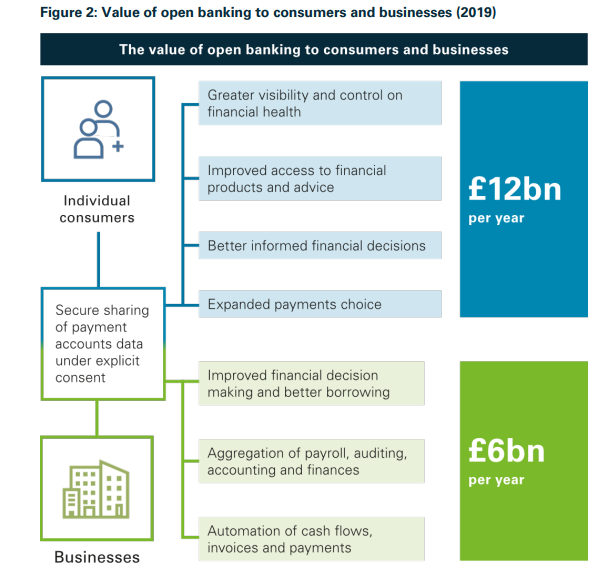
Value of open banking to consumers and businesses (2019). Source: Gov.uk
API
integration is a significant focus in the industry, involving linking
various software systems via APIs. APIs enable secure and efficient sharing of
data between software systems. Within banking, API integration facilitates the
exchange of consumer data among different financial institutions and enables
the creation of innovative new services.
The Global
Opportunity Analysis and Industry Forecast report states that the size of the
global online banking market was worth $11.43 billion in 2019 and is
expected to grow to $31.81 billion by 2027.
FCA Wants Greater Investor
Protection
In the
meantime, the FCA has released its business plan for 2023-2024, outlining its
roadmap for the next 12 months in accordance with the three-year development
strategy introduced a year ago. Its primary objective is to enhance overall
investor protection.
Meanwhile,
the UK is taking steps to prepare for cryptocurrency regulation by launching a
public consultation to create a draft law on regulating digital assets.
To further
bolster the safety of retail traders, the UK financial market supervisor has
appointed joint Executive Directors of Enforcement and Market Oversight, Steve
Smart and Therese Chambers, following Mark Steward's retirement in October last
year.
Additionally,
the FCA and the Advertising Standards Authority (ASA) have collaborated on a
campaign to educate financial influencers and prevent the promotion of illegal
'get rich quick' schemes. The agencies have partnered with prominent social
media influencer Sharon Gaffka.
Furthermore, the FCA is actively expanding its regulatory efforts, as evidenced by its rejection
of 8,582 financial promotions in 2022, seeking their amendment or removal by
authorized firms, which is an increase of 1,400% from the 573 financial promotions it
rejected in 2021.
The Joint
Regulatory Oversight Committee (JROC), which is co-led by the Financial Conduct
Authority (FCA) and the Payment Systems Regulator (PSR), has released its
proposed guidelines for the upcoming stage of open banking in the United
Kingdom.
JROC Unveils Two-Year Open
Banking Development Plan
JROC was
established with the cooperation of the FCA and the PSR in March 2022, and its
main purpose is to oversee planning and preparation for the creation of a
future open banking entity and the transition to the future framework.
The term 'open
banking' pertains to the utilization of banking data from clients at
established financial institutions by third-party companies to provide
customized services like lending and payments. This industry has contributed to
the transformation of the UK's fintech sector into the third largest in the
world.
More than a
year after its establishment, JROC has published recommendations presenting the
next phase of open banking development in the islands. Among the recommended
steps were proposals to develop a scalable, secure and economically sustainable
system.
"Open
banking can be a UK success story and we want to help it grow and develop
sustainably. Today's report sets out a roadmap and the framework for delivering
the next phase of open banking," the Co-Chairs of the Committee, PSR's
Managing Director, Chris Hemsley, and the FCA's Executive Director of Consumers and
Competition, Sheldon Mills, said in the statement.
"Only
through effective collaboration can we deliver on our ambition and develop open
banking in a way that promotes continued innovation and competition, for the
benefit of consumers, businesses, and the wider economy," the statement
added.
The report details how open banking can develop further in a safe, scalable and economically sustainable way. https://t.co/amOfOq155n
The JROC
has outlined its vision for the future of open banking and identified the
necessary steps required in its design. This includes a transition from the
current Open Banking Implementation Entity (OBIE) to the new entity that will
build on the substantial progress achieved so far.
"Britain
leads the pack in open banking, with 7 million users, but we can't sit back and
put our feet up," Andrew Griffith, the City Minister, said. "Today's plan
will deliver a new generation of products and services, making banking more
accessible and convenient for millions of people."
The JROC
will collaborate with industry stakeholders and oversee progress towards the
five key themes and the design of the future entity. They will provide a
progress report in Q4 2023 and a detailed plan for the transition from OBIE to
the future entity. The roadmap's full timetable is outlined
in the publication.
What Is the Future of Open
Banking?
After
Brexit, the UK is eager to advance open banking to draw in more fintech
companies, especially since the European Union is preparing to launch its own
comprehensive open banking scheme. While regulators have praised the successful
implementation of open banking technology in the UK fintech industry, industry
leaders cautioned against becoming too complacent.
According
to Chris Hayward, the Policy Chief at the City of London Corporation, which manages
London's financial district, the UK's fintech industry ranks third worldwide,
with a total investment of $12.5 billion in 2022, following the United States
and China.
Fintechs
and challenger banks are
projected to grow in the coming years. According to Business Insider
Intelligence, digital banks will have over 75 million subscribers in the United
States alone by 2023. This indicates a 25% growth over the current user base.
Value of open banking to consumers and businesses (2019). Source: Gov.uk
API
integration is a significant focus in the industry, involving linking
various software systems via APIs. APIs enable secure and efficient sharing of
data between software systems. Within banking, API integration facilitates the
exchange of consumer data among different financial institutions and enables
the creation of innovative new services.
The Global
Opportunity Analysis and Industry Forecast report states that the size of the
global online banking market was worth $11.43 billion in 2019 and is
expected to grow to $31.81 billion by 2027.
FCA Wants Greater Investor
Protection
In the
meantime, the FCA has released its business plan for 2023-2024, outlining its
roadmap for the next 12 months in accordance with the three-year development
strategy introduced a year ago. Its primary objective is to enhance overall
investor protection.
Meanwhile,
the UK is taking steps to prepare for cryptocurrency regulation by launching a
public consultation to create a draft law on regulating digital assets.
To further
bolster the safety of retail traders, the UK financial market supervisor has
appointed joint Executive Directors of Enforcement and Market Oversight, Steve
Smart and Therese Chambers, following Mark Steward's retirement in October last
year.
Additionally,
the FCA and the Advertising Standards Authority (ASA) have collaborated on a
campaign to educate financial influencers and prevent the promotion of illegal
'get rich quick' schemes. The agencies have partnered with prominent social
media influencer Sharon Gaffka.
Furthermore, the FCA is actively expanding its regulatory efforts, as evidenced by its rejection
of 8,582 financial promotions in 2022, seeking their amendment or removal by
authorized firms, which is an increase of 1,400% from the 573 financial promotions it
rejected in 2021.
Damian Chmiel is a Senior Analyst & Editor at Finance Magnates with more than 15 years of experience in the CFD and online trading industry. Active as both a trader and journalist since 2010, he focuses on broker coverage, fintech innovation, and regulatory developments across Europe, the Middle East, and Asia.
His work includes interviews with C-level leaders at major brokerages and fintech platforms, as well as co-authoring Finance Magnates’ quarterly industry benchmarking reports. Damian’s reporting is data-driven, market-aware, and grounded in direct industry engagement. His analysis and commentary have also been cited by external media outlets, including Investing.com, Binance, The Asset, Stockhead, and Dispatch.
Education:
MA in Finance and Accounting, Cracow University of Economics
Polymarket Adds Self-Exclusion and Deposit Limits for Prediction Traders
Featured Videos
AvaTrade to Acquire Most of FXCM; NAGA Raises $8M
AvaTrade to Acquire Most of FXCM; NAGA Raises $8M
AvaTrade to Acquire Most of FXCM; NAGA Raises $8M
AvaTrade to Acquire Most of FXCM; NAGA Raises $8M
Today’s financial news recap covers AvaTrade agrees to acquire most of FXCM, NAGA secures eight million dollars in new financing, and Wise seeks a tax settlement in the UK.
Finance Magnates Daily Recap brings you the latest news from forex and CFD brokers, fintech, payments, cryptocurrency, digital assets, trading platforms, financial regulation and global markets.
Get the key company news, executive moves, deals, regulatory updates and market developments of the day, in just a few minutes. New episodes published every weekday.
Read more: https://www.financemagnates.com
#FinanceMagnates #ForexNews #FintechNews
Today’s financial news recap covers AvaTrade agrees to acquire most of FXCM, NAGA secures eight million dollars in new financing, and Wise seeks a tax settlement in the UK.
Finance Magnates Daily Recap brings you the latest news from forex and CFD brokers, fintech, payments, cryptocurrency, digital assets, trading platforms, financial regulation and global markets.
Get the key company news, executive moves, deals, regulatory updates and market developments of the day, in just a few minutes. New episodes published every weekday.
Read more: https://www.financemagnates.com
#FinanceMagnates #ForexNews #FintechNews
Today’s financial news recap covers AvaTrade agrees to acquire most of FXCM, NAGA secures eight million dollars in new financing, and Wise seeks a tax settlement in the UK.
Finance Magnates Daily Recap brings you the latest news from forex and CFD brokers, fintech, payments, cryptocurrency, digital assets, trading platforms, financial regulation and global markets.
Get the key company news, executive moves, deals, regulatory updates and market developments of the day, in just a few minutes. New episodes published every weekday.
Read more: https://www.financemagnates.com
#FinanceMagnates #ForexNews #FintechNews
Today’s financial news recap covers AvaTrade agrees to acquire most of FXCM, NAGA secures eight million dollars in new financing, and Wise seeks a tax settlement in the UK.
Finance Magnates Daily Recap brings you the latest news from forex and CFD brokers, fintech, payments, cryptocurrency, digital assets, trading platforms, financial regulation and global markets.
Get the key company news, executive moves, deals, regulatory updates and market developments of the day, in just a few minutes. New episodes published every weekday.
Read more: https://www.financemagnates.com
#FinanceMagnates #ForexNews #FintechNews
XTB Adds Overnight US Stock Trading; Nasdaq Ventures Invests in One Trading
XTB Adds Overnight US Stock Trading; Nasdaq Ventures Invests in One Trading
XTB Adds Overnight US Stock Trading; Nasdaq Ventures Invests in One Trading
XTB Adds Overnight US Stock Trading; Nasdaq Ventures Invests in One Trading
XTB Adds Overnight US Stock Trading; Nasdaq Ventures Invests in One Trading
XTB Adds Overnight US Stock Trading; Nasdaq Ventures Invests in One Trading
Today’s financial news recap covers XTB expands overnight US stock trading, Fortrade reports higher revenue, Nasdaq backs One Trading, and Vest Labs raises 13 million dollars.
Finance Magnates Daily Recap brings you the latest news from forex and CFD brokers, fintech, payments, cryptocurrency, digital assets, trading platforms, financial regulation and global markets.
Get the key company news, executive moves, deals, regulatory updates and market developments of the day, in just a few minutes. New episodes published every weekday.
Read more: https://www.financemagnates.com
#FinanceMagnates #ForexNews #FintechNews
Today’s financial news recap covers XTB expands overnight US stock trading, Fortrade reports higher revenue, Nasdaq backs One Trading, and Vest Labs raises 13 million dollars.
Finance Magnates Daily Recap brings you the latest news from forex and CFD brokers, fintech, payments, cryptocurrency, digital assets, trading platforms, financial regulation and global markets.
Get the key company news, executive moves, deals, regulatory updates and market developments of the day, in just a few minutes. New episodes published every weekday.
Read more: https://www.financemagnates.com
#FinanceMagnates #ForexNews #FintechNews
Today’s financial news recap covers XTB expands overnight US stock trading, Fortrade reports higher revenue, Nasdaq backs One Trading, and Vest Labs raises 13 million dollars.
Finance Magnates Daily Recap brings you the latest news from forex and CFD brokers, fintech, payments, cryptocurrency, digital assets, trading platforms, financial regulation and global markets.
Get the key company news, executive moves, deals, regulatory updates and market developments of the day, in just a few minutes. New episodes published every weekday.
Read more: https://www.financemagnates.com
#FinanceMagnates #ForexNews #FintechNews
Today’s financial news recap covers XTB expands overnight US stock trading, Fortrade reports higher revenue, Nasdaq backs One Trading, and Vest Labs raises 13 million dollars.
Finance Magnates Daily Recap brings you the latest news from forex and CFD brokers, fintech, payments, cryptocurrency, digital assets, trading platforms, financial regulation and global markets.
Get the key company news, executive moves, deals, regulatory updates and market developments of the day, in just a few minutes. New episodes published every weekday.
Read more: https://www.financemagnates.com
#FinanceMagnates #ForexNews #FintechNews
Today’s financial news recap covers XTB expands overnight US stock trading, Fortrade reports higher revenue, Nasdaq backs One Trading, and Vest Labs raises 13 million dollars.
Finance Magnates Daily Recap brings you the latest news from forex and CFD brokers, fintech, payments, cryptocurrency, digital assets, trading platforms, financial regulation and global markets.
Get the key company news, executive moves, deals, regulatory updates and market developments of the day, in just a few minutes. New episodes published every weekday.
Read more: https://www.financemagnates.com
#FinanceMagnates #ForexNews #FintechNews
Today’s financial news recap covers XTB expands overnight US stock trading, Fortrade reports higher revenue, Nasdaq backs One Trading, and Vest Labs raises 13 million dollars.
Finance Magnates Daily Recap brings you the latest news from forex and CFD brokers, fintech, payments, cryptocurrency, digital assets, trading platforms, financial regulation and global markets.
Get the key company news, executive moves, deals, regulatory updates and market developments of the day, in just a few minutes. New episodes published every weekday.
Read more: https://www.financemagnates.com
#FinanceMagnates #ForexNews #FintechNews
CMC Founder Downplays Volatility Hit; Devexperts Names CEO
CMC Founder Downplays Volatility Hit; Devexperts Names CEO
CMC Founder Downplays Volatility Hit; Devexperts Names CEO
CMC Founder Downplays Volatility Hit; Devexperts Names CEO
CMC Founder Downplays Volatility Hit; Devexperts Names CEO
CMC Founder Downplays Volatility Hit; Devexperts Names CEO
Today’s financial news recap covers low volatility pressures brokers, Devexperts names a new CEO, Saxo cuts onboarding time, and OKX reaches a 25 billion dollar valuation.
Finance Magnates Daily Recap brings you the latest news from forex and CFD brokers, fintech, payments, cryptocurrency, digital assets, trading platforms, financial regulation and global markets.
Get the key company news, executive moves, deals, regulatory updates and market developments of the day, in just a few minutes. New episodes published every weekday.
Read more: https://www.financemagnates.com
#FinanceMagnates #ForexNews #FintechNews
Today’s financial news recap covers low volatility pressures brokers, Devexperts names a new CEO, Saxo cuts onboarding time, and OKX reaches a 25 billion dollar valuation.
Finance Magnates Daily Recap brings you the latest news from forex and CFD brokers, fintech, payments, cryptocurrency, digital assets, trading platforms, financial regulation and global markets.
Get the key company news, executive moves, deals, regulatory updates and market developments of the day, in just a few minutes. New episodes published every weekday.
Read more: https://www.financemagnates.com
#FinanceMagnates #ForexNews #FintechNews
Today’s financial news recap covers low volatility pressures brokers, Devexperts names a new CEO, Saxo cuts onboarding time, and OKX reaches a 25 billion dollar valuation.
Finance Magnates Daily Recap brings you the latest news from forex and CFD brokers, fintech, payments, cryptocurrency, digital assets, trading platforms, financial regulation and global markets.
Get the key company news, executive moves, deals, regulatory updates and market developments of the day, in just a few minutes. New episodes published every weekday.
Read more: https://www.financemagnates.com
#FinanceMagnates #ForexNews #FintechNews
Today’s financial news recap covers low volatility pressures brokers, Devexperts names a new CEO, Saxo cuts onboarding time, and OKX reaches a 25 billion dollar valuation.
Finance Magnates Daily Recap brings you the latest news from forex and CFD brokers, fintech, payments, cryptocurrency, digital assets, trading platforms, financial regulation and global markets.
Get the key company news, executive moves, deals, regulatory updates and market developments of the day, in just a few minutes. New episodes published every weekday.
Read more: https://www.financemagnates.com
#FinanceMagnates #ForexNews #FintechNews
Today’s financial news recap covers low volatility pressures brokers, Devexperts names a new CEO, Saxo cuts onboarding time, and OKX reaches a 25 billion dollar valuation.
Finance Magnates Daily Recap brings you the latest news from forex and CFD brokers, fintech, payments, cryptocurrency, digital assets, trading platforms, financial regulation and global markets.
Get the key company news, executive moves, deals, regulatory updates and market developments of the day, in just a few minutes. New episodes published every weekday.
Read more: https://www.financemagnates.com
#FinanceMagnates #ForexNews #FintechNews
Today’s financial news recap covers low volatility pressures brokers, Devexperts names a new CEO, Saxo cuts onboarding time, and OKX reaches a 25 billion dollar valuation.
Finance Magnates Daily Recap brings you the latest news from forex and CFD brokers, fintech, payments, cryptocurrency, digital assets, trading platforms, financial regulation and global markets.
Get the key company news, executive moves, deals, regulatory updates and market developments of the day, in just a few minutes. New episodes published every weekday.
Read more: https://www.financemagnates.com
#FinanceMagnates #ForexNews #FintechNews
Today’s financial news recap covers Trade Nation buys FXCM's UK client book, Trading 212 reports higher revenue, the CFTC's move to allow perpetual index futures.
Finance Magnates Daily Recap brings you the latest news from forex and CFD brokers, fintech, payments, cryptocurrency, digital assets, trading platforms, financial regulation and global markets.
Get the key company news, executive moves, deals, regulatory updates and market developments of the day, in just a few minutes. New episodes published every weekday.
Read more: https://www.financemagnates.com
#FinanceMagnates #ForexNews #FintechNews
Today’s financial news recap covers Trade Nation buys FXCM's UK client book, Trading 212 reports higher revenue, the CFTC's move to allow perpetual index futures.
Finance Magnates Daily Recap brings you the latest news from forex and CFD brokers, fintech, payments, cryptocurrency, digital assets, trading platforms, financial regulation and global markets.
Get the key company news, executive moves, deals, regulatory updates and market developments of the day, in just a few minutes. New episodes published every weekday.
Read more: https://www.financemagnates.com
#FinanceMagnates #ForexNews #FintechNews
Today’s financial news recap covers Trade Nation buys FXCM's UK client book, Trading 212 reports higher revenue, the CFTC's move to allow perpetual index futures.
Finance Magnates Daily Recap brings you the latest news from forex and CFD brokers, fintech, payments, cryptocurrency, digital assets, trading platforms, financial regulation and global markets.
Get the key company news, executive moves, deals, regulatory updates and market developments of the day, in just a few minutes. New episodes published every weekday.
Read more: https://www.financemagnates.com
#FinanceMagnates #ForexNews #FintechNews
Today’s financial news recap covers Trade Nation buys FXCM's UK client book, Trading 212 reports higher revenue, the CFTC's move to allow perpetual index futures.
Finance Magnates Daily Recap brings you the latest news from forex and CFD brokers, fintech, payments, cryptocurrency, digital assets, trading platforms, financial regulation and global markets.
Get the key company news, executive moves, deals, regulatory updates and market developments of the day, in just a few minutes. New episodes published every weekday.
Read more: https://www.financemagnates.com
#FinanceMagnates #ForexNews #FintechNews
Today’s financial news recap covers Trade Nation buys FXCM's UK client book, Trading 212 reports higher revenue, the CFTC's move to allow perpetual index futures.
Finance Magnates Daily Recap brings you the latest news from forex and CFD brokers, fintech, payments, cryptocurrency, digital assets, trading platforms, financial regulation and global markets.
Get the key company news, executive moves, deals, regulatory updates and market developments of the day, in just a few minutes. New episodes published every weekday.
Read more: https://www.financemagnates.com
#FinanceMagnates #ForexNews #FintechNews
Today’s financial news recap covers Trade Nation buys FXCM's UK client book, Trading 212 reports higher revenue, the CFTC's move to allow perpetual index futures.
Finance Magnates Daily Recap brings you the latest news from forex and CFD brokers, fintech, payments, cryptocurrency, digital assets, trading platforms, financial regulation and global markets.
Get the key company news, executive moves, deals, regulatory updates and market developments of the day, in just a few minutes. New episodes published every weekday.
Read more: https://www.financemagnates.com
#FinanceMagnates #ForexNews #FintechNews
Your career isn’t a linear path.
Your career isn’t a linear path.
Your career isn’t a linear path.
Your career isn’t a linear path.
Your career isn’t a linear path.
Your career isn’t a linear path.
Roles change. Career goals change. Sometimes you want a completely new challenge.
But the skills and knowledge you build along the way can stay with you and give you something to build on.
For Jeff Patterson, that continued growth is key to long-term career development.
You bring the skills. FM Academy helps you build the knowledge.
#FMAcademy #FinanceMagnates #FinanceCareers #ProfessionalDevelopment #Fintech
Roles change. Career goals change. Sometimes you want a completely new challenge.
But the skills and knowledge you build along the way can stay with you and give you something to build on.
For Jeff Patterson, that continued growth is key to long-term career development.
You bring the skills. FM Academy helps you build the knowledge.
#FMAcademy #FinanceMagnates #FinanceCareers #ProfessionalDevelopment #Fintech
Roles change. Career goals change. Sometimes you want a completely new challenge.
But the skills and knowledge you build along the way can stay with you and give you something to build on.
For Jeff Patterson, that continued growth is key to long-term career development.
You bring the skills. FM Academy helps you build the knowledge.
#FMAcademy #FinanceMagnates #FinanceCareers #ProfessionalDevelopment #Fintech
Roles change. Career goals change. Sometimes you want a completely new challenge.
But the skills and knowledge you build along the way can stay with you and give you something to build on.
For Jeff Patterson, that continued growth is key to long-term career development.
You bring the skills. FM Academy helps you build the knowledge.
#FMAcademy #FinanceMagnates #FinanceCareers #ProfessionalDevelopment #Fintech
Roles change. Career goals change. Sometimes you want a completely new challenge.
But the skills and knowledge you build along the way can stay with you and give you something to build on.
For Jeff Patterson, that continued growth is key to long-term career development.
You bring the skills. FM Academy helps you build the knowledge.
#FMAcademy #FinanceMagnates #FinanceCareers #ProfessionalDevelopment #Fintech
Roles change. Career goals change. Sometimes you want a completely new challenge.
But the skills and knowledge you build along the way can stay with you and give you something to build on.
For Jeff Patterson, that continued growth is key to long-term career development.
You bring the skills. FM Academy helps you build the knowledge.
#FMAcademy #FinanceMagnates #FinanceCareers #ProfessionalDevelopment #Fintech