


ARK Invest and prediction market platform Kalshi have announced a collaboration to test how prediction markets can be used within institutional research workflows.
Singapore Summit: Meet the largest APAC brokers you know (and those you still don't!)
Under the partnership, ARK will work with Kalshi to create event contracts tied to its investment themes, including macroeconomic indicators, company performance metrics and scientific or technological milestones.
“Bringing prediction markets into institutional workflows is a natural extension of how we think about research,” said Cathie Wood, Founder, CEO and CIO of ARK Invest. “We believe these signals can provide additional context around key drivers across disruptive sectors.”
At @ARKInvest, we’re always looking for new tools that can sharpen our research and improve how we make investment decisions. Prediction markets are not just a new derivatives market — they represent a powerful new way to quantify risk and surface forward-looking insights.
— Cathie Wood (@CathieDWood) March 26, 2026
We’ve… https://t.co/BLFzORsaVK
From Data Source to Research Input
The collaboration moves prediction markets from being an external data point to something that can be incorporated directly into the research process. Instead of only observing existing markets, ARK plans to help define the questions those markets track.
For example, this could include contracts tied to specific business outcomes, such as production targets or regulatory approvals, allowing the firm to monitor market expectations in real time.
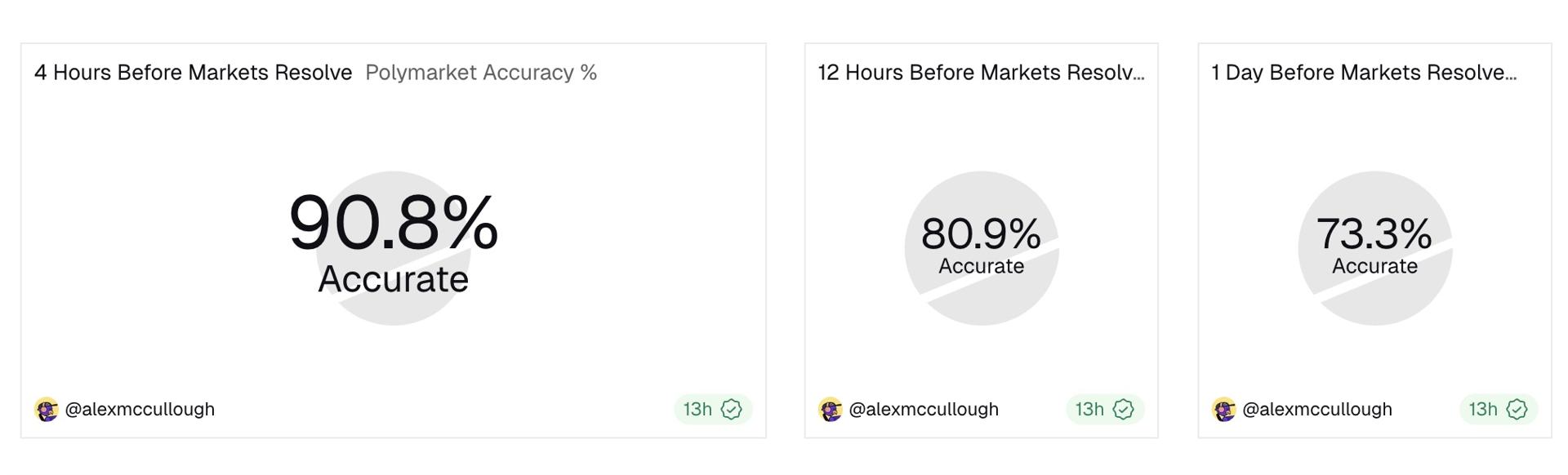
Prediction markets have shown relatively strong forecasting accuracy in certain domains. Analysis of Polymarket data suggests accuracy of around 73% across resolved markets, rising to over 90% in the final hours before events. This compares favorably with traditional polling models in some political forecasts.
However, these signals are not purely neutral. Market outcomes can be influenced by large traders and uneven participation, which may affect how prices are formed.
“We believe prediction markets offer a way to observe how participants price specific risks,” said Nick Grous, Director of Research at ARK Invest.
A Targeted Use Case
For Kalshi, the partnership expands its work with institutional participants by focusing on how its markets are used rather than just how they are traded.
“This was part of the original vision for Kalshi — to provide pricing on real-world events that institutions can use in decision-making,” said CEO Tarek Mansour.
As institutional adoption of prediction markets grows, Kalshi is seeing increased demand for a formal market request pipeline to help investors leverage the wisdom of the crowd.@ARKInvest is now working with Kalshi through this pipeline to list markets used in investment…
— Tarek Mansour (@mansourtarek_) March 26, 2026
The collaboration builds on a series of recent partnerships focused on institutional access. Kalshi has worked with firms such as Tradeweb on data distribution and FIS on clearing infrastructure, while other partnerships have focused on custody and market integrity.
For brokers, asset managers and data providers, the development points to a potential use case beyond trading. Prediction markets may be used as a supplementary signal within research and risk frameworks, rather than as a standalone trading product.
- Kalshi Defies U.S. Legal Tussle and Nevada Temporary Ban as Valuation Doubles to $22B
- Prediction Platform Kalshi Charged in Arizona Over Unlicensed Gambling Activities
- Kalshi Taps Brazil’s XP to Take Prediction Markets Global
Still an Early Experiment
The approach remains experimental. The usefulness of prediction market data depends on factors such as market depth, participant mix and how contracts are structured.
Activity is often concentrated in a limited number of contracts, with many markets remaining thinly traded. For now, the collaboration suggests one way these tools might be used within institutional workflows, rather than establishing a standard model.


