Solana's price forecast for 2025 suggests potential growth as SOL eyes the $1,000 mark.
SOL may reach $300–500 in 2024 before pushing higher, with analysts citing strong ecosystem momentum.
Logo of Solana
Solana has
gained significant attention in the cryptocurrency market, thanks to its
high-speed blockchain and low transaction fees. Many investors and analysts are
speculating whether Solana, often referred to as SOL, can achieve the
ambitious price target of $1,000. This article explores the factors that could
influence Solana's price, expert predictions, and challenges it may face.
What Is Solana?
Solana is a
blockchain platform known for its scalability and speed. It processes thousands
of transactions per second, making it one of the fastest blockchains in the
market. Its low fees and support for decentralized finance (DeFi) applications,
non-fungible tokens (NFTs), and other use cases have made it a popular choice
among developers and traders.
SOL Key Features:
High-Speed Transactions: Solana processes up to
65,000 transactions per second.
Low Costs: Transaction fees are
typically less than $0.01.
Ecosystem Growth: Solana supports a wide
range of applications, including DeFi, NFTs, and dApps (decentralized apps).
Current Solana Price and
Market Trends
Solana's Price Performance
As of
November 2024, Solana's price is trading around $250, with a market cap
exceeding $100 billion. It has experienced a significant price surge, climbing
48% in the past month. This momentum is driven by strong network activity and
positive sentiment in the crypto market.
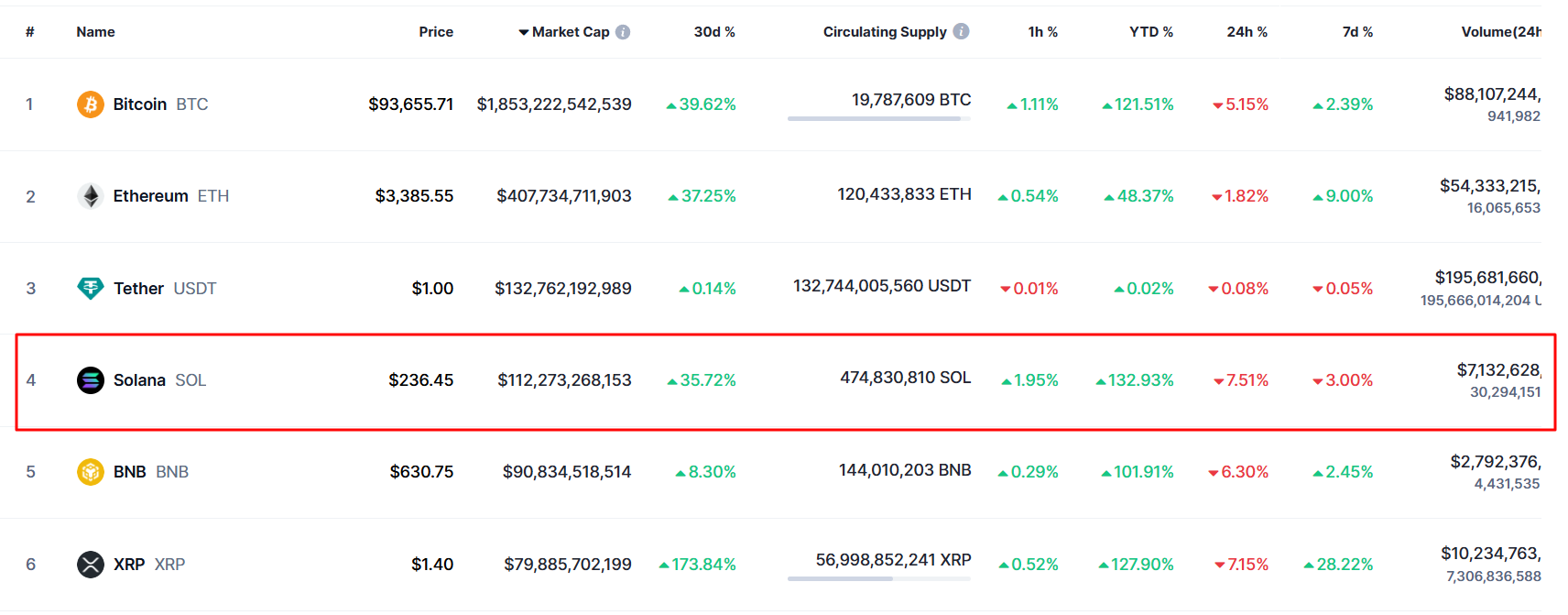
Solana (SOL) is currently the 4th largest cryptocurrency. Source: CoinMarketCap
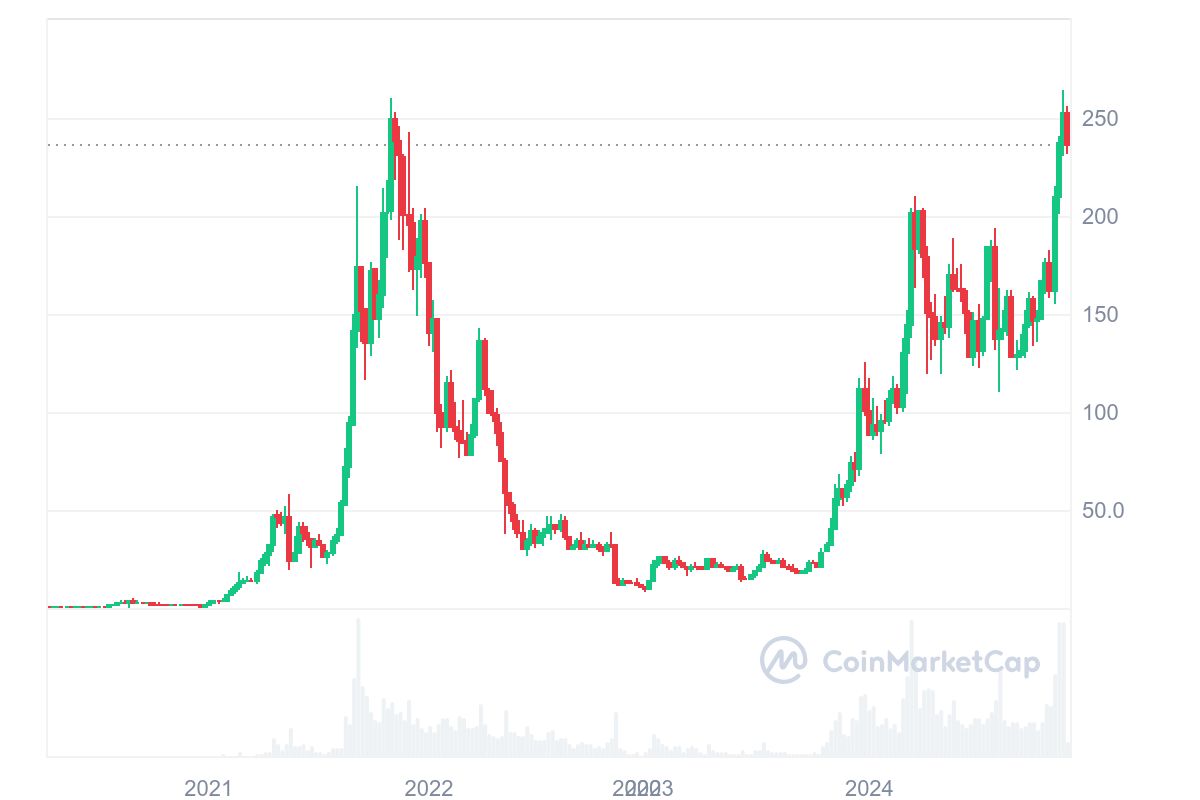
Solana is currently the fourth-largest cryptocurrency in the entire ecosystem, with a market cap approximately $20 billion smaller than Tether, which holds the third position. Moreover, as shown in the chart below, its price has tested the highest levels in over three years, nearing the all-time high of nearly $268 set on November 8, 2021.
Solana almost reached a new ATH in this cycle. Source: CoinMarketCap
Metric
Value
Current
Price (SOL)
$250
Market Cap
$100 billion
All-Time
High (2021)
$265
Daily
Transaction Volume
$100 billion
Solana Blockchain and Network
Performance: Network Activity
Active Users: Over 25 million monthly
active users.
DEX Volume: $100 billion in
decentralized exchange (DEX) transactions in November 2024.
You can also check other crypto prediction articles
by Finance Magnates. For example, “Will Dogecoin Reach $1?”
Can Solana Reach $1,000? SOL
Price Forecast
Reaching
$1,000 would require Solana to quadruple its current price. For this to happen,
several factors need to align.
Factors Supporting Price
Growth
Technological
Advancements: Solana's blockchain is known for its scalability and
efficiency. Future upgrades could enhance its transaction speed
and network capabilities.
Adoption in DeFi and NFTs: Solana is a major player in DeFi and NFTs, both of
which are growing sectors. Increased adoption of Solana-based projects could
drive demand for SOL.
Institutional
Investment: Large investors are increasingly interested in Solana
due to its performance and potential. Institutional backing could provide significant
capital inflows.
Bitwise Asset Management, a firm recognized for its spot Bitcoin and Ether exchange-traded funds (ETFs) in the U.S., has recently taken steps toward launching a spot Solana ETF. Last week, Bitwise registered a statutory trust in Delaware, indicating its intention to offer this new investment product. This move may boost SOL prices, as it did with BTC and ETH values in the past.
Solana Technical Analysis and Investment Strategies
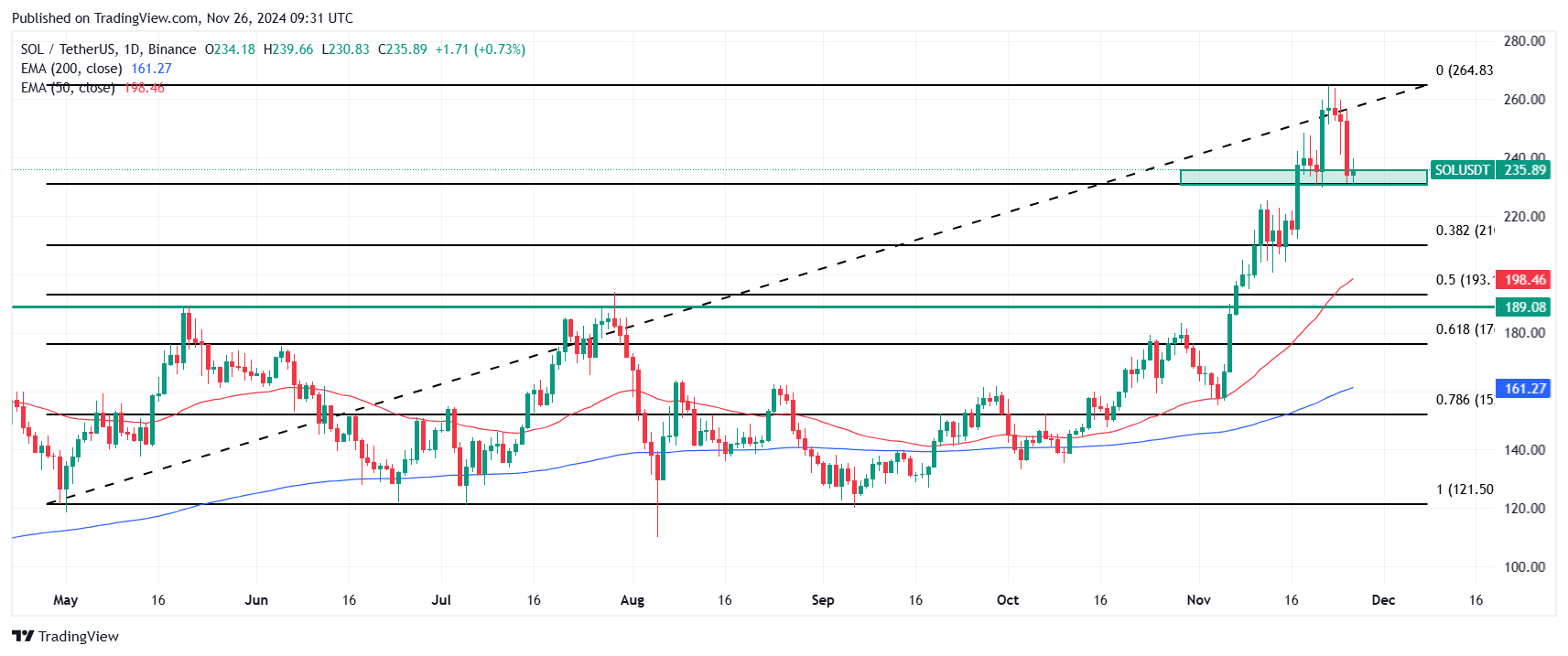
From a technical analysis standpoint, Solana has broken through a significant resistance zone at $190, which had contained the price within a consolidation range since April. Following this dynamic breakout, the price has moved upward, establishing new support at $230, where local lows and the 23.6% Fibonacci retracement level align.
Technical analysis suggests Solana has strong support levels. Source: TradingView
As long as SOL remains above the psychological level of $200 and the 50-day EMA (marked in red), any pullbacks are likely to present opportunities to purchase the token at more favorable prices.
For traders and investors, technical analysis provides critical insights
into Solana’s future price movements. Tools like Fibonacci retracement and
moving averages help forecast price levels and identify trends in Solana
trading.
Making Investment Decisions: Investors
are encouraged to use tools like price charts and study the Solana ecosystem
before making any investment decisions.
Research Before Investing: Readers are
encouraged to consider issues and broader market dynamics, such as regulatory
challenges, before committing capital.
Challenges Solana Price Forecast
Faces
While the
potential is there, several challenges could prevent Solana from reaching
$1,000.
Market
Volatility: The crypto market is highly volatile, with prices
often experiencing dramatic swings. A broader market downturn could negatively affect
Solana’s price.
Competition: Solana faces stiff competition from other blockchains
like Ethereum, Cardano, and Avalanche. Ethereum's upgrades, such as ETH 2.0, could reduce
Solana’s appeal.
Regulatory
Risks: Governments around the world are introducing
regulations that could impact cryptocurrency markets. Uncertainty in regulations may discourage new
investors from entering the market.
Network
Stability: Solana has faced outages and technical issues in the
past. Ensuring a stable and reliable network is crucial for
maintaining investor confidence.
Solana Price Forecast: Expert
Predictions
Cryptocurrency
analysts have mixed opinions about whether Solana can reach $1,000.
Solana Price Prediction: Bullish
Some analysts believe Solana could hit $1,000 within
the next five years if adoption continues to grow.
Factors like institutional investment and DeFi
expansion are cited as key drivers.
Others caution that Solana's price may face resistance
due to market volatility and competition.
They argue that $1,000 is an ambitious target,
especially in the short term.
When Could Solana Reach
$1,000?
The
timeline for Solana to reach $1,000 depends on several factors, including
market conditions and technological developments.
Scenario
Timeframe
Conditions
Short-Term
(1–2 Years)
Unlikely
Requires a massive bull run and adoption.
Medium-Term
(3–5 Years)
Possible
Needs consistent growth in DeFi and NFTs.
Long-Term
(5+ Years)
More Likely
Dependent on market maturity and stability.
Analyzing Solana’s Price
Action and Market Dynamics
Solana’s price prediction has become a key focus for investors and crypto
analysts alike. The blockchain’s scalability and ability to process thousands
of transactions per second make it a strong contender in the cryptocurrency
ecosystem. This section explores Solana’s price trends, forecasts, and the
factors driving its potential to dominate the market.
The $SOL price breaks through $260, setting a new #ATH!
Per SOL Price Trends: Current movements in
Solana trading suggest strong price action, with the network showing resilience
even during market corrections.
Initial Price Recovery: After significant
fluctuations, Solana continues to attract attention, demonstrating its
potential for sustained growth.
2022–2023
Price Movements and Breakout Potential
In 2022 and 2023, Solana demonstrated its ability to recover from market
downturns, showing significant price movements and staging multiple breakouts.
The network's stability and adoption among traders and developers have
strengthened its position in the crypto market.
Solana to Hit New Highs: Analysts like Michael
van de Poppe believe Solana is expected to break through resistance levels,
supported by strong fundamentals and increasing adoption.
Next Bull Run: With favorable market
conditions, Solana could see another bull run that brings it closer to the
$1,000 target.
Another PERFECTLY timed breakout 👌😎
6 months of consolidation and boom - $SOL broke out as expected 📈
The potential for Solana’s price in 2025 and beyond depends heavily on
favorable market conditions. If the cryptocurrency market enters a long-term
bull market, Solana would likely outperform many other altcoins.
Market Conditions Are Favorable: Solana
thrives in bullish conditions due to its strong fundamentals and ecosystem
growth.
Price Fails and Risks: On the other hand, if
the market experiences significant downturns, Solana's price fails could deter
short-term investors.
Will Solana Reach $1,000? Conclusion
Reaching
$1,000 is an ambitious target for Solana, but not impossible. The platform's
technological strengths, growing adoption, and market trends make it a strong
contender in the cryptocurrency space. However, challenges like competition,
market volatility, and regulatory risks cannot be ignored. Investors should
carefully weigh the potential rewards against the risks and stay informed about
market conditions.
Solana represents a significant opportunity for
investors and developers, thanks to its innovative blockchain and growing
ecosystem. While price predictions vary, the forecast for Solana remains
bullish in favorable market conditions. Whether it achieves a breakout to
$1,000 or faces setbacks, its role in the cryptocurrency landscape is
undeniable.
Solana Price Prediction, FAQs
Can
Solana reach $500?
Based on the latest predictions and market analysis, Solana has a strong
potential to reach $500 before 2026. Multiple analysts project SOL breaking
through the $500 barrier during 2025, with price targets ranging between
$450–$555 that year.
Can Solana reach $1,000 in
2025?
Solana is
expected to reach between $500 and $1,000, depending on market dynamics. While
possible, it is unlikely without significant market and ecosystem growth.
Analysts suggest that a longer timeline is more realistic.
Some
experts believe Solana could achieve this price point before 2030. The most
optimistic scenarios suggest SOL reaching $1,000 as early as 2026 in a
best-case scenario, though more conservative estimates place this milestone
around 2028–2029.
How high can Solana
realistically go?
Realistically, Solana's maximum potential appears to be in the
$1,250–$2,000 range before 2030, assuming widespread adoption and continued
ecosystem growth. This projection considers Solana's technical capabilities,
market position, and potential institutional adoption.
How
much will 1 Solana be worth in 2030?
For 2030 specifically, most analysts predict Solana will trade between
$1,100 and $1,325. The average consensus points to a price of around $1,136,
though estimates vary significantly. Some conservative predictions suggest a
price as low as $956, while optimistic forecasts extend up to $1,325. However,
it's worth noting that one outlier prediction from VanEck suggests a much lower
figure of $9.81, though this represents an extremely bearish scenario.
What factors drive Solana's
price?
Solana’s
price is influenced by adoption in DeFi and NFTs, institutional investment, and
market sentiment. Solana's ability to process transactions quickly and its
growing DeFi and NFT ecosystem set it apart. The potential of blockchain
technology in Solana is significant, but market volatility remains a concern.
Is Solana a good investment?
Solana has
shown strong growth potential, but like all cryptocurrencies, it carries risks.
Conduct thorough research before investing. Its developer-friendly environment
and low transaction costs make it a top choice for blockchain projects.
Solana has
gained significant attention in the cryptocurrency market, thanks to its
high-speed blockchain and low transaction fees. Many investors and analysts are
speculating whether Solana, often referred to as SOL, can achieve the
ambitious price target of $1,000. This article explores the factors that could
influence Solana's price, expert predictions, and challenges it may face.
What Is Solana?
Solana is a
blockchain platform known for its scalability and speed. It processes thousands
of transactions per second, making it one of the fastest blockchains in the
market. Its low fees and support for decentralized finance (DeFi) applications,
non-fungible tokens (NFTs), and other use cases have made it a popular choice
among developers and traders.
SOL Key Features:
High-Speed Transactions: Solana processes up to
65,000 transactions per second.
Low Costs: Transaction fees are
typically less than $0.01.
Ecosystem Growth: Solana supports a wide
range of applications, including DeFi, NFTs, and dApps (decentralized apps).
Current Solana Price and
Market Trends
Solana's Price Performance
As of
November 2024, Solana's price is trading around $250, with a market cap
exceeding $100 billion. It has experienced a significant price surge, climbing
48% in the past month. This momentum is driven by strong network activity and
positive sentiment in the crypto market.
Solana (SOL) is currently the 4th largest cryptocurrency. Source: CoinMarketCap
Solana is currently the fourth-largest cryptocurrency in the entire ecosystem, with a market cap approximately $20 billion smaller than Tether, which holds the third position. Moreover, as shown in the chart below, its price has tested the highest levels in over three years, nearing the all-time high of nearly $268 set on November 8, 2021.
Solana almost reached a new ATH in this cycle. Source: CoinMarketCap
Metric
Value
Current
Price (SOL)
$250
Market Cap
$100 billion
All-Time
High (2021)
$265
Daily
Transaction Volume
$100 billion
Solana Blockchain and Network
Performance: Network Activity
Active Users: Over 25 million monthly
active users.
DEX Volume: $100 billion in
decentralized exchange (DEX) transactions in November 2024.
You can also check other crypto prediction articles
by Finance Magnates. For example, “Will Dogecoin Reach $1?”
Can Solana Reach $1,000? SOL
Price Forecast
Reaching
$1,000 would require Solana to quadruple its current price. For this to happen,
several factors need to align.
Factors Supporting Price
Growth
Technological
Advancements: Solana's blockchain is known for its scalability and
efficiency. Future upgrades could enhance its transaction speed
and network capabilities.
Adoption in DeFi and NFTs: Solana is a major player in DeFi and NFTs, both of
which are growing sectors. Increased adoption of Solana-based projects could
drive demand for SOL.
Institutional
Investment: Large investors are increasingly interested in Solana
due to its performance and potential. Institutional backing could provide significant
capital inflows.
Bitwise Asset Management, a firm recognized for its spot Bitcoin and Ether exchange-traded funds (ETFs) in the U.S., has recently taken steps toward launching a spot Solana ETF. Last week, Bitwise registered a statutory trust in Delaware, indicating its intention to offer this new investment product. This move may boost SOL prices, as it did with BTC and ETH values in the past.
Solana Technical Analysis and Investment Strategies
From a technical analysis standpoint, Solana has broken through a significant resistance zone at $190, which had contained the price within a consolidation range since April. Following this dynamic breakout, the price has moved upward, establishing new support at $230, where local lows and the 23.6% Fibonacci retracement level align.
Technical analysis suggests Solana has strong support levels. Source: TradingView
As long as SOL remains above the psychological level of $200 and the 50-day EMA (marked in red), any pullbacks are likely to present opportunities to purchase the token at more favorable prices.
For traders and investors, technical analysis provides critical insights
into Solana’s future price movements. Tools like Fibonacci retracement and
moving averages help forecast price levels and identify trends in Solana
trading.
Making Investment Decisions: Investors
are encouraged to use tools like price charts and study the Solana ecosystem
before making any investment decisions.
Research Before Investing: Readers are
encouraged to consider issues and broader market dynamics, such as regulatory
challenges, before committing capital.
Challenges Solana Price Forecast
Faces
While the
potential is there, several challenges could prevent Solana from reaching
$1,000.
Market
Volatility: The crypto market is highly volatile, with prices
often experiencing dramatic swings. A broader market downturn could negatively affect
Solana’s price.
Competition: Solana faces stiff competition from other blockchains
like Ethereum, Cardano, and Avalanche. Ethereum's upgrades, such as ETH 2.0, could reduce
Solana’s appeal.
Regulatory
Risks: Governments around the world are introducing
regulations that could impact cryptocurrency markets. Uncertainty in regulations may discourage new
investors from entering the market.
Network
Stability: Solana has faced outages and technical issues in the
past. Ensuring a stable and reliable network is crucial for
maintaining investor confidence.
Solana Price Forecast: Expert
Predictions
Cryptocurrency
analysts have mixed opinions about whether Solana can reach $1,000.
Solana Price Prediction: Bullish
Some analysts believe Solana could hit $1,000 within
the next five years if adoption continues to grow.
Factors like institutional investment and DeFi
expansion are cited as key drivers.
Others caution that Solana's price may face resistance
due to market volatility and competition.
They argue that $1,000 is an ambitious target,
especially in the short term.
When Could Solana Reach
$1,000?
The
timeline for Solana to reach $1,000 depends on several factors, including
market conditions and technological developments.
Scenario
Timeframe
Conditions
Short-Term
(1–2 Years)
Unlikely
Requires a massive bull run and adoption.
Medium-Term
(3–5 Years)
Possible
Needs consistent growth in DeFi and NFTs.
Long-Term
(5+ Years)
More Likely
Dependent on market maturity and stability.
Analyzing Solana’s Price
Action and Market Dynamics
Solana’s price prediction has become a key focus for investors and crypto
analysts alike. The blockchain’s scalability and ability to process thousands
of transactions per second make it a strong contender in the cryptocurrency
ecosystem. This section explores Solana’s price trends, forecasts, and the
factors driving its potential to dominate the market.
The $SOL price breaks through $260, setting a new #ATH!
Per SOL Price Trends: Current movements in
Solana trading suggest strong price action, with the network showing resilience
even during market corrections.
Initial Price Recovery: After significant
fluctuations, Solana continues to attract attention, demonstrating its
potential for sustained growth.
2022–2023
Price Movements and Breakout Potential
In 2022 and 2023, Solana demonstrated its ability to recover from market
downturns, showing significant price movements and staging multiple breakouts.
The network's stability and adoption among traders and developers have
strengthened its position in the crypto market.
Solana to Hit New Highs: Analysts like Michael
van de Poppe believe Solana is expected to break through resistance levels,
supported by strong fundamentals and increasing adoption.
Next Bull Run: With favorable market
conditions, Solana could see another bull run that brings it closer to the
$1,000 target.
Another PERFECTLY timed breakout 👌😎
6 months of consolidation and boom - $SOL broke out as expected 📈
The potential for Solana’s price in 2025 and beyond depends heavily on
favorable market conditions. If the cryptocurrency market enters a long-term
bull market, Solana would likely outperform many other altcoins.
Market Conditions Are Favorable: Solana
thrives in bullish conditions due to its strong fundamentals and ecosystem
growth.
Price Fails and Risks: On the other hand, if
the market experiences significant downturns, Solana's price fails could deter
short-term investors.
Will Solana Reach $1,000? Conclusion
Reaching
$1,000 is an ambitious target for Solana, but not impossible. The platform's
technological strengths, growing adoption, and market trends make it a strong
contender in the cryptocurrency space. However, challenges like competition,
market volatility, and regulatory risks cannot be ignored. Investors should
carefully weigh the potential rewards against the risks and stay informed about
market conditions.
Solana represents a significant opportunity for
investors and developers, thanks to its innovative blockchain and growing
ecosystem. While price predictions vary, the forecast for Solana remains
bullish in favorable market conditions. Whether it achieves a breakout to
$1,000 or faces setbacks, its role in the cryptocurrency landscape is
undeniable.
Solana Price Prediction, FAQs
Can
Solana reach $500?
Based on the latest predictions and market analysis, Solana has a strong
potential to reach $500 before 2026. Multiple analysts project SOL breaking
through the $500 barrier during 2025, with price targets ranging between
$450–$555 that year.
Can Solana reach $1,000 in
2025?
Solana is
expected to reach between $500 and $1,000, depending on market dynamics. While
possible, it is unlikely without significant market and ecosystem growth.
Analysts suggest that a longer timeline is more realistic.
Some
experts believe Solana could achieve this price point before 2030. The most
optimistic scenarios suggest SOL reaching $1,000 as early as 2026 in a
best-case scenario, though more conservative estimates place this milestone
around 2028–2029.
How high can Solana
realistically go?
Realistically, Solana's maximum potential appears to be in the
$1,250–$2,000 range before 2030, assuming widespread adoption and continued
ecosystem growth. This projection considers Solana's technical capabilities,
market position, and potential institutional adoption.
How
much will 1 Solana be worth in 2030?
For 2030 specifically, most analysts predict Solana will trade between
$1,100 and $1,325. The average consensus points to a price of around $1,136,
though estimates vary significantly. Some conservative predictions suggest a
price as low as $956, while optimistic forecasts extend up to $1,325. However,
it's worth noting that one outlier prediction from VanEck suggests a much lower
figure of $9.81, though this represents an extremely bearish scenario.
What factors drive Solana's
price?
Solana’s
price is influenced by adoption in DeFi and NFTs, institutional investment, and
market sentiment. Solana's ability to process transactions quickly and its
growing DeFi and NFT ecosystem set it apart. The potential of blockchain
technology in Solana is significant, but market volatility remains a concern.
Is Solana a good investment?
Solana has
shown strong growth potential, but like all cryptocurrencies, it carries risks.
Conduct thorough research before investing. Its developer-friendly environment
and low transaction costs make it a top choice for blockchain projects.
Damian Chmiel is a Senior Analyst & Editor at Finance Magnates with more than 15 years of experience in the CFD and online trading industry. Active as both a trader and journalist since 2010, he focuses on broker coverage, fintech innovation, and regulatory developments across Europe, the Middle East, and Asia.
His work includes interviews with C-level leaders at major brokerages and fintech platforms, as well as co-authoring Finance Magnates’ quarterly industry benchmarking reports. Damian’s reporting is data-driven, market-aware, and grounded in direct industry engagement. His analysis and commentary have also been cited by external media outlets, including Investing.com, Binance, The Asset, Stockhead, and Dispatch.
Education:
MA in Finance and Accounting, Cracow University of Economics
Kraken Steps Up Speed Race with New Equinix Colocation Service for Crypto Traders
Featured Videos
FP Markets Winner Spotlight 🏆 | Global Broker of the Year 2025 #Trading #Broker #Innovation #Shorts
FP Markets Winner Spotlight 🏆 | Global Broker of the Year 2025 #Trading #Broker #Innovation #Shorts
FP Markets Winner Spotlight 🏆 | Global Broker of the Year 2025 #Trading #Broker #Innovation #Shorts
FP Markets Winner Spotlight 🏆 | Global Broker of the Year 2025 #Trading #Broker #Innovation #Shorts
FP Markets takes the spotlight as Global Broker of the Year 2025 at the Finance Magnates Awards.
Martin Stoilov, Head of Client Experience, shares that trust, innovation, and people played a key role in the company’s success, supported by a strong foundation of integrity and client-centricity.
Following this milestone, FP Markets continues to focus on growth, technology investment, and its core values of transparency and excellence.
👉 Be part of FM Awards 2026: https://awards.financemagnates.com/#nominate
FP Markets takes the spotlight as Global Broker of the Year 2025 at the Finance Magnates Awards.
Martin Stoilov, Head of Client Experience, shares that trust, innovation, and people played a key role in the company’s success, supported by a strong foundation of integrity and client-centricity.
Following this milestone, FP Markets continues to focus on growth, technology investment, and its core values of transparency and excellence.
👉 Be part of FM Awards 2026: https://awards.financemagnates.com/#nominate
FP Markets takes the spotlight as Global Broker of the Year 2025 at the Finance Magnates Awards.
Martin Stoilov, Head of Client Experience, shares that trust, innovation, and people played a key role in the company’s success, supported by a strong foundation of integrity and client-centricity.
Following this milestone, FP Markets continues to focus on growth, technology investment, and its core values of transparency and excellence.
👉 Be part of FM Awards 2026: https://awards.financemagnates.com/#nominate
FP Markets takes the spotlight as Global Broker of the Year 2025 at the Finance Magnates Awards.
Martin Stoilov, Head of Client Experience, shares that trust, innovation, and people played a key role in the company’s success, supported by a strong foundation of integrity and client-centricity.
Following this milestone, FP Markets continues to focus on growth, technology investment, and its core values of transparency and excellence.
👉 Be part of FM Awards 2026: https://awards.financemagnates.com/#nominate
In this video, we review @HolaPrimeMarketsOfficial, a multi-asset forex and CFDs broker offering different account types, trading platforms, and flexible trading conditions.
We cover the broker’s overall offering, including account options, trading environment, platforms like MT4 and MT5, and additional services such as managed accounts and fast withdrawals.
Watch the full video to see if Hola Prime Markets fits your trading needs.
📣 Stay up to date with the latest in finance and trading. Follow Finance Magnates for industry news, insights, and global event coverage.
Connect with us:
🔗 LinkedIn: /financemagnates
👍 Facebook: /financemagnates
📸 Instagram: https://www.instagram.com/financemagnates
🐦 X: https://x.com/financemagnates
🎥 TikTok: https://www.tiktok.com/tag/financemagnates
▶️ YouTube: /@financemagnates_official
#HolaPrime #ForexBroker #CFDTrading #FinanceMagnates #Trading #Forex #BrokerReview
In this video, we review @HolaPrimeMarketsOfficial, a multi-asset forex and CFDs broker offering different account types, trading platforms, and flexible trading conditions.
We cover the broker’s overall offering, including account options, trading environment, platforms like MT4 and MT5, and additional services such as managed accounts and fast withdrawals.
Watch the full video to see if Hola Prime Markets fits your trading needs.
📣 Stay up to date with the latest in finance and trading. Follow Finance Magnates for industry news, insights, and global event coverage.
Connect with us:
🔗 LinkedIn: /financemagnates
👍 Facebook: /financemagnates
📸 Instagram: https://www.instagram.com/financemagnates
🐦 X: https://x.com/financemagnates
🎥 TikTok: https://www.tiktok.com/tag/financemagnates
▶️ YouTube: /@financemagnates_official
#HolaPrime #ForexBroker #CFDTrading #FinanceMagnates #Trading #Forex #BrokerReview
In this video, we review @HolaPrimeMarketsOfficial, a multi-asset forex and CFDs broker offering different account types, trading platforms, and flexible trading conditions.
We cover the broker’s overall offering, including account options, trading environment, platforms like MT4 and MT5, and additional services such as managed accounts and fast withdrawals.
Watch the full video to see if Hola Prime Markets fits your trading needs.
📣 Stay up to date with the latest in finance and trading. Follow Finance Magnates for industry news, insights, and global event coverage.
Connect with us:
🔗 LinkedIn: /financemagnates
👍 Facebook: /financemagnates
📸 Instagram: https://www.instagram.com/financemagnates
🐦 X: https://x.com/financemagnates
🎥 TikTok: https://www.tiktok.com/tag/financemagnates
▶️ YouTube: /@financemagnates_official
#HolaPrime #ForexBroker #CFDTrading #FinanceMagnates #Trading #Forex #BrokerReview
In this video, we review @HolaPrimeMarketsOfficial, a multi-asset forex and CFDs broker offering different account types, trading platforms, and flexible trading conditions.
We cover the broker’s overall offering, including account options, trading environment, platforms like MT4 and MT5, and additional services such as managed accounts and fast withdrawals.
Watch the full video to see if Hola Prime Markets fits your trading needs.
📣 Stay up to date with the latest in finance and trading. Follow Finance Magnates for industry news, insights, and global event coverage.
Connect with us:
🔗 LinkedIn: /financemagnates
👍 Facebook: /financemagnates
📸 Instagram: https://www.instagram.com/financemagnates
🐦 X: https://x.com/financemagnates
🎥 TikTok: https://www.tiktok.com/tag/financemagnates
▶️ YouTube: /@financemagnates_official
#HolaPrime #ForexBroker #CFDTrading #FinanceMagnates #Trading #Forex #BrokerReview
In this video, we review @HolaPrimeMarketsOfficial, a multi-asset forex and CFDs broker offering different account types, trading platforms, and flexible trading conditions.
We cover the broker’s overall offering, including account options, trading environment, platforms like MT4 and MT5, and additional services such as managed accounts and fast withdrawals.
Watch the full video to see if Hola Prime Markets fits your trading needs.
📣 Stay up to date with the latest in finance and trading. Follow Finance Magnates for industry news, insights, and global event coverage.
Connect with us:
🔗 LinkedIn: /financemagnates
👍 Facebook: /financemagnates
📸 Instagram: https://www.instagram.com/financemagnates
🐦 X: https://x.com/financemagnates
🎥 TikTok: https://www.tiktok.com/tag/financemagnates
▶️ YouTube: /@financemagnates_official
#HolaPrime #ForexBroker #CFDTrading #FinanceMagnates #Trading #Forex #BrokerReview
In this video, we review @HolaPrimeMarketsOfficial, a multi-asset forex and CFDs broker offering different account types, trading platforms, and flexible trading conditions.
We cover the broker’s overall offering, including account options, trading environment, platforms like MT4 and MT5, and additional services such as managed accounts and fast withdrawals.
Watch the full video to see if Hola Prime Markets fits your trading needs.
📣 Stay up to date with the latest in finance and trading. Follow Finance Magnates for industry news, insights, and global event coverage.
Connect with us:
🔗 LinkedIn: /financemagnates
👍 Facebook: /financemagnates
📸 Instagram: https://www.instagram.com/financemagnates
🐦 X: https://x.com/financemagnates
🎥 TikTok: https://www.tiktok.com/tag/financemagnates
▶️ YouTube: /@financemagnates_official
#HolaPrime #ForexBroker #CFDTrading #FinanceMagnates #Trading #Forex #BrokerReview
Hola Prime Review: What You Need to Know | Full Breakdown by Finance Magnates
Hola Prime Review: What You Need to Know | Full Breakdown by Finance Magnates
Hola Prime Review: What You Need to Know | Full Breakdown by Finance Magnates
Hola Prime Review: What You Need to Know | Full Breakdown by Finance Magnates
Hola Prime Review: What You Need to Know | Full Breakdown by Finance Magnates
Hola Prime Review: What You Need to Know | Full Breakdown by Finance Magnates
In this video, we review @HolaPrime_Global, a proprietary trading firm offering evaluation programs and performance-based payouts in simulated market environments.
We cover how the challenge model works, including account types, profit splits (up to 95%), trading rules, and what it takes to reach a funded account. You’ll also learn about available platforms like MT4, MT5, cTrader, and more, along with insights into payouts, support, and trading conditions.
Watch the full video to see if Hola Prime fits your trading style.
📣 Stay up to date with the latest in finance and trading. Follow Finance Magnates for industry news, insights, and global event coverage.
Connect with us:
🔗 LinkedIn: /financemagnates
👍 Facebook: /financemagnates
📸 Instagram: https://www.instagram.com/financemagnates
🐦 X: https://x.com/financemagnates
🎥 TikTok: https://www.tiktok.com/tag/financemagnates
▶️ YouTube: /@financemagnates_official
#HolaPrime #PropFirm #Trading #FinanceMagnates #Forex #FuturesTrading #TradingReview #PropFirmReview
In this video, we review @HolaPrime_Global, a proprietary trading firm offering evaluation programs and performance-based payouts in simulated market environments.
We cover how the challenge model works, including account types, profit splits (up to 95%), trading rules, and what it takes to reach a funded account. You’ll also learn about available platforms like MT4, MT5, cTrader, and more, along with insights into payouts, support, and trading conditions.
Watch the full video to see if Hola Prime fits your trading style.
📣 Stay up to date with the latest in finance and trading. Follow Finance Magnates for industry news, insights, and global event coverage.
Connect with us:
🔗 LinkedIn: /financemagnates
👍 Facebook: /financemagnates
📸 Instagram: https://www.instagram.com/financemagnates
🐦 X: https://x.com/financemagnates
🎥 TikTok: https://www.tiktok.com/tag/financemagnates
▶️ YouTube: /@financemagnates_official
#HolaPrime #PropFirm #Trading #FinanceMagnates #Forex #FuturesTrading #TradingReview #PropFirmReview
In this video, we review @HolaPrime_Global, a proprietary trading firm offering evaluation programs and performance-based payouts in simulated market environments.
We cover how the challenge model works, including account types, profit splits (up to 95%), trading rules, and what it takes to reach a funded account. You’ll also learn about available platforms like MT4, MT5, cTrader, and more, along with insights into payouts, support, and trading conditions.
Watch the full video to see if Hola Prime fits your trading style.
📣 Stay up to date with the latest in finance and trading. Follow Finance Magnates for industry news, insights, and global event coverage.
Connect with us:
🔗 LinkedIn: /financemagnates
👍 Facebook: /financemagnates
📸 Instagram: https://www.instagram.com/financemagnates
🐦 X: https://x.com/financemagnates
🎥 TikTok: https://www.tiktok.com/tag/financemagnates
▶️ YouTube: /@financemagnates_official
#HolaPrime #PropFirm #Trading #FinanceMagnates #Forex #FuturesTrading #TradingReview #PropFirmReview
In this video, we review @HolaPrime_Global, a proprietary trading firm offering evaluation programs and performance-based payouts in simulated market environments.
We cover how the challenge model works, including account types, profit splits (up to 95%), trading rules, and what it takes to reach a funded account. You’ll also learn about available platforms like MT4, MT5, cTrader, and more, along with insights into payouts, support, and trading conditions.
Watch the full video to see if Hola Prime fits your trading style.
📣 Stay up to date with the latest in finance and trading. Follow Finance Magnates for industry news, insights, and global event coverage.
Connect with us:
🔗 LinkedIn: /financemagnates
👍 Facebook: /financemagnates
📸 Instagram: https://www.instagram.com/financemagnates
🐦 X: https://x.com/financemagnates
🎥 TikTok: https://www.tiktok.com/tag/financemagnates
▶️ YouTube: /@financemagnates_official
#HolaPrime #PropFirm #Trading #FinanceMagnates #Forex #FuturesTrading #TradingReview #PropFirmReview
In this video, we review @HolaPrime_Global, a proprietary trading firm offering evaluation programs and performance-based payouts in simulated market environments.
We cover how the challenge model works, including account types, profit splits (up to 95%), trading rules, and what it takes to reach a funded account. You’ll also learn about available platforms like MT4, MT5, cTrader, and more, along with insights into payouts, support, and trading conditions.
Watch the full video to see if Hola Prime fits your trading style.
📣 Stay up to date with the latest in finance and trading. Follow Finance Magnates for industry news, insights, and global event coverage.
Connect with us:
🔗 LinkedIn: /financemagnates
👍 Facebook: /financemagnates
📸 Instagram: https://www.instagram.com/financemagnates
🐦 X: https://x.com/financemagnates
🎥 TikTok: https://www.tiktok.com/tag/financemagnates
▶️ YouTube: /@financemagnates_official
#HolaPrime #PropFirm #Trading #FinanceMagnates #Forex #FuturesTrading #TradingReview #PropFirmReview
In this video, we review @HolaPrime_Global, a proprietary trading firm offering evaluation programs and performance-based payouts in simulated market environments.
We cover how the challenge model works, including account types, profit splits (up to 95%), trading rules, and what it takes to reach a funded account. You’ll also learn about available platforms like MT4, MT5, cTrader, and more, along with insights into payouts, support, and trading conditions.
Watch the full video to see if Hola Prime fits your trading style.
📣 Stay up to date with the latest in finance and trading. Follow Finance Magnates for industry news, insights, and global event coverage.
Connect with us:
🔗 LinkedIn: /financemagnates
👍 Facebook: /financemagnates
📸 Instagram: https://www.instagram.com/financemagnates
🐦 X: https://x.com/financemagnates
🎥 TikTok: https://www.tiktok.com/tag/financemagnates
▶️ YouTube: /@financemagnates_official
#HolaPrime #PropFirm #Trading #FinanceMagnates #Forex #FuturesTrading #TradingReview #PropFirmReview
Axi Winner Spotlight 🏆 | Global Most Innovative Broker 2025 #Innovation #Trading #Fintech #Broker
Axi Winner Spotlight 🏆 | Global Most Innovative Broker 2025 #Innovation #Trading #Fintech #Broker
Axi Winner Spotlight 🏆 | Global Most Innovative Broker 2025 #Innovation #Trading #Fintech #Broker
Axi Winner Spotlight 🏆 | Global Most Innovative Broker 2025 #Innovation #Trading #Fintech #Broker
Axi Winner Spotlight 🏆 | Global Most Innovative Broker 2025 #Innovation #Trading #Fintech #Broker
Axi Winner Spotlight 🏆 | Global Most Innovative Broker 2025 #Innovation #Trading #Fintech #Broker
Axi takes the spotlight at the Finance Magnates Awards, winning Global Most Innovative Broker 2025.
Olivia Xenofontos and Ivanna Openko share how the team will feel: proud, motivated, and ready to keep delivering.
They also describe the night as well-organized, focused, and enjoyable for all.
👉 Be part of FM Awards 2026.
Axi takes the spotlight at the Finance Magnates Awards, winning Global Most Innovative Broker 2025.
Olivia Xenofontos and Ivanna Openko share how the team will feel: proud, motivated, and ready to keep delivering.
They also describe the night as well-organized, focused, and enjoyable for all.
👉 Be part of FM Awards 2026.
Axi takes the spotlight at the Finance Magnates Awards, winning Global Most Innovative Broker 2025.
Olivia Xenofontos and Ivanna Openko share how the team will feel: proud, motivated, and ready to keep delivering.
They also describe the night as well-organized, focused, and enjoyable for all.
👉 Be part of FM Awards 2026.
Axi takes the spotlight at the Finance Magnates Awards, winning Global Most Innovative Broker 2025.
Olivia Xenofontos and Ivanna Openko share how the team will feel: proud, motivated, and ready to keep delivering.
They also describe the night as well-organized, focused, and enjoyable for all.
👉 Be part of FM Awards 2026.
Axi takes the spotlight at the Finance Magnates Awards, winning Global Most Innovative Broker 2025.
Olivia Xenofontos and Ivanna Openko share how the team will feel: proud, motivated, and ready to keep delivering.
They also describe the night as well-organized, focused, and enjoyable for all.
👉 Be part of FM Awards 2026.
Axi takes the spotlight at the Finance Magnates Awards, winning Global Most Innovative Broker 2025.
Olivia Xenofontos and Ivanna Openko share how the team will feel: proud, motivated, and ready to keep delivering.
They also describe the night as well-organized, focused, and enjoyable for all.
👉 Be part of FM Awards 2026.
Recognition that matters.
Built on transparency.
Driven by the industry.
The Finance Magnates Awards 2026.
Nominations are now open.
🔗 https://awards.financemagnates.com/?utm_source=SM&utm_medium=social&utm_campaign=recognition-matters
Recognition that matters.
Built on transparency.
Driven by the industry.
The Finance Magnates Awards 2026.
Nominations are now open.
🔗 https://awards.financemagnates.com/?utm_source=SM&utm_medium=social&utm_campaign=recognition-matters
Recognition that matters.
Built on transparency.
Driven by the industry.
The Finance Magnates Awards 2026.
Nominations are now open.
🔗 https://awards.financemagnates.com/?utm_source=SM&utm_medium=social&utm_campaign=recognition-matters
Recognition that matters.
Built on transparency.
Driven by the industry.
The Finance Magnates Awards 2026.
Nominations are now open.
🔗 https://awards.financemagnates.com/?utm_source=SM&utm_medium=social&utm_campaign=recognition-matters
Recognition that matters.
Built on transparency.
Driven by the industry.
The Finance Magnates Awards 2026.
Nominations are now open.
🔗 https://awards.financemagnates.com/?utm_source=SM&utm_medium=social&utm_campaign=recognition-matters
Recognition that matters.
Built on transparency.
Driven by the industry.
The Finance Magnates Awards 2026.
Nominations are now open.
🔗 https://awards.financemagnates.com/?utm_source=SM&utm_medium=social&utm_campaign=recognition-matters