Bitcoin could hit $200K by 2025 as bullish momentum and institutional inflows drive growth.
Experts predict Bitcoin's price may surge to $122K next month, reaching new highs amid market optimism.
A
significant price surge could be on the horizon for Bitcoin (BTC), with
analysts projecting potential gains to $122,000 by February amid strong
technical signals and market momentum.
More
optimistic forecasts suggest that in the coming months of 2025, the price of
BTC could approach $200,000, nearly doubling from its current levels.
How High Can Bitcoin Go?
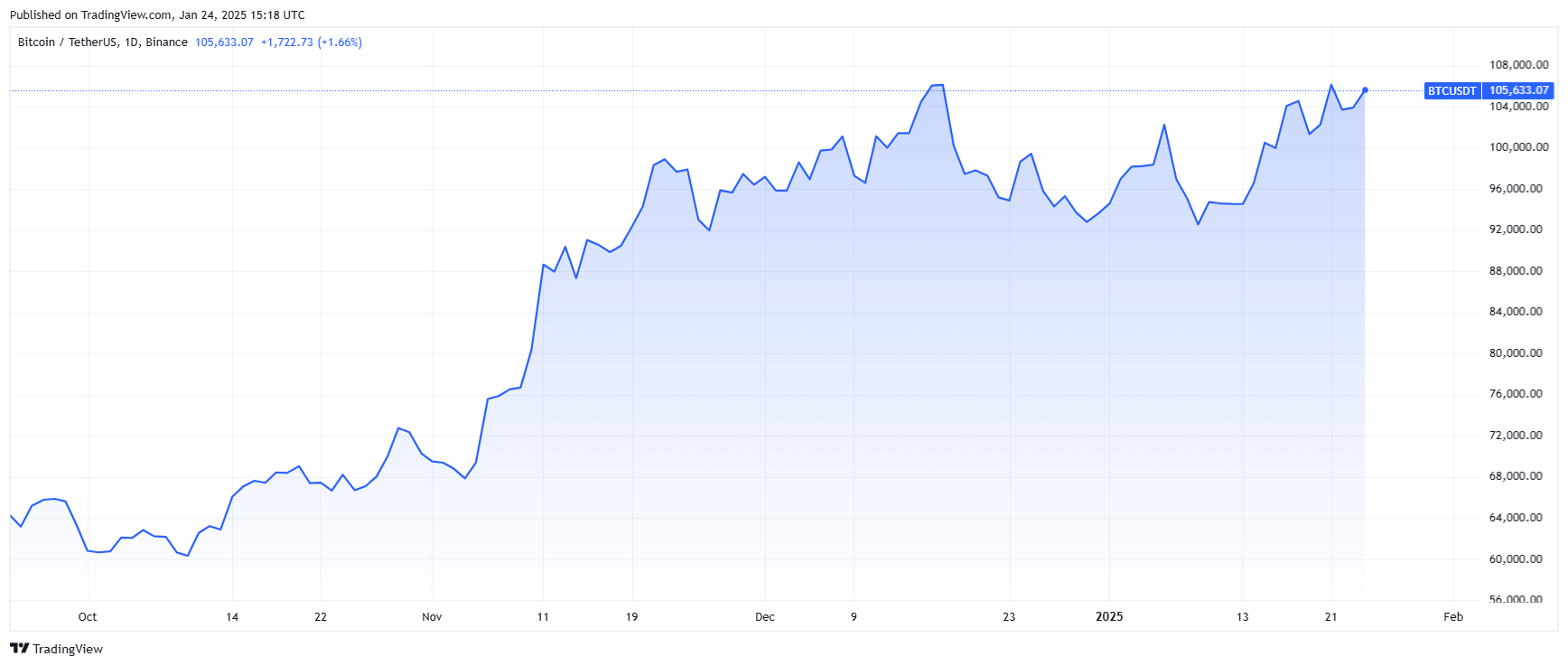
BTC Price Nears All-Time High
Why is Bitcoin going up today? Source: Tradingview.com
Although
BTC's price is currently stuck in a consolidation phase (established since
November), ranging between resistance near $106,000 and support around $92,000,
analysts' projections for value changes in 2025 remain fairly optimistic.
“Gold and
Bitcoin are entering a pivotal moment in the markets,” Thielen commented. “With
gold rebounding near its all-time high and Bitcoin continuing to show bullish
momentum, macroeconomic factors like easing inflation concerns,
milder-than-expected tariffs, and dovish Fed commentary are driving optimism.”
👇1-10) #Gold and Bitcoin are entering a pivotal moment in the markets. With gold rebounding near its all-time high and Bitcoin continuing to show bullish momentum, macroeconomic factors like easing inflation concerns,… pic.twitter.com/QTQ8K0Sti0
The current
market structure presents what analysts describe as a low-risk, high-reward
entry opportunity, with strategic stop-losses possible around the $98,000 mark.
Paul Howard, Wincent
"Following what many see as a lack of crypto initiatives from the
US administration in the first few days, Bitcoin price has been resilient and in line with the +/-10% move we anticipated 10-day period," Paul Howard, director at Wincent, commented for Finance Magnates.
"Bystanders can take price direction from upcoming macroeconomic data and
Lunar New Year which are expected to drive some downside risk before we
see the asset class gathering momentum into Q2. At a recent dinner hosted by GFO-X, a straw poll indicated a median BTC price target of $150K for year-end."
Several
macroeconomic factors are contributing to the positive outlook:
Easing
inflation concerns
Milder-than-expected
tariffs
Dovish
Federal Reserve commentary
These
elements, combined with recent CPI data, have strengthened the bullish case for
both Bitcoin and gold, suggesting a potentially pivotal moment in the markets.
Bitcoin's
recent performance has showcased remarkable resilience, particularly in
comparison to traditional stock markets. The cryptocurrency's strong recovery
following recent market events has reinforced confidence in its upward
trajectory.
Will Bitcoin Reach $200K?
The bullish
sentiment extends beyond the immediate price target. Market observers suggest
that if the current pattern holds, Bitcoin could potentially trade
significantly above the $122,000 level before establishing new support levels.
This projection is further supported by Keith Alan, co-founder of Material
Indicators, who identified a cup-and-handle pattern on Bitcoin's weekly chart
supporting the upward trajectory.
VanEck's head of digital assets research, Matthew Sigel
In
mid-December, VanEck
unveiled its latest Bitcoin price prediction, estimating that the
cryptocurrency could reach $180,000 by 2025. The firm’s analysis suggests
the current crypto bull market will peak in the first quarter of 2025.
Alongside Bitcoin’s projected surge, Ethereum is expected to exceed $6,000,
while other notable cryptocurrencies like Solana and Sui are forecasted to climb
to $500 and $10, respectively, highlighting the anticipated scope of the rally.
An even higher forecast was
presented over the past month by Standard Chartered, which claims that Bitcoin
will reach $200K by the end of 2025.
„The
dominance of institutional inflows to ETFs is likely to support BTC and ETH
performance; we see their prices reaching the $200,000 and $10,000 levels by
end-2025, respectively,” commented Geoffrey Kendrick from Standard Chartered.
Bitcoin Price Prediction
2025, FAQ
Bitcoin
could potentially reach $200,000 by the end of 2025, according to optimistic
market projections. Analysts from institutions like Standard Chartered suggest
institutional inflows into Bitcoin ETFs will drive the price upward. Other
estimates, such as VanEck’s, foresee a peak of $180,000 in the first quarter of
2025, with subsequent corrections and a potential recovery later in the year.
However, reaching $200,000 would require a continuation of bullish momentum,
supported by favorable macroeconomic factors, strong market demand, and
sustained investor confidence.
Can Bitcoin reach
$250,000?
Although
projections for Bitcoin reaching $250,000 remain speculative, they hinge on the
cryptocurrency maintaining significant market momentum and broader adoption.
Standard Chartered's $200,000 forecast suggests such milestones are not
entirely implausible but depend on institutional support, regulatory clarity,
and macroeconomic conditions. While Bitcoin's recent performance has shown
resilience, surpassing $250,000 would likely require a new wave of adoption and
investment beyond what analysts currently predict for 2025.
How high could Bitcoin
realistically go?
Bitcoin’s
price is influenced by market dynamics, macroeconomic conditions, and
technological adoption. Currently trading near its all-time high of $109,356,
realistic estimates for 2025 suggest a range of $122,000 to $200,000.
Predictions exceeding this range would depend on a confluence of factors,
including widespread adoption, institutional inflows, and positive regulatory
developments. While $250,000 or higher is conceivable in the long term, it
would require a paradigm shift in market dynamics.
What if you put $1,000 in
Bitcoin 5 years ago?
If you had
invested $1,000 in Bitcoin five years ago (January 2020), when Bitcoin was
trading around $8,000, your investment would have grown substantially. With
Bitcoin’s current price exceeding $105,000, your $1,000 investment would now be
worth approximately $13,125, reflecting a return of over 1,200%. This
calculation demonstrates Bitcoin's historical growth but also underscores the
volatility and risk associated with cryptocurrency investments.
A
significant price surge could be on the horizon for Bitcoin (BTC), with
analysts projecting potential gains to $122,000 by February amid strong
technical signals and market momentum.
More
optimistic forecasts suggest that in the coming months of 2025, the price of
BTC could approach $200,000, nearly doubling from its current levels.
How High Can Bitcoin Go?
BTC Price Nears All-Time High
Why is Bitcoin going up today? Source: Tradingview.com
Although
BTC's price is currently stuck in a consolidation phase (established since
November), ranging between resistance near $106,000 and support around $92,000,
analysts' projections for value changes in 2025 remain fairly optimistic.
“Gold and
Bitcoin are entering a pivotal moment in the markets,” Thielen commented. “With
gold rebounding near its all-time high and Bitcoin continuing to show bullish
momentum, macroeconomic factors like easing inflation concerns,
milder-than-expected tariffs, and dovish Fed commentary are driving optimism.”
👇1-10) #Gold and Bitcoin are entering a pivotal moment in the markets. With gold rebounding near its all-time high and Bitcoin continuing to show bullish momentum, macroeconomic factors like easing inflation concerns,… pic.twitter.com/QTQ8K0Sti0
The current
market structure presents what analysts describe as a low-risk, high-reward
entry opportunity, with strategic stop-losses possible around the $98,000 mark.
Paul Howard, Wincent
"Following what many see as a lack of crypto initiatives from the
US administration in the first few days, Bitcoin price has been resilient and in line with the +/-10% move we anticipated 10-day period," Paul Howard, director at Wincent, commented for Finance Magnates.
"Bystanders can take price direction from upcoming macroeconomic data and
Lunar New Year which are expected to drive some downside risk before we
see the asset class gathering momentum into Q2. At a recent dinner hosted by GFO-X, a straw poll indicated a median BTC price target of $150K for year-end."
Several
macroeconomic factors are contributing to the positive outlook:
Easing
inflation concerns
Milder-than-expected
tariffs
Dovish
Federal Reserve commentary
These
elements, combined with recent CPI data, have strengthened the bullish case for
both Bitcoin and gold, suggesting a potentially pivotal moment in the markets.
Bitcoin's
recent performance has showcased remarkable resilience, particularly in
comparison to traditional stock markets. The cryptocurrency's strong recovery
following recent market events has reinforced confidence in its upward
trajectory.
Will Bitcoin Reach $200K?
The bullish
sentiment extends beyond the immediate price target. Market observers suggest
that if the current pattern holds, Bitcoin could potentially trade
significantly above the $122,000 level before establishing new support levels.
This projection is further supported by Keith Alan, co-founder of Material
Indicators, who identified a cup-and-handle pattern on Bitcoin's weekly chart
supporting the upward trajectory.
VanEck's head of digital assets research, Matthew Sigel
In
mid-December, VanEck
unveiled its latest Bitcoin price prediction, estimating that the
cryptocurrency could reach $180,000 by 2025. The firm’s analysis suggests
the current crypto bull market will peak in the first quarter of 2025.
Alongside Bitcoin’s projected surge, Ethereum is expected to exceed $6,000,
while other notable cryptocurrencies like Solana and Sui are forecasted to climb
to $500 and $10, respectively, highlighting the anticipated scope of the rally.
An even higher forecast was
presented over the past month by Standard Chartered, which claims that Bitcoin
will reach $200K by the end of 2025.
„The
dominance of institutional inflows to ETFs is likely to support BTC and ETH
performance; we see their prices reaching the $200,000 and $10,000 levels by
end-2025, respectively,” commented Geoffrey Kendrick from Standard Chartered.
Bitcoin Price Prediction
2025, FAQ
Bitcoin
could potentially reach $200,000 by the end of 2025, according to optimistic
market projections. Analysts from institutions like Standard Chartered suggest
institutional inflows into Bitcoin ETFs will drive the price upward. Other
estimates, such as VanEck’s, foresee a peak of $180,000 in the first quarter of
2025, with subsequent corrections and a potential recovery later in the year.
However, reaching $200,000 would require a continuation of bullish momentum,
supported by favorable macroeconomic factors, strong market demand, and
sustained investor confidence.
Can Bitcoin reach
$250,000?
Although
projections for Bitcoin reaching $250,000 remain speculative, they hinge on the
cryptocurrency maintaining significant market momentum and broader adoption.
Standard Chartered's $200,000 forecast suggests such milestones are not
entirely implausible but depend on institutional support, regulatory clarity,
and macroeconomic conditions. While Bitcoin's recent performance has shown
resilience, surpassing $250,000 would likely require a new wave of adoption and
investment beyond what analysts currently predict for 2025.
How high could Bitcoin
realistically go?
Bitcoin’s
price is influenced by market dynamics, macroeconomic conditions, and
technological adoption. Currently trading near its all-time high of $109,356,
realistic estimates for 2025 suggest a range of $122,000 to $200,000.
Predictions exceeding this range would depend on a confluence of factors,
including widespread adoption, institutional inflows, and positive regulatory
developments. While $250,000 or higher is conceivable in the long term, it
would require a paradigm shift in market dynamics.
What if you put $1,000 in
Bitcoin 5 years ago?
If you had
invested $1,000 in Bitcoin five years ago (January 2020), when Bitcoin was
trading around $8,000, your investment would have grown substantially. With
Bitcoin’s current price exceeding $105,000, your $1,000 investment would now be
worth approximately $13,125, reflecting a return of over 1,200%. This
calculation demonstrates Bitcoin's historical growth but also underscores the
volatility and risk associated with cryptocurrency investments.
Damian Chmiel is a Senior Analyst & Editor at Finance Magnates with more than 15 years of experience in the CFD and online trading industry. Active as both a trader and journalist since 2010, he focuses on broker coverage, fintech innovation, and regulatory developments across Europe, the Middle East, and Asia.
His work includes interviews with C-level leaders at major brokerages and fintech platforms, as well as co-authoring Finance Magnates’ quarterly industry benchmarking reports. Damian’s reporting is data-driven, market-aware, and grounded in direct industry engagement. His analysis and commentary have also been cited by external media outlets, including Investing.com, Binance, The Asset, Stockhead, and Dispatch.
Education:
MA in Finance and Accounting, Cracow University of Economics
Kraken Steps Up Speed Race with New Equinix Colocation Service for Crypto Traders
Featured Videos
FP Markets Winner Spotlight 🏆 | Global Broker of the Year 2025 #Trading #Broker #Innovation #Shorts
FP Markets Winner Spotlight 🏆 | Global Broker of the Year 2025 #Trading #Broker #Innovation #Shorts
FP Markets Winner Spotlight 🏆 | Global Broker of the Year 2025 #Trading #Broker #Innovation #Shorts
FP Markets Winner Spotlight 🏆 | Global Broker of the Year 2025 #Trading #Broker #Innovation #Shorts
FP Markets takes the spotlight as Global Broker of the Year 2025 at the Finance Magnates Awards.
Martin Stoilov, Head of Client Experience, shares that trust, innovation, and people played a key role in the company’s success, supported by a strong foundation of integrity and client-centricity.
Following this milestone, FP Markets continues to focus on growth, technology investment, and its core values of transparency and excellence.
👉 Be part of FM Awards 2026: https://awards.financemagnates.com/#nominate
FP Markets takes the spotlight as Global Broker of the Year 2025 at the Finance Magnates Awards.
Martin Stoilov, Head of Client Experience, shares that trust, innovation, and people played a key role in the company’s success, supported by a strong foundation of integrity and client-centricity.
Following this milestone, FP Markets continues to focus on growth, technology investment, and its core values of transparency and excellence.
👉 Be part of FM Awards 2026: https://awards.financemagnates.com/#nominate
FP Markets takes the spotlight as Global Broker of the Year 2025 at the Finance Magnates Awards.
Martin Stoilov, Head of Client Experience, shares that trust, innovation, and people played a key role in the company’s success, supported by a strong foundation of integrity and client-centricity.
Following this milestone, FP Markets continues to focus on growth, technology investment, and its core values of transparency and excellence.
👉 Be part of FM Awards 2026: https://awards.financemagnates.com/#nominate
FP Markets takes the spotlight as Global Broker of the Year 2025 at the Finance Magnates Awards.
Martin Stoilov, Head of Client Experience, shares that trust, innovation, and people played a key role in the company’s success, supported by a strong foundation of integrity and client-centricity.
Following this milestone, FP Markets continues to focus on growth, technology investment, and its core values of transparency and excellence.
👉 Be part of FM Awards 2026: https://awards.financemagnates.com/#nominate
In this video, we review @HolaPrimeMarketsOfficial, a multi-asset forex and CFDs broker offering different account types, trading platforms, and flexible trading conditions.
We cover the broker’s overall offering, including account options, trading environment, platforms like MT4 and MT5, and additional services such as managed accounts and fast withdrawals.
Watch the full video to see if Hola Prime Markets fits your trading needs.
📣 Stay up to date with the latest in finance and trading. Follow Finance Magnates for industry news, insights, and global event coverage.
Connect with us:
🔗 LinkedIn: /financemagnates
👍 Facebook: /financemagnates
📸 Instagram: https://www.instagram.com/financemagnates
🐦 X: https://x.com/financemagnates
🎥 TikTok: https://www.tiktok.com/tag/financemagnates
▶️ YouTube: /@financemagnates_official
#HolaPrime #ForexBroker #CFDTrading #FinanceMagnates #Trading #Forex #BrokerReview
In this video, we review @HolaPrimeMarketsOfficial, a multi-asset forex and CFDs broker offering different account types, trading platforms, and flexible trading conditions.
We cover the broker’s overall offering, including account options, trading environment, platforms like MT4 and MT5, and additional services such as managed accounts and fast withdrawals.
Watch the full video to see if Hola Prime Markets fits your trading needs.
📣 Stay up to date with the latest in finance and trading. Follow Finance Magnates for industry news, insights, and global event coverage.
Connect with us:
🔗 LinkedIn: /financemagnates
👍 Facebook: /financemagnates
📸 Instagram: https://www.instagram.com/financemagnates
🐦 X: https://x.com/financemagnates
🎥 TikTok: https://www.tiktok.com/tag/financemagnates
▶️ YouTube: /@financemagnates_official
#HolaPrime #ForexBroker #CFDTrading #FinanceMagnates #Trading #Forex #BrokerReview
In this video, we review @HolaPrimeMarketsOfficial, a multi-asset forex and CFDs broker offering different account types, trading platforms, and flexible trading conditions.
We cover the broker’s overall offering, including account options, trading environment, platforms like MT4 and MT5, and additional services such as managed accounts and fast withdrawals.
Watch the full video to see if Hola Prime Markets fits your trading needs.
📣 Stay up to date with the latest in finance and trading. Follow Finance Magnates for industry news, insights, and global event coverage.
Connect with us:
🔗 LinkedIn: /financemagnates
👍 Facebook: /financemagnates
📸 Instagram: https://www.instagram.com/financemagnates
🐦 X: https://x.com/financemagnates
🎥 TikTok: https://www.tiktok.com/tag/financemagnates
▶️ YouTube: /@financemagnates_official
#HolaPrime #ForexBroker #CFDTrading #FinanceMagnates #Trading #Forex #BrokerReview
In this video, we review @HolaPrimeMarketsOfficial, a multi-asset forex and CFDs broker offering different account types, trading platforms, and flexible trading conditions.
We cover the broker’s overall offering, including account options, trading environment, platforms like MT4 and MT5, and additional services such as managed accounts and fast withdrawals.
Watch the full video to see if Hola Prime Markets fits your trading needs.
📣 Stay up to date with the latest in finance and trading. Follow Finance Magnates for industry news, insights, and global event coverage.
Connect with us:
🔗 LinkedIn: /financemagnates
👍 Facebook: /financemagnates
📸 Instagram: https://www.instagram.com/financemagnates
🐦 X: https://x.com/financemagnates
🎥 TikTok: https://www.tiktok.com/tag/financemagnates
▶️ YouTube: /@financemagnates_official
#HolaPrime #ForexBroker #CFDTrading #FinanceMagnates #Trading #Forex #BrokerReview
In this video, we review @HolaPrimeMarketsOfficial, a multi-asset forex and CFDs broker offering different account types, trading platforms, and flexible trading conditions.
We cover the broker’s overall offering, including account options, trading environment, platforms like MT4 and MT5, and additional services such as managed accounts and fast withdrawals.
Watch the full video to see if Hola Prime Markets fits your trading needs.
📣 Stay up to date with the latest in finance and trading. Follow Finance Magnates for industry news, insights, and global event coverage.
Connect with us:
🔗 LinkedIn: /financemagnates
👍 Facebook: /financemagnates
📸 Instagram: https://www.instagram.com/financemagnates
🐦 X: https://x.com/financemagnates
🎥 TikTok: https://www.tiktok.com/tag/financemagnates
▶️ YouTube: /@financemagnates_official
#HolaPrime #ForexBroker #CFDTrading #FinanceMagnates #Trading #Forex #BrokerReview
In this video, we review @HolaPrimeMarketsOfficial, a multi-asset forex and CFDs broker offering different account types, trading platforms, and flexible trading conditions.
We cover the broker’s overall offering, including account options, trading environment, platforms like MT4 and MT5, and additional services such as managed accounts and fast withdrawals.
Watch the full video to see if Hola Prime Markets fits your trading needs.
📣 Stay up to date with the latest in finance and trading. Follow Finance Magnates for industry news, insights, and global event coverage.
Connect with us:
🔗 LinkedIn: /financemagnates
👍 Facebook: /financemagnates
📸 Instagram: https://www.instagram.com/financemagnates
🐦 X: https://x.com/financemagnates
🎥 TikTok: https://www.tiktok.com/tag/financemagnates
▶️ YouTube: /@financemagnates_official
#HolaPrime #ForexBroker #CFDTrading #FinanceMagnates #Trading #Forex #BrokerReview
Hola Prime Review: What You Need to Know | Full Breakdown by Finance Magnates
Hola Prime Review: What You Need to Know | Full Breakdown by Finance Magnates
Hola Prime Review: What You Need to Know | Full Breakdown by Finance Magnates
Hola Prime Review: What You Need to Know | Full Breakdown by Finance Magnates
Hola Prime Review: What You Need to Know | Full Breakdown by Finance Magnates
Hola Prime Review: What You Need to Know | Full Breakdown by Finance Magnates
In this video, we review @HolaPrime_Global, a proprietary trading firm offering evaluation programs and performance-based payouts in simulated market environments.
We cover how the challenge model works, including account types, profit splits (up to 95%), trading rules, and what it takes to reach a funded account. You’ll also learn about available platforms like MT4, MT5, cTrader, and more, along with insights into payouts, support, and trading conditions.
Watch the full video to see if Hola Prime fits your trading style.
📣 Stay up to date with the latest in finance and trading. Follow Finance Magnates for industry news, insights, and global event coverage.
Connect with us:
🔗 LinkedIn: /financemagnates
👍 Facebook: /financemagnates
📸 Instagram: https://www.instagram.com/financemagnates
🐦 X: https://x.com/financemagnates
🎥 TikTok: https://www.tiktok.com/tag/financemagnates
▶️ YouTube: /@financemagnates_official
#HolaPrime #PropFirm #Trading #FinanceMagnates #Forex #FuturesTrading #TradingReview #PropFirmReview
In this video, we review @HolaPrime_Global, a proprietary trading firm offering evaluation programs and performance-based payouts in simulated market environments.
We cover how the challenge model works, including account types, profit splits (up to 95%), trading rules, and what it takes to reach a funded account. You’ll also learn about available platforms like MT4, MT5, cTrader, and more, along with insights into payouts, support, and trading conditions.
Watch the full video to see if Hola Prime fits your trading style.
📣 Stay up to date with the latest in finance and trading. Follow Finance Magnates for industry news, insights, and global event coverage.
Connect with us:
🔗 LinkedIn: /financemagnates
👍 Facebook: /financemagnates
📸 Instagram: https://www.instagram.com/financemagnates
🐦 X: https://x.com/financemagnates
🎥 TikTok: https://www.tiktok.com/tag/financemagnates
▶️ YouTube: /@financemagnates_official
#HolaPrime #PropFirm #Trading #FinanceMagnates #Forex #FuturesTrading #TradingReview #PropFirmReview
In this video, we review @HolaPrime_Global, a proprietary trading firm offering evaluation programs and performance-based payouts in simulated market environments.
We cover how the challenge model works, including account types, profit splits (up to 95%), trading rules, and what it takes to reach a funded account. You’ll also learn about available platforms like MT4, MT5, cTrader, and more, along with insights into payouts, support, and trading conditions.
Watch the full video to see if Hola Prime fits your trading style.
📣 Stay up to date with the latest in finance and trading. Follow Finance Magnates for industry news, insights, and global event coverage.
Connect with us:
🔗 LinkedIn: /financemagnates
👍 Facebook: /financemagnates
📸 Instagram: https://www.instagram.com/financemagnates
🐦 X: https://x.com/financemagnates
🎥 TikTok: https://www.tiktok.com/tag/financemagnates
▶️ YouTube: /@financemagnates_official
#HolaPrime #PropFirm #Trading #FinanceMagnates #Forex #FuturesTrading #TradingReview #PropFirmReview
In this video, we review @HolaPrime_Global, a proprietary trading firm offering evaluation programs and performance-based payouts in simulated market environments.
We cover how the challenge model works, including account types, profit splits (up to 95%), trading rules, and what it takes to reach a funded account. You’ll also learn about available platforms like MT4, MT5, cTrader, and more, along with insights into payouts, support, and trading conditions.
Watch the full video to see if Hola Prime fits your trading style.
📣 Stay up to date with the latest in finance and trading. Follow Finance Magnates for industry news, insights, and global event coverage.
Connect with us:
🔗 LinkedIn: /financemagnates
👍 Facebook: /financemagnates
📸 Instagram: https://www.instagram.com/financemagnates
🐦 X: https://x.com/financemagnates
🎥 TikTok: https://www.tiktok.com/tag/financemagnates
▶️ YouTube: /@financemagnates_official
#HolaPrime #PropFirm #Trading #FinanceMagnates #Forex #FuturesTrading #TradingReview #PropFirmReview
In this video, we review @HolaPrime_Global, a proprietary trading firm offering evaluation programs and performance-based payouts in simulated market environments.
We cover how the challenge model works, including account types, profit splits (up to 95%), trading rules, and what it takes to reach a funded account. You’ll also learn about available platforms like MT4, MT5, cTrader, and more, along with insights into payouts, support, and trading conditions.
Watch the full video to see if Hola Prime fits your trading style.
📣 Stay up to date with the latest in finance and trading. Follow Finance Magnates for industry news, insights, and global event coverage.
Connect with us:
🔗 LinkedIn: /financemagnates
👍 Facebook: /financemagnates
📸 Instagram: https://www.instagram.com/financemagnates
🐦 X: https://x.com/financemagnates
🎥 TikTok: https://www.tiktok.com/tag/financemagnates
▶️ YouTube: /@financemagnates_official
#HolaPrime #PropFirm #Trading #FinanceMagnates #Forex #FuturesTrading #TradingReview #PropFirmReview
In this video, we review @HolaPrime_Global, a proprietary trading firm offering evaluation programs and performance-based payouts in simulated market environments.
We cover how the challenge model works, including account types, profit splits (up to 95%), trading rules, and what it takes to reach a funded account. You’ll also learn about available platforms like MT4, MT5, cTrader, and more, along with insights into payouts, support, and trading conditions.
Watch the full video to see if Hola Prime fits your trading style.
📣 Stay up to date with the latest in finance and trading. Follow Finance Magnates for industry news, insights, and global event coverage.
Connect with us:
🔗 LinkedIn: /financemagnates
👍 Facebook: /financemagnates
📸 Instagram: https://www.instagram.com/financemagnates
🐦 X: https://x.com/financemagnates
🎥 TikTok: https://www.tiktok.com/tag/financemagnates
▶️ YouTube: /@financemagnates_official
#HolaPrime #PropFirm #Trading #FinanceMagnates #Forex #FuturesTrading #TradingReview #PropFirmReview
Axi Winner Spotlight 🏆 | Global Most Innovative Broker 2025 #Innovation #Trading #Fintech #Broker
Axi Winner Spotlight 🏆 | Global Most Innovative Broker 2025 #Innovation #Trading #Fintech #Broker
Axi Winner Spotlight 🏆 | Global Most Innovative Broker 2025 #Innovation #Trading #Fintech #Broker
Axi Winner Spotlight 🏆 | Global Most Innovative Broker 2025 #Innovation #Trading #Fintech #Broker
Axi Winner Spotlight 🏆 | Global Most Innovative Broker 2025 #Innovation #Trading #Fintech #Broker
Axi Winner Spotlight 🏆 | Global Most Innovative Broker 2025 #Innovation #Trading #Fintech #Broker
Axi takes the spotlight at the Finance Magnates Awards, winning Global Most Innovative Broker 2025.
Olivia Xenofontos and Ivanna Openko share how the team will feel: proud, motivated, and ready to keep delivering.
They also describe the night as well-organized, focused, and enjoyable for all.
👉 Be part of FM Awards 2026.
Axi takes the spotlight at the Finance Magnates Awards, winning Global Most Innovative Broker 2025.
Olivia Xenofontos and Ivanna Openko share how the team will feel: proud, motivated, and ready to keep delivering.
They also describe the night as well-organized, focused, and enjoyable for all.
👉 Be part of FM Awards 2026.
Axi takes the spotlight at the Finance Magnates Awards, winning Global Most Innovative Broker 2025.
Olivia Xenofontos and Ivanna Openko share how the team will feel: proud, motivated, and ready to keep delivering.
They also describe the night as well-organized, focused, and enjoyable for all.
👉 Be part of FM Awards 2026.
Axi takes the spotlight at the Finance Magnates Awards, winning Global Most Innovative Broker 2025.
Olivia Xenofontos and Ivanna Openko share how the team will feel: proud, motivated, and ready to keep delivering.
They also describe the night as well-organized, focused, and enjoyable for all.
👉 Be part of FM Awards 2026.
Axi takes the spotlight at the Finance Magnates Awards, winning Global Most Innovative Broker 2025.
Olivia Xenofontos and Ivanna Openko share how the team will feel: proud, motivated, and ready to keep delivering.
They also describe the night as well-organized, focused, and enjoyable for all.
👉 Be part of FM Awards 2026.
Axi takes the spotlight at the Finance Magnates Awards, winning Global Most Innovative Broker 2025.
Olivia Xenofontos and Ivanna Openko share how the team will feel: proud, motivated, and ready to keep delivering.
They also describe the night as well-organized, focused, and enjoyable for all.
👉 Be part of FM Awards 2026.
Recognition that matters.
Built on transparency.
Driven by the industry.
The Finance Magnates Awards 2026.
Nominations are now open.
🔗 https://awards.financemagnates.com/?utm_source=SM&utm_medium=social&utm_campaign=recognition-matters
Recognition that matters.
Built on transparency.
Driven by the industry.
The Finance Magnates Awards 2026.
Nominations are now open.
🔗 https://awards.financemagnates.com/?utm_source=SM&utm_medium=social&utm_campaign=recognition-matters
Recognition that matters.
Built on transparency.
Driven by the industry.
The Finance Magnates Awards 2026.
Nominations are now open.
🔗 https://awards.financemagnates.com/?utm_source=SM&utm_medium=social&utm_campaign=recognition-matters
Recognition that matters.
Built on transparency.
Driven by the industry.
The Finance Magnates Awards 2026.
Nominations are now open.
🔗 https://awards.financemagnates.com/?utm_source=SM&utm_medium=social&utm_campaign=recognition-matters
Recognition that matters.
Built on transparency.
Driven by the industry.
The Finance Magnates Awards 2026.
Nominations are now open.
🔗 https://awards.financemagnates.com/?utm_source=SM&utm_medium=social&utm_campaign=recognition-matters
Recognition that matters.
Built on transparency.
Driven by the industry.
The Finance Magnates Awards 2026.
Nominations are now open.
🔗 https://awards.financemagnates.com/?utm_source=SM&utm_medium=social&utm_campaign=recognition-matters