Bitcoin goes north after Donald Trump endorses a U.S. Crypto Reserve, sparking a rally in BTC, ETH, XRP, and SOL.
On-chain data shows whale accumulation as Bitcoin price regains key support above $80-82K.
Trump's personal crypto portfolio tumbles amid general upturn (designed by Grok).
Bitcoin’s (BTC) price is surging today, leaving many investors asking what’s driving the sudden
climb. Over the past 24 hours, Bitcoin (BTC) has jumped by double digits,
breaching the mid-$90,000s after a period of weakness. Several key factors are
behind this rally, including a high-profile endorsement from the U.S. President
Donald Trump.
And, obviously, BTC and ETH, as other valuable Cryptocurrencies, will be the heart of the Reserve. I also love Bitcoin and Ethereum! https://t.co/wA6110D3aJ
Bitcoin,
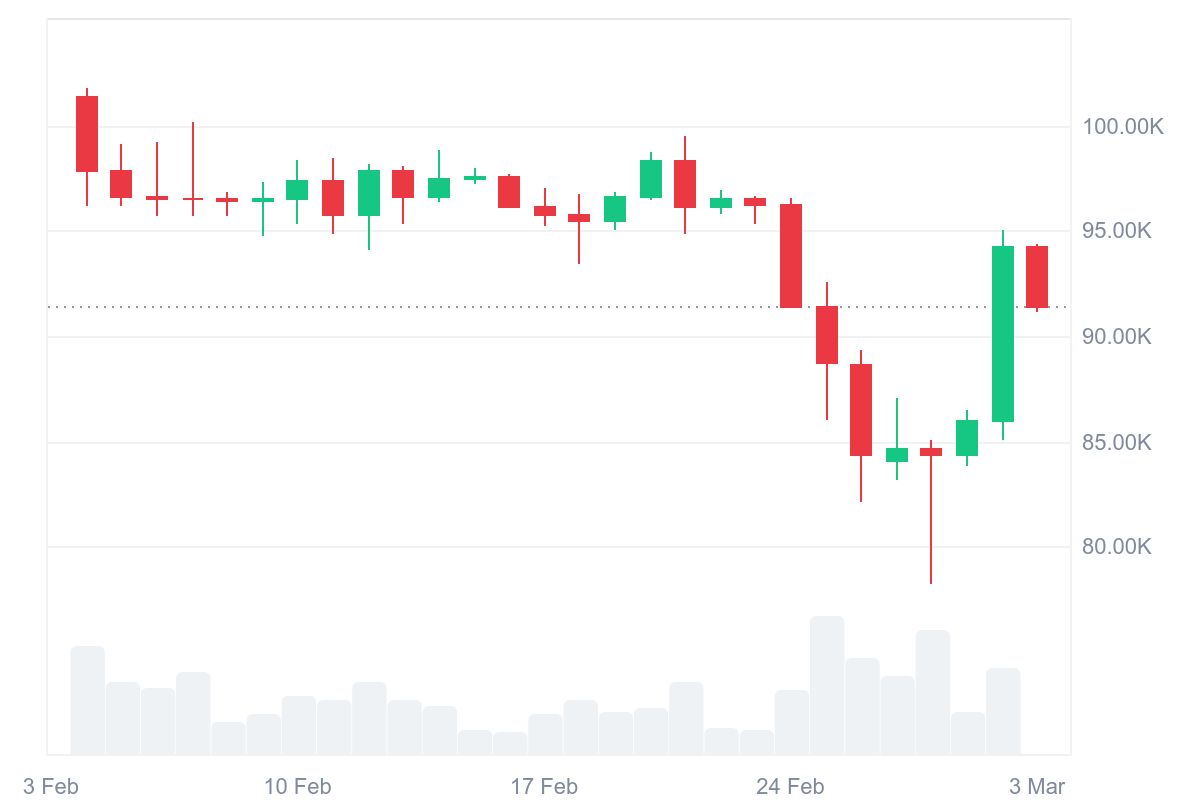
the world’s largest cryptocurrency, jumped about 10% on the news, briefly
trading around $93,000–$95,000.
Bitcoin price surged the most since November. Source: CoinMarketCap
The positive developments that lifted Bitcoin’s price have also caused a ripple
effect across the cryptocurrency market, with many altcoins (alternative
cryptocurrencies) logging impressive gains.
Here’s a look at how BTC’s movement compares with a few major altcoins and
what drove their prices: Ethereum leapt about 13% to roughly $2,516. In total,
over $300 billion in value was added to the crypto market’s market
capitalization within hours of Trump’s message, according to CoinGecko data
Altcoin Performance vs.
Bitcoin (past 24 hours):
Asset
24h Price Change
24h Volume Change
Bitcoin
(BTC)
+12% (to $95,000)
+140%
Ethereum
(ETH)
+17% (to $2,548)
+130%
XRP (XRP)
+33% (to $2.97)
+500%
Solana (SOL)
+27% (to $178.6)
+350%
Cardano
(ADA)
+75% (to $1.13)
+1450%
Why Is Bitcoin Rising Today?
BTC/USDT Technical Analysis
As
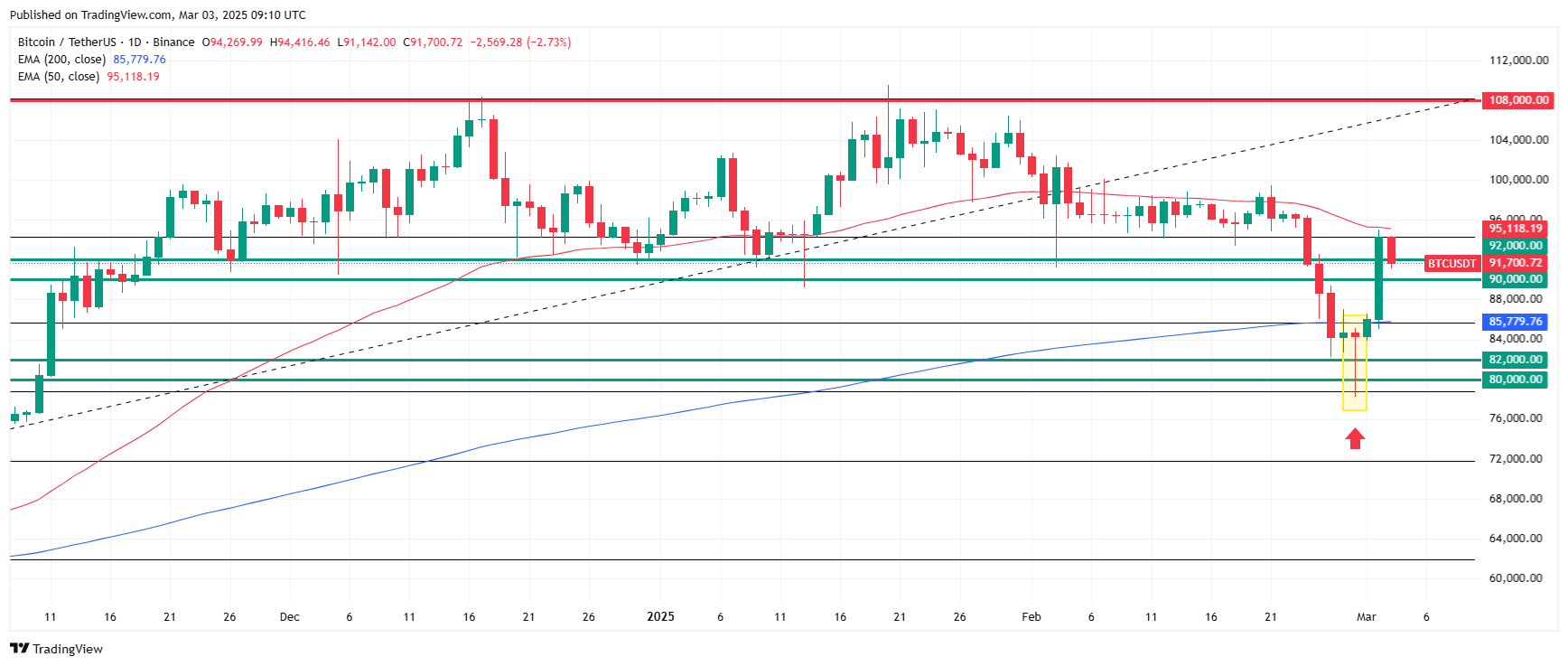
suggested in my last Bitcoin technical analysis, the fate of BTC's price
depended on movements around $80,000 and the 200 EMA. Although BTC temporarily
dipped below this crucial average separating bull and bear markets, key support
provided bulls with the necessary platform for a rebound, simultaneously
drawing a textbook single-candle reversal formation.
We're
talking about a bullish pin bar (or hammer) with an extremely long lower wick,
which was a clear signal from buyers: we intend to defend this level and buy
Bitcoins in its vicinity.
This
provided a platform for a stronger rebound, and Donald Trump added fuel to the
fire, allowing Bitcoin's price to return to the consolidation range drawn since
November, between $90-92,000 (support) and $108,000 (resistance).
Why is Bitcoin going up? Technical analysis. Source: Tradingview.com
If
Bitcoin's price holds above this level, testing new all-time highs (ATH) is, in
my opinion, only a matter of time.
Bicoin Price Support and
Resistance Levels
Support
Resistance
$90-92K -
lower limit of November consolidation
$95K - 50 EMA
$86K - 200 EMA
$100K - psychological level
$80-82K -
psychological support from late February
$108K -
ATH tested in December and January
Bitcoin Macro Factors: Inflation,
Interest Rates, and Economic Trends
Beyond the
buzz of Trump’s crypto endorsement, macroeconomic factors have been providing a
supportive backdrop for Bitcoin’s rise. Over the past few weeks, investors have
been parsing economic data and central bank signals that affect all risk
assets, including cryptocurrencies. Several trends stand out:
Recession
Fears and Rate Cut Bets: Recent U.S. economic data has been surprisingly soft, raising concerns
about a potential economic slowdown
Inflation
and Currency Dynamics:
Inflation has been a double-edged sword for Bitcoin. On one hand, high
inflation increases Bitcoin’s appeal as “digital gold” – a hard asset with a
capped supply. On the other hand, if inflation rises too fast, it forces
central banks to tighten policy (which can hurt risk assets).
Investor
Risk Appetite:
Global market sentiment has improved in early March. Stock markets, which
suffered losses in February, staged a late rebound as investors grew hopeful
that central banks would ease off tightening. In the U.S., the S&P 500 and
Nasdaq ended last week on a rally.
Today’s
Bitcoin price rise isn’t happening in a vacuum. It’s partially riding the wave
of macroeconomic trends. Cooling inflation, the potential for lower interest
rates, and a risk-friendly market environment have all made it easier for
Bitcoin to attract buyers.
Bitcoin trading volume increased
by over 140% in 24 hours, with the total crypto market volume jumping about
150% to $190 billion daily turnover.
Whale
Accumulation
Large Bitcoin holders (whales)
have been accumulating during the price rise, with several significant
transactions observed, including withdrawals of 600 BTC ($51.5 million) and
657 BTC ($60 million) from exchanges.
Exchange
Inflows/Outflows
Net outflows dominated, with
approximately $500 million worth of Bitcoin leaving exchanges in a 24-hour
period during the price rebound, indicating bullish sentiment.
Short
Squeeze Potential
On-chain data suggests that
Bitcoin's jump was partly fueled by a short squeeze, with analysts estimating
significant short liquidations if Bitcoin pushed past $95K.
FAQ: Common Questions
About Bitcoin’s Price Surge
Did Donald Trump’s
Announcement Really Cause Bitcoin’s Price to Surge?
Yes –
Trump’s announcement was a major trigger for the rally. In a post on March 2,
2025, he revealed plans for a U.S. crypto reserve including Bitcoin and several
altcoins. This unprecedented endorsement by a former (and now again) U.S.
President immediately boosted market confidence. Bitcoin jumped about 10%
within hours of the news.
Why Is Bitcoin Going Up
Now?
President
Donald Trump's recent executive order establishing a Crypto Strategic Reserve,
which includes Bitcoin, has significantly boosted investor confidence. This
move signals formal recognition of digital assets within the U.S. financial
system. Additionally, the anticipation of interest rate cuts by major central
banks in 2025 is creating a risk-on sentiment that favors cryptocurrencies.
How Much Will $1 Bitcoin
Be Worth in 2025?
Forecasts
suggest Bitcoin could reach between $125,000 and $250,000 by 2025. If these
predictions materialize, $1 invested at current prices could appreciate by 33%
to 166%. It's important to note that these are speculative projections and
actual performance may vary considerably due to market conditions, regulatory
changes, and technological developments in the cryptocurrency space.
How Much Is Bitcoin
Selling for Today?
As of March
3, 2025, Bitcoin is trading at approximately $93,913.86. This price represents
a significant recovery from recent lows around $78,200 seen in late February.
The cryptocurrency has shown resilience, rebounding strongly after a period of
volatility. It's worth noting that Bitcoin's price is currently about 13.86%
below its all-time high of $109,026.02.
Bitcoin’s (BTC) price is surging today, leaving many investors asking what’s driving the sudden
climb. Over the past 24 hours, Bitcoin (BTC) has jumped by double digits,
breaching the mid-$90,000s after a period of weakness. Several key factors are
behind this rally, including a high-profile endorsement from the U.S. President
Donald Trump.
And, obviously, BTC and ETH, as other valuable Cryptocurrencies, will be the heart of the Reserve. I also love Bitcoin and Ethereum! https://t.co/wA6110D3aJ
Bitcoin,
the world’s largest cryptocurrency, jumped about 10% on the news, briefly
trading around $93,000–$95,000.
Bitcoin price surged the most since November. Source: CoinMarketCap
The positive developments that lifted Bitcoin’s price have also caused a ripple
effect across the cryptocurrency market, with many altcoins (alternative
cryptocurrencies) logging impressive gains.
Here’s a look at how BTC’s movement compares with a few major altcoins and
what drove their prices: Ethereum leapt about 13% to roughly $2,516. In total,
over $300 billion in value was added to the crypto market’s market
capitalization within hours of Trump’s message, according to CoinGecko data
Altcoin Performance vs.
Bitcoin (past 24 hours):
Asset
24h Price Change
24h Volume Change
Bitcoin
(BTC)
+12% (to $95,000)
+140%
Ethereum
(ETH)
+17% (to $2,548)
+130%
XRP (XRP)
+33% (to $2.97)
+500%
Solana (SOL)
+27% (to $178.6)
+350%
Cardano
(ADA)
+75% (to $1.13)
+1450%
Why Is Bitcoin Rising Today?
BTC/USDT Technical Analysis
As
suggested in my last Bitcoin technical analysis, the fate of BTC's price
depended on movements around $80,000 and the 200 EMA. Although BTC temporarily
dipped below this crucial average separating bull and bear markets, key support
provided bulls with the necessary platform for a rebound, simultaneously
drawing a textbook single-candle reversal formation.
We're
talking about a bullish pin bar (or hammer) with an extremely long lower wick,
which was a clear signal from buyers: we intend to defend this level and buy
Bitcoins in its vicinity.
This
provided a platform for a stronger rebound, and Donald Trump added fuel to the
fire, allowing Bitcoin's price to return to the consolidation range drawn since
November, between $90-92,000 (support) and $108,000 (resistance).
Why is Bitcoin going up? Technical analysis. Source: Tradingview.com
If
Bitcoin's price holds above this level, testing new all-time highs (ATH) is, in
my opinion, only a matter of time.
Bicoin Price Support and
Resistance Levels
Support
Resistance
$90-92K -
lower limit of November consolidation
$95K - 50 EMA
$86K - 200 EMA
$100K - psychological level
$80-82K -
psychological support from late February
$108K -
ATH tested in December and January
Bitcoin Macro Factors: Inflation,
Interest Rates, and Economic Trends
Beyond the
buzz of Trump’s crypto endorsement, macroeconomic factors have been providing a
supportive backdrop for Bitcoin’s rise. Over the past few weeks, investors have
been parsing economic data and central bank signals that affect all risk
assets, including cryptocurrencies. Several trends stand out:
Recession
Fears and Rate Cut Bets: Recent U.S. economic data has been surprisingly soft, raising concerns
about a potential economic slowdown
Inflation
and Currency Dynamics:
Inflation has been a double-edged sword for Bitcoin. On one hand, high
inflation increases Bitcoin’s appeal as “digital gold” – a hard asset with a
capped supply. On the other hand, if inflation rises too fast, it forces
central banks to tighten policy (which can hurt risk assets).
Investor
Risk Appetite:
Global market sentiment has improved in early March. Stock markets, which
suffered losses in February, staged a late rebound as investors grew hopeful
that central banks would ease off tightening. In the U.S., the S&P 500 and
Nasdaq ended last week on a rally.
Today’s
Bitcoin price rise isn’t happening in a vacuum. It’s partially riding the wave
of macroeconomic trends. Cooling inflation, the potential for lower interest
rates, and a risk-friendly market environment have all made it easier for
Bitcoin to attract buyers.
Bitcoin trading volume increased
by over 140% in 24 hours, with the total crypto market volume jumping about
150% to $190 billion daily turnover.
Whale
Accumulation
Large Bitcoin holders (whales)
have been accumulating during the price rise, with several significant
transactions observed, including withdrawals of 600 BTC ($51.5 million) and
657 BTC ($60 million) from exchanges.
Exchange
Inflows/Outflows
Net outflows dominated, with
approximately $500 million worth of Bitcoin leaving exchanges in a 24-hour
period during the price rebound, indicating bullish sentiment.
Short
Squeeze Potential
On-chain data suggests that
Bitcoin's jump was partly fueled by a short squeeze, with analysts estimating
significant short liquidations if Bitcoin pushed past $95K.
FAQ: Common Questions
About Bitcoin’s Price Surge
Did Donald Trump’s
Announcement Really Cause Bitcoin’s Price to Surge?
Yes –
Trump’s announcement was a major trigger for the rally. In a post on March 2,
2025, he revealed plans for a U.S. crypto reserve including Bitcoin and several
altcoins. This unprecedented endorsement by a former (and now again) U.S.
President immediately boosted market confidence. Bitcoin jumped about 10%
within hours of the news.
Why Is Bitcoin Going Up
Now?
President
Donald Trump's recent executive order establishing a Crypto Strategic Reserve,
which includes Bitcoin, has significantly boosted investor confidence. This
move signals formal recognition of digital assets within the U.S. financial
system. Additionally, the anticipation of interest rate cuts by major central
banks in 2025 is creating a risk-on sentiment that favors cryptocurrencies.
How Much Will $1 Bitcoin
Be Worth in 2025?
Forecasts
suggest Bitcoin could reach between $125,000 and $250,000 by 2025. If these
predictions materialize, $1 invested at current prices could appreciate by 33%
to 166%. It's important to note that these are speculative projections and
actual performance may vary considerably due to market conditions, regulatory
changes, and technological developments in the cryptocurrency space.
How Much Is Bitcoin
Selling for Today?
As of March
3, 2025, Bitcoin is trading at approximately $93,913.86. This price represents
a significant recovery from recent lows around $78,200 seen in late February.
The cryptocurrency has shown resilience, rebounding strongly after a period of
volatility. It's worth noting that Bitcoin's price is currently about 13.86%
below its all-time high of $109,026.02.
Damian Chmiel is a Senior Analyst & Editor at Finance Magnates with more than 15 years of experience in the CFD and online trading industry. Active as both a trader and journalist since 2010, he focuses on broker coverage, fintech innovation, and regulatory developments across Europe, the Middle East, and Asia.
His work includes interviews with C-level leaders at major brokerages and fintech platforms, as well as co-authoring Finance Magnates’ quarterly industry benchmarking reports. Damian’s reporting is data-driven, market-aware, and grounded in direct industry engagement. His analysis and commentary have also been cited by external media outlets, including Investing.com, Binance, The Asset, Stockhead, and Dispatch.
Education:
MA in Finance and Accounting, Cracow University of Economics
Kraken Steps Up Speed Race with New Equinix Colocation Service for Crypto Traders
Featured Videos
FP Markets Winner Spotlight 🏆 | Global Broker of the Year 2025 #Trading #Broker #Innovation #Shorts
FP Markets Winner Spotlight 🏆 | Global Broker of the Year 2025 #Trading #Broker #Innovation #Shorts
FP Markets Winner Spotlight 🏆 | Global Broker of the Year 2025 #Trading #Broker #Innovation #Shorts
FP Markets Winner Spotlight 🏆 | Global Broker of the Year 2025 #Trading #Broker #Innovation #Shorts
FP Markets takes the spotlight as Global Broker of the Year 2025 at the Finance Magnates Awards.
Martin Stoilov, Head of Client Experience, shares that trust, innovation, and people played a key role in the company’s success, supported by a strong foundation of integrity and client-centricity.
Following this milestone, FP Markets continues to focus on growth, technology investment, and its core values of transparency and excellence.
👉 Be part of FM Awards 2026: https://awards.financemagnates.com/#nominate
FP Markets takes the spotlight as Global Broker of the Year 2025 at the Finance Magnates Awards.
Martin Stoilov, Head of Client Experience, shares that trust, innovation, and people played a key role in the company’s success, supported by a strong foundation of integrity and client-centricity.
Following this milestone, FP Markets continues to focus on growth, technology investment, and its core values of transparency and excellence.
👉 Be part of FM Awards 2026: https://awards.financemagnates.com/#nominate
FP Markets takes the spotlight as Global Broker of the Year 2025 at the Finance Magnates Awards.
Martin Stoilov, Head of Client Experience, shares that trust, innovation, and people played a key role in the company’s success, supported by a strong foundation of integrity and client-centricity.
Following this milestone, FP Markets continues to focus on growth, technology investment, and its core values of transparency and excellence.
👉 Be part of FM Awards 2026: https://awards.financemagnates.com/#nominate
FP Markets takes the spotlight as Global Broker of the Year 2025 at the Finance Magnates Awards.
Martin Stoilov, Head of Client Experience, shares that trust, innovation, and people played a key role in the company’s success, supported by a strong foundation of integrity and client-centricity.
Following this milestone, FP Markets continues to focus on growth, technology investment, and its core values of transparency and excellence.
👉 Be part of FM Awards 2026: https://awards.financemagnates.com/#nominate
In this video, we review @HolaPrimeMarketsOfficial, a multi-asset forex and CFDs broker offering different account types, trading platforms, and flexible trading conditions.
We cover the broker’s overall offering, including account options, trading environment, platforms like MT4 and MT5, and additional services such as managed accounts and fast withdrawals.
Watch the full video to see if Hola Prime Markets fits your trading needs.
📣 Stay up to date with the latest in finance and trading. Follow Finance Magnates for industry news, insights, and global event coverage.
Connect with us:
🔗 LinkedIn: /financemagnates
👍 Facebook: /financemagnates
📸 Instagram: https://www.instagram.com/financemagnates
🐦 X: https://x.com/financemagnates
🎥 TikTok: https://www.tiktok.com/tag/financemagnates
▶️ YouTube: /@financemagnates_official
#HolaPrime #ForexBroker #CFDTrading #FinanceMagnates #Trading #Forex #BrokerReview
In this video, we review @HolaPrimeMarketsOfficial, a multi-asset forex and CFDs broker offering different account types, trading platforms, and flexible trading conditions.
We cover the broker’s overall offering, including account options, trading environment, platforms like MT4 and MT5, and additional services such as managed accounts and fast withdrawals.
Watch the full video to see if Hola Prime Markets fits your trading needs.
📣 Stay up to date with the latest in finance and trading. Follow Finance Magnates for industry news, insights, and global event coverage.
Connect with us:
🔗 LinkedIn: /financemagnates
👍 Facebook: /financemagnates
📸 Instagram: https://www.instagram.com/financemagnates
🐦 X: https://x.com/financemagnates
🎥 TikTok: https://www.tiktok.com/tag/financemagnates
▶️ YouTube: /@financemagnates_official
#HolaPrime #ForexBroker #CFDTrading #FinanceMagnates #Trading #Forex #BrokerReview
In this video, we review @HolaPrimeMarketsOfficial, a multi-asset forex and CFDs broker offering different account types, trading platforms, and flexible trading conditions.
We cover the broker’s overall offering, including account options, trading environment, platforms like MT4 and MT5, and additional services such as managed accounts and fast withdrawals.
Watch the full video to see if Hola Prime Markets fits your trading needs.
📣 Stay up to date with the latest in finance and trading. Follow Finance Magnates for industry news, insights, and global event coverage.
Connect with us:
🔗 LinkedIn: /financemagnates
👍 Facebook: /financemagnates
📸 Instagram: https://www.instagram.com/financemagnates
🐦 X: https://x.com/financemagnates
🎥 TikTok: https://www.tiktok.com/tag/financemagnates
▶️ YouTube: /@financemagnates_official
#HolaPrime #ForexBroker #CFDTrading #FinanceMagnates #Trading #Forex #BrokerReview
In this video, we review @HolaPrimeMarketsOfficial, a multi-asset forex and CFDs broker offering different account types, trading platforms, and flexible trading conditions.
We cover the broker’s overall offering, including account options, trading environment, platforms like MT4 and MT5, and additional services such as managed accounts and fast withdrawals.
Watch the full video to see if Hola Prime Markets fits your trading needs.
📣 Stay up to date with the latest in finance and trading. Follow Finance Magnates for industry news, insights, and global event coverage.
Connect with us:
🔗 LinkedIn: /financemagnates
👍 Facebook: /financemagnates
📸 Instagram: https://www.instagram.com/financemagnates
🐦 X: https://x.com/financemagnates
🎥 TikTok: https://www.tiktok.com/tag/financemagnates
▶️ YouTube: /@financemagnates_official
#HolaPrime #ForexBroker #CFDTrading #FinanceMagnates #Trading #Forex #BrokerReview
In this video, we review @HolaPrimeMarketsOfficial, a multi-asset forex and CFDs broker offering different account types, trading platforms, and flexible trading conditions.
We cover the broker’s overall offering, including account options, trading environment, platforms like MT4 and MT5, and additional services such as managed accounts and fast withdrawals.
Watch the full video to see if Hola Prime Markets fits your trading needs.
📣 Stay up to date with the latest in finance and trading. Follow Finance Magnates for industry news, insights, and global event coverage.
Connect with us:
🔗 LinkedIn: /financemagnates
👍 Facebook: /financemagnates
📸 Instagram: https://www.instagram.com/financemagnates
🐦 X: https://x.com/financemagnates
🎥 TikTok: https://www.tiktok.com/tag/financemagnates
▶️ YouTube: /@financemagnates_official
#HolaPrime #ForexBroker #CFDTrading #FinanceMagnates #Trading #Forex #BrokerReview
In this video, we review @HolaPrimeMarketsOfficial, a multi-asset forex and CFDs broker offering different account types, trading platforms, and flexible trading conditions.
We cover the broker’s overall offering, including account options, trading environment, platforms like MT4 and MT5, and additional services such as managed accounts and fast withdrawals.
Watch the full video to see if Hola Prime Markets fits your trading needs.
📣 Stay up to date with the latest in finance and trading. Follow Finance Magnates for industry news, insights, and global event coverage.
Connect with us:
🔗 LinkedIn: /financemagnates
👍 Facebook: /financemagnates
📸 Instagram: https://www.instagram.com/financemagnates
🐦 X: https://x.com/financemagnates
🎥 TikTok: https://www.tiktok.com/tag/financemagnates
▶️ YouTube: /@financemagnates_official
#HolaPrime #ForexBroker #CFDTrading #FinanceMagnates #Trading #Forex #BrokerReview
Hola Prime Review: What You Need to Know | Full Breakdown by Finance Magnates
Hola Prime Review: What You Need to Know | Full Breakdown by Finance Magnates
Hola Prime Review: What You Need to Know | Full Breakdown by Finance Magnates
Hola Prime Review: What You Need to Know | Full Breakdown by Finance Magnates
Hola Prime Review: What You Need to Know | Full Breakdown by Finance Magnates
Hola Prime Review: What You Need to Know | Full Breakdown by Finance Magnates
In this video, we review @HolaPrime_Global, a proprietary trading firm offering evaluation programs and performance-based payouts in simulated market environments.
We cover how the challenge model works, including account types, profit splits (up to 95%), trading rules, and what it takes to reach a funded account. You’ll also learn about available platforms like MT4, MT5, cTrader, and more, along with insights into payouts, support, and trading conditions.
Watch the full video to see if Hola Prime fits your trading style.
📣 Stay up to date with the latest in finance and trading. Follow Finance Magnates for industry news, insights, and global event coverage.
Connect with us:
🔗 LinkedIn: /financemagnates
👍 Facebook: /financemagnates
📸 Instagram: https://www.instagram.com/financemagnates
🐦 X: https://x.com/financemagnates
🎥 TikTok: https://www.tiktok.com/tag/financemagnates
▶️ YouTube: /@financemagnates_official
#HolaPrime #PropFirm #Trading #FinanceMagnates #Forex #FuturesTrading #TradingReview #PropFirmReview
In this video, we review @HolaPrime_Global, a proprietary trading firm offering evaluation programs and performance-based payouts in simulated market environments.
We cover how the challenge model works, including account types, profit splits (up to 95%), trading rules, and what it takes to reach a funded account. You’ll also learn about available platforms like MT4, MT5, cTrader, and more, along with insights into payouts, support, and trading conditions.
Watch the full video to see if Hola Prime fits your trading style.
📣 Stay up to date with the latest in finance and trading. Follow Finance Magnates for industry news, insights, and global event coverage.
Connect with us:
🔗 LinkedIn: /financemagnates
👍 Facebook: /financemagnates
📸 Instagram: https://www.instagram.com/financemagnates
🐦 X: https://x.com/financemagnates
🎥 TikTok: https://www.tiktok.com/tag/financemagnates
▶️ YouTube: /@financemagnates_official
#HolaPrime #PropFirm #Trading #FinanceMagnates #Forex #FuturesTrading #TradingReview #PropFirmReview
In this video, we review @HolaPrime_Global, a proprietary trading firm offering evaluation programs and performance-based payouts in simulated market environments.
We cover how the challenge model works, including account types, profit splits (up to 95%), trading rules, and what it takes to reach a funded account. You’ll also learn about available platforms like MT4, MT5, cTrader, and more, along with insights into payouts, support, and trading conditions.
Watch the full video to see if Hola Prime fits your trading style.
📣 Stay up to date with the latest in finance and trading. Follow Finance Magnates for industry news, insights, and global event coverage.
Connect with us:
🔗 LinkedIn: /financemagnates
👍 Facebook: /financemagnates
📸 Instagram: https://www.instagram.com/financemagnates
🐦 X: https://x.com/financemagnates
🎥 TikTok: https://www.tiktok.com/tag/financemagnates
▶️ YouTube: /@financemagnates_official
#HolaPrime #PropFirm #Trading #FinanceMagnates #Forex #FuturesTrading #TradingReview #PropFirmReview
In this video, we review @HolaPrime_Global, a proprietary trading firm offering evaluation programs and performance-based payouts in simulated market environments.
We cover how the challenge model works, including account types, profit splits (up to 95%), trading rules, and what it takes to reach a funded account. You’ll also learn about available platforms like MT4, MT5, cTrader, and more, along with insights into payouts, support, and trading conditions.
Watch the full video to see if Hola Prime fits your trading style.
📣 Stay up to date with the latest in finance and trading. Follow Finance Magnates for industry news, insights, and global event coverage.
Connect with us:
🔗 LinkedIn: /financemagnates
👍 Facebook: /financemagnates
📸 Instagram: https://www.instagram.com/financemagnates
🐦 X: https://x.com/financemagnates
🎥 TikTok: https://www.tiktok.com/tag/financemagnates
▶️ YouTube: /@financemagnates_official
#HolaPrime #PropFirm #Trading #FinanceMagnates #Forex #FuturesTrading #TradingReview #PropFirmReview
In this video, we review @HolaPrime_Global, a proprietary trading firm offering evaluation programs and performance-based payouts in simulated market environments.
We cover how the challenge model works, including account types, profit splits (up to 95%), trading rules, and what it takes to reach a funded account. You’ll also learn about available platforms like MT4, MT5, cTrader, and more, along with insights into payouts, support, and trading conditions.
Watch the full video to see if Hola Prime fits your trading style.
📣 Stay up to date with the latest in finance and trading. Follow Finance Magnates for industry news, insights, and global event coverage.
Connect with us:
🔗 LinkedIn: /financemagnates
👍 Facebook: /financemagnates
📸 Instagram: https://www.instagram.com/financemagnates
🐦 X: https://x.com/financemagnates
🎥 TikTok: https://www.tiktok.com/tag/financemagnates
▶️ YouTube: /@financemagnates_official
#HolaPrime #PropFirm #Trading #FinanceMagnates #Forex #FuturesTrading #TradingReview #PropFirmReview
In this video, we review @HolaPrime_Global, a proprietary trading firm offering evaluation programs and performance-based payouts in simulated market environments.
We cover how the challenge model works, including account types, profit splits (up to 95%), trading rules, and what it takes to reach a funded account. You’ll also learn about available platforms like MT4, MT5, cTrader, and more, along with insights into payouts, support, and trading conditions.
Watch the full video to see if Hola Prime fits your trading style.
📣 Stay up to date with the latest in finance and trading. Follow Finance Magnates for industry news, insights, and global event coverage.
Connect with us:
🔗 LinkedIn: /financemagnates
👍 Facebook: /financemagnates
📸 Instagram: https://www.instagram.com/financemagnates
🐦 X: https://x.com/financemagnates
🎥 TikTok: https://www.tiktok.com/tag/financemagnates
▶️ YouTube: /@financemagnates_official
#HolaPrime #PropFirm #Trading #FinanceMagnates #Forex #FuturesTrading #TradingReview #PropFirmReview
Axi Winner Spotlight 🏆 | Global Most Innovative Broker 2025 #Innovation #Trading #Fintech #Broker
Axi Winner Spotlight 🏆 | Global Most Innovative Broker 2025 #Innovation #Trading #Fintech #Broker
Axi Winner Spotlight 🏆 | Global Most Innovative Broker 2025 #Innovation #Trading #Fintech #Broker
Axi Winner Spotlight 🏆 | Global Most Innovative Broker 2025 #Innovation #Trading #Fintech #Broker
Axi Winner Spotlight 🏆 | Global Most Innovative Broker 2025 #Innovation #Trading #Fintech #Broker
Axi Winner Spotlight 🏆 | Global Most Innovative Broker 2025 #Innovation #Trading #Fintech #Broker
Axi takes the spotlight at the Finance Magnates Awards, winning Global Most Innovative Broker 2025.
Olivia Xenofontos and Ivanna Openko share how the team will feel: proud, motivated, and ready to keep delivering.
They also describe the night as well-organized, focused, and enjoyable for all.
👉 Be part of FM Awards 2026.
Axi takes the spotlight at the Finance Magnates Awards, winning Global Most Innovative Broker 2025.
Olivia Xenofontos and Ivanna Openko share how the team will feel: proud, motivated, and ready to keep delivering.
They also describe the night as well-organized, focused, and enjoyable for all.
👉 Be part of FM Awards 2026.
Axi takes the spotlight at the Finance Magnates Awards, winning Global Most Innovative Broker 2025.
Olivia Xenofontos and Ivanna Openko share how the team will feel: proud, motivated, and ready to keep delivering.
They also describe the night as well-organized, focused, and enjoyable for all.
👉 Be part of FM Awards 2026.
Axi takes the spotlight at the Finance Magnates Awards, winning Global Most Innovative Broker 2025.
Olivia Xenofontos and Ivanna Openko share how the team will feel: proud, motivated, and ready to keep delivering.
They also describe the night as well-organized, focused, and enjoyable for all.
👉 Be part of FM Awards 2026.
Axi takes the spotlight at the Finance Magnates Awards, winning Global Most Innovative Broker 2025.
Olivia Xenofontos and Ivanna Openko share how the team will feel: proud, motivated, and ready to keep delivering.
They also describe the night as well-organized, focused, and enjoyable for all.
👉 Be part of FM Awards 2026.
Axi takes the spotlight at the Finance Magnates Awards, winning Global Most Innovative Broker 2025.
Olivia Xenofontos and Ivanna Openko share how the team will feel: proud, motivated, and ready to keep delivering.
They also describe the night as well-organized, focused, and enjoyable for all.
👉 Be part of FM Awards 2026.
Recognition that matters.
Built on transparency.
Driven by the industry.
The Finance Magnates Awards 2026.
Nominations are now open.
🔗 https://awards.financemagnates.com/?utm_source=SM&utm_medium=social&utm_campaign=recognition-matters
Recognition that matters.
Built on transparency.
Driven by the industry.
The Finance Magnates Awards 2026.
Nominations are now open.
🔗 https://awards.financemagnates.com/?utm_source=SM&utm_medium=social&utm_campaign=recognition-matters
Recognition that matters.
Built on transparency.
Driven by the industry.
The Finance Magnates Awards 2026.
Nominations are now open.
🔗 https://awards.financemagnates.com/?utm_source=SM&utm_medium=social&utm_campaign=recognition-matters
Recognition that matters.
Built on transparency.
Driven by the industry.
The Finance Magnates Awards 2026.
Nominations are now open.
🔗 https://awards.financemagnates.com/?utm_source=SM&utm_medium=social&utm_campaign=recognition-matters
Recognition that matters.
Built on transparency.
Driven by the industry.
The Finance Magnates Awards 2026.
Nominations are now open.
🔗 https://awards.financemagnates.com/?utm_source=SM&utm_medium=social&utm_campaign=recognition-matters
Recognition that matters.
Built on transparency.
Driven by the industry.
The Finance Magnates Awards 2026.
Nominations are now open.
🔗 https://awards.financemagnates.com/?utm_source=SM&utm_medium=social&utm_campaign=recognition-matters