Bitcoin drops to $91,200 amid strong US economic data. Fed rate cut hopes diminish as the dollar strengthens.
Analysts maintain a bullish outlook despite correction. Standard Chartered predicts $200K by 2025 end.
Technical analysis shows that Bitcoin bulls are still in charge and the BTC price may rebound.
Bitcoin has
experienced a significant decline this week, with the cryptocurrency dropping
from its recent high above $100,000 to around $91,200. This sharp downturn has
sent ripples through the entire crypto market, triggering substantial
liquidations and traders uncertainty.
Let’s check
why Bitcoin is going down and analyze if BTC price can rebound in the coming
days and weeks.
Why Is Bitcoin Falling?
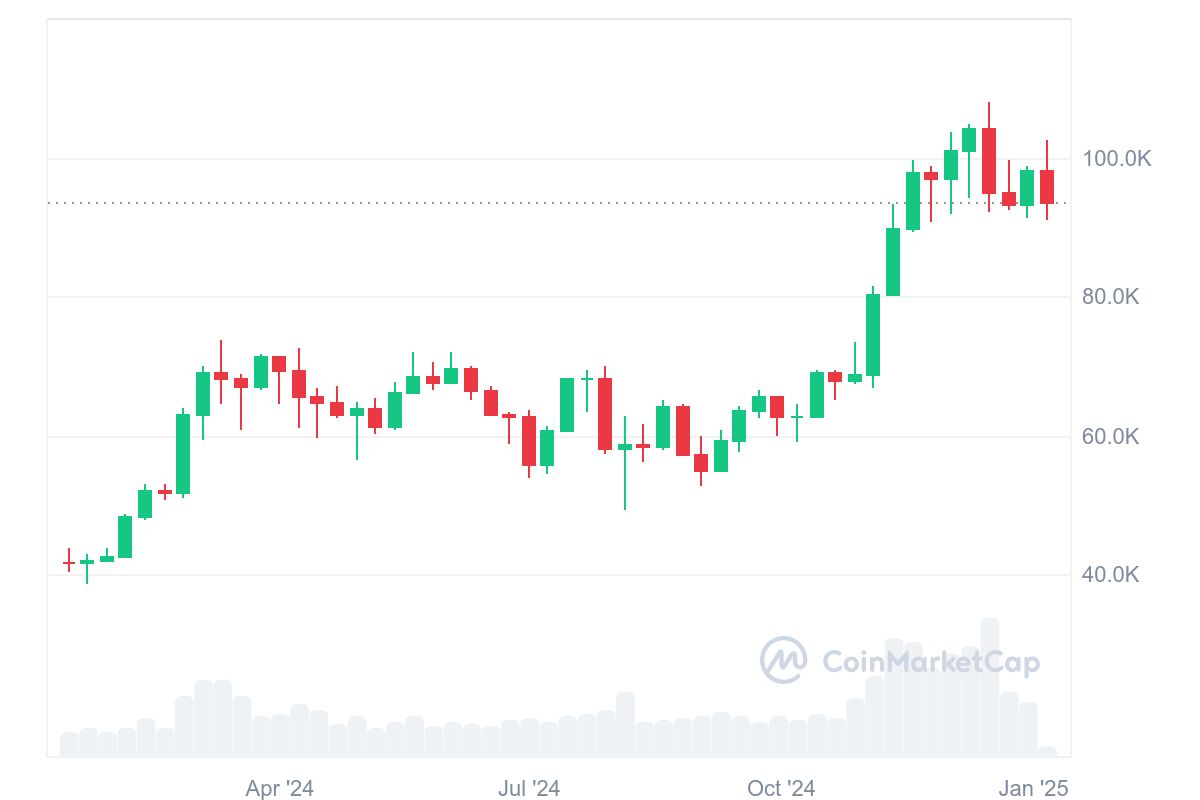
BTC Price Declined Three Days In a Row
From a
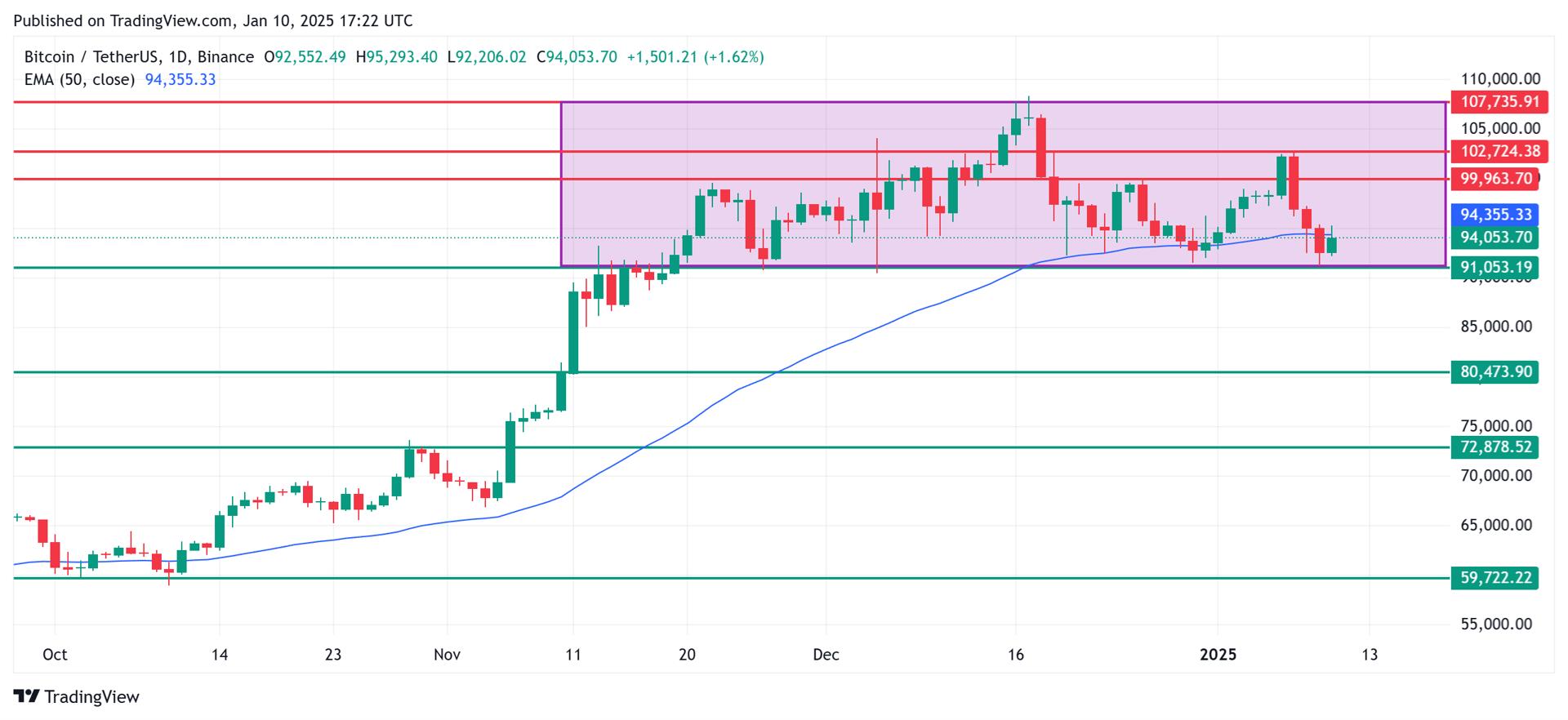
technical perspective, concerns arise as the price dropped below the 50-day
exponential moving average. However, the current levels align with the local
lows formed during the consolidation phase observed since mid-November.
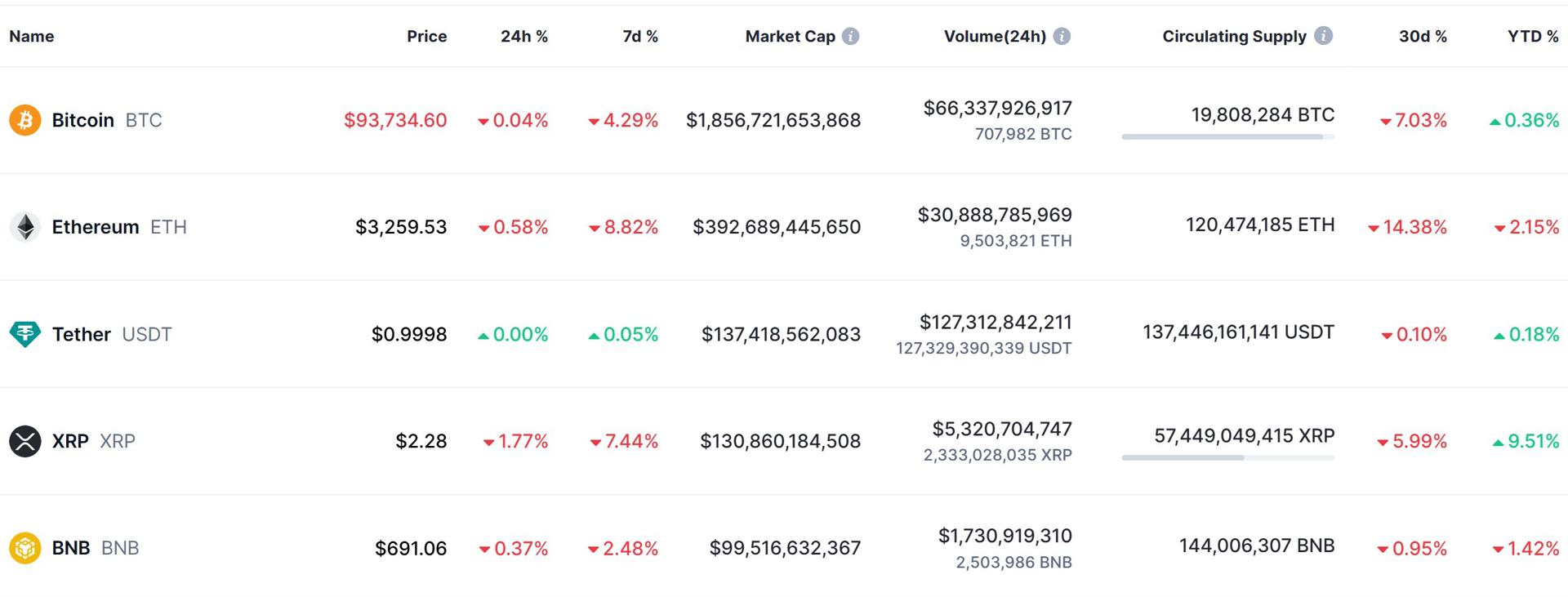
Major cryptocurrencies were falling in the last days. Source: CoinMarketCap.com
"There is a rumor that the recent market dump was initiated after the Department of Justice (DoJ) began selling some of its Silk Road Bitcoin holdings. One of the suspected wallet IDs has been identified," Paul
Howard, Senior Director at Wincent, commented for Finance Magnates. "As mentioned previously, this month is expected to be volatile, particularly as we approach January 20th, the inauguration date for President Trump.
Volatility, however, creates opportunities for trading."
At the time
of writing, Bitcoin changes hands at $94,300, rebounding from the local lows.
The primary
catalyst for this decline has been stronger-than-expected U.S. economic data,
particularly in the services sector and labor market. This robust economic
performance has diminished hopes for aggressive Federal Reserve rate cuts in
2025, leading to a spike in Treasury yields and a strengthening U.S. dollar.
The market
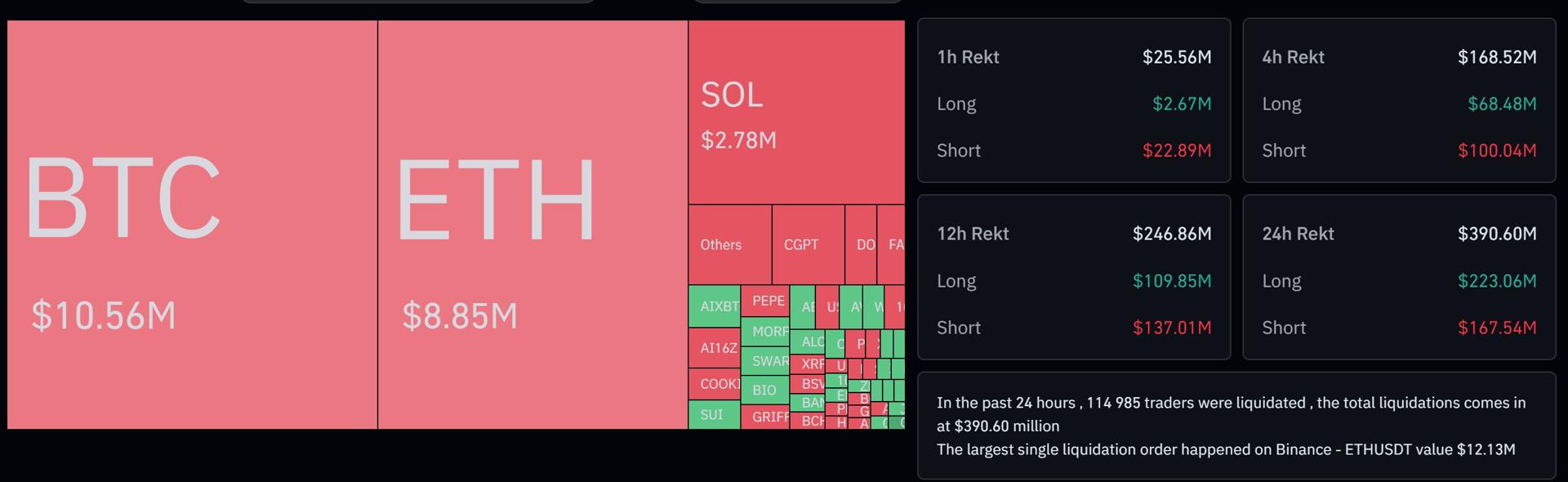
reaction has been severe, with over $390 million in total crypto liquidations
occurring in the last 24 hours, of which approximately $54 million was
specifically in Bitcoin positions.
Adding to
the selling pressure is the U.S. government's planned liquidation of 69,370
Bitcoins seized from the Silk Road marketplace. This substantial amount, valued
at approximately $6.5 billion, is scheduled for sale through the U.S. Marshals
Service, creating additional market uncertainty. Furthermore, institutional
sentiment has weakened, with significant ETF outflows and declining confidence among major investors.
Bitcoin Technical Analysis
and Market Outlook
Looking at
Bitcoin from a technical perspective, we see that the price is currently
utilizing the lower boundary of the consolidation channel formed since
mid-November. Although it has dropped below the previously mentioned 50-day
EMA, this should not cause concern for bulls and buyers. As long as the
sideways channel between the $91,000 support and the nearly $108,000 resistance
remains intact, bears are likely to stay on the sidelines.
Moreover,
in my opinion, even if the current formation highlighted in purple on the chart
breaks, it could present an opportunity to acquire Bitcoin at more attractive,
lower prices. The next technical support level is around $80,500, marked by the
local highs from mid-November. Another support level lies just below $73,000,
corresponding to the October peaks. In my view, only a drop below this level
would signify that sellers are regaining control.
The
ultimate support zone separating buyers' dominance from sellers' lies near
$60,000, representing the lows from three months ago. I would consider any
movement above these levels as a healthy correction within an extended upward
trend.
These
bullish predictions are based on factors such as increased institutional
adoption, the impact of Bitcoin ETFs, and the potential implementation of
crypto-friendly policies under the incoming administration.
Here's a
table summarizing recent Bitcoin price predictions from various analysts and
institutions:
Source
Predicted
Price
Timeframe
Notes
H.C.
Wainwright
$225,000
End of 2025
Anticipates a significant bull
market, with Bitcoin reaching $225,000 by the end of 2025.
Standard
Chartered
$200,000
2025
Projects Bitcoin to reach $200,000
in 2025, driven by increased institutional adoption.
Fundstrat
Global Advisors
$250,000
2025
Analyst Tom Lee predicts Bitcoin
will hit $250,000 in 2025, citing favorable market conditions.
Chamath
Palihapitiya
$500,000
October 2025
Venture capitalist suggests
Bitcoin could reach $500,000 by October 2025, with potential for $1 million
by 2040.
PlanB (Stock-to-Flow Model)
$800,000
2025
Predicts Bitcoin could reach
$150,000 by the end of 2024 and potentially $800,000 by 2025, based on the S2F
model.
CoinLore
$222,000
2025
Forecasts Bitcoin to hit $221,485
by 2025, with a potential rise to $369,701 by 2030.
Finder's
Panel
$113,300
End of 2025
Average prediction from crypto
industry specialists, expecting Bitcoin to reach $113,364 by year-end 2025.
Changelly
$115,000
2025
Analysts predict a maximum price
of $114,857 for Bitcoin in 2025, with an average of around $96,455.
BeInCrypto
$189,300
2025
Projects Bitcoin to reach a high
of $189,313 in 2025, considering historical price patterns and market cycles.
MarketWatch
$150,000
2025
Suggests Bitcoin could hit
$150,000 in 2025, based on historical trends and post-halving rallies.
The
market's immediate focus remains on whether Bitcoin can stabilize and regain
momentum above the psychological $100,000 level. While short-term volatility
persists, historical patterns suggest that such corrections often precede
significant rallies, particularly in the context of Bitcoin's four-year cycle.
Bitcoin Price, FAQ
Will Bitcoin Crash?
While
Bitcoin has experienced a significant decline recently, dropping to around
$91,200, analysts see this as a healthy correction rather than a crash. Key
support levels remain intact, with $91,000 and $80,500 providing potential
floors. A drop below $73,000 or $60,000 could signal a more bearish trend, but
this is not the current outlook.
Will Bitcoin Go Back Up?
Bitcoin has
already rebounded slightly to $94,300 from its local low. Long-term forecasts
remain optimistic, with analysts predicting prices ranging from $150,000 to
$250,000 by 2025. Factors such as institutional adoption and the impact of
Bitcoin ETFs are expected to drive future growth.
Why Is Bitcoin Down?
Bitcoin's
recent decline is attributed to stronger-than-expected U.S. economic data,
which reduced hopes for Federal Reserve rate cuts. This strengthened the U.S.
dollar and increased Treasury yields, creating a challenging environment for
cryptocurrencies. Additionally, the planned sale of seized Bitcoins by the U.S.
government and weak institutional sentiment have added to the selling pressure.
How Much is Bitcoin Worth?
At the time
of writing, Bitcoin is trading at approximately $94,300, rebounding from its
recent low of $91,200. It remains below the psychological $100,000 mark but
within a consolidation range between $91,000 and $108,000.
Bitcoin has
experienced a significant decline this week, with the cryptocurrency dropping
from its recent high above $100,000 to around $91,200. This sharp downturn has
sent ripples through the entire crypto market, triggering substantial
liquidations and traders uncertainty.
Let’s check
why Bitcoin is going down and analyze if BTC price can rebound in the coming
days and weeks.
Why Is Bitcoin Falling?
BTC Price Declined Three Days In a Row
From a
technical perspective, concerns arise as the price dropped below the 50-day
exponential moving average. However, the current levels align with the local
lows formed during the consolidation phase observed since mid-November.
Major cryptocurrencies were falling in the last days. Source: CoinMarketCap.com
"There is a rumor that the recent market dump was initiated after the Department of Justice (DoJ) began selling some of its Silk Road Bitcoin holdings. One of the suspected wallet IDs has been identified," Paul
Howard, Senior Director at Wincent, commented for Finance Magnates. "As mentioned previously, this month is expected to be volatile, particularly as we approach January 20th, the inauguration date for President Trump.
Volatility, however, creates opportunities for trading."
At the time
of writing, Bitcoin changes hands at $94,300, rebounding from the local lows.
The primary
catalyst for this decline has been stronger-than-expected U.S. economic data,
particularly in the services sector and labor market. This robust economic
performance has diminished hopes for aggressive Federal Reserve rate cuts in
2025, leading to a spike in Treasury yields and a strengthening U.S. dollar.
The market
reaction has been severe, with over $390 million in total crypto liquidations
occurring in the last 24 hours, of which approximately $54 million was
specifically in Bitcoin positions.
Adding to
the selling pressure is the U.S. government's planned liquidation of 69,370
Bitcoins seized from the Silk Road marketplace. This substantial amount, valued
at approximately $6.5 billion, is scheduled for sale through the U.S. Marshals
Service, creating additional market uncertainty. Furthermore, institutional
sentiment has weakened, with significant ETF outflows and declining confidence among major investors.
Bitcoin Technical Analysis
and Market Outlook
Looking at
Bitcoin from a technical perspective, we see that the price is currently
utilizing the lower boundary of the consolidation channel formed since
mid-November. Although it has dropped below the previously mentioned 50-day
EMA, this should not cause concern for bulls and buyers. As long as the
sideways channel between the $91,000 support and the nearly $108,000 resistance
remains intact, bears are likely to stay on the sidelines.
Moreover,
in my opinion, even if the current formation highlighted in purple on the chart
breaks, it could present an opportunity to acquire Bitcoin at more attractive,
lower prices. The next technical support level is around $80,500, marked by the
local highs from mid-November. Another support level lies just below $73,000,
corresponding to the October peaks. In my view, only a drop below this level
would signify that sellers are regaining control.
The
ultimate support zone separating buyers' dominance from sellers' lies near
$60,000, representing the lows from three months ago. I would consider any
movement above these levels as a healthy correction within an extended upward
trend.
These
bullish predictions are based on factors such as increased institutional
adoption, the impact of Bitcoin ETFs, and the potential implementation of
crypto-friendly policies under the incoming administration.
Here's a
table summarizing recent Bitcoin price predictions from various analysts and
institutions:
Source
Predicted
Price
Timeframe
Notes
H.C.
Wainwright
$225,000
End of 2025
Anticipates a significant bull
market, with Bitcoin reaching $225,000 by the end of 2025.
Standard
Chartered
$200,000
2025
Projects Bitcoin to reach $200,000
in 2025, driven by increased institutional adoption.
Fundstrat
Global Advisors
$250,000
2025
Analyst Tom Lee predicts Bitcoin
will hit $250,000 in 2025, citing favorable market conditions.
Chamath
Palihapitiya
$500,000
October 2025
Venture capitalist suggests
Bitcoin could reach $500,000 by October 2025, with potential for $1 million
by 2040.
PlanB (Stock-to-Flow Model)
$800,000
2025
Predicts Bitcoin could reach
$150,000 by the end of 2024 and potentially $800,000 by 2025, based on the S2F
model.
CoinLore
$222,000
2025
Forecasts Bitcoin to hit $221,485
by 2025, with a potential rise to $369,701 by 2030.
Finder's
Panel
$113,300
End of 2025
Average prediction from crypto
industry specialists, expecting Bitcoin to reach $113,364 by year-end 2025.
Changelly
$115,000
2025
Analysts predict a maximum price
of $114,857 for Bitcoin in 2025, with an average of around $96,455.
BeInCrypto
$189,300
2025
Projects Bitcoin to reach a high
of $189,313 in 2025, considering historical price patterns and market cycles.
MarketWatch
$150,000
2025
Suggests Bitcoin could hit
$150,000 in 2025, based on historical trends and post-halving rallies.
The
market's immediate focus remains on whether Bitcoin can stabilize and regain
momentum above the psychological $100,000 level. While short-term volatility
persists, historical patterns suggest that such corrections often precede
significant rallies, particularly in the context of Bitcoin's four-year cycle.
Bitcoin Price, FAQ
Will Bitcoin Crash?
While
Bitcoin has experienced a significant decline recently, dropping to around
$91,200, analysts see this as a healthy correction rather than a crash. Key
support levels remain intact, with $91,000 and $80,500 providing potential
floors. A drop below $73,000 or $60,000 could signal a more bearish trend, but
this is not the current outlook.
Will Bitcoin Go Back Up?
Bitcoin has
already rebounded slightly to $94,300 from its local low. Long-term forecasts
remain optimistic, with analysts predicting prices ranging from $150,000 to
$250,000 by 2025. Factors such as institutional adoption and the impact of
Bitcoin ETFs are expected to drive future growth.
Why Is Bitcoin Down?
Bitcoin's
recent decline is attributed to stronger-than-expected U.S. economic data,
which reduced hopes for Federal Reserve rate cuts. This strengthened the U.S.
dollar and increased Treasury yields, creating a challenging environment for
cryptocurrencies. Additionally, the planned sale of seized Bitcoins by the U.S.
government and weak institutional sentiment have added to the selling pressure.
How Much is Bitcoin Worth?
At the time
of writing, Bitcoin is trading at approximately $94,300, rebounding from its
recent low of $91,200. It remains below the psychological $100,000 mark but
within a consolidation range between $91,000 and $108,000.
Damian Chmiel is a Senior Analyst & Editor at Finance Magnates with more than 15 years of experience in the CFD and online trading industry. Active as both a trader and journalist since 2010, he focuses on broker coverage, fintech innovation, and regulatory developments across Europe, the Middle East, and Asia.
His work includes interviews with C-level leaders at major brokerages and fintech platforms, as well as co-authoring Finance Magnates’ quarterly industry benchmarking reports. Damian’s reporting is data-driven, market-aware, and grounded in direct industry engagement. His analysis and commentary have also been cited by external media outlets, including Investing.com, Binance, The Asset, Stockhead, and Dispatch.
Education:
MA in Finance and Accounting, Cracow University of Economics
CFTC Seeks Public Input on Proposed Retail Crypto Regulatory Framework
Featured Videos
AvaTrade to Acquire Most of FXCM; NAGA Raises $8M
AvaTrade to Acquire Most of FXCM; NAGA Raises $8M
AvaTrade to Acquire Most of FXCM; NAGA Raises $8M
AvaTrade to Acquire Most of FXCM; NAGA Raises $8M
Today’s financial news recap covers AvaTrade agrees to acquire most of FXCM, NAGA secures eight million dollars in new financing, and Wise seeks a tax settlement in the UK.
Finance Magnates Daily Recap brings you the latest news from forex and CFD brokers, fintech, payments, cryptocurrency, digital assets, trading platforms, financial regulation and global markets.
Get the key company news, executive moves, deals, regulatory updates and market developments of the day, in just a few minutes. New episodes published every weekday.
Read more: https://www.financemagnates.com
#FinanceMagnates #ForexNews #FintechNews
Today’s financial news recap covers AvaTrade agrees to acquire most of FXCM, NAGA secures eight million dollars in new financing, and Wise seeks a tax settlement in the UK.
Finance Magnates Daily Recap brings you the latest news from forex and CFD brokers, fintech, payments, cryptocurrency, digital assets, trading platforms, financial regulation and global markets.
Get the key company news, executive moves, deals, regulatory updates and market developments of the day, in just a few minutes. New episodes published every weekday.
Read more: https://www.financemagnates.com
#FinanceMagnates #ForexNews #FintechNews
Today’s financial news recap covers AvaTrade agrees to acquire most of FXCM, NAGA secures eight million dollars in new financing, and Wise seeks a tax settlement in the UK.
Finance Magnates Daily Recap brings you the latest news from forex and CFD brokers, fintech, payments, cryptocurrency, digital assets, trading platforms, financial regulation and global markets.
Get the key company news, executive moves, deals, regulatory updates and market developments of the day, in just a few minutes. New episodes published every weekday.
Read more: https://www.financemagnates.com
#FinanceMagnates #ForexNews #FintechNews
Today’s financial news recap covers AvaTrade agrees to acquire most of FXCM, NAGA secures eight million dollars in new financing, and Wise seeks a tax settlement in the UK.
Finance Magnates Daily Recap brings you the latest news from forex and CFD brokers, fintech, payments, cryptocurrency, digital assets, trading platforms, financial regulation and global markets.
Get the key company news, executive moves, deals, regulatory updates and market developments of the day, in just a few minutes. New episodes published every weekday.
Read more: https://www.financemagnates.com
#FinanceMagnates #ForexNews #FintechNews
XTB Adds Overnight US Stock Trading; Nasdaq Ventures Invests in One Trading
XTB Adds Overnight US Stock Trading; Nasdaq Ventures Invests in One Trading
XTB Adds Overnight US Stock Trading; Nasdaq Ventures Invests in One Trading
XTB Adds Overnight US Stock Trading; Nasdaq Ventures Invests in One Trading
XTB Adds Overnight US Stock Trading; Nasdaq Ventures Invests in One Trading
XTB Adds Overnight US Stock Trading; Nasdaq Ventures Invests in One Trading
Today’s financial news recap covers XTB expands overnight US stock trading, Fortrade reports higher revenue, Nasdaq backs One Trading, and Vest Labs raises 13 million dollars.
Finance Magnates Daily Recap brings you the latest news from forex and CFD brokers, fintech, payments, cryptocurrency, digital assets, trading platforms, financial regulation and global markets.
Get the key company news, executive moves, deals, regulatory updates and market developments of the day, in just a few minutes. New episodes published every weekday.
Read more: https://www.financemagnates.com
#FinanceMagnates #ForexNews #FintechNews
Today’s financial news recap covers XTB expands overnight US stock trading, Fortrade reports higher revenue, Nasdaq backs One Trading, and Vest Labs raises 13 million dollars.
Finance Magnates Daily Recap brings you the latest news from forex and CFD brokers, fintech, payments, cryptocurrency, digital assets, trading platforms, financial regulation and global markets.
Get the key company news, executive moves, deals, regulatory updates and market developments of the day, in just a few minutes. New episodes published every weekday.
Read more: https://www.financemagnates.com
#FinanceMagnates #ForexNews #FintechNews
Today’s financial news recap covers XTB expands overnight US stock trading, Fortrade reports higher revenue, Nasdaq backs One Trading, and Vest Labs raises 13 million dollars.
Finance Magnates Daily Recap brings you the latest news from forex and CFD brokers, fintech, payments, cryptocurrency, digital assets, trading platforms, financial regulation and global markets.
Get the key company news, executive moves, deals, regulatory updates and market developments of the day, in just a few minutes. New episodes published every weekday.
Read more: https://www.financemagnates.com
#FinanceMagnates #ForexNews #FintechNews
Today’s financial news recap covers XTB expands overnight US stock trading, Fortrade reports higher revenue, Nasdaq backs One Trading, and Vest Labs raises 13 million dollars.
Finance Magnates Daily Recap brings you the latest news from forex and CFD brokers, fintech, payments, cryptocurrency, digital assets, trading platforms, financial regulation and global markets.
Get the key company news, executive moves, deals, regulatory updates and market developments of the day, in just a few minutes. New episodes published every weekday.
Read more: https://www.financemagnates.com
#FinanceMagnates #ForexNews #FintechNews
Today’s financial news recap covers XTB expands overnight US stock trading, Fortrade reports higher revenue, Nasdaq backs One Trading, and Vest Labs raises 13 million dollars.
Finance Magnates Daily Recap brings you the latest news from forex and CFD brokers, fintech, payments, cryptocurrency, digital assets, trading platforms, financial regulation and global markets.
Get the key company news, executive moves, deals, regulatory updates and market developments of the day, in just a few minutes. New episodes published every weekday.
Read more: https://www.financemagnates.com
#FinanceMagnates #ForexNews #FintechNews
Today’s financial news recap covers XTB expands overnight US stock trading, Fortrade reports higher revenue, Nasdaq backs One Trading, and Vest Labs raises 13 million dollars.
Finance Magnates Daily Recap brings you the latest news from forex and CFD brokers, fintech, payments, cryptocurrency, digital assets, trading platforms, financial regulation and global markets.
Get the key company news, executive moves, deals, regulatory updates and market developments of the day, in just a few minutes. New episodes published every weekday.
Read more: https://www.financemagnates.com
#FinanceMagnates #ForexNews #FintechNews
CMC Founder Downplays Volatility Hit; Devexperts Names CEO
CMC Founder Downplays Volatility Hit; Devexperts Names CEO
CMC Founder Downplays Volatility Hit; Devexperts Names CEO
CMC Founder Downplays Volatility Hit; Devexperts Names CEO
CMC Founder Downplays Volatility Hit; Devexperts Names CEO
CMC Founder Downplays Volatility Hit; Devexperts Names CEO
Today’s financial news recap covers low volatility pressures brokers, Devexperts names a new CEO, Saxo cuts onboarding time, and OKX reaches a 25 billion dollar valuation.
Finance Magnates Daily Recap brings you the latest news from forex and CFD brokers, fintech, payments, cryptocurrency, digital assets, trading platforms, financial regulation and global markets.
Get the key company news, executive moves, deals, regulatory updates and market developments of the day, in just a few minutes. New episodes published every weekday.
Read more: https://www.financemagnates.com
#FinanceMagnates #ForexNews #FintechNews
Today’s financial news recap covers low volatility pressures brokers, Devexperts names a new CEO, Saxo cuts onboarding time, and OKX reaches a 25 billion dollar valuation.
Finance Magnates Daily Recap brings you the latest news from forex and CFD brokers, fintech, payments, cryptocurrency, digital assets, trading platforms, financial regulation and global markets.
Get the key company news, executive moves, deals, regulatory updates and market developments of the day, in just a few minutes. New episodes published every weekday.
Read more: https://www.financemagnates.com
#FinanceMagnates #ForexNews #FintechNews
Today’s financial news recap covers low volatility pressures brokers, Devexperts names a new CEO, Saxo cuts onboarding time, and OKX reaches a 25 billion dollar valuation.
Finance Magnates Daily Recap brings you the latest news from forex and CFD brokers, fintech, payments, cryptocurrency, digital assets, trading platforms, financial regulation and global markets.
Get the key company news, executive moves, deals, regulatory updates and market developments of the day, in just a few minutes. New episodes published every weekday.
Read more: https://www.financemagnates.com
#FinanceMagnates #ForexNews #FintechNews
Today’s financial news recap covers low volatility pressures brokers, Devexperts names a new CEO, Saxo cuts onboarding time, and OKX reaches a 25 billion dollar valuation.
Finance Magnates Daily Recap brings you the latest news from forex and CFD brokers, fintech, payments, cryptocurrency, digital assets, trading platforms, financial regulation and global markets.
Get the key company news, executive moves, deals, regulatory updates and market developments of the day, in just a few minutes. New episodes published every weekday.
Read more: https://www.financemagnates.com
#FinanceMagnates #ForexNews #FintechNews
Today’s financial news recap covers low volatility pressures brokers, Devexperts names a new CEO, Saxo cuts onboarding time, and OKX reaches a 25 billion dollar valuation.
Finance Magnates Daily Recap brings you the latest news from forex and CFD brokers, fintech, payments, cryptocurrency, digital assets, trading platforms, financial regulation and global markets.
Get the key company news, executive moves, deals, regulatory updates and market developments of the day, in just a few minutes. New episodes published every weekday.
Read more: https://www.financemagnates.com
#FinanceMagnates #ForexNews #FintechNews
Today’s financial news recap covers low volatility pressures brokers, Devexperts names a new CEO, Saxo cuts onboarding time, and OKX reaches a 25 billion dollar valuation.
Finance Magnates Daily Recap brings you the latest news from forex and CFD brokers, fintech, payments, cryptocurrency, digital assets, trading platforms, financial regulation and global markets.
Get the key company news, executive moves, deals, regulatory updates and market developments of the day, in just a few minutes. New episodes published every weekday.
Read more: https://www.financemagnates.com
#FinanceMagnates #ForexNews #FintechNews
Today’s financial news recap covers Trade Nation buys FXCM's UK client book, Trading 212 reports higher revenue, the CFTC's move to allow perpetual index futures.
Finance Magnates Daily Recap brings you the latest news from forex and CFD brokers, fintech, payments, cryptocurrency, digital assets, trading platforms, financial regulation and global markets.
Get the key company news, executive moves, deals, regulatory updates and market developments of the day, in just a few minutes. New episodes published every weekday.
Read more: https://www.financemagnates.com
#FinanceMagnates #ForexNews #FintechNews
Today’s financial news recap covers Trade Nation buys FXCM's UK client book, Trading 212 reports higher revenue, the CFTC's move to allow perpetual index futures.
Finance Magnates Daily Recap brings you the latest news from forex and CFD brokers, fintech, payments, cryptocurrency, digital assets, trading platforms, financial regulation and global markets.
Get the key company news, executive moves, deals, regulatory updates and market developments of the day, in just a few minutes. New episodes published every weekday.
Read more: https://www.financemagnates.com
#FinanceMagnates #ForexNews #FintechNews
Today’s financial news recap covers Trade Nation buys FXCM's UK client book, Trading 212 reports higher revenue, the CFTC's move to allow perpetual index futures.
Finance Magnates Daily Recap brings you the latest news from forex and CFD brokers, fintech, payments, cryptocurrency, digital assets, trading platforms, financial regulation and global markets.
Get the key company news, executive moves, deals, regulatory updates and market developments of the day, in just a few minutes. New episodes published every weekday.
Read more: https://www.financemagnates.com
#FinanceMagnates #ForexNews #FintechNews
Today’s financial news recap covers Trade Nation buys FXCM's UK client book, Trading 212 reports higher revenue, the CFTC's move to allow perpetual index futures.
Finance Magnates Daily Recap brings you the latest news from forex and CFD brokers, fintech, payments, cryptocurrency, digital assets, trading platforms, financial regulation and global markets.
Get the key company news, executive moves, deals, regulatory updates and market developments of the day, in just a few minutes. New episodes published every weekday.
Read more: https://www.financemagnates.com
#FinanceMagnates #ForexNews #FintechNews
Today’s financial news recap covers Trade Nation buys FXCM's UK client book, Trading 212 reports higher revenue, the CFTC's move to allow perpetual index futures.
Finance Magnates Daily Recap brings you the latest news from forex and CFD brokers, fintech, payments, cryptocurrency, digital assets, trading platforms, financial regulation and global markets.
Get the key company news, executive moves, deals, regulatory updates and market developments of the day, in just a few minutes. New episodes published every weekday.
Read more: https://www.financemagnates.com
#FinanceMagnates #ForexNews #FintechNews
Today’s financial news recap covers Trade Nation buys FXCM's UK client book, Trading 212 reports higher revenue, the CFTC's move to allow perpetual index futures.
Finance Magnates Daily Recap brings you the latest news from forex and CFD brokers, fintech, payments, cryptocurrency, digital assets, trading platforms, financial regulation and global markets.
Get the key company news, executive moves, deals, regulatory updates and market developments of the day, in just a few minutes. New episodes published every weekday.
Read more: https://www.financemagnates.com
#FinanceMagnates #ForexNews #FintechNews
Your career isn’t a linear path.
Your career isn’t a linear path.
Your career isn’t a linear path.
Your career isn’t a linear path.
Your career isn’t a linear path.
Your career isn’t a linear path.
Roles change. Career goals change. Sometimes you want a completely new challenge.
But the skills and knowledge you build along the way can stay with you and give you something to build on.
For Jeff Patterson, that continued growth is key to long-term career development.
You bring the skills. FM Academy helps you build the knowledge.
#FMAcademy #FinanceMagnates #FinanceCareers #ProfessionalDevelopment #Fintech
Roles change. Career goals change. Sometimes you want a completely new challenge.
But the skills and knowledge you build along the way can stay with you and give you something to build on.
For Jeff Patterson, that continued growth is key to long-term career development.
You bring the skills. FM Academy helps you build the knowledge.
#FMAcademy #FinanceMagnates #FinanceCareers #ProfessionalDevelopment #Fintech
Roles change. Career goals change. Sometimes you want a completely new challenge.
But the skills and knowledge you build along the way can stay with you and give you something to build on.
For Jeff Patterson, that continued growth is key to long-term career development.
You bring the skills. FM Academy helps you build the knowledge.
#FMAcademy #FinanceMagnates #FinanceCareers #ProfessionalDevelopment #Fintech
Roles change. Career goals change. Sometimes you want a completely new challenge.
But the skills and knowledge you build along the way can stay with you and give you something to build on.
For Jeff Patterson, that continued growth is key to long-term career development.
You bring the skills. FM Academy helps you build the knowledge.
#FMAcademy #FinanceMagnates #FinanceCareers #ProfessionalDevelopment #Fintech
Roles change. Career goals change. Sometimes you want a completely new challenge.
But the skills and knowledge you build along the way can stay with you and give you something to build on.
For Jeff Patterson, that continued growth is key to long-term career development.
You bring the skills. FM Academy helps you build the knowledge.
#FMAcademy #FinanceMagnates #FinanceCareers #ProfessionalDevelopment #Fintech
Roles change. Career goals change. Sometimes you want a completely new challenge.
But the skills and knowledge you build along the way can stay with you and give you something to build on.
For Jeff Patterson, that continued growth is key to long-term career development.
You bring the skills. FM Academy helps you build the knowledge.
#FMAcademy #FinanceMagnates #FinanceCareers #ProfessionalDevelopment #Fintech