Bitcoin briefly dropped below $100,000 following the Federal Reserve's hawkish stance on future rate cuts.
However, market experts still see BTC price 2025 closer to $200,000.
Check the newest Bitcoin price predictions for 2024 and 2025 and the technical analysis of the BTC chart.
The world's
leading cryptocurrency, Bitcoin (BTC), experienced significant volatility
following the Federal Reserve's (Fed’s) latest monetary policy announcement,
briefly dipping below the psychological $100,000 mark before staging a
recovery.
The price
action reflects broader market uncertainty as investors digest the Fed's more
conservative approach to rate cuts in 2025.
Why Is Bitcoin Down? $100K
Secured
Bitcoin
touched $98,760 in a sharp downturn that erased nearly $10,000 from its recent
all-time high (ATH). The movement coincided with a broader sell-off in risk
assets, as market participants adjusted their positions following
the Fed's hawkish guidance.
The
cryptocurrency market's reaction mirrors the complex interplay between monetary
policy and digital asset valuations. While
the Fed delivered its third consecutive rate cut, the central bank's
cautious stance on future reductions triggered a reassessment of risk positions
across multiple asset classes.
“In support
of its goals, the Committee decided to lower the target range for the federal
funds rate by 1/4 percentage point to 4-1/4 to 4-1/2 percent,” the Fed commented in
the official statement.
As a
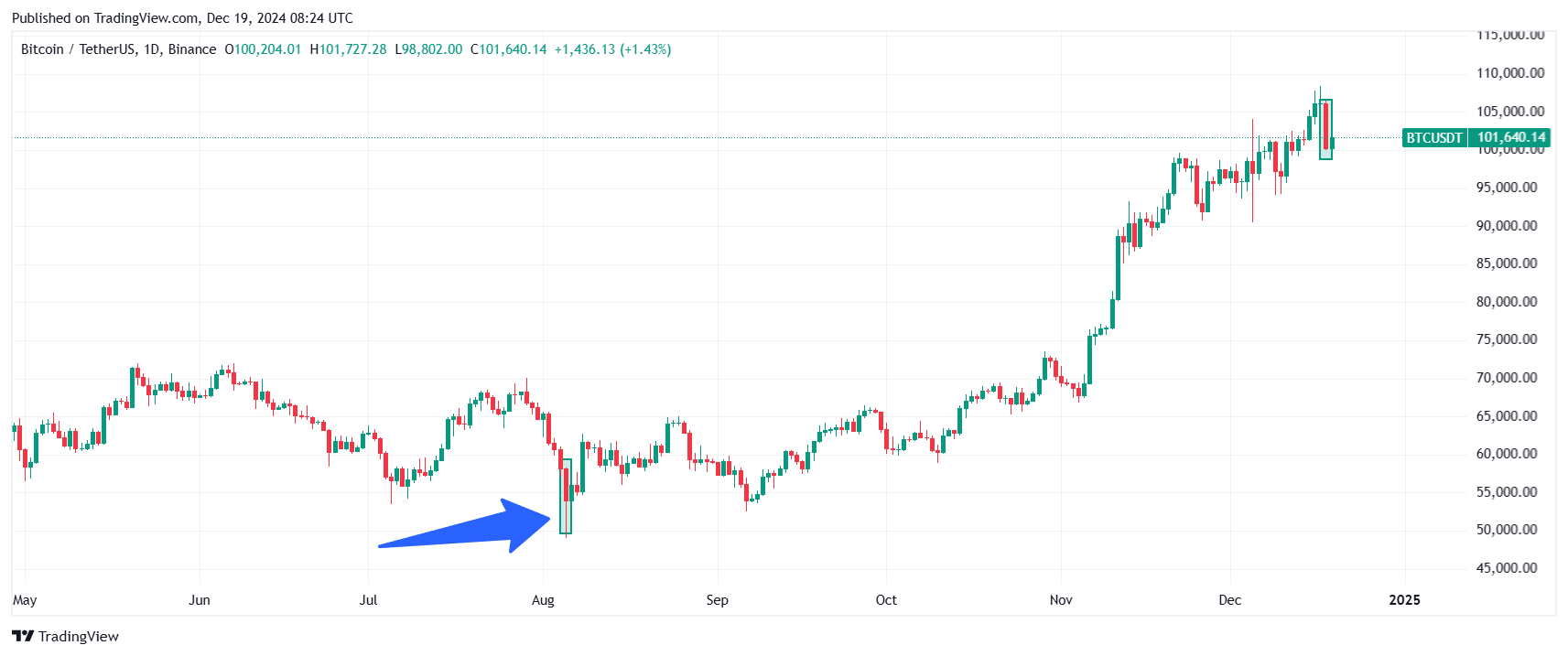
result, Bitcoin fell by 5.6% during Wednesday's session, testing
levels below the $100,000 mark. This marked the largest single-day drop
since August 5, when the price declined by 7%, hitting a low of $49,000. Today
(Thursday, December 19, 2024), Bitcoin also tested levels below the
psychological support of $100,000. However, at the time of writing, it has
modestly rebounded and is trading at $101,600 on Binance.
Bitcoin price defends the $100K mark. Source: TradingView
The
cryptocurrency's trajectory has been significantly influenced by political
developments, with a 50% surge following the November presidential election.
The president-elect's pro-crypto stance and proposals for a national Bitcoin
reserve have fundamentally altered market sentiment, though regulatory
uncertainties persist.
Federal Reserve Chair Jerome Powell says the Fed is "not allowed to own Bitcoin"
They weren't allowed to own Corporate Bonds before Covid either.
Over the
past 24 hours, more than $661 million in leveraged long positions have been
liquidated in the cryptocurrency market, according to Coinglass data. The
majority of these liquidations were tied to Bitcoin ($110 million) and Ethereum
($109 million).
Bitcoin's
decline fueled a broader depreciation across the altcoin market. Alongside the
oldest cryptocurrency, Ethereum also saw significant losses, dropping 4.4%,
along with XRP (5.4%), Solana (2.5%), and Dogecoin (5.6%).
The total
market capitalization shrank to $3.7 trillion, with Bitcoin accounting for over
$2 trillion of that value.
The total market capitalization of the most popular cryptocurrencies. Source: CoinMarketCap
Options
market activity has shown increased interest in downside protection, with
traders seeking hedging strategies amid heightened volatility. Market
specialists suggest the possibility of short-term price movements toward the
low $90,000 range, though such dips are expected to be temporary.
BTC Technical Analysis:
Will Bitcoin Keep Going Down?
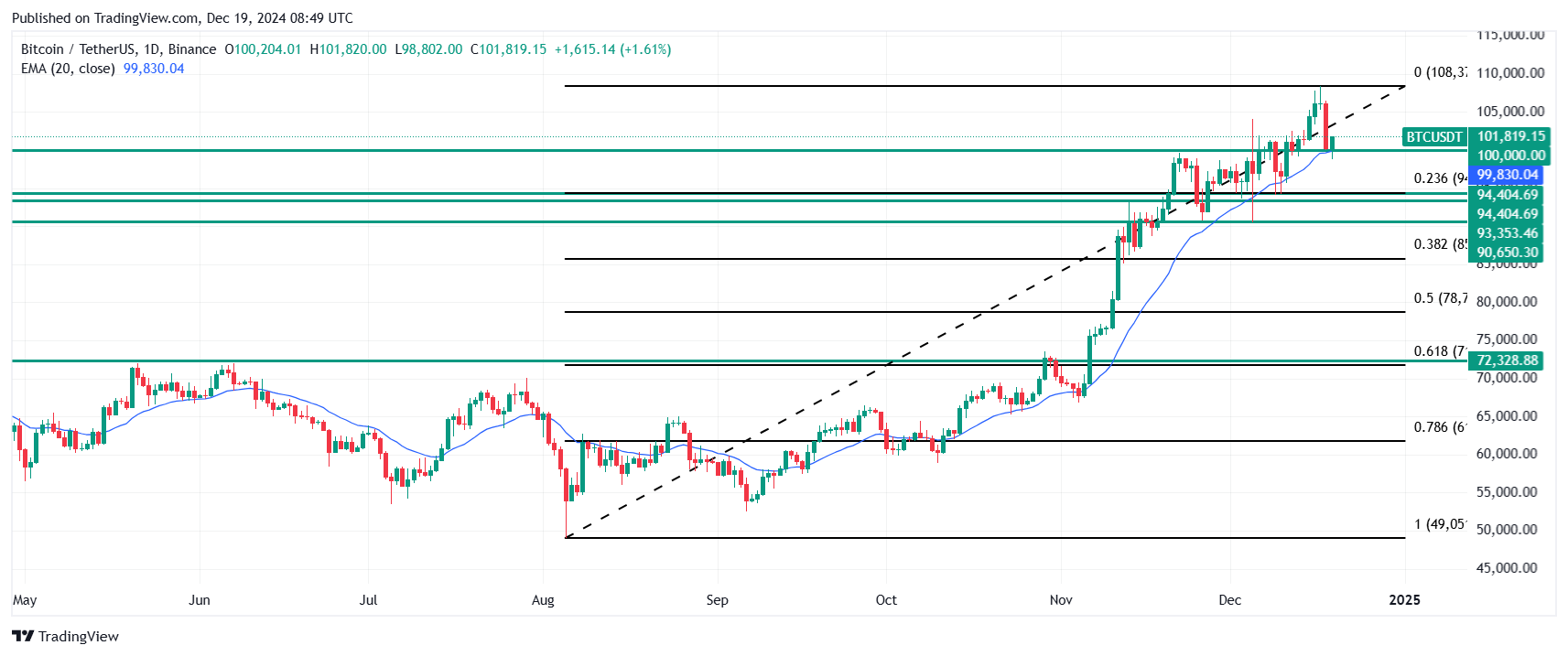
In my view,
the $100,000 level will serve as a key support floor, one that bears will find
challenging to break. Additionally, Bitcoin benefits from short-term support
provided by the 20-day exponential moving average (20 EMA).
The
post-Fed decision movement was significant, and without the substantial
accumulation of buy orders near $100K, we would likely be seeing even lower BTC
prices. I believe this six-figure value provides Bitcoin with room for a
rebound.
At this
moment, the critical resistance level is the previous all-time high (ATH) of
nearly $108,000, tested on December 15. My outlook will shift if Bitcoin drops
below the current support, though this is still no reason to panic. BTC has a
dense network of support levels ahead, but three key levels stand out.
Bitcoin Price Support
Levels
$94,400–$94,300 – 23.6% Fibonacci retracement, reinforced by local lows.
$90,000 –
Another psychological level and the low from December 5.
$72,328 –
61.8% Fibonacci retracement, aligning with the May-June highs.
Only if
Bitcoin falls below $72,000 will I change my stance to bearish. Until then,
I’ll view all downward corrections as opportunities to buy Bitcoin at more
attractive prices.
Bitcoin Long-Term Price
Prediction
VanEck's head of digital assets research, Matthew Sigel
“Following
this first peak, we anticipate a 30% retracement in BTC, with altcoins facing
sharper declines of up to 60% as the market consolidates during the summer,”
VanEck’s Matthew Sigel forecasted. “However, a recovery is likely in the fall,
with major tokens regaining momentum and reclaiming previous all-time highs by
the end of the year.”
VanEck
expects the ongoing crypto bull market to culminate in its first major peak
during Q1 2025. The firm anticipates Bitcoin reaching $180,000, with Ethereum
exceeding $6,000. Other notable cryptocurrencies like Solana and Sui are
projected to hit $500 and $10, respectively.
Broader Bitcoin Price
Predictions for 2025
VanEck’s forecast is one
of several ambitious projections for Bitcoin in 2025. Other
prominent predictions include:
Source
Prediction (BTC Price)
Key Drivers
Tim Draper
$250,000
Increased merchant adoption and Bitcoin
halving effects expected to drive demand.
Standard
Chartered
$200,000
Institutional inflows, regulatory clarity, and
the role of spot ETFs in mainstream adoption.
Tom Lee
(Fundstrat)
$250,000
A growing shortage of Bitcoin supply, making
the asset increasingly scarce on cryptocurrency exchanges.
Arthur Hayes
(BitMEX)
$175,000
A surge in capital from traditional financial
institutions entering the crypto market, referred to as the "wall of
money."
These
forecasts underline the diverse perspectives within the cryptocurrency
industry, highlighting a mix of macroeconomic factors and market dynamics
driving optimism for Bitcoin and the broader crypto ecosystem in 2025.
Bitcoin's
decline is primarily due to the Federal Reserve's hawkish stance on future
interest rate cuts. While the Fed delivered its third consecutive rate cut,
they signaled fewer rate reductions for 2025 than previously expected, causing
investors to reassess their positions in speculative assets.
Is Bitcoin having issues?
No, Bitcoin
isn't experiencing technical issues. The current price movement is a market
reaction to broader macroeconomic factors. The cryptocurrency dropped to
$98,760 before stabilizing above $100,000, reflecting normal market dynamics in
response to monetary policy changes.
Is Bitcoin predicted to go
up?
Multiple
analysts maintain bullish long-term predictions for Bitcoin: VanEck forecasts
$180,000 by Q1 2025, Standard Chartered maintains a $200,000 target for 2025, Tim
Draper projects $250,000 by the end of 2025. The average predicted trading
price for December 2024 is around $111,724. These predictions are based on
factors such as institutional adoption and regulatory clarity.
The world's
leading cryptocurrency, Bitcoin (BTC), experienced significant volatility
following the Federal Reserve's (Fed’s) latest monetary policy announcement,
briefly dipping below the psychological $100,000 mark before staging a
recovery.
The price
action reflects broader market uncertainty as investors digest the Fed's more
conservative approach to rate cuts in 2025.
Why Is Bitcoin Down? $100K
Secured
Bitcoin
touched $98,760 in a sharp downturn that erased nearly $10,000 from its recent
all-time high (ATH). The movement coincided with a broader sell-off in risk
assets, as market participants adjusted their positions following
the Fed's hawkish guidance.
The
cryptocurrency market's reaction mirrors the complex interplay between monetary
policy and digital asset valuations. While
the Fed delivered its third consecutive rate cut, the central bank's
cautious stance on future reductions triggered a reassessment of risk positions
across multiple asset classes.
“In support
of its goals, the Committee decided to lower the target range for the federal
funds rate by 1/4 percentage point to 4-1/4 to 4-1/2 percent,” the Fed commented in
the official statement.
As a
result, Bitcoin fell by 5.6% during Wednesday's session, testing
levels below the $100,000 mark. This marked the largest single-day drop
since August 5, when the price declined by 7%, hitting a low of $49,000. Today
(Thursday, December 19, 2024), Bitcoin also tested levels below the
psychological support of $100,000. However, at the time of writing, it has
modestly rebounded and is trading at $101,600 on Binance.
Bitcoin price defends the $100K mark. Source: TradingView
The
cryptocurrency's trajectory has been significantly influenced by political
developments, with a 50% surge following the November presidential election.
The president-elect's pro-crypto stance and proposals for a national Bitcoin
reserve have fundamentally altered market sentiment, though regulatory
uncertainties persist.
Federal Reserve Chair Jerome Powell says the Fed is "not allowed to own Bitcoin"
They weren't allowed to own Corporate Bonds before Covid either.
Over the
past 24 hours, more than $661 million in leveraged long positions have been
liquidated in the cryptocurrency market, according to Coinglass data. The
majority of these liquidations were tied to Bitcoin ($110 million) and Ethereum
($109 million).
Bitcoin's
decline fueled a broader depreciation across the altcoin market. Alongside the
oldest cryptocurrency, Ethereum also saw significant losses, dropping 4.4%,
along with XRP (5.4%), Solana (2.5%), and Dogecoin (5.6%).
The total
market capitalization shrank to $3.7 trillion, with Bitcoin accounting for over
$2 trillion of that value.
The total market capitalization of the most popular cryptocurrencies. Source: CoinMarketCap
Options
market activity has shown increased interest in downside protection, with
traders seeking hedging strategies amid heightened volatility. Market
specialists suggest the possibility of short-term price movements toward the
low $90,000 range, though such dips are expected to be temporary.
BTC Technical Analysis:
Will Bitcoin Keep Going Down?
In my view,
the $100,000 level will serve as a key support floor, one that bears will find
challenging to break. Additionally, Bitcoin benefits from short-term support
provided by the 20-day exponential moving average (20 EMA).
The
post-Fed decision movement was significant, and without the substantial
accumulation of buy orders near $100K, we would likely be seeing even lower BTC
prices. I believe this six-figure value provides Bitcoin with room for a
rebound.
At this
moment, the critical resistance level is the previous all-time high (ATH) of
nearly $108,000, tested on December 15. My outlook will shift if Bitcoin drops
below the current support, though this is still no reason to panic. BTC has a
dense network of support levels ahead, but three key levels stand out.
Bitcoin Price Support
Levels
$94,400–$94,300 – 23.6% Fibonacci retracement, reinforced by local lows.
$90,000 –
Another psychological level and the low from December 5.
$72,328 –
61.8% Fibonacci retracement, aligning with the May-June highs.
Only if
Bitcoin falls below $72,000 will I change my stance to bearish. Until then,
I’ll view all downward corrections as opportunities to buy Bitcoin at more
attractive prices.
Bitcoin Long-Term Price
Prediction
VanEck's head of digital assets research, Matthew Sigel
“Following
this first peak, we anticipate a 30% retracement in BTC, with altcoins facing
sharper declines of up to 60% as the market consolidates during the summer,”
VanEck’s Matthew Sigel forecasted. “However, a recovery is likely in the fall,
with major tokens regaining momentum and reclaiming previous all-time highs by
the end of the year.”
VanEck
expects the ongoing crypto bull market to culminate in its first major peak
during Q1 2025. The firm anticipates Bitcoin reaching $180,000, with Ethereum
exceeding $6,000. Other notable cryptocurrencies like Solana and Sui are
projected to hit $500 and $10, respectively.
Broader Bitcoin Price
Predictions for 2025
VanEck’s forecast is one
of several ambitious projections for Bitcoin in 2025. Other
prominent predictions include:
Source
Prediction (BTC Price)
Key Drivers
Tim Draper
$250,000
Increased merchant adoption and Bitcoin
halving effects expected to drive demand.
Standard
Chartered
$200,000
Institutional inflows, regulatory clarity, and
the role of spot ETFs in mainstream adoption.
Tom Lee
(Fundstrat)
$250,000
A growing shortage of Bitcoin supply, making
the asset increasingly scarce on cryptocurrency exchanges.
Arthur Hayes
(BitMEX)
$175,000
A surge in capital from traditional financial
institutions entering the crypto market, referred to as the "wall of
money."
These
forecasts underline the diverse perspectives within the cryptocurrency
industry, highlighting a mix of macroeconomic factors and market dynamics
driving optimism for Bitcoin and the broader crypto ecosystem in 2025.
Bitcoin's
decline is primarily due to the Federal Reserve's hawkish stance on future
interest rate cuts. While the Fed delivered its third consecutive rate cut,
they signaled fewer rate reductions for 2025 than previously expected, causing
investors to reassess their positions in speculative assets.
Is Bitcoin having issues?
No, Bitcoin
isn't experiencing technical issues. The current price movement is a market
reaction to broader macroeconomic factors. The cryptocurrency dropped to
$98,760 before stabilizing above $100,000, reflecting normal market dynamics in
response to monetary policy changes.
Is Bitcoin predicted to go
up?
Multiple
analysts maintain bullish long-term predictions for Bitcoin: VanEck forecasts
$180,000 by Q1 2025, Standard Chartered maintains a $200,000 target for 2025, Tim
Draper projects $250,000 by the end of 2025. The average predicted trading
price for December 2024 is around $111,724. These predictions are based on
factors such as institutional adoption and regulatory clarity.
Damian Chmiel is a Senior Analyst & Editor at Finance Magnates with more than 15 years of experience in the CFD and online trading industry. Active as both a trader and journalist since 2010, he focuses on broker coverage, fintech innovation, and regulatory developments across Europe, the Middle East, and Asia.
His work includes interviews with C-level leaders at major brokerages and fintech platforms, as well as co-authoring Finance Magnates’ quarterly industry benchmarking reports. Damian’s reporting is data-driven, market-aware, and grounded in direct industry engagement. His analysis and commentary have also been cited by external media outlets, including Investing.com, Binance, The Asset, Stockhead, and Dispatch.
Education:
MA in Finance and Accounting, Cracow University of Economics
Revolut Wins Gibraltar Crypto License, Reopens Sign-Ups for Local Residents
Featured Videos
FXOpen UK Applies to Cancel Licence; FCA Plans Staff Rule Changes
FXOpen UK Applies to Cancel Licence; FCA Plans Staff Rule Changes
FXOpen UK Applies to Cancel Licence; FCA Plans Staff Rule Changes
FXOpen UK Applies to Cancel Licence; FCA Plans Staff Rule Changes
Today’s financial news recap covers FXOpen UK closes client accounts, the FCA proposes changes to senior management rules, Webull extends options trading hours, and Match-Prime joins iSAM Securities Apex.
Finance Magnates Daily Recap brings you the latest news from forex and CFD brokers, fintech, payments, cryptocurrency, digital assets, trading platforms, financial regulation and global markets.
Get the key company news, executive moves, deals, regulatory updates and market developments of the day, in just a few minutes. New episodes published every weekday.
Read more: https://www.financemagnates.com
#FinanceMagnates #ForexNews #FintechNews
Today’s financial news recap covers FXOpen UK closes client accounts, the FCA proposes changes to senior management rules, Webull extends options trading hours, and Match-Prime joins iSAM Securities Apex.
Finance Magnates Daily Recap brings you the latest news from forex and CFD brokers, fintech, payments, cryptocurrency, digital assets, trading platforms, financial regulation and global markets.
Get the key company news, executive moves, deals, regulatory updates and market developments of the day, in just a few minutes. New episodes published every weekday.
Read more: https://www.financemagnates.com
#FinanceMagnates #ForexNews #FintechNews
Today’s financial news recap covers FXOpen UK closes client accounts, the FCA proposes changes to senior management rules, Webull extends options trading hours, and Match-Prime joins iSAM Securities Apex.
Finance Magnates Daily Recap brings you the latest news from forex and CFD brokers, fintech, payments, cryptocurrency, digital assets, trading platforms, financial regulation and global markets.
Get the key company news, executive moves, deals, regulatory updates and market developments of the day, in just a few minutes. New episodes published every weekday.
Read more: https://www.financemagnates.com
#FinanceMagnates #ForexNews #FintechNews
Today’s financial news recap covers FXOpen UK closes client accounts, the FCA proposes changes to senior management rules, Webull extends options trading hours, and Match-Prime joins iSAM Securities Apex.
Finance Magnates Daily Recap brings you the latest news from forex and CFD brokers, fintech, payments, cryptocurrency, digital assets, trading platforms, financial regulation and global markets.
Get the key company news, executive moves, deals, regulatory updates and market developments of the day, in just a few minutes. New episodes published every weekday.
Read more: https://www.financemagnates.com
#FinanceMagnates #ForexNews #FintechNews
IG Seeks UK Gambling Licence; OANDA Japan Holds Withdrawals
IG Seeks UK Gambling Licence; OANDA Japan Holds Withdrawals
IG Seeks UK Gambling Licence; OANDA Japan Holds Withdrawals
IG Seeks UK Gambling Licence; OANDA Japan Holds Withdrawals
IG Seeks UK Gambling Licence; OANDA Japan Holds Withdrawals
IG Seeks UK Gambling Licence; OANDA Japan Holds Withdrawals
Today’s financial news recap covers IG's plans to enter prediction markets, OANDA Japan's withdrawal suspension after a server hack, a NAGA's falling earnings amid rising marketing costs
Finance Magnates Daily Recap brings you the latest news from forex and CFD brokers, fintech, payments, cryptocurrency, digital assets, trading platforms, financial regulation and global markets.
Get the key company news, executive moves, deals, regulatory updates and market developments of the day, in just a few minutes. New episodes published every weekday.
Read more: https://www.financemagnates.com
#FinanceMagnates #ForexNews #FintechNews
Today’s financial news recap covers IG's plans to enter prediction markets, OANDA Japan's withdrawal suspension after a server hack, a NAGA's falling earnings amid rising marketing costs
Finance Magnates Daily Recap brings you the latest news from forex and CFD brokers, fintech, payments, cryptocurrency, digital assets, trading platforms, financial regulation and global markets.
Get the key company news, executive moves, deals, regulatory updates and market developments of the day, in just a few minutes. New episodes published every weekday.
Read more: https://www.financemagnates.com
#FinanceMagnates #ForexNews #FintechNews
Today’s financial news recap covers IG's plans to enter prediction markets, OANDA Japan's withdrawal suspension after a server hack, a NAGA's falling earnings amid rising marketing costs
Finance Magnates Daily Recap brings you the latest news from forex and CFD brokers, fintech, payments, cryptocurrency, digital assets, trading platforms, financial regulation and global markets.
Get the key company news, executive moves, deals, regulatory updates and market developments of the day, in just a few minutes. New episodes published every weekday.
Read more: https://www.financemagnates.com
#FinanceMagnates #ForexNews #FintechNews
Today’s financial news recap covers IG's plans to enter prediction markets, OANDA Japan's withdrawal suspension after a server hack, a NAGA's falling earnings amid rising marketing costs
Finance Magnates Daily Recap brings you the latest news from forex and CFD brokers, fintech, payments, cryptocurrency, digital assets, trading platforms, financial regulation and global markets.
Get the key company news, executive moves, deals, regulatory updates and market developments of the day, in just a few minutes. New episodes published every weekday.
Read more: https://www.financemagnates.com
#FinanceMagnates #ForexNews #FintechNews
Today’s financial news recap covers IG's plans to enter prediction markets, OANDA Japan's withdrawal suspension after a server hack, a NAGA's falling earnings amid rising marketing costs
Finance Magnates Daily Recap brings you the latest news from forex and CFD brokers, fintech, payments, cryptocurrency, digital assets, trading platforms, financial regulation and global markets.
Get the key company news, executive moves, deals, regulatory updates and market developments of the day, in just a few minutes. New episodes published every weekday.
Read more: https://www.financemagnates.com
#FinanceMagnates #ForexNews #FintechNews
Today’s financial news recap covers IG's plans to enter prediction markets, OANDA Japan's withdrawal suspension after a server hack, a NAGA's falling earnings amid rising marketing costs
Finance Magnates Daily Recap brings you the latest news from forex and CFD brokers, fintech, payments, cryptocurrency, digital assets, trading platforms, financial regulation and global markets.
Get the key company news, executive moves, deals, regulatory updates and market developments of the day, in just a few minutes. New episodes published every weekday.
Read more: https://www.financemagnates.com
#FinanceMagnates #ForexNews #FintechNews
FMIQ: Get Verified Market Intelligence in Seconds | FM Intelligence
FMIQ: Get Verified Market Intelligence in Seconds | FM Intelligence
FMIQ: Get Verified Market Intelligence in Seconds | FM Intelligence
FMIQ: Get Verified Market Intelligence in Seconds | FM Intelligence
FMIQ: Get Verified Market Intelligence in Seconds | FM Intelligence
FMIQ: Get Verified Market Intelligence in Seconds | FM Intelligence
Meet FMIQ (FM Intelligence Quantitative), now available inside the FM Intelligence Portal.
Ask the market a question in plain language and get a sourced, verified answer in seconds. FMIQ gives you the figures, time periods, and sources you need to make informed decisions, without the need to work through dashboards, filters, or spreadsheet exports.
What makes FMIQ different?
✓ Ask questions in plain language, with no SQL or dashboard setup required.
✓ Get verified answers checked through an independent quality assurance step.
✓ Access sourced figures you can cite with confidence.
✓ Ask follow-up questions and build on the same conversation.
✓ Query seven datasets in one place, covering trading volumes, traffic, platforms, market movements, regulations, fines, and licences.
Built for professionals across the financial markets
- Editorial teams: Find reliable figures and support your reporting with clear sources.
- Commercial teams: Access the market data you need to prepare for client meetings and sales discussions.
- Research and analyst teams: Explore market trends and get answers to specific questions.
- Compliance teams: Access intelligence on regulations, fines, and licences.
Every query is run live, and answers go through an independent quality check. FMIQ is read-only, stays focused on your question, and does not alter the underlying data.
Built on Finance Magnates market intelligence, FMIQ helps professionals get the answers they need, when they need them.
Access FMIQ today: https://datalab.financemagnates.com/market?utm_source=youtube&utm_medium=video&utm_campaign=fmiq_phase1_mvp_launch
#FMIntelligence #FMIQ #MarketIntelligence #FinanceMagnates #FinancialMarkets #MarketResearch
Meet FMIQ (FM Intelligence Quantitative), now available inside the FM Intelligence Portal.
Ask the market a question in plain language and get a sourced, verified answer in seconds. FMIQ gives you the figures, time periods, and sources you need to make informed decisions, without the need to work through dashboards, filters, or spreadsheet exports.
What makes FMIQ different?
✓ Ask questions in plain language, with no SQL or dashboard setup required.
✓ Get verified answers checked through an independent quality assurance step.
✓ Access sourced figures you can cite with confidence.
✓ Ask follow-up questions and build on the same conversation.
✓ Query seven datasets in one place, covering trading volumes, traffic, platforms, market movements, regulations, fines, and licences.
Built for professionals across the financial markets
- Editorial teams: Find reliable figures and support your reporting with clear sources.
- Commercial teams: Access the market data you need to prepare for client meetings and sales discussions.
- Research and analyst teams: Explore market trends and get answers to specific questions.
- Compliance teams: Access intelligence on regulations, fines, and licences.
Every query is run live, and answers go through an independent quality check. FMIQ is read-only, stays focused on your question, and does not alter the underlying data.
Built on Finance Magnates market intelligence, FMIQ helps professionals get the answers they need, when they need them.
Access FMIQ today: https://datalab.financemagnates.com/market?utm_source=youtube&utm_medium=video&utm_campaign=fmiq_phase1_mvp_launch
#FMIntelligence #FMIQ #MarketIntelligence #FinanceMagnates #FinancialMarkets #MarketResearch
Meet FMIQ (FM Intelligence Quantitative), now available inside the FM Intelligence Portal.
Ask the market a question in plain language and get a sourced, verified answer in seconds. FMIQ gives you the figures, time periods, and sources you need to make informed decisions, without the need to work through dashboards, filters, or spreadsheet exports.
What makes FMIQ different?
✓ Ask questions in plain language, with no SQL or dashboard setup required.
✓ Get verified answers checked through an independent quality assurance step.
✓ Access sourced figures you can cite with confidence.
✓ Ask follow-up questions and build on the same conversation.
✓ Query seven datasets in one place, covering trading volumes, traffic, platforms, market movements, regulations, fines, and licences.
Built for professionals across the financial markets
- Editorial teams: Find reliable figures and support your reporting with clear sources.
- Commercial teams: Access the market data you need to prepare for client meetings and sales discussions.
- Research and analyst teams: Explore market trends and get answers to specific questions.
- Compliance teams: Access intelligence on regulations, fines, and licences.
Every query is run live, and answers go through an independent quality check. FMIQ is read-only, stays focused on your question, and does not alter the underlying data.
Built on Finance Magnates market intelligence, FMIQ helps professionals get the answers they need, when they need them.
Access FMIQ today: https://datalab.financemagnates.com/market?utm_source=youtube&utm_medium=video&utm_campaign=fmiq_phase1_mvp_launch
#FMIntelligence #FMIQ #MarketIntelligence #FinanceMagnates #FinancialMarkets #MarketResearch
Meet FMIQ (FM Intelligence Quantitative), now available inside the FM Intelligence Portal.
Ask the market a question in plain language and get a sourced, verified answer in seconds. FMIQ gives you the figures, time periods, and sources you need to make informed decisions, without the need to work through dashboards, filters, or spreadsheet exports.
What makes FMIQ different?
✓ Ask questions in plain language, with no SQL or dashboard setup required.
✓ Get verified answers checked through an independent quality assurance step.
✓ Access sourced figures you can cite with confidence.
✓ Ask follow-up questions and build on the same conversation.
✓ Query seven datasets in one place, covering trading volumes, traffic, platforms, market movements, regulations, fines, and licences.
Built for professionals across the financial markets
- Editorial teams: Find reliable figures and support your reporting with clear sources.
- Commercial teams: Access the market data you need to prepare for client meetings and sales discussions.
- Research and analyst teams: Explore market trends and get answers to specific questions.
- Compliance teams: Access intelligence on regulations, fines, and licences.
Every query is run live, and answers go through an independent quality check. FMIQ is read-only, stays focused on your question, and does not alter the underlying data.
Built on Finance Magnates market intelligence, FMIQ helps professionals get the answers they need, when they need them.
Access FMIQ today: https://datalab.financemagnates.com/market?utm_source=youtube&utm_medium=video&utm_campaign=fmiq_phase1_mvp_launch
#FMIntelligence #FMIQ #MarketIntelligence #FinanceMagnates #FinancialMarkets #MarketResearch
Meet FMIQ (FM Intelligence Quantitative), now available inside the FM Intelligence Portal.
Ask the market a question in plain language and get a sourced, verified answer in seconds. FMIQ gives you the figures, time periods, and sources you need to make informed decisions, without the need to work through dashboards, filters, or spreadsheet exports.
What makes FMIQ different?
✓ Ask questions in plain language, with no SQL or dashboard setup required.
✓ Get verified answers checked through an independent quality assurance step.
✓ Access sourced figures you can cite with confidence.
✓ Ask follow-up questions and build on the same conversation.
✓ Query seven datasets in one place, covering trading volumes, traffic, platforms, market movements, regulations, fines, and licences.
Built for professionals across the financial markets
- Editorial teams: Find reliable figures and support your reporting with clear sources.
- Commercial teams: Access the market data you need to prepare for client meetings and sales discussions.
- Research and analyst teams: Explore market trends and get answers to specific questions.
- Compliance teams: Access intelligence on regulations, fines, and licences.
Every query is run live, and answers go through an independent quality check. FMIQ is read-only, stays focused on your question, and does not alter the underlying data.
Built on Finance Magnates market intelligence, FMIQ helps professionals get the answers they need, when they need them.
Access FMIQ today: https://datalab.financemagnates.com/market?utm_source=youtube&utm_medium=video&utm_campaign=fmiq_phase1_mvp_launch
#FMIntelligence #FMIQ #MarketIntelligence #FinanceMagnates #FinancialMarkets #MarketResearch
Meet FMIQ (FM Intelligence Quantitative), now available inside the FM Intelligence Portal.
Ask the market a question in plain language and get a sourced, verified answer in seconds. FMIQ gives you the figures, time periods, and sources you need to make informed decisions, without the need to work through dashboards, filters, or spreadsheet exports.
What makes FMIQ different?
✓ Ask questions in plain language, with no SQL or dashboard setup required.
✓ Get verified answers checked through an independent quality assurance step.
✓ Access sourced figures you can cite with confidence.
✓ Ask follow-up questions and build on the same conversation.
✓ Query seven datasets in one place, covering trading volumes, traffic, platforms, market movements, regulations, fines, and licences.
Built for professionals across the financial markets
- Editorial teams: Find reliable figures and support your reporting with clear sources.
- Commercial teams: Access the market data you need to prepare for client meetings and sales discussions.
- Research and analyst teams: Explore market trends and get answers to specific questions.
- Compliance teams: Access intelligence on regulations, fines, and licences.
Every query is run live, and answers go through an independent quality check. FMIQ is read-only, stays focused on your question, and does not alter the underlying data.
Built on Finance Magnates market intelligence, FMIQ helps professionals get the answers they need, when they need them.
Access FMIQ today: https://datalab.financemagnates.com/market?utm_source=youtube&utm_medium=video&utm_campaign=fmiq_phase1_mvp_launch
#FMIntelligence #FMIQ #MarketIntelligence #FinanceMagnates #FinancialMarkets #MarketResearch
MyForexFunds Details No Conflict Model; UK Eyes iPhone Wallets
MyForexFunds Details No Conflict Model; UK Eyes iPhone Wallets
MyForexFunds Details No Conflict Model; UK Eyes iPhone Wallets
MyForexFunds Details No Conflict Model; UK Eyes iPhone Wallets
MyForexFunds Details No Conflict Model; UK Eyes iPhone Wallets
MyForexFunds Details No Conflict Model; UK Eyes iPhone Wallets
Today’s financial news recap covers MyForexFunds outlines its Evolution relaunch, UK brokers could get their own iPhone wallets, Goat Funded Trader reports $26 million in payouts, and Kalshi explains its pitch to brokers.
Finance Magnates Daily Recap brings you the latest news from forex and CFD brokers, fintech, payments, cryptocurrency, digital assets, trading platforms, financial regulation and global markets.
Get the key company news, executive moves, deals, regulatory updates and market developments of the day, in just a few minutes. New episodes published every weekday.
Read more: https://www.financemagnates.com
#FinanceMagnates #ForexNews #FintechNews
Today’s financial news recap covers MyForexFunds outlines its Evolution relaunch, UK brokers could get their own iPhone wallets, Goat Funded Trader reports $26 million in payouts, and Kalshi explains its pitch to brokers.
Finance Magnates Daily Recap brings you the latest news from forex and CFD brokers, fintech, payments, cryptocurrency, digital assets, trading platforms, financial regulation and global markets.
Get the key company news, executive moves, deals, regulatory updates and market developments of the day, in just a few minutes. New episodes published every weekday.
Read more: https://www.financemagnates.com
#FinanceMagnates #ForexNews #FintechNews
Today’s financial news recap covers MyForexFunds outlines its Evolution relaunch, UK brokers could get their own iPhone wallets, Goat Funded Trader reports $26 million in payouts, and Kalshi explains its pitch to brokers.
Finance Magnates Daily Recap brings you the latest news from forex and CFD brokers, fintech, payments, cryptocurrency, digital assets, trading platforms, financial regulation and global markets.
Get the key company news, executive moves, deals, regulatory updates and market developments of the day, in just a few minutes. New episodes published every weekday.
Read more: https://www.financemagnates.com
#FinanceMagnates #ForexNews #FintechNews
Today’s financial news recap covers MyForexFunds outlines its Evolution relaunch, UK brokers could get their own iPhone wallets, Goat Funded Trader reports $26 million in payouts, and Kalshi explains its pitch to brokers.
Finance Magnates Daily Recap brings you the latest news from forex and CFD brokers, fintech, payments, cryptocurrency, digital assets, trading platforms, financial regulation and global markets.
Get the key company news, executive moves, deals, regulatory updates and market developments of the day, in just a few minutes. New episodes published every weekday.
Read more: https://www.financemagnates.com
#FinanceMagnates #ForexNews #FintechNews
Today’s financial news recap covers MyForexFunds outlines its Evolution relaunch, UK brokers could get their own iPhone wallets, Goat Funded Trader reports $26 million in payouts, and Kalshi explains its pitch to brokers.
Finance Magnates Daily Recap brings you the latest news from forex and CFD brokers, fintech, payments, cryptocurrency, digital assets, trading platforms, financial regulation and global markets.
Get the key company news, executive moves, deals, regulatory updates and market developments of the day, in just a few minutes. New episodes published every weekday.
Read more: https://www.financemagnates.com
#FinanceMagnates #ForexNews #FintechNews
Today’s financial news recap covers MyForexFunds outlines its Evolution relaunch, UK brokers could get their own iPhone wallets, Goat Funded Trader reports $26 million in payouts, and Kalshi explains its pitch to brokers.
Finance Magnates Daily Recap brings you the latest news from forex and CFD brokers, fintech, payments, cryptocurrency, digital assets, trading platforms, financial regulation and global markets.
Get the key company news, executive moves, deals, regulatory updates and market developments of the day, in just a few minutes. New episodes published every weekday.
Read more: https://www.financemagnates.com
#FinanceMagnates #ForexNews #FintechNews
How Much Are CFD Industry Executives Making; Plus500 Buys Brazilian Broker
How Much Are CFD Industry Executives Making; Plus500 Buys Brazilian Broker
How Much Are CFD Industry Executives Making; Plus500 Buys Brazilian Broker
How Much Are CFD Industry Executives Making; Plus500 Buys Brazilian Broker
How Much Are CFD Industry Executives Making; Plus500 Buys Brazilian Broker
How Much Are CFD Industry Executives Making; Plus500 Buys Brazilian Broker
Today’s financial news recap covers FinTop Consulting shared its 2026 salary surveys for Dubai, London and Cyprus with Finance Magnates, Plus500 buys a Brazilian broker, and Google opens the door to CFD ads in Denmark and Chile.
Finance Magnates Daily Recap brings you the latest news from forex and CFD brokers, fintech, payments, cryptocurrency, digital assets, trading platforms, financial regulation and global markets.
Get the key company news, executive moves, deals, regulatory updates and market developments of the day, in just a few minutes. New episodes published every weekday.
Read more: https://www.financemagnates.com
#FinanceMagnates #ForexNews #FintechNews
Today’s financial news recap covers FinTop Consulting shared its 2026 salary surveys for Dubai, London and Cyprus with Finance Magnates, Plus500 buys a Brazilian broker, and Google opens the door to CFD ads in Denmark and Chile.
Finance Magnates Daily Recap brings you the latest news from forex and CFD brokers, fintech, payments, cryptocurrency, digital assets, trading platforms, financial regulation and global markets.
Get the key company news, executive moves, deals, regulatory updates and market developments of the day, in just a few minutes. New episodes published every weekday.
Read more: https://www.financemagnates.com
#FinanceMagnates #ForexNews #FintechNews
Today’s financial news recap covers FinTop Consulting shared its 2026 salary surveys for Dubai, London and Cyprus with Finance Magnates, Plus500 buys a Brazilian broker, and Google opens the door to CFD ads in Denmark and Chile.
Finance Magnates Daily Recap brings you the latest news from forex and CFD brokers, fintech, payments, cryptocurrency, digital assets, trading platforms, financial regulation and global markets.
Get the key company news, executive moves, deals, regulatory updates and market developments of the day, in just a few minutes. New episodes published every weekday.
Read more: https://www.financemagnates.com
#FinanceMagnates #ForexNews #FintechNews
Today’s financial news recap covers FinTop Consulting shared its 2026 salary surveys for Dubai, London and Cyprus with Finance Magnates, Plus500 buys a Brazilian broker, and Google opens the door to CFD ads in Denmark and Chile.
Finance Magnates Daily Recap brings you the latest news from forex and CFD brokers, fintech, payments, cryptocurrency, digital assets, trading platforms, financial regulation and global markets.
Get the key company news, executive moves, deals, regulatory updates and market developments of the day, in just a few minutes. New episodes published every weekday.
Read more: https://www.financemagnates.com
#FinanceMagnates #ForexNews #FintechNews
Today’s financial news recap covers FinTop Consulting shared its 2026 salary surveys for Dubai, London and Cyprus with Finance Magnates, Plus500 buys a Brazilian broker, and Google opens the door to CFD ads in Denmark and Chile.
Finance Magnates Daily Recap brings you the latest news from forex and CFD brokers, fintech, payments, cryptocurrency, digital assets, trading platforms, financial regulation and global markets.
Get the key company news, executive moves, deals, regulatory updates and market developments of the day, in just a few minutes. New episodes published every weekday.
Read more: https://www.financemagnates.com
#FinanceMagnates #ForexNews #FintechNews
Today’s financial news recap covers FinTop Consulting shared its 2026 salary surveys for Dubai, London and Cyprus with Finance Magnates, Plus500 buys a Brazilian broker, and Google opens the door to CFD ads in Denmark and Chile.
Finance Magnates Daily Recap brings you the latest news from forex and CFD brokers, fintech, payments, cryptocurrency, digital assets, trading platforms, financial regulation and global markets.
Get the key company news, executive moves, deals, regulatory updates and market developments of the day, in just a few minutes. New episodes published every weekday.
Read more: https://www.financemagnates.com
#FinanceMagnates #ForexNews #FintechNews