MARA mined 717 Bitcoins in October, its best month since April's halving while increasing its hash rate to 40.2 EH/s.
The company benefited from significant transaction fees and remains on track for its 50 EH/s year-end target.
MARA
Holdings (NASDAQ: MARA), the publicly listed Bitcoin miner from Wall Street, reported mining 717 BTC in October, marking its strongest monthly production since April's halving event. The crypto mining giant continues expanding its operations toward year-end
targets.
MARA Posts Strong Bitcoin
Mining Performance in October, Hashrate Jumps 14%
The
company's energized hashrate reached 40.2 exahashes per second (EH/s) last
month, representing
a 14% increase from September levels. Despite winning slightly fewer blocks
due to rising network difficulty, overall bitcoin production grew 2%
month-over-month.
Fred Thiel, CEO, MARA, Source: LinkedIn
“Despite
a slight month-over-month decrease in block wins, driven by the growth in
global hash rate and the resulting rise in difficulty level, BTC production
increased by 2% to 717 BTC,” said Fred Thiel, MARA's Chairman and CEO.
Transaction
fees provided a notable boost to October's results, accounting for
approximately 5% of total Bitcoin produced. Two significant transactions
generated fees of 3.217 BTC and 2.665 BTC respectively, highlighting the
potential upside from MARA's proprietary mining technology platforms.
The company
informed two weeks ago, that
it acquired a $200 million line of credit. The company’s credit facility is
backed by a segment of its cryptocurrency holdings, underscoring the increasing
adoption of cryptocurrency-backed financing within the corporate sector.
MARA’s October 2024 #Bitcoin Production Update is here:
- Energized Hash Rate Increased 14% to 40.2 EH/s - 717 Bitcoin Produced in October, 2% Increase M/M - Transaction Fees Accounted for 5% of Total Bitcoin Produced
Although the
production numbers are rising, MARA and other publicly listed Bitcoin miners
from Wall Street are contending with rising production expenses, with the
average cost to mine one Bitcoin reaching $49,500 in the second quarter. When
including depreciation and stock-based compensation, this figure escalates to
$96,100 per Bitcoin, significantly impacting profit margins.
CoinShares'
recent report notes
that the industry is facing substantial challenges this year, with declining
revenues and hash prices. Increased market activity has elevated mining
difficulty to record levels, further exacerbating production costs.
In response
to these pressures, many mining operations are adjusting their business
strategies. Some are diversifying into artificial intelligence and
high-performance computing services to offset the financial strain caused by
escalating production costs.
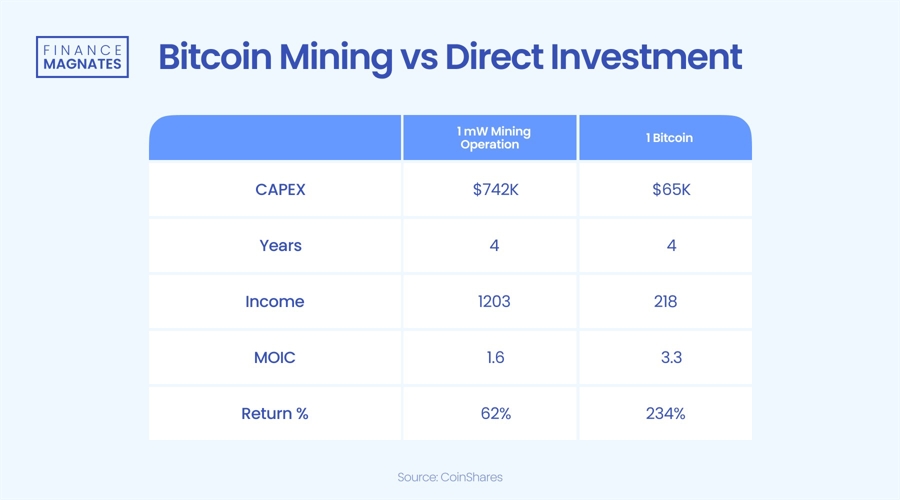
A
comparative study between Bitcoin mining and direct investment highlights key
financial dynamics (infographic above). A typical 1 MW mining project, using
advanced equipment like the Canaan Avalon A1566, demands around $740,000
upfront. Assuming Bitcoin prices reach $130,000 by late 2026 and electricity
costs remain at $0.045 per kilowatt-hour, operators could recover their initial
investment in approximately 27 months.
MARA
Holdings (NASDAQ: MARA), the publicly listed Bitcoin miner from Wall Street, reported mining 717 BTC in October, marking its strongest monthly production since April's halving event. The crypto mining giant continues expanding its operations toward year-end
targets.
MARA Posts Strong Bitcoin
Mining Performance in October, Hashrate Jumps 14%
The
company's energized hashrate reached 40.2 exahashes per second (EH/s) last
month, representing
a 14% increase from September levels. Despite winning slightly fewer blocks
due to rising network difficulty, overall bitcoin production grew 2%
month-over-month.
Fred Thiel, CEO, MARA, Source: LinkedIn
“Despite
a slight month-over-month decrease in block wins, driven by the growth in
global hash rate and the resulting rise in difficulty level, BTC production
increased by 2% to 717 BTC,” said Fred Thiel, MARA's Chairman and CEO.
Transaction
fees provided a notable boost to October's results, accounting for
approximately 5% of total Bitcoin produced. Two significant transactions
generated fees of 3.217 BTC and 2.665 BTC respectively, highlighting the
potential upside from MARA's proprietary mining technology platforms.
The company
informed two weeks ago, that
it acquired a $200 million line of credit. The company’s credit facility is
backed by a segment of its cryptocurrency holdings, underscoring the increasing
adoption of cryptocurrency-backed financing within the corporate sector.
MARA’s October 2024 #Bitcoin Production Update is here:
- Energized Hash Rate Increased 14% to 40.2 EH/s - 717 Bitcoin Produced in October, 2% Increase M/M - Transaction Fees Accounted for 5% of Total Bitcoin Produced
Although the
production numbers are rising, MARA and other publicly listed Bitcoin miners
from Wall Street are contending with rising production expenses, with the
average cost to mine one Bitcoin reaching $49,500 in the second quarter. When
including depreciation and stock-based compensation, this figure escalates to
$96,100 per Bitcoin, significantly impacting profit margins.
CoinShares'
recent report notes
that the industry is facing substantial challenges this year, with declining
revenues and hash prices. Increased market activity has elevated mining
difficulty to record levels, further exacerbating production costs.
In response
to these pressures, many mining operations are adjusting their business
strategies. Some are diversifying into artificial intelligence and
high-performance computing services to offset the financial strain caused by
escalating production costs.
A
comparative study between Bitcoin mining and direct investment highlights key
financial dynamics (infographic above). A typical 1 MW mining project, using
advanced equipment like the Canaan Avalon A1566, demands around $740,000
upfront. Assuming Bitcoin prices reach $130,000 by late 2026 and electricity
costs remain at $0.045 per kilowatt-hour, operators could recover their initial
investment in approximately 27 months.
Damian Chmiel is a Senior Analyst & Editor at Finance Magnates with more than 15 years of experience in the CFD and online trading industry. Active as both a trader and journalist since 2010, he focuses on broker coverage, fintech innovation, and regulatory developments across Europe, the Middle East, and Asia.
His work includes interviews with C-level leaders at major brokerages and fintech platforms, as well as co-authoring Finance Magnates’ quarterly industry benchmarking reports. Damian’s reporting is data-driven, market-aware, and grounded in direct industry engagement. His analysis and commentary have also been cited by external media outlets, including Investing.com, Binance, The Asset, Stockhead, and Dispatch.
Education:
MA in Finance and Accounting, Cracow University of Economics
Retail Traders Get Tokenized US IPO Allocations at Offer Price as Payward Expands xStocks
Featured Videos
Trading Tales: Stories from The Floor
Join seasoned financial markets professionals as they reflect on life spent in front of tickets, phones, and later screens, and the stories they’ve accumulated on sales and trading floors.
You can count on an unorthodox blend of candid perspectives and off-the-record tales that novices won’t get, and compliance won’t approve.
Attend at your own risk.
What to expect:
A deeper grasp of the evolution that Singapore's FX market has gone through
Practical wisdom on regional market peculiarities and FX careers
Unforgettable anecdotes that bring the Lion City's trading culture to life
Join seasoned financial markets professionals as they reflect on life spent in front of tickets, phones, and later screens, and the stories they’ve accumulated on sales and trading floors.
You can count on an unorthodox blend of candid perspectives and off-the-record tales that novices won’t get, and compliance won’t approve.
Attend at your own risk.
What to expect:
A deeper grasp of the evolution that Singapore's FX market has gone through
Practical wisdom on regional market peculiarities and FX careers
Unforgettable anecdotes that bring the Lion City's trading culture to life
Join seasoned financial markets professionals as they reflect on life spent in front of tickets, phones, and later screens, and the stories they’ve accumulated on sales and trading floors.
You can count on an unorthodox blend of candid perspectives and off-the-record tales that novices won’t get, and compliance won’t approve.
Attend at your own risk.
What to expect:
A deeper grasp of the evolution that Singapore's FX market has gone through
Practical wisdom on regional market peculiarities and FX careers
Unforgettable anecdotes that bring the Lion City's trading culture to life
Join seasoned financial markets professionals as they reflect on life spent in front of tickets, phones, and later screens, and the stories they’ve accumulated on sales and trading floors.
You can count on an unorthodox blend of candid perspectives and off-the-record tales that novices won’t get, and compliance won’t approve.
Attend at your own risk.
What to expect:
A deeper grasp of the evolution that Singapore's FX market has gone through
Practical wisdom on regional market peculiarities and FX careers
Unforgettable anecdotes that bring the Lion City's trading culture to life
Tokenized assets are all the rage across retail and institutional trading, but adoption might hit unique roadblocks for each.
This session gathers builders and architects practitioners to break down questions of infrastructure, ownership, and settlement that will define the next wave of asset tokenization.
Attendees will walk away with:
Institutional perspective on tokenized assets and what they unlock from bonds to debt
Understanding which paths are available for retail brokers and their compliance and product implications
Insight into where APAC regulators stand on tokenized securities
Tokenized assets are all the rage across retail and institutional trading, but adoption might hit unique roadblocks for each.
This session gathers builders and architects practitioners to break down questions of infrastructure, ownership, and settlement that will define the next wave of asset tokenization.
Attendees will walk away with:
Institutional perspective on tokenized assets and what they unlock from bonds to debt
Understanding which paths are available for retail brokers and their compliance and product implications
Insight into where APAC regulators stand on tokenized securities
Tokenized assets are all the rage across retail and institutional trading, but adoption might hit unique roadblocks for each.
This session gathers builders and architects practitioners to break down questions of infrastructure, ownership, and settlement that will define the next wave of asset tokenization.
Attendees will walk away with:
Institutional perspective on tokenized assets and what they unlock from bonds to debt
Understanding which paths are available for retail brokers and their compliance and product implications
Insight into where APAC regulators stand on tokenized securities
Tokenized assets are all the rage across retail and institutional trading, but adoption might hit unique roadblocks for each.
This session gathers builders and architects practitioners to break down questions of infrastructure, ownership, and settlement that will define the next wave of asset tokenization.
Attendees will walk away with:
Institutional perspective on tokenized assets and what they unlock from bonds to debt
Understanding which paths are available for retail brokers and their compliance and product implications
Insight into where APAC regulators stand on tokenized securities
Tokenized assets are all the rage across retail and institutional trading, but adoption might hit unique roadblocks for each.
This session gathers builders and architects practitioners to break down questions of infrastructure, ownership, and settlement that will define the next wave of asset tokenization.
Attendees will walk away with:
Institutional perspective on tokenized assets and what they unlock from bonds to debt
Understanding which paths are available for retail brokers and their compliance and product implications
Insight into where APAC regulators stand on tokenized securities
Tokenized assets are all the rage across retail and institutional trading, but adoption might hit unique roadblocks for each.
This session gathers builders and architects practitioners to break down questions of infrastructure, ownership, and settlement that will define the next wave of asset tokenization.
Attendees will walk away with:
Institutional perspective on tokenized assets and what they unlock from bonds to debt
Understanding which paths are available for retail brokers and their compliance and product implications
Insight into where APAC regulators stand on tokenized securities
As event contracts are set for ‘super-cycle’ growth in volumes and recognition, retail brokers simply can’t stay behind. But can regulated entities integrate a product that is awfully similar to betting?
Join builders across the ecosystemto gain insight into the industry's current and future stance on prediction markets.
Attendees will walk away with:
Better understanding of how the CME, Plus500, and prediction platforms collaborate
Assessment of 2026’s expected volumes and new ‘event’ areas ripe for contracts
Cross-industry understanding of different strategies by brokers (co-opt, partner, buy)
As event contracts are set for ‘super-cycle’ growth in volumes and recognition, retail brokers simply can’t stay behind. But can regulated entities integrate a product that is awfully similar to betting?
Join builders across the ecosystemto gain insight into the industry's current and future stance on prediction markets.
Attendees will walk away with:
Better understanding of how the CME, Plus500, and prediction platforms collaborate
Assessment of 2026’s expected volumes and new ‘event’ areas ripe for contracts
Cross-industry understanding of different strategies by brokers (co-opt, partner, buy)
As event contracts are set for ‘super-cycle’ growth in volumes and recognition, retail brokers simply can’t stay behind. But can regulated entities integrate a product that is awfully similar to betting?
Join builders across the ecosystemto gain insight into the industry's current and future stance on prediction markets.
Attendees will walk away with:
Better understanding of how the CME, Plus500, and prediction platforms collaborate
Assessment of 2026’s expected volumes and new ‘event’ areas ripe for contracts
Cross-industry understanding of different strategies by brokers (co-opt, partner, buy)
As event contracts are set for ‘super-cycle’ growth in volumes and recognition, retail brokers simply can’t stay behind. But can regulated entities integrate a product that is awfully similar to betting?
Join builders across the ecosystemto gain insight into the industry's current and future stance on prediction markets.
Attendees will walk away with:
Better understanding of how the CME, Plus500, and prediction platforms collaborate
Assessment of 2026’s expected volumes and new ‘event’ areas ripe for contracts
Cross-industry understanding of different strategies by brokers (co-opt, partner, buy)
As event contracts are set for ‘super-cycle’ growth in volumes and recognition, retail brokers simply can’t stay behind. But can regulated entities integrate a product that is awfully similar to betting?
Join builders across the ecosystemto gain insight into the industry's current and future stance on prediction markets.
Attendees will walk away with:
Better understanding of how the CME, Plus500, and prediction platforms collaborate
Assessment of 2026’s expected volumes and new ‘event’ areas ripe for contracts
Cross-industry understanding of different strategies by brokers (co-opt, partner, buy)
As event contracts are set for ‘super-cycle’ growth in volumes and recognition, retail brokers simply can’t stay behind. But can regulated entities integrate a product that is awfully similar to betting?
Join builders across the ecosystemto gain insight into the industry's current and future stance on prediction markets.
Attendees will walk away with:
Better understanding of how the CME, Plus500, and prediction platforms collaborate
Assessment of 2026’s expected volumes and new ‘event’ areas ripe for contracts
Cross-industry understanding of different strategies by brokers (co-opt, partner, buy)
Precious Insights: APAC's Bullion Market amid Record Volatility
The precious metals rally has challenged how brokers and LPs think about hedging, pricing, and physical delivery. But with regional banks eyeing physical gold retail and bullion brokers across Southeast Asia harnessing new tech, volatility is not only in 'safe havens'.
This session gathers practitioners from across the bullion ecosystem to unpack what the rally means on the ground in APAC.
Attendees will walk away with:
Insight into the physical market dynamics driving retail demand across Southeast Asia, from central bank buying to store-of-value purchases
Understanding of Singapore's distinct role as APAC's bullion gateway, and competition near and far
Perspective on operational challenges unique to APAC: kilogram pricing, local delivery, and bridging CFD and physical bullion infrastructure
The precious metals rally has challenged how brokers and LPs think about hedging, pricing, and physical delivery. But with regional banks eyeing physical gold retail and bullion brokers across Southeast Asia harnessing new tech, volatility is not only in 'safe havens'.
This session gathers practitioners from across the bullion ecosystem to unpack what the rally means on the ground in APAC.
Attendees will walk away with:
Insight into the physical market dynamics driving retail demand across Southeast Asia, from central bank buying to store-of-value purchases
Understanding of Singapore's distinct role as APAC's bullion gateway, and competition near and far
Perspective on operational challenges unique to APAC: kilogram pricing, local delivery, and bridging CFD and physical bullion infrastructure
The precious metals rally has challenged how brokers and LPs think about hedging, pricing, and physical delivery. But with regional banks eyeing physical gold retail and bullion brokers across Southeast Asia harnessing new tech, volatility is not only in 'safe havens'.
This session gathers practitioners from across the bullion ecosystem to unpack what the rally means on the ground in APAC.
Attendees will walk away with:
Insight into the physical market dynamics driving retail demand across Southeast Asia, from central bank buying to store-of-value purchases
Understanding of Singapore's distinct role as APAC's bullion gateway, and competition near and far
Perspective on operational challenges unique to APAC: kilogram pricing, local delivery, and bridging CFD and physical bullion infrastructure
The precious metals rally has challenged how brokers and LPs think about hedging, pricing, and physical delivery. But with regional banks eyeing physical gold retail and bullion brokers across Southeast Asia harnessing new tech, volatility is not only in 'safe havens'.
This session gathers practitioners from across the bullion ecosystem to unpack what the rally means on the ground in APAC.
Attendees will walk away with:
Insight into the physical market dynamics driving retail demand across Southeast Asia, from central bank buying to store-of-value purchases
Understanding of Singapore's distinct role as APAC's bullion gateway, and competition near and far
Perspective on operational challenges unique to APAC: kilogram pricing, local delivery, and bridging CFD and physical bullion infrastructure
The precious metals rally has challenged how brokers and LPs think about hedging, pricing, and physical delivery. But with regional banks eyeing physical gold retail and bullion brokers across Southeast Asia harnessing new tech, volatility is not only in 'safe havens'.
This session gathers practitioners from across the bullion ecosystem to unpack what the rally means on the ground in APAC.
Attendees will walk away with:
Insight into the physical market dynamics driving retail demand across Southeast Asia, from central bank buying to store-of-value purchases
Understanding of Singapore's distinct role as APAC's bullion gateway, and competition near and far
Perspective on operational challenges unique to APAC: kilogram pricing, local delivery, and bridging CFD and physical bullion infrastructure
The precious metals rally has challenged how brokers and LPs think about hedging, pricing, and physical delivery. But with regional banks eyeing physical gold retail and bullion brokers across Southeast Asia harnessing new tech, volatility is not only in 'safe havens'.
This session gathers practitioners from across the bullion ecosystem to unpack what the rally means on the ground in APAC.
Attendees will walk away with:
Insight into the physical market dynamics driving retail demand across Southeast Asia, from central bank buying to store-of-value purchases
Understanding of Singapore's distinct role as APAC's bullion gateway, and competition near and far
Perspective on operational challenges unique to APAC: kilogram pricing, local delivery, and bridging CFD and physical bullion infrastructure
License to Fill: Market Liquidity amid Global Turmoil
Asian markets bear unique characteristics, from connectivity to asset preference. The Singapore Summit will connect global executives and local experts across the liquidity chain to discuss volatility fluctuations, diversification vs over-reliance on single assets, and the role of trust and liquidity relationships in an increasingly automated sphere.