FTX's Founder, Sam Bankman-Fried, was found guilty of seven charges and will be sentenced in March.
The industry is now shifting into greater maturity.
Sam Bankman-Fried, FTX founder and former CEO
In an outcome that comes as no surprise to observers, Sam Bankman-Fried, the Founder and former CEO of the now-defunct crypto exchange FTX, has been found guilty on all seven charges that he faced during his trial. As a result, he now potentially faces a maximum prison sentence of 110 years.
Those charges include wire fraud, conspiracy to commit fraud, and conspiracy to commit money laundering. Bankman-Fried will be sentenced on March 28 next year, although he faces a second trial on March 11 for five additional charges.
With the trial concluded, there is a prevailing sense that a chapter has closed, and it prompts reflection on how this impacts the entire cryptocurrency industry. To fully grasp the significance of the past few tumultuous years, it’s essential to delve into the context and surrounding events that led to Bankman-Fried’s downfall.
2020 to 2021: A Crypto Carnival
Bankman-Fried launched FTX in 2019, and the exchange peaked in mid-2021. By then, it had become the third-largest crypto exchange in the world. It had over a million users, while its upper executives were, as is now widely documented, living in otherworldly opulence, and eccentricity, in the Bahamas.
Part of the reason this rapid growth was possible was that as FTX launched, crypto itself was heading towards a manically bullish period, having recovered from the crash of 2018, which happened after the hugely euphoric run-up in prices at the end of 2017.
As unprecedented pandemic measures went into force in 2020, entire populations worldwide found themselves at home, always online, and often with stimulus payments incoming from the government. This occurred in sync with 2020’s Bitcoin halving (a four-year event widely believed to move the BTC price upwards) and suddenly there was a perfect recipe for a surging crypto bull market, with FTX and other platforms reaping substantial returns.
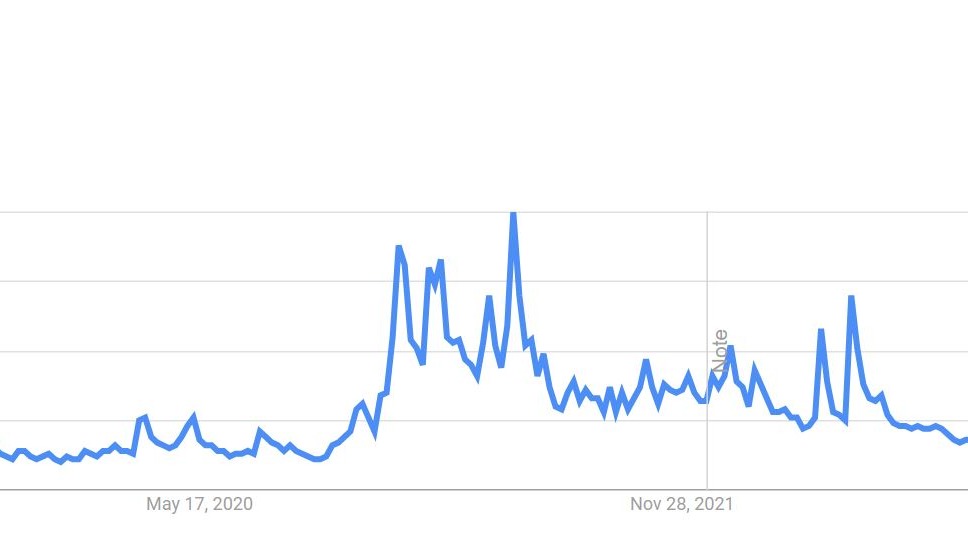
Worldwide Google searches for "bitcoin" surged in 2021.
What’s more, there was a public desire for a respectable exchange that retail investors, often inexperienced with crypto, could place their trust in. Bankman-fried stepped up to ensure that FTX played that role, putting in place celebrity endorsements, acquiring naming rights at what would briefly become the FTX Arena, and running a Super Bowl halftime commercial.
And, as for Bankman-Fried himself, he projected the role of disarmingly casual tech altruist: safely nerdish but visionary, or depicted as a genius who simply wanted to make society better, and make FTX’s users wealthier in the process. His hair was messy, he wore shorts, he claimed to drive a Toyota Corolla despite his riches, and he even advocated a supposedly world-changing brand of practical philosophy called Effective Altruism.
In addition, he generously contributed a significant portion of the funds he had available through FTX to politicians from both sides of the American political spectrum, thereby gaining influence and once more enhancing his political credibility.
The Crashes and Crises of 2022
In 2022, the exuberance around crypto that had propelled Bitcoin and other protocols to new all-time highs by late 2021 rapidly gave way to an industry-wide collapse, partly as a result of rising interest rates but fueled in a destructive feedback loop by the failure of Terra/Luna, and the collapse of crypto hedge fund Three Arrows Capital and lending protocol Celsius. Perhaps the most devastating blow occurred when FTX, a prominent player in the crypto space, filed for bankruptcy that November.
Remarkably, these shocks to the crypto system have resulted in four highly prominent individuals being arrested: not only Bankman-Fried but also Alex Mashinsky of Celsius on various counts of fraud and conspiracy; Do Kwon, the Co-Founder of Terra/Luna and creator Terraform Labs, now jailed in Montenegro for document forgery; and Su Zhu of Three Arrows Capital for failing to cooperate with bankruptcy proceedings in Singapore.
The End of an Era in Crypto?
The end of the SBF trial looks as though it may also mark the end of an era in crypto, indicating that the industry can never return to its wildest pioneer phase, or the attendant eccentricities and risks. That the jury verdict coincides with functioning regulatory frameworks being worked out worldwide, and even beginning to be put in place, only emphasizes the shift taking place.
Moreover, Bankman-Fried’s sentencing date, next March, looks like it might roughly coincide with the arrival of spot BTC ETFs, should they be approved. While we shouldn’t look for symbolism too much, one can’t help but detect that these changes in the landscape are happening all around the same time.
Crypto has been dominated in public, throughout its short history, by a series of flamboyant characters who sometimes push eccentricity to the extremes, or in Bankman-Fried’s case, into the realms of serious criminality. While we shouldn’t expect such participants to disappear entirely, on a stage to which sober corporate entities such as BlackRock are now entering, there will likely be fewer opportunities for another Bankman-Fried-like character to wrest temporary control of the story.
If the institutions are coming, then the game will change, and if you were on the front lines of crypto between 2019 and 2023, you got a close-up view of a clattering, one-of-a-kind spectacle that was truly of its moment.
The verdict may come to mark a change in crypto, as the industry shifts into greater maturity.
In an outcome that comes as no surprise to observers, Sam Bankman-Fried, the Founder and former CEO of the now-defunct crypto exchange FTX, has been found guilty on all seven charges that he faced during his trial. As a result, he now potentially faces a maximum prison sentence of 110 years.
Those charges include wire fraud, conspiracy to commit fraud, and conspiracy to commit money laundering. Bankman-Fried will be sentenced on March 28 next year, although he faces a second trial on March 11 for five additional charges.
With the trial concluded, there is a prevailing sense that a chapter has closed, and it prompts reflection on how this impacts the entire cryptocurrency industry. To fully grasp the significance of the past few tumultuous years, it’s essential to delve into the context and surrounding events that led to Bankman-Fried’s downfall.
2020 to 2021: A Crypto Carnival
Bankman-Fried launched FTX in 2019, and the exchange peaked in mid-2021. By then, it had become the third-largest crypto exchange in the world. It had over a million users, while its upper executives were, as is now widely documented, living in otherworldly opulence, and eccentricity, in the Bahamas.
Part of the reason this rapid growth was possible was that as FTX launched, crypto itself was heading towards a manically bullish period, having recovered from the crash of 2018, which happened after the hugely euphoric run-up in prices at the end of 2017.
As unprecedented pandemic measures went into force in 2020, entire populations worldwide found themselves at home, always online, and often with stimulus payments incoming from the government. This occurred in sync with 2020’s Bitcoin halving (a four-year event widely believed to move the BTC price upwards) and suddenly there was a perfect recipe for a surging crypto bull market, with FTX and other platforms reaping substantial returns.
Worldwide Google searches for "bitcoin" surged in 2021.
What’s more, there was a public desire for a respectable exchange that retail investors, often inexperienced with crypto, could place their trust in. Bankman-fried stepped up to ensure that FTX played that role, putting in place celebrity endorsements, acquiring naming rights at what would briefly become the FTX Arena, and running a Super Bowl halftime commercial.
And, as for Bankman-Fried himself, he projected the role of disarmingly casual tech altruist: safely nerdish but visionary, or depicted as a genius who simply wanted to make society better, and make FTX’s users wealthier in the process. His hair was messy, he wore shorts, he claimed to drive a Toyota Corolla despite his riches, and he even advocated a supposedly world-changing brand of practical philosophy called Effective Altruism.
In addition, he generously contributed a significant portion of the funds he had available through FTX to politicians from both sides of the American political spectrum, thereby gaining influence and once more enhancing his political credibility.
The Crashes and Crises of 2022
In 2022, the exuberance around crypto that had propelled Bitcoin and other protocols to new all-time highs by late 2021 rapidly gave way to an industry-wide collapse, partly as a result of rising interest rates but fueled in a destructive feedback loop by the failure of Terra/Luna, and the collapse of crypto hedge fund Three Arrows Capital and lending protocol Celsius. Perhaps the most devastating blow occurred when FTX, a prominent player in the crypto space, filed for bankruptcy that November.
Remarkably, these shocks to the crypto system have resulted in four highly prominent individuals being arrested: not only Bankman-Fried but also Alex Mashinsky of Celsius on various counts of fraud and conspiracy; Do Kwon, the Co-Founder of Terra/Luna and creator Terraform Labs, now jailed in Montenegro for document forgery; and Su Zhu of Three Arrows Capital for failing to cooperate with bankruptcy proceedings in Singapore.
The End of an Era in Crypto?
The end of the SBF trial looks as though it may also mark the end of an era in crypto, indicating that the industry can never return to its wildest pioneer phase, or the attendant eccentricities and risks. That the jury verdict coincides with functioning regulatory frameworks being worked out worldwide, and even beginning to be put in place, only emphasizes the shift taking place.
Moreover, Bankman-Fried’s sentencing date, next March, looks like it might roughly coincide with the arrival of spot BTC ETFs, should they be approved. While we shouldn’t look for symbolism too much, one can’t help but detect that these changes in the landscape are happening all around the same time.
Crypto has been dominated in public, throughout its short history, by a series of flamboyant characters who sometimes push eccentricity to the extremes, or in Bankman-Fried’s case, into the realms of serious criminality. While we shouldn’t expect such participants to disappear entirely, on a stage to which sober corporate entities such as BlackRock are now entering, there will likely be fewer opportunities for another Bankman-Fried-like character to wrest temporary control of the story.
If the institutions are coming, then the game will change, and if you were on the front lines of crypto between 2019 and 2023, you got a close-up view of a clattering, one-of-a-kind spectacle that was truly of its moment.
The verdict may come to mark a change in crypto, as the industry shifts into greater maturity.
Sam White is a writer and journalist from the UK who covers cryptocurrencies and web3, with a particular interest in NFTs and the crossover between art and finance. His work, on a wide variety of topics, has appeared on platforms including The Spectator, Vice and Hacker Noon.
Kraken Steps Up Speed Race with New Equinix Colocation Service for Crypto Traders
FP Markets Winner Spotlight 🏆 | Global Broker of the Year 2025 #Trading #Broker #Innovation #Shorts
FP Markets Winner Spotlight 🏆 | Global Broker of the Year 2025 #Trading #Broker #Innovation #Shorts
FP Markets takes the spotlight as Global Broker of the Year 2025 at the Finance Magnates Awards.
Martin Stoilov, Head of Client Experience, shares that trust, innovation, and people played a key role in the company’s success, supported by a strong foundation of integrity and client-centricity.
Following this milestone, FP Markets continues to focus on growth, technology investment, and its core values of transparency and excellence.
👉 Be part of FM Awards 2026: https://awards.financemagnates.com/#nominate
FP Markets takes the spotlight as Global Broker of the Year 2025 at the Finance Magnates Awards.
Martin Stoilov, Head of Client Experience, shares that trust, innovation, and people played a key role in the company’s success, supported by a strong foundation of integrity and client-centricity.
Following this milestone, FP Markets continues to focus on growth, technology investment, and its core values of transparency and excellence.
👉 Be part of FM Awards 2026: https://awards.financemagnates.com/#nominate
In this video, we review @HolaPrimeMarketsOfficial, a multi-asset forex and CFDs broker offering different account types, trading platforms, and flexible trading conditions.
We cover the broker’s overall offering, including account options, trading environment, platforms like MT4 and MT5, and additional services such as managed accounts and fast withdrawals.
Watch the full video to see if Hola Prime Markets fits your trading needs.
📣 Stay up to date with the latest in finance and trading. Follow Finance Magnates for industry news, insights, and global event coverage.
Connect with us:
🔗 LinkedIn: /financemagnates
👍 Facebook: /financemagnates
📸 Instagram: https://www.instagram.com/financemagnates
🐦 X: https://x.com/financemagnates
🎥 TikTok: https://www.tiktok.com/tag/financemagnates
▶️ YouTube: /@financemagnates_official
#HolaPrime #ForexBroker #CFDTrading #FinanceMagnates #Trading #Forex #BrokerReview
In this video, we review @HolaPrimeMarketsOfficial, a multi-asset forex and CFDs broker offering different account types, trading platforms, and flexible trading conditions.
We cover the broker’s overall offering, including account options, trading environment, platforms like MT4 and MT5, and additional services such as managed accounts and fast withdrawals.
Watch the full video to see if Hola Prime Markets fits your trading needs.
📣 Stay up to date with the latest in finance and trading. Follow Finance Magnates for industry news, insights, and global event coverage.
Connect with us:
🔗 LinkedIn: /financemagnates
👍 Facebook: /financemagnates
📸 Instagram: https://www.instagram.com/financemagnates
🐦 X: https://x.com/financemagnates
🎥 TikTok: https://www.tiktok.com/tag/financemagnates
▶️ YouTube: /@financemagnates_official
#HolaPrime #ForexBroker #CFDTrading #FinanceMagnates #Trading #Forex #BrokerReview
Hola Prime Review: What You Need to Know | Full Breakdown by Finance Magnates
Hola Prime Review: What You Need to Know | Full Breakdown by Finance Magnates
In this video, we review @HolaPrime_Global, a proprietary trading firm offering evaluation programs and performance-based payouts in simulated market environments.
We cover how the challenge model works, including account types, profit splits (up to 95%), trading rules, and what it takes to reach a funded account. You’ll also learn about available platforms like MT4, MT5, cTrader, and more, along with insights into payouts, support, and trading conditions.
Watch the full video to see if Hola Prime fits your trading style.
📣 Stay up to date with the latest in finance and trading. Follow Finance Magnates for industry news, insights, and global event coverage.
Connect with us:
🔗 LinkedIn: /financemagnates
👍 Facebook: /financemagnates
📸 Instagram: https://www.instagram.com/financemagnates
🐦 X: https://x.com/financemagnates
🎥 TikTok: https://www.tiktok.com/tag/financemagnates
▶️ YouTube: /@financemagnates_official
#HolaPrime #PropFirm #Trading #FinanceMagnates #Forex #FuturesTrading #TradingReview #PropFirmReview
In this video, we review @HolaPrime_Global, a proprietary trading firm offering evaluation programs and performance-based payouts in simulated market environments.
We cover how the challenge model works, including account types, profit splits (up to 95%), trading rules, and what it takes to reach a funded account. You’ll also learn about available platforms like MT4, MT5, cTrader, and more, along with insights into payouts, support, and trading conditions.
Watch the full video to see if Hola Prime fits your trading style.
📣 Stay up to date with the latest in finance and trading. Follow Finance Magnates for industry news, insights, and global event coverage.
Connect with us:
🔗 LinkedIn: /financemagnates
👍 Facebook: /financemagnates
📸 Instagram: https://www.instagram.com/financemagnates
🐦 X: https://x.com/financemagnates
🎥 TikTok: https://www.tiktok.com/tag/financemagnates
▶️ YouTube: /@financemagnates_official
#HolaPrime #PropFirm #Trading #FinanceMagnates #Forex #FuturesTrading #TradingReview #PropFirmReview
Axi Winner Spotlight 🏆 | Global Most Innovative Broker 2025 #Innovation #Trading #Fintech #Broker
Axi Winner Spotlight 🏆 | Global Most Innovative Broker 2025 #Innovation #Trading #Fintech #Broker
Axi takes the spotlight at the Finance Magnates Awards, winning Global Most Innovative Broker 2025.
Olivia Xenofontos and Ivanna Openko share how the team will feel: proud, motivated, and ready to keep delivering.
They also describe the night as well-organized, focused, and enjoyable for all.
👉 Be part of FM Awards 2026.
Axi takes the spotlight at the Finance Magnates Awards, winning Global Most Innovative Broker 2025.
Olivia Xenofontos and Ivanna Openko share how the team will feel: proud, motivated, and ready to keep delivering.
They also describe the night as well-organized, focused, and enjoyable for all.
👉 Be part of FM Awards 2026.
Recognition that matters.
Built on transparency.
Driven by the industry.
The Finance Magnates Awards 2026.
Nominations are now open.
🔗 https://awards.financemagnates.com/?utm_source=SM&utm_medium=social&utm_campaign=recognition-matters
Recognition that matters.
Built on transparency.
Driven by the industry.
The Finance Magnates Awards 2026.
Nominations are now open.
🔗 https://awards.financemagnates.com/?utm_source=SM&utm_medium=social&utm_campaign=recognition-matters