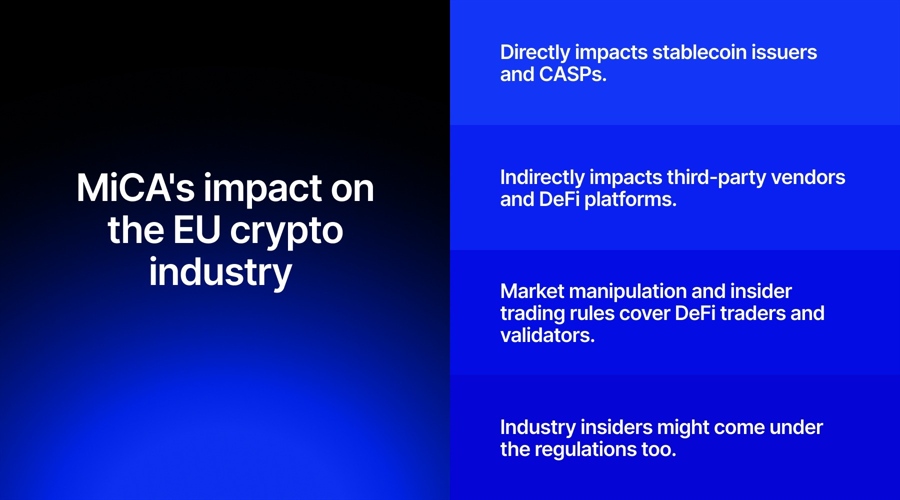
Finance Magnates spoke with industry representatives about how the new EU regulations will impact cryptocurrencies.
The CEO of ZondaCrypto pointed out that billions of dollars have already flowed out of non-compliant Tether.
Smaller entities may be pushed out of the market, further strengthening the dominance of larger players.
From left: Kral (zondacrypto), Melachrinos (Kaiko), Perrott (TRAction) and Manganiello (LIAN Group)
The
European Union's Markets in Crypto-Assets (MiCA) regulation is transforming the
continent's digital asset landscape, with early impacts already visible in
market shifts and competitive dynamics among the industry.
Are
companies ready for the new regulations? We asked industry representatives and
compliance experts, and the findings are rather grim. While major players will
likely adapt, most smaller firms are still unprepared to operate under the new
rules.
MiCA: “The Next Phase
of Crypto's Mainstream Adoption”
“This
is undoubtedly a sizable regulatory shift, and I completely recognize that
many feel underprepared,” noted Fiorenzo Manganiello of LIAN Group.
“That said, a robust framework that encourages institutional investors to
place their faith in these assets is exactly what we need right now, and
European players will reap the rewards in the long-term. This is the next phase
of crypto's mainstream adoption—soon, the markets will reap the benefits.”
“A Tendency for
Mergers and Acquisitions”—Market Consolidation Looms
Przemysław
Kral, CEO of zondacrypto, offered a stark assessment of the situation:
“For small players, MiCA compliance requirements might mean increased
market consolidation. We can expect a tendency for mergers and acquisitions.
Other smaller crypto businesses, particularly those with limited resources,
might be forced to quit the EU market as a result of high costs of
compliance.”
MiCA is officially live! 🇪🇺
After years of consultation, heated debates, contemplated bitcoin bans, last-minute amendments, and countless votes, MiCA now (actually since Dec 30 2024) officially applies to crypto-asset issuers and service providers in the EU - even if the latter… pic.twitter.com/3ZTH0KjkIC
Kral
further noted that some businesses might transition to more flexible
jurisdictions, potentially driving “migration of some businesses to
outside EU countries with less strict regulations or even without
regulations.”
Quinn
Perrott, co-CEO of TRAction, highlighted specific regional challenges: “EU
firms facing gaps in their infrastructure in relation to MiCA compliance,
particularly regions like Poland, Czechia and Baltic nations who are currently
in fairly relaxed regulatory environments, will need to put in significant
effort towards alignment and compliance with MiCA.”
Stablecoin Market Shifts: “The
Direction of Capital Flow”
The
regulatory framework, which took full effect in January 2025, has created a
clear divide between compliant and non-compliant entities, particularly in the
stablecoin market where Circle has gained ground as Tether faces challenges.
The
regulation's liquid reserve requirements—30% for asset-referenced tokens (ARTs)
and 60% for significant ARTs—have already triggered notable market movements.
“Tether
lost 1.3 billion USD of its market capitalization, which might be a sign of
outflow of investors in the face of new regulations. Circle gained 400 million
dollars. It shows the direction of the capital flow into projects perceived as
more compliant with the new regulations,” Kral explained.
Kaiko Head
of Research Anastasia Melachrinos provided additional context on these shifts:
“MiCA-compliant stablecoins, such as Circle's EURC and Société Générale's
EURCV, have seen their market share surge to an all-time high of 67%, primarily
due to major exchanges delisting non-compliant stablecoins like Tether's
EURT.”
“MiCA
regulations are already leaving their mark on digital asset issuers across the
EU, as some of the most successful crypto players get to grips with the new
guardrails,” added Manganiello. “Just one example is the stablecoin
market upheaval we're seeing as Circle takes a stab at Tether's market
share.”
Despite the
short-term disruption, many industry leaders remain optimistic about MiCA's
long-term impact on the European crypto sector.
“Once
issuers and exchanges get used to the new normal, I'd argue the stability and
credibility these rules bring will encourage more players to enter the market.
In the long-term, MiCA won't drown competition out—it'll drive innovation
further,” Manganiello said.
Kral echoed
this sentiment: “MiCA aims at creating a more stable and secure
environment for consumers and businesses. In the long-term, it is going to lead
to a more sustainable crypto market.”
However,
Melachrinos offered a more measured assessment of current market dynamics:
“Despite these changes, overall weekly trading volumes for EUR-backed
stablecoins have remained steady at around $30 million since MiCA's
implementation, indicating that the market share shifts are mainly due to
compliance-driven delistings rather than increased demand.”
As the
industry continues to adapt to the new regulatory framework, the competitive
landscape will likely continue to evolve. Well-capitalized and compliant
players will be positioned to gain market share while smaller entities face
difficult choices about their future in the European market.
Analysis: Convergence and
Divergence
The experts
converge on key points: MiCA will consolidate the market, favor compliant and
well-capitalized firms, and ultimately enhance stability. However, their tones
differ. Manganiello and Kral are proactive, viewing MiCA as a catalyst for
innovation and growth. Perrott is more cautious, emphasizing the logistical
hurdles, especially for Eastern Europe. Melachrinos, grounded in data, offers a
neutral lens, highlighting shifts without overpredicting outcomes.
The
stablecoin narrative exemplifies this dynamic: all note Circle’s gains and
Tether’s losses, but Manganiello sees it as healthy competition, Perrott as a
compliance triumph, Kral as a capital flow signal, and Melachrinos as a market
share realignment. This suggests MiCA’s impact is multifaceted, hinging on
firms’ readiness and resources.
The
European Union's Markets in Crypto-Assets (MiCA) regulation is transforming the
continent's digital asset landscape, with early impacts already visible in
market shifts and competitive dynamics among the industry.
Are
companies ready for the new regulations? We asked industry representatives and
compliance experts, and the findings are rather grim. While major players will
likely adapt, most smaller firms are still unprepared to operate under the new
rules.
MiCA: “The Next Phase
of Crypto's Mainstream Adoption”
“This
is undoubtedly a sizable regulatory shift, and I completely recognize that
many feel underprepared,” noted Fiorenzo Manganiello of LIAN Group.
“That said, a robust framework that encourages institutional investors to
place their faith in these assets is exactly what we need right now, and
European players will reap the rewards in the long-term. This is the next phase
of crypto's mainstream adoption—soon, the markets will reap the benefits.”
“A Tendency for
Mergers and Acquisitions”—Market Consolidation Looms
Przemysław
Kral, CEO of zondacrypto, offered a stark assessment of the situation:
“For small players, MiCA compliance requirements might mean increased
market consolidation. We can expect a tendency for mergers and acquisitions.
Other smaller crypto businesses, particularly those with limited resources,
might be forced to quit the EU market as a result of high costs of
compliance.”
MiCA is officially live! 🇪🇺
After years of consultation, heated debates, contemplated bitcoin bans, last-minute amendments, and countless votes, MiCA now (actually since Dec 30 2024) officially applies to crypto-asset issuers and service providers in the EU - even if the latter… pic.twitter.com/3ZTH0KjkIC
Kral
further noted that some businesses might transition to more flexible
jurisdictions, potentially driving “migration of some businesses to
outside EU countries with less strict regulations or even without
regulations.”
Quinn
Perrott, co-CEO of TRAction, highlighted specific regional challenges: “EU
firms facing gaps in their infrastructure in relation to MiCA compliance,
particularly regions like Poland, Czechia and Baltic nations who are currently
in fairly relaxed regulatory environments, will need to put in significant
effort towards alignment and compliance with MiCA.”
Stablecoin Market Shifts: “The
Direction of Capital Flow”
The
regulatory framework, which took full effect in January 2025, has created a
clear divide between compliant and non-compliant entities, particularly in the
stablecoin market where Circle has gained ground as Tether faces challenges.
The
regulation's liquid reserve requirements—30% for asset-referenced tokens (ARTs)
and 60% for significant ARTs—have already triggered notable market movements.
“Tether
lost 1.3 billion USD of its market capitalization, which might be a sign of
outflow of investors in the face of new regulations. Circle gained 400 million
dollars. It shows the direction of the capital flow into projects perceived as
more compliant with the new regulations,” Kral explained.
Kaiko Head
of Research Anastasia Melachrinos provided additional context on these shifts:
“MiCA-compliant stablecoins, such as Circle's EURC and Société Générale's
EURCV, have seen their market share surge to an all-time high of 67%, primarily
due to major exchanges delisting non-compliant stablecoins like Tether's
EURT.”
“MiCA
regulations are already leaving their mark on digital asset issuers across the
EU, as some of the most successful crypto players get to grips with the new
guardrails,” added Manganiello. “Just one example is the stablecoin
market upheaval we're seeing as Circle takes a stab at Tether's market
share.”
Despite the
short-term disruption, many industry leaders remain optimistic about MiCA's
long-term impact on the European crypto sector.
“Once
issuers and exchanges get used to the new normal, I'd argue the stability and
credibility these rules bring will encourage more players to enter the market.
In the long-term, MiCA won't drown competition out—it'll drive innovation
further,” Manganiello said.
Kral echoed
this sentiment: “MiCA aims at creating a more stable and secure
environment for consumers and businesses. In the long-term, it is going to lead
to a more sustainable crypto market.”
However,
Melachrinos offered a more measured assessment of current market dynamics:
“Despite these changes, overall weekly trading volumes for EUR-backed
stablecoins have remained steady at around $30 million since MiCA's
implementation, indicating that the market share shifts are mainly due to
compliance-driven delistings rather than increased demand.”
As the
industry continues to adapt to the new regulatory framework, the competitive
landscape will likely continue to evolve. Well-capitalized and compliant
players will be positioned to gain market share while smaller entities face
difficult choices about their future in the European market.
Analysis: Convergence and
Divergence
The experts
converge on key points: MiCA will consolidate the market, favor compliant and
well-capitalized firms, and ultimately enhance stability. However, their tones
differ. Manganiello and Kral are proactive, viewing MiCA as a catalyst for
innovation and growth. Perrott is more cautious, emphasizing the logistical
hurdles, especially for Eastern Europe. Melachrinos, grounded in data, offers a
neutral lens, highlighting shifts without overpredicting outcomes.
The
stablecoin narrative exemplifies this dynamic: all note Circle’s gains and
Tether’s losses, but Manganiello sees it as healthy competition, Perrott as a
compliance triumph, Kral as a capital flow signal, and Melachrinos as a market
share realignment. This suggests MiCA’s impact is multifaceted, hinging on
firms’ readiness and resources.
Damian Chmiel is a Senior Analyst & Editor at Finance Magnates with more than 15 years of experience in the CFD and online trading industry. Active as both a trader and journalist since 2010, he focuses on broker coverage, fintech innovation, and regulatory developments across Europe, the Middle East, and Asia.
His work includes interviews with C-level leaders at major brokerages and fintech platforms, as well as co-authoring Finance Magnates’ quarterly industry benchmarking reports. Damian’s reporting is data-driven, market-aware, and grounded in direct industry engagement. His analysis and commentary have also been cited by external media outlets, including Investing.com, Binance, The Asset, Stockhead, and Dispatch.
Education:
MA in Finance and Accounting, Cracow University of Economics
Kraken Steps Up Speed Race with New Equinix Colocation Service for Crypto Traders
Featured Videos
FP Markets Winner Spotlight 🏆 | Global Broker of the Year 2025 #Trading #Broker #Innovation #Shorts
FP Markets Winner Spotlight 🏆 | Global Broker of the Year 2025 #Trading #Broker #Innovation #Shorts
FP Markets Winner Spotlight 🏆 | Global Broker of the Year 2025 #Trading #Broker #Innovation #Shorts
FP Markets Winner Spotlight 🏆 | Global Broker of the Year 2025 #Trading #Broker #Innovation #Shorts
FP Markets takes the spotlight as Global Broker of the Year 2025 at the Finance Magnates Awards.
Martin Stoilov, Head of Client Experience, shares that trust, innovation, and people played a key role in the company’s success, supported by a strong foundation of integrity and client-centricity.
Following this milestone, FP Markets continues to focus on growth, technology investment, and its core values of transparency and excellence.
👉 Be part of FM Awards 2026: https://awards.financemagnates.com/#nominate
FP Markets takes the spotlight as Global Broker of the Year 2025 at the Finance Magnates Awards.
Martin Stoilov, Head of Client Experience, shares that trust, innovation, and people played a key role in the company’s success, supported by a strong foundation of integrity and client-centricity.
Following this milestone, FP Markets continues to focus on growth, technology investment, and its core values of transparency and excellence.
👉 Be part of FM Awards 2026: https://awards.financemagnates.com/#nominate
FP Markets takes the spotlight as Global Broker of the Year 2025 at the Finance Magnates Awards.
Martin Stoilov, Head of Client Experience, shares that trust, innovation, and people played a key role in the company’s success, supported by a strong foundation of integrity and client-centricity.
Following this milestone, FP Markets continues to focus on growth, technology investment, and its core values of transparency and excellence.
👉 Be part of FM Awards 2026: https://awards.financemagnates.com/#nominate
FP Markets takes the spotlight as Global Broker of the Year 2025 at the Finance Magnates Awards.
Martin Stoilov, Head of Client Experience, shares that trust, innovation, and people played a key role in the company’s success, supported by a strong foundation of integrity and client-centricity.
Following this milestone, FP Markets continues to focus on growth, technology investment, and its core values of transparency and excellence.
👉 Be part of FM Awards 2026: https://awards.financemagnates.com/#nominate
In this video, we review @HolaPrimeMarketsOfficial, a multi-asset forex and CFDs broker offering different account types, trading platforms, and flexible trading conditions.
We cover the broker’s overall offering, including account options, trading environment, platforms like MT4 and MT5, and additional services such as managed accounts and fast withdrawals.
Watch the full video to see if Hola Prime Markets fits your trading needs.
📣 Stay up to date with the latest in finance and trading. Follow Finance Magnates for industry news, insights, and global event coverage.
Connect with us:
🔗 LinkedIn: /financemagnates
👍 Facebook: /financemagnates
📸 Instagram: https://www.instagram.com/financemagnates
🐦 X: https://x.com/financemagnates
🎥 TikTok: https://www.tiktok.com/tag/financemagnates
▶️ YouTube: /@financemagnates_official
#HolaPrime #ForexBroker #CFDTrading #FinanceMagnates #Trading #Forex #BrokerReview
In this video, we review @HolaPrimeMarketsOfficial, a multi-asset forex and CFDs broker offering different account types, trading platforms, and flexible trading conditions.
We cover the broker’s overall offering, including account options, trading environment, platforms like MT4 and MT5, and additional services such as managed accounts and fast withdrawals.
Watch the full video to see if Hola Prime Markets fits your trading needs.
📣 Stay up to date with the latest in finance and trading. Follow Finance Magnates for industry news, insights, and global event coverage.
Connect with us:
🔗 LinkedIn: /financemagnates
👍 Facebook: /financemagnates
📸 Instagram: https://www.instagram.com/financemagnates
🐦 X: https://x.com/financemagnates
🎥 TikTok: https://www.tiktok.com/tag/financemagnates
▶️ YouTube: /@financemagnates_official
#HolaPrime #ForexBroker #CFDTrading #FinanceMagnates #Trading #Forex #BrokerReview
In this video, we review @HolaPrimeMarketsOfficial, a multi-asset forex and CFDs broker offering different account types, trading platforms, and flexible trading conditions.
We cover the broker’s overall offering, including account options, trading environment, platforms like MT4 and MT5, and additional services such as managed accounts and fast withdrawals.
Watch the full video to see if Hola Prime Markets fits your trading needs.
📣 Stay up to date with the latest in finance and trading. Follow Finance Magnates for industry news, insights, and global event coverage.
Connect with us:
🔗 LinkedIn: /financemagnates
👍 Facebook: /financemagnates
📸 Instagram: https://www.instagram.com/financemagnates
🐦 X: https://x.com/financemagnates
🎥 TikTok: https://www.tiktok.com/tag/financemagnates
▶️ YouTube: /@financemagnates_official
#HolaPrime #ForexBroker #CFDTrading #FinanceMagnates #Trading #Forex #BrokerReview
In this video, we review @HolaPrimeMarketsOfficial, a multi-asset forex and CFDs broker offering different account types, trading platforms, and flexible trading conditions.
We cover the broker’s overall offering, including account options, trading environment, platforms like MT4 and MT5, and additional services such as managed accounts and fast withdrawals.
Watch the full video to see if Hola Prime Markets fits your trading needs.
📣 Stay up to date with the latest in finance and trading. Follow Finance Magnates for industry news, insights, and global event coverage.
Connect with us:
🔗 LinkedIn: /financemagnates
👍 Facebook: /financemagnates
📸 Instagram: https://www.instagram.com/financemagnates
🐦 X: https://x.com/financemagnates
🎥 TikTok: https://www.tiktok.com/tag/financemagnates
▶️ YouTube: /@financemagnates_official
#HolaPrime #ForexBroker #CFDTrading #FinanceMagnates #Trading #Forex #BrokerReview
In this video, we review @HolaPrimeMarketsOfficial, a multi-asset forex and CFDs broker offering different account types, trading platforms, and flexible trading conditions.
We cover the broker’s overall offering, including account options, trading environment, platforms like MT4 and MT5, and additional services such as managed accounts and fast withdrawals.
Watch the full video to see if Hola Prime Markets fits your trading needs.
📣 Stay up to date with the latest in finance and trading. Follow Finance Magnates for industry news, insights, and global event coverage.
Connect with us:
🔗 LinkedIn: /financemagnates
👍 Facebook: /financemagnates
📸 Instagram: https://www.instagram.com/financemagnates
🐦 X: https://x.com/financemagnates
🎥 TikTok: https://www.tiktok.com/tag/financemagnates
▶️ YouTube: /@financemagnates_official
#HolaPrime #ForexBroker #CFDTrading #FinanceMagnates #Trading #Forex #BrokerReview
In this video, we review @HolaPrimeMarketsOfficial, a multi-asset forex and CFDs broker offering different account types, trading platforms, and flexible trading conditions.
We cover the broker’s overall offering, including account options, trading environment, platforms like MT4 and MT5, and additional services such as managed accounts and fast withdrawals.
Watch the full video to see if Hola Prime Markets fits your trading needs.
📣 Stay up to date with the latest in finance and trading. Follow Finance Magnates for industry news, insights, and global event coverage.
Connect with us:
🔗 LinkedIn: /financemagnates
👍 Facebook: /financemagnates
📸 Instagram: https://www.instagram.com/financemagnates
🐦 X: https://x.com/financemagnates
🎥 TikTok: https://www.tiktok.com/tag/financemagnates
▶️ YouTube: /@financemagnates_official
#HolaPrime #ForexBroker #CFDTrading #FinanceMagnates #Trading #Forex #BrokerReview
Hola Prime Review: What You Need to Know | Full Breakdown by Finance Magnates
Hola Prime Review: What You Need to Know | Full Breakdown by Finance Magnates
Hola Prime Review: What You Need to Know | Full Breakdown by Finance Magnates
Hola Prime Review: What You Need to Know | Full Breakdown by Finance Magnates
Hola Prime Review: What You Need to Know | Full Breakdown by Finance Magnates
Hola Prime Review: What You Need to Know | Full Breakdown by Finance Magnates
In this video, we review @HolaPrime_Global, a proprietary trading firm offering evaluation programs and performance-based payouts in simulated market environments.
We cover how the challenge model works, including account types, profit splits (up to 95%), trading rules, and what it takes to reach a funded account. You’ll also learn about available platforms like MT4, MT5, cTrader, and more, along with insights into payouts, support, and trading conditions.
Watch the full video to see if Hola Prime fits your trading style.
📣 Stay up to date with the latest in finance and trading. Follow Finance Magnates for industry news, insights, and global event coverage.
Connect with us:
🔗 LinkedIn: /financemagnates
👍 Facebook: /financemagnates
📸 Instagram: https://www.instagram.com/financemagnates
🐦 X: https://x.com/financemagnates
🎥 TikTok: https://www.tiktok.com/tag/financemagnates
▶️ YouTube: /@financemagnates_official
#HolaPrime #PropFirm #Trading #FinanceMagnates #Forex #FuturesTrading #TradingReview #PropFirmReview
In this video, we review @HolaPrime_Global, a proprietary trading firm offering evaluation programs and performance-based payouts in simulated market environments.
We cover how the challenge model works, including account types, profit splits (up to 95%), trading rules, and what it takes to reach a funded account. You’ll also learn about available platforms like MT4, MT5, cTrader, and more, along with insights into payouts, support, and trading conditions.
Watch the full video to see if Hola Prime fits your trading style.
📣 Stay up to date with the latest in finance and trading. Follow Finance Magnates for industry news, insights, and global event coverage.
Connect with us:
🔗 LinkedIn: /financemagnates
👍 Facebook: /financemagnates
📸 Instagram: https://www.instagram.com/financemagnates
🐦 X: https://x.com/financemagnates
🎥 TikTok: https://www.tiktok.com/tag/financemagnates
▶️ YouTube: /@financemagnates_official
#HolaPrime #PropFirm #Trading #FinanceMagnates #Forex #FuturesTrading #TradingReview #PropFirmReview
In this video, we review @HolaPrime_Global, a proprietary trading firm offering evaluation programs and performance-based payouts in simulated market environments.
We cover how the challenge model works, including account types, profit splits (up to 95%), trading rules, and what it takes to reach a funded account. You’ll also learn about available platforms like MT4, MT5, cTrader, and more, along with insights into payouts, support, and trading conditions.
Watch the full video to see if Hola Prime fits your trading style.
📣 Stay up to date with the latest in finance and trading. Follow Finance Magnates for industry news, insights, and global event coverage.
Connect with us:
🔗 LinkedIn: /financemagnates
👍 Facebook: /financemagnates
📸 Instagram: https://www.instagram.com/financemagnates
🐦 X: https://x.com/financemagnates
🎥 TikTok: https://www.tiktok.com/tag/financemagnates
▶️ YouTube: /@financemagnates_official
#HolaPrime #PropFirm #Trading #FinanceMagnates #Forex #FuturesTrading #TradingReview #PropFirmReview
In this video, we review @HolaPrime_Global, a proprietary trading firm offering evaluation programs and performance-based payouts in simulated market environments.
We cover how the challenge model works, including account types, profit splits (up to 95%), trading rules, and what it takes to reach a funded account. You’ll also learn about available platforms like MT4, MT5, cTrader, and more, along with insights into payouts, support, and trading conditions.
Watch the full video to see if Hola Prime fits your trading style.
📣 Stay up to date with the latest in finance and trading. Follow Finance Magnates for industry news, insights, and global event coverage.
Connect with us:
🔗 LinkedIn: /financemagnates
👍 Facebook: /financemagnates
📸 Instagram: https://www.instagram.com/financemagnates
🐦 X: https://x.com/financemagnates
🎥 TikTok: https://www.tiktok.com/tag/financemagnates
▶️ YouTube: /@financemagnates_official
#HolaPrime #PropFirm #Trading #FinanceMagnates #Forex #FuturesTrading #TradingReview #PropFirmReview
In this video, we review @HolaPrime_Global, a proprietary trading firm offering evaluation programs and performance-based payouts in simulated market environments.
We cover how the challenge model works, including account types, profit splits (up to 95%), trading rules, and what it takes to reach a funded account. You’ll also learn about available platforms like MT4, MT5, cTrader, and more, along with insights into payouts, support, and trading conditions.
Watch the full video to see if Hola Prime fits your trading style.
📣 Stay up to date with the latest in finance and trading. Follow Finance Magnates for industry news, insights, and global event coverage.
Connect with us:
🔗 LinkedIn: /financemagnates
👍 Facebook: /financemagnates
📸 Instagram: https://www.instagram.com/financemagnates
🐦 X: https://x.com/financemagnates
🎥 TikTok: https://www.tiktok.com/tag/financemagnates
▶️ YouTube: /@financemagnates_official
#HolaPrime #PropFirm #Trading #FinanceMagnates #Forex #FuturesTrading #TradingReview #PropFirmReview
In this video, we review @HolaPrime_Global, a proprietary trading firm offering evaluation programs and performance-based payouts in simulated market environments.
We cover how the challenge model works, including account types, profit splits (up to 95%), trading rules, and what it takes to reach a funded account. You’ll also learn about available platforms like MT4, MT5, cTrader, and more, along with insights into payouts, support, and trading conditions.
Watch the full video to see if Hola Prime fits your trading style.
📣 Stay up to date with the latest in finance and trading. Follow Finance Magnates for industry news, insights, and global event coverage.
Connect with us:
🔗 LinkedIn: /financemagnates
👍 Facebook: /financemagnates
📸 Instagram: https://www.instagram.com/financemagnates
🐦 X: https://x.com/financemagnates
🎥 TikTok: https://www.tiktok.com/tag/financemagnates
▶️ YouTube: /@financemagnates_official
#HolaPrime #PropFirm #Trading #FinanceMagnates #Forex #FuturesTrading #TradingReview #PropFirmReview
Axi Winner Spotlight 🏆 | Global Most Innovative Broker 2025 #Innovation #Trading #Fintech #Broker
Axi Winner Spotlight 🏆 | Global Most Innovative Broker 2025 #Innovation #Trading #Fintech #Broker
Axi Winner Spotlight 🏆 | Global Most Innovative Broker 2025 #Innovation #Trading #Fintech #Broker
Axi Winner Spotlight 🏆 | Global Most Innovative Broker 2025 #Innovation #Trading #Fintech #Broker
Axi Winner Spotlight 🏆 | Global Most Innovative Broker 2025 #Innovation #Trading #Fintech #Broker
Axi Winner Spotlight 🏆 | Global Most Innovative Broker 2025 #Innovation #Trading #Fintech #Broker
Axi takes the spotlight at the Finance Magnates Awards, winning Global Most Innovative Broker 2025.
Olivia Xenofontos and Ivanna Openko share how the team will feel: proud, motivated, and ready to keep delivering.
They also describe the night as well-organized, focused, and enjoyable for all.
👉 Be part of FM Awards 2026.
Axi takes the spotlight at the Finance Magnates Awards, winning Global Most Innovative Broker 2025.
Olivia Xenofontos and Ivanna Openko share how the team will feel: proud, motivated, and ready to keep delivering.
They also describe the night as well-organized, focused, and enjoyable for all.
👉 Be part of FM Awards 2026.
Axi takes the spotlight at the Finance Magnates Awards, winning Global Most Innovative Broker 2025.
Olivia Xenofontos and Ivanna Openko share how the team will feel: proud, motivated, and ready to keep delivering.
They also describe the night as well-organized, focused, and enjoyable for all.
👉 Be part of FM Awards 2026.
Axi takes the spotlight at the Finance Magnates Awards, winning Global Most Innovative Broker 2025.
Olivia Xenofontos and Ivanna Openko share how the team will feel: proud, motivated, and ready to keep delivering.
They also describe the night as well-organized, focused, and enjoyable for all.
👉 Be part of FM Awards 2026.
Axi takes the spotlight at the Finance Magnates Awards, winning Global Most Innovative Broker 2025.
Olivia Xenofontos and Ivanna Openko share how the team will feel: proud, motivated, and ready to keep delivering.
They also describe the night as well-organized, focused, and enjoyable for all.
👉 Be part of FM Awards 2026.
Axi takes the spotlight at the Finance Magnates Awards, winning Global Most Innovative Broker 2025.
Olivia Xenofontos and Ivanna Openko share how the team will feel: proud, motivated, and ready to keep delivering.
They also describe the night as well-organized, focused, and enjoyable for all.
👉 Be part of FM Awards 2026.
Recognition that matters.
Built on transparency.
Driven by the industry.
The Finance Magnates Awards 2026.
Nominations are now open.
🔗 https://awards.financemagnates.com/?utm_source=SM&utm_medium=social&utm_campaign=recognition-matters
Recognition that matters.
Built on transparency.
Driven by the industry.
The Finance Magnates Awards 2026.
Nominations are now open.
🔗 https://awards.financemagnates.com/?utm_source=SM&utm_medium=social&utm_campaign=recognition-matters
Recognition that matters.
Built on transparency.
Driven by the industry.
The Finance Magnates Awards 2026.
Nominations are now open.
🔗 https://awards.financemagnates.com/?utm_source=SM&utm_medium=social&utm_campaign=recognition-matters
Recognition that matters.
Built on transparency.
Driven by the industry.
The Finance Magnates Awards 2026.
Nominations are now open.
🔗 https://awards.financemagnates.com/?utm_source=SM&utm_medium=social&utm_campaign=recognition-matters
Recognition that matters.
Built on transparency.
Driven by the industry.
The Finance Magnates Awards 2026.
Nominations are now open.
🔗 https://awards.financemagnates.com/?utm_source=SM&utm_medium=social&utm_campaign=recognition-matters
Recognition that matters.
Built on transparency.
Driven by the industry.
The Finance Magnates Awards 2026.
Nominations are now open.
🔗 https://awards.financemagnates.com/?utm_source=SM&utm_medium=social&utm_campaign=recognition-matters