ETH ETF approval comes after rejection of anti-crypto SAB 121 and approval of pro-crypto FIT21.
Acceptance of ETH may signal acceptance of crypto more widely, and indicate a political shift.
Prior to spot Bitcoin ETFs gaining approval in January there was, as deadlines approached, a sense of expectation that the SEC would give the green light to the funds. Critically, the regulatory agency was engaging with applicants, and it was known that BTC was regarded as a commodity rather than as a security.
Compare that to this week’s spot ETH ETF approval, and it’s a very different story. Until the start of this week, the overwhelming expectation was that ETH ETFs were in line for rejection, amid reports that the SEC had not engaged with applicants, and with uncertainty around how ETH was categorized: as a commodity, like BTC, or as a security that was not properly registered.
As such, reports on Monday that the SEC was suddenly shifting towards approval caught the market entirely by surprise, and by Thursday, what had been almost unthinkable just a few days earlier actually occurred, with spot ETH ETFs gaining approval in the United States.
To say that this official turnaround was not priced in by the markets is an understatement, while from a broader context, what has occurred this week may have considerable long-term significance not just for ETH and its market value, but for the entire crypto industry, and what's more, it ties in closely with American politics.
Democrats Broke Ranks on SAB 121
Just a week before the ETF U-turn, there was a vote in the Senate around an SEC accounting proposal called SAB 121. This proposal would impose strict rules on banks and other institutions holding cryptocurrencies for customers, but was criticized for discouraging companies from taking custody of digital assets, and thereby creating negative knock-on effects for the crypto industry.
However, the Senate voted in favor of an act to repeal SAB 121, and it did so by 60 votes to 38, with several Democrats, including Senate Majority Leader Chuck Schumer, breaking ranks with President Biden and Senator Elizabeth Warren–who are publicly opposed to crypto–to take what is in practice a pro-crypto stance.
It’s notable also that this rejection of SAB 121 came immediately after presidential contender Donald Trump had voiced explicit support for the crypto industry, and this week, the Trump campaign also announced that it was accepting donations in a range of cryptocurrencies. This action reinforced the crypto-friendly message, but the campaign then went further still by declaring that Trump supporters “will build a crypto army”, making direct reference to Elizabeth Warren’s declaration last year that she is “building an anti-crypto army”.
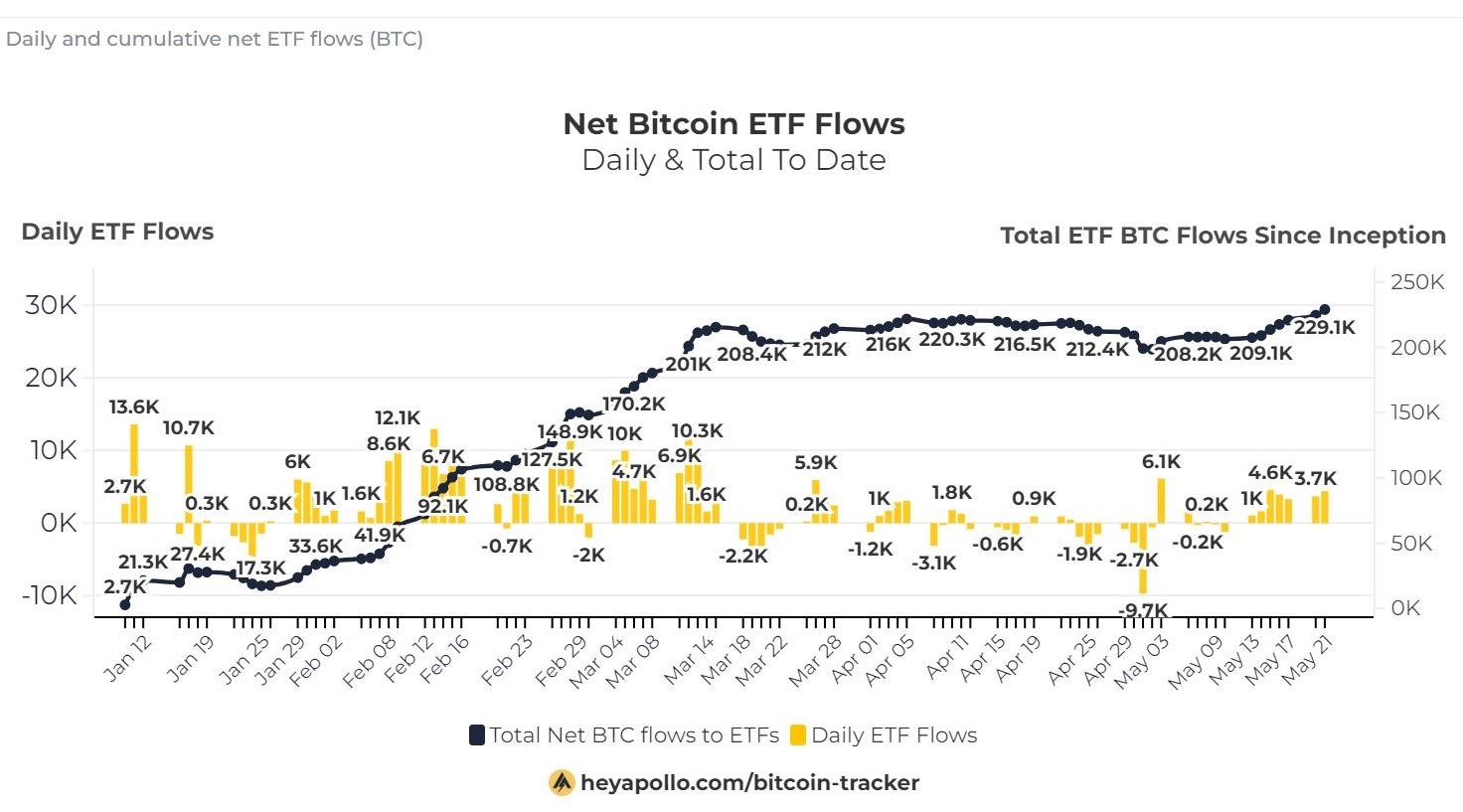
Perhaps if the crypto industry was still buried in the rubble of the FTX collapse, then Trump’s comments wouldn’t have mattered. Perhaps, in that case, he wouldn’t have made them at all. But the reality is that it’s not 2022, that BTC has been on the up for the past year and a half, and that those new BTC ETFs have got off to a tremendously bullish start, achieving inflows since launch of around 230,000 BTC, and attracting institutional investors.
Bitcoin ETF flows, chart from Apollo
That in mind, is it possible that Trump positioning himself as the pro-crypto candidate while Bitcoin is in this kind of form, and at the same time as he takes a polling lead in several swing states, has spooked Democrats and led them to abruptly reposition themselves when it comes to crypto?
We may get confirmation in this regard before the end of the month, as–prior to the Senate vote–Joe Biden let it be known that he would veto the act to reject SAB 121, were it to pass. The president now has until May 28th to sign the act through, and if he goes back on his intent to veto–particularly after ETH ETFs have been cleared by the SEC–it would suggest a meaningful change of direction.
Pro-Crypto FIT21 Passes House Vote
Following on from the Senate’s rejection of SAB 121 came, this week, another highly significant vote. This time, the House of Representatives voted on the Republican-led Financial Innovation and Technology for the 21st Century Act, known as FIT21. This is regarded as a bill aimed at integrating crypto, clearing up confusion around whether assets are securities or not, and creating a regulatory framework, with greater authority shifted from the SEC to the CFTC, which is regarded, for crypto, as the more accommodating agency.
And in this case, again, the pro-crypto side of the argument emerged on top, as the act passed by 279 to 136 votes. What’s more, this meant there was a strong show of support from the left, with 71 Democrats–including former Speaker of the House Nancy Pelosi–crossing party lines.
Notably, pre-vote, there had been a change of tone from President Biden, with a White House statement still opposing the act, but also explaining that “the Administration is eager to work with Congress to ensure a comprehensive and balanced regulatory framework for digital assets”, which is a world away from Senator Warren’s “anti-crypto army”. However, this conciliatory note was not evident when it came to SEC Chair Gary Gensler, who issued a characteristically combative statement against FIT21.
It should also be noted that FIT21 is still a work in progress, as it now has to be voted on in the Senate, where it faces the possibility of multiple reviews and markups, meaning the House vote is only an initial step.
ETH ETFs Send a Different Signal
Although spot BTC ETFs were crucial and led the way, the approval of spot ETH ETFs can be interpreted as significant in a distinctly different way. This is because Bitcoin stands apart from the rest of crypto–it’s the original, the oldest, the most robust, and there are–as mentioned–no arguments that it should be treated as a security. As such, it was possible for regulators to allow Bitcoin ETFs without, by implication, rubber-stamping the entire crypto industry.
By contrast, Ethereum is perceived as more closely connected with the whole crypto ecosystem, and there is no strong argument for accepting Ethereum while throwing out other similar blockchains, especially as growing networks such as Solana and Avalanche are positioned as market rivals delivering products to directly compete with Ethereum.
That all in mind, if ETH ETF approval was politically motivated, then this year's election race may just have hit the accelerator on a momentous shift away from DC’s incumbent anti-crypto guard. What’s more, with one party apparently in flux while the other leans strongly into the issue, we should expect that further shocks are possible.
Prior to spot Bitcoin ETFs gaining approval in January there was, as deadlines approached, a sense of expectation that the SEC would give the green light to the funds. Critically, the regulatory agency was engaging with applicants, and it was known that BTC was regarded as a commodity rather than as a security.
Compare that to this week’s spot ETH ETF approval, and it’s a very different story. Until the start of this week, the overwhelming expectation was that ETH ETFs were in line for rejection, amid reports that the SEC had not engaged with applicants, and with uncertainty around how ETH was categorized: as a commodity, like BTC, or as a security that was not properly registered.
As such, reports on Monday that the SEC was suddenly shifting towards approval caught the market entirely by surprise, and by Thursday, what had been almost unthinkable just a few days earlier actually occurred, with spot ETH ETFs gaining approval in the United States.
To say that this official turnaround was not priced in by the markets is an understatement, while from a broader context, what has occurred this week may have considerable long-term significance not just for ETH and its market value, but for the entire crypto industry, and what's more, it ties in closely with American politics.
Democrats Broke Ranks on SAB 121
Just a week before the ETF U-turn, there was a vote in the Senate around an SEC accounting proposal called SAB 121. This proposal would impose strict rules on banks and other institutions holding cryptocurrencies for customers, but was criticized for discouraging companies from taking custody of digital assets, and thereby creating negative knock-on effects for the crypto industry.
However, the Senate voted in favor of an act to repeal SAB 121, and it did so by 60 votes to 38, with several Democrats, including Senate Majority Leader Chuck Schumer, breaking ranks with President Biden and Senator Elizabeth Warren–who are publicly opposed to crypto–to take what is in practice a pro-crypto stance.
It’s notable also that this rejection of SAB 121 came immediately after presidential contender Donald Trump had voiced explicit support for the crypto industry, and this week, the Trump campaign also announced that it was accepting donations in a range of cryptocurrencies. This action reinforced the crypto-friendly message, but the campaign then went further still by declaring that Trump supporters “will build a crypto army”, making direct reference to Elizabeth Warren’s declaration last year that she is “building an anti-crypto army”.
Perhaps if the crypto industry was still buried in the rubble of the FTX collapse, then Trump’s comments wouldn’t have mattered. Perhaps, in that case, he wouldn’t have made them at all. But the reality is that it’s not 2022, that BTC has been on the up for the past year and a half, and that those new BTC ETFs have got off to a tremendously bullish start, achieving inflows since launch of around 230,000 BTC, and attracting institutional investors.
Bitcoin ETF flows, chart from Apollo
That in mind, is it possible that Trump positioning himself as the pro-crypto candidate while Bitcoin is in this kind of form, and at the same time as he takes a polling lead in several swing states, has spooked Democrats and led them to abruptly reposition themselves when it comes to crypto?
We may get confirmation in this regard before the end of the month, as–prior to the Senate vote–Joe Biden let it be known that he would veto the act to reject SAB 121, were it to pass. The president now has until May 28th to sign the act through, and if he goes back on his intent to veto–particularly after ETH ETFs have been cleared by the SEC–it would suggest a meaningful change of direction.
Pro-Crypto FIT21 Passes House Vote
Following on from the Senate’s rejection of SAB 121 came, this week, another highly significant vote. This time, the House of Representatives voted on the Republican-led Financial Innovation and Technology for the 21st Century Act, known as FIT21. This is regarded as a bill aimed at integrating crypto, clearing up confusion around whether assets are securities or not, and creating a regulatory framework, with greater authority shifted from the SEC to the CFTC, which is regarded, for crypto, as the more accommodating agency.
And in this case, again, the pro-crypto side of the argument emerged on top, as the act passed by 279 to 136 votes. What’s more, this meant there was a strong show of support from the left, with 71 Democrats–including former Speaker of the House Nancy Pelosi–crossing party lines.
Notably, pre-vote, there had been a change of tone from President Biden, with a White House statement still opposing the act, but also explaining that “the Administration is eager to work with Congress to ensure a comprehensive and balanced regulatory framework for digital assets”, which is a world away from Senator Warren’s “anti-crypto army”. However, this conciliatory note was not evident when it came to SEC Chair Gary Gensler, who issued a characteristically combative statement against FIT21.
It should also be noted that FIT21 is still a work in progress, as it now has to be voted on in the Senate, where it faces the possibility of multiple reviews and markups, meaning the House vote is only an initial step.
ETH ETFs Send a Different Signal
Although spot BTC ETFs were crucial and led the way, the approval of spot ETH ETFs can be interpreted as significant in a distinctly different way. This is because Bitcoin stands apart from the rest of crypto–it’s the original, the oldest, the most robust, and there are–as mentioned–no arguments that it should be treated as a security. As such, it was possible for regulators to allow Bitcoin ETFs without, by implication, rubber-stamping the entire crypto industry.
By contrast, Ethereum is perceived as more closely connected with the whole crypto ecosystem, and there is no strong argument for accepting Ethereum while throwing out other similar blockchains, especially as growing networks such as Solana and Avalanche are positioned as market rivals delivering products to directly compete with Ethereum.
That all in mind, if ETH ETF approval was politically motivated, then this year's election race may just have hit the accelerator on a momentous shift away from DC’s incumbent anti-crypto guard. What’s more, with one party apparently in flux while the other leans strongly into the issue, we should expect that further shocks are possible.
Sam White is a writer and journalist from the UK who covers cryptocurrencies and web3, with a particular interest in NFTs and the crossover between art and finance. His work, on a wide variety of topics, has appeared on platforms including The Spectator, Vice and Hacker Noon.
WhiteBIT secures brokerage license in Georgia to launch regulated crypto derivatives
FP Markets Winner Spotlight 🏆 | Global Broker of the Year 2025 #Trading #Broker #Innovation #Shorts
FP Markets Winner Spotlight 🏆 | Global Broker of the Year 2025 #Trading #Broker #Innovation #Shorts
FP Markets takes the spotlight as Global Broker of the Year 2025 at the Finance Magnates Awards.
Martin Stoilov, Head of Client Experience, shares that trust, innovation, and people played a key role in the company’s success, supported by a strong foundation of integrity and client-centricity.
Following this milestone, FP Markets continues to focus on growth, technology investment, and its core values of transparency and excellence.
👉 Be part of FM Awards 2026: https://awards.financemagnates.com/#nominate
FP Markets takes the spotlight as Global Broker of the Year 2025 at the Finance Magnates Awards.
Martin Stoilov, Head of Client Experience, shares that trust, innovation, and people played a key role in the company’s success, supported by a strong foundation of integrity and client-centricity.
Following this milestone, FP Markets continues to focus on growth, technology investment, and its core values of transparency and excellence.
👉 Be part of FM Awards 2026: https://awards.financemagnates.com/#nominate
In this video, we review @HolaPrimeMarketsOfficial, a multi-asset forex and CFDs broker offering different account types, trading platforms, and flexible trading conditions.
We cover the broker’s overall offering, including account options, trading environment, platforms like MT4 and MT5, and additional services such as managed accounts and fast withdrawals.
Watch the full video to see if Hola Prime Markets fits your trading needs.
📣 Stay up to date with the latest in finance and trading. Follow Finance Magnates for industry news, insights, and global event coverage.
Connect with us:
🔗 LinkedIn: /financemagnates
👍 Facebook: /financemagnates
📸 Instagram: https://www.instagram.com/financemagnates
🐦 X: https://x.com/financemagnates
🎥 TikTok: https://www.tiktok.com/tag/financemagnates
▶️ YouTube: /@financemagnates_official
#HolaPrime #ForexBroker #CFDTrading #FinanceMagnates #Trading #Forex #BrokerReview
In this video, we review @HolaPrimeMarketsOfficial, a multi-asset forex and CFDs broker offering different account types, trading platforms, and flexible trading conditions.
We cover the broker’s overall offering, including account options, trading environment, platforms like MT4 and MT5, and additional services such as managed accounts and fast withdrawals.
Watch the full video to see if Hola Prime Markets fits your trading needs.
📣 Stay up to date with the latest in finance and trading. Follow Finance Magnates for industry news, insights, and global event coverage.
Connect with us:
🔗 LinkedIn: /financemagnates
👍 Facebook: /financemagnates
📸 Instagram: https://www.instagram.com/financemagnates
🐦 X: https://x.com/financemagnates
🎥 TikTok: https://www.tiktok.com/tag/financemagnates
▶️ YouTube: /@financemagnates_official
#HolaPrime #ForexBroker #CFDTrading #FinanceMagnates #Trading #Forex #BrokerReview
Hola Prime Review: What You Need to Know | Full Breakdown by Finance Magnates
Hola Prime Review: What You Need to Know | Full Breakdown by Finance Magnates
In this video, we review @HolaPrime_Global, a proprietary trading firm offering evaluation programs and performance-based payouts in simulated market environments.
We cover how the challenge model works, including account types, profit splits (up to 95%), trading rules, and what it takes to reach a funded account. You’ll also learn about available platforms like MT4, MT5, cTrader, and more, along with insights into payouts, support, and trading conditions.
Watch the full video to see if Hola Prime fits your trading style.
📣 Stay up to date with the latest in finance and trading. Follow Finance Magnates for industry news, insights, and global event coverage.
Connect with us:
🔗 LinkedIn: /financemagnates
👍 Facebook: /financemagnates
📸 Instagram: https://www.instagram.com/financemagnates
🐦 X: https://x.com/financemagnates
🎥 TikTok: https://www.tiktok.com/tag/financemagnates
▶️ YouTube: /@financemagnates_official
#HolaPrime #PropFirm #Trading #FinanceMagnates #Forex #FuturesTrading #TradingReview #PropFirmReview
In this video, we review @HolaPrime_Global, a proprietary trading firm offering evaluation programs and performance-based payouts in simulated market environments.
We cover how the challenge model works, including account types, profit splits (up to 95%), trading rules, and what it takes to reach a funded account. You’ll also learn about available platforms like MT4, MT5, cTrader, and more, along with insights into payouts, support, and trading conditions.
Watch the full video to see if Hola Prime fits your trading style.
📣 Stay up to date with the latest in finance and trading. Follow Finance Magnates for industry news, insights, and global event coverage.
Connect with us:
🔗 LinkedIn: /financemagnates
👍 Facebook: /financemagnates
📸 Instagram: https://www.instagram.com/financemagnates
🐦 X: https://x.com/financemagnates
🎥 TikTok: https://www.tiktok.com/tag/financemagnates
▶️ YouTube: /@financemagnates_official
#HolaPrime #PropFirm #Trading #FinanceMagnates #Forex #FuturesTrading #TradingReview #PropFirmReview
Axi Winner Spotlight 🏆 | Global Most Innovative Broker 2025 #Innovation #Trading #Fintech #Broker
Axi Winner Spotlight 🏆 | Global Most Innovative Broker 2025 #Innovation #Trading #Fintech #Broker
Axi takes the spotlight at the Finance Magnates Awards, winning Global Most Innovative Broker 2025.
Olivia Xenofontos and Ivanna Openko share how the team will feel: proud, motivated, and ready to keep delivering.
They also describe the night as well-organized, focused, and enjoyable for all.
👉 Be part of FM Awards 2026.
Axi takes the spotlight at the Finance Magnates Awards, winning Global Most Innovative Broker 2025.
Olivia Xenofontos and Ivanna Openko share how the team will feel: proud, motivated, and ready to keep delivering.
They also describe the night as well-organized, focused, and enjoyable for all.
👉 Be part of FM Awards 2026.
Recognition that matters.
Built on transparency.
Driven by the industry.
The Finance Magnates Awards 2026.
Nominations are now open.
🔗 https://awards.financemagnates.com/?utm_source=SM&utm_medium=social&utm_campaign=recognition-matters
Recognition that matters.
Built on transparency.
Driven by the industry.
The Finance Magnates Awards 2026.
Nominations are now open.
🔗 https://awards.financemagnates.com/?utm_source=SM&utm_medium=social&utm_campaign=recognition-matters