Bitcoin has hung between $10k-$11k for most of September. What's next?
FM
As September draws to a close, Bitcoin continues its pattern of consolidation above $10,000, but what is next?
This marks the eighth week in a row that Bitcoin has traded consistently above $10k, a pattern of consolidation that many analysts believe may eventually give way to a bull run later this year.
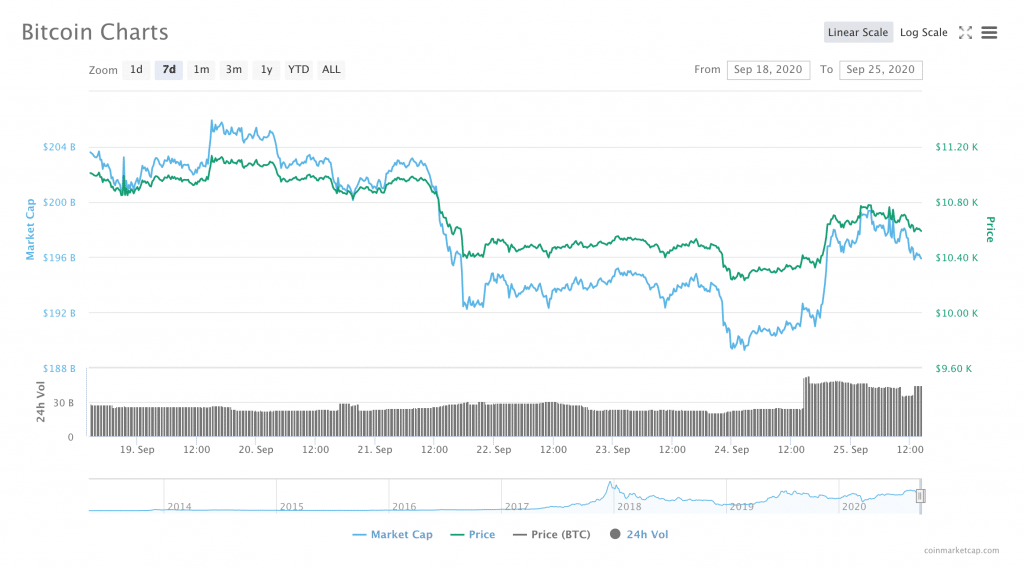
According to data from CoinMarketCap, the price of Bitcoin appears to be continuously holding steady above the $10,000 mark even though the token is trading at a slightly lower price today ($10,660) than it was a week ago ($10,930). Earlier this week, the price dipped as low as $10,220.
This is consistent with the price pattern for most of the month of September, which has stayed within the $10,000-$11,000 range since Friday, September 4th.
The lack of any major volatility in the price of Bitcoin in recent weeks may primarily benefit institutional traders that have access to microstrategy tools, while retail traders, who tend to buy and sell around bigger price events, might be holding onto their coins for now.
Jack Choros, crypto commentator and content manager at Crypto Radar, told Finance Magnates that “any consolidation is a good thing for the next bull run.
“Bitcoin is going to get close to $20,000 by the end of the year. Mark my words.”
“Bitcoin, like Gold, Is Inversely Correlated to the Dollar.”
But is another bull run feasible at this point? Perhaps, but there are many factors at play.
Case in point: for the past several weeks, “the DXY has been consolidating sideways as was the price of bitcoin,” Mr. Goodrich said.
However, over the past few days, “the DXY has experienced an upward impulse, which has had a negative effect on the price of bitcoin.”
Indeed, for the last five days, the DXY has made an upward movement from roughly 92.89 to around 94.30, and appeared to be continuously moving upward at press time.
“There Has Been Increased Economic Uncertainty as the Pandemic Continues to Exacerbate the Global Financial Crisis.”
While the dollar may be seeing a short-term recovery, the ongoing effects of the coronavirus and subsequent economic fallout on the global economy may keep driving the dollar down over the long term.
Juan Aja Aguinaco, co-founder of Shyft Network, told Finance Magnates that “there’s a large number of investors that use BTC as a hedge against fiat currency like the USD, and as a hedge against volatility in the gold and precious metals market.
Juan Aja Aguinaco, co-founder of Shyft Networ.
“There has been increased economic uncertainty as the pandemic continues to exacerbate the global financial crisis,” Peter Goodrich explained to Finance Magnates. “Governments have been using quantitative easing monetary policy in an attempt to mitigate the effects of the global financial crisis.”
“This injection of money supply into the economy has decreased the value of fiat which has been a major catalyst for the increased interest in cryptocurrency which is reflected in the total market cap for the asset class,” Mr. Goodrich continued.
Bitcoin could benefit from a long-term dollar dive: “Bitcoin was developed as a result of the 2008 financial crisis. The next major milestone for cryptocurrency is the much-needed regulatory clarity that would bring the asset class to the mainstream.”
New Regulatory Developments in the US and the EU Could Bring More Institutional Investors to Crypto
This regulatory clarity may already be on the way: last week, two significant regulatory developments took place in the cryptocurrency industry in both the European Union and the United States.
The price of Bitcoin did not seem to have any kind of major reaction to either of these developments. However, increased regulatory clarity in the crypto space could pave the way for further crypto adoption later on, particularly for institutional investors.
Ciara Sun, head of global markets at Huobi Group, commented on institutional traders’ regulatory needs at a CoinTelegraph event in July: “larger institutions have higher compliance requirements, but regulatory agencies have not provided enough guidance on digital assets in the past.
“This unclear regulatory landscape has made it riskier for larger institutions,” she said – a factor that has previously kept larger institutions out of the crypto space.
Growing Distrust of Large Financial Institutions Could Also Play a Role
However, at the same time, the role of larger financial institutions may be headed for a reduction on a global scale.
This has to do with trust: earlier this month, the BBC reported that leaked documents involving about $2 trillion of transactions revealed how some of the world's biggest banks have allowed criminals to move dirty money around the world.
Shyft Network’s Juan Aja Aguinaco commented to Finance Magnates that the “recent leak of FinCEN documents represents a massive point in favor of crypto.
Even with growing distrust in major financial institutions, meaningful cryptocurrency adoption will take time.
Socio-Political Drama in the US and across the Globe Could Play an Important Role in BTC’s Price in Q4
However, there are a number of other factors that could expedite crypto adoption across the globe.
“Not to sound pessimistic, but the rest of the year looks as strange as the first half of 2020, perhaps more,” Juan Aja Aguinaco said to Finance Magnates. “We have what appears to be a second wave of the COVID-19 pandemic hitting countries with economies that were weakened by the effects of the first wave.”
Additionally, “one factor is the current political and social issues affecting the United States,” Mr. Aguianco explained. Traditionally speaking, “elections in the US are an important generator of volatility both in traditional and crypto markets.”
However, this election cycle maybe even more significant for the global economy: drama around the 2020 US presidential election has given way to “a wave of civil unrest in the US, which may hit its tipping point during and after the upcoming elections. Other countries around the world are also experiencing civil unrest and political changes (e.g.Belarus, Mexico, and Bolivia.)
“All of these have considerable effects on traditional financial markets,” he continued. As such, “investors may start seeking better yields in non-traditional markets, like cryptocurrencies, and DeFi to be more specific.”
And indeed, the DeFi (decentralized finance) space did see a huge boom earlier this year. A number of tokens belonging to DeFi protocols consistently made headlines for sudden spikes in their price levels throughout the months of July and August.
DeFi Cooldown Continues
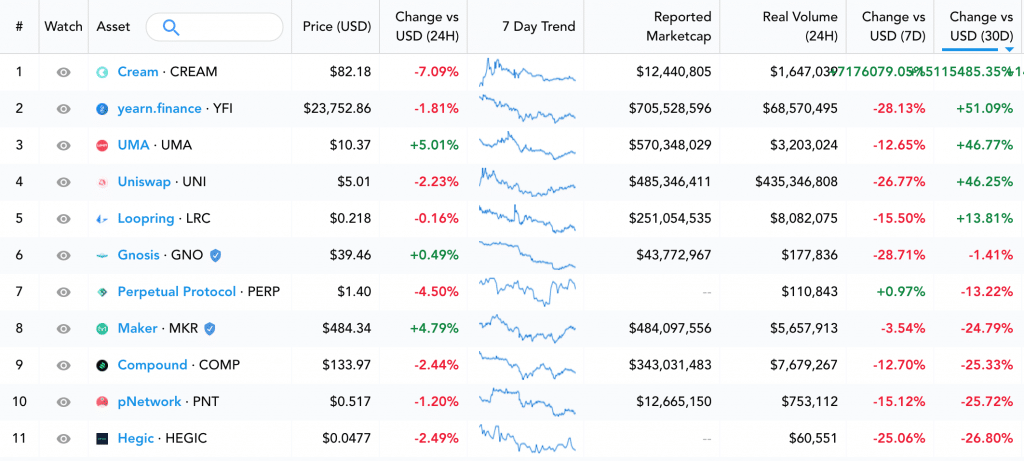
Though, September seems to have brought the DeFi space into a cooldown. Of 42 DeFi assets listed on crypto price data site Messari, only five had positive price movements over the last 30 days: Yearn.Finance, Uniswap, UMA, Cream, and Loopring.
CryptoRadar’s Jack Choros commented that while DeFi is indeed “cooling off a little bit,” projects “like Yearn have real value because the price of the token is actually connected to the amount of funds locked in by investors.”
In other words, the prices of some of these tokens are not driven purely by speculation: “the price of the coin is linked to actual value,” he said. “That’s a good sign for the fundamentals of the project.”
“Some investors shift capital between BTC and alternative tokens in search of better returns,” he said. “This battle-of-sorts between altcoins and Bitcoin represents a major influencing factor in their price.
“Also, a large amount of capital has moved from BTC to DeFi tokens like DAI, COMP, or has parked BTC on WBTC for liquidity pools and yield farming, further reducing available capital and liquidity on the BTC market.”
As September draws to a close, Bitcoin continues its pattern of consolidation above $10,000, but what is next?
This marks the eighth week in a row that Bitcoin has traded consistently above $10k, a pattern of consolidation that many analysts believe may eventually give way to a bull run later this year.
According to data from CoinMarketCap, the price of Bitcoin appears to be continuously holding steady above the $10,000 mark even though the token is trading at a slightly lower price today ($10,660) than it was a week ago ($10,930). Earlier this week, the price dipped as low as $10,220.
This is consistent with the price pattern for most of the month of September, which has stayed within the $10,000-$11,000 range since Friday, September 4th.
The lack of any major volatility in the price of Bitcoin in recent weeks may primarily benefit institutional traders that have access to microstrategy tools, while retail traders, who tend to buy and sell around bigger price events, might be holding onto their coins for now.
Jack Choros, crypto commentator and content manager at Crypto Radar, told Finance Magnates that “any consolidation is a good thing for the next bull run.
“Bitcoin is going to get close to $20,000 by the end of the year. Mark my words.”
“Bitcoin, like Gold, Is Inversely Correlated to the Dollar.”
But is another bull run feasible at this point? Perhaps, but there are many factors at play.
Case in point: for the past several weeks, “the DXY has been consolidating sideways as was the price of bitcoin,” Mr. Goodrich said.
However, over the past few days, “the DXY has experienced an upward impulse, which has had a negative effect on the price of bitcoin.”
Indeed, for the last five days, the DXY has made an upward movement from roughly 92.89 to around 94.30, and appeared to be continuously moving upward at press time.
“There Has Been Increased Economic Uncertainty as the Pandemic Continues to Exacerbate the Global Financial Crisis.”
While the dollar may be seeing a short-term recovery, the ongoing effects of the coronavirus and subsequent economic fallout on the global economy may keep driving the dollar down over the long term.
Juan Aja Aguinaco, co-founder of Shyft Network, told Finance Magnates that “there’s a large number of investors that use BTC as a hedge against fiat currency like the USD, and as a hedge against volatility in the gold and precious metals market.
Juan Aja Aguinaco, co-founder of Shyft Networ.
“There has been increased economic uncertainty as the pandemic continues to exacerbate the global financial crisis,” Peter Goodrich explained to Finance Magnates. “Governments have been using quantitative easing monetary policy in an attempt to mitigate the effects of the global financial crisis.”
“This injection of money supply into the economy has decreased the value of fiat which has been a major catalyst for the increased interest in cryptocurrency which is reflected in the total market cap for the asset class,” Mr. Goodrich continued.
Bitcoin could benefit from a long-term dollar dive: “Bitcoin was developed as a result of the 2008 financial crisis. The next major milestone for cryptocurrency is the much-needed regulatory clarity that would bring the asset class to the mainstream.”
New Regulatory Developments in the US and the EU Could Bring More Institutional Investors to Crypto
This regulatory clarity may already be on the way: last week, two significant regulatory developments took place in the cryptocurrency industry in both the European Union and the United States.
The price of Bitcoin did not seem to have any kind of major reaction to either of these developments. However, increased regulatory clarity in the crypto space could pave the way for further crypto adoption later on, particularly for institutional investors.
Ciara Sun, head of global markets at Huobi Group, commented on institutional traders’ regulatory needs at a CoinTelegraph event in July: “larger institutions have higher compliance requirements, but regulatory agencies have not provided enough guidance on digital assets in the past.
“This unclear regulatory landscape has made it riskier for larger institutions,” she said – a factor that has previously kept larger institutions out of the crypto space.
Growing Distrust of Large Financial Institutions Could Also Play a Role
However, at the same time, the role of larger financial institutions may be headed for a reduction on a global scale.
This has to do with trust: earlier this month, the BBC reported that leaked documents involving about $2 trillion of transactions revealed how some of the world's biggest banks have allowed criminals to move dirty money around the world.
Shyft Network’s Juan Aja Aguinaco commented to Finance Magnates that the “recent leak of FinCEN documents represents a massive point in favor of crypto.
Even with growing distrust in major financial institutions, meaningful cryptocurrency adoption will take time.
Socio-Political Drama in the US and across the Globe Could Play an Important Role in BTC’s Price in Q4
However, there are a number of other factors that could expedite crypto adoption across the globe.
“Not to sound pessimistic, but the rest of the year looks as strange as the first half of 2020, perhaps more,” Juan Aja Aguinaco said to Finance Magnates. “We have what appears to be a second wave of the COVID-19 pandemic hitting countries with economies that were weakened by the effects of the first wave.”
Additionally, “one factor is the current political and social issues affecting the United States,” Mr. Aguianco explained. Traditionally speaking, “elections in the US are an important generator of volatility both in traditional and crypto markets.”
However, this election cycle maybe even more significant for the global economy: drama around the 2020 US presidential election has given way to “a wave of civil unrest in the US, which may hit its tipping point during and after the upcoming elections. Other countries around the world are also experiencing civil unrest and political changes (e.g.Belarus, Mexico, and Bolivia.)
“All of these have considerable effects on traditional financial markets,” he continued. As such, “investors may start seeking better yields in non-traditional markets, like cryptocurrencies, and DeFi to be more specific.”
And indeed, the DeFi (decentralized finance) space did see a huge boom earlier this year. A number of tokens belonging to DeFi protocols consistently made headlines for sudden spikes in their price levels throughout the months of July and August.
DeFi Cooldown Continues
Though, September seems to have brought the DeFi space into a cooldown. Of 42 DeFi assets listed on crypto price data site Messari, only five had positive price movements over the last 30 days: Yearn.Finance, Uniswap, UMA, Cream, and Loopring.
CryptoRadar’s Jack Choros commented that while DeFi is indeed “cooling off a little bit,” projects “like Yearn have real value because the price of the token is actually connected to the amount of funds locked in by investors.”
In other words, the prices of some of these tokens are not driven purely by speculation: “the price of the coin is linked to actual value,” he said. “That’s a good sign for the fundamentals of the project.”
“Some investors shift capital between BTC and alternative tokens in search of better returns,” he said. “This battle-of-sorts between altcoins and Bitcoin represents a major influencing factor in their price.
“Also, a large amount of capital has moved from BTC to DeFi tokens like DAI, COMP, or has parked BTC on WBTC for liquidity pools and yield farming, further reducing available capital and liquidity on the BTC market.”
Rachel is a self-taught crypto geek and a passionate writer. She believes in the power that the written word has to educate, connect and empower individuals to make positive and powerful financial choices. She is the Podcast Host and a Cryptocurrency Editor at Finance Magnates.
Binance Launches Retail AI Assistant, Repackages Existing Trading Tools
Featured Videos
AvaTrade to Acquire Most of FXCM; NAGA Raises $8M
AvaTrade to Acquire Most of FXCM; NAGA Raises $8M
AvaTrade to Acquire Most of FXCM; NAGA Raises $8M
AvaTrade to Acquire Most of FXCM; NAGA Raises $8M
Today’s financial news recap covers AvaTrade agrees to acquire most of FXCM, NAGA secures eight million dollars in new financing, and Wise seeks a tax settlement in the UK.
Finance Magnates Daily Recap brings you the latest news from forex and CFD brokers, fintech, payments, cryptocurrency, digital assets, trading platforms, financial regulation and global markets.
Get the key company news, executive moves, deals, regulatory updates and market developments of the day, in just a few minutes. New episodes published every weekday.
Read more: https://www.financemagnates.com
#FinanceMagnates #ForexNews #FintechNews
Today’s financial news recap covers AvaTrade agrees to acquire most of FXCM, NAGA secures eight million dollars in new financing, and Wise seeks a tax settlement in the UK.
Finance Magnates Daily Recap brings you the latest news from forex and CFD brokers, fintech, payments, cryptocurrency, digital assets, trading platforms, financial regulation and global markets.
Get the key company news, executive moves, deals, regulatory updates and market developments of the day, in just a few minutes. New episodes published every weekday.
Read more: https://www.financemagnates.com
#FinanceMagnates #ForexNews #FintechNews
Today’s financial news recap covers AvaTrade agrees to acquire most of FXCM, NAGA secures eight million dollars in new financing, and Wise seeks a tax settlement in the UK.
Finance Magnates Daily Recap brings you the latest news from forex and CFD brokers, fintech, payments, cryptocurrency, digital assets, trading platforms, financial regulation and global markets.
Get the key company news, executive moves, deals, regulatory updates and market developments of the day, in just a few minutes. New episodes published every weekday.
Read more: https://www.financemagnates.com
#FinanceMagnates #ForexNews #FintechNews
Today’s financial news recap covers AvaTrade agrees to acquire most of FXCM, NAGA secures eight million dollars in new financing, and Wise seeks a tax settlement in the UK.
Finance Magnates Daily Recap brings you the latest news from forex and CFD brokers, fintech, payments, cryptocurrency, digital assets, trading platforms, financial regulation and global markets.
Get the key company news, executive moves, deals, regulatory updates and market developments of the day, in just a few minutes. New episodes published every weekday.
Read more: https://www.financemagnates.com
#FinanceMagnates #ForexNews #FintechNews
XTB Adds Overnight US Stock Trading; Nasdaq Ventures Invests in One Trading
XTB Adds Overnight US Stock Trading; Nasdaq Ventures Invests in One Trading
XTB Adds Overnight US Stock Trading; Nasdaq Ventures Invests in One Trading
XTB Adds Overnight US Stock Trading; Nasdaq Ventures Invests in One Trading
XTB Adds Overnight US Stock Trading; Nasdaq Ventures Invests in One Trading
XTB Adds Overnight US Stock Trading; Nasdaq Ventures Invests in One Trading
Today’s financial news recap covers XTB expands overnight US stock trading, Fortrade reports higher revenue, Nasdaq backs One Trading, and Vest Labs raises 13 million dollars.
Finance Magnates Daily Recap brings you the latest news from forex and CFD brokers, fintech, payments, cryptocurrency, digital assets, trading platforms, financial regulation and global markets.
Get the key company news, executive moves, deals, regulatory updates and market developments of the day, in just a few minutes. New episodes published every weekday.
Read more: https://www.financemagnates.com
#FinanceMagnates #ForexNews #FintechNews
Today’s financial news recap covers XTB expands overnight US stock trading, Fortrade reports higher revenue, Nasdaq backs One Trading, and Vest Labs raises 13 million dollars.
Finance Magnates Daily Recap brings you the latest news from forex and CFD brokers, fintech, payments, cryptocurrency, digital assets, trading platforms, financial regulation and global markets.
Get the key company news, executive moves, deals, regulatory updates and market developments of the day, in just a few minutes. New episodes published every weekday.
Read more: https://www.financemagnates.com
#FinanceMagnates #ForexNews #FintechNews
Today’s financial news recap covers XTB expands overnight US stock trading, Fortrade reports higher revenue, Nasdaq backs One Trading, and Vest Labs raises 13 million dollars.
Finance Magnates Daily Recap brings you the latest news from forex and CFD brokers, fintech, payments, cryptocurrency, digital assets, trading platforms, financial regulation and global markets.
Get the key company news, executive moves, deals, regulatory updates and market developments of the day, in just a few minutes. New episodes published every weekday.
Read more: https://www.financemagnates.com
#FinanceMagnates #ForexNews #FintechNews
Today’s financial news recap covers XTB expands overnight US stock trading, Fortrade reports higher revenue, Nasdaq backs One Trading, and Vest Labs raises 13 million dollars.
Finance Magnates Daily Recap brings you the latest news from forex and CFD brokers, fintech, payments, cryptocurrency, digital assets, trading platforms, financial regulation and global markets.
Get the key company news, executive moves, deals, regulatory updates and market developments of the day, in just a few minutes. New episodes published every weekday.
Read more: https://www.financemagnates.com
#FinanceMagnates #ForexNews #FintechNews
Today’s financial news recap covers XTB expands overnight US stock trading, Fortrade reports higher revenue, Nasdaq backs One Trading, and Vest Labs raises 13 million dollars.
Finance Magnates Daily Recap brings you the latest news from forex and CFD brokers, fintech, payments, cryptocurrency, digital assets, trading platforms, financial regulation and global markets.
Get the key company news, executive moves, deals, regulatory updates and market developments of the day, in just a few minutes. New episodes published every weekday.
Read more: https://www.financemagnates.com
#FinanceMagnates #ForexNews #FintechNews
Today’s financial news recap covers XTB expands overnight US stock trading, Fortrade reports higher revenue, Nasdaq backs One Trading, and Vest Labs raises 13 million dollars.
Finance Magnates Daily Recap brings you the latest news from forex and CFD brokers, fintech, payments, cryptocurrency, digital assets, trading platforms, financial regulation and global markets.
Get the key company news, executive moves, deals, regulatory updates and market developments of the day, in just a few minutes. New episodes published every weekday.
Read more: https://www.financemagnates.com
#FinanceMagnates #ForexNews #FintechNews
CMC Founder Downplays Volatility Hit; Devexperts Names CEO
CMC Founder Downplays Volatility Hit; Devexperts Names CEO
CMC Founder Downplays Volatility Hit; Devexperts Names CEO
CMC Founder Downplays Volatility Hit; Devexperts Names CEO
CMC Founder Downplays Volatility Hit; Devexperts Names CEO
CMC Founder Downplays Volatility Hit; Devexperts Names CEO
Today’s financial news recap covers low volatility pressures brokers, Devexperts names a new CEO, Saxo cuts onboarding time, and OKX reaches a 25 billion dollar valuation.
Finance Magnates Daily Recap brings you the latest news from forex and CFD brokers, fintech, payments, cryptocurrency, digital assets, trading platforms, financial regulation and global markets.
Get the key company news, executive moves, deals, regulatory updates and market developments of the day, in just a few minutes. New episodes published every weekday.
Read more: https://www.financemagnates.com
#FinanceMagnates #ForexNews #FintechNews
Today’s financial news recap covers low volatility pressures brokers, Devexperts names a new CEO, Saxo cuts onboarding time, and OKX reaches a 25 billion dollar valuation.
Finance Magnates Daily Recap brings you the latest news from forex and CFD brokers, fintech, payments, cryptocurrency, digital assets, trading platforms, financial regulation and global markets.
Get the key company news, executive moves, deals, regulatory updates and market developments of the day, in just a few minutes. New episodes published every weekday.
Read more: https://www.financemagnates.com
#FinanceMagnates #ForexNews #FintechNews
Today’s financial news recap covers low volatility pressures brokers, Devexperts names a new CEO, Saxo cuts onboarding time, and OKX reaches a 25 billion dollar valuation.
Finance Magnates Daily Recap brings you the latest news from forex and CFD brokers, fintech, payments, cryptocurrency, digital assets, trading platforms, financial regulation and global markets.
Get the key company news, executive moves, deals, regulatory updates and market developments of the day, in just a few minutes. New episodes published every weekday.
Read more: https://www.financemagnates.com
#FinanceMagnates #ForexNews #FintechNews
Today’s financial news recap covers low volatility pressures brokers, Devexperts names a new CEO, Saxo cuts onboarding time, and OKX reaches a 25 billion dollar valuation.
Finance Magnates Daily Recap brings you the latest news from forex and CFD brokers, fintech, payments, cryptocurrency, digital assets, trading platforms, financial regulation and global markets.
Get the key company news, executive moves, deals, regulatory updates and market developments of the day, in just a few minutes. New episodes published every weekday.
Read more: https://www.financemagnates.com
#FinanceMagnates #ForexNews #FintechNews
Today’s financial news recap covers low volatility pressures brokers, Devexperts names a new CEO, Saxo cuts onboarding time, and OKX reaches a 25 billion dollar valuation.
Finance Magnates Daily Recap brings you the latest news from forex and CFD brokers, fintech, payments, cryptocurrency, digital assets, trading platforms, financial regulation and global markets.
Get the key company news, executive moves, deals, regulatory updates and market developments of the day, in just a few minutes. New episodes published every weekday.
Read more: https://www.financemagnates.com
#FinanceMagnates #ForexNews #FintechNews
Today’s financial news recap covers low volatility pressures brokers, Devexperts names a new CEO, Saxo cuts onboarding time, and OKX reaches a 25 billion dollar valuation.
Finance Magnates Daily Recap brings you the latest news from forex and CFD brokers, fintech, payments, cryptocurrency, digital assets, trading platforms, financial regulation and global markets.
Get the key company news, executive moves, deals, regulatory updates and market developments of the day, in just a few minutes. New episodes published every weekday.
Read more: https://www.financemagnates.com
#FinanceMagnates #ForexNews #FintechNews
Today’s financial news recap covers Trade Nation buys FXCM's UK client book, Trading 212 reports higher revenue, the CFTC's move to allow perpetual index futures.
Finance Magnates Daily Recap brings you the latest news from forex and CFD brokers, fintech, payments, cryptocurrency, digital assets, trading platforms, financial regulation and global markets.
Get the key company news, executive moves, deals, regulatory updates and market developments of the day, in just a few minutes. New episodes published every weekday.
Read more: https://www.financemagnates.com
#FinanceMagnates #ForexNews #FintechNews
Today’s financial news recap covers Trade Nation buys FXCM's UK client book, Trading 212 reports higher revenue, the CFTC's move to allow perpetual index futures.
Finance Magnates Daily Recap brings you the latest news from forex and CFD brokers, fintech, payments, cryptocurrency, digital assets, trading platforms, financial regulation and global markets.
Get the key company news, executive moves, deals, regulatory updates and market developments of the day, in just a few minutes. New episodes published every weekday.
Read more: https://www.financemagnates.com
#FinanceMagnates #ForexNews #FintechNews
Today’s financial news recap covers Trade Nation buys FXCM's UK client book, Trading 212 reports higher revenue, the CFTC's move to allow perpetual index futures.
Finance Magnates Daily Recap brings you the latest news from forex and CFD brokers, fintech, payments, cryptocurrency, digital assets, trading platforms, financial regulation and global markets.
Get the key company news, executive moves, deals, regulatory updates and market developments of the day, in just a few minutes. New episodes published every weekday.
Read more: https://www.financemagnates.com
#FinanceMagnates #ForexNews #FintechNews
Today’s financial news recap covers Trade Nation buys FXCM's UK client book, Trading 212 reports higher revenue, the CFTC's move to allow perpetual index futures.
Finance Magnates Daily Recap brings you the latest news from forex and CFD brokers, fintech, payments, cryptocurrency, digital assets, trading platforms, financial regulation and global markets.
Get the key company news, executive moves, deals, regulatory updates and market developments of the day, in just a few minutes. New episodes published every weekday.
Read more: https://www.financemagnates.com
#FinanceMagnates #ForexNews #FintechNews
Today’s financial news recap covers Trade Nation buys FXCM's UK client book, Trading 212 reports higher revenue, the CFTC's move to allow perpetual index futures.
Finance Magnates Daily Recap brings you the latest news from forex and CFD brokers, fintech, payments, cryptocurrency, digital assets, trading platforms, financial regulation and global markets.
Get the key company news, executive moves, deals, regulatory updates and market developments of the day, in just a few minutes. New episodes published every weekday.
Read more: https://www.financemagnates.com
#FinanceMagnates #ForexNews #FintechNews
Today’s financial news recap covers Trade Nation buys FXCM's UK client book, Trading 212 reports higher revenue, the CFTC's move to allow perpetual index futures.
Finance Magnates Daily Recap brings you the latest news from forex and CFD brokers, fintech, payments, cryptocurrency, digital assets, trading platforms, financial regulation and global markets.
Get the key company news, executive moves, deals, regulatory updates and market developments of the day, in just a few minutes. New episodes published every weekday.
Read more: https://www.financemagnates.com
#FinanceMagnates #ForexNews #FintechNews
Your career isn’t a linear path.
Your career isn’t a linear path.
Your career isn’t a linear path.
Your career isn’t a linear path.
Your career isn’t a linear path.
Your career isn’t a linear path.
Roles change. Career goals change. Sometimes you want a completely new challenge.
But the skills and knowledge you build along the way can stay with you and give you something to build on.
For Jeff Patterson, that continued growth is key to long-term career development.
You bring the skills. FM Academy helps you build the knowledge.
#FMAcademy #FinanceMagnates #FinanceCareers #ProfessionalDevelopment #Fintech
Roles change. Career goals change. Sometimes you want a completely new challenge.
But the skills and knowledge you build along the way can stay with you and give you something to build on.
For Jeff Patterson, that continued growth is key to long-term career development.
You bring the skills. FM Academy helps you build the knowledge.
#FMAcademy #FinanceMagnates #FinanceCareers #ProfessionalDevelopment #Fintech
Roles change. Career goals change. Sometimes you want a completely new challenge.
But the skills and knowledge you build along the way can stay with you and give you something to build on.
For Jeff Patterson, that continued growth is key to long-term career development.
You bring the skills. FM Academy helps you build the knowledge.
#FMAcademy #FinanceMagnates #FinanceCareers #ProfessionalDevelopment #Fintech
Roles change. Career goals change. Sometimes you want a completely new challenge.
But the skills and knowledge you build along the way can stay with you and give you something to build on.
For Jeff Patterson, that continued growth is key to long-term career development.
You bring the skills. FM Academy helps you build the knowledge.
#FMAcademy #FinanceMagnates #FinanceCareers #ProfessionalDevelopment #Fintech
Roles change. Career goals change. Sometimes you want a completely new challenge.
But the skills and knowledge you build along the way can stay with you and give you something to build on.
For Jeff Patterson, that continued growth is key to long-term career development.
You bring the skills. FM Academy helps you build the knowledge.
#FMAcademy #FinanceMagnates #FinanceCareers #ProfessionalDevelopment #Fintech
Roles change. Career goals change. Sometimes you want a completely new challenge.
But the skills and knowledge you build along the way can stay with you and give you something to build on.
For Jeff Patterson, that continued growth is key to long-term career development.
You bring the skills. FM Academy helps you build the knowledge.
#FMAcademy #FinanceMagnates #FinanceCareers #ProfessionalDevelopment #Fintech