It was created on the Ethereum blockchain with the aim of eventually competing with it by improving on a number of features, the main one being scalability. This promise raised it no less than $4 billion over its year-long ICO, and it was supposed to finally be launched on its own blockchain at the beginning of June. However as we reported last week, this was a no-go.
So what exactly is holding it back?
We reported at the beginning of May when a Chinese security firm found a bug in the EOS code that could theoretically have been used to create tokens out of thin air. That same firm found an additional flaw at the end of May, one which could be used to take control of the whole system.
EOS responded to both complaints; regarding the first, CTO Dan Larimer said that the flaw was the result of poor coding rather than the system being badly designed, and regarding the second, EOS undertook to fix it before launch. As we reported at the time, this second problem was already threatening to push back the launch date, although EOS was quick to refute this:
Media has incorrectly reported a potential delay in the release of EOSIO V1 due to software vulnerabilities. Our team has already fixed most and is hard at work with the remaining ones. EOSIO V1 is on schedule; please stay tuned to our EOSIO channels for official information.
However, as reported by The Next Web, the very day after this posted message, block.one (the company that operates EOS) issued an open invitation in Medium for people to hunt for undiscovered bugs in return for monetary rewards ("Block.one is excited to engage the developer community to help us to continue to secure the integrity of the EOSIO software."). While this can be interpreted as a responsible move in and of itself, it was not reassuring coming as it did a few days before the official launch.
What was less reassuring was one hacker making thousands of dollars in this way in only a week:
Thank you. A couple more waiting to be rewarded. I think the final tally was $120K but I lost count. Took me about a week.
There was also a widely publicised hack in which scam emails were sent from the account of block.one. Millions of dollars worth of EOS and Ethereum tokens were reportedly stolen, although no accurate summation of the losses is available.
However the main problem holding up the launch is none of these issues - it is the voting issue.
Neither decentralised nor democratic
The EOS blockchain will be validated by no more than 21 nodes at any one time. These nodes are called 'block producers'. They will be elected via community vote and regularly have to stand for re-election.
This is a system designed to negate many of the problems caused by the proof-of-work consensus system, as I explain in this article. However, it has no shortage of its own problems before even being initialised.
As we have seen with other projects, EOS aims for a faster and more efficient network that can be scaled up. However, achieving this goal may mean that it is compromising on too much of what makes a blockchain a blockchain.
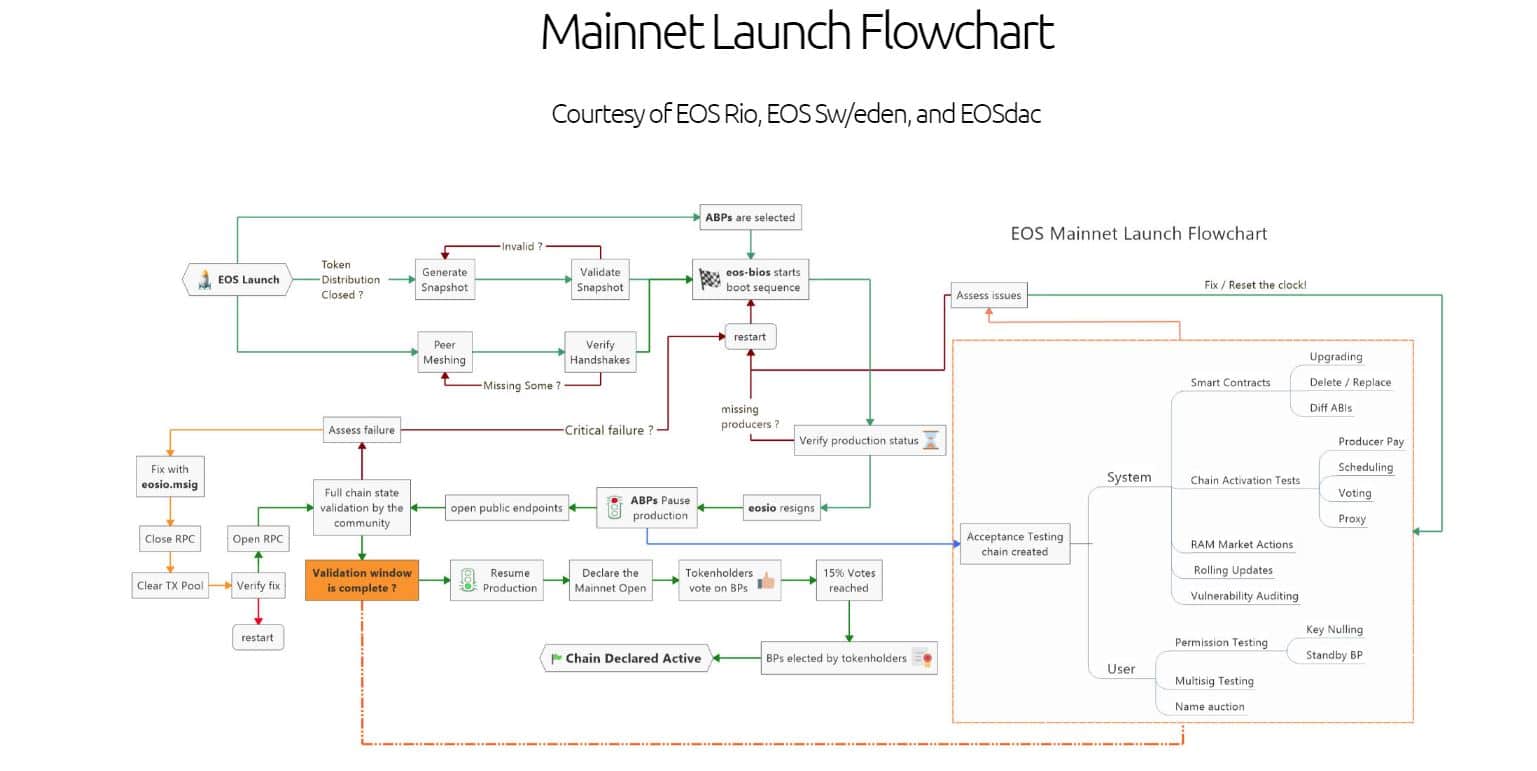
To wit: the blockchain is planning to launch with 'Appointed Block Producers' who will be "immediately replaced by the Elected Block Producers (BPs) that have been voted in by the community upon activation," according to the official EOS timeline. The APBs are to be chosen randomly. Confused? Just look at this easy-to-follow diagram:
Source: status.producer.vote/
Eric Wall, a Swedish cryptocurrency engineer, discovered that the plan is now to use one block producer to launch the system:
Now, something appears to have thwarted this plan. Based on something discovered on the different testnets, Dan Larimer instead recommended the BP community over Telegram to instead use only a single (!) ABP to hold the election just days before the launch. pic.twitter.com/wbacNsyzCe
I recommend reading that very interesting, and worrying, thread. To summarise: the manner in which the system is launched is key to the integrity of the subsequent blockchain. One block producer, who isn't even known, will have complete control over which votes are counted and which not.
A member of the EOS team replies to Wall's concerns, and the reply does not exactly allay concerns:
It is worrying that the decentralisation of EOS, such as it is, is being eroded even before the network begins operating. But this is only one problem; another is that at current prices a block producer stands to profit by an average of $2.5 million a year, according to Hackernoon. This gives them a massive incentive to do anything necessary to keep themselves in power.
The argument against this is that they have no incentive to behave in this way because this would make the community lose faith in the network, which is the foundation of its value. However, human beings are not generally known for being long-sighted or selfless when it comes to large sums of money.
I'll leave you with a word from Ethereum founder, Vitalik Buterin:
Why don't they just run the vote on an ethereum contract? ........
It was created on the Ethereum blockchain with the aim of eventually competing with it by improving on a number of features, the main one being scalability. This promise raised it no less than $4 billion over its year-long ICO, and it was supposed to finally be launched on its own blockchain at the beginning of June. However as we reported last week, this was a no-go.
So what exactly is holding it back?
We reported at the beginning of May when a Chinese security firm found a bug in the EOS code that could theoretically have been used to create tokens out of thin air. That same firm found an additional flaw at the end of May, one which could be used to take control of the whole system.
EOS responded to both complaints; regarding the first, CTO Dan Larimer said that the flaw was the result of poor coding rather than the system being badly designed, and regarding the second, EOS undertook to fix it before launch. As we reported at the time, this second problem was already threatening to push back the launch date, although EOS was quick to refute this:
Media has incorrectly reported a potential delay in the release of EOSIO V1 due to software vulnerabilities. Our team has already fixed most and is hard at work with the remaining ones. EOSIO V1 is on schedule; please stay tuned to our EOSIO channels for official information.
However, as reported by The Next Web, the very day after this posted message, block.one (the company that operates EOS) issued an open invitation in Medium for people to hunt for undiscovered bugs in return for monetary rewards ("Block.one is excited to engage the developer community to help us to continue to secure the integrity of the EOSIO software."). While this can be interpreted as a responsible move in and of itself, it was not reassuring coming as it did a few days before the official launch.
What was less reassuring was one hacker making thousands of dollars in this way in only a week:
Thank you. A couple more waiting to be rewarded. I think the final tally was $120K but I lost count. Took me about a week.
There was also a widely publicised hack in which scam emails were sent from the account of block.one. Millions of dollars worth of EOS and Ethereum tokens were reportedly stolen, although no accurate summation of the losses is available.
However the main problem holding up the launch is none of these issues - it is the voting issue.
Neither decentralised nor democratic
The EOS blockchain will be validated by no more than 21 nodes at any one time. These nodes are called 'block producers'. They will be elected via community vote and regularly have to stand for re-election.
This is a system designed to negate many of the problems caused by the proof-of-work consensus system, as I explain in this article. However, it has no shortage of its own problems before even being initialised.
As we have seen with other projects, EOS aims for a faster and more efficient network that can be scaled up. However, achieving this goal may mean that it is compromising on too much of what makes a blockchain a blockchain.
To wit: the blockchain is planning to launch with 'Appointed Block Producers' who will be "immediately replaced by the Elected Block Producers (BPs) that have been voted in by the community upon activation," according to the official EOS timeline. The APBs are to be chosen randomly. Confused? Just look at this easy-to-follow diagram:
Source: status.producer.vote/
Eric Wall, a Swedish cryptocurrency engineer, discovered that the plan is now to use one block producer to launch the system:
Now, something appears to have thwarted this plan. Based on something discovered on the different testnets, Dan Larimer instead recommended the BP community over Telegram to instead use only a single (!) ABP to hold the election just days before the launch. pic.twitter.com/wbacNsyzCe
I recommend reading that very interesting, and worrying, thread. To summarise: the manner in which the system is launched is key to the integrity of the subsequent blockchain. One block producer, who isn't even known, will have complete control over which votes are counted and which not.
A member of the EOS team replies to Wall's concerns, and the reply does not exactly allay concerns:
It is worrying that the decentralisation of EOS, such as it is, is being eroded even before the network begins operating. But this is only one problem; another is that at current prices a block producer stands to profit by an average of $2.5 million a year, according to Hackernoon. This gives them a massive incentive to do anything necessary to keep themselves in power.
The argument against this is that they have no incentive to behave in this way because this would make the community lose faith in the network, which is the foundation of its value. However, human beings are not generally known for being long-sighted or selfless when it comes to large sums of money.
I'll leave you with a word from Ethereum founder, Vitalik Buterin:
Why don't they just run the vote on an ethereum contract? ........
Binance Launches Retail AI Assistant, Repackages Existing Trading Tools
Featured Videos
AvaTrade to Acquire Most of FXCM; NAGA Raises $8M
AvaTrade to Acquire Most of FXCM; NAGA Raises $8M
AvaTrade to Acquire Most of FXCM; NAGA Raises $8M
AvaTrade to Acquire Most of FXCM; NAGA Raises $8M
Today’s financial news recap covers AvaTrade agrees to acquire most of FXCM, NAGA secures eight million dollars in new financing, and Wise seeks a tax settlement in the UK.
Finance Magnates Daily Recap brings you the latest news from forex and CFD brokers, fintech, payments, cryptocurrency, digital assets, trading platforms, financial regulation and global markets.
Get the key company news, executive moves, deals, regulatory updates and market developments of the day, in just a few minutes. New episodes published every weekday.
Read more: https://www.financemagnates.com
#FinanceMagnates #ForexNews #FintechNews
Today’s financial news recap covers AvaTrade agrees to acquire most of FXCM, NAGA secures eight million dollars in new financing, and Wise seeks a tax settlement in the UK.
Finance Magnates Daily Recap brings you the latest news from forex and CFD brokers, fintech, payments, cryptocurrency, digital assets, trading platforms, financial regulation and global markets.
Get the key company news, executive moves, deals, regulatory updates and market developments of the day, in just a few minutes. New episodes published every weekday.
Read more: https://www.financemagnates.com
#FinanceMagnates #ForexNews #FintechNews
Today’s financial news recap covers AvaTrade agrees to acquire most of FXCM, NAGA secures eight million dollars in new financing, and Wise seeks a tax settlement in the UK.
Finance Magnates Daily Recap brings you the latest news from forex and CFD brokers, fintech, payments, cryptocurrency, digital assets, trading platforms, financial regulation and global markets.
Get the key company news, executive moves, deals, regulatory updates and market developments of the day, in just a few minutes. New episodes published every weekday.
Read more: https://www.financemagnates.com
#FinanceMagnates #ForexNews #FintechNews
Today’s financial news recap covers AvaTrade agrees to acquire most of FXCM, NAGA secures eight million dollars in new financing, and Wise seeks a tax settlement in the UK.
Finance Magnates Daily Recap brings you the latest news from forex and CFD brokers, fintech, payments, cryptocurrency, digital assets, trading platforms, financial regulation and global markets.
Get the key company news, executive moves, deals, regulatory updates and market developments of the day, in just a few minutes. New episodes published every weekday.
Read more: https://www.financemagnates.com
#FinanceMagnates #ForexNews #FintechNews
XTB Adds Overnight US Stock Trading; Nasdaq Ventures Invests in One Trading
XTB Adds Overnight US Stock Trading; Nasdaq Ventures Invests in One Trading
XTB Adds Overnight US Stock Trading; Nasdaq Ventures Invests in One Trading
XTB Adds Overnight US Stock Trading; Nasdaq Ventures Invests in One Trading
XTB Adds Overnight US Stock Trading; Nasdaq Ventures Invests in One Trading
XTB Adds Overnight US Stock Trading; Nasdaq Ventures Invests in One Trading
Today’s financial news recap covers XTB expands overnight US stock trading, Fortrade reports higher revenue, Nasdaq backs One Trading, and Vest Labs raises 13 million dollars.
Finance Magnates Daily Recap brings you the latest news from forex and CFD brokers, fintech, payments, cryptocurrency, digital assets, trading platforms, financial regulation and global markets.
Get the key company news, executive moves, deals, regulatory updates and market developments of the day, in just a few minutes. New episodes published every weekday.
Read more: https://www.financemagnates.com
#FinanceMagnates #ForexNews #FintechNews
Today’s financial news recap covers XTB expands overnight US stock trading, Fortrade reports higher revenue, Nasdaq backs One Trading, and Vest Labs raises 13 million dollars.
Finance Magnates Daily Recap brings you the latest news from forex and CFD brokers, fintech, payments, cryptocurrency, digital assets, trading platforms, financial regulation and global markets.
Get the key company news, executive moves, deals, regulatory updates and market developments of the day, in just a few minutes. New episodes published every weekday.
Read more: https://www.financemagnates.com
#FinanceMagnates #ForexNews #FintechNews
Today’s financial news recap covers XTB expands overnight US stock trading, Fortrade reports higher revenue, Nasdaq backs One Trading, and Vest Labs raises 13 million dollars.
Finance Magnates Daily Recap brings you the latest news from forex and CFD brokers, fintech, payments, cryptocurrency, digital assets, trading platforms, financial regulation and global markets.
Get the key company news, executive moves, deals, regulatory updates and market developments of the day, in just a few minutes. New episodes published every weekday.
Read more: https://www.financemagnates.com
#FinanceMagnates #ForexNews #FintechNews
Today’s financial news recap covers XTB expands overnight US stock trading, Fortrade reports higher revenue, Nasdaq backs One Trading, and Vest Labs raises 13 million dollars.
Finance Magnates Daily Recap brings you the latest news from forex and CFD brokers, fintech, payments, cryptocurrency, digital assets, trading platforms, financial regulation and global markets.
Get the key company news, executive moves, deals, regulatory updates and market developments of the day, in just a few minutes. New episodes published every weekday.
Read more: https://www.financemagnates.com
#FinanceMagnates #ForexNews #FintechNews
Today’s financial news recap covers XTB expands overnight US stock trading, Fortrade reports higher revenue, Nasdaq backs One Trading, and Vest Labs raises 13 million dollars.
Finance Magnates Daily Recap brings you the latest news from forex and CFD brokers, fintech, payments, cryptocurrency, digital assets, trading platforms, financial regulation and global markets.
Get the key company news, executive moves, deals, regulatory updates and market developments of the day, in just a few minutes. New episodes published every weekday.
Read more: https://www.financemagnates.com
#FinanceMagnates #ForexNews #FintechNews
Today’s financial news recap covers XTB expands overnight US stock trading, Fortrade reports higher revenue, Nasdaq backs One Trading, and Vest Labs raises 13 million dollars.
Finance Magnates Daily Recap brings you the latest news from forex and CFD brokers, fintech, payments, cryptocurrency, digital assets, trading platforms, financial regulation and global markets.
Get the key company news, executive moves, deals, regulatory updates and market developments of the day, in just a few minutes. New episodes published every weekday.
Read more: https://www.financemagnates.com
#FinanceMagnates #ForexNews #FintechNews
CMC Founder Downplays Volatility Hit; Devexperts Names CEO
CMC Founder Downplays Volatility Hit; Devexperts Names CEO
CMC Founder Downplays Volatility Hit; Devexperts Names CEO
CMC Founder Downplays Volatility Hit; Devexperts Names CEO
CMC Founder Downplays Volatility Hit; Devexperts Names CEO
CMC Founder Downplays Volatility Hit; Devexperts Names CEO
Today’s financial news recap covers low volatility pressures brokers, Devexperts names a new CEO, Saxo cuts onboarding time, and OKX reaches a 25 billion dollar valuation.
Finance Magnates Daily Recap brings you the latest news from forex and CFD brokers, fintech, payments, cryptocurrency, digital assets, trading platforms, financial regulation and global markets.
Get the key company news, executive moves, deals, regulatory updates and market developments of the day, in just a few minutes. New episodes published every weekday.
Read more: https://www.financemagnates.com
#FinanceMagnates #ForexNews #FintechNews
Today’s financial news recap covers low volatility pressures brokers, Devexperts names a new CEO, Saxo cuts onboarding time, and OKX reaches a 25 billion dollar valuation.
Finance Magnates Daily Recap brings you the latest news from forex and CFD brokers, fintech, payments, cryptocurrency, digital assets, trading platforms, financial regulation and global markets.
Get the key company news, executive moves, deals, regulatory updates and market developments of the day, in just a few minutes. New episodes published every weekday.
Read more: https://www.financemagnates.com
#FinanceMagnates #ForexNews #FintechNews
Today’s financial news recap covers low volatility pressures brokers, Devexperts names a new CEO, Saxo cuts onboarding time, and OKX reaches a 25 billion dollar valuation.
Finance Magnates Daily Recap brings you the latest news from forex and CFD brokers, fintech, payments, cryptocurrency, digital assets, trading platforms, financial regulation and global markets.
Get the key company news, executive moves, deals, regulatory updates and market developments of the day, in just a few minutes. New episodes published every weekday.
Read more: https://www.financemagnates.com
#FinanceMagnates #ForexNews #FintechNews
Today’s financial news recap covers low volatility pressures brokers, Devexperts names a new CEO, Saxo cuts onboarding time, and OKX reaches a 25 billion dollar valuation.
Finance Magnates Daily Recap brings you the latest news from forex and CFD brokers, fintech, payments, cryptocurrency, digital assets, trading platforms, financial regulation and global markets.
Get the key company news, executive moves, deals, regulatory updates and market developments of the day, in just a few minutes. New episodes published every weekday.
Read more: https://www.financemagnates.com
#FinanceMagnates #ForexNews #FintechNews
Today’s financial news recap covers low volatility pressures brokers, Devexperts names a new CEO, Saxo cuts onboarding time, and OKX reaches a 25 billion dollar valuation.
Finance Magnates Daily Recap brings you the latest news from forex and CFD brokers, fintech, payments, cryptocurrency, digital assets, trading platforms, financial regulation and global markets.
Get the key company news, executive moves, deals, regulatory updates and market developments of the day, in just a few minutes. New episodes published every weekday.
Read more: https://www.financemagnates.com
#FinanceMagnates #ForexNews #FintechNews
Today’s financial news recap covers low volatility pressures brokers, Devexperts names a new CEO, Saxo cuts onboarding time, and OKX reaches a 25 billion dollar valuation.
Finance Magnates Daily Recap brings you the latest news from forex and CFD brokers, fintech, payments, cryptocurrency, digital assets, trading platforms, financial regulation and global markets.
Get the key company news, executive moves, deals, regulatory updates and market developments of the day, in just a few minutes. New episodes published every weekday.
Read more: https://www.financemagnates.com
#FinanceMagnates #ForexNews #FintechNews
Today’s financial news recap covers Trade Nation buys FXCM's UK client book, Trading 212 reports higher revenue, the CFTC's move to allow perpetual index futures.
Finance Magnates Daily Recap brings you the latest news from forex and CFD brokers, fintech, payments, cryptocurrency, digital assets, trading platforms, financial regulation and global markets.
Get the key company news, executive moves, deals, regulatory updates and market developments of the day, in just a few minutes. New episodes published every weekday.
Read more: https://www.financemagnates.com
#FinanceMagnates #ForexNews #FintechNews
Today’s financial news recap covers Trade Nation buys FXCM's UK client book, Trading 212 reports higher revenue, the CFTC's move to allow perpetual index futures.
Finance Magnates Daily Recap brings you the latest news from forex and CFD brokers, fintech, payments, cryptocurrency, digital assets, trading platforms, financial regulation and global markets.
Get the key company news, executive moves, deals, regulatory updates and market developments of the day, in just a few minutes. New episodes published every weekday.
Read more: https://www.financemagnates.com
#FinanceMagnates #ForexNews #FintechNews
Today’s financial news recap covers Trade Nation buys FXCM's UK client book, Trading 212 reports higher revenue, the CFTC's move to allow perpetual index futures.
Finance Magnates Daily Recap brings you the latest news from forex and CFD brokers, fintech, payments, cryptocurrency, digital assets, trading platforms, financial regulation and global markets.
Get the key company news, executive moves, deals, regulatory updates and market developments of the day, in just a few minutes. New episodes published every weekday.
Read more: https://www.financemagnates.com
#FinanceMagnates #ForexNews #FintechNews
Today’s financial news recap covers Trade Nation buys FXCM's UK client book, Trading 212 reports higher revenue, the CFTC's move to allow perpetual index futures.
Finance Magnates Daily Recap brings you the latest news from forex and CFD brokers, fintech, payments, cryptocurrency, digital assets, trading platforms, financial regulation and global markets.
Get the key company news, executive moves, deals, regulatory updates and market developments of the day, in just a few minutes. New episodes published every weekday.
Read more: https://www.financemagnates.com
#FinanceMagnates #ForexNews #FintechNews
Today’s financial news recap covers Trade Nation buys FXCM's UK client book, Trading 212 reports higher revenue, the CFTC's move to allow perpetual index futures.
Finance Magnates Daily Recap brings you the latest news from forex and CFD brokers, fintech, payments, cryptocurrency, digital assets, trading platforms, financial regulation and global markets.
Get the key company news, executive moves, deals, regulatory updates and market developments of the day, in just a few minutes. New episodes published every weekday.
Read more: https://www.financemagnates.com
#FinanceMagnates #ForexNews #FintechNews
Today’s financial news recap covers Trade Nation buys FXCM's UK client book, Trading 212 reports higher revenue, the CFTC's move to allow perpetual index futures.
Finance Magnates Daily Recap brings you the latest news from forex and CFD brokers, fintech, payments, cryptocurrency, digital assets, trading platforms, financial regulation and global markets.
Get the key company news, executive moves, deals, regulatory updates and market developments of the day, in just a few minutes. New episodes published every weekday.
Read more: https://www.financemagnates.com
#FinanceMagnates #ForexNews #FintechNews
Your career isn’t a linear path.
Your career isn’t a linear path.
Your career isn’t a linear path.
Your career isn’t a linear path.
Your career isn’t a linear path.
Your career isn’t a linear path.
Roles change. Career goals change. Sometimes you want a completely new challenge.
But the skills and knowledge you build along the way can stay with you and give you something to build on.
For Jeff Patterson, that continued growth is key to long-term career development.
You bring the skills. FM Academy helps you build the knowledge.
#FMAcademy #FinanceMagnates #FinanceCareers #ProfessionalDevelopment #Fintech
Roles change. Career goals change. Sometimes you want a completely new challenge.
But the skills and knowledge you build along the way can stay with you and give you something to build on.
For Jeff Patterson, that continued growth is key to long-term career development.
You bring the skills. FM Academy helps you build the knowledge.
#FMAcademy #FinanceMagnates #FinanceCareers #ProfessionalDevelopment #Fintech
Roles change. Career goals change. Sometimes you want a completely new challenge.
But the skills and knowledge you build along the way can stay with you and give you something to build on.
For Jeff Patterson, that continued growth is key to long-term career development.
You bring the skills. FM Academy helps you build the knowledge.
#FMAcademy #FinanceMagnates #FinanceCareers #ProfessionalDevelopment #Fintech
Roles change. Career goals change. Sometimes you want a completely new challenge.
But the skills and knowledge you build along the way can stay with you and give you something to build on.
For Jeff Patterson, that continued growth is key to long-term career development.
You bring the skills. FM Academy helps you build the knowledge.
#FMAcademy #FinanceMagnates #FinanceCareers #ProfessionalDevelopment #Fintech
Roles change. Career goals change. Sometimes you want a completely new challenge.
But the skills and knowledge you build along the way can stay with you and give you something to build on.
For Jeff Patterson, that continued growth is key to long-term career development.
You bring the skills. FM Academy helps you build the knowledge.
#FMAcademy #FinanceMagnates #FinanceCareers #ProfessionalDevelopment #Fintech
Roles change. Career goals change. Sometimes you want a completely new challenge.
But the skills and knowledge you build along the way can stay with you and give you something to build on.
For Jeff Patterson, that continued growth is key to long-term career development.
You bring the skills. FM Academy helps you build the knowledge.
#FMAcademy #FinanceMagnates #FinanceCareers #ProfessionalDevelopment #Fintech