The term, which was popularized by Nassim Nicholas Taleb, a finance professor, trader, and author of Fooled by Randomness, describes a novel, unpredictable event that stretches beyond what is normally expected of a situation and has potentially severe consequences.
Because these events are so unpredictable, it is often the case that there is no precedent for what their consequences might be.
Crypto markets aren't following any kind of predictable pattern
And this is precisely where traders seem to have found themselves--when the coronavirus began to spread around the globe, both traditional and crypto markets were seemingly in the midst of prosperous periods. Bitcoin had been finding its footing around the $8,000-10,500 range for the better part of a month (a significant period of time in crypto-land), and traditional stock and commodities markets, still boosted by the "Trump bump," were steadily climbing.
However, when the virus started to spread, all of that came crashing down--and fast. With a few exceptions, many of the days over the last two and a half weeks have been some of the worst in the history of modern financial markets--including the Bitcoin market.
Indeed, in a matter of days, Bitcoin plummeted from roughly $8,000 to nearly $4,000 before recovering to just about $6,100. While BTC is no stranger to volatility, the effects of the coronavirus had on Bitcoin markets challenged many of the assumptions that traders seemed to have had about Bitcoin's relationships to other financial markets and the world at large.
With so many assumptions about the stability of Bitcoin and other financial markets out the window, what have traders learned over the past month? And how can traders stay profitable in times of market decline and extreme volatility?
The spread of COVID-19 destroyed 'safe-haven' expectations in Bitcoin and beyond
One of the most significant truths that the coronavirus crisis has exposed is the revelation that the Bitcoin-as-a-safe-haven narrative wasn't aligned with the reality of how Bitcoin was viewed by most of its users.
Jon Deane, chief executive of physical commodity digitization firm Infinigold.
On a practical level, this means that "asset managers do not currently consider it in the same bucket as gold as a store of value and don't consider it as part of any risk parity structure in their portfolios. Whereas Gold and US, treasuries have both shown attributes of a safe haven asset, as market participants have switched quickly out of growth-related assets. Bitcoin, while it hasn't sold off to the same degree as some single stock equities, hasn't demonstrated the same resilience that many commentators were expecting."
Indeed, to a large extent, Bitcoin has mirrored sell-offs in stock markets.
Bitcoin back to mirroring stocks overnight. Chart on the right is the S&P 500. Seem them spike, peak and crash at the same times. pic.twitter.com/kXqDR27oax
But these unexpected sell-offs were not unique to Bitcoin, and indeed, not even to "frontier alternative assets" more generally.
Deane explained that "the initial reaction to a pandemic like COVID-19 is a repricing of global growth."
" The repricing of stores of value is usually over the medium term."
"Assumptions have to be made, and commodities like oil and copper are usually leading indicators of what the market is thinking around the global health of the economy," he continued. "As the market reprices growth by selling equities, as the price to future earnings ratio quickly readjusts, usually we see stores of value assets like gold and BTC hold value, if not appreciate."
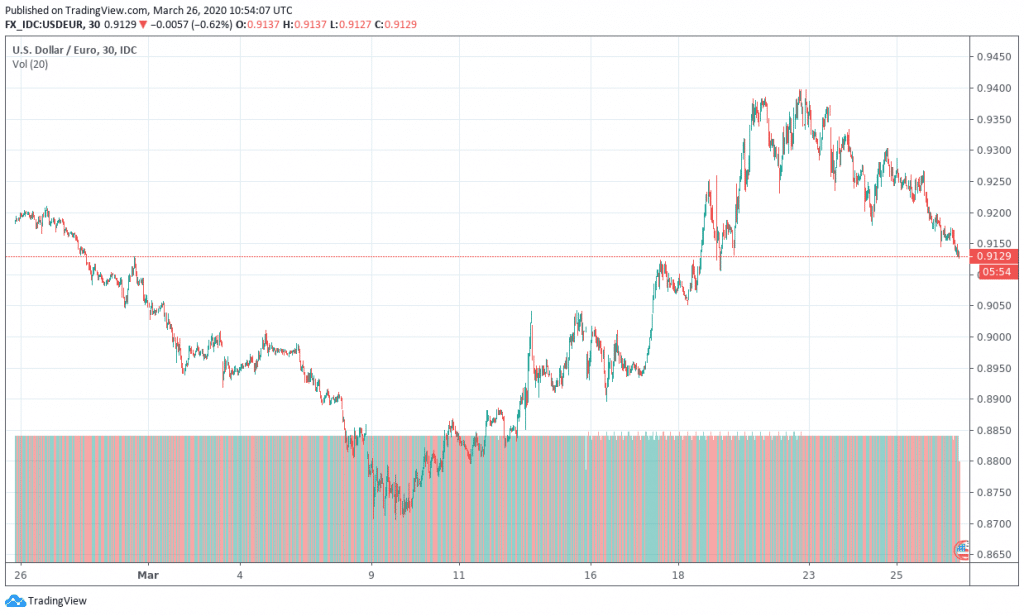
But the coronavirus pandemic defied expectations: "in the case of the COVID-19, the speed of the repricing of growth (sell-off in equities) saw huge swings in currencies, and in particular strength in the US dollar, as well as significant margin calls."
Deane says that, therefore, "a strong USD and unwinding of all positions (including stores of value) to finance margin requirements has had a short term negative effect on both gold and BTC in USD terms."
"However, if you look at both assets over a basket of currencies on a trade-weighted basis, gold is relatively flat during this cycle, and BTC only marginally lower. Similar to other significant sell-offs in equity markets, the repricing of stores of value is usually over the medium term."
In other words, the fallout that we've seen in assets like Bitcoin and gold may have been caused by the temporary capital flight into the USD, movement that has caused a rapid upward squeeze for the dollar.
However, the value of the USD could be in for a rude awakening when the crisis has passed, and the trillions of dollars that were printed as part of the coronavirus stimulus packages are still floating around the global economy.
"With COVID-19 and the unparalleled amount of fiscal and monetary stimulus we have witnessed to date, I believe we will see exactly the same scenario play out again," Deane explained. "As inflation comes back, decentralized assets will start to significantly appreciate in value."
However, crypto market analyst Alex Krüger pointed out that the extent to which inflation will occur in USD markets may be somewhat exaggerated in certain circles: while some inflation is likely, Krüger said that "the marketplace often misprices things, but hyper-inflation calls are exaggerated/premature."
Twitter: HYPER-INFLATION is coming.
Sophisticated investors: pricing in 0.8% average inflation over the next 10 years.
Granted, the marketplace often missprices things, but hyper-inflation calls are exaggerated/premature. https://t.co/4h7QjosoTp
Many other traders who have embraced this belief--that long-term inflation in USD markets will eventually cause a flow of capital into decentralized assets--have therefore viewed the fall in the price of BTC as an opportunity to "[be] greedy when others are fearful," as Warren Buffet famously advised.
But traders who may be interested in making gains in the nearer term could consider employing different strategies. On a basic level, "if you're a more active trader, derivatives can also be used to go short on a cryptocurrency and profit from a bear market," explained Jose Llisterri, Chief Product Officer at crypto derivatives exchange Interdax.
Interdax co-founder and Chief Product Officer Jose Llisterri.
"Betting that crypto-assets' values will go down is very lucrative if a trader knows how to read the markets and sentiment properly."
For example, in a recent report on the Bitcoin network's reaction to the coronavirus, blockchain data firm Chainalysis recently reported findings that "the amount of bitcoin that moved in and out of exchanges by small transfers – between 0.1 and 10 bitcoin – almost doubled since March 9," suggesting "significant 'retail' involvement in both selling and buying. However, transfers of between 10 and 1,000 bitcoin were responsible for 70% of the bitcoin in and out of exchanges."
Data points such as these are particularly important because there is still a relative lack of data on how Bitcoin and other cryptocurrencies fit into the greater financial ecosystem: "because of the relative age of the crypto market, there's considerably less research and evidence on how to value crypto assets from a fundamental perspective," Llisterri said.
Does higher volatility make a case for increased usage of AI & machine learning in crypto trading?
Llisteri also said that "since this market is nascent, and it's full of inefficiencies, there's also room for some High-Frequency Trading and Machine Learning, but on a much smaller scale compared to traditional markets."
However, Stephen Mathai-Davis, certified financial advisor and chief executive of Quantalytics AI, a fintech company focused on retail investing, also told Finance Magnates that the value of machine learning in markets that move as quickly as crypto markets do could not be underestimated, especially in times like these.
Stephen Mathai-Davis, certified financial advisor and chief executive of Quantalytics AI.
"In my opinion, using some form of machine learning is the most effective way to trade crypto markets," he said. "Unlike other asset classes, the time series for cryptos is not long enough (nor stationary enough) to cause technical analysis (TA) to be predictive."
In Mathai-Davis's view, "crypto markets offer a unique opportunity to truly test out different and unique AI and ML methodologies to the investment decision and execution processes."
That said, Mathai-Davis also suggested that "[...] at the end of the day, it makes more sense to own a basket of cryptos to diversify different tech and price risks," adding that "ironically, this makes 'investing' in cryptocurrencies very similar to investing in other traditional assets."
With volatility comes opportunities for arbitrage--but can the crypto ecosystem support this kind of inter-exchange trading?
Llisterri also pointed out that arbitrage between Bitcoin exchanges also provides an opportunity for profiting, particularly during times of volatility: "arbitrage is also quite common, and there's plenty of opportunities thanks to the big number of crypto exchanges in the industry," he said.
"There [was] so much leverage on margin trading that when people's stacks get liquidated, it creates a locally lower point for the Bitcoin price than the global price," Miko explained.
Miko Matsumura, general partner at Gumi Cryptos and renowned crypto market commentator.
However, Miko also pointed out that a lack of dependable infrastructure in the space can make it difficult--or even impossible--to profit off of these local pricing phenomena. "the problem is that if your assets are stuck in that bubble, you're unable to access the global price," he said, which "creates more potential for panic-selling and those kinds of things."
In a report on this particular type of phenomenon, Multicoin Capital's Kyle Samani wrote that "during times of crisis, [exchanges] become so congested that arbitrageurs cannot keep prices in line across venues, causing massive dislocations on individual exchanges." In one instance, "massive dislocations on a single exchange (BitMEX) caused Bitcoin to dip below $4,000 for 15-30 minutes; however, this would not have happened if the market operated correctly."
Miko said that "the thing that's interesting about it is that there's an impedance mismatch between exchanges, because [the exchange] networks get congested–the networks themselves don't move fast enough to enable arbitrage between networks," so that when these kinds of "strong hits" come, "you're not able to handle global liquidity."
Therefore, "in a way, what's happened here is that we have the strength of the underlying asset–which is custody and settlement–and then we have a weakness in the infrastructure above that," which includes things like cryptocurrency exchanges. Therefore, in many cases, the potential for arbitrage between cryptocurrency exchanges remains unmet.
What are your strategies for trading through the corona crisis? We'd love to hear your thoughts in the comment below. None of the content presented in this article constitutes investment advice.
The term, which was popularized by Nassim Nicholas Taleb, a finance professor, trader, and author of Fooled by Randomness, describes a novel, unpredictable event that stretches beyond what is normally expected of a situation and has potentially severe consequences.
Because these events are so unpredictable, it is often the case that there is no precedent for what their consequences might be.
Crypto markets aren't following any kind of predictable pattern
And this is precisely where traders seem to have found themselves--when the coronavirus began to spread around the globe, both traditional and crypto markets were seemingly in the midst of prosperous periods. Bitcoin had been finding its footing around the $8,000-10,500 range for the better part of a month (a significant period of time in crypto-land), and traditional stock and commodities markets, still boosted by the "Trump bump," were steadily climbing.
However, when the virus started to spread, all of that came crashing down--and fast. With a few exceptions, many of the days over the last two and a half weeks have been some of the worst in the history of modern financial markets--including the Bitcoin market.
Indeed, in a matter of days, Bitcoin plummeted from roughly $8,000 to nearly $4,000 before recovering to just about $6,100. While BTC is no stranger to volatility, the effects of the coronavirus had on Bitcoin markets challenged many of the assumptions that traders seemed to have had about Bitcoin's relationships to other financial markets and the world at large.
With so many assumptions about the stability of Bitcoin and other financial markets out the window, what have traders learned over the past month? And how can traders stay profitable in times of market decline and extreme volatility?
The spread of COVID-19 destroyed 'safe-haven' expectations in Bitcoin and beyond
One of the most significant truths that the coronavirus crisis has exposed is the revelation that the Bitcoin-as-a-safe-haven narrative wasn't aligned with the reality of how Bitcoin was viewed by most of its users.
Jon Deane, chief executive of physical commodity digitization firm Infinigold.
On a practical level, this means that "asset managers do not currently consider it in the same bucket as gold as a store of value and don't consider it as part of any risk parity structure in their portfolios. Whereas Gold and US, treasuries have both shown attributes of a safe haven asset, as market participants have switched quickly out of growth-related assets. Bitcoin, while it hasn't sold off to the same degree as some single stock equities, hasn't demonstrated the same resilience that many commentators were expecting."
Indeed, to a large extent, Bitcoin has mirrored sell-offs in stock markets.
Bitcoin back to mirroring stocks overnight. Chart on the right is the S&P 500. Seem them spike, peak and crash at the same times. pic.twitter.com/kXqDR27oax
But these unexpected sell-offs were not unique to Bitcoin, and indeed, not even to "frontier alternative assets" more generally.
Deane explained that "the initial reaction to a pandemic like COVID-19 is a repricing of global growth."
" The repricing of stores of value is usually over the medium term."
"Assumptions have to be made, and commodities like oil and copper are usually leading indicators of what the market is thinking around the global health of the economy," he continued. "As the market reprices growth by selling equities, as the price to future earnings ratio quickly readjusts, usually we see stores of value assets like gold and BTC hold value, if not appreciate."
But the coronavirus pandemic defied expectations: "in the case of the COVID-19, the speed of the repricing of growth (sell-off in equities) saw huge swings in currencies, and in particular strength in the US dollar, as well as significant margin calls."
Deane says that, therefore, "a strong USD and unwinding of all positions (including stores of value) to finance margin requirements has had a short term negative effect on both gold and BTC in USD terms."
"However, if you look at both assets over a basket of currencies on a trade-weighted basis, gold is relatively flat during this cycle, and BTC only marginally lower. Similar to other significant sell-offs in equity markets, the repricing of stores of value is usually over the medium term."
In other words, the fallout that we've seen in assets like Bitcoin and gold may have been caused by the temporary capital flight into the USD, movement that has caused a rapid upward squeeze for the dollar.
However, the value of the USD could be in for a rude awakening when the crisis has passed, and the trillions of dollars that were printed as part of the coronavirus stimulus packages are still floating around the global economy.
"With COVID-19 and the unparalleled amount of fiscal and monetary stimulus we have witnessed to date, I believe we will see exactly the same scenario play out again," Deane explained. "As inflation comes back, decentralized assets will start to significantly appreciate in value."
However, crypto market analyst Alex Krüger pointed out that the extent to which inflation will occur in USD markets may be somewhat exaggerated in certain circles: while some inflation is likely, Krüger said that "the marketplace often misprices things, but hyper-inflation calls are exaggerated/premature."
Twitter: HYPER-INFLATION is coming.
Sophisticated investors: pricing in 0.8% average inflation over the next 10 years.
Granted, the marketplace often missprices things, but hyper-inflation calls are exaggerated/premature. https://t.co/4h7QjosoTp
Many other traders who have embraced this belief--that long-term inflation in USD markets will eventually cause a flow of capital into decentralized assets--have therefore viewed the fall in the price of BTC as an opportunity to "[be] greedy when others are fearful," as Warren Buffet famously advised.
But traders who may be interested in making gains in the nearer term could consider employing different strategies. On a basic level, "if you're a more active trader, derivatives can also be used to go short on a cryptocurrency and profit from a bear market," explained Jose Llisterri, Chief Product Officer at crypto derivatives exchange Interdax.
Interdax co-founder and Chief Product Officer Jose Llisterri.
"Betting that crypto-assets' values will go down is very lucrative if a trader knows how to read the markets and sentiment properly."
For example, in a recent report on the Bitcoin network's reaction to the coronavirus, blockchain data firm Chainalysis recently reported findings that "the amount of bitcoin that moved in and out of exchanges by small transfers – between 0.1 and 10 bitcoin – almost doubled since March 9," suggesting "significant 'retail' involvement in both selling and buying. However, transfers of between 10 and 1,000 bitcoin were responsible for 70% of the bitcoin in and out of exchanges."
Data points such as these are particularly important because there is still a relative lack of data on how Bitcoin and other cryptocurrencies fit into the greater financial ecosystem: "because of the relative age of the crypto market, there's considerably less research and evidence on how to value crypto assets from a fundamental perspective," Llisterri said.
Does higher volatility make a case for increased usage of AI & machine learning in crypto trading?
Llisteri also said that "since this market is nascent, and it's full of inefficiencies, there's also room for some High-Frequency Trading and Machine Learning, but on a much smaller scale compared to traditional markets."
However, Stephen Mathai-Davis, certified financial advisor and chief executive of Quantalytics AI, a fintech company focused on retail investing, also told Finance Magnates that the value of machine learning in markets that move as quickly as crypto markets do could not be underestimated, especially in times like these.
Stephen Mathai-Davis, certified financial advisor and chief executive of Quantalytics AI.
"In my opinion, using some form of machine learning is the most effective way to trade crypto markets," he said. "Unlike other asset classes, the time series for cryptos is not long enough (nor stationary enough) to cause technical analysis (TA) to be predictive."
In Mathai-Davis's view, "crypto markets offer a unique opportunity to truly test out different and unique AI and ML methodologies to the investment decision and execution processes."
That said, Mathai-Davis also suggested that "[...] at the end of the day, it makes more sense to own a basket of cryptos to diversify different tech and price risks," adding that "ironically, this makes 'investing' in cryptocurrencies very similar to investing in other traditional assets."
With volatility comes opportunities for arbitrage--but can the crypto ecosystem support this kind of inter-exchange trading?
Llisterri also pointed out that arbitrage between Bitcoin exchanges also provides an opportunity for profiting, particularly during times of volatility: "arbitrage is also quite common, and there's plenty of opportunities thanks to the big number of crypto exchanges in the industry," he said.
"There [was] so much leverage on margin trading that when people's stacks get liquidated, it creates a locally lower point for the Bitcoin price than the global price," Miko explained.
Miko Matsumura, general partner at Gumi Cryptos and renowned crypto market commentator.
However, Miko also pointed out that a lack of dependable infrastructure in the space can make it difficult--or even impossible--to profit off of these local pricing phenomena. "the problem is that if your assets are stuck in that bubble, you're unable to access the global price," he said, which "creates more potential for panic-selling and those kinds of things."
In a report on this particular type of phenomenon, Multicoin Capital's Kyle Samani wrote that "during times of crisis, [exchanges] become so congested that arbitrageurs cannot keep prices in line across venues, causing massive dislocations on individual exchanges." In one instance, "massive dislocations on a single exchange (BitMEX) caused Bitcoin to dip below $4,000 for 15-30 minutes; however, this would not have happened if the market operated correctly."
Miko said that "the thing that's interesting about it is that there's an impedance mismatch between exchanges, because [the exchange] networks get congested–the networks themselves don't move fast enough to enable arbitrage between networks," so that when these kinds of "strong hits" come, "you're not able to handle global liquidity."
Therefore, "in a way, what's happened here is that we have the strength of the underlying asset–which is custody and settlement–and then we have a weakness in the infrastructure above that," which includes things like cryptocurrency exchanges. Therefore, in many cases, the potential for arbitrage between cryptocurrency exchanges remains unmet.
What are your strategies for trading through the corona crisis? We'd love to hear your thoughts in the comment below. None of the content presented in this article constitutes investment advice.
Rachel is a self-taught crypto geek and a passionate writer. She believes in the power that the written word has to educate, connect and empower individuals to make positive and powerful financial choices. She is the Podcast Host and a Cryptocurrency Editor at Finance Magnates.
Crypto Built More Rails, but the Next Battle Is Over How Much Work a Dollar Can Do
Featured Videos
FP Markets Winner Spotlight 🏆 | Global Broker of the Year 2025 #Trading #Broker #Innovation #Shorts
FP Markets Winner Spotlight 🏆 | Global Broker of the Year 2025 #Trading #Broker #Innovation #Shorts
FP Markets Winner Spotlight 🏆 | Global Broker of the Year 2025 #Trading #Broker #Innovation #Shorts
FP Markets Winner Spotlight 🏆 | Global Broker of the Year 2025 #Trading #Broker #Innovation #Shorts
FP Markets takes the spotlight as Global Broker of the Year 2025 at the Finance Magnates Awards.
Martin Stoilov, Head of Client Experience, shares that trust, innovation, and people played a key role in the company’s success, supported by a strong foundation of integrity and client-centricity.
Following this milestone, FP Markets continues to focus on growth, technology investment, and its core values of transparency and excellence.
👉 Be part of FM Awards 2026: https://awards.financemagnates.com/#nominate
FP Markets takes the spotlight as Global Broker of the Year 2025 at the Finance Magnates Awards.
Martin Stoilov, Head of Client Experience, shares that trust, innovation, and people played a key role in the company’s success, supported by a strong foundation of integrity and client-centricity.
Following this milestone, FP Markets continues to focus on growth, technology investment, and its core values of transparency and excellence.
👉 Be part of FM Awards 2026: https://awards.financemagnates.com/#nominate
FP Markets takes the spotlight as Global Broker of the Year 2025 at the Finance Magnates Awards.
Martin Stoilov, Head of Client Experience, shares that trust, innovation, and people played a key role in the company’s success, supported by a strong foundation of integrity and client-centricity.
Following this milestone, FP Markets continues to focus on growth, technology investment, and its core values of transparency and excellence.
👉 Be part of FM Awards 2026: https://awards.financemagnates.com/#nominate
FP Markets takes the spotlight as Global Broker of the Year 2025 at the Finance Magnates Awards.
Martin Stoilov, Head of Client Experience, shares that trust, innovation, and people played a key role in the company’s success, supported by a strong foundation of integrity and client-centricity.
Following this milestone, FP Markets continues to focus on growth, technology investment, and its core values of transparency and excellence.
👉 Be part of FM Awards 2026: https://awards.financemagnates.com/#nominate
In this video, we review @HolaPrimeMarketsOfficial, a multi-asset forex and CFDs broker offering different account types, trading platforms, and flexible trading conditions.
We cover the broker’s overall offering, including account options, trading environment, platforms like MT4 and MT5, and additional services such as managed accounts and fast withdrawals.
Watch the full video to see if Hola Prime Markets fits your trading needs.
📣 Stay up to date with the latest in finance and trading. Follow Finance Magnates for industry news, insights, and global event coverage.
Connect with us:
🔗 LinkedIn: /financemagnates
👍 Facebook: /financemagnates
📸 Instagram: https://www.instagram.com/financemagnates
🐦 X: https://x.com/financemagnates
🎥 TikTok: https://www.tiktok.com/tag/financemagnates
▶️ YouTube: /@financemagnates_official
#HolaPrime #ForexBroker #CFDTrading #FinanceMagnates #Trading #Forex #BrokerReview
In this video, we review @HolaPrimeMarketsOfficial, a multi-asset forex and CFDs broker offering different account types, trading platforms, and flexible trading conditions.
We cover the broker’s overall offering, including account options, trading environment, platforms like MT4 and MT5, and additional services such as managed accounts and fast withdrawals.
Watch the full video to see if Hola Prime Markets fits your trading needs.
📣 Stay up to date with the latest in finance and trading. Follow Finance Magnates for industry news, insights, and global event coverage.
Connect with us:
🔗 LinkedIn: /financemagnates
👍 Facebook: /financemagnates
📸 Instagram: https://www.instagram.com/financemagnates
🐦 X: https://x.com/financemagnates
🎥 TikTok: https://www.tiktok.com/tag/financemagnates
▶️ YouTube: /@financemagnates_official
#HolaPrime #ForexBroker #CFDTrading #FinanceMagnates #Trading #Forex #BrokerReview
In this video, we review @HolaPrimeMarketsOfficial, a multi-asset forex and CFDs broker offering different account types, trading platforms, and flexible trading conditions.
We cover the broker’s overall offering, including account options, trading environment, platforms like MT4 and MT5, and additional services such as managed accounts and fast withdrawals.
Watch the full video to see if Hola Prime Markets fits your trading needs.
📣 Stay up to date with the latest in finance and trading. Follow Finance Magnates for industry news, insights, and global event coverage.
Connect with us:
🔗 LinkedIn: /financemagnates
👍 Facebook: /financemagnates
📸 Instagram: https://www.instagram.com/financemagnates
🐦 X: https://x.com/financemagnates
🎥 TikTok: https://www.tiktok.com/tag/financemagnates
▶️ YouTube: /@financemagnates_official
#HolaPrime #ForexBroker #CFDTrading #FinanceMagnates #Trading #Forex #BrokerReview
In this video, we review @HolaPrimeMarketsOfficial, a multi-asset forex and CFDs broker offering different account types, trading platforms, and flexible trading conditions.
We cover the broker’s overall offering, including account options, trading environment, platforms like MT4 and MT5, and additional services such as managed accounts and fast withdrawals.
Watch the full video to see if Hola Prime Markets fits your trading needs.
📣 Stay up to date with the latest in finance and trading. Follow Finance Magnates for industry news, insights, and global event coverage.
Connect with us:
🔗 LinkedIn: /financemagnates
👍 Facebook: /financemagnates
📸 Instagram: https://www.instagram.com/financemagnates
🐦 X: https://x.com/financemagnates
🎥 TikTok: https://www.tiktok.com/tag/financemagnates
▶️ YouTube: /@financemagnates_official
#HolaPrime #ForexBroker #CFDTrading #FinanceMagnates #Trading #Forex #BrokerReview
In this video, we review @HolaPrimeMarketsOfficial, a multi-asset forex and CFDs broker offering different account types, trading platforms, and flexible trading conditions.
We cover the broker’s overall offering, including account options, trading environment, platforms like MT4 and MT5, and additional services such as managed accounts and fast withdrawals.
Watch the full video to see if Hola Prime Markets fits your trading needs.
📣 Stay up to date with the latest in finance and trading. Follow Finance Magnates for industry news, insights, and global event coverage.
Connect with us:
🔗 LinkedIn: /financemagnates
👍 Facebook: /financemagnates
📸 Instagram: https://www.instagram.com/financemagnates
🐦 X: https://x.com/financemagnates
🎥 TikTok: https://www.tiktok.com/tag/financemagnates
▶️ YouTube: /@financemagnates_official
#HolaPrime #ForexBroker #CFDTrading #FinanceMagnates #Trading #Forex #BrokerReview
In this video, we review @HolaPrimeMarketsOfficial, a multi-asset forex and CFDs broker offering different account types, trading platforms, and flexible trading conditions.
We cover the broker’s overall offering, including account options, trading environment, platforms like MT4 and MT5, and additional services such as managed accounts and fast withdrawals.
Watch the full video to see if Hola Prime Markets fits your trading needs.
📣 Stay up to date with the latest in finance and trading. Follow Finance Magnates for industry news, insights, and global event coverage.
Connect with us:
🔗 LinkedIn: /financemagnates
👍 Facebook: /financemagnates
📸 Instagram: https://www.instagram.com/financemagnates
🐦 X: https://x.com/financemagnates
🎥 TikTok: https://www.tiktok.com/tag/financemagnates
▶️ YouTube: /@financemagnates_official
#HolaPrime #ForexBroker #CFDTrading #FinanceMagnates #Trading #Forex #BrokerReview
Hola Prime Review: What You Need to Know | Full Breakdown by Finance Magnates
Hola Prime Review: What You Need to Know | Full Breakdown by Finance Magnates
Hola Prime Review: What You Need to Know | Full Breakdown by Finance Magnates
Hola Prime Review: What You Need to Know | Full Breakdown by Finance Magnates
Hola Prime Review: What You Need to Know | Full Breakdown by Finance Magnates
Hola Prime Review: What You Need to Know | Full Breakdown by Finance Magnates
In this video, we review @HolaPrime_Global, a proprietary trading firm offering evaluation programs and performance-based payouts in simulated market environments.
We cover how the challenge model works, including account types, profit splits (up to 95%), trading rules, and what it takes to reach a funded account. You’ll also learn about available platforms like MT4, MT5, cTrader, and more, along with insights into payouts, support, and trading conditions.
Watch the full video to see if Hola Prime fits your trading style.
📣 Stay up to date with the latest in finance and trading. Follow Finance Magnates for industry news, insights, and global event coverage.
Connect with us:
🔗 LinkedIn: /financemagnates
👍 Facebook: /financemagnates
📸 Instagram: https://www.instagram.com/financemagnates
🐦 X: https://x.com/financemagnates
🎥 TikTok: https://www.tiktok.com/tag/financemagnates
▶️ YouTube: /@financemagnates_official
#HolaPrime #PropFirm #Trading #FinanceMagnates #Forex #FuturesTrading #TradingReview #PropFirmReview
In this video, we review @HolaPrime_Global, a proprietary trading firm offering evaluation programs and performance-based payouts in simulated market environments.
We cover how the challenge model works, including account types, profit splits (up to 95%), trading rules, and what it takes to reach a funded account. You’ll also learn about available platforms like MT4, MT5, cTrader, and more, along with insights into payouts, support, and trading conditions.
Watch the full video to see if Hola Prime fits your trading style.
📣 Stay up to date with the latest in finance and trading. Follow Finance Magnates for industry news, insights, and global event coverage.
Connect with us:
🔗 LinkedIn: /financemagnates
👍 Facebook: /financemagnates
📸 Instagram: https://www.instagram.com/financemagnates
🐦 X: https://x.com/financemagnates
🎥 TikTok: https://www.tiktok.com/tag/financemagnates
▶️ YouTube: /@financemagnates_official
#HolaPrime #PropFirm #Trading #FinanceMagnates #Forex #FuturesTrading #TradingReview #PropFirmReview
In this video, we review @HolaPrime_Global, a proprietary trading firm offering evaluation programs and performance-based payouts in simulated market environments.
We cover how the challenge model works, including account types, profit splits (up to 95%), trading rules, and what it takes to reach a funded account. You’ll also learn about available platforms like MT4, MT5, cTrader, and more, along with insights into payouts, support, and trading conditions.
Watch the full video to see if Hola Prime fits your trading style.
📣 Stay up to date with the latest in finance and trading. Follow Finance Magnates for industry news, insights, and global event coverage.
Connect with us:
🔗 LinkedIn: /financemagnates
👍 Facebook: /financemagnates
📸 Instagram: https://www.instagram.com/financemagnates
🐦 X: https://x.com/financemagnates
🎥 TikTok: https://www.tiktok.com/tag/financemagnates
▶️ YouTube: /@financemagnates_official
#HolaPrime #PropFirm #Trading #FinanceMagnates #Forex #FuturesTrading #TradingReview #PropFirmReview
In this video, we review @HolaPrime_Global, a proprietary trading firm offering evaluation programs and performance-based payouts in simulated market environments.
We cover how the challenge model works, including account types, profit splits (up to 95%), trading rules, and what it takes to reach a funded account. You’ll also learn about available platforms like MT4, MT5, cTrader, and more, along with insights into payouts, support, and trading conditions.
Watch the full video to see if Hola Prime fits your trading style.
📣 Stay up to date with the latest in finance and trading. Follow Finance Magnates for industry news, insights, and global event coverage.
Connect with us:
🔗 LinkedIn: /financemagnates
👍 Facebook: /financemagnates
📸 Instagram: https://www.instagram.com/financemagnates
🐦 X: https://x.com/financemagnates
🎥 TikTok: https://www.tiktok.com/tag/financemagnates
▶️ YouTube: /@financemagnates_official
#HolaPrime #PropFirm #Trading #FinanceMagnates #Forex #FuturesTrading #TradingReview #PropFirmReview
In this video, we review @HolaPrime_Global, a proprietary trading firm offering evaluation programs and performance-based payouts in simulated market environments.
We cover how the challenge model works, including account types, profit splits (up to 95%), trading rules, and what it takes to reach a funded account. You’ll also learn about available platforms like MT4, MT5, cTrader, and more, along with insights into payouts, support, and trading conditions.
Watch the full video to see if Hola Prime fits your trading style.
📣 Stay up to date with the latest in finance and trading. Follow Finance Magnates for industry news, insights, and global event coverage.
Connect with us:
🔗 LinkedIn: /financemagnates
👍 Facebook: /financemagnates
📸 Instagram: https://www.instagram.com/financemagnates
🐦 X: https://x.com/financemagnates
🎥 TikTok: https://www.tiktok.com/tag/financemagnates
▶️ YouTube: /@financemagnates_official
#HolaPrime #PropFirm #Trading #FinanceMagnates #Forex #FuturesTrading #TradingReview #PropFirmReview
In this video, we review @HolaPrime_Global, a proprietary trading firm offering evaluation programs and performance-based payouts in simulated market environments.
We cover how the challenge model works, including account types, profit splits (up to 95%), trading rules, and what it takes to reach a funded account. You’ll also learn about available platforms like MT4, MT5, cTrader, and more, along with insights into payouts, support, and trading conditions.
Watch the full video to see if Hola Prime fits your trading style.
📣 Stay up to date with the latest in finance and trading. Follow Finance Magnates for industry news, insights, and global event coverage.
Connect with us:
🔗 LinkedIn: /financemagnates
👍 Facebook: /financemagnates
📸 Instagram: https://www.instagram.com/financemagnates
🐦 X: https://x.com/financemagnates
🎥 TikTok: https://www.tiktok.com/tag/financemagnates
▶️ YouTube: /@financemagnates_official
#HolaPrime #PropFirm #Trading #FinanceMagnates #Forex #FuturesTrading #TradingReview #PropFirmReview
Axi Winner Spotlight 🏆 | Global Most Innovative Broker 2025 #Innovation #Trading #Fintech #Broker
Axi Winner Spotlight 🏆 | Global Most Innovative Broker 2025 #Innovation #Trading #Fintech #Broker
Axi Winner Spotlight 🏆 | Global Most Innovative Broker 2025 #Innovation #Trading #Fintech #Broker
Axi Winner Spotlight 🏆 | Global Most Innovative Broker 2025 #Innovation #Trading #Fintech #Broker
Axi Winner Spotlight 🏆 | Global Most Innovative Broker 2025 #Innovation #Trading #Fintech #Broker
Axi Winner Spotlight 🏆 | Global Most Innovative Broker 2025 #Innovation #Trading #Fintech #Broker
Axi takes the spotlight at the Finance Magnates Awards, winning Global Most Innovative Broker 2025.
Olivia Xenofontos and Ivanna Openko share how the team will feel: proud, motivated, and ready to keep delivering.
They also describe the night as well-organized, focused, and enjoyable for all.
👉 Be part of FM Awards 2026.
Axi takes the spotlight at the Finance Magnates Awards, winning Global Most Innovative Broker 2025.
Olivia Xenofontos and Ivanna Openko share how the team will feel: proud, motivated, and ready to keep delivering.
They also describe the night as well-organized, focused, and enjoyable for all.
👉 Be part of FM Awards 2026.
Axi takes the spotlight at the Finance Magnates Awards, winning Global Most Innovative Broker 2025.
Olivia Xenofontos and Ivanna Openko share how the team will feel: proud, motivated, and ready to keep delivering.
They also describe the night as well-organized, focused, and enjoyable for all.
👉 Be part of FM Awards 2026.
Axi takes the spotlight at the Finance Magnates Awards, winning Global Most Innovative Broker 2025.
Olivia Xenofontos and Ivanna Openko share how the team will feel: proud, motivated, and ready to keep delivering.
They also describe the night as well-organized, focused, and enjoyable for all.
👉 Be part of FM Awards 2026.
Axi takes the spotlight at the Finance Magnates Awards, winning Global Most Innovative Broker 2025.
Olivia Xenofontos and Ivanna Openko share how the team will feel: proud, motivated, and ready to keep delivering.
They also describe the night as well-organized, focused, and enjoyable for all.
👉 Be part of FM Awards 2026.
Axi takes the spotlight at the Finance Magnates Awards, winning Global Most Innovative Broker 2025.
Olivia Xenofontos and Ivanna Openko share how the team will feel: proud, motivated, and ready to keep delivering.
They also describe the night as well-organized, focused, and enjoyable for all.
👉 Be part of FM Awards 2026.
Recognition that matters.
Built on transparency.
Driven by the industry.
The Finance Magnates Awards 2026.
Nominations are now open.
🔗 https://awards.financemagnates.com/?utm_source=SM&utm_medium=social&utm_campaign=recognition-matters
Recognition that matters.
Built on transparency.
Driven by the industry.
The Finance Magnates Awards 2026.
Nominations are now open.
🔗 https://awards.financemagnates.com/?utm_source=SM&utm_medium=social&utm_campaign=recognition-matters
Recognition that matters.
Built on transparency.
Driven by the industry.
The Finance Magnates Awards 2026.
Nominations are now open.
🔗 https://awards.financemagnates.com/?utm_source=SM&utm_medium=social&utm_campaign=recognition-matters
Recognition that matters.
Built on transparency.
Driven by the industry.
The Finance Magnates Awards 2026.
Nominations are now open.
🔗 https://awards.financemagnates.com/?utm_source=SM&utm_medium=social&utm_campaign=recognition-matters
Recognition that matters.
Built on transparency.
Driven by the industry.
The Finance Magnates Awards 2026.
Nominations are now open.
🔗 https://awards.financemagnates.com/?utm_source=SM&utm_medium=social&utm_campaign=recognition-matters
Recognition that matters.
Built on transparency.
Driven by the industry.
The Finance Magnates Awards 2026.
Nominations are now open.
🔗 https://awards.financemagnates.com/?utm_source=SM&utm_medium=social&utm_campaign=recognition-matters