This week, the Federal Reserve cut interest rates to 0 and announced a $700B stimulus package.
FM
Both of the last two weeks in the financial world have started off with a bang--on March 9th, stocks and oil prices spiraled down in a series of practically unprecedented crashes and price lows that, in some cases, hadn't been seen for decades.
But, if the news cycle over the last two months--and particularly the last two weeks--has taught us anything, it's that just when things seem as if they can't get any wilder, there's always someone or something that exclaims, "hold my beer."
Indeed, it seems that Wall Street investors are bracing for what could evolve into a global recession fueled by an extended shutdown of public life.
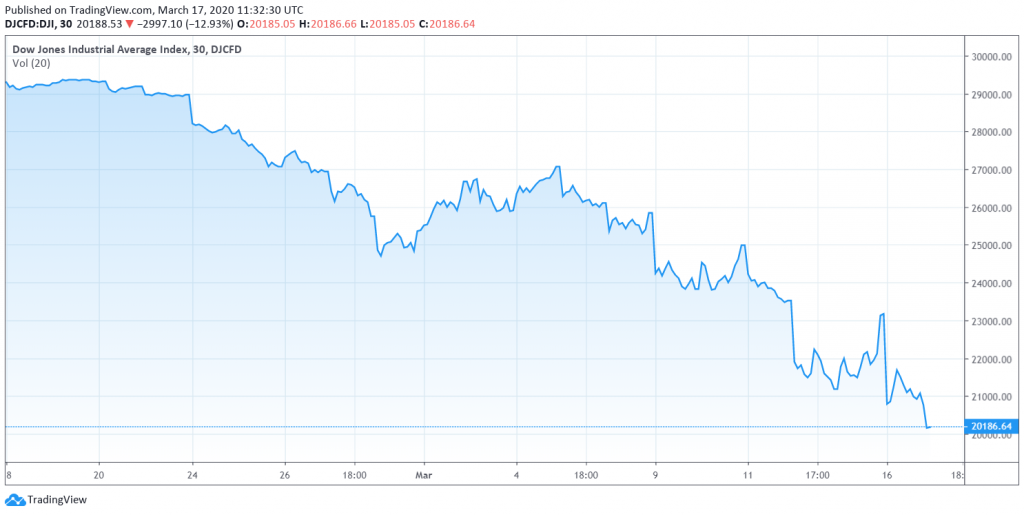
Trading throughout Monday was once again a series of cliff dives: the developing response to the coronavirus outbreak caused the Dow Jones Industrial Average to dive 2,997 points throughout the day (its worse-ever loss on a point basis); the sell-off's percentage decline of 12.93% had not been matched since the "Black Monday" crash of 1987 and was the second-large percentage crash that the index had seen in its more than 100 years of operation.
The Nasdaq also faced its worst percentage decline--12.32%--since its foundation in 1971. The S&P 500 also ended the day with significant losses, falling by 11.98%.
Trading on stock futures also opened significantly lower on Sunday evening, which was especially surprising because of the news that came the Sunday eve before trading opened.
But if the stimulus package hasn't effectively slowed the downward spiral in financial markets, what other courses of action can the Fed take? And what will the long- and short-term consequences on financial markets be?
"There are always unintended consequences."
Since the package already seems to have failed to assuage the concerns of investors, other analysts are wondering if there could be unintended consequences from the stimulus package.
Miko Matsumura, co-founder of the Evercoin cryptocurrency exchange and General Partner with Gumi Cryptos Capital.
"The trouble with big Fed action is that there are two reactions," Mr. Mastumura continued, "the first being 'how wonderful that the authorities are acting so swiftly, we are being taken care of,' and of course, the opposite reaction, which is 'oh my god, it must be crazily bad for them to do something like this.'"
"Given the drop in the Dow after the Fed announcement, people reacted in the latter way," he explained.
This is most likely not what the Fed expected to happen. Indeed, Pankaj Balaji, chief executive of cryptocurrency derivatives trading platform Delta Exchange, explained to Finance Magnates that "the Fed would've liked the markets to bounce in the wake of the measures it announced, but we saw little relief."
Instead, investors are continuously reacting to the uncertainty of the situation: "the market is not seeing the Fed's plan to boost its bond holdings by $700BN as sufficient to recover from the demand shock that we will see because of the prolonged shutdowns across the globe," Mr. Balaji said.
"Markets are factoring a large scale economic contraction, and the Fed will have to announce more, and bigger, measures to arrest the current fall."
If the Fed already pulled out the bazooka...what other tools are left in its arsenal?
Indeed, the fact that the announcement of the stimulus package seems to have had such a negligible effect on stock markets has led some analysts to question the timing--or even the competency--of the stimulus package.
This is especially true considering the fact that a $1.5 trillion capital injection into money markets seemed to have almost no effect on the downward spiral that had already been wreaking havoc on markets.
Market analyst and Epsilon Theory author Ben Hunt wrote on Twitter that "the Fed just fired a $1.5 trillion bazooka, including tens of billions in outright QE, and so we're only down 5% instead of 8%."
"This is not a market-world crisis," he said. "This is a real-world war. Treat it for what it is, and the markets will recover."
So the Fed just fired a $1.5 TRILLION bazooka, including tens of billions in outright QE, and so we're only down 5% instead of 8%.
This is not a market-world crisis. This is a real-world war. Treat it for what it is and the markets will recover.
Indeed, when the stimulus package was announced, Federal Reserve Chairman Jerome Powell said that the Fed was prepared to use its "full range of tools" in order to fight the negative effects of the coronavirus.
However, some seem to think that the $1.5 trillion capital injection, as well as the decision to cut rates to zero, was a bit like firing a few of the biggest weapons in the Fed's arsenal into the dark; there aren't so many more precedented drastic actions that can be taken--especially since the Fed said that it is not considering negative interest rates.
But, just like the rest of the world, the Fed is stepping into the unknown, and unprecedented actions may have to be taken.
Anthony Pompliano, Partner at Morgan Creek Digital, wrote on Twitter that although Jerome Powell said that the Fed does "not see negative interest rates as appropriate policy here in the United States," drastic times could call for drastic measures: "either they won't cut again or he will have to change his mind," he wrote.
Fed Chairman Jerome Powell was just asked if he would consider negative interest rates.
He said they do not see negative interest rates as appropriate policy here in the United States.
Either they won't cut again or he will have to change his mind.
In other words, exactly what constitutes "appropriate policy" in the United States may be in for a change.
"The Fed is running out of options."
Indeed, Miko Matsumura said that "there are additional levers including negative rates and even deeper QE."
In other words, the Fed isn't quite at the bottom of its barrel--yet: "there are more bazookas left," Mr. Matsumura said, "but the tools the market is looking for right now are the primary economic stimulus that creates more Keyensian acceleration"--that is, the government is attempting to increase demand in order to boost growth.
Indeed, more stimulus packages are likely on their way--and, even though Chairman Powell said that negative rates aren't in the cards, the reality of the situation may bear out differently: "there is already precedent globally for central banks to move rates below zero," said Joe Vezzani, chief executive and founder of crypto investment research firm LunarCrush, in an email to Finance Magnates.
Joe Vezzani, chief executive and founder of crypto investment research firm LunarCrush.
"This is a real possibility in [the United States'] market, as insane as that sounds," he continued. "The Fed is running out of options. The next phase would be to lower capital requirements for banks. Which is ultra dangerous, as we all know what happened last time the banks were under-capitalized."
Until that happens, however, the best that the Fed can continue to do is simply basic damage control: "at this stage, they do not care about where market prices will land, they are simply providing liquidity to the bond markets so that they do not seize up and we still have money flowing through the system," Mr. Vezzani explained.
Indeed, Terraform Capital Managing Partner Michael Poutre told Finance Magnates that "the intended effects of cutting the rates to zero and re-introducing quantitative easing into the economy are designed to slow the effects of business and the economy grinding to a halt."
"For example, the reduction in rates will spur a round of refinancing around the country. People will risk getting infected to lock in a 30 Year Fixed rate loan at 2%. Whereas if these measures weren't taken, the real estate market could collapse," Mr. Poutre explained.
The intention is that "once people refinance, they will have some extra money. Therefore, "when things settle down, they can be some of the first people to start spending again."
In short, "by doing whatever can be down to keep the economy going, even at a snail's pace, the government is acting responsibly."
Terraform Capital Managing Partner Michael Poutre.
"The risk of inaction is greater than the risk of action."
Indeed, even though the Fed's actions may not be having the antidotal effect to the extent that the Fed intended them to, Miko Matsumura said that at this point in the game, "the risk of inaction is greater than the risk of action."
If nothing else, the actions that the Fed has taken could reassure investors--at least, on some level. In a statement shared with Finance Magnates, Joshua Roberts, Associate Director at Chatham Financial, wrote that "at this point, the primary purpose of aggressive rate cuts is to generate confidence that policymakers are willing to do whatever it takes to support the financial system."
Still, the possible permanent changes to United States financial policy that could result from the responses to the coronavirus could have unforeseen long-term effects on the global economy.
And of course, there are the effects that can be predicted, to a certain extent--for one the thing, the QE that the US government has initiated as part of its stimulus package could weaken the United States dollar over the long term.
After all, "the more QE, the more inflationary pressure on the dollar," Miko Matsumura explained. This is because of the likely source of the money that will be used in the QE, which Mr. Matsumura described as "thin air."
WHALE ALERT 🐳
🚨 🚨 🚨 $700,000,000,000 #USD transferred from THIN AIR to Federal Reserve
In other words, a large portion--if not all--of the money that has been designated for the QE package will likely be printed specifically for this purpose; it will be distributed to banks, businesses, and other financial institutions in the form of purchases and loans that the government hopes will be repaid. Then, the next time there's a financial crisis, the government will print more money, and the process will begin again.
Of course, this is nothing new--" we have seen even more draconian measures in the past,' Michael Poutre told Finance Magnates.
"In an attempt to pull [the United States] out of the depression, Frederick Delano Roosevelt made it illegal for any American to [hoard] gold and forced all Americans to turn in their gold for $20 per Troy ounce. Once completed, FDR reset the gold rate to $36 per Troy ounce, and that is how he financed The New Deal."
"QE is more or less an updated version of that," Mr. Poutre explained. "We are printing more money, to buy more of our debt, that our taxes will eventually need to pay for."
Interdax co-founder and Chief Product Officer Jose Llisterri.
Long term effects on the USD
It seems that the result of this process, however, is that over the long-term, flooding the market with more and more USD leads to the continual devaluation of the USD.
On the other hand, however, this process of devaluation could be slowed by the fact that so many investors seem to have traded in their assets for the good ol' greenback.
Indeed, Steve Ehrlich, chief executive and co-founder of cryptocurrency exchange Voyager Digital, told Finance Magnates that "while we see a variety of assets, including stocks and precious metals, experiencing timely and temporary corrections, many institutions have decided to de-risk into U.S. dollars," which effectively "shows the faith the economy still has in the U.S. Dollar."
Steve Ehrlich, chief executive officer and co-founder of crypto trading platform Voyager.
The fact that the economic crisis that has resulted from the reaction to the coronavirus isn't restricted to the US also raises some questions about the future of the USD. "QE should weaken the US Dollar, but since all other major economies are engaged in a similar policy, the net result is uncertain,' said Interdax co-founder and Chief Product Officer Jose Llisterri.
Indeed, "the USD, along with many other major currencies around the world, are being flooded with new supply,' It's a very simple game," explained Joe Vezzani. "Every new dollar"--or euro, or yen, for that matter--" added to the system makes your [money] worth just a little bit less. And when you do this with large sums, the value decreases faster."
Short-term, coronavirus has been disastrous for Bitcoin. What about the long-term?
However, the devaluation of the United States dollar could eventually bring positive news to cryptocurrency traders whose hopes may have been dashed by Bitcoin's response to the coronavirus.
Indeed, while plenty of cryptocurrency traders have long believed that Bitcoin is a safe haven asset that will rise in times of crisis, the price movements that Bitcoin has made over the past several weeks seem to indicate that the opposite is true--that Bitcoin is a risk-on asset, one that doesn't do too well in times of uncertainty.
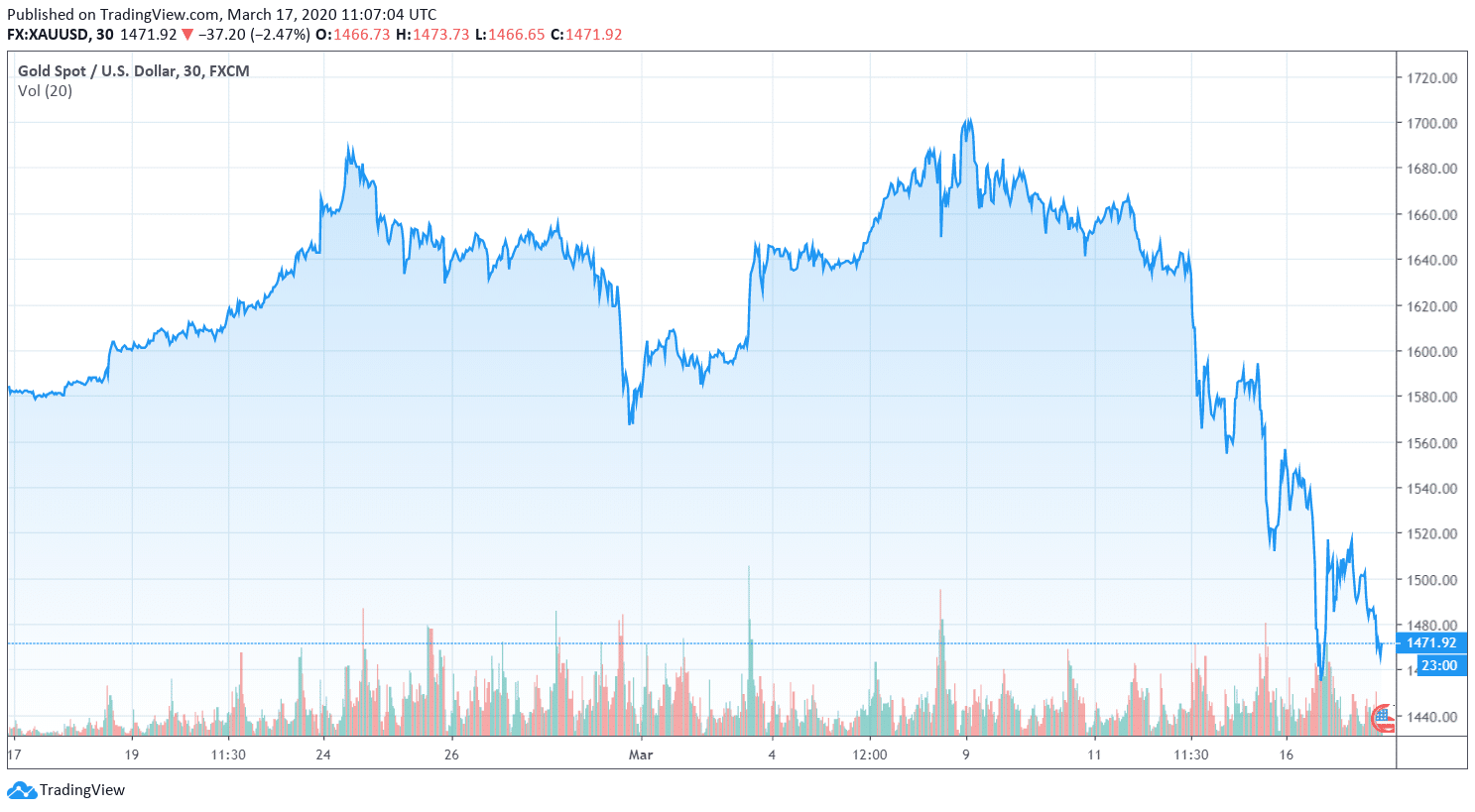
This is because "consumers are selling everything, Gold is down, Oil is down, Bitcoin is down. There are no off-risk investments in this environment."
In fact, cryptocurrency markets could be even more susceptible to sell-offs than other kinds of assets: "because it's easier to liquidate crypto holdings as compared to other assets, this is why we are seeing a sell-off in bitcoin and other cryptos, as holding cash is the best bet if the situation worsens," Jose Llisterri told Finance Magnates.
However, Bitcoin and other cryptocurrencies have historically been used as "safe havens" in countries that have highly unstable fiat currencies, such as Venezuela,Zimbabwe, and even Turkey. Therefore, a rapid devaluation of the USD could potentially result in capital flight to Bitcoin; however, this kind of rapid devaluation does not seem to be very likely at this point in time.
Still, there are some who believe that while the short-term effects on Bitcoin have been disastrous, the long-term could be prove to be beneficial for BTC: "this should be a boon for crypto," Michale Poutre said.
"Bitcoin has seen some good fluctuations and will emerge from this as a solid and tested financial instrument. Like everything else, it will see some 'panic' pressure, but when this subsides, Bitcoin will be one of the best investments one can make coming out of this Virus-initiated global slowdown."
Both of the last two weeks in the financial world have started off with a bang--on March 9th, stocks and oil prices spiraled down in a series of practically unprecedented crashes and price lows that, in some cases, hadn't been seen for decades.
But, if the news cycle over the last two months--and particularly the last two weeks--has taught us anything, it's that just when things seem as if they can't get any wilder, there's always someone or something that exclaims, "hold my beer."
Indeed, it seems that Wall Street investors are bracing for what could evolve into a global recession fueled by an extended shutdown of public life.
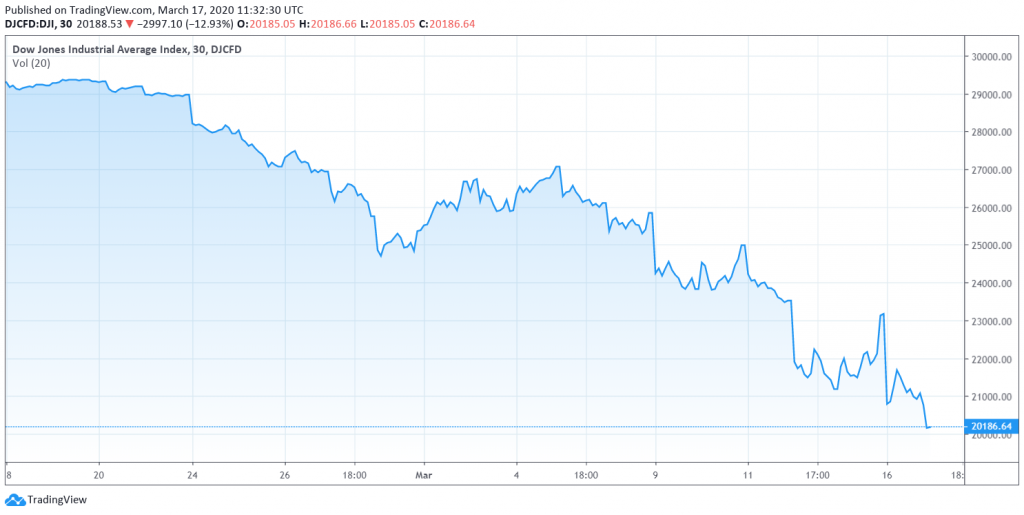
Trading throughout Monday was once again a series of cliff dives: the developing response to the coronavirus outbreak caused the Dow Jones Industrial Average to dive 2,997 points throughout the day (its worse-ever loss on a point basis); the sell-off's percentage decline of 12.93% had not been matched since the "Black Monday" crash of 1987 and was the second-large percentage crash that the index had seen in its more than 100 years of operation.
The Nasdaq also faced its worst percentage decline--12.32%--since its foundation in 1971. The S&P 500 also ended the day with significant losses, falling by 11.98%.
Trading on stock futures also opened significantly lower on Sunday evening, which was especially surprising because of the news that came the Sunday eve before trading opened.
But if the stimulus package hasn't effectively slowed the downward spiral in financial markets, what other courses of action can the Fed take? And what will the long- and short-term consequences on financial markets be?
"There are always unintended consequences."
Since the package already seems to have failed to assuage the concerns of investors, other analysts are wondering if there could be unintended consequences from the stimulus package.
Miko Matsumura, co-founder of the Evercoin cryptocurrency exchange and General Partner with Gumi Cryptos Capital.
"The trouble with big Fed action is that there are two reactions," Mr. Mastumura continued, "the first being 'how wonderful that the authorities are acting so swiftly, we are being taken care of,' and of course, the opposite reaction, which is 'oh my god, it must be crazily bad for them to do something like this.'"
"Given the drop in the Dow after the Fed announcement, people reacted in the latter way," he explained.
This is most likely not what the Fed expected to happen. Indeed, Pankaj Balaji, chief executive of cryptocurrency derivatives trading platform Delta Exchange, explained to Finance Magnates that "the Fed would've liked the markets to bounce in the wake of the measures it announced, but we saw little relief."
Instead, investors are continuously reacting to the uncertainty of the situation: "the market is not seeing the Fed's plan to boost its bond holdings by $700BN as sufficient to recover from the demand shock that we will see because of the prolonged shutdowns across the globe," Mr. Balaji said.
"Markets are factoring a large scale economic contraction, and the Fed will have to announce more, and bigger, measures to arrest the current fall."
If the Fed already pulled out the bazooka...what other tools are left in its arsenal?
Indeed, the fact that the announcement of the stimulus package seems to have had such a negligible effect on stock markets has led some analysts to question the timing--or even the competency--of the stimulus package.
This is especially true considering the fact that a $1.5 trillion capital injection into money markets seemed to have almost no effect on the downward spiral that had already been wreaking havoc on markets.
Market analyst and Epsilon Theory author Ben Hunt wrote on Twitter that "the Fed just fired a $1.5 trillion bazooka, including tens of billions in outright QE, and so we're only down 5% instead of 8%."
"This is not a market-world crisis," he said. "This is a real-world war. Treat it for what it is, and the markets will recover."
So the Fed just fired a $1.5 TRILLION bazooka, including tens of billions in outright QE, and so we're only down 5% instead of 8%.
This is not a market-world crisis. This is a real-world war. Treat it for what it is and the markets will recover.
Indeed, when the stimulus package was announced, Federal Reserve Chairman Jerome Powell said that the Fed was prepared to use its "full range of tools" in order to fight the negative effects of the coronavirus.
However, some seem to think that the $1.5 trillion capital injection, as well as the decision to cut rates to zero, was a bit like firing a few of the biggest weapons in the Fed's arsenal into the dark; there aren't so many more precedented drastic actions that can be taken--especially since the Fed said that it is not considering negative interest rates.
But, just like the rest of the world, the Fed is stepping into the unknown, and unprecedented actions may have to be taken.
Anthony Pompliano, Partner at Morgan Creek Digital, wrote on Twitter that although Jerome Powell said that the Fed does "not see negative interest rates as appropriate policy here in the United States," drastic times could call for drastic measures: "either they won't cut again or he will have to change his mind," he wrote.
Fed Chairman Jerome Powell was just asked if he would consider negative interest rates.
He said they do not see negative interest rates as appropriate policy here in the United States.
Either they won't cut again or he will have to change his mind.
In other words, exactly what constitutes "appropriate policy" in the United States may be in for a change.
"The Fed is running out of options."
Indeed, Miko Matsumura said that "there are additional levers including negative rates and even deeper QE."
In other words, the Fed isn't quite at the bottom of its barrel--yet: "there are more bazookas left," Mr. Matsumura said, "but the tools the market is looking for right now are the primary economic stimulus that creates more Keyensian acceleration"--that is, the government is attempting to increase demand in order to boost growth.
Indeed, more stimulus packages are likely on their way--and, even though Chairman Powell said that negative rates aren't in the cards, the reality of the situation may bear out differently: "there is already precedent globally for central banks to move rates below zero," said Joe Vezzani, chief executive and founder of crypto investment research firm LunarCrush, in an email to Finance Magnates.
Joe Vezzani, chief executive and founder of crypto investment research firm LunarCrush.
"This is a real possibility in [the United States'] market, as insane as that sounds," he continued. "The Fed is running out of options. The next phase would be to lower capital requirements for banks. Which is ultra dangerous, as we all know what happened last time the banks were under-capitalized."
Until that happens, however, the best that the Fed can continue to do is simply basic damage control: "at this stage, they do not care about where market prices will land, they are simply providing liquidity to the bond markets so that they do not seize up and we still have money flowing through the system," Mr. Vezzani explained.
Indeed, Terraform Capital Managing Partner Michael Poutre told Finance Magnates that "the intended effects of cutting the rates to zero and re-introducing quantitative easing into the economy are designed to slow the effects of business and the economy grinding to a halt."
"For example, the reduction in rates will spur a round of refinancing around the country. People will risk getting infected to lock in a 30 Year Fixed rate loan at 2%. Whereas if these measures weren't taken, the real estate market could collapse," Mr. Poutre explained.
The intention is that "once people refinance, they will have some extra money. Therefore, "when things settle down, they can be some of the first people to start spending again."
In short, "by doing whatever can be down to keep the economy going, even at a snail's pace, the government is acting responsibly."
Terraform Capital Managing Partner Michael Poutre.
"The risk of inaction is greater than the risk of action."
Indeed, even though the Fed's actions may not be having the antidotal effect to the extent that the Fed intended them to, Miko Matsumura said that at this point in the game, "the risk of inaction is greater than the risk of action."
If nothing else, the actions that the Fed has taken could reassure investors--at least, on some level. In a statement shared with Finance Magnates, Joshua Roberts, Associate Director at Chatham Financial, wrote that "at this point, the primary purpose of aggressive rate cuts is to generate confidence that policymakers are willing to do whatever it takes to support the financial system."
Still, the possible permanent changes to United States financial policy that could result from the responses to the coronavirus could have unforeseen long-term effects on the global economy.
And of course, there are the effects that can be predicted, to a certain extent--for one the thing, the QE that the US government has initiated as part of its stimulus package could weaken the United States dollar over the long term.
After all, "the more QE, the more inflationary pressure on the dollar," Miko Matsumura explained. This is because of the likely source of the money that will be used in the QE, which Mr. Matsumura described as "thin air."
WHALE ALERT 🐳
🚨 🚨 🚨 $700,000,000,000 #USD transferred from THIN AIR to Federal Reserve
In other words, a large portion--if not all--of the money that has been designated for the QE package will likely be printed specifically for this purpose; it will be distributed to banks, businesses, and other financial institutions in the form of purchases and loans that the government hopes will be repaid. Then, the next time there's a financial crisis, the government will print more money, and the process will begin again.
Of course, this is nothing new--" we have seen even more draconian measures in the past,' Michael Poutre told Finance Magnates.
"In an attempt to pull [the United States] out of the depression, Frederick Delano Roosevelt made it illegal for any American to [hoard] gold and forced all Americans to turn in their gold for $20 per Troy ounce. Once completed, FDR reset the gold rate to $36 per Troy ounce, and that is how he financed The New Deal."
"QE is more or less an updated version of that," Mr. Poutre explained. "We are printing more money, to buy more of our debt, that our taxes will eventually need to pay for."
Interdax co-founder and Chief Product Officer Jose Llisterri.
Long term effects on the USD
It seems that the result of this process, however, is that over the long-term, flooding the market with more and more USD leads to the continual devaluation of the USD.
On the other hand, however, this process of devaluation could be slowed by the fact that so many investors seem to have traded in their assets for the good ol' greenback.
Indeed, Steve Ehrlich, chief executive and co-founder of cryptocurrency exchange Voyager Digital, told Finance Magnates that "while we see a variety of assets, including stocks and precious metals, experiencing timely and temporary corrections, many institutions have decided to de-risk into U.S. dollars," which effectively "shows the faith the economy still has in the U.S. Dollar."
Steve Ehrlich, chief executive officer and co-founder of crypto trading platform Voyager.
The fact that the economic crisis that has resulted from the reaction to the coronavirus isn't restricted to the US also raises some questions about the future of the USD. "QE should weaken the US Dollar, but since all other major economies are engaged in a similar policy, the net result is uncertain,' said Interdax co-founder and Chief Product Officer Jose Llisterri.
Indeed, "the USD, along with many other major currencies around the world, are being flooded with new supply,' It's a very simple game," explained Joe Vezzani. "Every new dollar"--or euro, or yen, for that matter--" added to the system makes your [money] worth just a little bit less. And when you do this with large sums, the value decreases faster."
Short-term, coronavirus has been disastrous for Bitcoin. What about the long-term?
However, the devaluation of the United States dollar could eventually bring positive news to cryptocurrency traders whose hopes may have been dashed by Bitcoin's response to the coronavirus.
Indeed, while plenty of cryptocurrency traders have long believed that Bitcoin is a safe haven asset that will rise in times of crisis, the price movements that Bitcoin has made over the past several weeks seem to indicate that the opposite is true--that Bitcoin is a risk-on asset, one that doesn't do too well in times of uncertainty.
This is because "consumers are selling everything, Gold is down, Oil is down, Bitcoin is down. There are no off-risk investments in this environment."
In fact, cryptocurrency markets could be even more susceptible to sell-offs than other kinds of assets: "because it's easier to liquidate crypto holdings as compared to other assets, this is why we are seeing a sell-off in bitcoin and other cryptos, as holding cash is the best bet if the situation worsens," Jose Llisterri told Finance Magnates.
However, Bitcoin and other cryptocurrencies have historically been used as "safe havens" in countries that have highly unstable fiat currencies, such as Venezuela,Zimbabwe, and even Turkey. Therefore, a rapid devaluation of the USD could potentially result in capital flight to Bitcoin; however, this kind of rapid devaluation does not seem to be very likely at this point in time.
Still, there are some who believe that while the short-term effects on Bitcoin have been disastrous, the long-term could be prove to be beneficial for BTC: "this should be a boon for crypto," Michale Poutre said.
"Bitcoin has seen some good fluctuations and will emerge from this as a solid and tested financial instrument. Like everything else, it will see some 'panic' pressure, but when this subsides, Bitcoin will be one of the best investments one can make coming out of this Virus-initiated global slowdown."
Rachel is a self-taught crypto geek and a passionate writer. She believes in the power that the written word has to educate, connect and empower individuals to make positive and powerful financial choices. She is the Podcast Host and a Cryptocurrency Editor at Finance Magnates.
Moomoo Adds Crossover’s Crypto Execution Network for US Retail Traders
Featured Videos
AvaTrade to Acquire Most of FXCM; NAGA Raises $8M
AvaTrade to Acquire Most of FXCM; NAGA Raises $8M
AvaTrade to Acquire Most of FXCM; NAGA Raises $8M
AvaTrade to Acquire Most of FXCM; NAGA Raises $8M
Today’s financial news recap covers AvaTrade agrees to acquire most of FXCM, NAGA secures eight million dollars in new financing, and Wise seeks a tax settlement in the UK.
Finance Magnates Daily Recap brings you the latest news from forex and CFD brokers, fintech, payments, cryptocurrency, digital assets, trading platforms, financial regulation and global markets.
Get the key company news, executive moves, deals, regulatory updates and market developments of the day, in just a few minutes. New episodes published every weekday.
Read more: https://www.financemagnates.com
#FinanceMagnates #ForexNews #FintechNews
Today’s financial news recap covers AvaTrade agrees to acquire most of FXCM, NAGA secures eight million dollars in new financing, and Wise seeks a tax settlement in the UK.
Finance Magnates Daily Recap brings you the latest news from forex and CFD brokers, fintech, payments, cryptocurrency, digital assets, trading platforms, financial regulation and global markets.
Get the key company news, executive moves, deals, regulatory updates and market developments of the day, in just a few minutes. New episodes published every weekday.
Read more: https://www.financemagnates.com
#FinanceMagnates #ForexNews #FintechNews
Today’s financial news recap covers AvaTrade agrees to acquire most of FXCM, NAGA secures eight million dollars in new financing, and Wise seeks a tax settlement in the UK.
Finance Magnates Daily Recap brings you the latest news from forex and CFD brokers, fintech, payments, cryptocurrency, digital assets, trading platforms, financial regulation and global markets.
Get the key company news, executive moves, deals, regulatory updates and market developments of the day, in just a few minutes. New episodes published every weekday.
Read more: https://www.financemagnates.com
#FinanceMagnates #ForexNews #FintechNews
Today’s financial news recap covers AvaTrade agrees to acquire most of FXCM, NAGA secures eight million dollars in new financing, and Wise seeks a tax settlement in the UK.
Finance Magnates Daily Recap brings you the latest news from forex and CFD brokers, fintech, payments, cryptocurrency, digital assets, trading platforms, financial regulation and global markets.
Get the key company news, executive moves, deals, regulatory updates and market developments of the day, in just a few minutes. New episodes published every weekday.
Read more: https://www.financemagnates.com
#FinanceMagnates #ForexNews #FintechNews
XTB Adds Overnight US Stock Trading; Nasdaq Ventures Invests in One Trading
XTB Adds Overnight US Stock Trading; Nasdaq Ventures Invests in One Trading
XTB Adds Overnight US Stock Trading; Nasdaq Ventures Invests in One Trading
XTB Adds Overnight US Stock Trading; Nasdaq Ventures Invests in One Trading
XTB Adds Overnight US Stock Trading; Nasdaq Ventures Invests in One Trading
XTB Adds Overnight US Stock Trading; Nasdaq Ventures Invests in One Trading
Today’s financial news recap covers XTB expands overnight US stock trading, Fortrade reports higher revenue, Nasdaq backs One Trading, and Vest Labs raises 13 million dollars.
Finance Magnates Daily Recap brings you the latest news from forex and CFD brokers, fintech, payments, cryptocurrency, digital assets, trading platforms, financial regulation and global markets.
Get the key company news, executive moves, deals, regulatory updates and market developments of the day, in just a few minutes. New episodes published every weekday.
Read more: https://www.financemagnates.com
#FinanceMagnates #ForexNews #FintechNews
Today’s financial news recap covers XTB expands overnight US stock trading, Fortrade reports higher revenue, Nasdaq backs One Trading, and Vest Labs raises 13 million dollars.
Finance Magnates Daily Recap brings you the latest news from forex and CFD brokers, fintech, payments, cryptocurrency, digital assets, trading platforms, financial regulation and global markets.
Get the key company news, executive moves, deals, regulatory updates and market developments of the day, in just a few minutes. New episodes published every weekday.
Read more: https://www.financemagnates.com
#FinanceMagnates #ForexNews #FintechNews
Today’s financial news recap covers XTB expands overnight US stock trading, Fortrade reports higher revenue, Nasdaq backs One Trading, and Vest Labs raises 13 million dollars.
Finance Magnates Daily Recap brings you the latest news from forex and CFD brokers, fintech, payments, cryptocurrency, digital assets, trading platforms, financial regulation and global markets.
Get the key company news, executive moves, deals, regulatory updates and market developments of the day, in just a few minutes. New episodes published every weekday.
Read more: https://www.financemagnates.com
#FinanceMagnates #ForexNews #FintechNews
Today’s financial news recap covers XTB expands overnight US stock trading, Fortrade reports higher revenue, Nasdaq backs One Trading, and Vest Labs raises 13 million dollars.
Finance Magnates Daily Recap brings you the latest news from forex and CFD brokers, fintech, payments, cryptocurrency, digital assets, trading platforms, financial regulation and global markets.
Get the key company news, executive moves, deals, regulatory updates and market developments of the day, in just a few minutes. New episodes published every weekday.
Read more: https://www.financemagnates.com
#FinanceMagnates #ForexNews #FintechNews
Today’s financial news recap covers XTB expands overnight US stock trading, Fortrade reports higher revenue, Nasdaq backs One Trading, and Vest Labs raises 13 million dollars.
Finance Magnates Daily Recap brings you the latest news from forex and CFD brokers, fintech, payments, cryptocurrency, digital assets, trading platforms, financial regulation and global markets.
Get the key company news, executive moves, deals, regulatory updates and market developments of the day, in just a few minutes. New episodes published every weekday.
Read more: https://www.financemagnates.com
#FinanceMagnates #ForexNews #FintechNews
Today’s financial news recap covers XTB expands overnight US stock trading, Fortrade reports higher revenue, Nasdaq backs One Trading, and Vest Labs raises 13 million dollars.
Finance Magnates Daily Recap brings you the latest news from forex and CFD brokers, fintech, payments, cryptocurrency, digital assets, trading platforms, financial regulation and global markets.
Get the key company news, executive moves, deals, regulatory updates and market developments of the day, in just a few minutes. New episodes published every weekday.
Read more: https://www.financemagnates.com
#FinanceMagnates #ForexNews #FintechNews
CMC Founder Downplays Volatility Hit; Devexperts Names CEO
CMC Founder Downplays Volatility Hit; Devexperts Names CEO
CMC Founder Downplays Volatility Hit; Devexperts Names CEO
CMC Founder Downplays Volatility Hit; Devexperts Names CEO
CMC Founder Downplays Volatility Hit; Devexperts Names CEO
CMC Founder Downplays Volatility Hit; Devexperts Names CEO
Today’s financial news recap covers low volatility pressures brokers, Devexperts names a new CEO, Saxo cuts onboarding time, and OKX reaches a 25 billion dollar valuation.
Finance Magnates Daily Recap brings you the latest news from forex and CFD brokers, fintech, payments, cryptocurrency, digital assets, trading platforms, financial regulation and global markets.
Get the key company news, executive moves, deals, regulatory updates and market developments of the day, in just a few minutes. New episodes published every weekday.
Read more: https://www.financemagnates.com
#FinanceMagnates #ForexNews #FintechNews
Today’s financial news recap covers low volatility pressures brokers, Devexperts names a new CEO, Saxo cuts onboarding time, and OKX reaches a 25 billion dollar valuation.
Finance Magnates Daily Recap brings you the latest news from forex and CFD brokers, fintech, payments, cryptocurrency, digital assets, trading platforms, financial regulation and global markets.
Get the key company news, executive moves, deals, regulatory updates and market developments of the day, in just a few minutes. New episodes published every weekday.
Read more: https://www.financemagnates.com
#FinanceMagnates #ForexNews #FintechNews
Today’s financial news recap covers low volatility pressures brokers, Devexperts names a new CEO, Saxo cuts onboarding time, and OKX reaches a 25 billion dollar valuation.
Finance Magnates Daily Recap brings you the latest news from forex and CFD brokers, fintech, payments, cryptocurrency, digital assets, trading platforms, financial regulation and global markets.
Get the key company news, executive moves, deals, regulatory updates and market developments of the day, in just a few minutes. New episodes published every weekday.
Read more: https://www.financemagnates.com
#FinanceMagnates #ForexNews #FintechNews
Today’s financial news recap covers low volatility pressures brokers, Devexperts names a new CEO, Saxo cuts onboarding time, and OKX reaches a 25 billion dollar valuation.
Finance Magnates Daily Recap brings you the latest news from forex and CFD brokers, fintech, payments, cryptocurrency, digital assets, trading platforms, financial regulation and global markets.
Get the key company news, executive moves, deals, regulatory updates and market developments of the day, in just a few minutes. New episodes published every weekday.
Read more: https://www.financemagnates.com
#FinanceMagnates #ForexNews #FintechNews
Today’s financial news recap covers low volatility pressures brokers, Devexperts names a new CEO, Saxo cuts onboarding time, and OKX reaches a 25 billion dollar valuation.
Finance Magnates Daily Recap brings you the latest news from forex and CFD brokers, fintech, payments, cryptocurrency, digital assets, trading platforms, financial regulation and global markets.
Get the key company news, executive moves, deals, regulatory updates and market developments of the day, in just a few minutes. New episodes published every weekday.
Read more: https://www.financemagnates.com
#FinanceMagnates #ForexNews #FintechNews
Today’s financial news recap covers low volatility pressures brokers, Devexperts names a new CEO, Saxo cuts onboarding time, and OKX reaches a 25 billion dollar valuation.
Finance Magnates Daily Recap brings you the latest news from forex and CFD brokers, fintech, payments, cryptocurrency, digital assets, trading platforms, financial regulation and global markets.
Get the key company news, executive moves, deals, regulatory updates and market developments of the day, in just a few minutes. New episodes published every weekday.
Read more: https://www.financemagnates.com
#FinanceMagnates #ForexNews #FintechNews
Today’s financial news recap covers Trade Nation buys FXCM's UK client book, Trading 212 reports higher revenue, the CFTC's move to allow perpetual index futures.
Finance Magnates Daily Recap brings you the latest news from forex and CFD brokers, fintech, payments, cryptocurrency, digital assets, trading platforms, financial regulation and global markets.
Get the key company news, executive moves, deals, regulatory updates and market developments of the day, in just a few minutes. New episodes published every weekday.
Read more: https://www.financemagnates.com
#FinanceMagnates #ForexNews #FintechNews
Today’s financial news recap covers Trade Nation buys FXCM's UK client book, Trading 212 reports higher revenue, the CFTC's move to allow perpetual index futures.
Finance Magnates Daily Recap brings you the latest news from forex and CFD brokers, fintech, payments, cryptocurrency, digital assets, trading platforms, financial regulation and global markets.
Get the key company news, executive moves, deals, regulatory updates and market developments of the day, in just a few minutes. New episodes published every weekday.
Read more: https://www.financemagnates.com
#FinanceMagnates #ForexNews #FintechNews
Today’s financial news recap covers Trade Nation buys FXCM's UK client book, Trading 212 reports higher revenue, the CFTC's move to allow perpetual index futures.
Finance Magnates Daily Recap brings you the latest news from forex and CFD brokers, fintech, payments, cryptocurrency, digital assets, trading platforms, financial regulation and global markets.
Get the key company news, executive moves, deals, regulatory updates and market developments of the day, in just a few minutes. New episodes published every weekday.
Read more: https://www.financemagnates.com
#FinanceMagnates #ForexNews #FintechNews
Today’s financial news recap covers Trade Nation buys FXCM's UK client book, Trading 212 reports higher revenue, the CFTC's move to allow perpetual index futures.
Finance Magnates Daily Recap brings you the latest news from forex and CFD brokers, fintech, payments, cryptocurrency, digital assets, trading platforms, financial regulation and global markets.
Get the key company news, executive moves, deals, regulatory updates and market developments of the day, in just a few minutes. New episodes published every weekday.
Read more: https://www.financemagnates.com
#FinanceMagnates #ForexNews #FintechNews
Today’s financial news recap covers Trade Nation buys FXCM's UK client book, Trading 212 reports higher revenue, the CFTC's move to allow perpetual index futures.
Finance Magnates Daily Recap brings you the latest news from forex and CFD brokers, fintech, payments, cryptocurrency, digital assets, trading platforms, financial regulation and global markets.
Get the key company news, executive moves, deals, regulatory updates and market developments of the day, in just a few minutes. New episodes published every weekday.
Read more: https://www.financemagnates.com
#FinanceMagnates #ForexNews #FintechNews
Today’s financial news recap covers Trade Nation buys FXCM's UK client book, Trading 212 reports higher revenue, the CFTC's move to allow perpetual index futures.
Finance Magnates Daily Recap brings you the latest news from forex and CFD brokers, fintech, payments, cryptocurrency, digital assets, trading platforms, financial regulation and global markets.
Get the key company news, executive moves, deals, regulatory updates and market developments of the day, in just a few minutes. New episodes published every weekday.
Read more: https://www.financemagnates.com
#FinanceMagnates #ForexNews #FintechNews
Your career isn’t a linear path.
Your career isn’t a linear path.
Your career isn’t a linear path.
Your career isn’t a linear path.
Your career isn’t a linear path.
Your career isn’t a linear path.
Roles change. Career goals change. Sometimes you want a completely new challenge.
But the skills and knowledge you build along the way can stay with you and give you something to build on.
For Jeff Patterson, that continued growth is key to long-term career development.
You bring the skills. FM Academy helps you build the knowledge.
#FMAcademy #FinanceMagnates #FinanceCareers #ProfessionalDevelopment #Fintech
Roles change. Career goals change. Sometimes you want a completely new challenge.
But the skills and knowledge you build along the way can stay with you and give you something to build on.
For Jeff Patterson, that continued growth is key to long-term career development.
You bring the skills. FM Academy helps you build the knowledge.
#FMAcademy #FinanceMagnates #FinanceCareers #ProfessionalDevelopment #Fintech
Roles change. Career goals change. Sometimes you want a completely new challenge.
But the skills and knowledge you build along the way can stay with you and give you something to build on.
For Jeff Patterson, that continued growth is key to long-term career development.
You bring the skills. FM Academy helps you build the knowledge.
#FMAcademy #FinanceMagnates #FinanceCareers #ProfessionalDevelopment #Fintech
Roles change. Career goals change. Sometimes you want a completely new challenge.
But the skills and knowledge you build along the way can stay with you and give you something to build on.
For Jeff Patterson, that continued growth is key to long-term career development.
You bring the skills. FM Academy helps you build the knowledge.
#FMAcademy #FinanceMagnates #FinanceCareers #ProfessionalDevelopment #Fintech
Roles change. Career goals change. Sometimes you want a completely new challenge.
But the skills and knowledge you build along the way can stay with you and give you something to build on.
For Jeff Patterson, that continued growth is key to long-term career development.
You bring the skills. FM Academy helps you build the knowledge.
#FMAcademy #FinanceMagnates #FinanceCareers #ProfessionalDevelopment #Fintech
Roles change. Career goals change. Sometimes you want a completely new challenge.
But the skills and knowledge you build along the way can stay with you and give you something to build on.
For Jeff Patterson, that continued growth is key to long-term career development.
You bring the skills. FM Academy helps you build the knowledge.
#FMAcademy #FinanceMagnates #FinanceCareers #ProfessionalDevelopment #Fintech