Reports that Bitcoin is "headed to zero" have become a very normal part of the crypto industry. Why?
The idea that Bitcoin may be “headed to zero” is one that flares up occasionally in the media. At this point, the crypto community sees this kind of doomsday speak as par for the course--it usually appears after being uttered by Wall Street analysts, Bitcoin skeptics, or industry insiders who have lost hope (or have their sights set on other coins.)
Once the words have been spoken, they appear in headlines across various financial and cryptocurrency-oriented news sources; they are echoed by other analysts and reporters alike.
Unfortunately, the idea that Bitcoin is going to crash into the ground then spreads into the minds of Bitcoin holders, some of whom may panic and sell their BTC before they see have the chance to see the value of their assets vanish into thin air. And if Bitcoin has been in the midst of a bear market (like it is right now), the message is particularly potent.
With each person that sells off their assets, BTC drops a little lower… and a little lower… and lower.
But could Bitcoin ever actually reach zero? And what might be the motivations for saying that it could?
”But BTC Has Lost Almost All of its Value! Right?”
The most common argument for Bitcoin headed to zero comes from individuals who claim to see “the writing on the wall.” And indeed, Bitcoin has been nose-diving for months--BTC has lost over 70 percent of its value since its all-time high of roughly $20,000 in late 2017.
In September, the long-standing bear market led Stern School professor Nouriel Roubini tweeted that Bitcoin “worth zero.”
He’s definitely not wrong about the blood bath--in addition to Bitcoin, most altcoins have lost shocking amounts of value.
However, BTC has recovered from similar circumstances in the past--more than once. “In 2013, for example, Bitcoin experienced an 83 percent correction from its all-time high achieved in 2012,” wrote Hong-Kong based finance journalist Joseph Young for CryptoSlate.
“The next year, it achieved a new all-time high, only to fall by more than 87 percent in 2014. After a mid-term recovery, in 2015, Bitcoin experienced yet another 87 percent correction and reached $19,500 in 2017.”
Yet, Roubini is only one of many who continue to claim that BTC is headed into oblivion.
Bitcoin Cash and Bitcoin SV Advocates Have a Vested Interest in BTC Reaching $0
One of the other most recent rounds of “Bitcoin to zero” happened this December, when former Bitcoin Cash evangelist and CoinGeek founder Calvin Ayre said that Bitcoin would plunge into nothingness.
Ayre belongs to a school of Bitcoin skeptics that have chosen to jump the Bitcoin ship in favor of one of two Bitcoin-borne altcoins: Bitcoin Cash and Bitcoin SV (“Satoshi’s Vision”),. Members of the communities around both of these currencies see valid problems with the Bitcoin network--namely, poor scaling capabilities and a lack of utility.
Ayre claimed that BTC was headed to zero because people would "see the light" and switch en masse to Bitcoin SV, which was formed in late November 2018 as the result of an ideological split in the Bitcoin Cash community.
“I am predicting it to go to zero value [in 2019], as it has no utility,” Ayre told Express UK. “It does not do anything, and [Bitcoin developers] intentionally are anti-scaling.” Meanwhile, though, “Bitcoin SV [is] going to have an amazing year,” he promised.
Its clear that using real #Bitcoin#BSV has so many advantages why submit to jurisdiction by using the wrong token. Must read for gaming site teams:https://t.co/ZqIqmkFZIM
People like Ayre believe that the solution to Bitcoin's problems is to scrap the coin entirely. They want to see Bitcoin burn, but not because of some kind of inherent dislike or skepticism around cryptocurrency as a whole. Rather, they want Bitcoin to be replaced by their altcoin of choice.
The ideological battles that have been waged by Bitcoin Cash and Bitcoin SV advocates have caused some rather iconic moments (and subsequent price dives) in crypto history. In mid-November of 2017, the price of Bitcoin Cash suddenly spiked as its advocates--Bitcoin Jesus-turned-Judas Roger Ver and Gavin Andresen among them--claimed that it was the “real” Bitcoin. However, a price rebound just hours later left new BCH investors with empty wallets.
The weekend has come to an end. Many Koreans that have bought BCH at $2400-$2500 have gone to beds with 40% - 50% of their investment value wiped out in less than 48 hours.. They will remember this weekend for a long long time ...
Another of these iconic moments took place just over a year later when a highly publicized battle of egos and hash power was waged between advocates of Bitcoin Cash and Bitcoin SV, leading to devastating price crashes.
The point is that in the months following the creation of both of these cryptocurrencies, much of the crypto community has begun to view both Bitcoin SV and Bitcoin Cash as centralized grabs for money and attention.
In other words, many people believe that the advocates of these altcoins have a vested interest in Bitcoin going to zero because damage to the Bitcoin network could quite possibly result in increased usage (and higher valuations) for either Bitcoin Cash or Bitcoin SV. (Keep in mind that many of the high-powered advocates of these tokens may also hold large amounts of them.)
So, naturally, it makes sense for hardcore Bitcoin Cash and Bitcoin SV advocates to spread “FUD” (fear, uncertainty, and doubt) about Bitcoin--and each other, for that matter.
But these altcoin advocates aren’t the only ones who have grim predictions for the price of Bitcoin.
Bitcoin Isn’t “Based on Nothing”
“Bitcoin to zero” popped up again in January when Jeff Schumacher, founder of BCG Digital Ventures, spoke on a panel hosted by CNBC in Davos, Switzerland. “I do believe [Bitcoin] will go to zero. I think it's a great technology but I don't believe it's a currency. It's not based on anything,” he remarked.
However, “based on nothing” is a bit of a tough card to play when all currencies--fiat and crypto alike--are essentially based on nothing more than belief. Societies--local and global--believe that their currencies are valuable.
Of course, there are “proofs” for these beliefs--goods and services that people provide to one another on a local level, and the assets that national economies contribute to the global economy. Countries with greater influence over the global economy have currencies that are relatively more valuable.
Bitcoin Is Valuable Because People Choose to Use It
And there’s no shortage of countries whose currencies have completely lost their value. In fact, for some countries that have been stricken by serious hyperinflation, Bitcoin has proved to be a “safe-haven” of sorts for savings. For example, a number of families in Venezuela and Zimbabwe have turned to BTC and other cryptocurrencies to survive in the midst of financial crises.
The difference between Bitcoin and nationally-issued currencies is that Bitcoin gains its value because people choose to use it, not because of the value of the goods and services its creators can offer to the world. Every time someone buys into the Bitcoin network, the value of all Bitcoins increases--and the value fluctuations are based on a mathematical algorithm, not on the demand and supply of something like oil or weapons, for example.
“Bitcoin has the characteristics of money (durability, portability, fungibility, scarcity, divisibility, and recognizability) based on the properties of mathematics rather than relying on physical properties (like gold and silver) or trust in central authorities (like fiat currencies),” reads an explanation on Bitcoin gains its value from Bitcoin.org.
“In short, Bitcoin is backed by mathematics. With these attributes, all that is required for a form of money to hold value is trust and adoption. In the case of Bitcoin, this can be measured by its growing base of users, merchants, and startups.”
Of course, because Bitcoins are (at the moment) primarily acquired by being purchased with fiat money, a serious fiat collapse could have unknown implications for the ways that Bitcoin is valued. Additionally, concerns of centralization of the BTC mining industry could have an entirely different set of implications for the way that BTC is valued and used in the event of a global financial crisis. But that’s another story for another time.
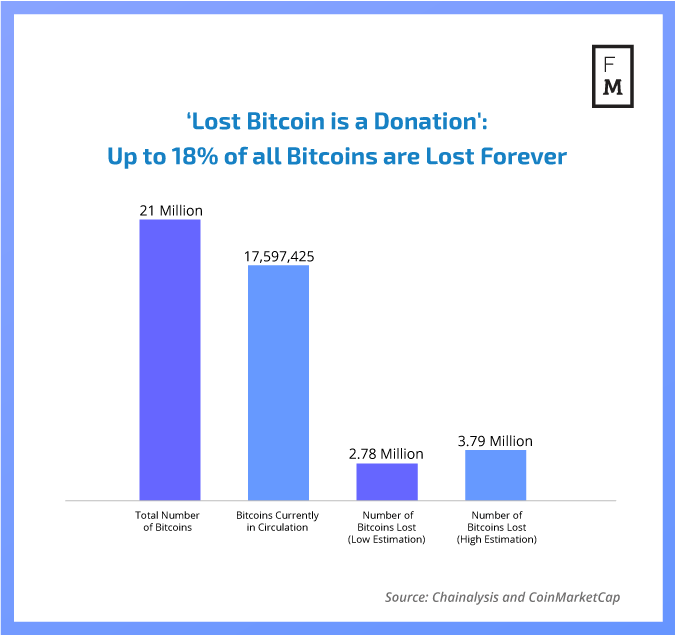
Roughly 20 Percent of the Bitcoin Network is Permanently Locked in Due to Lost Coins
Even Bitcoin creator Satoshi Nakamoto acknowledged the fact that lost coins are a sort of blessing-in-disguise for the BTC network, though the tales of lost hard drives and deceased keepers-of-the-keys can be harrowing and heartbreaking. Before Nakamoto quietly disappeared from the internet forever, he or she wrote that “lost coins only make everyone else's coins worth slightly more. Think of it as a donation to everyone.”
This isn’t to say that Bitcoin could one day be rendered totally obsolete--it can, and it most likely will, just as fiat currency is a technology that will also likely face obsolescence one day in the future.
But to claim that Bitcoin is headed to zero in the near future is to undermine the hedge funds, retail investors, families, companies, startups, deep-web entrepreneurs, and others that rely on BTC. Bitcoin has been declared “dead” more than 350 times. If those declarations are to be believed as true, BTC could be the single most resilient force on the planet.
The idea that Bitcoin may be “headed to zero” is one that flares up occasionally in the media. At this point, the crypto community sees this kind of doomsday speak as par for the course--it usually appears after being uttered by Wall Street analysts, Bitcoin skeptics, or industry insiders who have lost hope (or have their sights set on other coins.)
Once the words have been spoken, they appear in headlines across various financial and cryptocurrency-oriented news sources; they are echoed by other analysts and reporters alike.
Unfortunately, the idea that Bitcoin is going to crash into the ground then spreads into the minds of Bitcoin holders, some of whom may panic and sell their BTC before they see have the chance to see the value of their assets vanish into thin air. And if Bitcoin has been in the midst of a bear market (like it is right now), the message is particularly potent.
With each person that sells off their assets, BTC drops a little lower… and a little lower… and lower.
But could Bitcoin ever actually reach zero? And what might be the motivations for saying that it could?
”But BTC Has Lost Almost All of its Value! Right?”
The most common argument for Bitcoin headed to zero comes from individuals who claim to see “the writing on the wall.” And indeed, Bitcoin has been nose-diving for months--BTC has lost over 70 percent of its value since its all-time high of roughly $20,000 in late 2017.
In September, the long-standing bear market led Stern School professor Nouriel Roubini tweeted that Bitcoin “worth zero.”
He’s definitely not wrong about the blood bath--in addition to Bitcoin, most altcoins have lost shocking amounts of value.
However, BTC has recovered from similar circumstances in the past--more than once. “In 2013, for example, Bitcoin experienced an 83 percent correction from its all-time high achieved in 2012,” wrote Hong-Kong based finance journalist Joseph Young for CryptoSlate.
“The next year, it achieved a new all-time high, only to fall by more than 87 percent in 2014. After a mid-term recovery, in 2015, Bitcoin experienced yet another 87 percent correction and reached $19,500 in 2017.”
Yet, Roubini is only one of many who continue to claim that BTC is headed into oblivion.
Bitcoin Cash and Bitcoin SV Advocates Have a Vested Interest in BTC Reaching $0
One of the other most recent rounds of “Bitcoin to zero” happened this December, when former Bitcoin Cash evangelist and CoinGeek founder Calvin Ayre said that Bitcoin would plunge into nothingness.
Ayre belongs to a school of Bitcoin skeptics that have chosen to jump the Bitcoin ship in favor of one of two Bitcoin-borne altcoins: Bitcoin Cash and Bitcoin SV (“Satoshi’s Vision”),. Members of the communities around both of these currencies see valid problems with the Bitcoin network--namely, poor scaling capabilities and a lack of utility.
Ayre claimed that BTC was headed to zero because people would "see the light" and switch en masse to Bitcoin SV, which was formed in late November 2018 as the result of an ideological split in the Bitcoin Cash community.
“I am predicting it to go to zero value [in 2019], as it has no utility,” Ayre told Express UK. “It does not do anything, and [Bitcoin developers] intentionally are anti-scaling.” Meanwhile, though, “Bitcoin SV [is] going to have an amazing year,” he promised.
Its clear that using real #Bitcoin#BSV has so many advantages why submit to jurisdiction by using the wrong token. Must read for gaming site teams:https://t.co/ZqIqmkFZIM
People like Ayre believe that the solution to Bitcoin's problems is to scrap the coin entirely. They want to see Bitcoin burn, but not because of some kind of inherent dislike or skepticism around cryptocurrency as a whole. Rather, they want Bitcoin to be replaced by their altcoin of choice.
The ideological battles that have been waged by Bitcoin Cash and Bitcoin SV advocates have caused some rather iconic moments (and subsequent price dives) in crypto history. In mid-November of 2017, the price of Bitcoin Cash suddenly spiked as its advocates--Bitcoin Jesus-turned-Judas Roger Ver and Gavin Andresen among them--claimed that it was the “real” Bitcoin. However, a price rebound just hours later left new BCH investors with empty wallets.
The weekend has come to an end. Many Koreans that have bought BCH at $2400-$2500 have gone to beds with 40% - 50% of their investment value wiped out in less than 48 hours.. They will remember this weekend for a long long time ...
Another of these iconic moments took place just over a year later when a highly publicized battle of egos and hash power was waged between advocates of Bitcoin Cash and Bitcoin SV, leading to devastating price crashes.
The point is that in the months following the creation of both of these cryptocurrencies, much of the crypto community has begun to view both Bitcoin SV and Bitcoin Cash as centralized grabs for money and attention.
In other words, many people believe that the advocates of these altcoins have a vested interest in Bitcoin going to zero because damage to the Bitcoin network could quite possibly result in increased usage (and higher valuations) for either Bitcoin Cash or Bitcoin SV. (Keep in mind that many of the high-powered advocates of these tokens may also hold large amounts of them.)
So, naturally, it makes sense for hardcore Bitcoin Cash and Bitcoin SV advocates to spread “FUD” (fear, uncertainty, and doubt) about Bitcoin--and each other, for that matter.
But these altcoin advocates aren’t the only ones who have grim predictions for the price of Bitcoin.
Bitcoin Isn’t “Based on Nothing”
“Bitcoin to zero” popped up again in January when Jeff Schumacher, founder of BCG Digital Ventures, spoke on a panel hosted by CNBC in Davos, Switzerland. “I do believe [Bitcoin] will go to zero. I think it's a great technology but I don't believe it's a currency. It's not based on anything,” he remarked.
However, “based on nothing” is a bit of a tough card to play when all currencies--fiat and crypto alike--are essentially based on nothing more than belief. Societies--local and global--believe that their currencies are valuable.
Of course, there are “proofs” for these beliefs--goods and services that people provide to one another on a local level, and the assets that national economies contribute to the global economy. Countries with greater influence over the global economy have currencies that are relatively more valuable.
Bitcoin Is Valuable Because People Choose to Use It
And there’s no shortage of countries whose currencies have completely lost their value. In fact, for some countries that have been stricken by serious hyperinflation, Bitcoin has proved to be a “safe-haven” of sorts for savings. For example, a number of families in Venezuela and Zimbabwe have turned to BTC and other cryptocurrencies to survive in the midst of financial crises.
The difference between Bitcoin and nationally-issued currencies is that Bitcoin gains its value because people choose to use it, not because of the value of the goods and services its creators can offer to the world. Every time someone buys into the Bitcoin network, the value of all Bitcoins increases--and the value fluctuations are based on a mathematical algorithm, not on the demand and supply of something like oil or weapons, for example.
“Bitcoin has the characteristics of money (durability, portability, fungibility, scarcity, divisibility, and recognizability) based on the properties of mathematics rather than relying on physical properties (like gold and silver) or trust in central authorities (like fiat currencies),” reads an explanation on Bitcoin gains its value from Bitcoin.org.
“In short, Bitcoin is backed by mathematics. With these attributes, all that is required for a form of money to hold value is trust and adoption. In the case of Bitcoin, this can be measured by its growing base of users, merchants, and startups.”
Of course, because Bitcoins are (at the moment) primarily acquired by being purchased with fiat money, a serious fiat collapse could have unknown implications for the ways that Bitcoin is valued. Additionally, concerns of centralization of the BTC mining industry could have an entirely different set of implications for the way that BTC is valued and used in the event of a global financial crisis. But that’s another story for another time.
Roughly 20 Percent of the Bitcoin Network is Permanently Locked in Due to Lost Coins
Even Bitcoin creator Satoshi Nakamoto acknowledged the fact that lost coins are a sort of blessing-in-disguise for the BTC network, though the tales of lost hard drives and deceased keepers-of-the-keys can be harrowing and heartbreaking. Before Nakamoto quietly disappeared from the internet forever, he or she wrote that “lost coins only make everyone else's coins worth slightly more. Think of it as a donation to everyone.”
This isn’t to say that Bitcoin could one day be rendered totally obsolete--it can, and it most likely will, just as fiat currency is a technology that will also likely face obsolescence one day in the future.
But to claim that Bitcoin is headed to zero in the near future is to undermine the hedge funds, retail investors, families, companies, startups, deep-web entrepreneurs, and others that rely on BTC. Bitcoin has been declared “dead” more than 350 times. If those declarations are to be believed as true, BTC could be the single most resilient force on the planet.
Rachel is a self-taught crypto geek and a passionate writer. She believes in the power that the written word has to educate, connect and empower individuals to make positive and powerful financial choices. She is the Podcast Host and a Cryptocurrency Editor at Finance Magnates.
Crypto Built More Rails, but the Next Battle Is Over How Much Work a Dollar Can Do
Featured Videos
FP Markets Winner Spotlight 🏆 | Global Broker of the Year 2025 #Trading #Broker #Innovation #Shorts
FP Markets Winner Spotlight 🏆 | Global Broker of the Year 2025 #Trading #Broker #Innovation #Shorts
FP Markets Winner Spotlight 🏆 | Global Broker of the Year 2025 #Trading #Broker #Innovation #Shorts
FP Markets Winner Spotlight 🏆 | Global Broker of the Year 2025 #Trading #Broker #Innovation #Shorts
FP Markets takes the spotlight as Global Broker of the Year 2025 at the Finance Magnates Awards.
Martin Stoilov, Head of Client Experience, shares that trust, innovation, and people played a key role in the company’s success, supported by a strong foundation of integrity and client-centricity.
Following this milestone, FP Markets continues to focus on growth, technology investment, and its core values of transparency and excellence.
👉 Be part of FM Awards 2026: https://awards.financemagnates.com/#nominate
FP Markets takes the spotlight as Global Broker of the Year 2025 at the Finance Magnates Awards.
Martin Stoilov, Head of Client Experience, shares that trust, innovation, and people played a key role in the company’s success, supported by a strong foundation of integrity and client-centricity.
Following this milestone, FP Markets continues to focus on growth, technology investment, and its core values of transparency and excellence.
👉 Be part of FM Awards 2026: https://awards.financemagnates.com/#nominate
FP Markets takes the spotlight as Global Broker of the Year 2025 at the Finance Magnates Awards.
Martin Stoilov, Head of Client Experience, shares that trust, innovation, and people played a key role in the company’s success, supported by a strong foundation of integrity and client-centricity.
Following this milestone, FP Markets continues to focus on growth, technology investment, and its core values of transparency and excellence.
👉 Be part of FM Awards 2026: https://awards.financemagnates.com/#nominate
FP Markets takes the spotlight as Global Broker of the Year 2025 at the Finance Magnates Awards.
Martin Stoilov, Head of Client Experience, shares that trust, innovation, and people played a key role in the company’s success, supported by a strong foundation of integrity and client-centricity.
Following this milestone, FP Markets continues to focus on growth, technology investment, and its core values of transparency and excellence.
👉 Be part of FM Awards 2026: https://awards.financemagnates.com/#nominate
In this video, we review @HolaPrimeMarketsOfficial, a multi-asset forex and CFDs broker offering different account types, trading platforms, and flexible trading conditions.
We cover the broker’s overall offering, including account options, trading environment, platforms like MT4 and MT5, and additional services such as managed accounts and fast withdrawals.
Watch the full video to see if Hola Prime Markets fits your trading needs.
📣 Stay up to date with the latest in finance and trading. Follow Finance Magnates for industry news, insights, and global event coverage.
Connect with us:
🔗 LinkedIn: /financemagnates
👍 Facebook: /financemagnates
📸 Instagram: https://www.instagram.com/financemagnates
🐦 X: https://x.com/financemagnates
🎥 TikTok: https://www.tiktok.com/tag/financemagnates
▶️ YouTube: /@financemagnates_official
#HolaPrime #ForexBroker #CFDTrading #FinanceMagnates #Trading #Forex #BrokerReview
In this video, we review @HolaPrimeMarketsOfficial, a multi-asset forex and CFDs broker offering different account types, trading platforms, and flexible trading conditions.
We cover the broker’s overall offering, including account options, trading environment, platforms like MT4 and MT5, and additional services such as managed accounts and fast withdrawals.
Watch the full video to see if Hola Prime Markets fits your trading needs.
📣 Stay up to date with the latest in finance and trading. Follow Finance Magnates for industry news, insights, and global event coverage.
Connect with us:
🔗 LinkedIn: /financemagnates
👍 Facebook: /financemagnates
📸 Instagram: https://www.instagram.com/financemagnates
🐦 X: https://x.com/financemagnates
🎥 TikTok: https://www.tiktok.com/tag/financemagnates
▶️ YouTube: /@financemagnates_official
#HolaPrime #ForexBroker #CFDTrading #FinanceMagnates #Trading #Forex #BrokerReview
In this video, we review @HolaPrimeMarketsOfficial, a multi-asset forex and CFDs broker offering different account types, trading platforms, and flexible trading conditions.
We cover the broker’s overall offering, including account options, trading environment, platforms like MT4 and MT5, and additional services such as managed accounts and fast withdrawals.
Watch the full video to see if Hola Prime Markets fits your trading needs.
📣 Stay up to date with the latest in finance and trading. Follow Finance Magnates for industry news, insights, and global event coverage.
Connect with us:
🔗 LinkedIn: /financemagnates
👍 Facebook: /financemagnates
📸 Instagram: https://www.instagram.com/financemagnates
🐦 X: https://x.com/financemagnates
🎥 TikTok: https://www.tiktok.com/tag/financemagnates
▶️ YouTube: /@financemagnates_official
#HolaPrime #ForexBroker #CFDTrading #FinanceMagnates #Trading #Forex #BrokerReview
In this video, we review @HolaPrimeMarketsOfficial, a multi-asset forex and CFDs broker offering different account types, trading platforms, and flexible trading conditions.
We cover the broker’s overall offering, including account options, trading environment, platforms like MT4 and MT5, and additional services such as managed accounts and fast withdrawals.
Watch the full video to see if Hola Prime Markets fits your trading needs.
📣 Stay up to date with the latest in finance and trading. Follow Finance Magnates for industry news, insights, and global event coverage.
Connect with us:
🔗 LinkedIn: /financemagnates
👍 Facebook: /financemagnates
📸 Instagram: https://www.instagram.com/financemagnates
🐦 X: https://x.com/financemagnates
🎥 TikTok: https://www.tiktok.com/tag/financemagnates
▶️ YouTube: /@financemagnates_official
#HolaPrime #ForexBroker #CFDTrading #FinanceMagnates #Trading #Forex #BrokerReview
In this video, we review @HolaPrimeMarketsOfficial, a multi-asset forex and CFDs broker offering different account types, trading platforms, and flexible trading conditions.
We cover the broker’s overall offering, including account options, trading environment, platforms like MT4 and MT5, and additional services such as managed accounts and fast withdrawals.
Watch the full video to see if Hola Prime Markets fits your trading needs.
📣 Stay up to date with the latest in finance and trading. Follow Finance Magnates for industry news, insights, and global event coverage.
Connect with us:
🔗 LinkedIn: /financemagnates
👍 Facebook: /financemagnates
📸 Instagram: https://www.instagram.com/financemagnates
🐦 X: https://x.com/financemagnates
🎥 TikTok: https://www.tiktok.com/tag/financemagnates
▶️ YouTube: /@financemagnates_official
#HolaPrime #ForexBroker #CFDTrading #FinanceMagnates #Trading #Forex #BrokerReview
In this video, we review @HolaPrimeMarketsOfficial, a multi-asset forex and CFDs broker offering different account types, trading platforms, and flexible trading conditions.
We cover the broker’s overall offering, including account options, trading environment, platforms like MT4 and MT5, and additional services such as managed accounts and fast withdrawals.
Watch the full video to see if Hola Prime Markets fits your trading needs.
📣 Stay up to date with the latest in finance and trading. Follow Finance Magnates for industry news, insights, and global event coverage.
Connect with us:
🔗 LinkedIn: /financemagnates
👍 Facebook: /financemagnates
📸 Instagram: https://www.instagram.com/financemagnates
🐦 X: https://x.com/financemagnates
🎥 TikTok: https://www.tiktok.com/tag/financemagnates
▶️ YouTube: /@financemagnates_official
#HolaPrime #ForexBroker #CFDTrading #FinanceMagnates #Trading #Forex #BrokerReview
Hola Prime Review: What You Need to Know | Full Breakdown by Finance Magnates
Hola Prime Review: What You Need to Know | Full Breakdown by Finance Magnates
Hola Prime Review: What You Need to Know | Full Breakdown by Finance Magnates
Hola Prime Review: What You Need to Know | Full Breakdown by Finance Magnates
Hola Prime Review: What You Need to Know | Full Breakdown by Finance Magnates
Hola Prime Review: What You Need to Know | Full Breakdown by Finance Magnates
In this video, we review @HolaPrime_Global, a proprietary trading firm offering evaluation programs and performance-based payouts in simulated market environments.
We cover how the challenge model works, including account types, profit splits (up to 95%), trading rules, and what it takes to reach a funded account. You’ll also learn about available platforms like MT4, MT5, cTrader, and more, along with insights into payouts, support, and trading conditions.
Watch the full video to see if Hola Prime fits your trading style.
📣 Stay up to date with the latest in finance and trading. Follow Finance Magnates for industry news, insights, and global event coverage.
Connect with us:
🔗 LinkedIn: /financemagnates
👍 Facebook: /financemagnates
📸 Instagram: https://www.instagram.com/financemagnates
🐦 X: https://x.com/financemagnates
🎥 TikTok: https://www.tiktok.com/tag/financemagnates
▶️ YouTube: /@financemagnates_official
#HolaPrime #PropFirm #Trading #FinanceMagnates #Forex #FuturesTrading #TradingReview #PropFirmReview
In this video, we review @HolaPrime_Global, a proprietary trading firm offering evaluation programs and performance-based payouts in simulated market environments.
We cover how the challenge model works, including account types, profit splits (up to 95%), trading rules, and what it takes to reach a funded account. You’ll also learn about available platforms like MT4, MT5, cTrader, and more, along with insights into payouts, support, and trading conditions.
Watch the full video to see if Hola Prime fits your trading style.
📣 Stay up to date with the latest in finance and trading. Follow Finance Magnates for industry news, insights, and global event coverage.
Connect with us:
🔗 LinkedIn: /financemagnates
👍 Facebook: /financemagnates
📸 Instagram: https://www.instagram.com/financemagnates
🐦 X: https://x.com/financemagnates
🎥 TikTok: https://www.tiktok.com/tag/financemagnates
▶️ YouTube: /@financemagnates_official
#HolaPrime #PropFirm #Trading #FinanceMagnates #Forex #FuturesTrading #TradingReview #PropFirmReview
In this video, we review @HolaPrime_Global, a proprietary trading firm offering evaluation programs and performance-based payouts in simulated market environments.
We cover how the challenge model works, including account types, profit splits (up to 95%), trading rules, and what it takes to reach a funded account. You’ll also learn about available platforms like MT4, MT5, cTrader, and more, along with insights into payouts, support, and trading conditions.
Watch the full video to see if Hola Prime fits your trading style.
📣 Stay up to date with the latest in finance and trading. Follow Finance Magnates for industry news, insights, and global event coverage.
Connect with us:
🔗 LinkedIn: /financemagnates
👍 Facebook: /financemagnates
📸 Instagram: https://www.instagram.com/financemagnates
🐦 X: https://x.com/financemagnates
🎥 TikTok: https://www.tiktok.com/tag/financemagnates
▶️ YouTube: /@financemagnates_official
#HolaPrime #PropFirm #Trading #FinanceMagnates #Forex #FuturesTrading #TradingReview #PropFirmReview
In this video, we review @HolaPrime_Global, a proprietary trading firm offering evaluation programs and performance-based payouts in simulated market environments.
We cover how the challenge model works, including account types, profit splits (up to 95%), trading rules, and what it takes to reach a funded account. You’ll also learn about available platforms like MT4, MT5, cTrader, and more, along with insights into payouts, support, and trading conditions.
Watch the full video to see if Hola Prime fits your trading style.
📣 Stay up to date with the latest in finance and trading. Follow Finance Magnates for industry news, insights, and global event coverage.
Connect with us:
🔗 LinkedIn: /financemagnates
👍 Facebook: /financemagnates
📸 Instagram: https://www.instagram.com/financemagnates
🐦 X: https://x.com/financemagnates
🎥 TikTok: https://www.tiktok.com/tag/financemagnates
▶️ YouTube: /@financemagnates_official
#HolaPrime #PropFirm #Trading #FinanceMagnates #Forex #FuturesTrading #TradingReview #PropFirmReview
In this video, we review @HolaPrime_Global, a proprietary trading firm offering evaluation programs and performance-based payouts in simulated market environments.
We cover how the challenge model works, including account types, profit splits (up to 95%), trading rules, and what it takes to reach a funded account. You’ll also learn about available platforms like MT4, MT5, cTrader, and more, along with insights into payouts, support, and trading conditions.
Watch the full video to see if Hola Prime fits your trading style.
📣 Stay up to date with the latest in finance and trading. Follow Finance Magnates for industry news, insights, and global event coverage.
Connect with us:
🔗 LinkedIn: /financemagnates
👍 Facebook: /financemagnates
📸 Instagram: https://www.instagram.com/financemagnates
🐦 X: https://x.com/financemagnates
🎥 TikTok: https://www.tiktok.com/tag/financemagnates
▶️ YouTube: /@financemagnates_official
#HolaPrime #PropFirm #Trading #FinanceMagnates #Forex #FuturesTrading #TradingReview #PropFirmReview
In this video, we review @HolaPrime_Global, a proprietary trading firm offering evaluation programs and performance-based payouts in simulated market environments.
We cover how the challenge model works, including account types, profit splits (up to 95%), trading rules, and what it takes to reach a funded account. You’ll also learn about available platforms like MT4, MT5, cTrader, and more, along with insights into payouts, support, and trading conditions.
Watch the full video to see if Hola Prime fits your trading style.
📣 Stay up to date with the latest in finance and trading. Follow Finance Magnates for industry news, insights, and global event coverage.
Connect with us:
🔗 LinkedIn: /financemagnates
👍 Facebook: /financemagnates
📸 Instagram: https://www.instagram.com/financemagnates
🐦 X: https://x.com/financemagnates
🎥 TikTok: https://www.tiktok.com/tag/financemagnates
▶️ YouTube: /@financemagnates_official
#HolaPrime #PropFirm #Trading #FinanceMagnates #Forex #FuturesTrading #TradingReview #PropFirmReview
Axi Winner Spotlight 🏆 | Global Most Innovative Broker 2025 #Innovation #Trading #Fintech #Broker
Axi Winner Spotlight 🏆 | Global Most Innovative Broker 2025 #Innovation #Trading #Fintech #Broker
Axi Winner Spotlight 🏆 | Global Most Innovative Broker 2025 #Innovation #Trading #Fintech #Broker
Axi Winner Spotlight 🏆 | Global Most Innovative Broker 2025 #Innovation #Trading #Fintech #Broker
Axi Winner Spotlight 🏆 | Global Most Innovative Broker 2025 #Innovation #Trading #Fintech #Broker
Axi Winner Spotlight 🏆 | Global Most Innovative Broker 2025 #Innovation #Trading #Fintech #Broker
Axi takes the spotlight at the Finance Magnates Awards, winning Global Most Innovative Broker 2025.
Olivia Xenofontos and Ivanna Openko share how the team will feel: proud, motivated, and ready to keep delivering.
They also describe the night as well-organized, focused, and enjoyable for all.
👉 Be part of FM Awards 2026.
Axi takes the spotlight at the Finance Magnates Awards, winning Global Most Innovative Broker 2025.
Olivia Xenofontos and Ivanna Openko share how the team will feel: proud, motivated, and ready to keep delivering.
They also describe the night as well-organized, focused, and enjoyable for all.
👉 Be part of FM Awards 2026.
Axi takes the spotlight at the Finance Magnates Awards, winning Global Most Innovative Broker 2025.
Olivia Xenofontos and Ivanna Openko share how the team will feel: proud, motivated, and ready to keep delivering.
They also describe the night as well-organized, focused, and enjoyable for all.
👉 Be part of FM Awards 2026.
Axi takes the spotlight at the Finance Magnates Awards, winning Global Most Innovative Broker 2025.
Olivia Xenofontos and Ivanna Openko share how the team will feel: proud, motivated, and ready to keep delivering.
They also describe the night as well-organized, focused, and enjoyable for all.
👉 Be part of FM Awards 2026.
Axi takes the spotlight at the Finance Magnates Awards, winning Global Most Innovative Broker 2025.
Olivia Xenofontos and Ivanna Openko share how the team will feel: proud, motivated, and ready to keep delivering.
They also describe the night as well-organized, focused, and enjoyable for all.
👉 Be part of FM Awards 2026.
Axi takes the spotlight at the Finance Magnates Awards, winning Global Most Innovative Broker 2025.
Olivia Xenofontos and Ivanna Openko share how the team will feel: proud, motivated, and ready to keep delivering.
They also describe the night as well-organized, focused, and enjoyable for all.
👉 Be part of FM Awards 2026.
Recognition that matters.
Built on transparency.
Driven by the industry.
The Finance Magnates Awards 2026.
Nominations are now open.
🔗 https://awards.financemagnates.com/?utm_source=SM&utm_medium=social&utm_campaign=recognition-matters
Recognition that matters.
Built on transparency.
Driven by the industry.
The Finance Magnates Awards 2026.
Nominations are now open.
🔗 https://awards.financemagnates.com/?utm_source=SM&utm_medium=social&utm_campaign=recognition-matters
Recognition that matters.
Built on transparency.
Driven by the industry.
The Finance Magnates Awards 2026.
Nominations are now open.
🔗 https://awards.financemagnates.com/?utm_source=SM&utm_medium=social&utm_campaign=recognition-matters
Recognition that matters.
Built on transparency.
Driven by the industry.
The Finance Magnates Awards 2026.
Nominations are now open.
🔗 https://awards.financemagnates.com/?utm_source=SM&utm_medium=social&utm_campaign=recognition-matters
Recognition that matters.
Built on transparency.
Driven by the industry.
The Finance Magnates Awards 2026.
Nominations are now open.
🔗 https://awards.financemagnates.com/?utm_source=SM&utm_medium=social&utm_campaign=recognition-matters
Recognition that matters.
Built on transparency.
Driven by the industry.
The Finance Magnates Awards 2026.
Nominations are now open.
🔗 https://awards.financemagnates.com/?utm_source=SM&utm_medium=social&utm_campaign=recognition-matters