Exante's data reveals that New spot ETFs have nearly 90% of BTC products' daily trading volume, futures ETFs around 10%.
The broker describes “increasing US institutional demand for crypto-related exposure and hedging.”
The new US spot bitcoin ETFs, which launched in January after gaining the SEC's approval, have dramatically shifted the crypto industry landscape, and appear to be in the process of altering traditional finance.
In fact, the new ETFs have been unprecedented in their levels of attention and initial demand over their first two months, and are leading to an urgent need for deeper analysis of bitcoin and crypto among traditional financial firms.
The global trading and investment firm Exante, providing access to markets encompassing shares, ETFs, currencies, metals, and bonds across more than twenty locations, exemplifies this trend. Recognizing that offering ETFs also entails providing access to BTC, Exante has been quick to get to grips with bitcoin as a legitimate new asset class.
Focused on Crypto ETF Analysis
Exante is publishing a digest titled "The Crypt," which focused on crypto ETFs, with analysis based on the firm’s proprietary data along with insights curated from third parties, and the first issue, published this month, provides useful data, analysis and speculation on how the BTC ETFs have been performing and where they might be headed from here.
The digest got straight to the point from the first paragraph and set a bullish tone when it explained: “Our clients are jumping in wholeheartedly, investing more into these new ETFs, as a percentage, than the market average. An example of this is on Monday, 11 March when Bitcoin hit a new high, our clients' AuM was +11.18% day-over-day compared to the Total market AuM which was actually -0.97%.”
This ties in with recent analysis from JP Morgan which compared BTC ETFs with gold ETFs, and noted that even as bitcoin funds have seen strong inflows, gold ETFs have seen movement in the opposite direction. In short, when it comes to ETFs, bitcoin is catching up with gold, and there’s the suggestion that attitudes towards the new bitcoin funds are detached from broader sentiment.
"Led by the newly created spot bitcoin ETFs, bitcoin funds saw an inflow of $10.6bn YTD vs. an outflow of $7.6bn for physical gold ETFs."
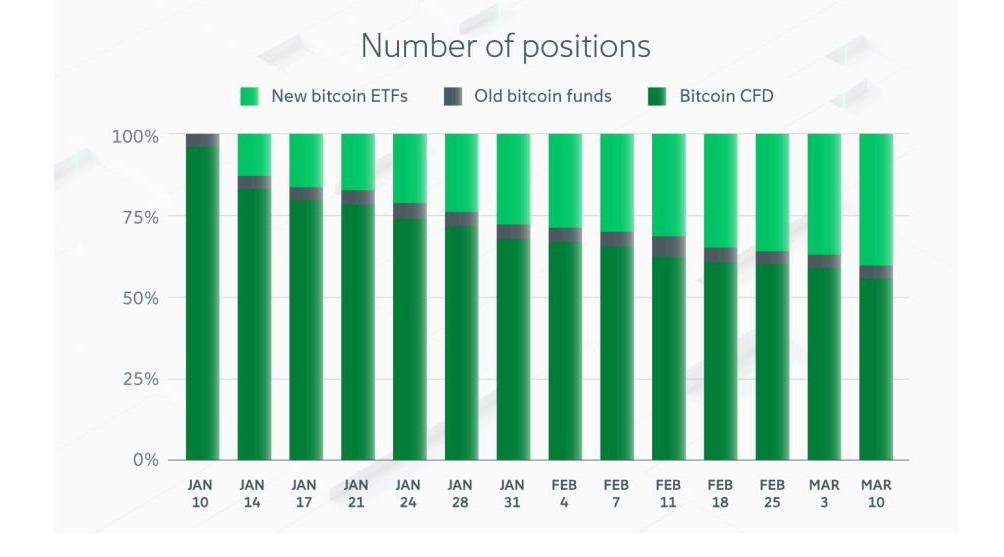
It’s apparent also, in Exante’s data, that the firm’s clients are switching from previously existing bitcoin products, into the new ETFs.
Chart from Exante
It seems, then, that not only are the newer products creating fresh demand, but they’re also exercising a pull on investors who were already open-minded towards crypto. Relatedly, it should be noted that among new ETF issuers, we have the financial giants BlackRock and Fidelity, which can exert outsized gravity.
Exante noted that: “The surge in Bitcoin is being driven largely by the enormous success of Spot Bitcoin ETFs, including those from BlackRock and Fidelity Investments, which now control around 69% of the market and have already drawn net inflows of about $10 billion.”
The figure of $10 billion has actually grown further, and the digest went on to suggest that: “The impetus behind the growth in EXANTE’s clients interest has much to do with how the overall crypto market has been revitalised since these ETFs came into being. And, the overwhelming success of the ETFs to date seems to be creating an almost virtuous circle for Bitcoin and other digital tokens.”
This has certainly appeared to be the case since soon after the ETFs launched, with soaring BTC price action breaking previous trends by achieving a new all-time high before the upcoming halving event in April, something which has never happened before in any of Bitcoin’s previous four-year halving cycles (with the caveat that bitcoin’s history only goes back as far as 2009.)
We’ve also seen the exuberance around bitcoin spread to cryptocurrencies across the board, and most recently, there has been intense trading around meme coins launched on the Solana blockchain, with the SOL token itself hitting prices not seen since 2021.
Seasoned crypto participants will point out that periods of hyper-bullishness and explosive gains are nothing new in crypto, but still, there is a sense that the current cycle feels accelerated, ahead of schedule, and doesn’t map precisely onto previous patterns.
What Happens Next?
The Exante digest concluded by wondering whether current levels of demand for bitcoin are sustainable, noting that while crypto ETPs have been offered in European markets since 2019, the approval of spot BTC ETFs in the US was “a watershed moment,” meaning that “US investors could access the Spot price of Bitcoin in a brokerage account via a less risky ETF structure.”
Furthermore, citing data from The Block, the digest outlined how, with regard to all ETFs offering bitcoin price exposure: “Spot Bitcoin ETFs now hold nearly 90% of the daily trading volume market share, while bitcoin futures ETFs, introduced in 2021, account for around 10%. What is becoming clearer is that ETFs appear to be improving liquidity for Spot Bitcoin traders, with better crypto market depth.”
And, then there are the knock-on global effects, with the report citing recent developments in the UK, where the Financial Conduct Authority will, “accept requests from Recognised Investment Exchanges to list crypto asset-backed Exchange Traded Notes. The products would be available for professional investors, such as investment firms and credit institutions authorised or regulated to operate in financial markets.”
Additionally, “the London Stock Exchange started accepting applications for Bitcoin and Ethereum exchange-traded notes.”
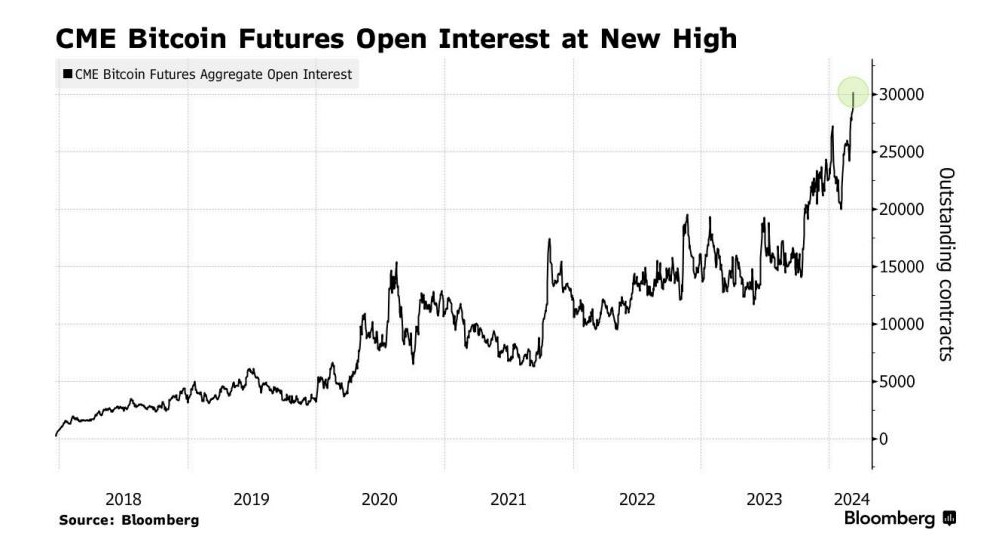
Finally, the digest noted the increased bitcoin-related activity in the derivatives sector, explaining that in the first half of March,
“Outstanding contracts, or open interest, at the Chicago Mercantile Exchange (CME) Bitcoin futures market reached a fresh peak.”
And, it explained that the CME is currently the largest holder of bitcoin futures. “This dominance wasn't present during the November 2021 peak, which was followed by a rapid 31.5% price decline. In terms of Bitcoin open interest specifically, the current figure is 27% lower than its October 2022 peak. All of this points to the fact that there is increasing US institutional demand for crypto-related exposure and hedging.”
Chart from Bloomberg, featured in Exante's digest, The Crypt
Since Exante's digest was written, Bitcoin has experienced a price correction. However, this is in line with the coin’s price action before previous halving events and doesn’t detract from Exante’s conclusion that while price dips and risks are an ever-present consideration, when it come to the new ETFs, “the creation of these instruments is fostering a more robust and diversified investment landscape for digital assets.”
The new US spot bitcoin ETFs, which launched in January after gaining the SEC's approval, have dramatically shifted the crypto industry landscape, and appear to be in the process of altering traditional finance.
In fact, the new ETFs have been unprecedented in their levels of attention and initial demand over their first two months, and are leading to an urgent need for deeper analysis of bitcoin and crypto among traditional financial firms.
The global trading and investment firm Exante, providing access to markets encompassing shares, ETFs, currencies, metals, and bonds across more than twenty locations, exemplifies this trend. Recognizing that offering ETFs also entails providing access to BTC, Exante has been quick to get to grips with bitcoin as a legitimate new asset class.
Focused on Crypto ETF Analysis
Exante is publishing a digest titled "The Crypt," which focused on crypto ETFs, with analysis based on the firm’s proprietary data along with insights curated from third parties, and the first issue, published this month, provides useful data, analysis and speculation on how the BTC ETFs have been performing and where they might be headed from here.
The digest got straight to the point from the first paragraph and set a bullish tone when it explained: “Our clients are jumping in wholeheartedly, investing more into these new ETFs, as a percentage, than the market average. An example of this is on Monday, 11 March when Bitcoin hit a new high, our clients' AuM was +11.18% day-over-day compared to the Total market AuM which was actually -0.97%.”
This ties in with recent analysis from JP Morgan which compared BTC ETFs with gold ETFs, and noted that even as bitcoin funds have seen strong inflows, gold ETFs have seen movement in the opposite direction. In short, when it comes to ETFs, bitcoin is catching up with gold, and there’s the suggestion that attitudes towards the new bitcoin funds are detached from broader sentiment.
"Led by the newly created spot bitcoin ETFs, bitcoin funds saw an inflow of $10.6bn YTD vs. an outflow of $7.6bn for physical gold ETFs."
It’s apparent also, in Exante’s data, that the firm’s clients are switching from previously existing bitcoin products, into the new ETFs.
Chart from Exante
It seems, then, that not only are the newer products creating fresh demand, but they’re also exercising a pull on investors who were already open-minded towards crypto. Relatedly, it should be noted that among new ETF issuers, we have the financial giants BlackRock and Fidelity, which can exert outsized gravity.
Exante noted that: “The surge in Bitcoin is being driven largely by the enormous success of Spot Bitcoin ETFs, including those from BlackRock and Fidelity Investments, which now control around 69% of the market and have already drawn net inflows of about $10 billion.”
The figure of $10 billion has actually grown further, and the digest went on to suggest that: “The impetus behind the growth in EXANTE’s clients interest has much to do with how the overall crypto market has been revitalised since these ETFs came into being. And, the overwhelming success of the ETFs to date seems to be creating an almost virtuous circle for Bitcoin and other digital tokens.”
This has certainly appeared to be the case since soon after the ETFs launched, with soaring BTC price action breaking previous trends by achieving a new all-time high before the upcoming halving event in April, something which has never happened before in any of Bitcoin’s previous four-year halving cycles (with the caveat that bitcoin’s history only goes back as far as 2009.)
We’ve also seen the exuberance around bitcoin spread to cryptocurrencies across the board, and most recently, there has been intense trading around meme coins launched on the Solana blockchain, with the SOL token itself hitting prices not seen since 2021.
Seasoned crypto participants will point out that periods of hyper-bullishness and explosive gains are nothing new in crypto, but still, there is a sense that the current cycle feels accelerated, ahead of schedule, and doesn’t map precisely onto previous patterns.
What Happens Next?
The Exante digest concluded by wondering whether current levels of demand for bitcoin are sustainable, noting that while crypto ETPs have been offered in European markets since 2019, the approval of spot BTC ETFs in the US was “a watershed moment,” meaning that “US investors could access the Spot price of Bitcoin in a brokerage account via a less risky ETF structure.”
Furthermore, citing data from The Block, the digest outlined how, with regard to all ETFs offering bitcoin price exposure: “Spot Bitcoin ETFs now hold nearly 90% of the daily trading volume market share, while bitcoin futures ETFs, introduced in 2021, account for around 10%. What is becoming clearer is that ETFs appear to be improving liquidity for Spot Bitcoin traders, with better crypto market depth.”
And, then there are the knock-on global effects, with the report citing recent developments in the UK, where the Financial Conduct Authority will, “accept requests from Recognised Investment Exchanges to list crypto asset-backed Exchange Traded Notes. The products would be available for professional investors, such as investment firms and credit institutions authorised or regulated to operate in financial markets.”
Additionally, “the London Stock Exchange started accepting applications for Bitcoin and Ethereum exchange-traded notes.”
Finally, the digest noted the increased bitcoin-related activity in the derivatives sector, explaining that in the first half of March,
“Outstanding contracts, or open interest, at the Chicago Mercantile Exchange (CME) Bitcoin futures market reached a fresh peak.”
And, it explained that the CME is currently the largest holder of bitcoin futures. “This dominance wasn't present during the November 2021 peak, which was followed by a rapid 31.5% price decline. In terms of Bitcoin open interest specifically, the current figure is 27% lower than its October 2022 peak. All of this points to the fact that there is increasing US institutional demand for crypto-related exposure and hedging.”
Chart from Bloomberg, featured in Exante's digest, The Crypt
Since Exante's digest was written, Bitcoin has experienced a price correction. However, this is in line with the coin’s price action before previous halving events and doesn’t detract from Exante’s conclusion that while price dips and risks are an ever-present consideration, when it come to the new ETFs, “the creation of these instruments is fostering a more robust and diversified investment landscape for digital assets.”
Sam White is a writer and journalist from the UK who covers cryptocurrencies and web3, with a particular interest in NFTs and the crossover between art and finance. His work, on a wide variety of topics, has appeared on platforms including The Spectator, Vice and Hacker Noon.
Kraken Steps Up Speed Race with New Equinix Colocation Service for Crypto Traders
Featured Videos
FP Markets Winner Spotlight 🏆 | Global Broker of the Year 2025 #Trading #Broker #Innovation #Shorts
FP Markets Winner Spotlight 🏆 | Global Broker of the Year 2025 #Trading #Broker #Innovation #Shorts
FP Markets Winner Spotlight 🏆 | Global Broker of the Year 2025 #Trading #Broker #Innovation #Shorts
FP Markets Winner Spotlight 🏆 | Global Broker of the Year 2025 #Trading #Broker #Innovation #Shorts
FP Markets takes the spotlight as Global Broker of the Year 2025 at the Finance Magnates Awards.
Martin Stoilov, Head of Client Experience, shares that trust, innovation, and people played a key role in the company’s success, supported by a strong foundation of integrity and client-centricity.
Following this milestone, FP Markets continues to focus on growth, technology investment, and its core values of transparency and excellence.
👉 Be part of FM Awards 2026: https://awards.financemagnates.com/#nominate
FP Markets takes the spotlight as Global Broker of the Year 2025 at the Finance Magnates Awards.
Martin Stoilov, Head of Client Experience, shares that trust, innovation, and people played a key role in the company’s success, supported by a strong foundation of integrity and client-centricity.
Following this milestone, FP Markets continues to focus on growth, technology investment, and its core values of transparency and excellence.
👉 Be part of FM Awards 2026: https://awards.financemagnates.com/#nominate
FP Markets takes the spotlight as Global Broker of the Year 2025 at the Finance Magnates Awards.
Martin Stoilov, Head of Client Experience, shares that trust, innovation, and people played a key role in the company’s success, supported by a strong foundation of integrity and client-centricity.
Following this milestone, FP Markets continues to focus on growth, technology investment, and its core values of transparency and excellence.
👉 Be part of FM Awards 2026: https://awards.financemagnates.com/#nominate
FP Markets takes the spotlight as Global Broker of the Year 2025 at the Finance Magnates Awards.
Martin Stoilov, Head of Client Experience, shares that trust, innovation, and people played a key role in the company’s success, supported by a strong foundation of integrity and client-centricity.
Following this milestone, FP Markets continues to focus on growth, technology investment, and its core values of transparency and excellence.
👉 Be part of FM Awards 2026: https://awards.financemagnates.com/#nominate
In this video, we review @HolaPrimeMarketsOfficial, a multi-asset forex and CFDs broker offering different account types, trading platforms, and flexible trading conditions.
We cover the broker’s overall offering, including account options, trading environment, platforms like MT4 and MT5, and additional services such as managed accounts and fast withdrawals.
Watch the full video to see if Hola Prime Markets fits your trading needs.
📣 Stay up to date with the latest in finance and trading. Follow Finance Magnates for industry news, insights, and global event coverage.
Connect with us:
🔗 LinkedIn: /financemagnates
👍 Facebook: /financemagnates
📸 Instagram: https://www.instagram.com/financemagnates
🐦 X: https://x.com/financemagnates
🎥 TikTok: https://www.tiktok.com/tag/financemagnates
▶️ YouTube: /@financemagnates_official
#HolaPrime #ForexBroker #CFDTrading #FinanceMagnates #Trading #Forex #BrokerReview
In this video, we review @HolaPrimeMarketsOfficial, a multi-asset forex and CFDs broker offering different account types, trading platforms, and flexible trading conditions.
We cover the broker’s overall offering, including account options, trading environment, platforms like MT4 and MT5, and additional services such as managed accounts and fast withdrawals.
Watch the full video to see if Hola Prime Markets fits your trading needs.
📣 Stay up to date with the latest in finance and trading. Follow Finance Magnates for industry news, insights, and global event coverage.
Connect with us:
🔗 LinkedIn: /financemagnates
👍 Facebook: /financemagnates
📸 Instagram: https://www.instagram.com/financemagnates
🐦 X: https://x.com/financemagnates
🎥 TikTok: https://www.tiktok.com/tag/financemagnates
▶️ YouTube: /@financemagnates_official
#HolaPrime #ForexBroker #CFDTrading #FinanceMagnates #Trading #Forex #BrokerReview
In this video, we review @HolaPrimeMarketsOfficial, a multi-asset forex and CFDs broker offering different account types, trading platforms, and flexible trading conditions.
We cover the broker’s overall offering, including account options, trading environment, platforms like MT4 and MT5, and additional services such as managed accounts and fast withdrawals.
Watch the full video to see if Hola Prime Markets fits your trading needs.
📣 Stay up to date with the latest in finance and trading. Follow Finance Magnates for industry news, insights, and global event coverage.
Connect with us:
🔗 LinkedIn: /financemagnates
👍 Facebook: /financemagnates
📸 Instagram: https://www.instagram.com/financemagnates
🐦 X: https://x.com/financemagnates
🎥 TikTok: https://www.tiktok.com/tag/financemagnates
▶️ YouTube: /@financemagnates_official
#HolaPrime #ForexBroker #CFDTrading #FinanceMagnates #Trading #Forex #BrokerReview
In this video, we review @HolaPrimeMarketsOfficial, a multi-asset forex and CFDs broker offering different account types, trading platforms, and flexible trading conditions.
We cover the broker’s overall offering, including account options, trading environment, platforms like MT4 and MT5, and additional services such as managed accounts and fast withdrawals.
Watch the full video to see if Hola Prime Markets fits your trading needs.
📣 Stay up to date with the latest in finance and trading. Follow Finance Magnates for industry news, insights, and global event coverage.
Connect with us:
🔗 LinkedIn: /financemagnates
👍 Facebook: /financemagnates
📸 Instagram: https://www.instagram.com/financemagnates
🐦 X: https://x.com/financemagnates
🎥 TikTok: https://www.tiktok.com/tag/financemagnates
▶️ YouTube: /@financemagnates_official
#HolaPrime #ForexBroker #CFDTrading #FinanceMagnates #Trading #Forex #BrokerReview
In this video, we review @HolaPrimeMarketsOfficial, a multi-asset forex and CFDs broker offering different account types, trading platforms, and flexible trading conditions.
We cover the broker’s overall offering, including account options, trading environment, platforms like MT4 and MT5, and additional services such as managed accounts and fast withdrawals.
Watch the full video to see if Hola Prime Markets fits your trading needs.
📣 Stay up to date with the latest in finance and trading. Follow Finance Magnates for industry news, insights, and global event coverage.
Connect with us:
🔗 LinkedIn: /financemagnates
👍 Facebook: /financemagnates
📸 Instagram: https://www.instagram.com/financemagnates
🐦 X: https://x.com/financemagnates
🎥 TikTok: https://www.tiktok.com/tag/financemagnates
▶️ YouTube: /@financemagnates_official
#HolaPrime #ForexBroker #CFDTrading #FinanceMagnates #Trading #Forex #BrokerReview
In this video, we review @HolaPrimeMarketsOfficial, a multi-asset forex and CFDs broker offering different account types, trading platforms, and flexible trading conditions.
We cover the broker’s overall offering, including account options, trading environment, platforms like MT4 and MT5, and additional services such as managed accounts and fast withdrawals.
Watch the full video to see if Hola Prime Markets fits your trading needs.
📣 Stay up to date with the latest in finance and trading. Follow Finance Magnates for industry news, insights, and global event coverage.
Connect with us:
🔗 LinkedIn: /financemagnates
👍 Facebook: /financemagnates
📸 Instagram: https://www.instagram.com/financemagnates
🐦 X: https://x.com/financemagnates
🎥 TikTok: https://www.tiktok.com/tag/financemagnates
▶️ YouTube: /@financemagnates_official
#HolaPrime #ForexBroker #CFDTrading #FinanceMagnates #Trading #Forex #BrokerReview
Hola Prime Review: What You Need to Know | Full Breakdown by Finance Magnates
Hola Prime Review: What You Need to Know | Full Breakdown by Finance Magnates
Hola Prime Review: What You Need to Know | Full Breakdown by Finance Magnates
Hola Prime Review: What You Need to Know | Full Breakdown by Finance Magnates
Hola Prime Review: What You Need to Know | Full Breakdown by Finance Magnates
Hola Prime Review: What You Need to Know | Full Breakdown by Finance Magnates
In this video, we review @HolaPrime_Global, a proprietary trading firm offering evaluation programs and performance-based payouts in simulated market environments.
We cover how the challenge model works, including account types, profit splits (up to 95%), trading rules, and what it takes to reach a funded account. You’ll also learn about available platforms like MT4, MT5, cTrader, and more, along with insights into payouts, support, and trading conditions.
Watch the full video to see if Hola Prime fits your trading style.
📣 Stay up to date with the latest in finance and trading. Follow Finance Magnates for industry news, insights, and global event coverage.
Connect with us:
🔗 LinkedIn: /financemagnates
👍 Facebook: /financemagnates
📸 Instagram: https://www.instagram.com/financemagnates
🐦 X: https://x.com/financemagnates
🎥 TikTok: https://www.tiktok.com/tag/financemagnates
▶️ YouTube: /@financemagnates_official
#HolaPrime #PropFirm #Trading #FinanceMagnates #Forex #FuturesTrading #TradingReview #PropFirmReview
In this video, we review @HolaPrime_Global, a proprietary trading firm offering evaluation programs and performance-based payouts in simulated market environments.
We cover how the challenge model works, including account types, profit splits (up to 95%), trading rules, and what it takes to reach a funded account. You’ll also learn about available platforms like MT4, MT5, cTrader, and more, along with insights into payouts, support, and trading conditions.
Watch the full video to see if Hola Prime fits your trading style.
📣 Stay up to date with the latest in finance and trading. Follow Finance Magnates for industry news, insights, and global event coverage.
Connect with us:
🔗 LinkedIn: /financemagnates
👍 Facebook: /financemagnates
📸 Instagram: https://www.instagram.com/financemagnates
🐦 X: https://x.com/financemagnates
🎥 TikTok: https://www.tiktok.com/tag/financemagnates
▶️ YouTube: /@financemagnates_official
#HolaPrime #PropFirm #Trading #FinanceMagnates #Forex #FuturesTrading #TradingReview #PropFirmReview
In this video, we review @HolaPrime_Global, a proprietary trading firm offering evaluation programs and performance-based payouts in simulated market environments.
We cover how the challenge model works, including account types, profit splits (up to 95%), trading rules, and what it takes to reach a funded account. You’ll also learn about available platforms like MT4, MT5, cTrader, and more, along with insights into payouts, support, and trading conditions.
Watch the full video to see if Hola Prime fits your trading style.
📣 Stay up to date with the latest in finance and trading. Follow Finance Magnates for industry news, insights, and global event coverage.
Connect with us:
🔗 LinkedIn: /financemagnates
👍 Facebook: /financemagnates
📸 Instagram: https://www.instagram.com/financemagnates
🐦 X: https://x.com/financemagnates
🎥 TikTok: https://www.tiktok.com/tag/financemagnates
▶️ YouTube: /@financemagnates_official
#HolaPrime #PropFirm #Trading #FinanceMagnates #Forex #FuturesTrading #TradingReview #PropFirmReview
In this video, we review @HolaPrime_Global, a proprietary trading firm offering evaluation programs and performance-based payouts in simulated market environments.
We cover how the challenge model works, including account types, profit splits (up to 95%), trading rules, and what it takes to reach a funded account. You’ll also learn about available platforms like MT4, MT5, cTrader, and more, along with insights into payouts, support, and trading conditions.
Watch the full video to see if Hola Prime fits your trading style.
📣 Stay up to date with the latest in finance and trading. Follow Finance Magnates for industry news, insights, and global event coverage.
Connect with us:
🔗 LinkedIn: /financemagnates
👍 Facebook: /financemagnates
📸 Instagram: https://www.instagram.com/financemagnates
🐦 X: https://x.com/financemagnates
🎥 TikTok: https://www.tiktok.com/tag/financemagnates
▶️ YouTube: /@financemagnates_official
#HolaPrime #PropFirm #Trading #FinanceMagnates #Forex #FuturesTrading #TradingReview #PropFirmReview
In this video, we review @HolaPrime_Global, a proprietary trading firm offering evaluation programs and performance-based payouts in simulated market environments.
We cover how the challenge model works, including account types, profit splits (up to 95%), trading rules, and what it takes to reach a funded account. You’ll also learn about available platforms like MT4, MT5, cTrader, and more, along with insights into payouts, support, and trading conditions.
Watch the full video to see if Hola Prime fits your trading style.
📣 Stay up to date with the latest in finance and trading. Follow Finance Magnates for industry news, insights, and global event coverage.
Connect with us:
🔗 LinkedIn: /financemagnates
👍 Facebook: /financemagnates
📸 Instagram: https://www.instagram.com/financemagnates
🐦 X: https://x.com/financemagnates
🎥 TikTok: https://www.tiktok.com/tag/financemagnates
▶️ YouTube: /@financemagnates_official
#HolaPrime #PropFirm #Trading #FinanceMagnates #Forex #FuturesTrading #TradingReview #PropFirmReview
In this video, we review @HolaPrime_Global, a proprietary trading firm offering evaluation programs and performance-based payouts in simulated market environments.
We cover how the challenge model works, including account types, profit splits (up to 95%), trading rules, and what it takes to reach a funded account. You’ll also learn about available platforms like MT4, MT5, cTrader, and more, along with insights into payouts, support, and trading conditions.
Watch the full video to see if Hola Prime fits your trading style.
📣 Stay up to date with the latest in finance and trading. Follow Finance Magnates for industry news, insights, and global event coverage.
Connect with us:
🔗 LinkedIn: /financemagnates
👍 Facebook: /financemagnates
📸 Instagram: https://www.instagram.com/financemagnates
🐦 X: https://x.com/financemagnates
🎥 TikTok: https://www.tiktok.com/tag/financemagnates
▶️ YouTube: /@financemagnates_official
#HolaPrime #PropFirm #Trading #FinanceMagnates #Forex #FuturesTrading #TradingReview #PropFirmReview
Axi Winner Spotlight 🏆 | Global Most Innovative Broker 2025 #Innovation #Trading #Fintech #Broker
Axi Winner Spotlight 🏆 | Global Most Innovative Broker 2025 #Innovation #Trading #Fintech #Broker
Axi Winner Spotlight 🏆 | Global Most Innovative Broker 2025 #Innovation #Trading #Fintech #Broker
Axi Winner Spotlight 🏆 | Global Most Innovative Broker 2025 #Innovation #Trading #Fintech #Broker
Axi Winner Spotlight 🏆 | Global Most Innovative Broker 2025 #Innovation #Trading #Fintech #Broker
Axi Winner Spotlight 🏆 | Global Most Innovative Broker 2025 #Innovation #Trading #Fintech #Broker
Axi takes the spotlight at the Finance Magnates Awards, winning Global Most Innovative Broker 2025.
Olivia Xenofontos and Ivanna Openko share how the team will feel: proud, motivated, and ready to keep delivering.
They also describe the night as well-organized, focused, and enjoyable for all.
👉 Be part of FM Awards 2026.
Axi takes the spotlight at the Finance Magnates Awards, winning Global Most Innovative Broker 2025.
Olivia Xenofontos and Ivanna Openko share how the team will feel: proud, motivated, and ready to keep delivering.
They also describe the night as well-organized, focused, and enjoyable for all.
👉 Be part of FM Awards 2026.
Axi takes the spotlight at the Finance Magnates Awards, winning Global Most Innovative Broker 2025.
Olivia Xenofontos and Ivanna Openko share how the team will feel: proud, motivated, and ready to keep delivering.
They also describe the night as well-organized, focused, and enjoyable for all.
👉 Be part of FM Awards 2026.
Axi takes the spotlight at the Finance Magnates Awards, winning Global Most Innovative Broker 2025.
Olivia Xenofontos and Ivanna Openko share how the team will feel: proud, motivated, and ready to keep delivering.
They also describe the night as well-organized, focused, and enjoyable for all.
👉 Be part of FM Awards 2026.
Axi takes the spotlight at the Finance Magnates Awards, winning Global Most Innovative Broker 2025.
Olivia Xenofontos and Ivanna Openko share how the team will feel: proud, motivated, and ready to keep delivering.
They also describe the night as well-organized, focused, and enjoyable for all.
👉 Be part of FM Awards 2026.
Axi takes the spotlight at the Finance Magnates Awards, winning Global Most Innovative Broker 2025.
Olivia Xenofontos and Ivanna Openko share how the team will feel: proud, motivated, and ready to keep delivering.
They also describe the night as well-organized, focused, and enjoyable for all.
👉 Be part of FM Awards 2026.
Recognition that matters.
Built on transparency.
Driven by the industry.
The Finance Magnates Awards 2026.
Nominations are now open.
🔗 https://awards.financemagnates.com/?utm_source=SM&utm_medium=social&utm_campaign=recognition-matters
Recognition that matters.
Built on transparency.
Driven by the industry.
The Finance Magnates Awards 2026.
Nominations are now open.
🔗 https://awards.financemagnates.com/?utm_source=SM&utm_medium=social&utm_campaign=recognition-matters
Recognition that matters.
Built on transparency.
Driven by the industry.
The Finance Magnates Awards 2026.
Nominations are now open.
🔗 https://awards.financemagnates.com/?utm_source=SM&utm_medium=social&utm_campaign=recognition-matters
Recognition that matters.
Built on transparency.
Driven by the industry.
The Finance Magnates Awards 2026.
Nominations are now open.
🔗 https://awards.financemagnates.com/?utm_source=SM&utm_medium=social&utm_campaign=recognition-matters
Recognition that matters.
Built on transparency.
Driven by the industry.
The Finance Magnates Awards 2026.
Nominations are now open.
🔗 https://awards.financemagnates.com/?utm_source=SM&utm_medium=social&utm_campaign=recognition-matters
Recognition that matters.
Built on transparency.
Driven by the industry.
The Finance Magnates Awards 2026.
Nominations are now open.
🔗 https://awards.financemagnates.com/?utm_source=SM&utm_medium=social&utm_campaign=recognition-matters