Check the latest MARA stock news and learn why the shares are falling today.
Bitcoin production rose by 26% to 907 BTC and hash rate by 15% to 46.1 EH/s.
MARA
Holdings, Inc. (NASDAQ: MARA), a
leading name in digital asset compute and blockchain technology and the biggest
Bitcoin miner from Wall Street, announced two significant updates on its
operations and financial strategy today (Monday).
These
developments underscore the company’s robust positioning in the cryptocurrency
and digital asset market, providing fresh insights for investors tracking MARA
stock and the broader market.
MARA Stock News: November
Bitcoin Mining Reaches Record Highs
MARA
Holdings revealed its November 2024 Bitcoin production update, highlighting a
record-breaking performance in mining operations. The company achieved a 27%
month-over-month increase in blocks won, totaling 254, while bitcoin (BTC)
production rose by 26% to 907 BTC. This surge was driven by enhanced
operational efficiency and the deployment of additional mining rigs, increasing
MARA’s energized hash rate to 46.1 EH/s, a 15% improvement from October.
Fred Thiel, CEO, MARA, Source: LinkedIn
“November
was a record-breaking month for MARA, with our mining operations achieving
unprecedented levels of production. These results highlight the significant
strides we've made in scaling operations and optimizing performance,” Fred
Thiel, MARA’s chairman and CEO, noted.
Average
acquisition price for purchased BTC: $77,692
YTD BTC
yield per share:
37.2%
MARA’s
hybrid strategy of mining and purchasing Bitcoin provides flexibility to
capitalize on market conditions. The company acquired 6,474 BTC in November
alone, leveraging price declines to optimize acquisition costs. This dual
approach positions MARA to maintain a competitive edge while delivering
long-term shareholder value.
MARA’s November 2024 #Bitcoin Production Update is here:
- Energized Hash Rate Increased 15% to 46.1 EH/s - Record 254 Blocks Won, a 27% Increase M/M - 907 BTC Produced, a 26% Increase M/M - Total BTC HODL: 34,959 BTC valued at $3.3B (spot: $95K) - 12,965 BTC acquired YTD at…
Proceeds
from the offering will be allocated primarily toward acquiring additional Bitcoin and repurchasing the company’s existing convertible notes due 2026. The remaining funds may be used for general corporate purposes, including strategic
acquisitions, expansion of assets, and debt repayment.
Today, we announced a proposed private offering of 0% convertible notes of $700 million + $105 million option. Proceeds to be used primarily to acquire bitcoin and repurchase existing 2026 convertible notes up to $50 million.https://t.co/S9kgfId4rp
“MARA
expects to use up to $50 million of the net proceeds from the sale of the notes
to repurchase a portion of its existing convertible notes due 2026 in privately negotiated transactions with the
remainder of the net proceeds to be used to acquire additional Bitcoin and for
general corporate purposes,” the company commented.
The notes,
expected to be convertible into MARA stock or cash, will not accrue interest.
Special interest, if applicable, will commence in mid-2025. The anticipated
reference price for conversion will be determined based on MARA stock’s
volume-weighted average price on the pricing date.
MARA has
also highlighted potential market activity linked to the repurchase of existing
notes. Hedged holders may unwind their positions, potentially impacting the
market price of MARA stock during the pricing period.
Although
the information published in the report seemed positive, the market reacted
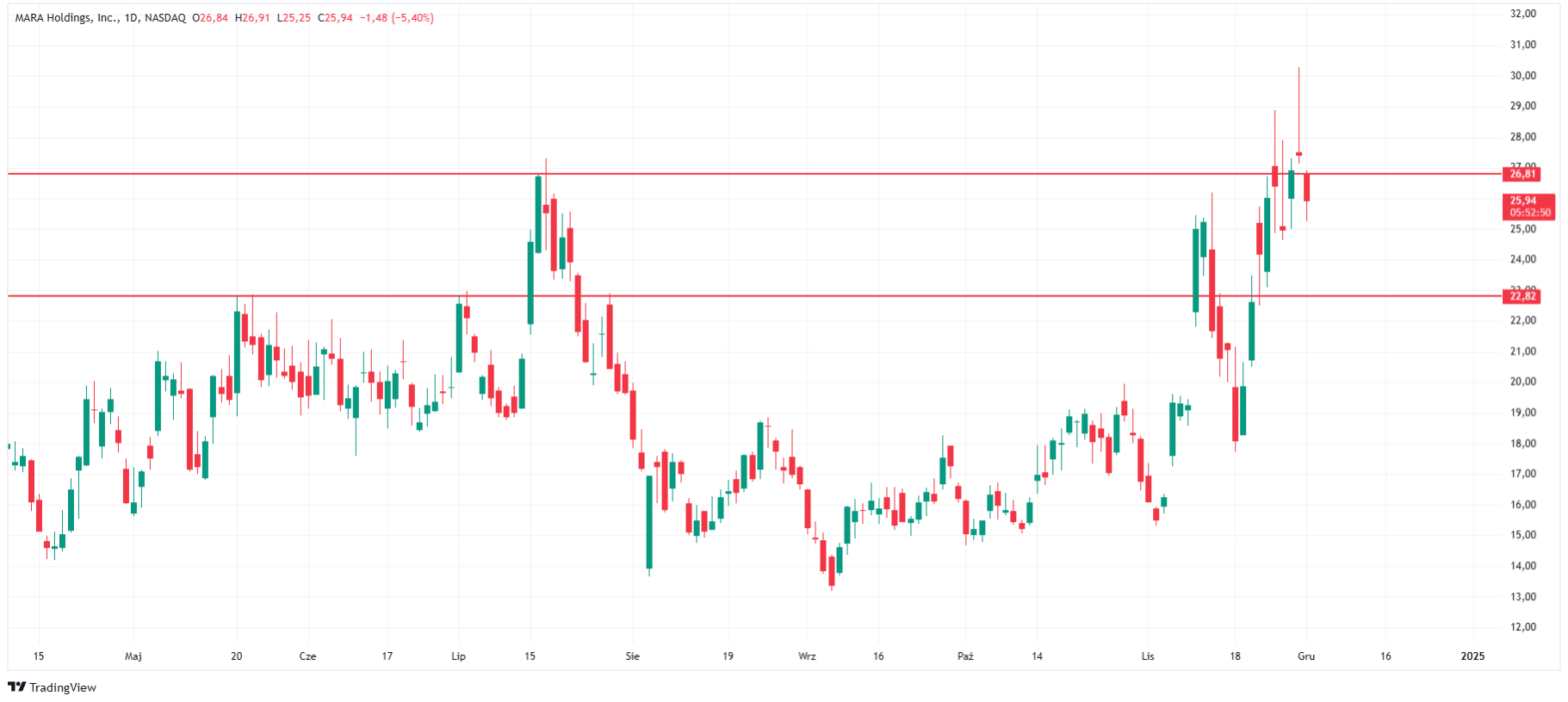
with a decline. On Monday, December 2, 2024, MARA stock opened on NASDAQ with a
6% drop, reaching an intraday low of approximately $25. Currently, one MARA
stock is trading at $25.85.
MARA stock price on Monday. Source: TradingView
It is worth
noting, however, that the stock remains close to mid-term highs, with the $23
level expected to serve as a significant support point.
MARA has
also reminded investors of potential risks, urging them to carefully review the
company’s latest filings with the SEC, including annual and quarterly reports.
The cryptocurrency and digital asset markets remain highly volatile,
emphasizing the importance of making informed trading and investment decisions.
Almost a
month ago, the
company reported a net loss of $124.8 million in the third quarter of 2024,
despite a 34.5% year-over-year revenue increase to $131.6 million. The loss was
primarily due to a $40 million rise in operational expenses, which overshadowed
the revenue growth.
About MARA Holdings
MARA
Holdings, Inc. (NASDAQ: MARA) is a global leader in digital asset compute,
leveraging innovative technologies to secure blockchain networks and transform
underutilized energy into economic value.
The company
continues to expand its presence in the digital asset space, making MARA stock
a focal point for analysts and investors tracking the intersection of
blockchain and financial markets.
Frequently Asked Questions
(FAQs), MARA Stock News
What is MARA’s current BTC
holding?
As of
November 30, 2024, MARA holds 34,959 BTC, valued at $3.3 billion.
How will the proceeds from
the $700 million notes offering be used?
Proceeds
will primarily fund bitcoin acquisitions, repurchase existing 2026 convertible
notes, and support corporate initiatives.
What was MARA’s BTC
production growth in November 2024?
MARA
achieved a 26% month-over-month growth in BTC production, mining 907 BTC in
November.
Is MARA stock impacted by
the proposed offering?
The
proposed offering may influence MARA stock’s market price due to activities
linked to hedged holders and derivative transactions. After the newest
announcements the stock price of MARA fell more than 6% on Monday, testing $25.7.
For the
latest MARA stock news, financial updates, and operational highlights, stay
connected with Finance Magnates’ updates.
MARA
Holdings, Inc. (NASDAQ: MARA), a
leading name in digital asset compute and blockchain technology and the biggest
Bitcoin miner from Wall Street, announced two significant updates on its
operations and financial strategy today (Monday).
These
developments underscore the company’s robust positioning in the cryptocurrency
and digital asset market, providing fresh insights for investors tracking MARA
stock and the broader market.
MARA Stock News: November
Bitcoin Mining Reaches Record Highs
MARA
Holdings revealed its November 2024 Bitcoin production update, highlighting a
record-breaking performance in mining operations. The company achieved a 27%
month-over-month increase in blocks won, totaling 254, while bitcoin (BTC)
production rose by 26% to 907 BTC. This surge was driven by enhanced
operational efficiency and the deployment of additional mining rigs, increasing
MARA’s energized hash rate to 46.1 EH/s, a 15% improvement from October.
Fred Thiel, CEO, MARA, Source: LinkedIn
“November
was a record-breaking month for MARA, with our mining operations achieving
unprecedented levels of production. These results highlight the significant
strides we've made in scaling operations and optimizing performance,” Fred
Thiel, MARA’s chairman and CEO, noted.
Average
acquisition price for purchased BTC: $77,692
YTD BTC
yield per share:
37.2%
MARA’s
hybrid strategy of mining and purchasing Bitcoin provides flexibility to
capitalize on market conditions. The company acquired 6,474 BTC in November
alone, leveraging price declines to optimize acquisition costs. This dual
approach positions MARA to maintain a competitive edge while delivering
long-term shareholder value.
MARA’s November 2024 #Bitcoin Production Update is here:
- Energized Hash Rate Increased 15% to 46.1 EH/s - Record 254 Blocks Won, a 27% Increase M/M - 907 BTC Produced, a 26% Increase M/M - Total BTC HODL: 34,959 BTC valued at $3.3B (spot: $95K) - 12,965 BTC acquired YTD at…
Proceeds
from the offering will be allocated primarily toward acquiring additional Bitcoin and repurchasing the company’s existing convertible notes due 2026. The remaining funds may be used for general corporate purposes, including strategic
acquisitions, expansion of assets, and debt repayment.
Today, we announced a proposed private offering of 0% convertible notes of $700 million + $105 million option. Proceeds to be used primarily to acquire bitcoin and repurchase existing 2026 convertible notes up to $50 million.https://t.co/S9kgfId4rp
“MARA
expects to use up to $50 million of the net proceeds from the sale of the notes
to repurchase a portion of its existing convertible notes due 2026 in privately negotiated transactions with the
remainder of the net proceeds to be used to acquire additional Bitcoin and for
general corporate purposes,” the company commented.
The notes,
expected to be convertible into MARA stock or cash, will not accrue interest.
Special interest, if applicable, will commence in mid-2025. The anticipated
reference price for conversion will be determined based on MARA stock’s
volume-weighted average price on the pricing date.
MARA has
also highlighted potential market activity linked to the repurchase of existing
notes. Hedged holders may unwind their positions, potentially impacting the
market price of MARA stock during the pricing period.
Although
the information published in the report seemed positive, the market reacted
with a decline. On Monday, December 2, 2024, MARA stock opened on NASDAQ with a
6% drop, reaching an intraday low of approximately $25. Currently, one MARA
stock is trading at $25.85.
MARA stock price on Monday. Source: TradingView
It is worth
noting, however, that the stock remains close to mid-term highs, with the $23
level expected to serve as a significant support point.
MARA has
also reminded investors of potential risks, urging them to carefully review the
company’s latest filings with the SEC, including annual and quarterly reports.
The cryptocurrency and digital asset markets remain highly volatile,
emphasizing the importance of making informed trading and investment decisions.
Almost a
month ago, the
company reported a net loss of $124.8 million in the third quarter of 2024,
despite a 34.5% year-over-year revenue increase to $131.6 million. The loss was
primarily due to a $40 million rise in operational expenses, which overshadowed
the revenue growth.
About MARA Holdings
MARA
Holdings, Inc. (NASDAQ: MARA) is a global leader in digital asset compute,
leveraging innovative technologies to secure blockchain networks and transform
underutilized energy into economic value.
The company
continues to expand its presence in the digital asset space, making MARA stock
a focal point for analysts and investors tracking the intersection of
blockchain and financial markets.
Frequently Asked Questions
(FAQs), MARA Stock News
What is MARA’s current BTC
holding?
As of
November 30, 2024, MARA holds 34,959 BTC, valued at $3.3 billion.
How will the proceeds from
the $700 million notes offering be used?
Proceeds
will primarily fund bitcoin acquisitions, repurchase existing 2026 convertible
notes, and support corporate initiatives.
What was MARA’s BTC
production growth in November 2024?
MARA
achieved a 26% month-over-month growth in BTC production, mining 907 BTC in
November.
Is MARA stock impacted by
the proposed offering?
The
proposed offering may influence MARA stock’s market price due to activities
linked to hedged holders and derivative transactions. After the newest
announcements the stock price of MARA fell more than 6% on Monday, testing $25.7.
For the
latest MARA stock news, financial updates, and operational highlights, stay
connected with Finance Magnates’ updates.
Damian Chmiel is a Senior Analyst & Editor at Finance Magnates with more than 15 years of experience in the CFD and online trading industry. Active as both a trader and journalist since 2010, he focuses on broker coverage, fintech innovation, and regulatory developments across Europe, the Middle East, and Asia.
His work includes interviews with C-level leaders at major brokerages and fintech platforms, as well as co-authoring Finance Magnates’ quarterly industry benchmarking reports. Damian’s reporting is data-driven, market-aware, and grounded in direct industry engagement. His analysis and commentary have also been cited by external media outlets, including Investing.com, Binance, The Asset, Stockhead, and Dispatch.
Education:
MA in Finance and Accounting, Cracow University of Economics
In this video, we review @HolaPrimeMarketsOfficial, a multi-asset forex and CFDs broker offering different account types, trading platforms, and flexible trading conditions.
We cover the broker’s overall offering, including account options, trading environment, platforms like MT4 and MT5, and additional services such as managed accounts and fast withdrawals.
Watch the full video to see if Hola Prime Markets fits your trading needs.
📣 Stay up to date with the latest in finance and trading. Follow Finance Magnates for industry news, insights, and global event coverage.
Connect with us:
🔗 LinkedIn: /financemagnates
👍 Facebook: /financemagnates
📸 Instagram: https://www.instagram.com/financemagnates
🐦 X: https://x.com/financemagnates
🎥 TikTok: https://www.tiktok.com/tag/financemagnates
▶️ YouTube: /@financemagnates_official
#HolaPrime #ForexBroker #CFDTrading #FinanceMagnates #Trading #Forex #BrokerReview
In this video, we review @HolaPrimeMarketsOfficial, a multi-asset forex and CFDs broker offering different account types, trading platforms, and flexible trading conditions.
We cover the broker’s overall offering, including account options, trading environment, platforms like MT4 and MT5, and additional services such as managed accounts and fast withdrawals.
Watch the full video to see if Hola Prime Markets fits your trading needs.
📣 Stay up to date with the latest in finance and trading. Follow Finance Magnates for industry news, insights, and global event coverage.
Connect with us:
🔗 LinkedIn: /financemagnates
👍 Facebook: /financemagnates
📸 Instagram: https://www.instagram.com/financemagnates
🐦 X: https://x.com/financemagnates
🎥 TikTok: https://www.tiktok.com/tag/financemagnates
▶️ YouTube: /@financemagnates_official
#HolaPrime #ForexBroker #CFDTrading #FinanceMagnates #Trading #Forex #BrokerReview
In this video, we review @HolaPrimeMarketsOfficial, a multi-asset forex and CFDs broker offering different account types, trading platforms, and flexible trading conditions.
We cover the broker’s overall offering, including account options, trading environment, platforms like MT4 and MT5, and additional services such as managed accounts and fast withdrawals.
Watch the full video to see if Hola Prime Markets fits your trading needs.
📣 Stay up to date with the latest in finance and trading. Follow Finance Magnates for industry news, insights, and global event coverage.
Connect with us:
🔗 LinkedIn: /financemagnates
👍 Facebook: /financemagnates
📸 Instagram: https://www.instagram.com/financemagnates
🐦 X: https://x.com/financemagnates
🎥 TikTok: https://www.tiktok.com/tag/financemagnates
▶️ YouTube: /@financemagnates_official
#HolaPrime #ForexBroker #CFDTrading #FinanceMagnates #Trading #Forex #BrokerReview
In this video, we review @HolaPrimeMarketsOfficial, a multi-asset forex and CFDs broker offering different account types, trading platforms, and flexible trading conditions.
We cover the broker’s overall offering, including account options, trading environment, platforms like MT4 and MT5, and additional services such as managed accounts and fast withdrawals.
Watch the full video to see if Hola Prime Markets fits your trading needs.
📣 Stay up to date with the latest in finance and trading. Follow Finance Magnates for industry news, insights, and global event coverage.
Connect with us:
🔗 LinkedIn: /financemagnates
👍 Facebook: /financemagnates
📸 Instagram: https://www.instagram.com/financemagnates
🐦 X: https://x.com/financemagnates
🎥 TikTok: https://www.tiktok.com/tag/financemagnates
▶️ YouTube: /@financemagnates_official
#HolaPrime #ForexBroker #CFDTrading #FinanceMagnates #Trading #Forex #BrokerReview
Hola Prime Review: What You Need to Know | Full Breakdown by Finance Magnates
Hola Prime Review: What You Need to Know | Full Breakdown by Finance Magnates
Hola Prime Review: What You Need to Know | Full Breakdown by Finance Magnates
Hola Prime Review: What You Need to Know | Full Breakdown by Finance Magnates
Hola Prime Review: What You Need to Know | Full Breakdown by Finance Magnates
Hola Prime Review: What You Need to Know | Full Breakdown by Finance Magnates
In this video, we review @HolaPrime_Global, a proprietary trading firm offering evaluation programs and performance-based payouts in simulated market environments.
We cover how the challenge model works, including account types, profit splits (up to 95%), trading rules, and what it takes to reach a funded account. You’ll also learn about available platforms like MT4, MT5, cTrader, and more, along with insights into payouts, support, and trading conditions.
Watch the full video to see if Hola Prime fits your trading style.
📣 Stay up to date with the latest in finance and trading. Follow Finance Magnates for industry news, insights, and global event coverage.
Connect with us:
🔗 LinkedIn: /financemagnates
👍 Facebook: /financemagnates
📸 Instagram: https://www.instagram.com/financemagnates
🐦 X: https://x.com/financemagnates
🎥 TikTok: https://www.tiktok.com/tag/financemagnates
▶️ YouTube: /@financemagnates_official
#HolaPrime #PropFirm #Trading #FinanceMagnates #Forex #FuturesTrading #TradingReview #PropFirmReview
In this video, we review @HolaPrime_Global, a proprietary trading firm offering evaluation programs and performance-based payouts in simulated market environments.
We cover how the challenge model works, including account types, profit splits (up to 95%), trading rules, and what it takes to reach a funded account. You’ll also learn about available platforms like MT4, MT5, cTrader, and more, along with insights into payouts, support, and trading conditions.
Watch the full video to see if Hola Prime fits your trading style.
📣 Stay up to date with the latest in finance and trading. Follow Finance Magnates for industry news, insights, and global event coverage.
Connect with us:
🔗 LinkedIn: /financemagnates
👍 Facebook: /financemagnates
📸 Instagram: https://www.instagram.com/financemagnates
🐦 X: https://x.com/financemagnates
🎥 TikTok: https://www.tiktok.com/tag/financemagnates
▶️ YouTube: /@financemagnates_official
#HolaPrime #PropFirm #Trading #FinanceMagnates #Forex #FuturesTrading #TradingReview #PropFirmReview
In this video, we review @HolaPrime_Global, a proprietary trading firm offering evaluation programs and performance-based payouts in simulated market environments.
We cover how the challenge model works, including account types, profit splits (up to 95%), trading rules, and what it takes to reach a funded account. You’ll also learn about available platforms like MT4, MT5, cTrader, and more, along with insights into payouts, support, and trading conditions.
Watch the full video to see if Hola Prime fits your trading style.
📣 Stay up to date with the latest in finance and trading. Follow Finance Magnates for industry news, insights, and global event coverage.
Connect with us:
🔗 LinkedIn: /financemagnates
👍 Facebook: /financemagnates
📸 Instagram: https://www.instagram.com/financemagnates
🐦 X: https://x.com/financemagnates
🎥 TikTok: https://www.tiktok.com/tag/financemagnates
▶️ YouTube: /@financemagnates_official
#HolaPrime #PropFirm #Trading #FinanceMagnates #Forex #FuturesTrading #TradingReview #PropFirmReview
In this video, we review @HolaPrime_Global, a proprietary trading firm offering evaluation programs and performance-based payouts in simulated market environments.
We cover how the challenge model works, including account types, profit splits (up to 95%), trading rules, and what it takes to reach a funded account. You’ll also learn about available platforms like MT4, MT5, cTrader, and more, along with insights into payouts, support, and trading conditions.
Watch the full video to see if Hola Prime fits your trading style.
📣 Stay up to date with the latest in finance and trading. Follow Finance Magnates for industry news, insights, and global event coverage.
Connect with us:
🔗 LinkedIn: /financemagnates
👍 Facebook: /financemagnates
📸 Instagram: https://www.instagram.com/financemagnates
🐦 X: https://x.com/financemagnates
🎥 TikTok: https://www.tiktok.com/tag/financemagnates
▶️ YouTube: /@financemagnates_official
#HolaPrime #PropFirm #Trading #FinanceMagnates #Forex #FuturesTrading #TradingReview #PropFirmReview
In this video, we review @HolaPrime_Global, a proprietary trading firm offering evaluation programs and performance-based payouts in simulated market environments.
We cover how the challenge model works, including account types, profit splits (up to 95%), trading rules, and what it takes to reach a funded account. You’ll also learn about available platforms like MT4, MT5, cTrader, and more, along with insights into payouts, support, and trading conditions.
Watch the full video to see if Hola Prime fits your trading style.
📣 Stay up to date with the latest in finance and trading. Follow Finance Magnates for industry news, insights, and global event coverage.
Connect with us:
🔗 LinkedIn: /financemagnates
👍 Facebook: /financemagnates
📸 Instagram: https://www.instagram.com/financemagnates
🐦 X: https://x.com/financemagnates
🎥 TikTok: https://www.tiktok.com/tag/financemagnates
▶️ YouTube: /@financemagnates_official
#HolaPrime #PropFirm #Trading #FinanceMagnates #Forex #FuturesTrading #TradingReview #PropFirmReview
In this video, we review @HolaPrime_Global, a proprietary trading firm offering evaluation programs and performance-based payouts in simulated market environments.
We cover how the challenge model works, including account types, profit splits (up to 95%), trading rules, and what it takes to reach a funded account. You’ll also learn about available platforms like MT4, MT5, cTrader, and more, along with insights into payouts, support, and trading conditions.
Watch the full video to see if Hola Prime fits your trading style.
📣 Stay up to date with the latest in finance and trading. Follow Finance Magnates for industry news, insights, and global event coverage.
Connect with us:
🔗 LinkedIn: /financemagnates
👍 Facebook: /financemagnates
📸 Instagram: https://www.instagram.com/financemagnates
🐦 X: https://x.com/financemagnates
🎥 TikTok: https://www.tiktok.com/tag/financemagnates
▶️ YouTube: /@financemagnates_official
#HolaPrime #PropFirm #Trading #FinanceMagnates #Forex #FuturesTrading #TradingReview #PropFirmReview
Axi Winner Spotlight 🏆 | Global Most Innovative Broker 2025 #Innovation #Trading #Fintech #Broker
Axi Winner Spotlight 🏆 | Global Most Innovative Broker 2025 #Innovation #Trading #Fintech #Broker
Axi Winner Spotlight 🏆 | Global Most Innovative Broker 2025 #Innovation #Trading #Fintech #Broker
Axi Winner Spotlight 🏆 | Global Most Innovative Broker 2025 #Innovation #Trading #Fintech #Broker
Axi Winner Spotlight 🏆 | Global Most Innovative Broker 2025 #Innovation #Trading #Fintech #Broker
Axi Winner Spotlight 🏆 | Global Most Innovative Broker 2025 #Innovation #Trading #Fintech #Broker
Axi takes the spotlight at the Finance Magnates Awards, winning Global Most Innovative Broker 2025.
Olivia Xenofontos and Ivanna Openko share how the team will feel: proud, motivated, and ready to keep delivering.
They also describe the night as well-organized, focused, and enjoyable for all.
👉 Be part of FM Awards 2026.
Axi takes the spotlight at the Finance Magnates Awards, winning Global Most Innovative Broker 2025.
Olivia Xenofontos and Ivanna Openko share how the team will feel: proud, motivated, and ready to keep delivering.
They also describe the night as well-organized, focused, and enjoyable for all.
👉 Be part of FM Awards 2026.
Axi takes the spotlight at the Finance Magnates Awards, winning Global Most Innovative Broker 2025.
Olivia Xenofontos and Ivanna Openko share how the team will feel: proud, motivated, and ready to keep delivering.
They also describe the night as well-organized, focused, and enjoyable for all.
👉 Be part of FM Awards 2026.
Axi takes the spotlight at the Finance Magnates Awards, winning Global Most Innovative Broker 2025.
Olivia Xenofontos and Ivanna Openko share how the team will feel: proud, motivated, and ready to keep delivering.
They also describe the night as well-organized, focused, and enjoyable for all.
👉 Be part of FM Awards 2026.
Axi takes the spotlight at the Finance Magnates Awards, winning Global Most Innovative Broker 2025.
Olivia Xenofontos and Ivanna Openko share how the team will feel: proud, motivated, and ready to keep delivering.
They also describe the night as well-organized, focused, and enjoyable for all.
👉 Be part of FM Awards 2026.
Axi takes the spotlight at the Finance Magnates Awards, winning Global Most Innovative Broker 2025.
Olivia Xenofontos and Ivanna Openko share how the team will feel: proud, motivated, and ready to keep delivering.
They also describe the night as well-organized, focused, and enjoyable for all.
👉 Be part of FM Awards 2026.
Recognition that matters.
Built on transparency.
Driven by the industry.
The Finance Magnates Awards 2026.
Nominations are now open.
🔗 https://awards.financemagnates.com/?utm_source=SM&utm_medium=social&utm_campaign=recognition-matters
Recognition that matters.
Built on transparency.
Driven by the industry.
The Finance Magnates Awards 2026.
Nominations are now open.
🔗 https://awards.financemagnates.com/?utm_source=SM&utm_medium=social&utm_campaign=recognition-matters
Recognition that matters.
Built on transparency.
Driven by the industry.
The Finance Magnates Awards 2026.
Nominations are now open.
🔗 https://awards.financemagnates.com/?utm_source=SM&utm_medium=social&utm_campaign=recognition-matters
Recognition that matters.
Built on transparency.
Driven by the industry.
The Finance Magnates Awards 2026.
Nominations are now open.
🔗 https://awards.financemagnates.com/?utm_source=SM&utm_medium=social&utm_campaign=recognition-matters
Recognition that matters.
Built on transparency.
Driven by the industry.
The Finance Magnates Awards 2026.
Nominations are now open.
🔗 https://awards.financemagnates.com/?utm_source=SM&utm_medium=social&utm_campaign=recognition-matters
Recognition that matters.
Built on transparency.
Driven by the industry.
The Finance Magnates Awards 2026.
Nominations are now open.
🔗 https://awards.financemagnates.com/?utm_source=SM&utm_medium=social&utm_campaign=recognition-matters
Tickmill Winner Spotlight | Broker of the Year 2025 (LATAM) 🏆 | Finance Magnates Awards #Trading
Tickmill Winner Spotlight | Broker of the Year 2025 (LATAM) 🏆 | Finance Magnates Awards #Trading
Tickmill Winner Spotlight | Broker of the Year 2025 (LATAM) 🏆 | Finance Magnates Awards #Trading
Tickmill Winner Spotlight | Broker of the Year 2025 (LATAM) 🏆 | Finance Magnates Awards #Trading
Tickmill Winner Spotlight | Broker of the Year 2025 (LATAM) 🏆 | Finance Magnates Awards #Trading
Tickmill Winner Spotlight | Broker of the Year 2025 (LATAM) 🏆 | Finance Magnates Awards #Trading
What helped Tickmill stand out this year?
In this Winner Spotlight, Johnny Khalil, Executive Director at Tickmill Europe, shares how listening closely to clients and delivering strong trading conditions made the difference.
A big thank you to the community whose support continues to drive progress every day.
👉 Think your brand has what it takes? Nominate for the 2026 Finance Magnates Awards: https://awards.financemagnates.com/#nominate
What helped Tickmill stand out this year?
In this Winner Spotlight, Johnny Khalil, Executive Director at Tickmill Europe, shares how listening closely to clients and delivering strong trading conditions made the difference.
A big thank you to the community whose support continues to drive progress every day.
👉 Think your brand has what it takes? Nominate for the 2026 Finance Magnates Awards: https://awards.financemagnates.com/#nominate
What helped Tickmill stand out this year?
In this Winner Spotlight, Johnny Khalil, Executive Director at Tickmill Europe, shares how listening closely to clients and delivering strong trading conditions made the difference.
A big thank you to the community whose support continues to drive progress every day.
👉 Think your brand has what it takes? Nominate for the 2026 Finance Magnates Awards: https://awards.financemagnates.com/#nominate
What helped Tickmill stand out this year?
In this Winner Spotlight, Johnny Khalil, Executive Director at Tickmill Europe, shares how listening closely to clients and delivering strong trading conditions made the difference.
A big thank you to the community whose support continues to drive progress every day.
👉 Think your brand has what it takes? Nominate for the 2026 Finance Magnates Awards: https://awards.financemagnates.com/#nominate
What helped Tickmill stand out this year?
In this Winner Spotlight, Johnny Khalil, Executive Director at Tickmill Europe, shares how listening closely to clients and delivering strong trading conditions made the difference.
A big thank you to the community whose support continues to drive progress every day.
👉 Think your brand has what it takes? Nominate for the 2026 Finance Magnates Awards: https://awards.financemagnates.com/#nominate
What helped Tickmill stand out this year?
In this Winner Spotlight, Johnny Khalil, Executive Director at Tickmill Europe, shares how listening closely to clients and delivering strong trading conditions made the difference.
A big thank you to the community whose support continues to drive progress every day.
👉 Think your brand has what it takes? Nominate for the 2026 Finance Magnates Awards: https://awards.financemagnates.com/#nominate