Former Marathon Digital Holdings plans to use the funds for “strategic opportunities.”
According to Macquarie Financial Group, Nasdaq-listed MARA stock is expected to grow by 50%.
The biggest publicly listed Wall Street Bitcoin (BTC) miner, MARA Holdings (NASDAQ: MARA), has
announced the acquisition of a $200 million line of credit. The credit facility
is secured by a portion of the company's crypto holdings, highlighting the
growing trend of cryptocurrency-backed financing in the corporate world.
MARA Leverages Bitcoin
Stack in $200 Million Credit Deal
The
statement presented
yesterday (Tuesday) by MARA doesn't delve too deeply into details, only
informing that the cryptocurrency miner used a portion of its substantial
Bitcoin stack to secure a $200 million line of credit.
Fred Thiel, CEO, MARA, Source: LinkedIn
What will
the funds be used for? Here too, no detailed information was provided beyond a
general statement that “MARA may use the funds to capitalize on strategic
opportunities and for other general corporate purposes.”
It's worth
noting that MARA, known as Marathon Digital Holdings until August, is the
largest BTC producer listed on Wall Street, with a current market
capitalization of nearly $5 billion. It significantly outpaces Core Scientific,
which is in second place with a value of $3.3 billion.
The move
comes a few months after MARA decided to purchase Bitcoin for $249 million. In
August, it successfully completed a $300 million offering of convertible senior
notes, most of which was allocated to buying BTC.
MARA is
currently the second-largest public holder of Bitcoin, right behind
MicroStrategy. According to Bitbo data, it holds 0.12% of the total BTC supply,
or nearly 26,000 tokens, with an estimated value of almost $1.8 billion.
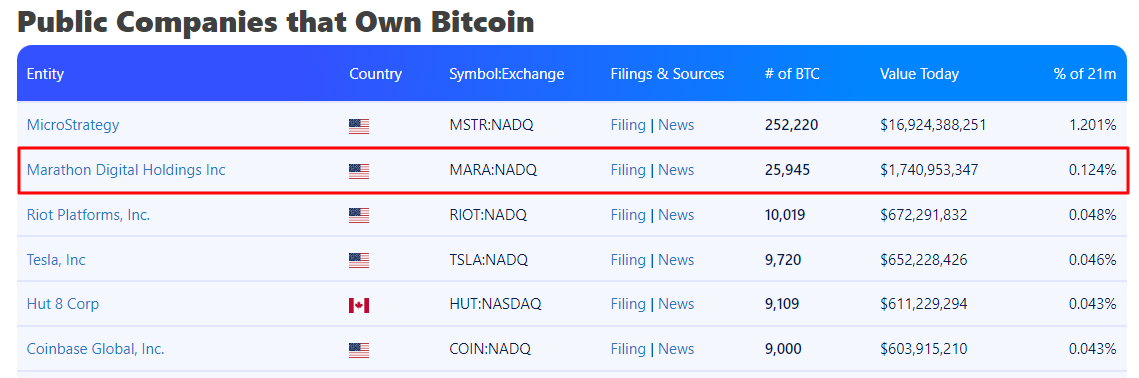
Source: Bitbo
MARA Stock: Potential for
a 50% Rebound According to Macquarie
However,
the latest report from financial group Macquarie suggests that this situation
may soon change. The firm initiated coverage of the company's shares with an
“Outperform” rating and claims that its move towards artificial
intelligence (AI) and high-performance computing (HPC) could lead to a 50%
increase in valuation. Macquarie's current price target for MARA shares is $22,
the highest since July.
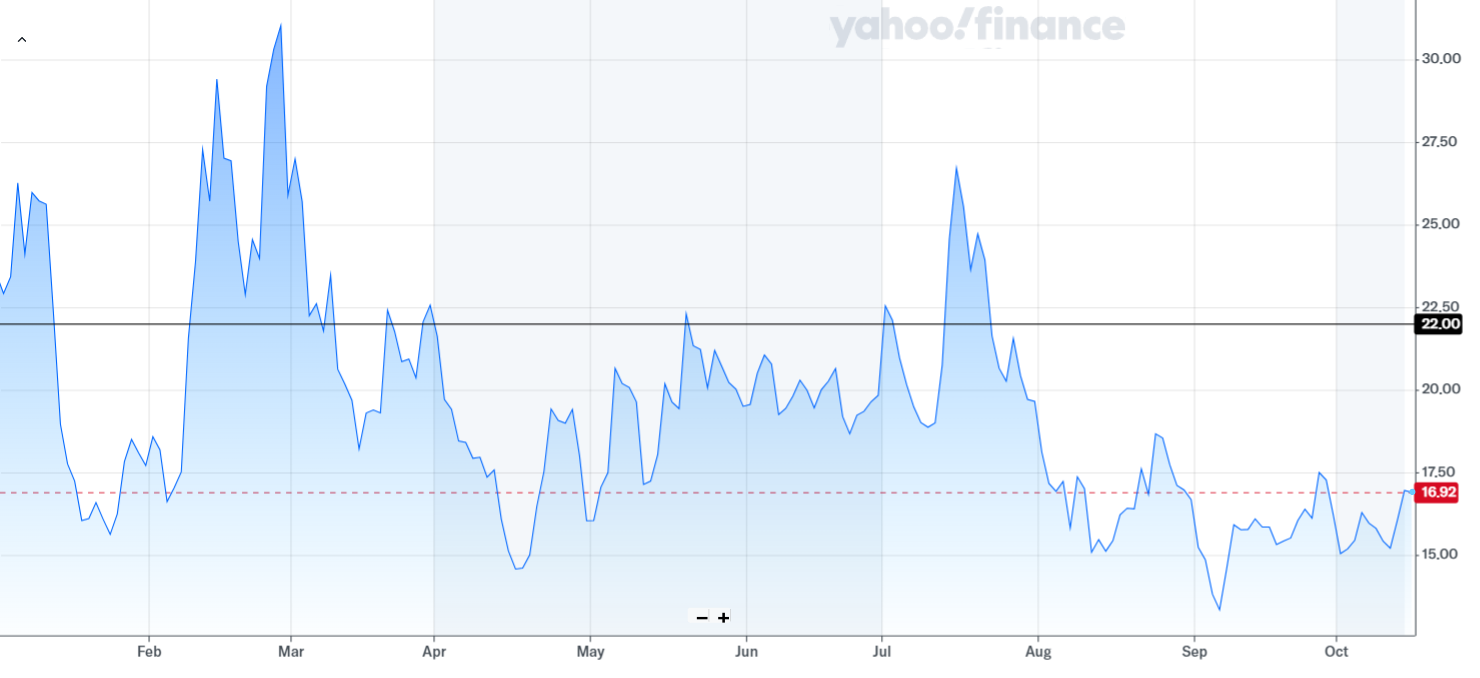
Source: Yahoo Finance
Wall Street Bitcoin Miners
Move to AI and HPC
MARA is at
the forefront of a trend among Bitcoin miners, which involves seeking new
sources of income from their massive data centers (so-called mines) in the face
of growing competition and difficulties in the mining sector, while industry
margins are declining.
While MARA
has not made any official announcements regarding a shift towards AI, recent
changes in leadership suggest a potential move in this direction. The company
has bolstered its Board of Directors with new appointments, including
individuals with significant experience in artificial intelligence and data
center operations.
VanEck's head of digital assets research, Matthew Sigel
Industry
analysts are taking note of the potential for Bitcoin mining companies to pivot
towards AI and high-performance computing. Matthew Sigel, head of digital
assets research at VanEck, projects that this strategic shift could generate
substantial value for mining firms in the coming years.
MARA,
formerly known as Marathon Digital Holdings, is the largest publicly-listed
Bitcoin mining company on Wall Street. It operates as a digital asset
technology company that mines cryptocurrencies with a focus on the blockchain
ecosystem3.
Why is MARA in the news?
MARA
recently announced access to a $200 million line of credit backed by its
Bitcoin holdings. This move highlights the growing trend of
cryptocurrency-backed financing in the corporate world.
What is MARA's current stock
price?
As of the
latest data, MARA's stock price is $15.21 per share. However, stock prices can
fluctuate rapidly, so it's best to check real-time market data for the most
current price.
What do analysts predict
for MARA stock?
The financial group Macquarie
has initiated coverage of MARA with an “Outperform”
rating and suggests the stock could grow by 50%. Their current price target for
MARA shares is $22, the highest since July.
How much Bitcoin does MARA
hold?
MARA is
currently the second-largest public holder of Bitcoin, right behind
MicroStrategy. It holds approximately 26,000 tokens, or 0.12% of the total BTC
supply, valued at nearly $1.8 billion.
What is MARA's market
capitalization?
As of the
latest data, MARA's market capitalization is approximately $4.44 billion.
The biggest publicly listed Wall Street Bitcoin (BTC) miner, MARA Holdings (NASDAQ: MARA), has
announced the acquisition of a $200 million line of credit. The credit facility
is secured by a portion of the company's crypto holdings, highlighting the
growing trend of cryptocurrency-backed financing in the corporate world.
MARA Leverages Bitcoin
Stack in $200 Million Credit Deal
The
statement presented
yesterday (Tuesday) by MARA doesn't delve too deeply into details, only
informing that the cryptocurrency miner used a portion of its substantial
Bitcoin stack to secure a $200 million line of credit.
Fred Thiel, CEO, MARA, Source: LinkedIn
What will
the funds be used for? Here too, no detailed information was provided beyond a
general statement that “MARA may use the funds to capitalize on strategic
opportunities and for other general corporate purposes.”
It's worth
noting that MARA, known as Marathon Digital Holdings until August, is the
largest BTC producer listed on Wall Street, with a current market
capitalization of nearly $5 billion. It significantly outpaces Core Scientific,
which is in second place with a value of $3.3 billion.
The move
comes a few months after MARA decided to purchase Bitcoin for $249 million. In
August, it successfully completed a $300 million offering of convertible senior
notes, most of which was allocated to buying BTC.
MARA is
currently the second-largest public holder of Bitcoin, right behind
MicroStrategy. According to Bitbo data, it holds 0.12% of the total BTC supply,
or nearly 26,000 tokens, with an estimated value of almost $1.8 billion.
Source: Bitbo
MARA Stock: Potential for
a 50% Rebound According to Macquarie
However,
the latest report from financial group Macquarie suggests that this situation
may soon change. The firm initiated coverage of the company's shares with an
“Outperform” rating and claims that its move towards artificial
intelligence (AI) and high-performance computing (HPC) could lead to a 50%
increase in valuation. Macquarie's current price target for MARA shares is $22,
the highest since July.
Source: Yahoo Finance
Wall Street Bitcoin Miners
Move to AI and HPC
MARA is at
the forefront of a trend among Bitcoin miners, which involves seeking new
sources of income from their massive data centers (so-called mines) in the face
of growing competition and difficulties in the mining sector, while industry
margins are declining.
While MARA
has not made any official announcements regarding a shift towards AI, recent
changes in leadership suggest a potential move in this direction. The company
has bolstered its Board of Directors with new appointments, including
individuals with significant experience in artificial intelligence and data
center operations.
VanEck's head of digital assets research, Matthew Sigel
Industry
analysts are taking note of the potential for Bitcoin mining companies to pivot
towards AI and high-performance computing. Matthew Sigel, head of digital
assets research at VanEck, projects that this strategic shift could generate
substantial value for mining firms in the coming years.
MARA,
formerly known as Marathon Digital Holdings, is the largest publicly-listed
Bitcoin mining company on Wall Street. It operates as a digital asset
technology company that mines cryptocurrencies with a focus on the blockchain
ecosystem3.
Why is MARA in the news?
MARA
recently announced access to a $200 million line of credit backed by its
Bitcoin holdings. This move highlights the growing trend of
cryptocurrency-backed financing in the corporate world.
What is MARA's current stock
price?
As of the
latest data, MARA's stock price is $15.21 per share. However, stock prices can
fluctuate rapidly, so it's best to check real-time market data for the most
current price.
What do analysts predict
for MARA stock?
The financial group Macquarie
has initiated coverage of MARA with an “Outperform”
rating and suggests the stock could grow by 50%. Their current price target for
MARA shares is $22, the highest since July.
How much Bitcoin does MARA
hold?
MARA is
currently the second-largest public holder of Bitcoin, right behind
MicroStrategy. It holds approximately 26,000 tokens, or 0.12% of the total BTC
supply, valued at nearly $1.8 billion.
What is MARA's market
capitalization?
As of the
latest data, MARA's market capitalization is approximately $4.44 billion.
Damian's adventure with financial markets began at the Cracow University of Economics, where he obtained his MA in finance and accounting. Starting from the retail trader perspective, he collaborated with brokerage houses and financial portals in Poland as an independent editor and content manager. His adventure with Finance Magnates began in 2016, where he is working as a business intelligence analyst.
Kraken Taps Alpaca for xStocks After Backed Finance Acquisition
Featured Videos
Executive Interview | Charlotte Bullock | Chief Product Officer, Bank of London | FMLS:25
In this interview, we sat down with Charlotte Bullock, Head of Product at The Bank of London, previously at SAP and now shaping product at one of the sector’s most ambitious new banking players.
Charlotte reflects on the Summit so far and talks about the culture inside fintech banks today. We look at the pressures that come with scaling, and how firms can hold onto the nimble approach that made them stand out early on.
We also cover the state of payments ahead of her appearance on the payments roundtable: the blockages financial firms face, the areas that still need fixing, and what a realistic solution looks like in 2026.
In this interview, we sat down with Charlotte Bullock, Head of Product at The Bank of London, previously at SAP and now shaping product at one of the sector’s most ambitious new banking players.
Charlotte reflects on the Summit so far and talks about the culture inside fintech banks today. We look at the pressures that come with scaling, and how firms can hold onto the nimble approach that made them stand out early on.
We also cover the state of payments ahead of her appearance on the payments roundtable: the blockages financial firms face, the areas that still need fixing, and what a realistic solution looks like in 2026.
In this interview, we sat down with Charlotte Bullock, Head of Product at The Bank of London, previously at SAP and now shaping product at one of the sector’s most ambitious new banking players.
Charlotte reflects on the Summit so far and talks about the culture inside fintech banks today. We look at the pressures that come with scaling, and how firms can hold onto the nimble approach that made them stand out early on.
We also cover the state of payments ahead of her appearance on the payments roundtable: the blockages financial firms face, the areas that still need fixing, and what a realistic solution looks like in 2026.
In this interview, we sat down with Charlotte Bullock, Head of Product at The Bank of London, previously at SAP and now shaping product at one of the sector’s most ambitious new banking players.
Charlotte reflects on the Summit so far and talks about the culture inside fintech banks today. We look at the pressures that come with scaling, and how firms can hold onto the nimble approach that made them stand out early on.
We also cover the state of payments ahead of her appearance on the payments roundtable: the blockages financial firms face, the areas that still need fixing, and what a realistic solution looks like in 2026.
In this conversation, we sit down with Drew Niv, CSO at ATFX Connect and one of the most influential figures in modern FX.
We speak about market structure, the institutional view on liquidity, and the sharp rise of prop trading, a sector Drew has been commenting on in recent months. Drew explains why he once dismissed prop trading, why his view changed, and what he now thinks the model means for brokers, clients and risk managers.
We explore subscription-fee dependency, the high reneging rate, and the long-term challenge: how brokers can build a more stable and honest version of the model. Drew also talks about the traffic advantage standalone prop firms have built and why brokers may still win in the long run if they take the right approach.
In this conversation, we sit down with Drew Niv, CSO at ATFX Connect and one of the most influential figures in modern FX.
We speak about market structure, the institutional view on liquidity, and the sharp rise of prop trading, a sector Drew has been commenting on in recent months. Drew explains why he once dismissed prop trading, why his view changed, and what he now thinks the model means for brokers, clients and risk managers.
We explore subscription-fee dependency, the high reneging rate, and the long-term challenge: how brokers can build a more stable and honest version of the model. Drew also talks about the traffic advantage standalone prop firms have built and why brokers may still win in the long run if they take the right approach.
In this conversation, we sit down with Drew Niv, CSO at ATFX Connect and one of the most influential figures in modern FX.
We speak about market structure, the institutional view on liquidity, and the sharp rise of prop trading, a sector Drew has been commenting on in recent months. Drew explains why he once dismissed prop trading, why his view changed, and what he now thinks the model means for brokers, clients and risk managers.
We explore subscription-fee dependency, the high reneging rate, and the long-term challenge: how brokers can build a more stable and honest version of the model. Drew also talks about the traffic advantage standalone prop firms have built and why brokers may still win in the long run if they take the right approach.
In this conversation, we sit down with Drew Niv, CSO at ATFX Connect and one of the most influential figures in modern FX.
We speak about market structure, the institutional view on liquidity, and the sharp rise of prop trading, a sector Drew has been commenting on in recent months. Drew explains why he once dismissed prop trading, why his view changed, and what he now thinks the model means for brokers, clients and risk managers.
We explore subscription-fee dependency, the high reneging rate, and the long-term challenge: how brokers can build a more stable and honest version of the model. Drew also talks about the traffic advantage standalone prop firms have built and why brokers may still win in the long run if they take the right approach.
In this conversation, we sit down with Drew Niv, CSO at ATFX Connect and one of the most influential figures in modern FX.
We speak about market structure, the institutional view on liquidity, and the sharp rise of prop trading, a sector Drew has been commenting on in recent months. Drew explains why he once dismissed prop trading, why his view changed, and what he now thinks the model means for brokers, clients and risk managers.
We explore subscription-fee dependency, the high reneging rate, and the long-term challenge: how brokers can build a more stable and honest version of the model. Drew also talks about the traffic advantage standalone prop firms have built and why brokers may still win in the long run if they take the right approach.
In this conversation, we sit down with Drew Niv, CSO at ATFX Connect and one of the most influential figures in modern FX.
We speak about market structure, the institutional view on liquidity, and the sharp rise of prop trading, a sector Drew has been commenting on in recent months. Drew explains why he once dismissed prop trading, why his view changed, and what he now thinks the model means for brokers, clients and risk managers.
We explore subscription-fee dependency, the high reneging rate, and the long-term challenge: how brokers can build a more stable and honest version of the model. Drew also talks about the traffic advantage standalone prop firms have built and why brokers may still win in the long run if they take the right approach.
Executive Interview | Remonda Z. Kirketerp Møller| CEO & Founder Muinmos | FMLS:25
In this interview, Remonda Z. Kirketerp Møller, founder of Muinmos, breaks down the state of AI in regtech and what responsible adoption really looks like for brokers. We talk about rising fragmentation, the pressures around compliance accuracy, and why most firms are still in the early stages of AI maturity.
Ramanda also shares insights on regulator sandboxes, shifting expectations around accountability, and the current reality of MiCA licensing and passporting in Europe.
A concise look at where compliance, onboarding, and AI-driven processes are heading next.
In this interview, Remonda Z. Kirketerp Møller, founder of Muinmos, breaks down the state of AI in regtech and what responsible adoption really looks like for brokers. We talk about rising fragmentation, the pressures around compliance accuracy, and why most firms are still in the early stages of AI maturity.
Ramanda also shares insights on regulator sandboxes, shifting expectations around accountability, and the current reality of MiCA licensing and passporting in Europe.
A concise look at where compliance, onboarding, and AI-driven processes are heading next.
In this interview, Remonda Z. Kirketerp Møller, founder of Muinmos, breaks down the state of AI in regtech and what responsible adoption really looks like for brokers. We talk about rising fragmentation, the pressures around compliance accuracy, and why most firms are still in the early stages of AI maturity.
Ramanda also shares insights on regulator sandboxes, shifting expectations around accountability, and the current reality of MiCA licensing and passporting in Europe.
A concise look at where compliance, onboarding, and AI-driven processes are heading next.
In this interview, Remonda Z. Kirketerp Møller, founder of Muinmos, breaks down the state of AI in regtech and what responsible adoption really looks like for brokers. We talk about rising fragmentation, the pressures around compliance accuracy, and why most firms are still in the early stages of AI maturity.
Ramanda also shares insights on regulator sandboxes, shifting expectations around accountability, and the current reality of MiCA licensing and passporting in Europe.
A concise look at where compliance, onboarding, and AI-driven processes are heading next.
In this interview, Remonda Z. Kirketerp Møller, founder of Muinmos, breaks down the state of AI in regtech and what responsible adoption really looks like for brokers. We talk about rising fragmentation, the pressures around compliance accuracy, and why most firms are still in the early stages of AI maturity.
Ramanda also shares insights on regulator sandboxes, shifting expectations around accountability, and the current reality of MiCA licensing and passporting in Europe.
A concise look at where compliance, onboarding, and AI-driven processes are heading next.
In this interview, Remonda Z. Kirketerp Møller, founder of Muinmos, breaks down the state of AI in regtech and what responsible adoption really looks like for brokers. We talk about rising fragmentation, the pressures around compliance accuracy, and why most firms are still in the early stages of AI maturity.
Ramanda also shares insights on regulator sandboxes, shifting expectations around accountability, and the current reality of MiCA licensing and passporting in Europe.
A concise look at where compliance, onboarding, and AI-driven processes are heading next.
In this conversation, we speak with Aydin Bonabi, CEO and co-founder of Surveill, a firm focused on fraud detection and AI-driven compliance tools for financial institutions.
We start with Aydin’s view of the Summit and the challenges brokers face as fraud tactics grow more complex. He explains how firms can stay ahead through real-time signals, data patterns, and early-stage detection.
We also talk about AI training and why compliance teams often struggle to keep models accurate, fair, and aligned with regulatory expectations. Aydin breaks down what “good” AI training looks like inside a financial environment, including the importance of clean data, domain expertise, and human oversight.
He closes with a clear message: fraud is scaling, and so must the tools that stop it.
In this conversation, we speak with Aydin Bonabi, CEO and co-founder of Surveill, a firm focused on fraud detection and AI-driven compliance tools for financial institutions.
We start with Aydin’s view of the Summit and the challenges brokers face as fraud tactics grow more complex. He explains how firms can stay ahead through real-time signals, data patterns, and early-stage detection.
We also talk about AI training and why compliance teams often struggle to keep models accurate, fair, and aligned with regulatory expectations. Aydin breaks down what “good” AI training looks like inside a financial environment, including the importance of clean data, domain expertise, and human oversight.
He closes with a clear message: fraud is scaling, and so must the tools that stop it.
In this conversation, we speak with Aydin Bonabi, CEO and co-founder of Surveill, a firm focused on fraud detection and AI-driven compliance tools for financial institutions.
We start with Aydin’s view of the Summit and the challenges brokers face as fraud tactics grow more complex. He explains how firms can stay ahead through real-time signals, data patterns, and early-stage detection.
We also talk about AI training and why compliance teams often struggle to keep models accurate, fair, and aligned with regulatory expectations. Aydin breaks down what “good” AI training looks like inside a financial environment, including the importance of clean data, domain expertise, and human oversight.
He closes with a clear message: fraud is scaling, and so must the tools that stop it.
In this conversation, we speak with Aydin Bonabi, CEO and co-founder of Surveill, a firm focused on fraud detection and AI-driven compliance tools for financial institutions.
We start with Aydin’s view of the Summit and the challenges brokers face as fraud tactics grow more complex. He explains how firms can stay ahead through real-time signals, data patterns, and early-stage detection.
We also talk about AI training and why compliance teams often struggle to keep models accurate, fair, and aligned with regulatory expectations. Aydin breaks down what “good” AI training looks like inside a financial environment, including the importance of clean data, domain expertise, and human oversight.
He closes with a clear message: fraud is scaling, and so must the tools that stop it.
In this conversation, we speak with Aydin Bonabi, CEO and co-founder of Surveill, a firm focused on fraud detection and AI-driven compliance tools for financial institutions.
We start with Aydin’s view of the Summit and the challenges brokers face as fraud tactics grow more complex. He explains how firms can stay ahead through real-time signals, data patterns, and early-stage detection.
We also talk about AI training and why compliance teams often struggle to keep models accurate, fair, and aligned with regulatory expectations. Aydin breaks down what “good” AI training looks like inside a financial environment, including the importance of clean data, domain expertise, and human oversight.
He closes with a clear message: fraud is scaling, and so must the tools that stop it.
In this conversation, we speak with Aydin Bonabi, CEO and co-founder of Surveill, a firm focused on fraud detection and AI-driven compliance tools for financial institutions.
We start with Aydin’s view of the Summit and the challenges brokers face as fraud tactics grow more complex. He explains how firms can stay ahead through real-time signals, data patterns, and early-stage detection.
We also talk about AI training and why compliance teams often struggle to keep models accurate, fair, and aligned with regulatory expectations. Aydin breaks down what “good” AI training looks like inside a financial environment, including the importance of clean data, domain expertise, and human oversight.
He closes with a clear message: fraud is scaling, and so must the tools that stop it.
Exness expands its presence in Africa: Inside our interview with Paul Margarites in Cape Town
Finance Magnates met with Paul Margarites, Exness regional commercial director for Sub-Saharan Africa, during a visit to the firm’s office opening in Cape Town. In this talk, led by Andrea Badiola Mateos, Co-CEO at Finance Magnates, Paul shares views on the South African trading space, local user behavior, mobile trends, regulation, team growth, and how Exness plans to grow in more markets across the region. @Exness
Read the article at: https://www.financemagnates.com/thought-leadership/exness-expands-its-presence-in-africa-inside-our-interview-with-paul-margarites/
#exness #financemagnates #exnesstrading #CFDtrading #tradeonline #africanews #capetown
Finance Magnates met with Paul Margarites, Exness regional commercial director for Sub-Saharan Africa, during a visit to the firm’s office opening in Cape Town. In this talk, led by Andrea Badiola Mateos, Co-CEO at Finance Magnates, Paul shares views on the South African trading space, local user behavior, mobile trends, regulation, team growth, and how Exness plans to grow in more markets across the region. @Exness
Read the article at: https://www.financemagnates.com/thought-leadership/exness-expands-its-presence-in-africa-inside-our-interview-with-paul-margarites/
#exness #financemagnates #exnesstrading #CFDtrading #tradeonline #africanews #capetown
Finance Magnates met with Paul Margarites, Exness regional commercial director for Sub-Saharan Africa, during a visit to the firm’s office opening in Cape Town. In this talk, led by Andrea Badiola Mateos, Co-CEO at Finance Magnates, Paul shares views on the South African trading space, local user behavior, mobile trends, regulation, team growth, and how Exness plans to grow in more markets across the region. @Exness
Read the article at: https://www.financemagnates.com/thought-leadership/exness-expands-its-presence-in-africa-inside-our-interview-with-paul-margarites/
#exness #financemagnates #exnesstrading #CFDtrading #tradeonline #africanews #capetown
Finance Magnates met with Paul Margarites, Exness regional commercial director for Sub-Saharan Africa, during a visit to the firm’s office opening in Cape Town. In this talk, led by Andrea Badiola Mateos, Co-CEO at Finance Magnates, Paul shares views on the South African trading space, local user behavior, mobile trends, regulation, team growth, and how Exness plans to grow in more markets across the region. @Exness
Read the article at: https://www.financemagnates.com/thought-leadership/exness-expands-its-presence-in-africa-inside-our-interview-with-paul-margarites/
#exness #financemagnates #exnesstrading #CFDtrading #tradeonline #africanews #capetown
Finance Magnates met with Paul Margarites, Exness regional commercial director for Sub-Saharan Africa, during a visit to the firm’s office opening in Cape Town. In this talk, led by Andrea Badiola Mateos, Co-CEO at Finance Magnates, Paul shares views on the South African trading space, local user behavior, mobile trends, regulation, team growth, and how Exness plans to grow in more markets across the region. @Exness
Read the article at: https://www.financemagnates.com/thought-leadership/exness-expands-its-presence-in-africa-inside-our-interview-with-paul-margarites/
#exness #financemagnates #exnesstrading #CFDtrading #tradeonline #africanews #capetown
Finance Magnates met with Paul Margarites, Exness regional commercial director for Sub-Saharan Africa, during a visit to the firm’s office opening in Cape Town. In this talk, led by Andrea Badiola Mateos, Co-CEO at Finance Magnates, Paul shares views on the South African trading space, local user behavior, mobile trends, regulation, team growth, and how Exness plans to grow in more markets across the region. @Exness
Read the article at: https://www.financemagnates.com/thought-leadership/exness-expands-its-presence-in-africa-inside-our-interview-with-paul-margarites/
#exness #financemagnates #exnesstrading #CFDtrading #tradeonline #africanews #capetown