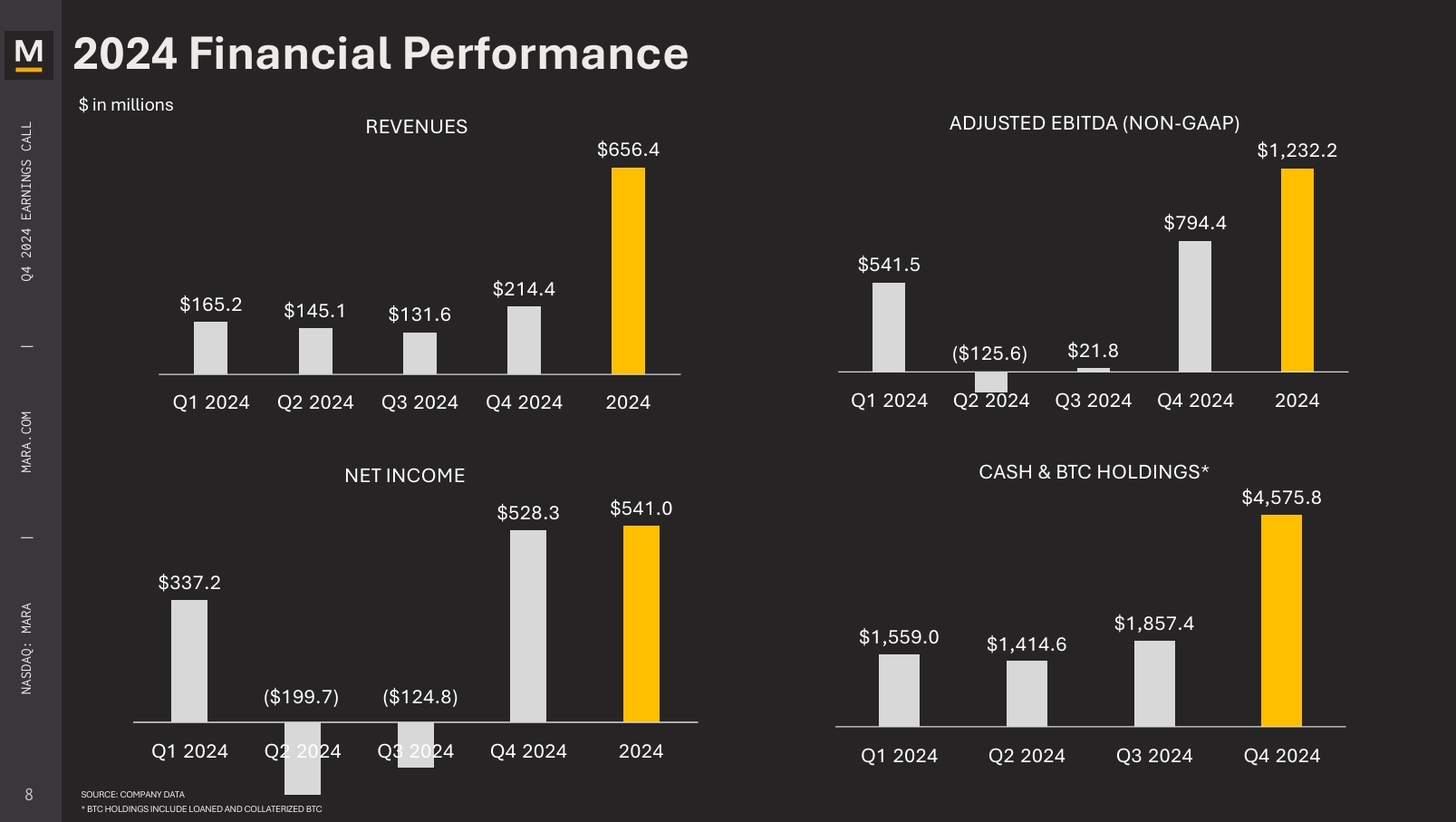
MARA Holdings reported record financial results for Q4 and full-year 2024, with revenue up 69% annually to $656.4 million.
Wall Street Bitcoin miner transforms into vertical energy and infrastructure company amid AI market shift.
MARA
Holdings, the publicly listed Bitcoin (BTC) miner from Wall Street (NASDAQ:
MARA), announced record financial results for the fourth quarter and full year
2024. Revenue, net income, and adjusted EBITDA significantly increased despite
April's bitcoin halving event.
MARA Reports Record Q4 and
Full-Year Results,
The
cryptocurrency mining giant reported a 37% increase in Q4 revenue to $214.4
million and full-year revenue growth of 69% to $656.4 million. Net income
surged 248% to $528.3 million for the quarter, while adjusted EBITDA reached an
industry benchmark of $794.4 million, up 207% from the previous year.
“2024
was a transformative year for MARA. We accelerated our transition to a
vertically integrated energy and digital infrastructure company,” the
company wrote in the shareholder letter. “We now have greater control over
our energy, infrastructure, technology, and ultimately, our future.”
Source: MARA
The Bitcoin
miner significantly expanded its energy capacity, securing approximately 1.2
gigawatts at prices 28% lower than industry peers paid for similar
acquisitions. This move increased MARA's owned data center portfolio from 0% to
approximately 70% since the beginning of 2024.
MARA stock
has been closely watched by investors as the company deploys its first owned
power generating assets, now operating 136 MW of capacity. The company launched
a 25-megawatt micro data center initiative at wellheads in Texas and North
Dakota and acquired a wind farm in Texas with 240 MW of interconnection
capacity.
“Our
HODL strategy and the opportunistic BTC purchases have benefited our
shareholders as they continue to see sustained yield when it comes to our BTC
holdings from a per share perspective,” MARA continued in the report.
The MARA
forecast for 2025 focuses on three key themes: Generate, Activate, and
Differentiate. The company aims to own and operate not just data center assets
but energy generation assets as well, potentially impacting MARA stock price
prediction 2025.
“By
owning energy assets, we optimize how power is consumed, stored, and
distributed. This allows us to activate new services for data centers, AI
operators, and energy markets,” the company further explained.
MARA Forecast: The Second
Wave of AI
Looking
ahead, MARA is positioning itself for the second wave of AI, focusing on
inference at the edge rather than training. The company believes this shift
presents significant opportunities for its infrastructure and energy management
capabilities.
The
company's return on capital employed during the last 12-month period remains
top tier amongst competitors at 30.6%, highlighting MARA's capital efficiency
in a capital-intensive industry.
MARA Stock News: It Hasn’t
Been This Bad Since November 2023
Although
the market has yet to show a clear reaction to MARA’s latest financial results,
the stock is currently trading near $12, its lowest level since November 2023.
This aligns with Bitcoin’s recent drop—testing multi-month lows—which is
pulling cryptocurrency mining stocks down significantly.
MARA’s
shares have plummeted by 60%, highlighting that, for most investors, publicly
traded miners remain primarily a proxy for Bitcoin exposure on Wall Street. As
a result, their share prices are closely tied to the performance of BTC.
Source: Tradingview.com
MARA Stock Price
Prediction 2025
Analysts
from major financial institutions have provided 12-month price targets for MARA
stock, with forecasts extending into late 2025. The consensus average price
target as of early 2025 stands at approximately $26–27, derived from
evaluations by 13 analysts.
The
range spans a low of $20 to a high of $43, indicating varied expectations
depending on market conditions and company execution.
B. Riley Securities: Analyst
Lucas Pipes raised the price target from $21.00 to $23.00, maintaining a
“Neutral” rating, suggesting a 71.90% upside from the
then-current price of
Piper Sandler: Set a $28.00 target with an
“Overweight” rating.
JP Morgan: Issued a $29.00 target with a
“Neutral” rating, balancing MARA’s robust 2024 performance
against volatility risks in the crypto market.
Cantor Fitzgerald: Analyst Brett Knoblauch
lifted the target to $42.00 from $33.00, retaining an
“Overweight” rating, one of the most bullish outlooks, driven by
MARA’s vertical integration and potential AI infrastructure expansion.
Macquarie: Raised its target to $29.00
from $22.00, signaling confidence in MARA’s energy cost management and
bitcoin accumulation strategy.
Another Wall Street
Bitcoin Miner Also Reported 2024 Results
Alongside
MARA Holdings’ Q4 and full-year 2024 results, Core Scientific (NASDAQ: CORZ), another
major player in the Bitcoin mining and digital infrastructure space, also
released its financial performance for the same period, reporting a net loss of
$265.5 million for Q4, largely due to a $224.7 million non-cash adjustment tied
to warrants and contingent liabilities, compared to a $195.7 million loss in Q4
2023.
The
Austin-based company generated $94.9 million in revenue, driven by $79.9
million from self-mining 974 bitcoins at an average cash cost of $51,035 per
BTC, alongside contributions from hosted mining and high-performance computing
(HPC).
Adding to
its momentum, Core Scientific announced a $1.2 billion expansion of its Denton,
Texas data center with CoreWeave, boosting its AI and cloud computing capacity
and projecting $10.2 billion in revenue over a 12-year contract term, further
solidifying its growth trajectory in both crypto and HPC markets.
MARA Stock News, FAQ
What Is MARA’s 12-Month
Price Target?
The
12-month price target for MARA stock, as of early 2025, averages between $25.67
and $27.45, according to analyst consensus from platforms like MarketBeat and
TipRanks. This range is based on evaluations from 8 to 13 analysts, with
targets spanning a low of $20.00 (HC Wainwright) to a high of $43.00 (Cantor
Fitzgerald).
Is MARA a Buy, Sell, or
Hold?
Analyst
sentiment on MARA leans toward “Buy” or “Hold” as of February 2025. MarketBeat
reports a “Buy” consensus from 11 analysts, with no “Sell” ratings, driven by
MARA’s record $656.4 million revenue and $541 million net income in 2024. The
“Buy” case hinges on MARA’s bitcoin holdings and AI potential, though “Hold”
ratings caution against crypto volatility.
MARA
Holdings, the publicly listed Bitcoin (BTC) miner from Wall Street (NASDAQ:
MARA), announced record financial results for the fourth quarter and full year
2024. Revenue, net income, and adjusted EBITDA significantly increased despite
April's bitcoin halving event.
MARA Reports Record Q4 and
Full-Year Results,
The
cryptocurrency mining giant reported a 37% increase in Q4 revenue to $214.4
million and full-year revenue growth of 69% to $656.4 million. Net income
surged 248% to $528.3 million for the quarter, while adjusted EBITDA reached an
industry benchmark of $794.4 million, up 207% from the previous year.
“2024
was a transformative year for MARA. We accelerated our transition to a
vertically integrated energy and digital infrastructure company,” the
company wrote in the shareholder letter. “We now have greater control over
our energy, infrastructure, technology, and ultimately, our future.”
Source: MARA
The Bitcoin
miner significantly expanded its energy capacity, securing approximately 1.2
gigawatts at prices 28% lower than industry peers paid for similar
acquisitions. This move increased MARA's owned data center portfolio from 0% to
approximately 70% since the beginning of 2024.
MARA stock
has been closely watched by investors as the company deploys its first owned
power generating assets, now operating 136 MW of capacity. The company launched
a 25-megawatt micro data center initiative at wellheads in Texas and North
Dakota and acquired a wind farm in Texas with 240 MW of interconnection
capacity.
“Our
HODL strategy and the opportunistic BTC purchases have benefited our
shareholders as they continue to see sustained yield when it comes to our BTC
holdings from a per share perspective,” MARA continued in the report.
The MARA
forecast for 2025 focuses on three key themes: Generate, Activate, and
Differentiate. The company aims to own and operate not just data center assets
but energy generation assets as well, potentially impacting MARA stock price
prediction 2025.
“By
owning energy assets, we optimize how power is consumed, stored, and
distributed. This allows us to activate new services for data centers, AI
operators, and energy markets,” the company further explained.
MARA Forecast: The Second
Wave of AI
Looking
ahead, MARA is positioning itself for the second wave of AI, focusing on
inference at the edge rather than training. The company believes this shift
presents significant opportunities for its infrastructure and energy management
capabilities.
The
company's return on capital employed during the last 12-month period remains
top tier amongst competitors at 30.6%, highlighting MARA's capital efficiency
in a capital-intensive industry.
MARA Stock News: It Hasn’t
Been This Bad Since November 2023
Although
the market has yet to show a clear reaction to MARA’s latest financial results,
the stock is currently trading near $12, its lowest level since November 2023.
This aligns with Bitcoin’s recent drop—testing multi-month lows—which is
pulling cryptocurrency mining stocks down significantly.
MARA’s
shares have plummeted by 60%, highlighting that, for most investors, publicly
traded miners remain primarily a proxy for Bitcoin exposure on Wall Street. As
a result, their share prices are closely tied to the performance of BTC.
Source: Tradingview.com
MARA Stock Price
Prediction 2025
Analysts
from major financial institutions have provided 12-month price targets for MARA
stock, with forecasts extending into late 2025. The consensus average price
target as of early 2025 stands at approximately $26–27, derived from
evaluations by 13 analysts.
The
range spans a low of $20 to a high of $43, indicating varied expectations
depending on market conditions and company execution.
B. Riley Securities: Analyst
Lucas Pipes raised the price target from $21.00 to $23.00, maintaining a
“Neutral” rating, suggesting a 71.90% upside from the
then-current price of
Piper Sandler: Set a $28.00 target with an
“Overweight” rating.
JP Morgan: Issued a $29.00 target with a
“Neutral” rating, balancing MARA’s robust 2024 performance
against volatility risks in the crypto market.
Cantor Fitzgerald: Analyst Brett Knoblauch
lifted the target to $42.00 from $33.00, retaining an
“Overweight” rating, one of the most bullish outlooks, driven by
MARA’s vertical integration and potential AI infrastructure expansion.
Macquarie: Raised its target to $29.00
from $22.00, signaling confidence in MARA’s energy cost management and
bitcoin accumulation strategy.
Another Wall Street
Bitcoin Miner Also Reported 2024 Results
Alongside
MARA Holdings’ Q4 and full-year 2024 results, Core Scientific (NASDAQ: CORZ), another
major player in the Bitcoin mining and digital infrastructure space, also
released its financial performance for the same period, reporting a net loss of
$265.5 million for Q4, largely due to a $224.7 million non-cash adjustment tied
to warrants and contingent liabilities, compared to a $195.7 million loss in Q4
2023.
The
Austin-based company generated $94.9 million in revenue, driven by $79.9
million from self-mining 974 bitcoins at an average cash cost of $51,035 per
BTC, alongside contributions from hosted mining and high-performance computing
(HPC).
Adding to
its momentum, Core Scientific announced a $1.2 billion expansion of its Denton,
Texas data center with CoreWeave, boosting its AI and cloud computing capacity
and projecting $10.2 billion in revenue over a 12-year contract term, further
solidifying its growth trajectory in both crypto and HPC markets.
MARA Stock News, FAQ
What Is MARA’s 12-Month
Price Target?
The
12-month price target for MARA stock, as of early 2025, averages between $25.67
and $27.45, according to analyst consensus from platforms like MarketBeat and
TipRanks. This range is based on evaluations from 8 to 13 analysts, with
targets spanning a low of $20.00 (HC Wainwright) to a high of $43.00 (Cantor
Fitzgerald).
Is MARA a Buy, Sell, or
Hold?
Analyst
sentiment on MARA leans toward “Buy” or “Hold” as of February 2025. MarketBeat
reports a “Buy” consensus from 11 analysts, with no “Sell” ratings, driven by
MARA’s record $656.4 million revenue and $541 million net income in 2024. The
“Buy” case hinges on MARA’s bitcoin holdings and AI potential, though “Hold”
ratings caution against crypto volatility.
Damian Chmiel is a Senior Analyst & Editor at Finance Magnates with more than 15 years of experience in the CFD and online trading industry. Active as both a trader and journalist since 2010, he focuses on broker coverage, fintech innovation, and regulatory developments across Europe, the Middle East, and Asia.
His work includes interviews with C-level leaders at major brokerages and fintech platforms, as well as co-authoring Finance Magnates’ quarterly industry benchmarking reports. Damian’s reporting is data-driven, market-aware, and grounded in direct industry engagement. His analysis and commentary have also been cited by external media outlets, including Investing.com, Binance, The Asset, Stockhead, and Dispatch.
Education:
MA in Finance and Accounting, Cracow University of Economics
Kraken Steps Up Speed Race with New Equinix Colocation Service for Crypto Traders
Featured Videos
FP Markets Winner Spotlight 🏆 | Global Broker of the Year 2025 #Trading #Broker #Innovation #Shorts
FP Markets Winner Spotlight 🏆 | Global Broker of the Year 2025 #Trading #Broker #Innovation #Shorts
FP Markets Winner Spotlight 🏆 | Global Broker of the Year 2025 #Trading #Broker #Innovation #Shorts
FP Markets Winner Spotlight 🏆 | Global Broker of the Year 2025 #Trading #Broker #Innovation #Shorts
FP Markets takes the spotlight as Global Broker of the Year 2025 at the Finance Magnates Awards.
Martin Stoilov, Head of Client Experience, shares that trust, innovation, and people played a key role in the company’s success, supported by a strong foundation of integrity and client-centricity.
Following this milestone, FP Markets continues to focus on growth, technology investment, and its core values of transparency and excellence.
👉 Be part of FM Awards 2026: https://awards.financemagnates.com/#nominate
FP Markets takes the spotlight as Global Broker of the Year 2025 at the Finance Magnates Awards.
Martin Stoilov, Head of Client Experience, shares that trust, innovation, and people played a key role in the company’s success, supported by a strong foundation of integrity and client-centricity.
Following this milestone, FP Markets continues to focus on growth, technology investment, and its core values of transparency and excellence.
👉 Be part of FM Awards 2026: https://awards.financemagnates.com/#nominate
FP Markets takes the spotlight as Global Broker of the Year 2025 at the Finance Magnates Awards.
Martin Stoilov, Head of Client Experience, shares that trust, innovation, and people played a key role in the company’s success, supported by a strong foundation of integrity and client-centricity.
Following this milestone, FP Markets continues to focus on growth, technology investment, and its core values of transparency and excellence.
👉 Be part of FM Awards 2026: https://awards.financemagnates.com/#nominate
FP Markets takes the spotlight as Global Broker of the Year 2025 at the Finance Magnates Awards.
Martin Stoilov, Head of Client Experience, shares that trust, innovation, and people played a key role in the company’s success, supported by a strong foundation of integrity and client-centricity.
Following this milestone, FP Markets continues to focus on growth, technology investment, and its core values of transparency and excellence.
👉 Be part of FM Awards 2026: https://awards.financemagnates.com/#nominate
In this video, we review @HolaPrimeMarketsOfficial, a multi-asset forex and CFDs broker offering different account types, trading platforms, and flexible trading conditions.
We cover the broker’s overall offering, including account options, trading environment, platforms like MT4 and MT5, and additional services such as managed accounts and fast withdrawals.
Watch the full video to see if Hola Prime Markets fits your trading needs.
📣 Stay up to date with the latest in finance and trading. Follow Finance Magnates for industry news, insights, and global event coverage.
Connect with us:
🔗 LinkedIn: /financemagnates
👍 Facebook: /financemagnates
📸 Instagram: https://www.instagram.com/financemagnates
🐦 X: https://x.com/financemagnates
🎥 TikTok: https://www.tiktok.com/tag/financemagnates
▶️ YouTube: /@financemagnates_official
#HolaPrime #ForexBroker #CFDTrading #FinanceMagnates #Trading #Forex #BrokerReview
In this video, we review @HolaPrimeMarketsOfficial, a multi-asset forex and CFDs broker offering different account types, trading platforms, and flexible trading conditions.
We cover the broker’s overall offering, including account options, trading environment, platforms like MT4 and MT5, and additional services such as managed accounts and fast withdrawals.
Watch the full video to see if Hola Prime Markets fits your trading needs.
📣 Stay up to date with the latest in finance and trading. Follow Finance Magnates for industry news, insights, and global event coverage.
Connect with us:
🔗 LinkedIn: /financemagnates
👍 Facebook: /financemagnates
📸 Instagram: https://www.instagram.com/financemagnates
🐦 X: https://x.com/financemagnates
🎥 TikTok: https://www.tiktok.com/tag/financemagnates
▶️ YouTube: /@financemagnates_official
#HolaPrime #ForexBroker #CFDTrading #FinanceMagnates #Trading #Forex #BrokerReview
In this video, we review @HolaPrimeMarketsOfficial, a multi-asset forex and CFDs broker offering different account types, trading platforms, and flexible trading conditions.
We cover the broker’s overall offering, including account options, trading environment, platforms like MT4 and MT5, and additional services such as managed accounts and fast withdrawals.
Watch the full video to see if Hola Prime Markets fits your trading needs.
📣 Stay up to date with the latest in finance and trading. Follow Finance Magnates for industry news, insights, and global event coverage.
Connect with us:
🔗 LinkedIn: /financemagnates
👍 Facebook: /financemagnates
📸 Instagram: https://www.instagram.com/financemagnates
🐦 X: https://x.com/financemagnates
🎥 TikTok: https://www.tiktok.com/tag/financemagnates
▶️ YouTube: /@financemagnates_official
#HolaPrime #ForexBroker #CFDTrading #FinanceMagnates #Trading #Forex #BrokerReview
In this video, we review @HolaPrimeMarketsOfficial, a multi-asset forex and CFDs broker offering different account types, trading platforms, and flexible trading conditions.
We cover the broker’s overall offering, including account options, trading environment, platforms like MT4 and MT5, and additional services such as managed accounts and fast withdrawals.
Watch the full video to see if Hola Prime Markets fits your trading needs.
📣 Stay up to date with the latest in finance and trading. Follow Finance Magnates for industry news, insights, and global event coverage.
Connect with us:
🔗 LinkedIn: /financemagnates
👍 Facebook: /financemagnates
📸 Instagram: https://www.instagram.com/financemagnates
🐦 X: https://x.com/financemagnates
🎥 TikTok: https://www.tiktok.com/tag/financemagnates
▶️ YouTube: /@financemagnates_official
#HolaPrime #ForexBroker #CFDTrading #FinanceMagnates #Trading #Forex #BrokerReview
In this video, we review @HolaPrimeMarketsOfficial, a multi-asset forex and CFDs broker offering different account types, trading platforms, and flexible trading conditions.
We cover the broker’s overall offering, including account options, trading environment, platforms like MT4 and MT5, and additional services such as managed accounts and fast withdrawals.
Watch the full video to see if Hola Prime Markets fits your trading needs.
📣 Stay up to date with the latest in finance and trading. Follow Finance Magnates for industry news, insights, and global event coverage.
Connect with us:
🔗 LinkedIn: /financemagnates
👍 Facebook: /financemagnates
📸 Instagram: https://www.instagram.com/financemagnates
🐦 X: https://x.com/financemagnates
🎥 TikTok: https://www.tiktok.com/tag/financemagnates
▶️ YouTube: /@financemagnates_official
#HolaPrime #ForexBroker #CFDTrading #FinanceMagnates #Trading #Forex #BrokerReview
In this video, we review @HolaPrimeMarketsOfficial, a multi-asset forex and CFDs broker offering different account types, trading platforms, and flexible trading conditions.
We cover the broker’s overall offering, including account options, trading environment, platforms like MT4 and MT5, and additional services such as managed accounts and fast withdrawals.
Watch the full video to see if Hola Prime Markets fits your trading needs.
📣 Stay up to date with the latest in finance and trading. Follow Finance Magnates for industry news, insights, and global event coverage.
Connect with us:
🔗 LinkedIn: /financemagnates
👍 Facebook: /financemagnates
📸 Instagram: https://www.instagram.com/financemagnates
🐦 X: https://x.com/financemagnates
🎥 TikTok: https://www.tiktok.com/tag/financemagnates
▶️ YouTube: /@financemagnates_official
#HolaPrime #ForexBroker #CFDTrading #FinanceMagnates #Trading #Forex #BrokerReview
Hola Prime Review: What You Need to Know | Full Breakdown by Finance Magnates
Hola Prime Review: What You Need to Know | Full Breakdown by Finance Magnates
Hola Prime Review: What You Need to Know | Full Breakdown by Finance Magnates
Hola Prime Review: What You Need to Know | Full Breakdown by Finance Magnates
Hola Prime Review: What You Need to Know | Full Breakdown by Finance Magnates
Hola Prime Review: What You Need to Know | Full Breakdown by Finance Magnates
In this video, we review @HolaPrime_Global, a proprietary trading firm offering evaluation programs and performance-based payouts in simulated market environments.
We cover how the challenge model works, including account types, profit splits (up to 95%), trading rules, and what it takes to reach a funded account. You’ll also learn about available platforms like MT4, MT5, cTrader, and more, along with insights into payouts, support, and trading conditions.
Watch the full video to see if Hola Prime fits your trading style.
📣 Stay up to date with the latest in finance and trading. Follow Finance Magnates for industry news, insights, and global event coverage.
Connect with us:
🔗 LinkedIn: /financemagnates
👍 Facebook: /financemagnates
📸 Instagram: https://www.instagram.com/financemagnates
🐦 X: https://x.com/financemagnates
🎥 TikTok: https://www.tiktok.com/tag/financemagnates
▶️ YouTube: /@financemagnates_official
#HolaPrime #PropFirm #Trading #FinanceMagnates #Forex #FuturesTrading #TradingReview #PropFirmReview
In this video, we review @HolaPrime_Global, a proprietary trading firm offering evaluation programs and performance-based payouts in simulated market environments.
We cover how the challenge model works, including account types, profit splits (up to 95%), trading rules, and what it takes to reach a funded account. You’ll also learn about available platforms like MT4, MT5, cTrader, and more, along with insights into payouts, support, and trading conditions.
Watch the full video to see if Hola Prime fits your trading style.
📣 Stay up to date with the latest in finance and trading. Follow Finance Magnates for industry news, insights, and global event coverage.
Connect with us:
🔗 LinkedIn: /financemagnates
👍 Facebook: /financemagnates
📸 Instagram: https://www.instagram.com/financemagnates
🐦 X: https://x.com/financemagnates
🎥 TikTok: https://www.tiktok.com/tag/financemagnates
▶️ YouTube: /@financemagnates_official
#HolaPrime #PropFirm #Trading #FinanceMagnates #Forex #FuturesTrading #TradingReview #PropFirmReview
In this video, we review @HolaPrime_Global, a proprietary trading firm offering evaluation programs and performance-based payouts in simulated market environments.
We cover how the challenge model works, including account types, profit splits (up to 95%), trading rules, and what it takes to reach a funded account. You’ll also learn about available platforms like MT4, MT5, cTrader, and more, along with insights into payouts, support, and trading conditions.
Watch the full video to see if Hola Prime fits your trading style.
📣 Stay up to date with the latest in finance and trading. Follow Finance Magnates for industry news, insights, and global event coverage.
Connect with us:
🔗 LinkedIn: /financemagnates
👍 Facebook: /financemagnates
📸 Instagram: https://www.instagram.com/financemagnates
🐦 X: https://x.com/financemagnates
🎥 TikTok: https://www.tiktok.com/tag/financemagnates
▶️ YouTube: /@financemagnates_official
#HolaPrime #PropFirm #Trading #FinanceMagnates #Forex #FuturesTrading #TradingReview #PropFirmReview
In this video, we review @HolaPrime_Global, a proprietary trading firm offering evaluation programs and performance-based payouts in simulated market environments.
We cover how the challenge model works, including account types, profit splits (up to 95%), trading rules, and what it takes to reach a funded account. You’ll also learn about available platforms like MT4, MT5, cTrader, and more, along with insights into payouts, support, and trading conditions.
Watch the full video to see if Hola Prime fits your trading style.
📣 Stay up to date with the latest in finance and trading. Follow Finance Magnates for industry news, insights, and global event coverage.
Connect with us:
🔗 LinkedIn: /financemagnates
👍 Facebook: /financemagnates
📸 Instagram: https://www.instagram.com/financemagnates
🐦 X: https://x.com/financemagnates
🎥 TikTok: https://www.tiktok.com/tag/financemagnates
▶️ YouTube: /@financemagnates_official
#HolaPrime #PropFirm #Trading #FinanceMagnates #Forex #FuturesTrading #TradingReview #PropFirmReview
In this video, we review @HolaPrime_Global, a proprietary trading firm offering evaluation programs and performance-based payouts in simulated market environments.
We cover how the challenge model works, including account types, profit splits (up to 95%), trading rules, and what it takes to reach a funded account. You’ll also learn about available platforms like MT4, MT5, cTrader, and more, along with insights into payouts, support, and trading conditions.
Watch the full video to see if Hola Prime fits your trading style.
📣 Stay up to date with the latest in finance and trading. Follow Finance Magnates for industry news, insights, and global event coverage.
Connect with us:
🔗 LinkedIn: /financemagnates
👍 Facebook: /financemagnates
📸 Instagram: https://www.instagram.com/financemagnates
🐦 X: https://x.com/financemagnates
🎥 TikTok: https://www.tiktok.com/tag/financemagnates
▶️ YouTube: /@financemagnates_official
#HolaPrime #PropFirm #Trading #FinanceMagnates #Forex #FuturesTrading #TradingReview #PropFirmReview
In this video, we review @HolaPrime_Global, a proprietary trading firm offering evaluation programs and performance-based payouts in simulated market environments.
We cover how the challenge model works, including account types, profit splits (up to 95%), trading rules, and what it takes to reach a funded account. You’ll also learn about available platforms like MT4, MT5, cTrader, and more, along with insights into payouts, support, and trading conditions.
Watch the full video to see if Hola Prime fits your trading style.
📣 Stay up to date with the latest in finance and trading. Follow Finance Magnates for industry news, insights, and global event coverage.
Connect with us:
🔗 LinkedIn: /financemagnates
👍 Facebook: /financemagnates
📸 Instagram: https://www.instagram.com/financemagnates
🐦 X: https://x.com/financemagnates
🎥 TikTok: https://www.tiktok.com/tag/financemagnates
▶️ YouTube: /@financemagnates_official
#HolaPrime #PropFirm #Trading #FinanceMagnates #Forex #FuturesTrading #TradingReview #PropFirmReview
Axi Winner Spotlight 🏆 | Global Most Innovative Broker 2025 #Innovation #Trading #Fintech #Broker
Axi Winner Spotlight 🏆 | Global Most Innovative Broker 2025 #Innovation #Trading #Fintech #Broker
Axi Winner Spotlight 🏆 | Global Most Innovative Broker 2025 #Innovation #Trading #Fintech #Broker
Axi Winner Spotlight 🏆 | Global Most Innovative Broker 2025 #Innovation #Trading #Fintech #Broker
Axi Winner Spotlight 🏆 | Global Most Innovative Broker 2025 #Innovation #Trading #Fintech #Broker
Axi Winner Spotlight 🏆 | Global Most Innovative Broker 2025 #Innovation #Trading #Fintech #Broker
Axi takes the spotlight at the Finance Magnates Awards, winning Global Most Innovative Broker 2025.
Olivia Xenofontos and Ivanna Openko share how the team will feel: proud, motivated, and ready to keep delivering.
They also describe the night as well-organized, focused, and enjoyable for all.
👉 Be part of FM Awards 2026.
Axi takes the spotlight at the Finance Magnates Awards, winning Global Most Innovative Broker 2025.
Olivia Xenofontos and Ivanna Openko share how the team will feel: proud, motivated, and ready to keep delivering.
They also describe the night as well-organized, focused, and enjoyable for all.
👉 Be part of FM Awards 2026.
Axi takes the spotlight at the Finance Magnates Awards, winning Global Most Innovative Broker 2025.
Olivia Xenofontos and Ivanna Openko share how the team will feel: proud, motivated, and ready to keep delivering.
They also describe the night as well-organized, focused, and enjoyable for all.
👉 Be part of FM Awards 2026.
Axi takes the spotlight at the Finance Magnates Awards, winning Global Most Innovative Broker 2025.
Olivia Xenofontos and Ivanna Openko share how the team will feel: proud, motivated, and ready to keep delivering.
They also describe the night as well-organized, focused, and enjoyable for all.
👉 Be part of FM Awards 2026.
Axi takes the spotlight at the Finance Magnates Awards, winning Global Most Innovative Broker 2025.
Olivia Xenofontos and Ivanna Openko share how the team will feel: proud, motivated, and ready to keep delivering.
They also describe the night as well-organized, focused, and enjoyable for all.
👉 Be part of FM Awards 2026.
Axi takes the spotlight at the Finance Magnates Awards, winning Global Most Innovative Broker 2025.
Olivia Xenofontos and Ivanna Openko share how the team will feel: proud, motivated, and ready to keep delivering.
They also describe the night as well-organized, focused, and enjoyable for all.
👉 Be part of FM Awards 2026.
Recognition that matters.
Built on transparency.
Driven by the industry.
The Finance Magnates Awards 2026.
Nominations are now open.
🔗 https://awards.financemagnates.com/?utm_source=SM&utm_medium=social&utm_campaign=recognition-matters
Recognition that matters.
Built on transparency.
Driven by the industry.
The Finance Magnates Awards 2026.
Nominations are now open.
🔗 https://awards.financemagnates.com/?utm_source=SM&utm_medium=social&utm_campaign=recognition-matters
Recognition that matters.
Built on transparency.
Driven by the industry.
The Finance Magnates Awards 2026.
Nominations are now open.
🔗 https://awards.financemagnates.com/?utm_source=SM&utm_medium=social&utm_campaign=recognition-matters
Recognition that matters.
Built on transparency.
Driven by the industry.
The Finance Magnates Awards 2026.
Nominations are now open.
🔗 https://awards.financemagnates.com/?utm_source=SM&utm_medium=social&utm_campaign=recognition-matters
Recognition that matters.
Built on transparency.
Driven by the industry.
The Finance Magnates Awards 2026.
Nominations are now open.
🔗 https://awards.financemagnates.com/?utm_source=SM&utm_medium=social&utm_campaign=recognition-matters
Recognition that matters.
Built on transparency.
Driven by the industry.
The Finance Magnates Awards 2026.
Nominations are now open.
🔗 https://awards.financemagnates.com/?utm_source=SM&utm_medium=social&utm_campaign=recognition-matters