The Launch Festival is a yearly technology conference organized by noted entrepreneur and angel investor Jason Calacanis. The main draw of the conference, and why it draws over 10,000 attendees, is the focus on company founders and entrepreneurs. This is partially done through the distribution of low-cost and free tickets to founders, while charging premiums to large corporate sponsors. The tradeoff is that the sponsors are able to get in front of a targeted audience for their products, sponsors such as Salesforce, Microsoft and Google.
With its focus on entrepreneurs, as per its name, the three-day Launch Festival is highlighted by company launches, who show themselves publicly for the first time on the conference’s stage. Also included is a pre-festival hackathon as well as 2.0 launches which are established startups revealing new products for the first time. But the real meat is the 1.0 competition of firms showing themselves publicly for the first time. Previous winners include Connect, Boxbee and SpaceMonkey.
Taking home the best-launched startup for 2015 was Abra, a mobile-based remittance app. The product is a peer-to-peer (P2P) dollar-denominated payment transfer app focused on the remittance sector. Abra is based on creating a network of human ATM tellers. For a fee, these tellers provide deposits and withdrawals to other users. Abra is similar to mPesa in that users fill up credits and make withdrawals at licensed vendors. The main difference is that Abra is decentralized and anyone can become a teller.
In its presentation, Abra founder Bill Barhydt used an example of a Mexican worker (Bill) in the US who uses the mobile app to send funds to his family in Mexico (Miguel). Bill opens the app and finds the nearest human ATM teller and massages them. Bill then gives the teller $200 and, scanning QR codes of each other, the funds are uploaded to Bill’s mobile app. Bill then sends the $200 to Miguel, who finds a local human ATM in Mexico who he meets in person to transfer the funds and make a withdrawal in dollars or a peso equivalent.
As there are plenty of bitcoin wallets out there, the innovation Abra is bringing to the table is the ability to "fork" the traditional bitcoin wallet and offer it as a dollar-denominated solution. One of the advantages of the system being denominated in dollars is that it removes currency fluctuation involved with bitcoins or other fiat. Also, focusing on the remittance market, Abra’s core users are in locations where exchanging hard cash dollars to local currency is expected to be available. In this regard, as Abra has presented a product that uses bitcoins, but is forked in an offering that is adapted to the greater markets, as well as keeping fees substantially lower than comparable remittance transfer systems. Abra has been able to gain the distinction from the Launch Festival as a "killer app" of bitcoins.
Similar to Mycellium wallet’s Local Trader
Abra’s success lies in its ability to draw human tellers to the product to establish a scalable network for transfers. In this regard it contrasts centralized systems where a firm like mPesa or WesternUnion can bankroll the opening of transfer locations in various markets to increase its presence and scale its user base. Similarly, machine-based bitcoin ATM operators are able to offer incentives to have their machines placed in many locations, with the expectation that they will recoup costs from fees collected on bitcoin exchanges. As a P2P network, Abra is limited to the size of its user base and geographic locations. Abra is banking on the fact that like Uber and Airbnb have been able to draw non-taxi drivers and hotel operators to provide their time for some extra cash. So to will people become tellers to make a side-business.
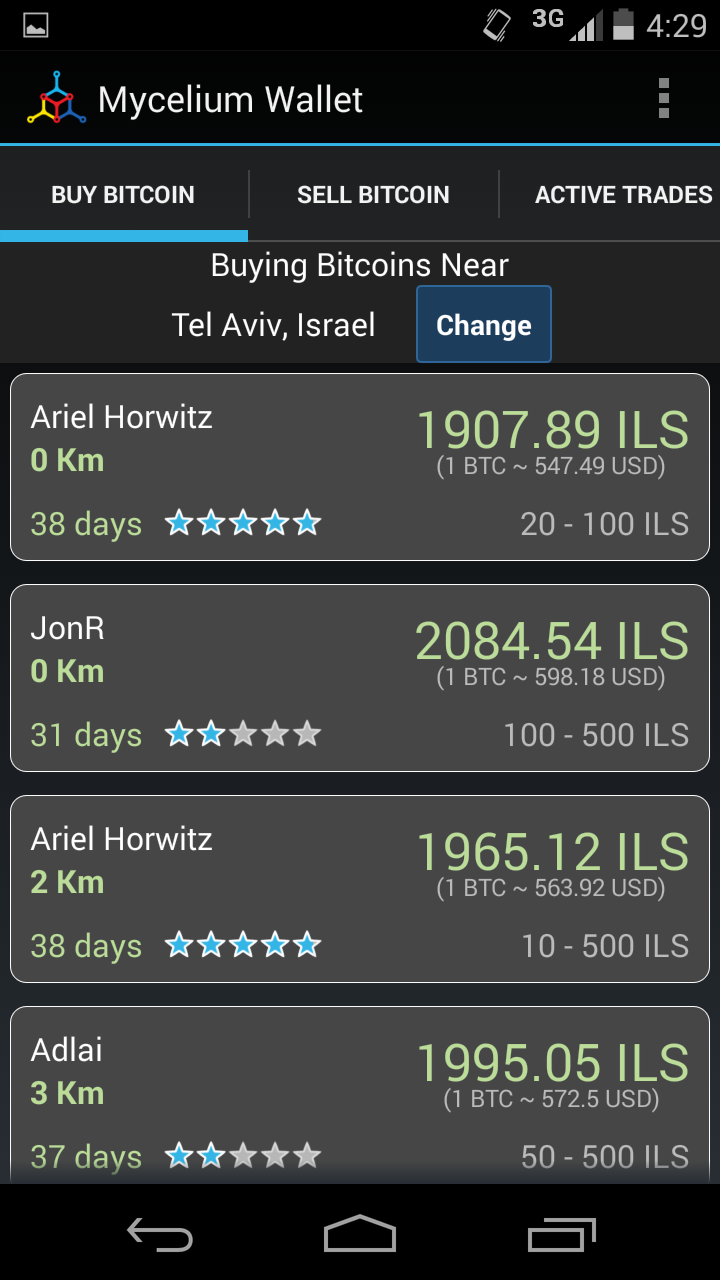
As a reference product, Abra very much resembles Mycellium’s mobile wallet app. Like other bitcoin wallets, Mycellium’s version allows users to store, secure, send and receive bitcoins. The "killer app" of Mycellium is its "Local Trader" feature.
Similar to the LocalBitcoin’s website, Mycellieum provides the ability for users to become dealers to buy and sell bitcoins. App users are then able to enter their location to find local dealers to buy bitcoins. In theory, a user can buy $500 in bitcoins from a local dealer in New York, and then sell them for euros when they arrive in Paris for a vacation.
Unlike Abra, Mycellium users are exposed to foreign exchange risk involved with price fluctuations of bitcoins, as the wallet is denominated in bitcoins. However, the advantage is that Local Trader is based on dealers who quote bitcoins in local currencies.
Mycellium + Abra = Killer App
Where Mycellium really has the edge is with its massive entrenched set of users. This network makes it easy to find dealers to buy and sell bitcoins to around the globe. But it can be argued that being denominated in bitcoins, Mycellium lacks the scalability that a product like Abra can have since it won’t appeal to mainstream users.
The Launch Festival is a yearly technology conference organized by noted entrepreneur and angel investor Jason Calacanis. The main draw of the conference, and why it draws over 10,000 attendees, is the focus on company founders and entrepreneurs. This is partially done through the distribution of low-cost and free tickets to founders, while charging premiums to large corporate sponsors. The tradeoff is that the sponsors are able to get in front of a targeted audience for their products, sponsors such as Salesforce, Microsoft and Google.
With its focus on entrepreneurs, as per its name, the three-day Launch Festival is highlighted by company launches, who show themselves publicly for the first time on the conference’s stage. Also included is a pre-festival hackathon as well as 2.0 launches which are established startups revealing new products for the first time. But the real meat is the 1.0 competition of firms showing themselves publicly for the first time. Previous winners include Connect, Boxbee and SpaceMonkey.
Taking home the best-launched startup for 2015 was Abra, a mobile-based remittance app. The product is a peer-to-peer (P2P) dollar-denominated payment transfer app focused on the remittance sector. Abra is based on creating a network of human ATM tellers. For a fee, these tellers provide deposits and withdrawals to other users. Abra is similar to mPesa in that users fill up credits and make withdrawals at licensed vendors. The main difference is that Abra is decentralized and anyone can become a teller.
In its presentation, Abra founder Bill Barhydt used an example of a Mexican worker (Bill) in the US who uses the mobile app to send funds to his family in Mexico (Miguel). Bill opens the app and finds the nearest human ATM teller and massages them. Bill then gives the teller $200 and, scanning QR codes of each other, the funds are uploaded to Bill’s mobile app. Bill then sends the $200 to Miguel, who finds a local human ATM in Mexico who he meets in person to transfer the funds and make a withdrawal in dollars or a peso equivalent.
As there are plenty of bitcoin wallets out there, the innovation Abra is bringing to the table is the ability to "fork" the traditional bitcoin wallet and offer it as a dollar-denominated solution. One of the advantages of the system being denominated in dollars is that it removes currency fluctuation involved with bitcoins or other fiat. Also, focusing on the remittance market, Abra’s core users are in locations where exchanging hard cash dollars to local currency is expected to be available. In this regard, as Abra has presented a product that uses bitcoins, but is forked in an offering that is adapted to the greater markets, as well as keeping fees substantially lower than comparable remittance transfer systems. Abra has been able to gain the distinction from the Launch Festival as a "killer app" of bitcoins.
Similar to Mycellium wallet’s Local Trader
Abra’s success lies in its ability to draw human tellers to the product to establish a scalable network for transfers. In this regard it contrasts centralized systems where a firm like mPesa or WesternUnion can bankroll the opening of transfer locations in various markets to increase its presence and scale its user base. Similarly, machine-based bitcoin ATM operators are able to offer incentives to have their machines placed in many locations, with the expectation that they will recoup costs from fees collected on bitcoin exchanges. As a P2P network, Abra is limited to the size of its user base and geographic locations. Abra is banking on the fact that like Uber and Airbnb have been able to draw non-taxi drivers and hotel operators to provide their time for some extra cash. So to will people become tellers to make a side-business.
As a reference product, Abra very much resembles Mycellium’s mobile wallet app. Like other bitcoin wallets, Mycellium’s version allows users to store, secure, send and receive bitcoins. The "killer app" of Mycellium is its "Local Trader" feature.
Similar to the LocalBitcoin’s website, Mycellieum provides the ability for users to become dealers to buy and sell bitcoins. App users are then able to enter their location to find local dealers to buy bitcoins. In theory, a user can buy $500 in bitcoins from a local dealer in New York, and then sell them for euros when they arrive in Paris for a vacation.
Unlike Abra, Mycellium users are exposed to foreign exchange risk involved with price fluctuations of bitcoins, as the wallet is denominated in bitcoins. However, the advantage is that Local Trader is based on dealers who quote bitcoins in local currencies.
Mycellium + Abra = Killer App
Where Mycellium really has the edge is with its massive entrenched set of users. This network makes it easy to find dealers to buy and sell bitcoins to around the globe. But it can be argued that being denominated in bitcoins, Mycellium lacks the scalability that a product like Abra can have since it won’t appeal to mainstream users.
Schwab Aims Crypto Custody at Its $5 Trillion Advisor Channel by 2027
Featured Videos
FM Daily Brief – 9 June 2026
Today’s Tuesday, the 9th of June 2026, and these are our main stories: eToro’s customer assets climbed back above $20 billion, Prop trading model in prediction markets, and Leverate launched a new AI assistant for brokers and traders.
War Stories: Lessons from 20 Years in Markets (the pain, the pitfalls and the profits)
The trades that taught me the most aren't the ones that worked. They're the ones that didn't — or the ones I almost caught and didn't have the nerve to ride. In this session, I'll tell you about the Brexit miss, the SNB shocker that nearly handed me a 5400% return, the BoJ surprise that punched me in the gut, and a few wins along the way. Each story carries a lesson, but the lessons aren't the point. Everyone who trades long enough collects a portfolio of moments like these; what separates the people who stay in the game is what they do with them.
The Engine and the Fuel: How AI & Data Drives African Future
If AI is the engine, data is the fuel. Without quality, accessible data, AI cannot work well; and without the right mindset, data remains just numbers instead of insight. In this session, leading experts will explore how AI and data are democratizing opportunities for businesses and personal growth. Discover practical ways to make AI accessible today, anticipate its transformative impact on African markets, and learn actionable steps to prepare for what's next. Let's talk about:
-How AI and data drive business efficiency and innovation in trading and fintech
-AI tools to elevate trading or business strategies
-How to access and maximise the power of data and AI
-Emerging AI and data trends in Africa and their economic ripple effects
If AI is the engine, data is the fuel. Without quality, accessible data, AI cannot work well; and without the right mindset, data remains just numbers instead of insight. In this session, leading experts will explore how AI and data are democratizing opportunities for businesses and personal growth. Discover practical ways to make AI accessible today, anticipate its transformative impact on African markets, and learn actionable steps to prepare for what's next. Let's talk about:
-How AI and data drive business efficiency and innovation in trading and fintech
-AI tools to elevate trading or business strategies
-How to access and maximise the power of data and AI
-Emerging AI and data trends in Africa and their economic ripple effects
If AI is the engine, data is the fuel. Without quality, accessible data, AI cannot work well; and without the right mindset, data remains just numbers instead of insight. In this session, leading experts will explore how AI and data are democratizing opportunities for businesses and personal growth. Discover practical ways to make AI accessible today, anticipate its transformative impact on African markets, and learn actionable steps to prepare for what's next. Let's talk about:
-How AI and data drive business efficiency and innovation in trading and fintech
-AI tools to elevate trading or business strategies
-How to access and maximise the power of data and AI
-Emerging AI and data trends in Africa and their economic ripple effects
If AI is the engine, data is the fuel. Without quality, accessible data, AI cannot work well; and without the right mindset, data remains just numbers instead of insight. In this session, leading experts will explore how AI and data are democratizing opportunities for businesses and personal growth. Discover practical ways to make AI accessible today, anticipate its transformative impact on African markets, and learn actionable steps to prepare for what's next. Let's talk about:
-How AI and data drive business efficiency and innovation in trading and fintech
-AI tools to elevate trading or business strategies
-How to access and maximise the power of data and AI
-Emerging AI and data trends in Africa and their economic ripple effects
If AI is the engine, data is the fuel. Without quality, accessible data, AI cannot work well; and without the right mindset, data remains just numbers instead of insight. In this session, leading experts will explore how AI and data are democratizing opportunities for businesses and personal growth. Discover practical ways to make AI accessible today, anticipate its transformative impact on African markets, and learn actionable steps to prepare for what's next. Let's talk about:
-How AI and data drive business efficiency and innovation in trading and fintech
-AI tools to elevate trading or business strategies
-How to access and maximise the power of data and AI
-Emerging AI and data trends in Africa and their economic ripple effects
If AI is the engine, data is the fuel. Without quality, accessible data, AI cannot work well; and without the right mindset, data remains just numbers instead of insight. In this session, leading experts will explore how AI and data are democratizing opportunities for businesses and personal growth. Discover practical ways to make AI accessible today, anticipate its transformative impact on African markets, and learn actionable steps to prepare for what's next. Let's talk about:
-How AI and data drive business efficiency and innovation in trading and fintech
-AI tools to elevate trading or business strategies
-How to access and maximise the power of data and AI
-Emerging AI and data trends in Africa and their economic ripple effects
Inside My Best Trade with Jimmy Moyaha
Most market post-mortems describe what happened to prices. Few describe what happened in the trading room while the position was open: the entry conviction, the moments that tested it, and the exit decision that closed the book.
This session brings one seasoned trader to the stage for an unfiltered account of the position that still defines how they think about markets.
Attendees will walk away with:
-A first-hand account of how a conviction trade is built, from thesis and entry through position management and exit
-Understanding of what turns a market observation into a live position, and what holds it when conditions shift
-Insight into how timing, execution quality, and market structure shaped the final result
-Perspective on what the trade revealed about edge, risk tolerance, and when to hold through a position moving against you
-Clarity on what separates a well-built trade from a well-timed one
Most market post-mortems describe what happened to prices. Few describe what happened in the trading room while the position was open: the entry conviction, the moments that tested it, and the exit decision that closed the book.
This session brings one seasoned trader to the stage for an unfiltered account of the position that still defines how they think about markets.
Attendees will walk away with:
-A first-hand account of how a conviction trade is built, from thesis and entry through position management and exit
-Understanding of what turns a market observation into a live position, and what holds it when conditions shift
-Insight into how timing, execution quality, and market structure shaped the final result
-Perspective on what the trade revealed about edge, risk tolerance, and when to hold through a position moving against you
-Clarity on what separates a well-built trade from a well-timed one
Most market post-mortems describe what happened to prices. Few describe what happened in the trading room while the position was open: the entry conviction, the moments that tested it, and the exit decision that closed the book.
This session brings one seasoned trader to the stage for an unfiltered account of the position that still defines how they think about markets.
Attendees will walk away with:
-A first-hand account of how a conviction trade is built, from thesis and entry through position management and exit
-Understanding of what turns a market observation into a live position, and what holds it when conditions shift
-Insight into how timing, execution quality, and market structure shaped the final result
-Perspective on what the trade revealed about edge, risk tolerance, and when to hold through a position moving against you
-Clarity on what separates a well-built trade from a well-timed one
Most market post-mortems describe what happened to prices. Few describe what happened in the trading room while the position was open: the entry conviction, the moments that tested it, and the exit decision that closed the book.
This session brings one seasoned trader to the stage for an unfiltered account of the position that still defines how they think about markets.
Attendees will walk away with:
-A first-hand account of how a conviction trade is built, from thesis and entry through position management and exit
-Understanding of what turns a market observation into a live position, and what holds it when conditions shift
-Insight into how timing, execution quality, and market structure shaped the final result
-Perspective on what the trade revealed about edge, risk tolerance, and when to hold through a position moving against you
-Clarity on what separates a well-built trade from a well-timed one
Most market post-mortems describe what happened to prices. Few describe what happened in the trading room while the position was open: the entry conviction, the moments that tested it, and the exit decision that closed the book.
This session brings one seasoned trader to the stage for an unfiltered account of the position that still defines how they think about markets.
Attendees will walk away with:
-A first-hand account of how a conviction trade is built, from thesis and entry through position management and exit
-Understanding of what turns a market observation into a live position, and what holds it when conditions shift
-Insight into how timing, execution quality, and market structure shaped the final result
-Perspective on what the trade revealed about edge, risk tolerance, and when to hold through a position moving against you
-Clarity on what separates a well-built trade from a well-timed one
Most market post-mortems describe what happened to prices. Few describe what happened in the trading room while the position was open: the entry conviction, the moments that tested it, and the exit decision that closed the book.
This session brings one seasoned trader to the stage for an unfiltered account of the position that still defines how they think about markets.
Attendees will walk away with:
-A first-hand account of how a conviction trade is built, from thesis and entry through position management and exit
-Understanding of what turns a market observation into a live position, and what holds it when conditions shift
-Insight into how timing, execution quality, and market structure shaped the final result
-Perspective on what the trade revealed about edge, risk tolerance, and when to hold through a position moving against you
-Clarity on what separates a well-built trade from a well-timed one
Agentic Inequality: Democratizing Financial Access Through AI & Blockchain
As crypto and CFD trading continue to expand across Africa, access to advanced tools and market insights remains uneven. This session explores how AI and blockchain can bridge that gap by empowering informal traders and underserved communities to participate more effectively in digital financial markets. The discussion will focus on practical applications of technology to improve accessibility, education, and investment outcomes in both formal and informal sectors.
In this discussion, we will explore:
-The role of AI in democratizing access to trading tools, insights, and strategy development
-How crypto and blockchain can enable broader participation beyond traditional financial systems
-Addressing access barriers: infrastructure, education, and affordability in underserved communities
-Opportunities for brokers and platforms to tap into the informal trading economy
As crypto and CFD trading continue to expand across Africa, access to advanced tools and market insights remains uneven. This session explores how AI and blockchain can bridge that gap by empowering informal traders and underserved communities to participate more effectively in digital financial markets. The discussion will focus on practical applications of technology to improve accessibility, education, and investment outcomes in both formal and informal sectors.
In this discussion, we will explore:
-The role of AI in democratizing access to trading tools, insights, and strategy development
-How crypto and blockchain can enable broader participation beyond traditional financial systems
-Addressing access barriers: infrastructure, education, and affordability in underserved communities
-Opportunities for brokers and platforms to tap into the informal trading economy
As crypto and CFD trading continue to expand across Africa, access to advanced tools and market insights remains uneven. This session explores how AI and blockchain can bridge that gap by empowering informal traders and underserved communities to participate more effectively in digital financial markets. The discussion will focus on practical applications of technology to improve accessibility, education, and investment outcomes in both formal and informal sectors.
In this discussion, we will explore:
-The role of AI in democratizing access to trading tools, insights, and strategy development
-How crypto and blockchain can enable broader participation beyond traditional financial systems
-Addressing access barriers: infrastructure, education, and affordability in underserved communities
-Opportunities for brokers and platforms to tap into the informal trading economy
As crypto and CFD trading continue to expand across Africa, access to advanced tools and market insights remains uneven. This session explores how AI and blockchain can bridge that gap by empowering informal traders and underserved communities to participate more effectively in digital financial markets. The discussion will focus on practical applications of technology to improve accessibility, education, and investment outcomes in both formal and informal sectors.
In this discussion, we will explore:
-The role of AI in democratizing access to trading tools, insights, and strategy development
-How crypto and blockchain can enable broader participation beyond traditional financial systems
-Addressing access barriers: infrastructure, education, and affordability in underserved communities
-Opportunities for brokers and platforms to tap into the informal trading economy
As crypto and CFD trading continue to expand across Africa, access to advanced tools and market insights remains uneven. This session explores how AI and blockchain can bridge that gap by empowering informal traders and underserved communities to participate more effectively in digital financial markets. The discussion will focus on practical applications of technology to improve accessibility, education, and investment outcomes in both formal and informal sectors.
In this discussion, we will explore:
-The role of AI in democratizing access to trading tools, insights, and strategy development
-How crypto and blockchain can enable broader participation beyond traditional financial systems
-Addressing access barriers: infrastructure, education, and affordability in underserved communities
-Opportunities for brokers and platforms to tap into the informal trading economy
As crypto and CFD trading continue to expand across Africa, access to advanced tools and market insights remains uneven. This session explores how AI and blockchain can bridge that gap by empowering informal traders and underserved communities to participate more effectively in digital financial markets. The discussion will focus on practical applications of technology to improve accessibility, education, and investment outcomes in both formal and informal sectors.
In this discussion, we will explore:
-The role of AI in democratizing access to trading tools, insights, and strategy development
-How crypto and blockchain can enable broader participation beyond traditional financial systems
-Addressing access barriers: infrastructure, education, and affordability in underserved communities
-Opportunities for brokers and platforms to tap into the informal trading economy