With growth and adoption, the Bitcoin halving might become a less important price driver.
Alternatively, alongside supply and demand, market psychology may keep the halving influential.
Every four years, the Bitcoin halving occurs, meaning that the amount of new coins issued through mining rewards is cut in half. When Bitcoin first launched, mining rewards were 50 BTC. Currently, that figure is 6.25 BTC, and after the next halving, it will be reduced to 3.125 BTC.
The halving occurs every 210,000 blocks rather than on pre-specified dates, but this corresponds to a roughly four-year cycle, which means that the next reduction in issuance should reach us this April. Notably, a glance at BTC’s price action since inception reveals a repeating pattern of vertical gains, deep corrections, and drawn-out recoveries, and this sequence appears to correspond closely with the halvings, leading among bitcoin traders to an entrenched belief in halving-driven movements.
However, as Bitcoin has matured and grown in market capitalization, and with the introduction now of spot Bitcoin ETFs in the United States, some are questioning whether the halving event is still relevant, while you can also find a few voices asserting that the halving was in fact never as important as assumed, arguing instead that other, less obvious factors have fueled price movements up to now.
The Case Against Halving Importance
As described, the halvings cut miner rewards in half, but there is an argument that this had more impact when most of the final supply had not yet been issued. However, as of right now, around 93.5% of Bitcoin’s total supply is already in circulation. That means less than 1.4 million BTC, from the capped total supply of 21 million BTC, remains to be created, and so, as a result, new issuance is creating a smaller splash in a larger pool.
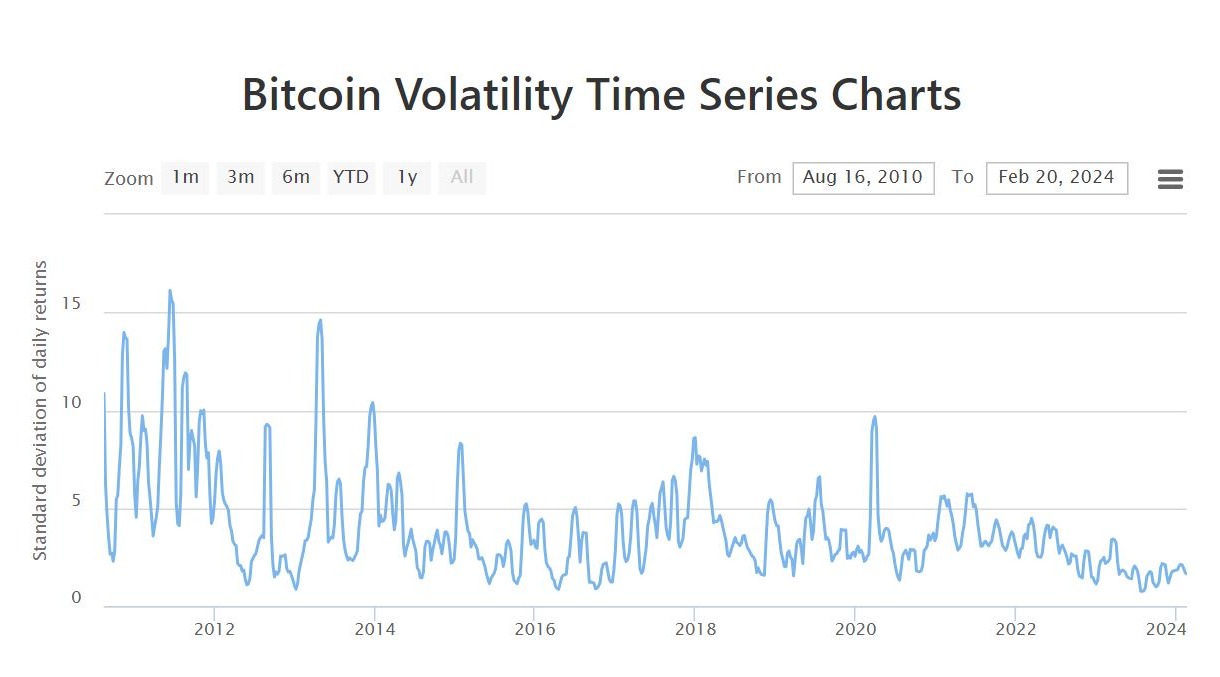
On top of this, the Bitcoin market cap is far larger now than in the early days of the asset’s existence, currently sitting just above $1 trillion, which is approaching the November 2021 all-time high of over $1.2 trillion. This still puts BTC a long way off gold (for which it is touted as a digital replacement), which has a market cap of around $13.6 trillion, but nonetheless, BTC is a weightier asset than it once was, which corresponds to reduced volatility.
Chart from Buy Bitcoin Worldwide
And then there is the fact that if BTC really is here for the long run, is growing in value and adoption as supply nears its cap, and is now a Wall Street asset sold through ETPs into the portfolios of investors who have no special interest in crypto, then halvings must, at some point, cease to influence the determination of a fair price.
Ultimately, after fifteen years, Bitcoin has moved towards the mainstream: spot ETFs reposition BTC within the investing landscape; if institutional adoption catches on, it will reinforce that shift and banking institutions are currently pushing the SEC to allow them to custody crypto. While the halvings might have been influential in BTC’s infancy, meaningful acceptance at scale may start a transition away from those early dynamics.
Why the Halving Might Never Have Mattered
Although it may not be a widely adhered to point of view, it’s worth being aware of the case for the halving not simply becoming reduced in significance but never having actually been a critical factor affecting bitcoin's price cycles.
Essentially, it’s a simple argument: larger rises and falls in Bitcoin’s price may appear to match up with halving events, but they also correspond closely with ups and downs in the global M2 money supply, and from there, it's plausible that it is in fact the latter influence, liquidity, that is the primary driving factor.
Reasons the Halving Is Still Important
On the other side of the fence, most arguments for the importance of the halving come down to straightforward matters of supply and demand, which aren’t eclipsed by the arrival of spot ETFs. In fact, this view takes into account the ETFs: last week, ETF inflows were eating up, on average, around 9,000 BTC per day, while new coin issuance is only around 900 BTC per day, an amount which, after the halving will be reduced to around 450 BTC per day.
That means the ETFs–as things stand, pre-halving–are taking in around ten times more bitcoin than is being newly issued, and so on the surface of it, cutting issuance in half looks significant. But there’s also another, less quantifiable factor at work, which is trading psychology, along with the influence of popular narratives and shared beliefs.
Look at any of the visualized, long-term Bitcoin projections that circulate online, running from launch in 2009 to the current moment and then out into the next decade, and the halvings feature prominently. In fact, they are often the central columns from which emanate blow-off tops and crypto-winter troughs, and what’s more, BTC's repeating price swings appear remarkably well-ordered.
As such, the idea that the halvings are fundamental to price action has become ingrained, and from this perspective, even if the halvings didn’t matter from a technical standpoint, they would still be critical simply because they influence expectations, and expectations influence behavior.
Or, to put it another way, as long as enough people believe that the halvings matter, then the halvings may still continue to be important.
Every four years, the Bitcoin halving occurs, meaning that the amount of new coins issued through mining rewards is cut in half. When Bitcoin first launched, mining rewards were 50 BTC. Currently, that figure is 6.25 BTC, and after the next halving, it will be reduced to 3.125 BTC.
The halving occurs every 210,000 blocks rather than on pre-specified dates, but this corresponds to a roughly four-year cycle, which means that the next reduction in issuance should reach us this April. Notably, a glance at BTC’s price action since inception reveals a repeating pattern of vertical gains, deep corrections, and drawn-out recoveries, and this sequence appears to correspond closely with the halvings, leading among bitcoin traders to an entrenched belief in halving-driven movements.
However, as Bitcoin has matured and grown in market capitalization, and with the introduction now of spot Bitcoin ETFs in the United States, some are questioning whether the halving event is still relevant, while you can also find a few voices asserting that the halving was in fact never as important as assumed, arguing instead that other, less obvious factors have fueled price movements up to now.
The Case Against Halving Importance
As described, the halvings cut miner rewards in half, but there is an argument that this had more impact when most of the final supply had not yet been issued. However, as of right now, around 93.5% of Bitcoin’s total supply is already in circulation. That means less than 1.4 million BTC, from the capped total supply of 21 million BTC, remains to be created, and so, as a result, new issuance is creating a smaller splash in a larger pool.
On top of this, the Bitcoin market cap is far larger now than in the early days of the asset’s existence, currently sitting just above $1 trillion, which is approaching the November 2021 all-time high of over $1.2 trillion. This still puts BTC a long way off gold (for which it is touted as a digital replacement), which has a market cap of around $13.6 trillion, but nonetheless, BTC is a weightier asset than it once was, which corresponds to reduced volatility.
Chart from Buy Bitcoin Worldwide
And then there is the fact that if BTC really is here for the long run, is growing in value and adoption as supply nears its cap, and is now a Wall Street asset sold through ETPs into the portfolios of investors who have no special interest in crypto, then halvings must, at some point, cease to influence the determination of a fair price.
Ultimately, after fifteen years, Bitcoin has moved towards the mainstream: spot ETFs reposition BTC within the investing landscape; if institutional adoption catches on, it will reinforce that shift and banking institutions are currently pushing the SEC to allow them to custody crypto. While the halvings might have been influential in BTC’s infancy, meaningful acceptance at scale may start a transition away from those early dynamics.
Why the Halving Might Never Have Mattered
Although it may not be a widely adhered to point of view, it’s worth being aware of the case for the halving not simply becoming reduced in significance but never having actually been a critical factor affecting bitcoin's price cycles.
Essentially, it’s a simple argument: larger rises and falls in Bitcoin’s price may appear to match up with halving events, but they also correspond closely with ups and downs in the global M2 money supply, and from there, it's plausible that it is in fact the latter influence, liquidity, that is the primary driving factor.
Reasons the Halving Is Still Important
On the other side of the fence, most arguments for the importance of the halving come down to straightforward matters of supply and demand, which aren’t eclipsed by the arrival of spot ETFs. In fact, this view takes into account the ETFs: last week, ETF inflows were eating up, on average, around 9,000 BTC per day, while new coin issuance is only around 900 BTC per day, an amount which, after the halving will be reduced to around 450 BTC per day.
That means the ETFs–as things stand, pre-halving–are taking in around ten times more bitcoin than is being newly issued, and so on the surface of it, cutting issuance in half looks significant. But there’s also another, less quantifiable factor at work, which is trading psychology, along with the influence of popular narratives and shared beliefs.
Look at any of the visualized, long-term Bitcoin projections that circulate online, running from launch in 2009 to the current moment and then out into the next decade, and the halvings feature prominently. In fact, they are often the central columns from which emanate blow-off tops and crypto-winter troughs, and what’s more, BTC's repeating price swings appear remarkably well-ordered.
As such, the idea that the halvings are fundamental to price action has become ingrained, and from this perspective, even if the halvings didn’t matter from a technical standpoint, they would still be critical simply because they influence expectations, and expectations influence behavior.
Or, to put it another way, as long as enough people believe that the halvings matter, then the halvings may still continue to be important.
Sam White is a writer and journalist from the UK who covers cryptocurrencies and web3, with a particular interest in NFTs and the crossover between art and finance. His work, on a wide variety of topics, has appeared on platforms including The Spectator, Vice and Hacker Noon.
Kraken Steps Up Speed Race with New Equinix Colocation Service for Crypto Traders
FP Markets Winner Spotlight 🏆 | Global Broker of the Year 2025 #Trading #Broker #Innovation #Shorts
FP Markets Winner Spotlight 🏆 | Global Broker of the Year 2025 #Trading #Broker #Innovation #Shorts
FP Markets takes the spotlight as Global Broker of the Year 2025 at the Finance Magnates Awards.
Martin Stoilov, Head of Client Experience, shares that trust, innovation, and people played a key role in the company’s success, supported by a strong foundation of integrity and client-centricity.
Following this milestone, FP Markets continues to focus on growth, technology investment, and its core values of transparency and excellence.
👉 Be part of FM Awards 2026: https://awards.financemagnates.com/#nominate
FP Markets takes the spotlight as Global Broker of the Year 2025 at the Finance Magnates Awards.
Martin Stoilov, Head of Client Experience, shares that trust, innovation, and people played a key role in the company’s success, supported by a strong foundation of integrity and client-centricity.
Following this milestone, FP Markets continues to focus on growth, technology investment, and its core values of transparency and excellence.
👉 Be part of FM Awards 2026: https://awards.financemagnates.com/#nominate
In this video, we review @HolaPrimeMarketsOfficial, a multi-asset forex and CFDs broker offering different account types, trading platforms, and flexible trading conditions.
We cover the broker’s overall offering, including account options, trading environment, platforms like MT4 and MT5, and additional services such as managed accounts and fast withdrawals.
Watch the full video to see if Hola Prime Markets fits your trading needs.
📣 Stay up to date with the latest in finance and trading. Follow Finance Magnates for industry news, insights, and global event coverage.
Connect with us:
🔗 LinkedIn: /financemagnates
👍 Facebook: /financemagnates
📸 Instagram: https://www.instagram.com/financemagnates
🐦 X: https://x.com/financemagnates
🎥 TikTok: https://www.tiktok.com/tag/financemagnates
▶️ YouTube: /@financemagnates_official
#HolaPrime #ForexBroker #CFDTrading #FinanceMagnates #Trading #Forex #BrokerReview
In this video, we review @HolaPrimeMarketsOfficial, a multi-asset forex and CFDs broker offering different account types, trading platforms, and flexible trading conditions.
We cover the broker’s overall offering, including account options, trading environment, platforms like MT4 and MT5, and additional services such as managed accounts and fast withdrawals.
Watch the full video to see if Hola Prime Markets fits your trading needs.
📣 Stay up to date with the latest in finance and trading. Follow Finance Magnates for industry news, insights, and global event coverage.
Connect with us:
🔗 LinkedIn: /financemagnates
👍 Facebook: /financemagnates
📸 Instagram: https://www.instagram.com/financemagnates
🐦 X: https://x.com/financemagnates
🎥 TikTok: https://www.tiktok.com/tag/financemagnates
▶️ YouTube: /@financemagnates_official
#HolaPrime #ForexBroker #CFDTrading #FinanceMagnates #Trading #Forex #BrokerReview
Hola Prime Review: What You Need to Know | Full Breakdown by Finance Magnates
Hola Prime Review: What You Need to Know | Full Breakdown by Finance Magnates
In this video, we review @HolaPrime_Global, a proprietary trading firm offering evaluation programs and performance-based payouts in simulated market environments.
We cover how the challenge model works, including account types, profit splits (up to 95%), trading rules, and what it takes to reach a funded account. You’ll also learn about available platforms like MT4, MT5, cTrader, and more, along with insights into payouts, support, and trading conditions.
Watch the full video to see if Hola Prime fits your trading style.
📣 Stay up to date with the latest in finance and trading. Follow Finance Magnates for industry news, insights, and global event coverage.
Connect with us:
🔗 LinkedIn: /financemagnates
👍 Facebook: /financemagnates
📸 Instagram: https://www.instagram.com/financemagnates
🐦 X: https://x.com/financemagnates
🎥 TikTok: https://www.tiktok.com/tag/financemagnates
▶️ YouTube: /@financemagnates_official
#HolaPrime #PropFirm #Trading #FinanceMagnates #Forex #FuturesTrading #TradingReview #PropFirmReview
In this video, we review @HolaPrime_Global, a proprietary trading firm offering evaluation programs and performance-based payouts in simulated market environments.
We cover how the challenge model works, including account types, profit splits (up to 95%), trading rules, and what it takes to reach a funded account. You’ll also learn about available platforms like MT4, MT5, cTrader, and more, along with insights into payouts, support, and trading conditions.
Watch the full video to see if Hola Prime fits your trading style.
📣 Stay up to date with the latest in finance and trading. Follow Finance Magnates for industry news, insights, and global event coverage.
Connect with us:
🔗 LinkedIn: /financemagnates
👍 Facebook: /financemagnates
📸 Instagram: https://www.instagram.com/financemagnates
🐦 X: https://x.com/financemagnates
🎥 TikTok: https://www.tiktok.com/tag/financemagnates
▶️ YouTube: /@financemagnates_official
#HolaPrime #PropFirm #Trading #FinanceMagnates #Forex #FuturesTrading #TradingReview #PropFirmReview
Axi Winner Spotlight 🏆 | Global Most Innovative Broker 2025 #Innovation #Trading #Fintech #Broker
Axi Winner Spotlight 🏆 | Global Most Innovative Broker 2025 #Innovation #Trading #Fintech #Broker
Axi takes the spotlight at the Finance Magnates Awards, winning Global Most Innovative Broker 2025.
Olivia Xenofontos and Ivanna Openko share how the team will feel: proud, motivated, and ready to keep delivering.
They also describe the night as well-organized, focused, and enjoyable for all.
👉 Be part of FM Awards 2026.
Axi takes the spotlight at the Finance Magnates Awards, winning Global Most Innovative Broker 2025.
Olivia Xenofontos and Ivanna Openko share how the team will feel: proud, motivated, and ready to keep delivering.
They also describe the night as well-organized, focused, and enjoyable for all.
👉 Be part of FM Awards 2026.
Recognition that matters.
Built on transparency.
Driven by the industry.
The Finance Magnates Awards 2026.
Nominations are now open.
🔗 https://awards.financemagnates.com/?utm_source=SM&utm_medium=social&utm_campaign=recognition-matters
Recognition that matters.
Built on transparency.
Driven by the industry.
The Finance Magnates Awards 2026.
Nominations are now open.
🔗 https://awards.financemagnates.com/?utm_source=SM&utm_medium=social&utm_campaign=recognition-matters