New BTC and ETH ETFs share similarities, including holding crypto assets regarded as commodities.
Differences include the use cases of the underlying assets, and leadership around those assets.
When spot BTC ETFs went live in the US back in January, it wasn’t yet clear how they would perform, but there was a sense that their launch was an occurrence that–if not exactly inevitable–had been likely to occur at some point.
In the case, though, of spot ETH ETFs, which went into operation last Tuesday, it feels in some ways like a different story. Approval from the SEC came through in May, but that decision surprised many observers. It even prompted speculation that there could have been political motivations at work, since presidential candidate Donald Trump was at that time in the process of establishing a publicly pro-crypto campaign stance.
From there, it didn’t take long to get to launch. 2024 is becoming a year that will be remembered for its crypto ETF developments (don’t forget that two firms–VanEck and 21Shares–have also filed applications with the SEC for spot SOL ETFs). However, it’s becoming apparent that along with similarities between the BTC and ETF products, there are also some key differences.
With that in mind, let’s take a look at the comparable and differentiating aspects. Let's also examine the implications for the products, their underlying assets, and the rest of the crypto space.
How Are the BTC and ETH ETFs Similar?
In the US, there have been ongoing disagreements, mainly between the SEC and almost the entire crypto industry, about whether or not the majority of crypto tokens can be classified as securities and therefore fall under the purview of the SEC. What’s notable is that the SEC appears to want crypto tokens within its remit, and often argues the case for coins as securities, with a few exceptions.
Most obviously, the commission accepts that BTC is best placed in the commodities category, and–although Chair Gary Gensler has been equivocal on the matter–the widespread consensus appears now to be that ETH also can be accepted as a commodity.
In fact, as far back as 2018, then-director of the SEC’s Commission of Corporate Finance William Hinman expressed the opinion that ETH, like BTC, was decentralized enough to be treated as a commodity rather than a security.
Also, in 2023, CFTC Chair Rostin Behnam explained about ETH futures funds, “We would not have allowed the Ether futures product to be listed on a CFTC exchange if we did not feel strongly that it was a commodity asset.”
Another similarity between the BTC and ETH funds lies in how they are affected by Grayscale. In short, prior to spot BTC and ETH ETFs, Grayscale already ran BTC and ETH trusts, both of which have now been converted to ETFs.
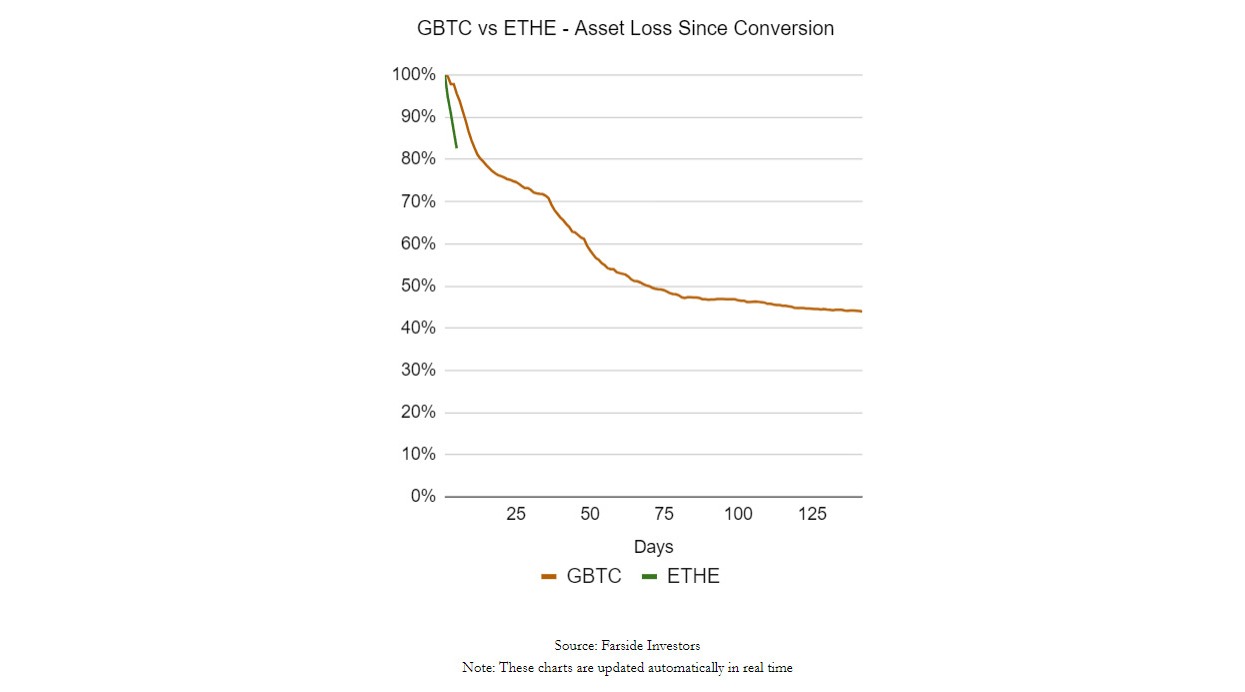
However, neither of the converted funds has fees set to be competitive with newcomer ETFs from other firms. Moreover, significant outflows have occurred from the BTC product, and the same process appears to be happening with the ETH product.
The new BTC ETFs had such strong, sustained inflows that they have been able to thrive despite the Grayscale overhang. However, it remains to be seen whether the ETH products can also produce the demand necessary to immediately offset any short-term Grayscale outflows, should they continue to occur.
Data from Farside Investors showing asset loss from Grayscale funds since conversion to spot ETFs
Another similarity lies in the way Bitcoin is being publicly praised by BlackRock CEO Larry Fink. At the same time BlackRock’s tokenized treasuries fund, BUIDL, runs on the Ethereum blockchain. To long-term crypto users–who have weathered countless criticisms and dismissals through the years from establishment sources–this is a rapid turn of events. Nevertheless, it’s telling that Fink and BlackRock currently reserve the lengths of their crypto-asset adoption to BTC and ETH.
How Are the BTC and ETH ETFs Different?
One area in which the ETFs differ from one another is around the narratives driving interest in their respective underlying assets. Bitcoin, at the moment, is frequently promoted as a store of value that can be regarded–as Larry Fink has stated–as digital gold, and which also, for example in El Salvador, can be a working currency.
Ethereum, on the other hand, was described in a recent BlackRock ETH ETF promotional video as “a global platform for applications that run without decentralized intermediaries”. The same video directly contrasts BTC’s “scarcity” with ETH’s “utility”.
Finally, one more notable difference stems from the fact that Bitcoin has no identifiable founder. As such, its most prominent advocates operate as adopters leading by example rather than as technicians. That means persuasive individuals such as MicroStrategy Executive Chairman Michael Saylor, President of El Salvador Nayib Bukele, and now also BlackRock’s Larry Fink, make the public case for BTC. This makes it a little more like gold again, which, after all, has no CEO explaining his invention in the media circuit.
ETH, on the other hand, has Vitalik Buterin, a famous and still-active co-founder regarded as a figurehead for the blockchain. This sometimes results in misunderstandings. Investors from a traditional business and finance background may wonder why Buterin is not in the spotlight promoting ETH now that the ETFs are freshly launched. At the same time, to crypto-natives this sounds strange: Ethereum is a decentralized network and, according to a common kind of crypto ethos, should always be moving away from hierarchical leadership.
However, if it’s not Vitalik Buterin’s job to promote ETH (just as it’s not the job of the pseudonymous and long-absent Bitcoin creator Satoshi Nakamoto to promote BTC), then who, if anyone, should be doing that job? Does Ethereum need a Michael Saylor-type figure pushing its value proposition and taking the bet in real time?
That depends on who you ask. Perhaps ETF issuers–as through the above-mentioned BlackRock video–will take up the task. Alternatively, perhaps crypto will always operate by its novel conventions, and traditional finance will adapt accordingly.
When spot BTC ETFs went live in the US back in January, it wasn’t yet clear how they would perform, but there was a sense that their launch was an occurrence that–if not exactly inevitable–had been likely to occur at some point.
In the case, though, of spot ETH ETFs, which went into operation last Tuesday, it feels in some ways like a different story. Approval from the SEC came through in May, but that decision surprised many observers. It even prompted speculation that there could have been political motivations at work, since presidential candidate Donald Trump was at that time in the process of establishing a publicly pro-crypto campaign stance.
From there, it didn’t take long to get to launch. 2024 is becoming a year that will be remembered for its crypto ETF developments (don’t forget that two firms–VanEck and 21Shares–have also filed applications with the SEC for spot SOL ETFs). However, it’s becoming apparent that along with similarities between the BTC and ETF products, there are also some key differences.
With that in mind, let’s take a look at the comparable and differentiating aspects. Let's also examine the implications for the products, their underlying assets, and the rest of the crypto space.
How Are the BTC and ETH ETFs Similar?
In the US, there have been ongoing disagreements, mainly between the SEC and almost the entire crypto industry, about whether or not the majority of crypto tokens can be classified as securities and therefore fall under the purview of the SEC. What’s notable is that the SEC appears to want crypto tokens within its remit, and often argues the case for coins as securities, with a few exceptions.
Most obviously, the commission accepts that BTC is best placed in the commodities category, and–although Chair Gary Gensler has been equivocal on the matter–the widespread consensus appears now to be that ETH also can be accepted as a commodity.
In fact, as far back as 2018, then-director of the SEC’s Commission of Corporate Finance William Hinman expressed the opinion that ETH, like BTC, was decentralized enough to be treated as a commodity rather than a security.
Also, in 2023, CFTC Chair Rostin Behnam explained about ETH futures funds, “We would not have allowed the Ether futures product to be listed on a CFTC exchange if we did not feel strongly that it was a commodity asset.”
Another similarity between the BTC and ETH funds lies in how they are affected by Grayscale. In short, prior to spot BTC and ETH ETFs, Grayscale already ran BTC and ETH trusts, both of which have now been converted to ETFs.
However, neither of the converted funds has fees set to be competitive with newcomer ETFs from other firms. Moreover, significant outflows have occurred from the BTC product, and the same process appears to be happening with the ETH product.
The new BTC ETFs had such strong, sustained inflows that they have been able to thrive despite the Grayscale overhang. However, it remains to be seen whether the ETH products can also produce the demand necessary to immediately offset any short-term Grayscale outflows, should they continue to occur.
Data from Farside Investors showing asset loss from Grayscale funds since conversion to spot ETFs
Another similarity lies in the way Bitcoin is being publicly praised by BlackRock CEO Larry Fink. At the same time BlackRock’s tokenized treasuries fund, BUIDL, runs on the Ethereum blockchain. To long-term crypto users–who have weathered countless criticisms and dismissals through the years from establishment sources–this is a rapid turn of events. Nevertheless, it’s telling that Fink and BlackRock currently reserve the lengths of their crypto-asset adoption to BTC and ETH.
How Are the BTC and ETH ETFs Different?
One area in which the ETFs differ from one another is around the narratives driving interest in their respective underlying assets. Bitcoin, at the moment, is frequently promoted as a store of value that can be regarded–as Larry Fink has stated–as digital gold, and which also, for example in El Salvador, can be a working currency.
Ethereum, on the other hand, was described in a recent BlackRock ETH ETF promotional video as “a global platform for applications that run without decentralized intermediaries”. The same video directly contrasts BTC’s “scarcity” with ETH’s “utility”.
Finally, one more notable difference stems from the fact that Bitcoin has no identifiable founder. As such, its most prominent advocates operate as adopters leading by example rather than as technicians. That means persuasive individuals such as MicroStrategy Executive Chairman Michael Saylor, President of El Salvador Nayib Bukele, and now also BlackRock’s Larry Fink, make the public case for BTC. This makes it a little more like gold again, which, after all, has no CEO explaining his invention in the media circuit.
ETH, on the other hand, has Vitalik Buterin, a famous and still-active co-founder regarded as a figurehead for the blockchain. This sometimes results in misunderstandings. Investors from a traditional business and finance background may wonder why Buterin is not in the spotlight promoting ETH now that the ETFs are freshly launched. At the same time, to crypto-natives this sounds strange: Ethereum is a decentralized network and, according to a common kind of crypto ethos, should always be moving away from hierarchical leadership.
However, if it’s not Vitalik Buterin’s job to promote ETH (just as it’s not the job of the pseudonymous and long-absent Bitcoin creator Satoshi Nakamoto to promote BTC), then who, if anyone, should be doing that job? Does Ethereum need a Michael Saylor-type figure pushing its value proposition and taking the bet in real time?
That depends on who you ask. Perhaps ETF issuers–as through the above-mentioned BlackRock video–will take up the task. Alternatively, perhaps crypto will always operate by its novel conventions, and traditional finance will adapt accordingly.
Sam White is a writer and journalist from the UK who covers cryptocurrencies and web3, with a particular interest in NFTs and the crossover between art and finance. His work, on a wide variety of topics, has appeared on platforms including The Spectator, Vice and Hacker Noon.
Kraken Steps Up Speed Race with New Equinix Colocation Service for Crypto Traders
FP Markets Winner Spotlight 🏆 | Global Broker of the Year 2025 #Trading #Broker #Innovation #Shorts
FP Markets Winner Spotlight 🏆 | Global Broker of the Year 2025 #Trading #Broker #Innovation #Shorts
FP Markets takes the spotlight as Global Broker of the Year 2025 at the Finance Magnates Awards.
Martin Stoilov, Head of Client Experience, shares that trust, innovation, and people played a key role in the company’s success, supported by a strong foundation of integrity and client-centricity.
Following this milestone, FP Markets continues to focus on growth, technology investment, and its core values of transparency and excellence.
👉 Be part of FM Awards 2026: https://awards.financemagnates.com/#nominate
FP Markets takes the spotlight as Global Broker of the Year 2025 at the Finance Magnates Awards.
Martin Stoilov, Head of Client Experience, shares that trust, innovation, and people played a key role in the company’s success, supported by a strong foundation of integrity and client-centricity.
Following this milestone, FP Markets continues to focus on growth, technology investment, and its core values of transparency and excellence.
👉 Be part of FM Awards 2026: https://awards.financemagnates.com/#nominate
In this video, we review @HolaPrimeMarketsOfficial, a multi-asset forex and CFDs broker offering different account types, trading platforms, and flexible trading conditions.
We cover the broker’s overall offering, including account options, trading environment, platforms like MT4 and MT5, and additional services such as managed accounts and fast withdrawals.
Watch the full video to see if Hola Prime Markets fits your trading needs.
📣 Stay up to date with the latest in finance and trading. Follow Finance Magnates for industry news, insights, and global event coverage.
Connect with us:
🔗 LinkedIn: /financemagnates
👍 Facebook: /financemagnates
📸 Instagram: https://www.instagram.com/financemagnates
🐦 X: https://x.com/financemagnates
🎥 TikTok: https://www.tiktok.com/tag/financemagnates
▶️ YouTube: /@financemagnates_official
#HolaPrime #ForexBroker #CFDTrading #FinanceMagnates #Trading #Forex #BrokerReview
In this video, we review @HolaPrimeMarketsOfficial, a multi-asset forex and CFDs broker offering different account types, trading platforms, and flexible trading conditions.
We cover the broker’s overall offering, including account options, trading environment, platforms like MT4 and MT5, and additional services such as managed accounts and fast withdrawals.
Watch the full video to see if Hola Prime Markets fits your trading needs.
📣 Stay up to date with the latest in finance and trading. Follow Finance Magnates for industry news, insights, and global event coverage.
Connect with us:
🔗 LinkedIn: /financemagnates
👍 Facebook: /financemagnates
📸 Instagram: https://www.instagram.com/financemagnates
🐦 X: https://x.com/financemagnates
🎥 TikTok: https://www.tiktok.com/tag/financemagnates
▶️ YouTube: /@financemagnates_official
#HolaPrime #ForexBroker #CFDTrading #FinanceMagnates #Trading #Forex #BrokerReview
Hola Prime Review: What You Need to Know | Full Breakdown by Finance Magnates
Hola Prime Review: What You Need to Know | Full Breakdown by Finance Magnates
In this video, we review @HolaPrime_Global, a proprietary trading firm offering evaluation programs and performance-based payouts in simulated market environments.
We cover how the challenge model works, including account types, profit splits (up to 95%), trading rules, and what it takes to reach a funded account. You’ll also learn about available platforms like MT4, MT5, cTrader, and more, along with insights into payouts, support, and trading conditions.
Watch the full video to see if Hola Prime fits your trading style.
📣 Stay up to date with the latest in finance and trading. Follow Finance Magnates for industry news, insights, and global event coverage.
Connect with us:
🔗 LinkedIn: /financemagnates
👍 Facebook: /financemagnates
📸 Instagram: https://www.instagram.com/financemagnates
🐦 X: https://x.com/financemagnates
🎥 TikTok: https://www.tiktok.com/tag/financemagnates
▶️ YouTube: /@financemagnates_official
#HolaPrime #PropFirm #Trading #FinanceMagnates #Forex #FuturesTrading #TradingReview #PropFirmReview
In this video, we review @HolaPrime_Global, a proprietary trading firm offering evaluation programs and performance-based payouts in simulated market environments.
We cover how the challenge model works, including account types, profit splits (up to 95%), trading rules, and what it takes to reach a funded account. You’ll also learn about available platforms like MT4, MT5, cTrader, and more, along with insights into payouts, support, and trading conditions.
Watch the full video to see if Hola Prime fits your trading style.
📣 Stay up to date with the latest in finance and trading. Follow Finance Magnates for industry news, insights, and global event coverage.
Connect with us:
🔗 LinkedIn: /financemagnates
👍 Facebook: /financemagnates
📸 Instagram: https://www.instagram.com/financemagnates
🐦 X: https://x.com/financemagnates
🎥 TikTok: https://www.tiktok.com/tag/financemagnates
▶️ YouTube: /@financemagnates_official
#HolaPrime #PropFirm #Trading #FinanceMagnates #Forex #FuturesTrading #TradingReview #PropFirmReview
Axi Winner Spotlight 🏆 | Global Most Innovative Broker 2025 #Innovation #Trading #Fintech #Broker
Axi Winner Spotlight 🏆 | Global Most Innovative Broker 2025 #Innovation #Trading #Fintech #Broker
Axi takes the spotlight at the Finance Magnates Awards, winning Global Most Innovative Broker 2025.
Olivia Xenofontos and Ivanna Openko share how the team will feel: proud, motivated, and ready to keep delivering.
They also describe the night as well-organized, focused, and enjoyable for all.
👉 Be part of FM Awards 2026.
Axi takes the spotlight at the Finance Magnates Awards, winning Global Most Innovative Broker 2025.
Olivia Xenofontos and Ivanna Openko share how the team will feel: proud, motivated, and ready to keep delivering.
They also describe the night as well-organized, focused, and enjoyable for all.
👉 Be part of FM Awards 2026.
Recognition that matters.
Built on transparency.
Driven by the industry.
The Finance Magnates Awards 2026.
Nominations are now open.
🔗 https://awards.financemagnates.com/?utm_source=SM&utm_medium=social&utm_campaign=recognition-matters
Recognition that matters.
Built on transparency.
Driven by the industry.
The Finance Magnates Awards 2026.
Nominations are now open.
🔗 https://awards.financemagnates.com/?utm_source=SM&utm_medium=social&utm_campaign=recognition-matters