Partnerships announced between ENS and GoDaddy, MetaMask and Robinhood, and Transak and Visa.
The trend is towards greater integration between traditional firms and crypto products.
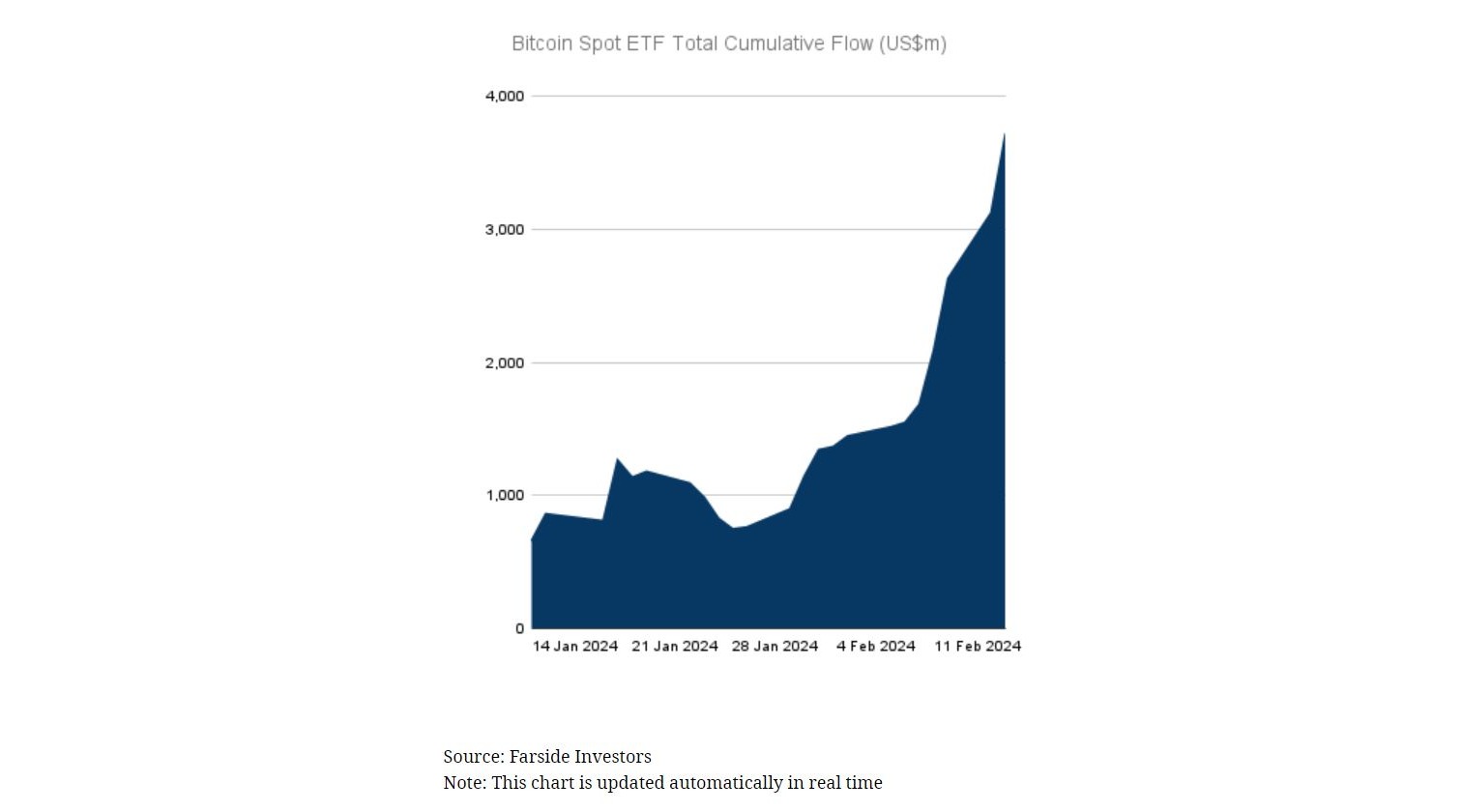
There’s plenty of talk recently about crypto going mainstream, triggered especially by events around spot bitcoin ETFs in the US. These products were approved and launched in January, which is significant in itself, but what has followed is a hugely impressive start, which has seen net flows for all BTC ETFs cumulatively surpass $3 billion, while two of the funds (IBIT and FBTC) are already–despite being only around a month old–in the top ten funds for year-to-date flows.
Bitcoin Spot ETF Flows
The ETFs are center stage and demand has been relentless, but there are further indicators suggesting that crypto is coming in from the cold, with a series of recent announcements regarding tie-ups between crypto products and mainstream, well-known companies.
Ethereum Name Service and GoDaddy
Ethereum Name Service (ENS) has been around since May 2017, and is a domain name service operating on Ethereum. What that means is that an Ethereum wallet address (which looks like a long, random string of numbers and letters) can be mapped to a readable, ownable domain name on the Ethereum blockchain. Up to now, though, ENS domain ownership has been relatively niche, with distinctive .eth domain names common in crypto circles (or among Ethereum devotees, at least), but still–from a wider perspective–limited in adoption.
As such, it looks significant that ENS has now partnered with GoDaddy, one of the biggest names in regular (non-crypto) internet naming services and web hosting. With over 20 million users, GoDaddy is highly recognizable, and so a shift towards crypto–and Ethereum specifically–is worth noting, keeping in mind also that applications for spot ETH ETFs are currently being processed by the SEC.
Additionally, it's important to remember that ENS was never a direct competitor to GoDaddy and similar services, since the Ethereum-based product was not intended to supersede the standard Domain Naming Service (DNS). Rather, the intent was to work in parallel alongside regular mechanisms, and the ENS/GoDaddy collaboration underlines this ambition, providing easy inter-connection between Ethereum and established web architecture.
Through GoDaddy, users will be able to connect a standard DNS domain name with an Ethereum wallet address (just as ENS provides a connection between ENS domain name and wallet address). What’s more, Ethereum gas fees (which vary and can at times be very expensive) are cut out of the equation through a mechanism called Gasless DNSSEC, which may be a critical factor, since excessive gas fees can be an obstacle to bringing on board new Ethereum users.
MetaMask and Robinhood
When it comes to crypto hot wallets, browser-based MetaMask–with well over 22 million downloads since it launched in 2016–is the dominant product, allowing users to hook up permissionlessly with DEXes, NFT marketplaces, and anything else web3-related.
And when it comes to online stock trading aimed squarely at retail participants, Robinhood is among the most dominant platforms, with around 11 million monthly active users. Since 2018, Robinhood has also supported crypto trading, and so it now follows coherently that the trading platform has announced a partnership with MetaMask.
What makes this connection stand out is that MetaMask is a self-custodial wallet option, meaning that users are holding their own assets without the need for a third party. By integrating with MetaMask, Robinhood is allowing users to buy crypto assets through Robinhood itself, but to custody them in their own wallets, creating a crossover between the centralized platforms of the regular web, and the more self-reliant ethos that is central to web3 and crypto.
And again, as with the ENS/GoDaddy partnership, we’re seeing crypto-native products seeking not to replace existing companies and ways of operating, but rather to work alongside them and establish connectivity.
The MetaMask/Robinhood partnership also establishes further on-ramps from traditional finance and fiat currency, to web3 products and crypto, potentially enabling broader crypto adoption. However, viewed alongside the new BTC ETFs, there’s a key difference at play, as the ETFs enable exposure to bitcoin without needing on-ramps, while Robinhood and MetaMask are making it easier for users to actually hold their own crypto, which can then be put to use in decentralized applications.
Transak and Visa
It was reported at the end of January that global payments giant Visa is entering into a partnership with crypto payments firm Transak. Again, this collaboration works to provide accessible connections between fiat and crypto, easing friction around off-ramps, and in the process solving a recurring concerns around crypto ownership: the need to be able to cash out easily when required.
The Transak/Visa partnership will enable real-time card withdrawals (from crypto to fiat), and remove complication around local crypto regulations, due to Transak’s compliance with rules and regulations around the world, and its multiple licenses allowing operations in a variety of global regions.
Here again, then, we have traditional finance and crypto (or, perhaps, web2 and web3) each playing to their respective strengths while moving towards integrated cooperation. This appears to be mutually beneficial for both sectors, and in that case, we shouldn’t be surprised if there are further partnerships still to come between traditional firms and crypto products.
There’s plenty of talk recently about crypto going mainstream, triggered especially by events around spot bitcoin ETFs in the US. These products were approved and launched in January, which is significant in itself, but what has followed is a hugely impressive start, which has seen net flows for all BTC ETFs cumulatively surpass $3 billion, while two of the funds (IBIT and FBTC) are already–despite being only around a month old–in the top ten funds for year-to-date flows.
Bitcoin Spot ETF Flows
The ETFs are center stage and demand has been relentless, but there are further indicators suggesting that crypto is coming in from the cold, with a series of recent announcements regarding tie-ups between crypto products and mainstream, well-known companies.
Ethereum Name Service and GoDaddy
Ethereum Name Service (ENS) has been around since May 2017, and is a domain name service operating on Ethereum. What that means is that an Ethereum wallet address (which looks like a long, random string of numbers and letters) can be mapped to a readable, ownable domain name on the Ethereum blockchain. Up to now, though, ENS domain ownership has been relatively niche, with distinctive .eth domain names common in crypto circles (or among Ethereum devotees, at least), but still–from a wider perspective–limited in adoption.
As such, it looks significant that ENS has now partnered with GoDaddy, one of the biggest names in regular (non-crypto) internet naming services and web hosting. With over 20 million users, GoDaddy is highly recognizable, and so a shift towards crypto–and Ethereum specifically–is worth noting, keeping in mind also that applications for spot ETH ETFs are currently being processed by the SEC.
Additionally, it's important to remember that ENS was never a direct competitor to GoDaddy and similar services, since the Ethereum-based product was not intended to supersede the standard Domain Naming Service (DNS). Rather, the intent was to work in parallel alongside regular mechanisms, and the ENS/GoDaddy collaboration underlines this ambition, providing easy inter-connection between Ethereum and established web architecture.
Through GoDaddy, users will be able to connect a standard DNS domain name with an Ethereum wallet address (just as ENS provides a connection between ENS domain name and wallet address). What’s more, Ethereum gas fees (which vary and can at times be very expensive) are cut out of the equation through a mechanism called Gasless DNSSEC, which may be a critical factor, since excessive gas fees can be an obstacle to bringing on board new Ethereum users.
MetaMask and Robinhood
When it comes to crypto hot wallets, browser-based MetaMask–with well over 22 million downloads since it launched in 2016–is the dominant product, allowing users to hook up permissionlessly with DEXes, NFT marketplaces, and anything else web3-related.
And when it comes to online stock trading aimed squarely at retail participants, Robinhood is among the most dominant platforms, with around 11 million monthly active users. Since 2018, Robinhood has also supported crypto trading, and so it now follows coherently that the trading platform has announced a partnership with MetaMask.
What makes this connection stand out is that MetaMask is a self-custodial wallet option, meaning that users are holding their own assets without the need for a third party. By integrating with MetaMask, Robinhood is allowing users to buy crypto assets through Robinhood itself, but to custody them in their own wallets, creating a crossover between the centralized platforms of the regular web, and the more self-reliant ethos that is central to web3 and crypto.
And again, as with the ENS/GoDaddy partnership, we’re seeing crypto-native products seeking not to replace existing companies and ways of operating, but rather to work alongside them and establish connectivity.
The MetaMask/Robinhood partnership also establishes further on-ramps from traditional finance and fiat currency, to web3 products and crypto, potentially enabling broader crypto adoption. However, viewed alongside the new BTC ETFs, there’s a key difference at play, as the ETFs enable exposure to bitcoin without needing on-ramps, while Robinhood and MetaMask are making it easier for users to actually hold their own crypto, which can then be put to use in decentralized applications.
Transak and Visa
It was reported at the end of January that global payments giant Visa is entering into a partnership with crypto payments firm Transak. Again, this collaboration works to provide accessible connections between fiat and crypto, easing friction around off-ramps, and in the process solving a recurring concerns around crypto ownership: the need to be able to cash out easily when required.
The Transak/Visa partnership will enable real-time card withdrawals (from crypto to fiat), and remove complication around local crypto regulations, due to Transak’s compliance with rules and regulations around the world, and its multiple licenses allowing operations in a variety of global regions.
Here again, then, we have traditional finance and crypto (or, perhaps, web2 and web3) each playing to their respective strengths while moving towards integrated cooperation. This appears to be mutually beneficial for both sectors, and in that case, we shouldn’t be surprised if there are further partnerships still to come between traditional firms and crypto products.
Sam White is a writer and journalist from the UK who covers cryptocurrencies and web3, with a particular interest in NFTs and the crossover between art and finance. His work, on a wide variety of topics, has appeared on platforms including The Spectator, Vice and Hacker Noon.
Kraken Steps Up Speed Race with New Equinix Colocation Service for Crypto Traders
FP Markets Winner Spotlight 🏆 | Global Broker of the Year 2025 #Trading #Broker #Innovation #Shorts
FP Markets Winner Spotlight 🏆 | Global Broker of the Year 2025 #Trading #Broker #Innovation #Shorts
FP Markets takes the spotlight as Global Broker of the Year 2025 at the Finance Magnates Awards.
Martin Stoilov, Head of Client Experience, shares that trust, innovation, and people played a key role in the company’s success, supported by a strong foundation of integrity and client-centricity.
Following this milestone, FP Markets continues to focus on growth, technology investment, and its core values of transparency and excellence.
👉 Be part of FM Awards 2026: https://awards.financemagnates.com/#nominate
FP Markets takes the spotlight as Global Broker of the Year 2025 at the Finance Magnates Awards.
Martin Stoilov, Head of Client Experience, shares that trust, innovation, and people played a key role in the company’s success, supported by a strong foundation of integrity and client-centricity.
Following this milestone, FP Markets continues to focus on growth, technology investment, and its core values of transparency and excellence.
👉 Be part of FM Awards 2026: https://awards.financemagnates.com/#nominate
In this video, we review @HolaPrimeMarketsOfficial, a multi-asset forex and CFDs broker offering different account types, trading platforms, and flexible trading conditions.
We cover the broker’s overall offering, including account options, trading environment, platforms like MT4 and MT5, and additional services such as managed accounts and fast withdrawals.
Watch the full video to see if Hola Prime Markets fits your trading needs.
📣 Stay up to date with the latest in finance and trading. Follow Finance Magnates for industry news, insights, and global event coverage.
Connect with us:
🔗 LinkedIn: /financemagnates
👍 Facebook: /financemagnates
📸 Instagram: https://www.instagram.com/financemagnates
🐦 X: https://x.com/financemagnates
🎥 TikTok: https://www.tiktok.com/tag/financemagnates
▶️ YouTube: /@financemagnates_official
#HolaPrime #ForexBroker #CFDTrading #FinanceMagnates #Trading #Forex #BrokerReview
In this video, we review @HolaPrimeMarketsOfficial, a multi-asset forex and CFDs broker offering different account types, trading platforms, and flexible trading conditions.
We cover the broker’s overall offering, including account options, trading environment, platforms like MT4 and MT5, and additional services such as managed accounts and fast withdrawals.
Watch the full video to see if Hola Prime Markets fits your trading needs.
📣 Stay up to date with the latest in finance and trading. Follow Finance Magnates for industry news, insights, and global event coverage.
Connect with us:
🔗 LinkedIn: /financemagnates
👍 Facebook: /financemagnates
📸 Instagram: https://www.instagram.com/financemagnates
🐦 X: https://x.com/financemagnates
🎥 TikTok: https://www.tiktok.com/tag/financemagnates
▶️ YouTube: /@financemagnates_official
#HolaPrime #ForexBroker #CFDTrading #FinanceMagnates #Trading #Forex #BrokerReview
Hola Prime Review: What You Need to Know | Full Breakdown by Finance Magnates
Hola Prime Review: What You Need to Know | Full Breakdown by Finance Magnates
In this video, we review @HolaPrime_Global, a proprietary trading firm offering evaluation programs and performance-based payouts in simulated market environments.
We cover how the challenge model works, including account types, profit splits (up to 95%), trading rules, and what it takes to reach a funded account. You’ll also learn about available platforms like MT4, MT5, cTrader, and more, along with insights into payouts, support, and trading conditions.
Watch the full video to see if Hola Prime fits your trading style.
📣 Stay up to date with the latest in finance and trading. Follow Finance Magnates for industry news, insights, and global event coverage.
Connect with us:
🔗 LinkedIn: /financemagnates
👍 Facebook: /financemagnates
📸 Instagram: https://www.instagram.com/financemagnates
🐦 X: https://x.com/financemagnates
🎥 TikTok: https://www.tiktok.com/tag/financemagnates
▶️ YouTube: /@financemagnates_official
#HolaPrime #PropFirm #Trading #FinanceMagnates #Forex #FuturesTrading #TradingReview #PropFirmReview
In this video, we review @HolaPrime_Global, a proprietary trading firm offering evaluation programs and performance-based payouts in simulated market environments.
We cover how the challenge model works, including account types, profit splits (up to 95%), trading rules, and what it takes to reach a funded account. You’ll also learn about available platforms like MT4, MT5, cTrader, and more, along with insights into payouts, support, and trading conditions.
Watch the full video to see if Hola Prime fits your trading style.
📣 Stay up to date with the latest in finance and trading. Follow Finance Magnates for industry news, insights, and global event coverage.
Connect with us:
🔗 LinkedIn: /financemagnates
👍 Facebook: /financemagnates
📸 Instagram: https://www.instagram.com/financemagnates
🐦 X: https://x.com/financemagnates
🎥 TikTok: https://www.tiktok.com/tag/financemagnates
▶️ YouTube: /@financemagnates_official
#HolaPrime #PropFirm #Trading #FinanceMagnates #Forex #FuturesTrading #TradingReview #PropFirmReview
Axi Winner Spotlight 🏆 | Global Most Innovative Broker 2025 #Innovation #Trading #Fintech #Broker
Axi Winner Spotlight 🏆 | Global Most Innovative Broker 2025 #Innovation #Trading #Fintech #Broker
Axi takes the spotlight at the Finance Magnates Awards, winning Global Most Innovative Broker 2025.
Olivia Xenofontos and Ivanna Openko share how the team will feel: proud, motivated, and ready to keep delivering.
They also describe the night as well-organized, focused, and enjoyable for all.
👉 Be part of FM Awards 2026.
Axi takes the spotlight at the Finance Magnates Awards, winning Global Most Innovative Broker 2025.
Olivia Xenofontos and Ivanna Openko share how the team will feel: proud, motivated, and ready to keep delivering.
They also describe the night as well-organized, focused, and enjoyable for all.
👉 Be part of FM Awards 2026.
Recognition that matters.
Built on transparency.
Driven by the industry.
The Finance Magnates Awards 2026.
Nominations are now open.
🔗 https://awards.financemagnates.com/?utm_source=SM&utm_medium=social&utm_campaign=recognition-matters
Recognition that matters.
Built on transparency.
Driven by the industry.
The Finance Magnates Awards 2026.
Nominations are now open.
🔗 https://awards.financemagnates.com/?utm_source=SM&utm_medium=social&utm_campaign=recognition-matters