New market entrants will further increase competition for experienced professionals.
Benefits and flexible working options can be as important as salary.
Op-ed
According to Glassdoor (which collates salary data submitted anonymously), the average base salary for an FX trader in the UK in November 2022 was £69,182 and additional cash compensation, including bonuses and commission, averaged £86,851. The equivalent figures for an FX analyst were £40,207 and £4,102, respectively.
The most in-demand roles within the institutional space are sales professionals that have a genuine transferable book of clients, followed by trade support roles, such as solutions and operations, observed Reece Pawsey, the Director FinTop Consulting. “Within the retail space the greatest demand is for multilingual sales and business development professionals, which typically consists of retention and conversion,” he said.
Unsurprisingly, there are insufficient numbers of candidates who meet the institutional profile, which has led to some brokers extending their search beyond individuals who bring business with them to those with experience but no transferable book of clients, or even more junior candidates. In the retail space, many candidates fit into either the retention or conversation category but lack the experience to generate new business.
Reece Pawsey, FinTop Consulting
According to Pawsey, brokers in the institutional space are now offering significantly higher base salaries than they were 12 months ago, unlike their retail counterparts, where salaries have remained largely the same. “As more new players enter the market it will become increasingly competitive with brokers competing for experienced candidates with a book of clients,” he said. “That being said, the suitability of these clients also depends on the spreads, products and additional solutions offered by the broker.”
Rebalancing of Roles
Michael Williams Associates has seen a consistent demand for both sales and trading roles explained the Managing Partner, Neil Price. “Following the transition of selected staff from London to the EU in line with the post-Brexit regulatory requirement over the last two years, we are now seeing firms rebalance – essentially moving from the establishment of new desks to expansion and upgrading,” he said.
The move towards digitisation of the FX business continues to drive the need for technical and quantitative experience, particularly in trading, which means that demand can outweigh the supply for specific skills, added Price.
In Cyprus, there is strong demand for MT4/MT5 administrators, experienced traders/dealers who are willing to work rotational shifts to cover all markets, and IT development profiles said Hayley Buckle, the Director of Recruitment at GRS Recruitment.
“Not only is the supply of talent looking for work very limited – the needs of the individuals have changed,” she explained. “Over the past few years with the implementation of hybrid and remote working, more people are looking for positions that will allow them to work from home. With wellbeing at the top of most individuals’ lists when job hunting, the benefits that companies offer have also changed to include gym memberships and on site massages, for example.”
“Compliance/AML candidates are particularly highly sought after,” she said. “Given CySEC’s stricter controls and fines, and what is happening in the financial world in general, companies are assessing their compliance programmes and enhancing them in order to meet regulatory guidelines.”
Crypto Cannibalism?
As we have previously reported high-profile figures have made the transition from FX to crypto in recent times, including the former Head of Electronic FX trading at Lloyds Bank. One of the most notable moves was made earlier this year by the Managing Director and Global Head of FX prime brokerage at Jefferies and the investment bank’s Global Head of FXPB distribution, who set up execution-only crypto ECN Crossover Markets.
“The attractiveness of working at a crypto company gives them an edge when competing for candidates within the FX talent pool,” said Donna Stephenson. “We have spoken to candidates that are actively seeking opportunities within the crypto space, from software engineers to executive directors that want to head up a CySEC licensed crypto asset service provider.”
Donna Stephenson, founder and CEO Emerald Zebra
Comparing average salaries and incentives for similar positions in FX and crypto is not easy. Glassdoor data suggests the national average salary for a crypto trader in the UK is £56,500, which rises to £80,200 when bonuses and commission are factored in. To put that in context, additional cash compensation alone for FX traders was more than £86,850.
However, Stephenson refers to rising salary expectations linked to the shortage of skilled and experienced people. “One of our crypto clients has stated that crypto software engineers are more expensive than FX engineers due to the complexity of the industry and that companies are paying up to 30% above the market rate, which we can confirm from recent experience.”
A further complicating factor, when it comes to a comparison of earnings, is that those working in the crypto sector often receive a significant portion of their salaries in cryptocurrency.
In today's crypto winter, where crypto layoffs and crypto company collapses like that of FTX, are dominating the news, the whole crypto sector itself is witnessing a drastic change unfurl. How that impacts the FX talent wars remains to be seen, FX jobs it seems, are for the long term. However, it would not be surprising to see a few more resumes in FX HR inboxes over the coming months and it will be interesting to see what the knock-on effect that will bring.
Passive Incentives
The lack of suitably qualified/experienced technology candidates actively seeking career moves has contributed to firms offering higher salaries to attract passive candidates: those individuals that are not necessarily looking to change employers but might consider a move to realise a higher salary. In Cyprus, this has translated into an increase in the salaries offered to a mid-level developer from €40-45,000 in 2020 to €50-70,000 this year.
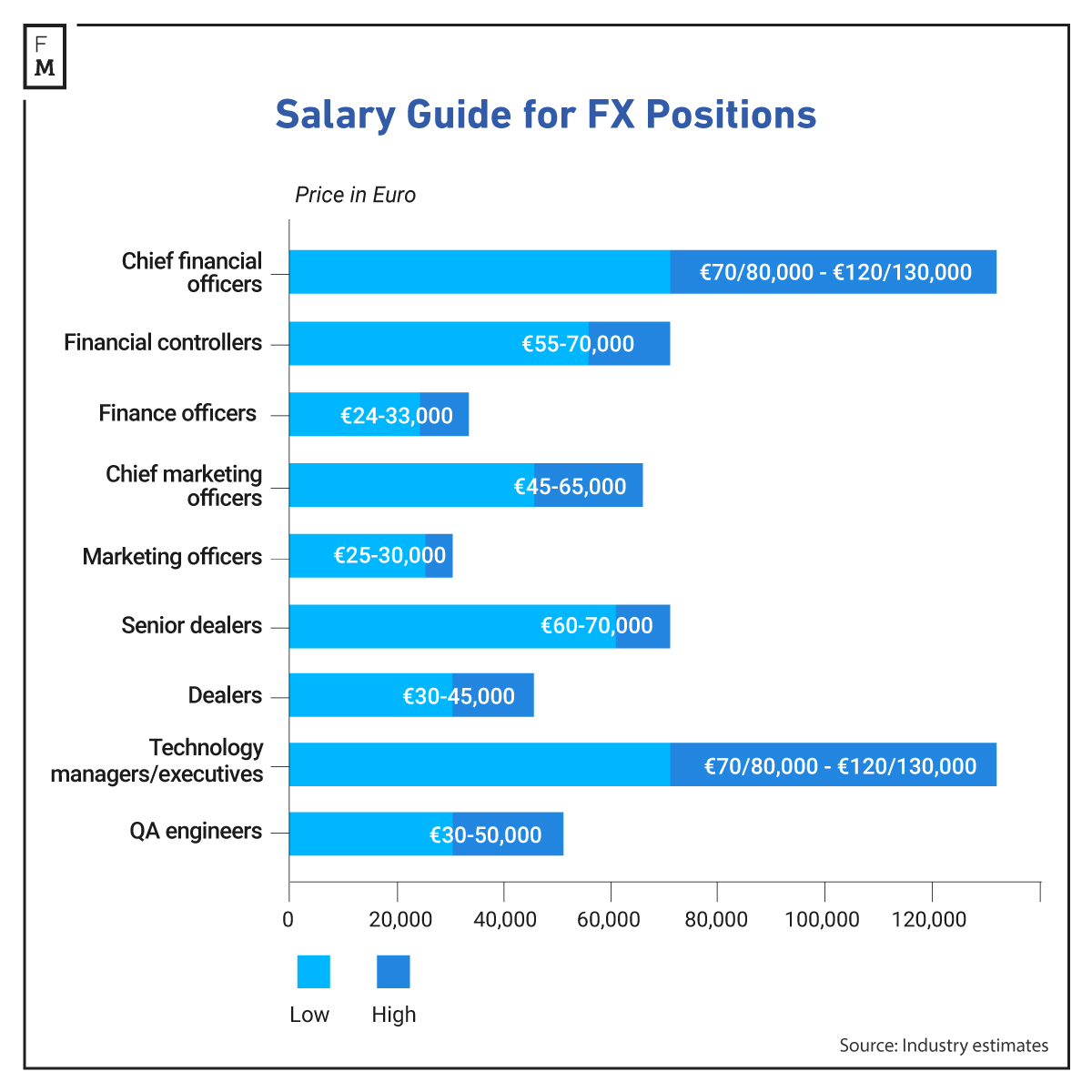
Candidates are not only commanding higher salaries, but they are also factoring the culture of the company and its reputation into their decision-making process explains Donna Stephenson, the CEO of Emerald Zebra. Stephenson offers the following salary guide for FX positions, corroborated by other industry sources:
“Whilst salary is still king, the majority of employers have fixed their retention issues and now boast shiny new offices, new management teams, training, coaching and wellbeing programmes, signing on bonuses, lunch and refreshment facilities, team socials, and hybrid or flexible working,” she said.
This means that not only are there more jobs than candidates, but passive candidates are not easily tempted. Many employers have sought to address this by providing relocation assistance and work visa sponsorship.
Earlier this year, the Cypriot government introduced new tax incentive schemes, third-country work visas and spousal work visas to assist companies to attract candidates to relocate to Cyprus.
Katerina Andreou, the CEO of HR Innovate, which sees the greatest demand for affiliate roles, sales and retention, observed that staff turnover makes the recruitment process even more challenging.
Inflated Expectations?
Inflation is running high in both the UK (where the consumer prices index rose by 9.6% in the 12 months to October 2022) and Cyprus, where the October figure of 8.6% was the lowest since April. However, it is still almost double the amount it was for the same period of time last year.
Yet, while Pawsey reckons UK candidate salary expectations have not been significantly impacted by rising inflation rates, it’s a different story in the eastern Mediterranean where the cost of living in the forex hub of Limassol has dramatically increased, meaning a bigger salary is now a must.
“Most candidates are aware that there is a talent shortage and that – coupled with ever-increasing living costs – has meant salary expectations are definitely higher, as are general expectations regarding package benefits and working conditions,” said Andreou.
Terri Neofitou, the Country Director at Emerald Zebra, reckoned candidates are considering the stability as well as the value of a new role and are more likely to ask whether a prospective employer is a good career move for them.
“Questions include ‘is it a new role created due to the success or expansion of the team’ and ‘is it a replacement and if so, why,” said Neofitou. “There is also greater questioning of the job responsibilities and the company’s short and long-term goals.”
According to Glassdoor (which collates salary data submitted anonymously), the average base salary for an FX trader in the UK in November 2022 was £69,182 and additional cash compensation, including bonuses and commission, averaged £86,851. The equivalent figures for an FX analyst were £40,207 and £4,102, respectively.
The most in-demand roles within the institutional space are sales professionals that have a genuine transferable book of clients, followed by trade support roles, such as solutions and operations, observed Reece Pawsey, the Director FinTop Consulting. “Within the retail space the greatest demand is for multilingual sales and business development professionals, which typically consists of retention and conversion,” he said.
Unsurprisingly, there are insufficient numbers of candidates who meet the institutional profile, which has led to some brokers extending their search beyond individuals who bring business with them to those with experience but no transferable book of clients, or even more junior candidates. In the retail space, many candidates fit into either the retention or conversation category but lack the experience to generate new business.
Reece Pawsey, FinTop Consulting
According to Pawsey, brokers in the institutional space are now offering significantly higher base salaries than they were 12 months ago, unlike their retail counterparts, where salaries have remained largely the same. “As more new players enter the market it will become increasingly competitive with brokers competing for experienced candidates with a book of clients,” he said. “That being said, the suitability of these clients also depends on the spreads, products and additional solutions offered by the broker.”
Rebalancing of Roles
Michael Williams Associates has seen a consistent demand for both sales and trading roles explained the Managing Partner, Neil Price. “Following the transition of selected staff from London to the EU in line with the post-Brexit regulatory requirement over the last two years, we are now seeing firms rebalance – essentially moving from the establishment of new desks to expansion and upgrading,” he said.
The move towards digitisation of the FX business continues to drive the need for technical and quantitative experience, particularly in trading, which means that demand can outweigh the supply for specific skills, added Price.
In Cyprus, there is strong demand for MT4/MT5 administrators, experienced traders/dealers who are willing to work rotational shifts to cover all markets, and IT development profiles said Hayley Buckle, the Director of Recruitment at GRS Recruitment.
“Not only is the supply of talent looking for work very limited – the needs of the individuals have changed,” she explained. “Over the past few years with the implementation of hybrid and remote working, more people are looking for positions that will allow them to work from home. With wellbeing at the top of most individuals’ lists when job hunting, the benefits that companies offer have also changed to include gym memberships and on site massages, for example.”
“Compliance/AML candidates are particularly highly sought after,” she said. “Given CySEC’s stricter controls and fines, and what is happening in the financial world in general, companies are assessing their compliance programmes and enhancing them in order to meet regulatory guidelines.”
Crypto Cannibalism?
As we have previously reported high-profile figures have made the transition from FX to crypto in recent times, including the former Head of Electronic FX trading at Lloyds Bank. One of the most notable moves was made earlier this year by the Managing Director and Global Head of FX prime brokerage at Jefferies and the investment bank’s Global Head of FXPB distribution, who set up execution-only crypto ECN Crossover Markets.
“The attractiveness of working at a crypto company gives them an edge when competing for candidates within the FX talent pool,” said Donna Stephenson. “We have spoken to candidates that are actively seeking opportunities within the crypto space, from software engineers to executive directors that want to head up a CySEC licensed crypto asset service provider.”
Donna Stephenson, founder and CEO Emerald Zebra
Comparing average salaries and incentives for similar positions in FX and crypto is not easy. Glassdoor data suggests the national average salary for a crypto trader in the UK is £56,500, which rises to £80,200 when bonuses and commission are factored in. To put that in context, additional cash compensation alone for FX traders was more than £86,850.
However, Stephenson refers to rising salary expectations linked to the shortage of skilled and experienced people. “One of our crypto clients has stated that crypto software engineers are more expensive than FX engineers due to the complexity of the industry and that companies are paying up to 30% above the market rate, which we can confirm from recent experience.”
A further complicating factor, when it comes to a comparison of earnings, is that those working in the crypto sector often receive a significant portion of their salaries in cryptocurrency.
In today's crypto winter, where crypto layoffs and crypto company collapses like that of FTX, are dominating the news, the whole crypto sector itself is witnessing a drastic change unfurl. How that impacts the FX talent wars remains to be seen, FX jobs it seems, are for the long term. However, it would not be surprising to see a few more resumes in FX HR inboxes over the coming months and it will be interesting to see what the knock-on effect that will bring.
Passive Incentives
The lack of suitably qualified/experienced technology candidates actively seeking career moves has contributed to firms offering higher salaries to attract passive candidates: those individuals that are not necessarily looking to change employers but might consider a move to realise a higher salary. In Cyprus, this has translated into an increase in the salaries offered to a mid-level developer from €40-45,000 in 2020 to €50-70,000 this year.
Candidates are not only commanding higher salaries, but they are also factoring the culture of the company and its reputation into their decision-making process explains Donna Stephenson, the CEO of Emerald Zebra. Stephenson offers the following salary guide for FX positions, corroborated by other industry sources:
“Whilst salary is still king, the majority of employers have fixed their retention issues and now boast shiny new offices, new management teams, training, coaching and wellbeing programmes, signing on bonuses, lunch and refreshment facilities, team socials, and hybrid or flexible working,” she said.
This means that not only are there more jobs than candidates, but passive candidates are not easily tempted. Many employers have sought to address this by providing relocation assistance and work visa sponsorship.
Earlier this year, the Cypriot government introduced new tax incentive schemes, third-country work visas and spousal work visas to assist companies to attract candidates to relocate to Cyprus.
Katerina Andreou, the CEO of HR Innovate, which sees the greatest demand for affiliate roles, sales and retention, observed that staff turnover makes the recruitment process even more challenging.
Inflated Expectations?
Inflation is running high in both the UK (where the consumer prices index rose by 9.6% in the 12 months to October 2022) and Cyprus, where the October figure of 8.6% was the lowest since April. However, it is still almost double the amount it was for the same period of time last year.
Yet, while Pawsey reckons UK candidate salary expectations have not been significantly impacted by rising inflation rates, it’s a different story in the eastern Mediterranean where the cost of living in the forex hub of Limassol has dramatically increased, meaning a bigger salary is now a must.
“Most candidates are aware that there is a talent shortage and that – coupled with ever-increasing living costs – has meant salary expectations are definitely higher, as are general expectations regarding package benefits and working conditions,” said Andreou.
Terri Neofitou, the Country Director at Emerald Zebra, reckoned candidates are considering the stability as well as the value of a new role and are more likely to ask whether a prospective employer is a good career move for them.
“Questions include ‘is it a new role created due to the success or expansion of the team’ and ‘is it a replacement and if so, why,” said Neofitou. “There is also greater questioning of the job responsibilities and the company’s short and long-term goals.”
Paul Golden is an experienced freelance financial journalist with a strong institutional background. Over the past two decades, he has written for globally recognised financial publications, covering topics such as market structure, regulation, trading behaviour, and economic policy.
ASIC Removed 87 Firms and Individuals From Financial Services Last Year, Up From 58
Featured Videos
Plus500 Payout Rises; Hirose Costs Jump
Plus500 Payout Rises; Hirose Costs Jump
Plus500 Payout Rises; Hirose Costs Jump
Plus500 Payout Rises; Hirose Costs Jump
Today’s financial news recap covers Plus500 declares a $182 million payout for shareholders, Hirose Financial UK's costs rise 40%, and a Chinese broker goes private.
Finance Magnates Daily Recap brings you the latest news from forex and CFD brokers, fintech, payments, cryptocurrency, digital assets, trading platforms, financial regulation and global markets.
Get the key company news, executive moves, deals, regulatory updates and market developments of the day, in just a few minutes. New episodes published every weekday.
Read more: https://www.financemagnates.com
#FinanceMagnates #ForexNews #FintechNews
Today’s financial news recap covers Plus500 declares a $182 million payout for shareholders, Hirose Financial UK's costs rise 40%, and a Chinese broker goes private.
Finance Magnates Daily Recap brings you the latest news from forex and CFD brokers, fintech, payments, cryptocurrency, digital assets, trading platforms, financial regulation and global markets.
Get the key company news, executive moves, deals, regulatory updates and market developments of the day, in just a few minutes. New episodes published every weekday.
Read more: https://www.financemagnates.com
#FinanceMagnates #ForexNews #FintechNews
Today’s financial news recap covers Plus500 declares a $182 million payout for shareholders, Hirose Financial UK's costs rise 40%, and a Chinese broker goes private.
Finance Magnates Daily Recap brings you the latest news from forex and CFD brokers, fintech, payments, cryptocurrency, digital assets, trading platforms, financial regulation and global markets.
Get the key company news, executive moves, deals, regulatory updates and market developments of the day, in just a few minutes. New episodes published every weekday.
Read more: https://www.financemagnates.com
#FinanceMagnates #ForexNews #FintechNews
Today’s financial news recap covers Plus500 declares a $182 million payout for shareholders, Hirose Financial UK's costs rise 40%, and a Chinese broker goes private.
Finance Magnates Daily Recap brings you the latest news from forex and CFD brokers, fintech, payments, cryptocurrency, digital assets, trading platforms, financial regulation and global markets.
Get the key company news, executive moves, deals, regulatory updates and market developments of the day, in just a few minutes. New episodes published every weekday.
Read more: https://www.financemagnates.com
#FinanceMagnates #ForexNews #FintechNews
Reading financial headlines can keep you informed. But if you want to actually level up your finance career, you need more than information.
You need structured education and actionable skills you can take into your next role or use to grow where you are.
That’s what FM Academy is built to provide.
Explore FM Academy: https://academy.financemagnates.com/subscription-all?utm_source=YT&utm_medium=sm_video_post&utm_campaign=fm_academy_awareness&utm_id=V1
#FinanceMagnates #FMAcademy #FinanceCareers #Fintech #CareerDevelopment
Reading financial headlines can keep you informed. But if you want to actually level up your finance career, you need more than information.
You need structured education and actionable skills you can take into your next role or use to grow where you are.
That’s what FM Academy is built to provide.
Explore FM Academy: https://academy.financemagnates.com/subscription-all?utm_source=YT&utm_medium=sm_video_post&utm_campaign=fm_academy_awareness&utm_id=V1
#FinanceMagnates #FMAcademy #FinanceCareers #Fintech #CareerDevelopment
Reading financial headlines can keep you informed. But if you want to actually level up your finance career, you need more than information.
You need structured education and actionable skills you can take into your next role or use to grow where you are.
That’s what FM Academy is built to provide.
Explore FM Academy: https://academy.financemagnates.com/subscription-all?utm_source=YT&utm_medium=sm_video_post&utm_campaign=fm_academy_awareness&utm_id=V1
#FinanceMagnates #FMAcademy #FinanceCareers #Fintech #CareerDevelopment
Reading financial headlines can keep you informed. But if you want to actually level up your finance career, you need more than information.
You need structured education and actionable skills you can take into your next role or use to grow where you are.
That’s what FM Academy is built to provide.
Explore FM Academy: https://academy.financemagnates.com/subscription-all?utm_source=YT&utm_medium=sm_video_post&utm_campaign=fm_academy_awareness&utm_id=V1
#FinanceMagnates #FMAcademy #FinanceCareers #Fintech #CareerDevelopment
Reading financial headlines can keep you informed. But if you want to actually level up your finance career, you need more than information.
You need structured education and actionable skills you can take into your next role or use to grow where you are.
That’s what FM Academy is built to provide.
Explore FM Academy: https://academy.financemagnates.com/subscription-all?utm_source=YT&utm_medium=sm_video_post&utm_campaign=fm_academy_awareness&utm_id=V1
#FinanceMagnates #FMAcademy #FinanceCareers #Fintech #CareerDevelopment
Reading financial headlines can keep you informed. But if you want to actually level up your finance career, you need more than information.
You need structured education and actionable skills you can take into your next role or use to grow where you are.
That’s what FM Academy is built to provide.
Explore FM Academy: https://academy.financemagnates.com/subscription-all?utm_source=YT&utm_medium=sm_video_post&utm_campaign=fm_academy_awareness&utm_id=V1
#FinanceMagnates #FMAcademy #FinanceCareers #Fintech #CareerDevelopment
Gold Rally, CME Eyes CFD Traders?
Gold Rally, CME Eyes CFD Traders?
Gold Rally, CME Eyes CFD Traders?
Gold Rally, CME Eyes CFD Traders?
Gold Rally, CME Eyes CFD Traders?
Gold Rally, CME Eyes CFD Traders?
Today’s financial news recap covers a major shift in European CFD trading towards gold, CME's smaller futures contracts targeting retail traders, and XM's launch of seven-day gold trading.
Finance Magnates Daily Recap brings you the latest news from forex and CFD brokers, fintech, payments, cryptocurrency, digital assets, trading platforms, financial regulation and global markets.
Get the key company news, executive moves, deals, regulatory updates and market developments of the day, in just a few minutes. New episodes published every weekday.
Read more: https://www.financemagnates.com
#FinanceMagnates #ForexNews #FintechNews
Today’s financial news recap covers a major shift in European CFD trading towards gold, CME's smaller futures contracts targeting retail traders, and XM's launch of seven-day gold trading.
Finance Magnates Daily Recap brings you the latest news from forex and CFD brokers, fintech, payments, cryptocurrency, digital assets, trading platforms, financial regulation and global markets.
Get the key company news, executive moves, deals, regulatory updates and market developments of the day, in just a few minutes. New episodes published every weekday.
Read more: https://www.financemagnates.com
#FinanceMagnates #ForexNews #FintechNews
Today’s financial news recap covers a major shift in European CFD trading towards gold, CME's smaller futures contracts targeting retail traders, and XM's launch of seven-day gold trading.
Finance Magnates Daily Recap brings you the latest news from forex and CFD brokers, fintech, payments, cryptocurrency, digital assets, trading platforms, financial regulation and global markets.
Get the key company news, executive moves, deals, regulatory updates and market developments of the day, in just a few minutes. New episodes published every weekday.
Read more: https://www.financemagnates.com
#FinanceMagnates #ForexNews #FintechNews
Today’s financial news recap covers a major shift in European CFD trading towards gold, CME's smaller futures contracts targeting retail traders, and XM's launch of seven-day gold trading.
Finance Magnates Daily Recap brings you the latest news from forex and CFD brokers, fintech, payments, cryptocurrency, digital assets, trading platforms, financial regulation and global markets.
Get the key company news, executive moves, deals, regulatory updates and market developments of the day, in just a few minutes. New episodes published every weekday.
Read more: https://www.financemagnates.com
#FinanceMagnates #ForexNews #FintechNews
Today’s financial news recap covers a major shift in European CFD trading towards gold, CME's smaller futures contracts targeting retail traders, and XM's launch of seven-day gold trading.
Finance Magnates Daily Recap brings you the latest news from forex and CFD brokers, fintech, payments, cryptocurrency, digital assets, trading platforms, financial regulation and global markets.
Get the key company news, executive moves, deals, regulatory updates and market developments of the day, in just a few minutes. New episodes published every weekday.
Read more: https://www.financemagnates.com
#FinanceMagnates #ForexNews #FintechNews
Today’s financial news recap covers a major shift in European CFD trading towards gold, CME's smaller futures contracts targeting retail traders, and XM's launch of seven-day gold trading.
Finance Magnates Daily Recap brings you the latest news from forex and CFD brokers, fintech, payments, cryptocurrency, digital assets, trading platforms, financial regulation and global markets.
Get the key company news, executive moves, deals, regulatory updates and market developments of the day, in just a few minutes. New episodes published every weekday.
Read more: https://www.financemagnates.com
#FinanceMagnates #ForexNews #FintechNews
Brex Capital Rebrand, IBKR Outage, and Leverate Belarus Exit
Brex Capital Rebrand, IBKR Outage, and Leverate Belarus Exit
Brex Capital Rebrand, IBKR Outage, and Leverate Belarus Exit
Brex Capital Rebrand, IBKR Outage, and Leverate Belarus Exit
Brex Capital Rebrand, IBKR Outage, and Leverate Belarus Exit
Brex Capital Rebrand, IBKR Outage, and Leverate Belarus Exit
Today’s financial news recap covers Brex Capital emerges from the controversial QRS Global broker, Interactive Brokers restores access after login issues, Leverate moves to exit Belarus's forex market
Finance Magnates Daily Recap brings you the latest news from forex and CFD brokers, fintech, payments, cryptocurrency, digital assets, trading platforms, financial regulation and global markets.
Get the key company news, executive moves, deals, regulatory updates and market developments of the day, in just a few minutes. New episodes published every weekday.
Read more: https://www.financemagnates.com
#FinanceMagnates #ForexNews #FintechNews
Today’s financial news recap covers Brex Capital emerges from the controversial QRS Global broker, Interactive Brokers restores access after login issues, Leverate moves to exit Belarus's forex market
Finance Magnates Daily Recap brings you the latest news from forex and CFD brokers, fintech, payments, cryptocurrency, digital assets, trading platforms, financial regulation and global markets.
Get the key company news, executive moves, deals, regulatory updates and market developments of the day, in just a few minutes. New episodes published every weekday.
Read more: https://www.financemagnates.com
#FinanceMagnates #ForexNews #FintechNews
Today’s financial news recap covers Brex Capital emerges from the controversial QRS Global broker, Interactive Brokers restores access after login issues, Leverate moves to exit Belarus's forex market
Finance Magnates Daily Recap brings you the latest news from forex and CFD brokers, fintech, payments, cryptocurrency, digital assets, trading platforms, financial regulation and global markets.
Get the key company news, executive moves, deals, regulatory updates and market developments of the day, in just a few minutes. New episodes published every weekday.
Read more: https://www.financemagnates.com
#FinanceMagnates #ForexNews #FintechNews
Today’s financial news recap covers Brex Capital emerges from the controversial QRS Global broker, Interactive Brokers restores access after login issues, Leverate moves to exit Belarus's forex market
Finance Magnates Daily Recap brings you the latest news from forex and CFD brokers, fintech, payments, cryptocurrency, digital assets, trading platforms, financial regulation and global markets.
Get the key company news, executive moves, deals, regulatory updates and market developments of the day, in just a few minutes. New episodes published every weekday.
Read more: https://www.financemagnates.com
#FinanceMagnates #ForexNews #FintechNews
Today’s financial news recap covers Brex Capital emerges from the controversial QRS Global broker, Interactive Brokers restores access after login issues, Leverate moves to exit Belarus's forex market
Finance Magnates Daily Recap brings you the latest news from forex and CFD brokers, fintech, payments, cryptocurrency, digital assets, trading platforms, financial regulation and global markets.
Get the key company news, executive moves, deals, regulatory updates and market developments of the day, in just a few minutes. New episodes published every weekday.
Read more: https://www.financemagnates.com
#FinanceMagnates #ForexNews #FintechNews
Today’s financial news recap covers Brex Capital emerges from the controversial QRS Global broker, Interactive Brokers restores access after login issues, Leverate moves to exit Belarus's forex market
Finance Magnates Daily Recap brings you the latest news from forex and CFD brokers, fintech, payments, cryptocurrency, digital assets, trading platforms, financial regulation and global markets.
Get the key company news, executive moves, deals, regulatory updates and market developments of the day, in just a few minutes. New episodes published every weekday.
Read more: https://www.financemagnates.com
#FinanceMagnates #ForexNews #FintechNews
FM Daily Brief – 5 August 2026
FM Daily Brief – 5 August 2026
FM Daily Brief – 5 August 2026
FM Daily Brief – 5 August 2026
FM Daily Brief – 5 August 2026
FM Daily Brief – 5 August 2026
Today is Wednesday, the fifth of August, twenty twenty six, and these are our main stories: Finance Magnates found out who led Lithuania’s 5,000x increase in cross-border investing clients, how traders reacted to the US-Iran conflict, and a subscription push at cTrader.
Today is Wednesday, the fifth of August, twenty twenty six, and these are our main stories: Finance Magnates found out who led Lithuania’s 5,000x increase in cross-border investing clients, how traders reacted to the US-Iran conflict, and a subscription push at cTrader.
Today is Wednesday, the fifth of August, twenty twenty six, and these are our main stories: Finance Magnates found out who led Lithuania’s 5,000x increase in cross-border investing clients, how traders reacted to the US-Iran conflict, and a subscription push at cTrader.
Today is Wednesday, the fifth of August, twenty twenty six, and these are our main stories: Finance Magnates found out who led Lithuania’s 5,000x increase in cross-border investing clients, how traders reacted to the US-Iran conflict, and a subscription push at cTrader.
Today is Wednesday, the fifth of August, twenty twenty six, and these are our main stories: Finance Magnates found out who led Lithuania’s 5,000x increase in cross-border investing clients, how traders reacted to the US-Iran conflict, and a subscription push at cTrader.
Today is Wednesday, the fifth of August, twenty twenty six, and these are our main stories: Finance Magnates found out who led Lithuania’s 5,000x increase in cross-border investing clients, how traders reacted to the US-Iran conflict, and a subscription push at cTrader.