Two-factor authentication (2FA) requires two distinct forms of identification for login.
The false tweet momentarily pushed Bitcoin prices 4 percent higher.
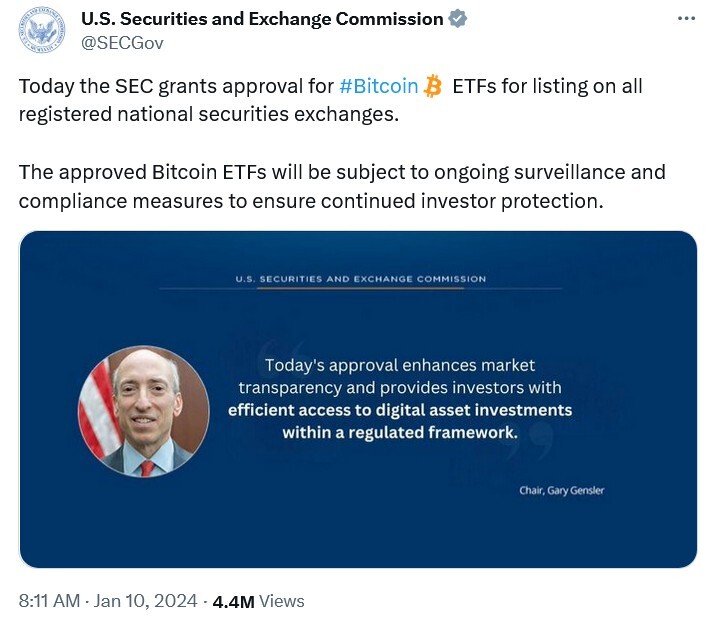
On Tuesday afternoon, the official X (formerly Twitter) account of the Securities and Exchange Commission (SEC) posted a much-anticipated tweet: “Today the SEC grants approval for Bitcoin ETFs for listing on all registered national securities exchanges.” However, it was a false announcement as the SEC X account was hacked.
Screenshot of the fake Bitcoin approval tweet
SEC Failed to Secure Its X Account
According to the Safety team at X, the compromise was “due to an unidentified individual obtaining control over a phone number associated with the [SEC] account through a third party.”
The “preliminary investigation” of X further found that the SEC account “did not have two-factor authentication enabled at the time the account was compromised.” This raised massive security concerns on the part of the regulator.
We can confirm that the account @SECGov was compromised and we have completed a preliminary investigation. Based on our investigation, the compromise was not due to any breach of X’s systems, but rather due to an unidentified individual obtaining control over a phone number…
After the false tweet, the SEC's Chief, Gary Gensler, quickly announced from his personal X account that the official X account of the regulator was compromised, and the fake tweet was deleted in about 30 minutes. However, the damage was already done.
The @SECGov twitter account was compromised, and an unauthorized tweet was posted. The SEC has not approved the listing and trading of spot bitcoin exchange-traded products.
Some theories of an “inside job” and “fat finger” mistake were floated around. However, X’s confirmation of a compromised phone number debunked those theories.
The false announcement was made a day before the deadline for the SEC’s decision on the spot Bitcoin ETF application submitted by Ark and 21Shares. Although the regulator has been delaying or rejecting Bitcoin ETF applications since 2013, this time, the industry is anticipating approval. Even two top Bloomberg analysts have put 90 percent odds on the approval before the Wednesday deadline.
Crypto Market Reacts Quickly
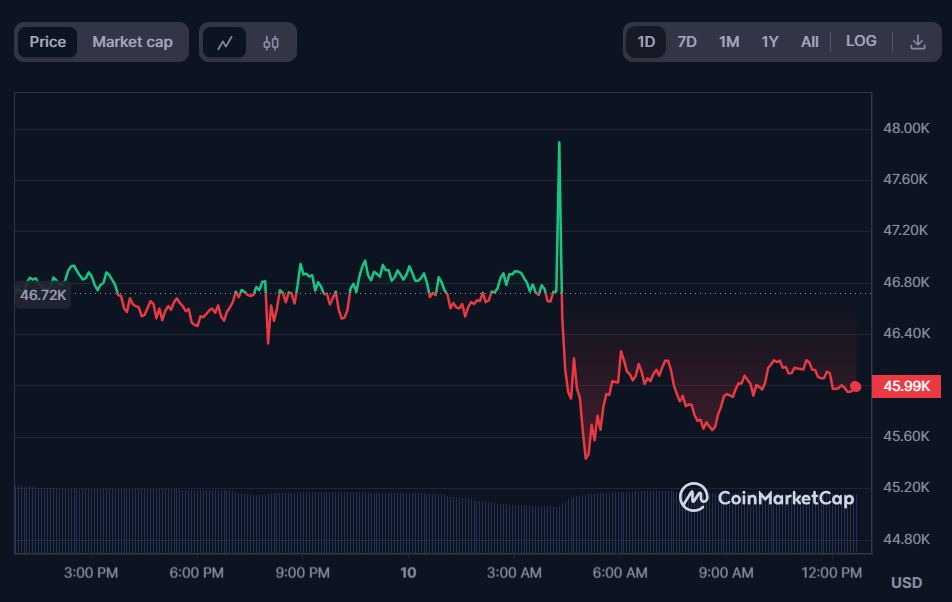
The already bullish demand for Bitcoin momentarily jumped 4 percent in response to a false tweet from the compromised X account of the SEC. However, the prices swiftly corrected once the inaccuracy of the announcement came to light. There are some speculations that the hackers might have benefited from the Bitcoin price swings caused by the fake announcement.
The spike in the price was caused by the fake Bitcoin ETF approval tweet
Allegations of “Market Manipulation”
Earlier, Gensler was vocal about cybersecurity for financial services firms. He even encouraged investors to secure their financial accounts. However, the lack of 2FA for the regulator’s X account raised basic security questions.
This is a reminder to secure your financial accounts as well as protect against identity theft and fraud.
The regulator is now facing backlash from a section of lawmakers and other pro-crypto lawyers and influencers. Most are pointing at “market manipulation” of Bitcoin prices caused by the fake tweet. Senator Bill Hagerty has demanded an answer from the SEC on the “market-moving mistake”.
Another state legislator questioned the “horrible rulemaking” by the SEC.
Does this mean we can blame more of the @secgov’s horrible rulemaking and so-called regulation by enforcement on a “compromised account”? #askingforafriend
Sincerely,
Chairman of the House Financial Services Oversight and Investigations Subcommittee pic.twitter.com/THqZ2PlVle
Crypto industry entrepreneurs and influencers additionally criticized the SEC, which is actively engaged in legal battles with multiple crypto companies for alleged securities law violations, for manipulating the markets.
Just like the SEC would demand accountability from a public company if they made such a colossal market-moving mistake, Congress needs answers on what just happened. This is unacceptable. https://t.co/tWtLqHtqpu
Meanwhile, murmurs from the securities lawyers indicate that the SEC needs to “investigate itself” for possible market manipulation.
BREAKING: Securities lawyers tell @FoxBusiness the @SECGov will have to investigate itself for market manipulation after moving the price of $BTC up and down following the hacked tweet that it had approved the first spot BTC ETF and then saying it was fake. That said, for the SEC…
"The SEC will work with law enforcement and our partners across government to investigate the matter and determine appropriate next steps relating to both the unauthorized access and any related misconduct," an SEC spokesperson told the media.
On Tuesday afternoon, the official X (formerly Twitter) account of the Securities and Exchange Commission (SEC) posted a much-anticipated tweet: “Today the SEC grants approval for Bitcoin ETFs for listing on all registered national securities exchanges.” However, it was a false announcement as the SEC X account was hacked.
Screenshot of the fake Bitcoin approval tweet
SEC Failed to Secure Its X Account
According to the Safety team at X, the compromise was “due to an unidentified individual obtaining control over a phone number associated with the [SEC] account through a third party.”
The “preliminary investigation” of X further found that the SEC account “did not have two-factor authentication enabled at the time the account was compromised.” This raised massive security concerns on the part of the regulator.
We can confirm that the account @SECGov was compromised and we have completed a preliminary investigation. Based on our investigation, the compromise was not due to any breach of X’s systems, but rather due to an unidentified individual obtaining control over a phone number…
After the false tweet, the SEC's Chief, Gary Gensler, quickly announced from his personal X account that the official X account of the regulator was compromised, and the fake tweet was deleted in about 30 minutes. However, the damage was already done.
The @SECGov twitter account was compromised, and an unauthorized tweet was posted. The SEC has not approved the listing and trading of spot bitcoin exchange-traded products.
Some theories of an “inside job” and “fat finger” mistake were floated around. However, X’s confirmation of a compromised phone number debunked those theories.
The false announcement was made a day before the deadline for the SEC’s decision on the spot Bitcoin ETF application submitted by Ark and 21Shares. Although the regulator has been delaying or rejecting Bitcoin ETF applications since 2013, this time, the industry is anticipating approval. Even two top Bloomberg analysts have put 90 percent odds on the approval before the Wednesday deadline.
Crypto Market Reacts Quickly
The already bullish demand for Bitcoin momentarily jumped 4 percent in response to a false tweet from the compromised X account of the SEC. However, the prices swiftly corrected once the inaccuracy of the announcement came to light. There are some speculations that the hackers might have benefited from the Bitcoin price swings caused by the fake announcement.
The spike in the price was caused by the fake Bitcoin ETF approval tweet
Allegations of “Market Manipulation”
Earlier, Gensler was vocal about cybersecurity for financial services firms. He even encouraged investors to secure their financial accounts. However, the lack of 2FA for the regulator’s X account raised basic security questions.
This is a reminder to secure your financial accounts as well as protect against identity theft and fraud.
The regulator is now facing backlash from a section of lawmakers and other pro-crypto lawyers and influencers. Most are pointing at “market manipulation” of Bitcoin prices caused by the fake tweet. Senator Bill Hagerty has demanded an answer from the SEC on the “market-moving mistake”.
Another state legislator questioned the “horrible rulemaking” by the SEC.
Does this mean we can blame more of the @secgov’s horrible rulemaking and so-called regulation by enforcement on a “compromised account”? #askingforafriend
Sincerely,
Chairman of the House Financial Services Oversight and Investigations Subcommittee pic.twitter.com/THqZ2PlVle
Crypto industry entrepreneurs and influencers additionally criticized the SEC, which is actively engaged in legal battles with multiple crypto companies for alleged securities law violations, for manipulating the markets.
Just like the SEC would demand accountability from a public company if they made such a colossal market-moving mistake, Congress needs answers on what just happened. This is unacceptable. https://t.co/tWtLqHtqpu
Meanwhile, murmurs from the securities lawyers indicate that the SEC needs to “investigate itself” for possible market manipulation.
BREAKING: Securities lawyers tell @FoxBusiness the @SECGov will have to investigate itself for market manipulation after moving the price of $BTC up and down following the hacked tweet that it had approved the first spot BTC ETF and then saying it was fake. That said, for the SEC…
"The SEC will work with law enforcement and our partners across government to investigate the matter and determine appropriate next steps relating to both the unauthorized access and any related misconduct," an SEC spokesperson told the media.
Arnab is an electronics engineer-turned-financial editor. He entered the industry covering the cryptocurrency market for Finance Magnates and later expanded his reach to forex as well. He is passionate about the changing regulatory landscape on financial markets and keenly follows the disruptions in the industry with new-age technologies.
Kraken Taps Alpaca for xStocks After Backed Finance Acquisition
Featured Videos
Executive Interview | Charlotte Bullock | Chief Product Officer, Bank of London | FMLS:25
In this interview, we sat down with Charlotte Bullock, Head of Product at The Bank of London, previously at SAP and now shaping product at one of the sector’s most ambitious new banking players.
Charlotte reflects on the Summit so far and talks about the culture inside fintech banks today. We look at the pressures that come with scaling, and how firms can hold onto the nimble approach that made them stand out early on.
We also cover the state of payments ahead of her appearance on the payments roundtable: the blockages financial firms face, the areas that still need fixing, and what a realistic solution looks like in 2026.
In this interview, we sat down with Charlotte Bullock, Head of Product at The Bank of London, previously at SAP and now shaping product at one of the sector’s most ambitious new banking players.
Charlotte reflects on the Summit so far and talks about the culture inside fintech banks today. We look at the pressures that come with scaling, and how firms can hold onto the nimble approach that made them stand out early on.
We also cover the state of payments ahead of her appearance on the payments roundtable: the blockages financial firms face, the areas that still need fixing, and what a realistic solution looks like in 2026.
In this interview, we sat down with Charlotte Bullock, Head of Product at The Bank of London, previously at SAP and now shaping product at one of the sector’s most ambitious new banking players.
Charlotte reflects on the Summit so far and talks about the culture inside fintech banks today. We look at the pressures that come with scaling, and how firms can hold onto the nimble approach that made them stand out early on.
We also cover the state of payments ahead of her appearance on the payments roundtable: the blockages financial firms face, the areas that still need fixing, and what a realistic solution looks like in 2026.
In this interview, we sat down with Charlotte Bullock, Head of Product at The Bank of London, previously at SAP and now shaping product at one of the sector’s most ambitious new banking players.
Charlotte reflects on the Summit so far and talks about the culture inside fintech banks today. We look at the pressures that come with scaling, and how firms can hold onto the nimble approach that made them stand out early on.
We also cover the state of payments ahead of her appearance on the payments roundtable: the blockages financial firms face, the areas that still need fixing, and what a realistic solution looks like in 2026.
In this conversation, we sit down with Drew Niv, CSO at ATFX Connect and one of the most influential figures in modern FX.
We speak about market structure, the institutional view on liquidity, and the sharp rise of prop trading, a sector Drew has been commenting on in recent months. Drew explains why he once dismissed prop trading, why his view changed, and what he now thinks the model means for brokers, clients and risk managers.
We explore subscription-fee dependency, the high reneging rate, and the long-term challenge: how brokers can build a more stable and honest version of the model. Drew also talks about the traffic advantage standalone prop firms have built and why brokers may still win in the long run if they take the right approach.
In this conversation, we sit down with Drew Niv, CSO at ATFX Connect and one of the most influential figures in modern FX.
We speak about market structure, the institutional view on liquidity, and the sharp rise of prop trading, a sector Drew has been commenting on in recent months. Drew explains why he once dismissed prop trading, why his view changed, and what he now thinks the model means for brokers, clients and risk managers.
We explore subscription-fee dependency, the high reneging rate, and the long-term challenge: how brokers can build a more stable and honest version of the model. Drew also talks about the traffic advantage standalone prop firms have built and why brokers may still win in the long run if they take the right approach.
In this conversation, we sit down with Drew Niv, CSO at ATFX Connect and one of the most influential figures in modern FX.
We speak about market structure, the institutional view on liquidity, and the sharp rise of prop trading, a sector Drew has been commenting on in recent months. Drew explains why he once dismissed prop trading, why his view changed, and what he now thinks the model means for brokers, clients and risk managers.
We explore subscription-fee dependency, the high reneging rate, and the long-term challenge: how brokers can build a more stable and honest version of the model. Drew also talks about the traffic advantage standalone prop firms have built and why brokers may still win in the long run if they take the right approach.
In this conversation, we sit down with Drew Niv, CSO at ATFX Connect and one of the most influential figures in modern FX.
We speak about market structure, the institutional view on liquidity, and the sharp rise of prop trading, a sector Drew has been commenting on in recent months. Drew explains why he once dismissed prop trading, why his view changed, and what he now thinks the model means for brokers, clients and risk managers.
We explore subscription-fee dependency, the high reneging rate, and the long-term challenge: how brokers can build a more stable and honest version of the model. Drew also talks about the traffic advantage standalone prop firms have built and why brokers may still win in the long run if they take the right approach.
In this conversation, we sit down with Drew Niv, CSO at ATFX Connect and one of the most influential figures in modern FX.
We speak about market structure, the institutional view on liquidity, and the sharp rise of prop trading, a sector Drew has been commenting on in recent months. Drew explains why he once dismissed prop trading, why his view changed, and what he now thinks the model means for brokers, clients and risk managers.
We explore subscription-fee dependency, the high reneging rate, and the long-term challenge: how brokers can build a more stable and honest version of the model. Drew also talks about the traffic advantage standalone prop firms have built and why brokers may still win in the long run if they take the right approach.
In this conversation, we sit down with Drew Niv, CSO at ATFX Connect and one of the most influential figures in modern FX.
We speak about market structure, the institutional view on liquidity, and the sharp rise of prop trading, a sector Drew has been commenting on in recent months. Drew explains why he once dismissed prop trading, why his view changed, and what he now thinks the model means for brokers, clients and risk managers.
We explore subscription-fee dependency, the high reneging rate, and the long-term challenge: how brokers can build a more stable and honest version of the model. Drew also talks about the traffic advantage standalone prop firms have built and why brokers may still win in the long run if they take the right approach.
Executive Interview | Remonda Z. Kirketerp Møller| CEO & Founder Muinmos | FMLS:25
In this interview, Remonda Z. Kirketerp Møller, founder of Muinmos, breaks down the state of AI in regtech and what responsible adoption really looks like for brokers. We talk about rising fragmentation, the pressures around compliance accuracy, and why most firms are still in the early stages of AI maturity.
Ramanda also shares insights on regulator sandboxes, shifting expectations around accountability, and the current reality of MiCA licensing and passporting in Europe.
A concise look at where compliance, onboarding, and AI-driven processes are heading next.
In this interview, Remonda Z. Kirketerp Møller, founder of Muinmos, breaks down the state of AI in regtech and what responsible adoption really looks like for brokers. We talk about rising fragmentation, the pressures around compliance accuracy, and why most firms are still in the early stages of AI maturity.
Ramanda also shares insights on regulator sandboxes, shifting expectations around accountability, and the current reality of MiCA licensing and passporting in Europe.
A concise look at where compliance, onboarding, and AI-driven processes are heading next.
In this interview, Remonda Z. Kirketerp Møller, founder of Muinmos, breaks down the state of AI in regtech and what responsible adoption really looks like for brokers. We talk about rising fragmentation, the pressures around compliance accuracy, and why most firms are still in the early stages of AI maturity.
Ramanda also shares insights on regulator sandboxes, shifting expectations around accountability, and the current reality of MiCA licensing and passporting in Europe.
A concise look at where compliance, onboarding, and AI-driven processes are heading next.
In this interview, Remonda Z. Kirketerp Møller, founder of Muinmos, breaks down the state of AI in regtech and what responsible adoption really looks like for brokers. We talk about rising fragmentation, the pressures around compliance accuracy, and why most firms are still in the early stages of AI maturity.
Ramanda also shares insights on regulator sandboxes, shifting expectations around accountability, and the current reality of MiCA licensing and passporting in Europe.
A concise look at where compliance, onboarding, and AI-driven processes are heading next.
In this interview, Remonda Z. Kirketerp Møller, founder of Muinmos, breaks down the state of AI in regtech and what responsible adoption really looks like for brokers. We talk about rising fragmentation, the pressures around compliance accuracy, and why most firms are still in the early stages of AI maturity.
Ramanda also shares insights on regulator sandboxes, shifting expectations around accountability, and the current reality of MiCA licensing and passporting in Europe.
A concise look at where compliance, onboarding, and AI-driven processes are heading next.
In this interview, Remonda Z. Kirketerp Møller, founder of Muinmos, breaks down the state of AI in regtech and what responsible adoption really looks like for brokers. We talk about rising fragmentation, the pressures around compliance accuracy, and why most firms are still in the early stages of AI maturity.
Ramanda also shares insights on regulator sandboxes, shifting expectations around accountability, and the current reality of MiCA licensing and passporting in Europe.
A concise look at where compliance, onboarding, and AI-driven processes are heading next.
In this conversation, we speak with Aydin Bonabi, CEO and co-founder of Surveill, a firm focused on fraud detection and AI-driven compliance tools for financial institutions.
We start with Aydin’s view of the Summit and the challenges brokers face as fraud tactics grow more complex. He explains how firms can stay ahead through real-time signals, data patterns, and early-stage detection.
We also talk about AI training and why compliance teams often struggle to keep models accurate, fair, and aligned with regulatory expectations. Aydin breaks down what “good” AI training looks like inside a financial environment, including the importance of clean data, domain expertise, and human oversight.
He closes with a clear message: fraud is scaling, and so must the tools that stop it.
In this conversation, we speak with Aydin Bonabi, CEO and co-founder of Surveill, a firm focused on fraud detection and AI-driven compliance tools for financial institutions.
We start with Aydin’s view of the Summit and the challenges brokers face as fraud tactics grow more complex. He explains how firms can stay ahead through real-time signals, data patterns, and early-stage detection.
We also talk about AI training and why compliance teams often struggle to keep models accurate, fair, and aligned with regulatory expectations. Aydin breaks down what “good” AI training looks like inside a financial environment, including the importance of clean data, domain expertise, and human oversight.
He closes with a clear message: fraud is scaling, and so must the tools that stop it.
In this conversation, we speak with Aydin Bonabi, CEO and co-founder of Surveill, a firm focused on fraud detection and AI-driven compliance tools for financial institutions.
We start with Aydin’s view of the Summit and the challenges brokers face as fraud tactics grow more complex. He explains how firms can stay ahead through real-time signals, data patterns, and early-stage detection.
We also talk about AI training and why compliance teams often struggle to keep models accurate, fair, and aligned with regulatory expectations. Aydin breaks down what “good” AI training looks like inside a financial environment, including the importance of clean data, domain expertise, and human oversight.
He closes with a clear message: fraud is scaling, and so must the tools that stop it.
In this conversation, we speak with Aydin Bonabi, CEO and co-founder of Surveill, a firm focused on fraud detection and AI-driven compliance tools for financial institutions.
We start with Aydin’s view of the Summit and the challenges brokers face as fraud tactics grow more complex. He explains how firms can stay ahead through real-time signals, data patterns, and early-stage detection.
We also talk about AI training and why compliance teams often struggle to keep models accurate, fair, and aligned with regulatory expectations. Aydin breaks down what “good” AI training looks like inside a financial environment, including the importance of clean data, domain expertise, and human oversight.
He closes with a clear message: fraud is scaling, and so must the tools that stop it.
In this conversation, we speak with Aydin Bonabi, CEO and co-founder of Surveill, a firm focused on fraud detection and AI-driven compliance tools for financial institutions.
We start with Aydin’s view of the Summit and the challenges brokers face as fraud tactics grow more complex. He explains how firms can stay ahead through real-time signals, data patterns, and early-stage detection.
We also talk about AI training and why compliance teams often struggle to keep models accurate, fair, and aligned with regulatory expectations. Aydin breaks down what “good” AI training looks like inside a financial environment, including the importance of clean data, domain expertise, and human oversight.
He closes with a clear message: fraud is scaling, and so must the tools that stop it.
In this conversation, we speak with Aydin Bonabi, CEO and co-founder of Surveill, a firm focused on fraud detection and AI-driven compliance tools for financial institutions.
We start with Aydin’s view of the Summit and the challenges brokers face as fraud tactics grow more complex. He explains how firms can stay ahead through real-time signals, data patterns, and early-stage detection.
We also talk about AI training and why compliance teams often struggle to keep models accurate, fair, and aligned with regulatory expectations. Aydin breaks down what “good” AI training looks like inside a financial environment, including the importance of clean data, domain expertise, and human oversight.
He closes with a clear message: fraud is scaling, and so must the tools that stop it.
Exness expands its presence in Africa: Inside our interview with Paul Margarites in Cape Town
Finance Magnates met with Paul Margarites, Exness regional commercial director for Sub-Saharan Africa, during a visit to the firm’s office opening in Cape Town. In this talk, led by Andrea Badiola Mateos, Co-CEO at Finance Magnates, Paul shares views on the South African trading space, local user behavior, mobile trends, regulation, team growth, and how Exness plans to grow in more markets across the region. @Exness
Read the article at: https://www.financemagnates.com/thought-leadership/exness-expands-its-presence-in-africa-inside-our-interview-with-paul-margarites/
#exness #financemagnates #exnesstrading #CFDtrading #tradeonline #africanews #capetown
Finance Magnates met with Paul Margarites, Exness regional commercial director for Sub-Saharan Africa, during a visit to the firm’s office opening in Cape Town. In this talk, led by Andrea Badiola Mateos, Co-CEO at Finance Magnates, Paul shares views on the South African trading space, local user behavior, mobile trends, regulation, team growth, and how Exness plans to grow in more markets across the region. @Exness
Read the article at: https://www.financemagnates.com/thought-leadership/exness-expands-its-presence-in-africa-inside-our-interview-with-paul-margarites/
#exness #financemagnates #exnesstrading #CFDtrading #tradeonline #africanews #capetown
Finance Magnates met with Paul Margarites, Exness regional commercial director for Sub-Saharan Africa, during a visit to the firm’s office opening in Cape Town. In this talk, led by Andrea Badiola Mateos, Co-CEO at Finance Magnates, Paul shares views on the South African trading space, local user behavior, mobile trends, regulation, team growth, and how Exness plans to grow in more markets across the region. @Exness
Read the article at: https://www.financemagnates.com/thought-leadership/exness-expands-its-presence-in-africa-inside-our-interview-with-paul-margarites/
#exness #financemagnates #exnesstrading #CFDtrading #tradeonline #africanews #capetown
Finance Magnates met with Paul Margarites, Exness regional commercial director for Sub-Saharan Africa, during a visit to the firm’s office opening in Cape Town. In this talk, led by Andrea Badiola Mateos, Co-CEO at Finance Magnates, Paul shares views on the South African trading space, local user behavior, mobile trends, regulation, team growth, and how Exness plans to grow in more markets across the region. @Exness
Read the article at: https://www.financemagnates.com/thought-leadership/exness-expands-its-presence-in-africa-inside-our-interview-with-paul-margarites/
#exness #financemagnates #exnesstrading #CFDtrading #tradeonline #africanews #capetown
Finance Magnates met with Paul Margarites, Exness regional commercial director for Sub-Saharan Africa, during a visit to the firm’s office opening in Cape Town. In this talk, led by Andrea Badiola Mateos, Co-CEO at Finance Magnates, Paul shares views on the South African trading space, local user behavior, mobile trends, regulation, team growth, and how Exness plans to grow in more markets across the region. @Exness
Read the article at: https://www.financemagnates.com/thought-leadership/exness-expands-its-presence-in-africa-inside-our-interview-with-paul-margarites/
#exness #financemagnates #exnesstrading #CFDtrading #tradeonline #africanews #capetown
Finance Magnates met with Paul Margarites, Exness regional commercial director for Sub-Saharan Africa, during a visit to the firm’s office opening in Cape Town. In this talk, led by Andrea Badiola Mateos, Co-CEO at Finance Magnates, Paul shares views on the South African trading space, local user behavior, mobile trends, regulation, team growth, and how Exness plans to grow in more markets across the region. @Exness
Read the article at: https://www.financemagnates.com/thought-leadership/exness-expands-its-presence-in-africa-inside-our-interview-with-paul-margarites/
#exness #financemagnates #exnesstrading #CFDtrading #tradeonline #africanews #capetown