The third update in a series of posts that recap the recent NY fintech event.
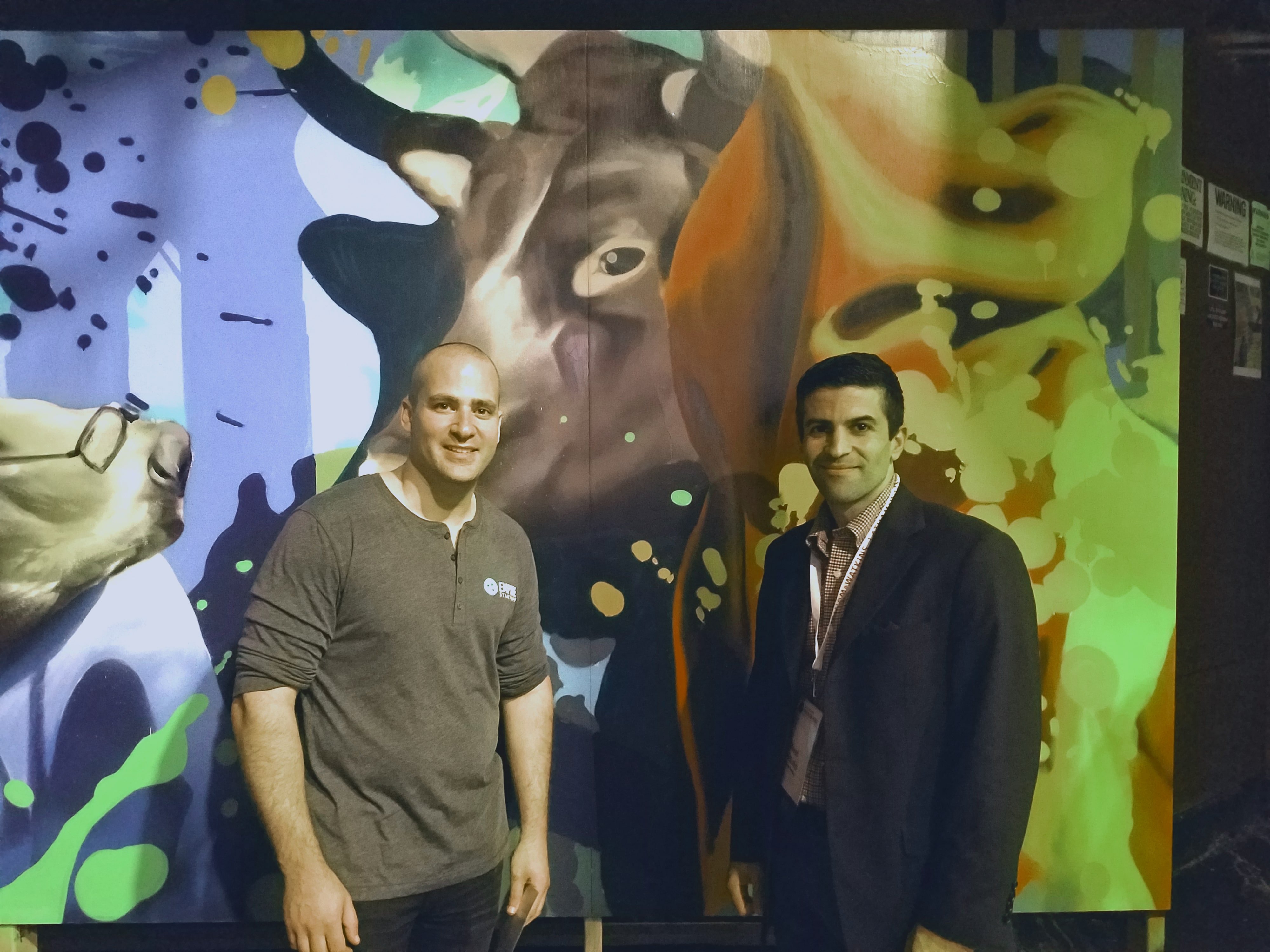
Pictured left, Jon Zanoff, founder of Empire Startups, poses for a photo with Finance Magnates' Editor Steven Hatzakis, pictured right, in front of a Bull/Bear mural that was painted live during the Empire Startups Fintech event in NY on April 26, 2016.
Source: Steven Hatzakis
“Fintech has shifted from disrupting banks - to collaboration.”
Earlier this week on Tuesday, New York-based Empire Startups closed the Nasdaq by ringing the closing bell, and the next morning they hosted a fintech conference at Webster Hall and Finance Magnates reported live from the event.
The event was well-attended in terms of the number of people and diverse range of companies, for example, some of the attendees that Finance Magnates saw included incoming CEO of TD Ameritrade Tim Hockey - who currently holds the role of president - who we had written about last November when it was announced that he was coming over from TD Bank in Canada to replace the current CEO who is set to retire this year.
As emerging startups are often represented by young talent and people fresh out of university who lead innovation with the latest approaches and techniques learned from their school, one attendee at the event was twenty-one years old and studying finance while working for an asset management company, and who had been tasked to scope out the scene. Others said that they attended to get an idea of the current vibe within New York's fintech space.
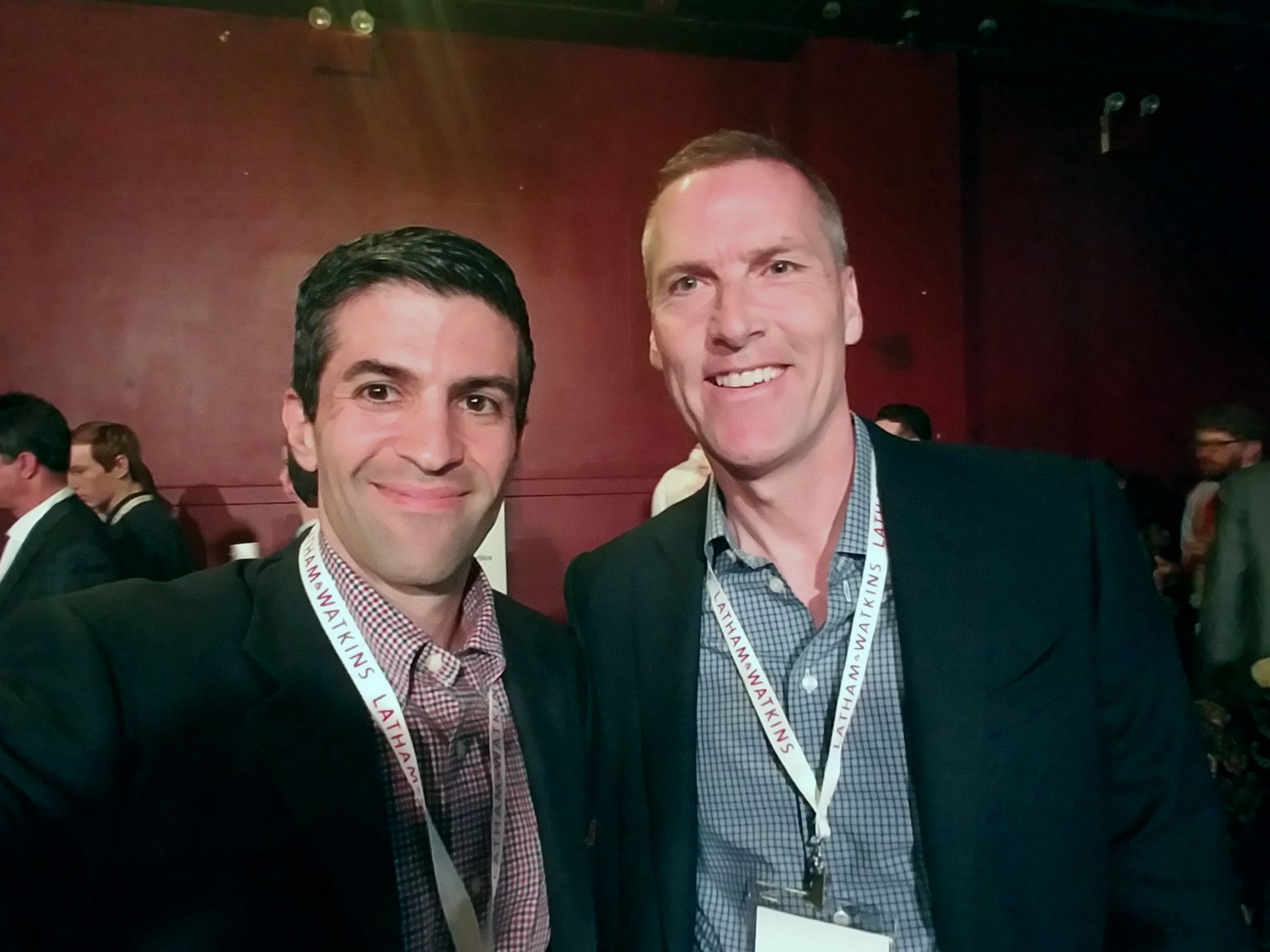
From left to right: Steven Hatzakis, Editor at FinanceMagnates.com and Tim Hockey, President and incoming CEO of TD Ameritrade. Photo shot during Empire Startups Fintech NY event on April 26, 2016. Source: Steven Hatzakis
Tapping the startup ecosystem
The second panel started with the theme of ‘tapping the startup ecosystem for accelerated growth’, and was launched with an introduction form Michael Doody of Thomson Reuters who is responsible for global business development for the company’s new Eikon App Studio arm and covers partnerships and fintech. There were also representatives from Santander, InnoVentures, BBVA, SigFig, and the Fidelity Center for Applied Technology, as part of the list of speakers and the panel’s moderator.
I feel like the market is getting saturated with incubators and accelerators, but at this point the number of accelerators is mind-boggling,
During the panel, one point that came up is the idea that millennials are not as brand sensitive and put more emphasis on building trust and the integrity of the firm and not just how big the brand is or the amounts of money large corporations spend on advertising. And, how the amount of trust alone is not as correlated to the marketing dollars spent.
As the market is becoming saturated with companies calling themselves a blockchain or fintech company, one of the speakers added with regard to the number of startup accelerators: “I feel like the market is getting saturated with incubators and accelerators, but at this point the number of accelerators is mind-boggling,” according to Scarlett Sieber of BBVA speaking on the panel at the event.
Using a sandbox
The use of a sandbox or testing environment where a startup can deploy its product offering in a test mode to see how it would fare in a simulated live market environment was a recurring phrase that came up throughout several panels, and the United Kingdom's Financial Conduct Authority saw praise on its sandbox initiative from some of the event delegates.
Mr. Doody said: "It is difficult [for startups] to get into a large financial institution, and in many cases we have those relationships already," and added how a fintech sandbox is a great place where firms can meet large companies.
One of the exhibitors at the event was a firm that actually goes by the name FinTech Sandbox, a Boston-based non-profit that helps firms get started with their business by providing them with free access for a limited time to otherwise costly data-feed and related services from larger financial companies, and as a means to help foster innovation from bootstrapped startups who are on a limited budget.
it is difficult [for startups] to get into a large financial institution, and in many cases we have those relationships already.
Speaking with Jean Donnelly, Executive Director at FinTech Sandox, she explained that sometimes startups can spend between 40%-50% of their monthly burn on data subscriptions, and how her firm helps remove the friction that startups face by connecting qualified firms to data partners where they can access the data for free - for a period of six months - for example.
Another benefit for the data providers is that they are also sometimes interested in the technology being developed. The company had a demo day at Fidelity's headquarters earlier in March, and is backed by a number of other partners across financial services that help support its sandbox initiative. During a related panel, one person said: “If we had a network of sandboxes around the world, we would have had a different environment for bitcoin.”
From disruption to collaboration
Speaking on the earlier panel, Scarlett Sieber, who is senior vice president of Global Business Development for BBVA, explained: “Fintech has shifted from disrupting banks - to collaboration.”
In addition, one of the speakers said that in the US the regulators are getting closer to where the innovation is happening. This indicates that the typical lag of rules that trail behind new technologies could become shortened as regulatory developments follow more closely alongside innovation in the future.
During the insurance panel it was emphasized how regulators appreciate it when you talk to them early, as opposed to coming in afterwards, as one of the speakers said his firm even engaged with various regulators at the state level, as well as with the treasury, in order to stay up-to-speed as new insurance rules were going into effect.
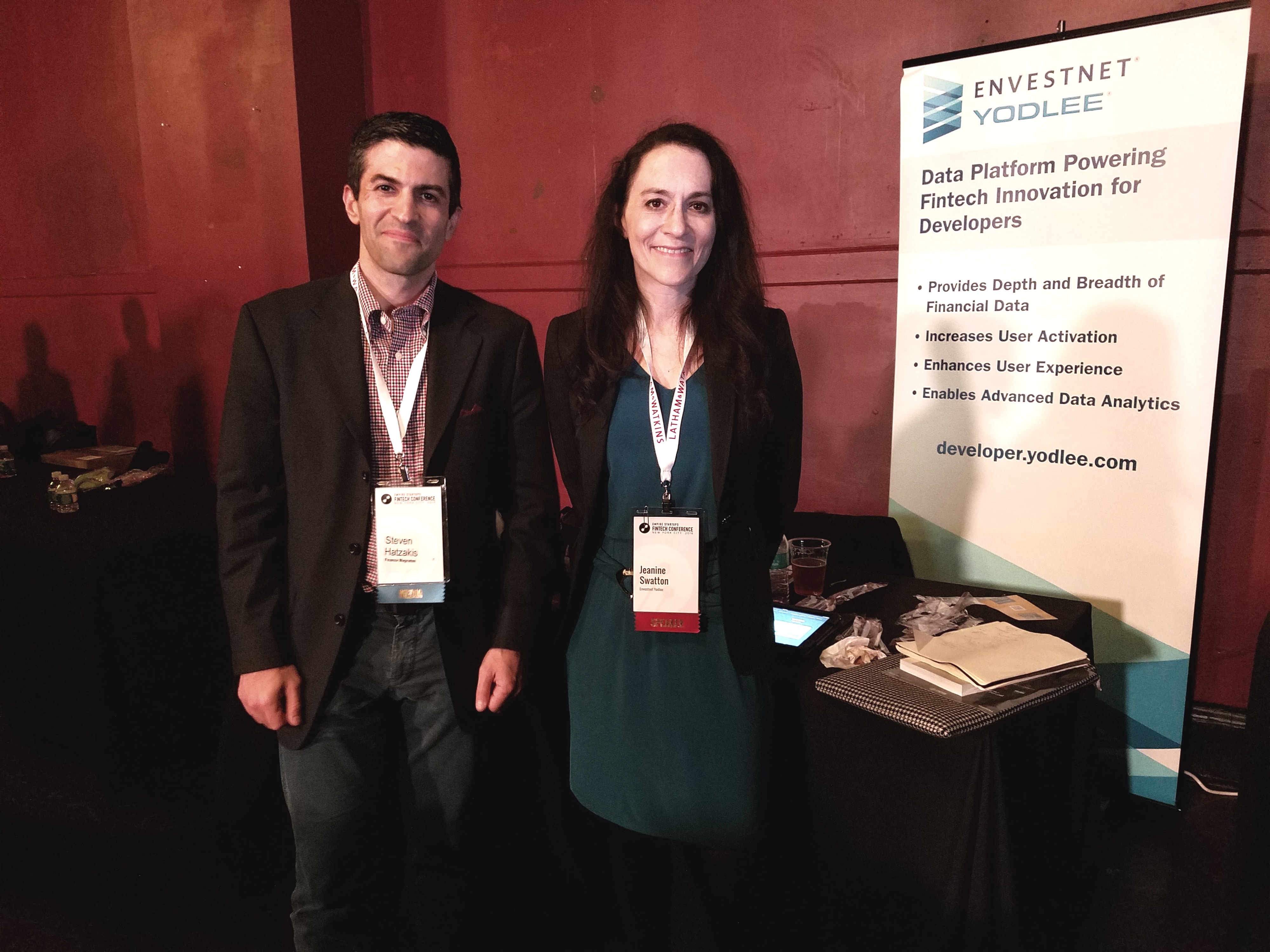
Later in the day, talking with one of the speakers Jeanine Swatton, Director of Developer Evangelism of Envestnet Yodlee, a demo of the company's web platform was shown that enables users to authenticate across a large number of banks using login and authorisation tokens that help developers build out fintech and related apps by accessing and scraping data from among various banks using the company's solution.
Steven Hatzakis (left), Editor at Finance Magnates, and Jeanine Swatton, Director, Developer Evangelism at Envestnet Yodlee. Source: Steven Hatzakis
A.I. and robo-advisory
The number of traders in the US equity markets that are starting to trade other asset classes is increasing and reflected in trading volumes, according to a number of brokerage operators that Finance Magnates reporters spoke with during the event.
The recent win by computer in a game of Go in South Korea, which Finance Magnates wrote about with regard to related news in A.I. and robo-advisors, may seem like nothing major since computers beat grandmaster chess players all the time and for over a decade already, however, one attendee explained that the game of Go is infinitely more complex than chess and how the win happened probably 10-15 years ahead of expectations.
This observation was important as the computing speeds and processing power along with memory are expanding and more than doubling at such an exponential rate that in the next few years there may be a quantum leap that vastly offsets all the prior growth and computing speed progress by many times over. This could also test Moore's law, as it is known in the computer world, as the growth changes from linear to a more non-linear quantum leap.
A talk from Learnvest's CEO, and a RegTech panel was also of great interest, and will be the next follow-up post related to this event, so our readers can stay tuned for that post on Finance Magnates website.
Differentiating between artificial intelligence and automation, somewhere in between lies cognitive computing, which appears to be where the A.I. field is currently hovering around with regard to financial services, although other industries may be more advanced in the space.
Clarity uses approaches such as genetic programming to help achieve machine learning over client data, so that subsequent machine learning is improved as the software gets trained on the data, under guidance from human discretion to account for correcting or matching data fields as needed. During the meeting with clarity at their booth, we stopped for a photo as can be seen below.
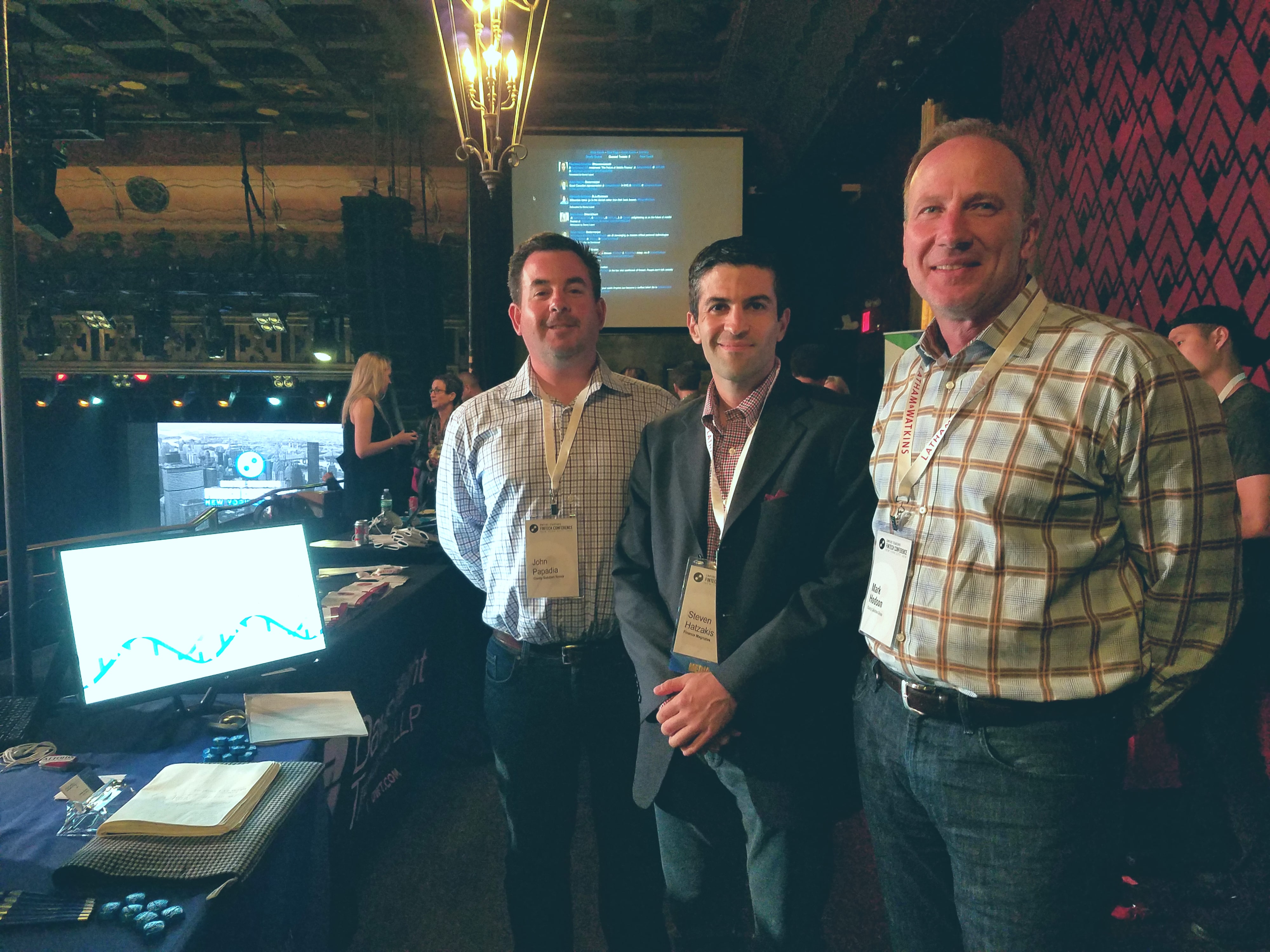
Finance Magnates' Editor Steven Hatzakis (middle) meets with John Papadia (left), President and Founder of Clarity Solutions Group, and Mark Hodson (right), Vice President of Clarity Solutions Group at the company's exhibitor booth at the Empire Startups Fintech NY conference April 28, 2016. Source: Steven Hatzakis
“Fintech has shifted from disrupting banks - to collaboration.”
Earlier this week on Tuesday, New York-based Empire Startups closed the Nasdaq by ringing the closing bell, and the next morning they hosted a fintech conference at Webster Hall and Finance Magnates reported live from the event.
The event was well-attended in terms of the number of people and diverse range of companies, for example, some of the attendees that Finance Magnates saw included incoming CEO of TD Ameritrade Tim Hockey - who currently holds the role of president - who we had written about last November when it was announced that he was coming over from TD Bank in Canada to replace the current CEO who is set to retire this year.
As emerging startups are often represented by young talent and people fresh out of university who lead innovation with the latest approaches and techniques learned from their school, one attendee at the event was twenty-one years old and studying finance while working for an asset management company, and who had been tasked to scope out the scene. Others said that they attended to get an idea of the current vibe within New York's fintech space.
From left to right: Steven Hatzakis, Editor at FinanceMagnates.com and Tim Hockey, President and incoming CEO of TD Ameritrade. Photo shot during Empire Startups Fintech NY event on April 26, 2016. Source: Steven Hatzakis
Tapping the startup ecosystem
The second panel started with the theme of ‘tapping the startup ecosystem for accelerated growth’, and was launched with an introduction form Michael Doody of Thomson Reuters who is responsible for global business development for the company’s new Eikon App Studio arm and covers partnerships and fintech. There were also representatives from Santander, InnoVentures, BBVA, SigFig, and the Fidelity Center for Applied Technology, as part of the list of speakers and the panel’s moderator.
I feel like the market is getting saturated with incubators and accelerators, but at this point the number of accelerators is mind-boggling,
During the panel, one point that came up is the idea that millennials are not as brand sensitive and put more emphasis on building trust and the integrity of the firm and not just how big the brand is or the amounts of money large corporations spend on advertising. And, how the amount of trust alone is not as correlated to the marketing dollars spent.
As the market is becoming saturated with companies calling themselves a blockchain or fintech company, one of the speakers added with regard to the number of startup accelerators: “I feel like the market is getting saturated with incubators and accelerators, but at this point the number of accelerators is mind-boggling,” according to Scarlett Sieber of BBVA speaking on the panel at the event.
Using a sandbox
The use of a sandbox or testing environment where a startup can deploy its product offering in a test mode to see how it would fare in a simulated live market environment was a recurring phrase that came up throughout several panels, and the United Kingdom's Financial Conduct Authority saw praise on its sandbox initiative from some of the event delegates.
Mr. Doody said: "It is difficult [for startups] to get into a large financial institution, and in many cases we have those relationships already," and added how a fintech sandbox is a great place where firms can meet large companies.
One of the exhibitors at the event was a firm that actually goes by the name FinTech Sandbox, a Boston-based non-profit that helps firms get started with their business by providing them with free access for a limited time to otherwise costly data-feed and related services from larger financial companies, and as a means to help foster innovation from bootstrapped startups who are on a limited budget.
it is difficult [for startups] to get into a large financial institution, and in many cases we have those relationships already.
Speaking with Jean Donnelly, Executive Director at FinTech Sandox, she explained that sometimes startups can spend between 40%-50% of their monthly burn on data subscriptions, and how her firm helps remove the friction that startups face by connecting qualified firms to data partners where they can access the data for free - for a period of six months - for example.
Another benefit for the data providers is that they are also sometimes interested in the technology being developed. The company had a demo day at Fidelity's headquarters earlier in March, and is backed by a number of other partners across financial services that help support its sandbox initiative. During a related panel, one person said: “If we had a network of sandboxes around the world, we would have had a different environment for bitcoin.”
From disruption to collaboration
Speaking on the earlier panel, Scarlett Sieber, who is senior vice president of Global Business Development for BBVA, explained: “Fintech has shifted from disrupting banks - to collaboration.”
In addition, one of the speakers said that in the US the regulators are getting closer to where the innovation is happening. This indicates that the typical lag of rules that trail behind new technologies could become shortened as regulatory developments follow more closely alongside innovation in the future.
During the insurance panel it was emphasized how regulators appreciate it when you talk to them early, as opposed to coming in afterwards, as one of the speakers said his firm even engaged with various regulators at the state level, as well as with the treasury, in order to stay up-to-speed as new insurance rules were going into effect.
Later in the day, talking with one of the speakers Jeanine Swatton, Director of Developer Evangelism of Envestnet Yodlee, a demo of the company's web platform was shown that enables users to authenticate across a large number of banks using login and authorisation tokens that help developers build out fintech and related apps by accessing and scraping data from among various banks using the company's solution.
Steven Hatzakis (left), Editor at Finance Magnates, and Jeanine Swatton, Director, Developer Evangelism at Envestnet Yodlee. Source: Steven Hatzakis
A.I. and robo-advisory
The number of traders in the US equity markets that are starting to trade other asset classes is increasing and reflected in trading volumes, according to a number of brokerage operators that Finance Magnates reporters spoke with during the event.
The recent win by computer in a game of Go in South Korea, which Finance Magnates wrote about with regard to related news in A.I. and robo-advisors, may seem like nothing major since computers beat grandmaster chess players all the time and for over a decade already, however, one attendee explained that the game of Go is infinitely more complex than chess and how the win happened probably 10-15 years ahead of expectations.
This observation was important as the computing speeds and processing power along with memory are expanding and more than doubling at such an exponential rate that in the next few years there may be a quantum leap that vastly offsets all the prior growth and computing speed progress by many times over. This could also test Moore's law, as it is known in the computer world, as the growth changes from linear to a more non-linear quantum leap.
A talk from Learnvest's CEO, and a RegTech panel was also of great interest, and will be the next follow-up post related to this event, so our readers can stay tuned for that post on Finance Magnates website.
Differentiating between artificial intelligence and automation, somewhere in between lies cognitive computing, which appears to be where the A.I. field is currently hovering around with regard to financial services, although other industries may be more advanced in the space.
Clarity uses approaches such as genetic programming to help achieve machine learning over client data, so that subsequent machine learning is improved as the software gets trained on the data, under guidance from human discretion to account for correcting or matching data fields as needed. During the meeting with clarity at their booth, we stopped for a photo as can be seen below.
Finance Magnates' Editor Steven Hatzakis (middle) meets with John Papadia (left), President and Founder of Clarity Solutions Group, and Mark Hodson (right), Vice President of Clarity Solutions Group at the company's exhibitor booth at the Empire Startups Fintech NY conference April 28, 2016. Source: Steven Hatzakis
Visa Brings Stablecoins to Main Street Banking With U.S. Rollout
Featured Videos
Executive Interview | Charlotte Bullock | Chief Product Officer, Bank of London | FMLS:25
In this interview, we sat down with Charlotte Bullock, Head of Product at The Bank of London, previously at SAP and now shaping product at one of the sector’s most ambitious new banking players.
Charlotte reflects on the Summit so far and talks about the culture inside fintech banks today. We look at the pressures that come with scaling, and how firms can hold onto the nimble approach that made them stand out early on.
We also cover the state of payments ahead of her appearance on the payments roundtable: the blockages financial firms face, the areas that still need fixing, and what a realistic solution looks like in 2026.
In this interview, we sat down with Charlotte Bullock, Head of Product at The Bank of London, previously at SAP and now shaping product at one of the sector’s most ambitious new banking players.
Charlotte reflects on the Summit so far and talks about the culture inside fintech banks today. We look at the pressures that come with scaling, and how firms can hold onto the nimble approach that made them stand out early on.
We also cover the state of payments ahead of her appearance on the payments roundtable: the blockages financial firms face, the areas that still need fixing, and what a realistic solution looks like in 2026.
In this interview, we sat down with Charlotte Bullock, Head of Product at The Bank of London, previously at SAP and now shaping product at one of the sector’s most ambitious new banking players.
Charlotte reflects on the Summit so far and talks about the culture inside fintech banks today. We look at the pressures that come with scaling, and how firms can hold onto the nimble approach that made them stand out early on.
We also cover the state of payments ahead of her appearance on the payments roundtable: the blockages financial firms face, the areas that still need fixing, and what a realistic solution looks like in 2026.
In this interview, we sat down with Charlotte Bullock, Head of Product at The Bank of London, previously at SAP and now shaping product at one of the sector’s most ambitious new banking players.
Charlotte reflects on the Summit so far and talks about the culture inside fintech banks today. We look at the pressures that come with scaling, and how firms can hold onto the nimble approach that made them stand out early on.
We also cover the state of payments ahead of her appearance on the payments roundtable: the blockages financial firms face, the areas that still need fixing, and what a realistic solution looks like in 2026.
In this conversation, we sit down with Drew Niv, CSO at ATFX Connect and one of the most influential figures in modern FX.
We speak about market structure, the institutional view on liquidity, and the sharp rise of prop trading, a sector Drew has been commenting on in recent months. Drew explains why he once dismissed prop trading, why his view changed, and what he now thinks the model means for brokers, clients and risk managers.
We explore subscription-fee dependency, the high reneging rate, and the long-term challenge: how brokers can build a more stable and honest version of the model. Drew also talks about the traffic advantage standalone prop firms have built and why brokers may still win in the long run if they take the right approach.
In this conversation, we sit down with Drew Niv, CSO at ATFX Connect and one of the most influential figures in modern FX.
We speak about market structure, the institutional view on liquidity, and the sharp rise of prop trading, a sector Drew has been commenting on in recent months. Drew explains why he once dismissed prop trading, why his view changed, and what he now thinks the model means for brokers, clients and risk managers.
We explore subscription-fee dependency, the high reneging rate, and the long-term challenge: how brokers can build a more stable and honest version of the model. Drew also talks about the traffic advantage standalone prop firms have built and why brokers may still win in the long run if they take the right approach.
In this conversation, we sit down with Drew Niv, CSO at ATFX Connect and one of the most influential figures in modern FX.
We speak about market structure, the institutional view on liquidity, and the sharp rise of prop trading, a sector Drew has been commenting on in recent months. Drew explains why he once dismissed prop trading, why his view changed, and what he now thinks the model means for brokers, clients and risk managers.
We explore subscription-fee dependency, the high reneging rate, and the long-term challenge: how brokers can build a more stable and honest version of the model. Drew also talks about the traffic advantage standalone prop firms have built and why brokers may still win in the long run if they take the right approach.
In this conversation, we sit down with Drew Niv, CSO at ATFX Connect and one of the most influential figures in modern FX.
We speak about market structure, the institutional view on liquidity, and the sharp rise of prop trading, a sector Drew has been commenting on in recent months. Drew explains why he once dismissed prop trading, why his view changed, and what he now thinks the model means for brokers, clients and risk managers.
We explore subscription-fee dependency, the high reneging rate, and the long-term challenge: how brokers can build a more stable and honest version of the model. Drew also talks about the traffic advantage standalone prop firms have built and why brokers may still win in the long run if they take the right approach.
In this conversation, we sit down with Drew Niv, CSO at ATFX Connect and one of the most influential figures in modern FX.
We speak about market structure, the institutional view on liquidity, and the sharp rise of prop trading, a sector Drew has been commenting on in recent months. Drew explains why he once dismissed prop trading, why his view changed, and what he now thinks the model means for brokers, clients and risk managers.
We explore subscription-fee dependency, the high reneging rate, and the long-term challenge: how brokers can build a more stable and honest version of the model. Drew also talks about the traffic advantage standalone prop firms have built and why brokers may still win in the long run if they take the right approach.
In this conversation, we sit down with Drew Niv, CSO at ATFX Connect and one of the most influential figures in modern FX.
We speak about market structure, the institutional view on liquidity, and the sharp rise of prop trading, a sector Drew has been commenting on in recent months. Drew explains why he once dismissed prop trading, why his view changed, and what he now thinks the model means for brokers, clients and risk managers.
We explore subscription-fee dependency, the high reneging rate, and the long-term challenge: how brokers can build a more stable and honest version of the model. Drew also talks about the traffic advantage standalone prop firms have built and why brokers may still win in the long run if they take the right approach.
Executive Interview | Remonda Z. Kirketerp Møller| CEO & Founder Muinmos | FMLS:25
In this interview, Remonda Z. Kirketerp Møller, founder of Muinmos, breaks down the state of AI in regtech and what responsible adoption really looks like for brokers. We talk about rising fragmentation, the pressures around compliance accuracy, and why most firms are still in the early stages of AI maturity.
Ramanda also shares insights on regulator sandboxes, shifting expectations around accountability, and the current reality of MiCA licensing and passporting in Europe.
A concise look at where compliance, onboarding, and AI-driven processes are heading next.
In this interview, Remonda Z. Kirketerp Møller, founder of Muinmos, breaks down the state of AI in regtech and what responsible adoption really looks like for brokers. We talk about rising fragmentation, the pressures around compliance accuracy, and why most firms are still in the early stages of AI maturity.
Ramanda also shares insights on regulator sandboxes, shifting expectations around accountability, and the current reality of MiCA licensing and passporting in Europe.
A concise look at where compliance, onboarding, and AI-driven processes are heading next.
In this interview, Remonda Z. Kirketerp Møller, founder of Muinmos, breaks down the state of AI in regtech and what responsible adoption really looks like for brokers. We talk about rising fragmentation, the pressures around compliance accuracy, and why most firms are still in the early stages of AI maturity.
Ramanda also shares insights on regulator sandboxes, shifting expectations around accountability, and the current reality of MiCA licensing and passporting in Europe.
A concise look at where compliance, onboarding, and AI-driven processes are heading next.
In this interview, Remonda Z. Kirketerp Møller, founder of Muinmos, breaks down the state of AI in regtech and what responsible adoption really looks like for brokers. We talk about rising fragmentation, the pressures around compliance accuracy, and why most firms are still in the early stages of AI maturity.
Ramanda also shares insights on regulator sandboxes, shifting expectations around accountability, and the current reality of MiCA licensing and passporting in Europe.
A concise look at where compliance, onboarding, and AI-driven processes are heading next.
In this interview, Remonda Z. Kirketerp Møller, founder of Muinmos, breaks down the state of AI in regtech and what responsible adoption really looks like for brokers. We talk about rising fragmentation, the pressures around compliance accuracy, and why most firms are still in the early stages of AI maturity.
Ramanda also shares insights on regulator sandboxes, shifting expectations around accountability, and the current reality of MiCA licensing and passporting in Europe.
A concise look at where compliance, onboarding, and AI-driven processes are heading next.
In this interview, Remonda Z. Kirketerp Møller, founder of Muinmos, breaks down the state of AI in regtech and what responsible adoption really looks like for brokers. We talk about rising fragmentation, the pressures around compliance accuracy, and why most firms are still in the early stages of AI maturity.
Ramanda also shares insights on regulator sandboxes, shifting expectations around accountability, and the current reality of MiCA licensing and passporting in Europe.
A concise look at where compliance, onboarding, and AI-driven processes are heading next.
In this conversation, we speak with Aydin Bonabi, CEO and co-founder of Surveill, a firm focused on fraud detection and AI-driven compliance tools for financial institutions.
We start with Aydin’s view of the Summit and the challenges brokers face as fraud tactics grow more complex. He explains how firms can stay ahead through real-time signals, data patterns, and early-stage detection.
We also talk about AI training and why compliance teams often struggle to keep models accurate, fair, and aligned with regulatory expectations. Aydin breaks down what “good” AI training looks like inside a financial environment, including the importance of clean data, domain expertise, and human oversight.
He closes with a clear message: fraud is scaling, and so must the tools that stop it.
In this conversation, we speak with Aydin Bonabi, CEO and co-founder of Surveill, a firm focused on fraud detection and AI-driven compliance tools for financial institutions.
We start with Aydin’s view of the Summit and the challenges brokers face as fraud tactics grow more complex. He explains how firms can stay ahead through real-time signals, data patterns, and early-stage detection.
We also talk about AI training and why compliance teams often struggle to keep models accurate, fair, and aligned with regulatory expectations. Aydin breaks down what “good” AI training looks like inside a financial environment, including the importance of clean data, domain expertise, and human oversight.
He closes with a clear message: fraud is scaling, and so must the tools that stop it.
In this conversation, we speak with Aydin Bonabi, CEO and co-founder of Surveill, a firm focused on fraud detection and AI-driven compliance tools for financial institutions.
We start with Aydin’s view of the Summit and the challenges brokers face as fraud tactics grow more complex. He explains how firms can stay ahead through real-time signals, data patterns, and early-stage detection.
We also talk about AI training and why compliance teams often struggle to keep models accurate, fair, and aligned with regulatory expectations. Aydin breaks down what “good” AI training looks like inside a financial environment, including the importance of clean data, domain expertise, and human oversight.
He closes with a clear message: fraud is scaling, and so must the tools that stop it.
In this conversation, we speak with Aydin Bonabi, CEO and co-founder of Surveill, a firm focused on fraud detection and AI-driven compliance tools for financial institutions.
We start with Aydin’s view of the Summit and the challenges brokers face as fraud tactics grow more complex. He explains how firms can stay ahead through real-time signals, data patterns, and early-stage detection.
We also talk about AI training and why compliance teams often struggle to keep models accurate, fair, and aligned with regulatory expectations. Aydin breaks down what “good” AI training looks like inside a financial environment, including the importance of clean data, domain expertise, and human oversight.
He closes with a clear message: fraud is scaling, and so must the tools that stop it.
In this conversation, we speak with Aydin Bonabi, CEO and co-founder of Surveill, a firm focused on fraud detection and AI-driven compliance tools for financial institutions.
We start with Aydin’s view of the Summit and the challenges brokers face as fraud tactics grow more complex. He explains how firms can stay ahead through real-time signals, data patterns, and early-stage detection.
We also talk about AI training and why compliance teams often struggle to keep models accurate, fair, and aligned with regulatory expectations. Aydin breaks down what “good” AI training looks like inside a financial environment, including the importance of clean data, domain expertise, and human oversight.
He closes with a clear message: fraud is scaling, and so must the tools that stop it.
In this conversation, we speak with Aydin Bonabi, CEO and co-founder of Surveill, a firm focused on fraud detection and AI-driven compliance tools for financial institutions.
We start with Aydin’s view of the Summit and the challenges brokers face as fraud tactics grow more complex. He explains how firms can stay ahead through real-time signals, data patterns, and early-stage detection.
We also talk about AI training and why compliance teams often struggle to keep models accurate, fair, and aligned with regulatory expectations. Aydin breaks down what “good” AI training looks like inside a financial environment, including the importance of clean data, domain expertise, and human oversight.
He closes with a clear message: fraud is scaling, and so must the tools that stop it.
Exness expands its presence in Africa: Inside our interview with Paul Margarites in Cape Town
Finance Magnates met with Paul Margarites, Exness regional commercial director for Sub-Saharan Africa, during a visit to the firm’s office opening in Cape Town. In this talk, led by Andrea Badiola Mateos, Co-CEO at Finance Magnates, Paul shares views on the South African trading space, local user behavior, mobile trends, regulation, team growth, and how Exness plans to grow in more markets across the region. @Exness
Read the article at: https://www.financemagnates.com/thought-leadership/exness-expands-its-presence-in-africa-inside-our-interview-with-paul-margarites/
#exness #financemagnates #exnesstrading #CFDtrading #tradeonline #africanews #capetown
Finance Magnates met with Paul Margarites, Exness regional commercial director for Sub-Saharan Africa, during a visit to the firm’s office opening in Cape Town. In this talk, led by Andrea Badiola Mateos, Co-CEO at Finance Magnates, Paul shares views on the South African trading space, local user behavior, mobile trends, regulation, team growth, and how Exness plans to grow in more markets across the region. @Exness
Read the article at: https://www.financemagnates.com/thought-leadership/exness-expands-its-presence-in-africa-inside-our-interview-with-paul-margarites/
#exness #financemagnates #exnesstrading #CFDtrading #tradeonline #africanews #capetown
Finance Magnates met with Paul Margarites, Exness regional commercial director for Sub-Saharan Africa, during a visit to the firm’s office opening in Cape Town. In this talk, led by Andrea Badiola Mateos, Co-CEO at Finance Magnates, Paul shares views on the South African trading space, local user behavior, mobile trends, regulation, team growth, and how Exness plans to grow in more markets across the region. @Exness
Read the article at: https://www.financemagnates.com/thought-leadership/exness-expands-its-presence-in-africa-inside-our-interview-with-paul-margarites/
#exness #financemagnates #exnesstrading #CFDtrading #tradeonline #africanews #capetown
Finance Magnates met with Paul Margarites, Exness regional commercial director for Sub-Saharan Africa, during a visit to the firm’s office opening in Cape Town. In this talk, led by Andrea Badiola Mateos, Co-CEO at Finance Magnates, Paul shares views on the South African trading space, local user behavior, mobile trends, regulation, team growth, and how Exness plans to grow in more markets across the region. @Exness
Read the article at: https://www.financemagnates.com/thought-leadership/exness-expands-its-presence-in-africa-inside-our-interview-with-paul-margarites/
#exness #financemagnates #exnesstrading #CFDtrading #tradeonline #africanews #capetown
Finance Magnates met with Paul Margarites, Exness regional commercial director for Sub-Saharan Africa, during a visit to the firm’s office opening in Cape Town. In this talk, led by Andrea Badiola Mateos, Co-CEO at Finance Magnates, Paul shares views on the South African trading space, local user behavior, mobile trends, regulation, team growth, and how Exness plans to grow in more markets across the region. @Exness
Read the article at: https://www.financemagnates.com/thought-leadership/exness-expands-its-presence-in-africa-inside-our-interview-with-paul-margarites/
#exness #financemagnates #exnesstrading #CFDtrading #tradeonline #africanews #capetown
Finance Magnates met with Paul Margarites, Exness regional commercial director for Sub-Saharan Africa, during a visit to the firm’s office opening in Cape Town. In this talk, led by Andrea Badiola Mateos, Co-CEO at Finance Magnates, Paul shares views on the South African trading space, local user behavior, mobile trends, regulation, team growth, and how Exness plans to grow in more markets across the region. @Exness
Read the article at: https://www.financemagnates.com/thought-leadership/exness-expands-its-presence-in-africa-inside-our-interview-with-paul-margarites/
#exness #financemagnates #exnesstrading #CFDtrading #tradeonline #africanews #capetown