Tesla shares dropped 7% in two days following President Trump's threat to investigate Elon Musk's government subsidies.
Wall Street analysts remain deeply divided, with 2025 price targets ranging from $249 to $1,109.
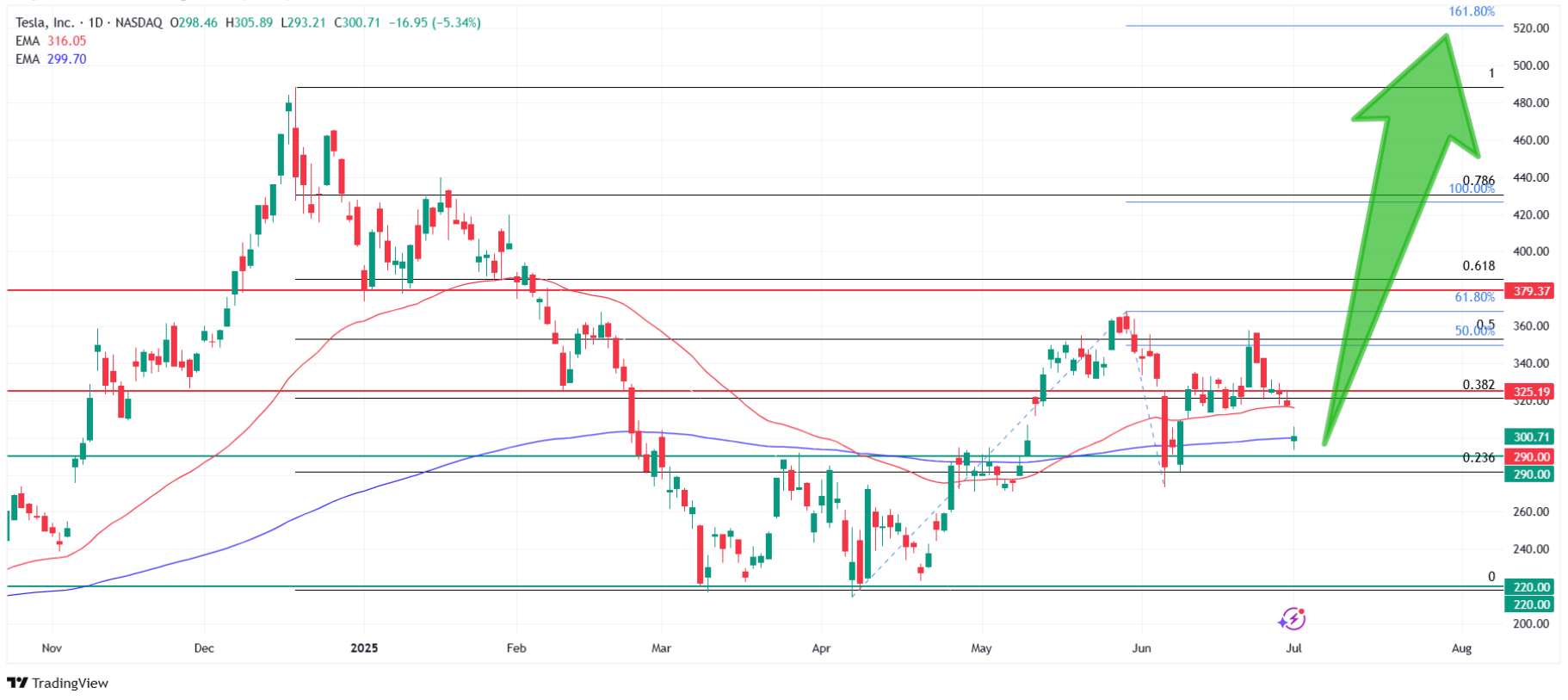
My technical analysis and Tesla price prediction show that the stock may go up more than 70% in the mid-term.
Elon Musk's pay deal is being voted on this Thursday.
Tesla share
price (NASDAQ: TSLA) plummeted 7% in just two trading days, dropping from
$323.63 on Friday to $300.71 by Tuesday's close, as investors grappled with a
renewed feud between CEO Elon Musk and President Donald Trump.
The
electric vehicle giant now faces a perfect storm of political uncertainty and
disappointing delivery expectations, creating significant headwinds for the
stock that had surged 90% in June 2025.
The timing
couldn't be worse for Tesla, with the company set to report second-quarter
delivery figures on Wednesday morning. Wall Street analysts anticipate
deliveries of approximately 387,000 vehicles, representing a 13% year-over-year
decline from the nearly 444,000 deliveries reported in the same period last
year.
Let’s check why Tesla stock is down today and what the newest Tesla share price predictions are for 2025 and beyond.
Tesla news: Political Feud
Triggers Immediate Selloff
The latest
Tesla stock decline stems directly from President Trump's explosive Truth
Social post on Monday night, where he suggested the Department of Government
Efficiency should investigate Musk's subsidies.
“Elon
may get more subsidy than any human being in history, by far, and without
subsidies, Elon would probably have to close up shop and head back home to
South Africa,” Trump declared.
This public
confrontation marks the second major political clash between the two figures in
2025. The previous feud in early June caused Tesla shares to sink 18% in a
single day before recovering some losses. However, the current dispute appears
more serious, with Trump explicitly threatening to target Musk's business
empire through government policy changes.
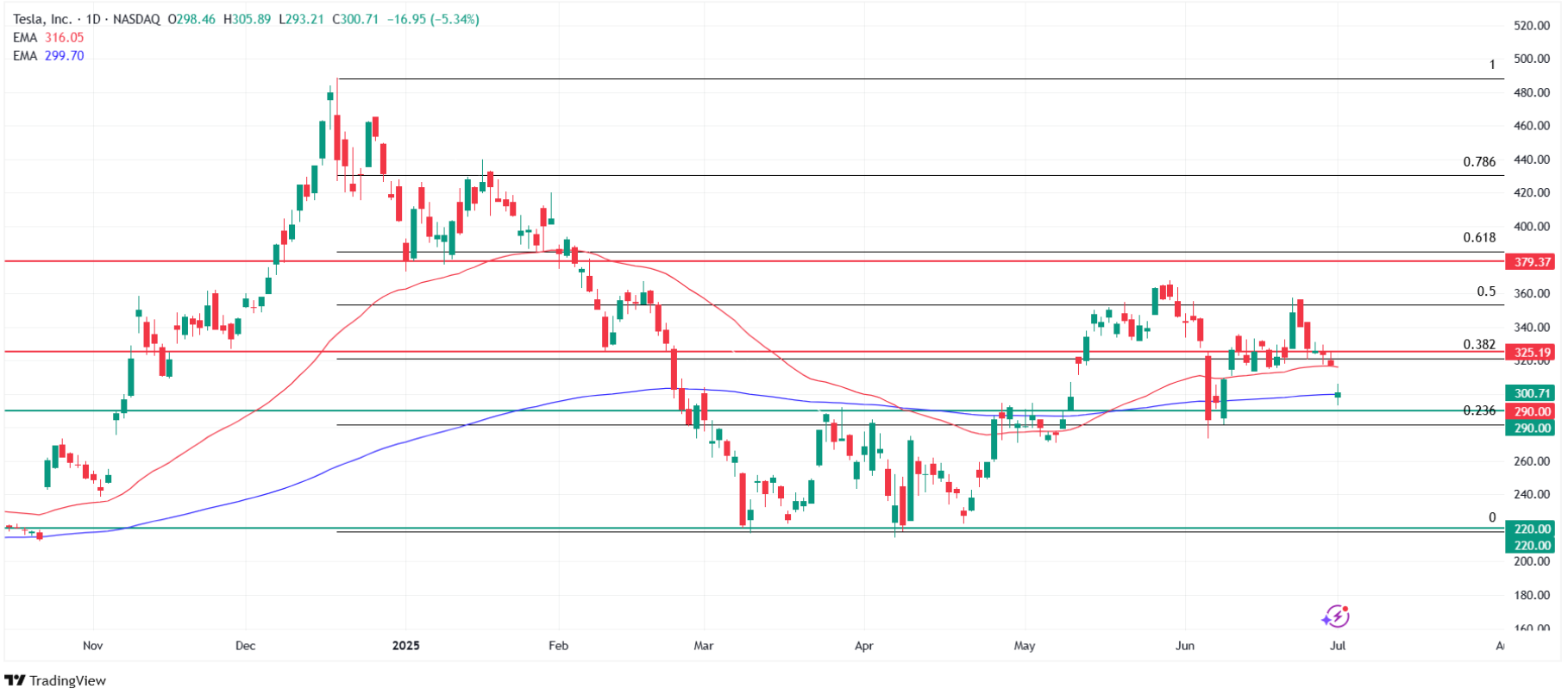
Tesla stock price today is down by more than 7%. Source: Tradingview.com
The
president's comments carry particular weight given Tesla's heavy reliance on
government support. The company has reported $11.8 billion in automotive
regulatory credit sales since 2015, with these credits accounting for
approximately 60% of Tesla's net income in Q2 2024. Meanwhile, SpaceX has
received over $22 billion in federal contracts since 2008, highlighting the
vulnerability of Musk's business empire to political winds.
Why Tesla Stock Is Down
Today? Delivery Disappointment Looms Large
Beyond
political drama, Tesla faces fundamental business challenges that explain why
the stock continues declining. UBS maintains a “sell” rating with a
target price of just $215 per share, projecting Q2 deliveries of approximately
366,000 units—an 18% year-over-year decrease.
The
delivery decline reflects broader struggles in Tesla's core automotive
business. European sales dropped 45% in January compared to the previous year,
while reports indicate declining sales in China and Australia. Even in
California, Tesla's home market, the company's EV market share has fallen below
50% for the first time, signaling intensifying competition.
Tesla's
automotive margins have also compressed significantly from post-pandemic highs.
The company's Q4 2024 automotive revenue decreased 8% year-over-year to $19.8
billion, while operating profit fell 23% to $1.6 billion. These margin
pressures stem from aggressive price cuts implemented to maintain market share
amid growing competition.
Metric
Current
Performance
Year-over-Year
Change
Impact
Q2 2025
Delivery Projection
366,000 units
(UBS estimate)
-18% decline
Significant
demand weakness
European
Sales (January)
9,913 units
-45% decline
Major
regional market loss
California
Market Share
Below 50%
First time
under 50%
Home market
erosion
Q4 2024
Automotive Revenue
$19.8 billion
-8% decline
Core business
contraction
Q4 2024
Operating Profit
$1.6 billion
-23% decline
Margin
compression impact
UBS Price
Target
$215 per
share
“Sell”
rating
Bearish
analyst outlook
Market Forces Beyond
Tesla's Control
Tesla's
stock decline reflects broader market dynamics that extend beyond
company-specific factors. The S&P 500 dropped 9.28% in Q2 2025, creating
headwinds for growth stocks like Tesla. Additionally, ongoing U.S.-China trade
tensions and macroeconomic uncertainties continue pressuring the automotive
sector.
The
proposed “One Big Beautiful Bill” legislation adds another layer of
uncertainty. The spending bill includes provisions that would cut hundreds of
billions in renewable energy support and phase out EV tax credits, potentially
reducing Tesla sales by approximately 100,000 vehicles annually by 2035. These
policy changes could significantly impact both Tesla's automotive and energy
storage divisions.
TSLA Technical Analysis
Points to New All-Time High
The stock's
technical indicators signal potential weakness. After reaching an all-time high
of $320 per share in December 2024 following Trump's election victory, Tesla
has now declined 38.20% from those peaks. The year-to-date performance shows a
22% decline, despite the remarkable June surge that temporarily boosted
investor confidence.
However, based
on my technical analysis, Tesla's stock price is currently testing a critical
level, the psychological barrier of $300. This level is further reinforced by
the 200-period exponential moving average (EMA). It's also worth noting that
the price action is unfolding within a broader support zone, defined by the
$290 level, which aligns with local highs from March and April of this year.
This zone is further strengthened by the 23.6% Fibonacci retracement level,
measured from the downward trend that began in late December 2024 and extended
to the April 2025 lows.
This area
marks the lower boundary of a consolidation range that stretches down to around
$280, as last adjusted in early June. The upper boundary of this structure
currently lies near $317, and it is within this range that Tesla shares are now
moving—and likely will continue to move in the near term. A breakout above this
range would require the price to reclaim the 200 EMA, followed by the 50-day
moving average and then challenge the next resistance zone between $320 and
$325.
The
technical outlook also presents a strongly bullish scenario when using
Fibonacci extensions based on the previous upward trend. According to this
model, the target area for Tesla’s stock price lies above $520, which
corresponds to the 161.8% Fibonacci extension. Reaching this level would imply
a breakout above the previous all-time high from December, located around $488,
and suggest a potential upside of more than 70% from current levels.
How high can Tesla shares go? Source: Tradingview.com
Tesla Share Price
Prediction: Analyst Perspectives Remain Divided
Despite
current challenges, some analysts maintain optimistic long-term views on Tesla.
The company's forward P/E ratio of 62 reflects continued investor confidence in
AI-driven growth prospects, particularly around Full Self-Driving technology
and robotaxi services. Tesla's recent launch of limited robotaxi service in
Austin, Texas, generated initial enthusiasm before political concerns
overshadowed operational progress.
However,
valuation concerns persist. Tesla trades at a P/E ratio of 120 compared to the
industry average of 15, making the stock vulnerable to any disappointment in
growth expectations. Wells Fargo previously predicted a 61% stock price drop
due to fundamental business challenges, though Tesla's Q1 2025 earnings helped
stabilize sentiment temporarily.
The analyst
community remains split on Tesla's prospects, with 16 analysts rating it a
“Buy,” 10 rating it “Hold,” and 11 rating it
“Sell” out of 37 total coverage. The median Wall Street price target
of $285.97 suggests potential downside from current levels, though several
prominent firms maintain significantly higher targets.
2025 Tesla Stock Price
Predictions by Major Analysts
Forecaster
2025 Price
Target ($)
Rating/Outlook
Economy
Forecast Agency
$1,109
Very high target, extreme bullish
Wedbush
$515–$650
Price range, AI/robotaxi optimism
Mizuho
Securities
$515
Upgraded
target, positive recalibration
Baird
$480
Optimistic,
71% increase from previous
Morgan
Stanley
$410
Buy rating,
32.86% upside potential
24/7 Wall
St.
$352.99
Bullish,
19.65% upside
UBS
$291.31
Median
target, 1.25% downside
U.S. News
$249.76
Solemn
outlook, bearish perspective
The wide
divergence in analyst opinions stems from differing views on Tesla's core
business transformation. Bulls like Wedbush maintain price targets up to
$650, citing the company's AI initiatives and potential regulatory
fast-tracking of robotaxi services under the Trump administration. Conversely,
bears point to intensifying competition and margin compression as reasons for
more conservative targets.
Morgan
Stanley's Adam Jonas recently reiterated his $410 price target with a
“Buy” rating, arguing that recent EV tax-credit cuts won't
significantly impact Tesla's long-term trajectory. The firm believes Tesla's
strengths in AI, robotics, and renewable energy infrastructure will
drive future growth despite near-term political headwinds.
Looking Ahead: Key
Catalysts and Risks for Tesla
Tesla's
immediate future hinges on several critical factors. Wednesday's Q2 delivery
report will provide crucial insight into demand trends and competitive
positioning. The company's Q2 2025 earnings call, scheduled for July 29, will
offer management's perspective on political risks and business fundamentals.
The
resolution of the Trump-Musk feud remains paramount for investor confidence. As
Wedbush analyst Dan Ives noted, the political tension “puts massive
pressure on Tesla shares with fears that Trump will turn from friend to foe and
create a tough regulatory environment.”
Tesla's
robotaxi expansion and FSD technology development continue as long-term growth
drivers. The company reported a 25% increase in FSD subscription rates in Q1,
suggesting growing consumer acceptance of autonomous driving features. However,
regulatory approval for fully autonomous vehicles remains subject to political
considerations.
Tesla stock
faces a challenging period as political uncertainty compounds fundamental
business headwinds. The combination of declining deliveries, margin pressure,
and potential subsidy cuts creates a perfect storm for continued weakness.
While long-term AI and energy opportunities remain compelling, near-term
catalysts appear limited until political tensions resolve and delivery trends
stabilize.
Investors
should monitor Wednesday's delivery announcement closely, as disappointing
figures could accelerate the current decline toward UBS's $215 target price.
Conversely, better-than-expected deliveries might provide temporary relief,
though structural challenges in the EV market and political risks will likely
continue weighing on the stock throughout 2025.
Tesla News FAQ
Why Has Tesla Stock Been
Going Down?
Tesla stock
has declined 7% in just two trading days due to a perfect storm of factors. The
primary catalyst is the renewed political feud between CEO Elon Musk and
President Trump, triggered by Trump's Truth Social post threatening to cut
Musk's subsidies.
Why Is Tesla Losing?
Tesla is
facing multiple headwinds that explain its recent struggles. The company's
European sales dropped 45% in January compared to the previous year, while its
California market share has fallen below 50% for the first time. Tesla's
automotive revenue decreased 8% year-over-year to $19.8 billion in Q4 2024,
with operating profit falling 23% to $1.6 billion.
How Much Will Tesla Stock
Be Worth in 2025?
Analyst
predictions for Tesla's 2025 stock price vary dramatically, ranging from a
bearish $249.76 to an extremely bullish $1,109. The median Wall Street price
target sits at $285.97, suggesting potential downside from current levels.
Major firms show significant divergence: Wedbush maintains targets up to $650,
Morgan Stanley projects $410, while UBS forecasts $291.31. The wide spread of
$859.24 between the highest and lowest targets reflects fundamental uncertainty
about Tesla's trajectory amid political turmoil and evolving market dynamics.
Is Tesla Stock Predicted
to Go Up?
Analyst
opinions remain deeply divided on Tesla's direction. Out of 37 analysts
covering the stock, 16 rate it a “Buy,” 10 rate it “Hold,”
and 11 rate it “Sell”. Bulls like Wedbush cite AI initiatives and
potential regulatory fast-tracking of robotaxi services, while bears point to
intensifying competition and margin compression. The median price target of
$285.97 suggests limited upside potential, though some firms like Morgan
Stanley maintain “Buy” ratings with 32.86% upside potential.
What Is the 12 Month Stock
Forecast for Tesla?
The
12-month outlook for Tesla remains highly uncertain given current political and
business challenges. Revenue projections show more consensus, with analysts
collectively forecasting a 17.5% increase to $117.2 billion for 2025. However,
delivery estimates vary significantly, with Barclays projecting 1.95 million
units compared to Bloomberg's consensus of 2.08 million.
Tesla share
price (NASDAQ: TSLA) plummeted 7% in just two trading days, dropping from
$323.63 on Friday to $300.71 by Tuesday's close, as investors grappled with a
renewed feud between CEO Elon Musk and President Donald Trump.
The
electric vehicle giant now faces a perfect storm of political uncertainty and
disappointing delivery expectations, creating significant headwinds for the
stock that had surged 90% in June 2025.
The timing
couldn't be worse for Tesla, with the company set to report second-quarter
delivery figures on Wednesday morning. Wall Street analysts anticipate
deliveries of approximately 387,000 vehicles, representing a 13% year-over-year
decline from the nearly 444,000 deliveries reported in the same period last
year.
Let’s check why Tesla stock is down today and what the newest Tesla share price predictions are for 2025 and beyond.
Tesla news: Political Feud
Triggers Immediate Selloff
The latest
Tesla stock decline stems directly from President Trump's explosive Truth
Social post on Monday night, where he suggested the Department of Government
Efficiency should investigate Musk's subsidies.
“Elon
may get more subsidy than any human being in history, by far, and without
subsidies, Elon would probably have to close up shop and head back home to
South Africa,” Trump declared.
This public
confrontation marks the second major political clash between the two figures in
2025. The previous feud in early June caused Tesla shares to sink 18% in a
single day before recovering some losses. However, the current dispute appears
more serious, with Trump explicitly threatening to target Musk's business
empire through government policy changes.
Tesla stock price today is down by more than 7%. Source: Tradingview.com
The
president's comments carry particular weight given Tesla's heavy reliance on
government support. The company has reported $11.8 billion in automotive
regulatory credit sales since 2015, with these credits accounting for
approximately 60% of Tesla's net income in Q2 2024. Meanwhile, SpaceX has
received over $22 billion in federal contracts since 2008, highlighting the
vulnerability of Musk's business empire to political winds.
Why Tesla Stock Is Down
Today? Delivery Disappointment Looms Large
Beyond
political drama, Tesla faces fundamental business challenges that explain why
the stock continues declining. UBS maintains a “sell” rating with a
target price of just $215 per share, projecting Q2 deliveries of approximately
366,000 units—an 18% year-over-year decrease.
The
delivery decline reflects broader struggles in Tesla's core automotive
business. European sales dropped 45% in January compared to the previous year,
while reports indicate declining sales in China and Australia. Even in
California, Tesla's home market, the company's EV market share has fallen below
50% for the first time, signaling intensifying competition.
Tesla's
automotive margins have also compressed significantly from post-pandemic highs.
The company's Q4 2024 automotive revenue decreased 8% year-over-year to $19.8
billion, while operating profit fell 23% to $1.6 billion. These margin
pressures stem from aggressive price cuts implemented to maintain market share
amid growing competition.
Metric
Current
Performance
Year-over-Year
Change
Impact
Q2 2025
Delivery Projection
366,000 units
(UBS estimate)
-18% decline
Significant
demand weakness
European
Sales (January)
9,913 units
-45% decline
Major
regional market loss
California
Market Share
Below 50%
First time
under 50%
Home market
erosion
Q4 2024
Automotive Revenue
$19.8 billion
-8% decline
Core business
contraction
Q4 2024
Operating Profit
$1.6 billion
-23% decline
Margin
compression impact
UBS Price
Target
$215 per
share
“Sell”
rating
Bearish
analyst outlook
Market Forces Beyond
Tesla's Control
Tesla's
stock decline reflects broader market dynamics that extend beyond
company-specific factors. The S&P 500 dropped 9.28% in Q2 2025, creating
headwinds for growth stocks like Tesla. Additionally, ongoing U.S.-China trade
tensions and macroeconomic uncertainties continue pressuring the automotive
sector.
The
proposed “One Big Beautiful Bill” legislation adds another layer of
uncertainty. The spending bill includes provisions that would cut hundreds of
billions in renewable energy support and phase out EV tax credits, potentially
reducing Tesla sales by approximately 100,000 vehicles annually by 2035. These
policy changes could significantly impact both Tesla's automotive and energy
storage divisions.
TSLA Technical Analysis
Points to New All-Time High
The stock's
technical indicators signal potential weakness. After reaching an all-time high
of $320 per share in December 2024 following Trump's election victory, Tesla
has now declined 38.20% from those peaks. The year-to-date performance shows a
22% decline, despite the remarkable June surge that temporarily boosted
investor confidence.
However, based
on my technical analysis, Tesla's stock price is currently testing a critical
level, the psychological barrier of $300. This level is further reinforced by
the 200-period exponential moving average (EMA). It's also worth noting that
the price action is unfolding within a broader support zone, defined by the
$290 level, which aligns with local highs from March and April of this year.
This zone is further strengthened by the 23.6% Fibonacci retracement level,
measured from the downward trend that began in late December 2024 and extended
to the April 2025 lows.
This area
marks the lower boundary of a consolidation range that stretches down to around
$280, as last adjusted in early June. The upper boundary of this structure
currently lies near $317, and it is within this range that Tesla shares are now
moving—and likely will continue to move in the near term. A breakout above this
range would require the price to reclaim the 200 EMA, followed by the 50-day
moving average and then challenge the next resistance zone between $320 and
$325.
The
technical outlook also presents a strongly bullish scenario when using
Fibonacci extensions based on the previous upward trend. According to this
model, the target area for Tesla’s stock price lies above $520, which
corresponds to the 161.8% Fibonacci extension. Reaching this level would imply
a breakout above the previous all-time high from December, located around $488,
and suggest a potential upside of more than 70% from current levels.
How high can Tesla shares go? Source: Tradingview.com
Tesla Share Price
Prediction: Analyst Perspectives Remain Divided
Despite
current challenges, some analysts maintain optimistic long-term views on Tesla.
The company's forward P/E ratio of 62 reflects continued investor confidence in
AI-driven growth prospects, particularly around Full Self-Driving technology
and robotaxi services. Tesla's recent launch of limited robotaxi service in
Austin, Texas, generated initial enthusiasm before political concerns
overshadowed operational progress.
However,
valuation concerns persist. Tesla trades at a P/E ratio of 120 compared to the
industry average of 15, making the stock vulnerable to any disappointment in
growth expectations. Wells Fargo previously predicted a 61% stock price drop
due to fundamental business challenges, though Tesla's Q1 2025 earnings helped
stabilize sentiment temporarily.
The analyst
community remains split on Tesla's prospects, with 16 analysts rating it a
“Buy,” 10 rating it “Hold,” and 11 rating it
“Sell” out of 37 total coverage. The median Wall Street price target
of $285.97 suggests potential downside from current levels, though several
prominent firms maintain significantly higher targets.
2025 Tesla Stock Price
Predictions by Major Analysts
Forecaster
2025 Price
Target ($)
Rating/Outlook
Economy
Forecast Agency
$1,109
Very high target, extreme bullish
Wedbush
$515–$650
Price range, AI/robotaxi optimism
Mizuho
Securities
$515
Upgraded
target, positive recalibration
Baird
$480
Optimistic,
71% increase from previous
Morgan
Stanley
$410
Buy rating,
32.86% upside potential
24/7 Wall
St.
$352.99
Bullish,
19.65% upside
UBS
$291.31
Median
target, 1.25% downside
U.S. News
$249.76
Solemn
outlook, bearish perspective
The wide
divergence in analyst opinions stems from differing views on Tesla's core
business transformation. Bulls like Wedbush maintain price targets up to
$650, citing the company's AI initiatives and potential regulatory
fast-tracking of robotaxi services under the Trump administration. Conversely,
bears point to intensifying competition and margin compression as reasons for
more conservative targets.
Morgan
Stanley's Adam Jonas recently reiterated his $410 price target with a
“Buy” rating, arguing that recent EV tax-credit cuts won't
significantly impact Tesla's long-term trajectory. The firm believes Tesla's
strengths in AI, robotics, and renewable energy infrastructure will
drive future growth despite near-term political headwinds.
Looking Ahead: Key
Catalysts and Risks for Tesla
Tesla's
immediate future hinges on several critical factors. Wednesday's Q2 delivery
report will provide crucial insight into demand trends and competitive
positioning. The company's Q2 2025 earnings call, scheduled for July 29, will
offer management's perspective on political risks and business fundamentals.
The
resolution of the Trump-Musk feud remains paramount for investor confidence. As
Wedbush analyst Dan Ives noted, the political tension “puts massive
pressure on Tesla shares with fears that Trump will turn from friend to foe and
create a tough regulatory environment.”
Tesla's
robotaxi expansion and FSD technology development continue as long-term growth
drivers. The company reported a 25% increase in FSD subscription rates in Q1,
suggesting growing consumer acceptance of autonomous driving features. However,
regulatory approval for fully autonomous vehicles remains subject to political
considerations.
Tesla stock
faces a challenging period as political uncertainty compounds fundamental
business headwinds. The combination of declining deliveries, margin pressure,
and potential subsidy cuts creates a perfect storm for continued weakness.
While long-term AI and energy opportunities remain compelling, near-term
catalysts appear limited until political tensions resolve and delivery trends
stabilize.
Investors
should monitor Wednesday's delivery announcement closely, as disappointing
figures could accelerate the current decline toward UBS's $215 target price.
Conversely, better-than-expected deliveries might provide temporary relief,
though structural challenges in the EV market and political risks will likely
continue weighing on the stock throughout 2025.
Tesla News FAQ
Why Has Tesla Stock Been
Going Down?
Tesla stock
has declined 7% in just two trading days due to a perfect storm of factors. The
primary catalyst is the renewed political feud between CEO Elon Musk and
President Trump, triggered by Trump's Truth Social post threatening to cut
Musk's subsidies.
Why Is Tesla Losing?
Tesla is
facing multiple headwinds that explain its recent struggles. The company's
European sales dropped 45% in January compared to the previous year, while its
California market share has fallen below 50% for the first time. Tesla's
automotive revenue decreased 8% year-over-year to $19.8 billion in Q4 2024,
with operating profit falling 23% to $1.6 billion.
How Much Will Tesla Stock
Be Worth in 2025?
Analyst
predictions for Tesla's 2025 stock price vary dramatically, ranging from a
bearish $249.76 to an extremely bullish $1,109. The median Wall Street price
target sits at $285.97, suggesting potential downside from current levels.
Major firms show significant divergence: Wedbush maintains targets up to $650,
Morgan Stanley projects $410, while UBS forecasts $291.31. The wide spread of
$859.24 between the highest and lowest targets reflects fundamental uncertainty
about Tesla's trajectory amid political turmoil and evolving market dynamics.
Is Tesla Stock Predicted
to Go Up?
Analyst
opinions remain deeply divided on Tesla's direction. Out of 37 analysts
covering the stock, 16 rate it a “Buy,” 10 rate it “Hold,”
and 11 rate it “Sell”. Bulls like Wedbush cite AI initiatives and
potential regulatory fast-tracking of robotaxi services, while bears point to
intensifying competition and margin compression. The median price target of
$285.97 suggests limited upside potential, though some firms like Morgan
Stanley maintain “Buy” ratings with 32.86% upside potential.
What Is the 12 Month Stock
Forecast for Tesla?
The
12-month outlook for Tesla remains highly uncertain given current political and
business challenges. Revenue projections show more consensus, with analysts
collectively forecasting a 17.5% increase to $117.2 billion for 2025. However,
delivery estimates vary significantly, with Barclays projecting 1.95 million
units compared to Bloomberg's consensus of 2.08 million.
Damian Chmiel is a Senior Analyst & Editor at Finance Magnates with more than 15 years of experience in the CFD and online trading industry. Active as both a trader and journalist since 2010, he focuses on broker coverage, fintech innovation, and regulatory developments across Europe, the Middle East, and Asia.
His work includes interviews with C-level leaders at major brokerages and fintech platforms, as well as co-authoring Finance Magnates’ quarterly industry benchmarking reports. Damian’s reporting is data-driven, market-aware, and grounded in direct industry engagement. His analysis and commentary have also been cited by external media outlets, including Investing.com, Binance, The Asset, Stockhead, and Dispatch.
Education:
MA in Finance and Accounting, Cracow University of Economics
Why Is Dogecoin Going Up Today? DOGE Price Prediction Shows 25% Upside Potential
Featured Videos
AvaTrade to Acquire Most of FXCM; NAGA Raises $8M
AvaTrade to Acquire Most of FXCM; NAGA Raises $8M
AvaTrade to Acquire Most of FXCM; NAGA Raises $8M
AvaTrade to Acquire Most of FXCM; NAGA Raises $8M
Today’s financial news recap covers AvaTrade agrees to acquire most of FXCM, NAGA secures eight million dollars in new financing, and Wise seeks a tax settlement in the UK.
Finance Magnates Daily Recap brings you the latest news from forex and CFD brokers, fintech, payments, cryptocurrency, digital assets, trading platforms, financial regulation and global markets.
Get the key company news, executive moves, deals, regulatory updates and market developments of the day, in just a few minutes. New episodes published every weekday.
Read more: https://www.financemagnates.com
#FinanceMagnates #ForexNews #FintechNews
Today’s financial news recap covers AvaTrade agrees to acquire most of FXCM, NAGA secures eight million dollars in new financing, and Wise seeks a tax settlement in the UK.
Finance Magnates Daily Recap brings you the latest news from forex and CFD brokers, fintech, payments, cryptocurrency, digital assets, trading platforms, financial regulation and global markets.
Get the key company news, executive moves, deals, regulatory updates and market developments of the day, in just a few minutes. New episodes published every weekday.
Read more: https://www.financemagnates.com
#FinanceMagnates #ForexNews #FintechNews
Today’s financial news recap covers AvaTrade agrees to acquire most of FXCM, NAGA secures eight million dollars in new financing, and Wise seeks a tax settlement in the UK.
Finance Magnates Daily Recap brings you the latest news from forex and CFD brokers, fintech, payments, cryptocurrency, digital assets, trading platforms, financial regulation and global markets.
Get the key company news, executive moves, deals, regulatory updates and market developments of the day, in just a few minutes. New episodes published every weekday.
Read more: https://www.financemagnates.com
#FinanceMagnates #ForexNews #FintechNews
Today’s financial news recap covers AvaTrade agrees to acquire most of FXCM, NAGA secures eight million dollars in new financing, and Wise seeks a tax settlement in the UK.
Finance Magnates Daily Recap brings you the latest news from forex and CFD brokers, fintech, payments, cryptocurrency, digital assets, trading platforms, financial regulation and global markets.
Get the key company news, executive moves, deals, regulatory updates and market developments of the day, in just a few minutes. New episodes published every weekday.
Read more: https://www.financemagnates.com
#FinanceMagnates #ForexNews #FintechNews
XTB Adds Overnight US Stock Trading; Nasdaq Ventures Invests in One Trading
XTB Adds Overnight US Stock Trading; Nasdaq Ventures Invests in One Trading
XTB Adds Overnight US Stock Trading; Nasdaq Ventures Invests in One Trading
XTB Adds Overnight US Stock Trading; Nasdaq Ventures Invests in One Trading
XTB Adds Overnight US Stock Trading; Nasdaq Ventures Invests in One Trading
XTB Adds Overnight US Stock Trading; Nasdaq Ventures Invests in One Trading
Today’s financial news recap covers XTB expands overnight US stock trading, Fortrade reports higher revenue, Nasdaq backs One Trading, and Vest Labs raises 13 million dollars.
Finance Magnates Daily Recap brings you the latest news from forex and CFD brokers, fintech, payments, cryptocurrency, digital assets, trading platforms, financial regulation and global markets.
Get the key company news, executive moves, deals, regulatory updates and market developments of the day, in just a few minutes. New episodes published every weekday.
Read more: https://www.financemagnates.com
#FinanceMagnates #ForexNews #FintechNews
Today’s financial news recap covers XTB expands overnight US stock trading, Fortrade reports higher revenue, Nasdaq backs One Trading, and Vest Labs raises 13 million dollars.
Finance Magnates Daily Recap brings you the latest news from forex and CFD brokers, fintech, payments, cryptocurrency, digital assets, trading platforms, financial regulation and global markets.
Get the key company news, executive moves, deals, regulatory updates and market developments of the day, in just a few minutes. New episodes published every weekday.
Read more: https://www.financemagnates.com
#FinanceMagnates #ForexNews #FintechNews
Today’s financial news recap covers XTB expands overnight US stock trading, Fortrade reports higher revenue, Nasdaq backs One Trading, and Vest Labs raises 13 million dollars.
Finance Magnates Daily Recap brings you the latest news from forex and CFD brokers, fintech, payments, cryptocurrency, digital assets, trading platforms, financial regulation and global markets.
Get the key company news, executive moves, deals, regulatory updates and market developments of the day, in just a few minutes. New episodes published every weekday.
Read more: https://www.financemagnates.com
#FinanceMagnates #ForexNews #FintechNews
Today’s financial news recap covers XTB expands overnight US stock trading, Fortrade reports higher revenue, Nasdaq backs One Trading, and Vest Labs raises 13 million dollars.
Finance Magnates Daily Recap brings you the latest news from forex and CFD brokers, fintech, payments, cryptocurrency, digital assets, trading platforms, financial regulation and global markets.
Get the key company news, executive moves, deals, regulatory updates and market developments of the day, in just a few minutes. New episodes published every weekday.
Read more: https://www.financemagnates.com
#FinanceMagnates #ForexNews #FintechNews
Today’s financial news recap covers XTB expands overnight US stock trading, Fortrade reports higher revenue, Nasdaq backs One Trading, and Vest Labs raises 13 million dollars.
Finance Magnates Daily Recap brings you the latest news from forex and CFD brokers, fintech, payments, cryptocurrency, digital assets, trading platforms, financial regulation and global markets.
Get the key company news, executive moves, deals, regulatory updates and market developments of the day, in just a few minutes. New episodes published every weekday.
Read more: https://www.financemagnates.com
#FinanceMagnates #ForexNews #FintechNews
Today’s financial news recap covers XTB expands overnight US stock trading, Fortrade reports higher revenue, Nasdaq backs One Trading, and Vest Labs raises 13 million dollars.
Finance Magnates Daily Recap brings you the latest news from forex and CFD brokers, fintech, payments, cryptocurrency, digital assets, trading platforms, financial regulation and global markets.
Get the key company news, executive moves, deals, regulatory updates and market developments of the day, in just a few minutes. New episodes published every weekday.
Read more: https://www.financemagnates.com
#FinanceMagnates #ForexNews #FintechNews
CMC Founder Downplays Volatility Hit; Devexperts Names CEO
CMC Founder Downplays Volatility Hit; Devexperts Names CEO
CMC Founder Downplays Volatility Hit; Devexperts Names CEO
CMC Founder Downplays Volatility Hit; Devexperts Names CEO
CMC Founder Downplays Volatility Hit; Devexperts Names CEO
CMC Founder Downplays Volatility Hit; Devexperts Names CEO
Today’s financial news recap covers low volatility pressures brokers, Devexperts names a new CEO, Saxo cuts onboarding time, and OKX reaches a 25 billion dollar valuation.
Finance Magnates Daily Recap brings you the latest news from forex and CFD brokers, fintech, payments, cryptocurrency, digital assets, trading platforms, financial regulation and global markets.
Get the key company news, executive moves, deals, regulatory updates and market developments of the day, in just a few minutes. New episodes published every weekday.
Read more: https://www.financemagnates.com
#FinanceMagnates #ForexNews #FintechNews
Today’s financial news recap covers low volatility pressures brokers, Devexperts names a new CEO, Saxo cuts onboarding time, and OKX reaches a 25 billion dollar valuation.
Finance Magnates Daily Recap brings you the latest news from forex and CFD brokers, fintech, payments, cryptocurrency, digital assets, trading platforms, financial regulation and global markets.
Get the key company news, executive moves, deals, regulatory updates and market developments of the day, in just a few minutes. New episodes published every weekday.
Read more: https://www.financemagnates.com
#FinanceMagnates #ForexNews #FintechNews
Today’s financial news recap covers low volatility pressures brokers, Devexperts names a new CEO, Saxo cuts onboarding time, and OKX reaches a 25 billion dollar valuation.
Finance Magnates Daily Recap brings you the latest news from forex and CFD brokers, fintech, payments, cryptocurrency, digital assets, trading platforms, financial regulation and global markets.
Get the key company news, executive moves, deals, regulatory updates and market developments of the day, in just a few minutes. New episodes published every weekday.
Read more: https://www.financemagnates.com
#FinanceMagnates #ForexNews #FintechNews
Today’s financial news recap covers low volatility pressures brokers, Devexperts names a new CEO, Saxo cuts onboarding time, and OKX reaches a 25 billion dollar valuation.
Finance Magnates Daily Recap brings you the latest news from forex and CFD brokers, fintech, payments, cryptocurrency, digital assets, trading platforms, financial regulation and global markets.
Get the key company news, executive moves, deals, regulatory updates and market developments of the day, in just a few minutes. New episodes published every weekday.
Read more: https://www.financemagnates.com
#FinanceMagnates #ForexNews #FintechNews
Today’s financial news recap covers low volatility pressures brokers, Devexperts names a new CEO, Saxo cuts onboarding time, and OKX reaches a 25 billion dollar valuation.
Finance Magnates Daily Recap brings you the latest news from forex and CFD brokers, fintech, payments, cryptocurrency, digital assets, trading platforms, financial regulation and global markets.
Get the key company news, executive moves, deals, regulatory updates and market developments of the day, in just a few minutes. New episodes published every weekday.
Read more: https://www.financemagnates.com
#FinanceMagnates #ForexNews #FintechNews
Today’s financial news recap covers low volatility pressures brokers, Devexperts names a new CEO, Saxo cuts onboarding time, and OKX reaches a 25 billion dollar valuation.
Finance Magnates Daily Recap brings you the latest news from forex and CFD brokers, fintech, payments, cryptocurrency, digital assets, trading platforms, financial regulation and global markets.
Get the key company news, executive moves, deals, regulatory updates and market developments of the day, in just a few minutes. New episodes published every weekday.
Read more: https://www.financemagnates.com
#FinanceMagnates #ForexNews #FintechNews
Today’s financial news recap covers Trade Nation buys FXCM's UK client book, Trading 212 reports higher revenue, the CFTC's move to allow perpetual index futures.
Finance Magnates Daily Recap brings you the latest news from forex and CFD brokers, fintech, payments, cryptocurrency, digital assets, trading platforms, financial regulation and global markets.
Get the key company news, executive moves, deals, regulatory updates and market developments of the day, in just a few minutes. New episodes published every weekday.
Read more: https://www.financemagnates.com
#FinanceMagnates #ForexNews #FintechNews
Today’s financial news recap covers Trade Nation buys FXCM's UK client book, Trading 212 reports higher revenue, the CFTC's move to allow perpetual index futures.
Finance Magnates Daily Recap brings you the latest news from forex and CFD brokers, fintech, payments, cryptocurrency, digital assets, trading platforms, financial regulation and global markets.
Get the key company news, executive moves, deals, regulatory updates and market developments of the day, in just a few minutes. New episodes published every weekday.
Read more: https://www.financemagnates.com
#FinanceMagnates #ForexNews #FintechNews
Today’s financial news recap covers Trade Nation buys FXCM's UK client book, Trading 212 reports higher revenue, the CFTC's move to allow perpetual index futures.
Finance Magnates Daily Recap brings you the latest news from forex and CFD brokers, fintech, payments, cryptocurrency, digital assets, trading platforms, financial regulation and global markets.
Get the key company news, executive moves, deals, regulatory updates and market developments of the day, in just a few minutes. New episodes published every weekday.
Read more: https://www.financemagnates.com
#FinanceMagnates #ForexNews #FintechNews
Today’s financial news recap covers Trade Nation buys FXCM's UK client book, Trading 212 reports higher revenue, the CFTC's move to allow perpetual index futures.
Finance Magnates Daily Recap brings you the latest news from forex and CFD brokers, fintech, payments, cryptocurrency, digital assets, trading platforms, financial regulation and global markets.
Get the key company news, executive moves, deals, regulatory updates and market developments of the day, in just a few minutes. New episodes published every weekday.
Read more: https://www.financemagnates.com
#FinanceMagnates #ForexNews #FintechNews
Today’s financial news recap covers Trade Nation buys FXCM's UK client book, Trading 212 reports higher revenue, the CFTC's move to allow perpetual index futures.
Finance Magnates Daily Recap brings you the latest news from forex and CFD brokers, fintech, payments, cryptocurrency, digital assets, trading platforms, financial regulation and global markets.
Get the key company news, executive moves, deals, regulatory updates and market developments of the day, in just a few minutes. New episodes published every weekday.
Read more: https://www.financemagnates.com
#FinanceMagnates #ForexNews #FintechNews
Today’s financial news recap covers Trade Nation buys FXCM's UK client book, Trading 212 reports higher revenue, the CFTC's move to allow perpetual index futures.
Finance Magnates Daily Recap brings you the latest news from forex and CFD brokers, fintech, payments, cryptocurrency, digital assets, trading platforms, financial regulation and global markets.
Get the key company news, executive moves, deals, regulatory updates and market developments of the day, in just a few minutes. New episodes published every weekday.
Read more: https://www.financemagnates.com
#FinanceMagnates #ForexNews #FintechNews
Your career isn’t a linear path.
Your career isn’t a linear path.
Your career isn’t a linear path.
Your career isn’t a linear path.
Your career isn’t a linear path.
Your career isn’t a linear path.
Roles change. Career goals change. Sometimes you want a completely new challenge.
But the skills and knowledge you build along the way can stay with you and give you something to build on.
For Jeff Patterson, that continued growth is key to long-term career development.
You bring the skills. FM Academy helps you build the knowledge.
#FMAcademy #FinanceMagnates #FinanceCareers #ProfessionalDevelopment #Fintech
Roles change. Career goals change. Sometimes you want a completely new challenge.
But the skills and knowledge you build along the way can stay with you and give you something to build on.
For Jeff Patterson, that continued growth is key to long-term career development.
You bring the skills. FM Academy helps you build the knowledge.
#FMAcademy #FinanceMagnates #FinanceCareers #ProfessionalDevelopment #Fintech
Roles change. Career goals change. Sometimes you want a completely new challenge.
But the skills and knowledge you build along the way can stay with you and give you something to build on.
For Jeff Patterson, that continued growth is key to long-term career development.
You bring the skills. FM Academy helps you build the knowledge.
#FMAcademy #FinanceMagnates #FinanceCareers #ProfessionalDevelopment #Fintech
Roles change. Career goals change. Sometimes you want a completely new challenge.
But the skills and knowledge you build along the way can stay with you and give you something to build on.
For Jeff Patterson, that continued growth is key to long-term career development.
You bring the skills. FM Academy helps you build the knowledge.
#FMAcademy #FinanceMagnates #FinanceCareers #ProfessionalDevelopment #Fintech
Roles change. Career goals change. Sometimes you want a completely new challenge.
But the skills and knowledge you build along the way can stay with you and give you something to build on.
For Jeff Patterson, that continued growth is key to long-term career development.
You bring the skills. FM Academy helps you build the knowledge.
#FMAcademy #FinanceMagnates #FinanceCareers #ProfessionalDevelopment #Fintech
Roles change. Career goals change. Sometimes you want a completely new challenge.
But the skills and knowledge you build along the way can stay with you and give you something to build on.
For Jeff Patterson, that continued growth is key to long-term career development.
You bring the skills. FM Academy helps you build the knowledge.
#FMAcademy #FinanceMagnates #FinanceCareers #ProfessionalDevelopment #Fintech