iFOREX Shares Frozen in Place Three Weeks After London Debut

Wednesday, 18/03/2026 | 07:24 GMT by Damian Chmiel
  • The CFD broker's stock hasn't changed hands since early March, as a paper-thin free float leaves the newly listed company with barely a market.
  • With financials declining ahead of the listing and no clear catalysts on the horizon, questions are growing about when trading will meaningfully resume.
iFOREX IPO
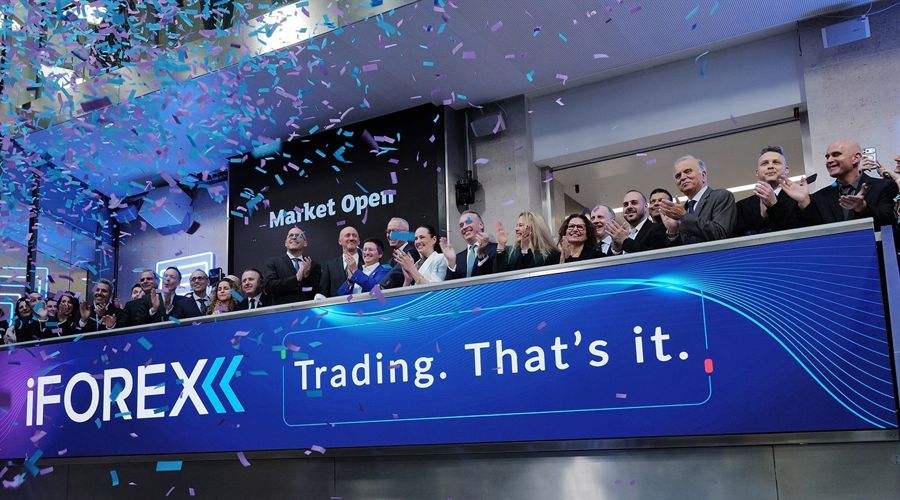
CFD broker iFOREX debuts on London Stock Exchange Main Market, Source: X

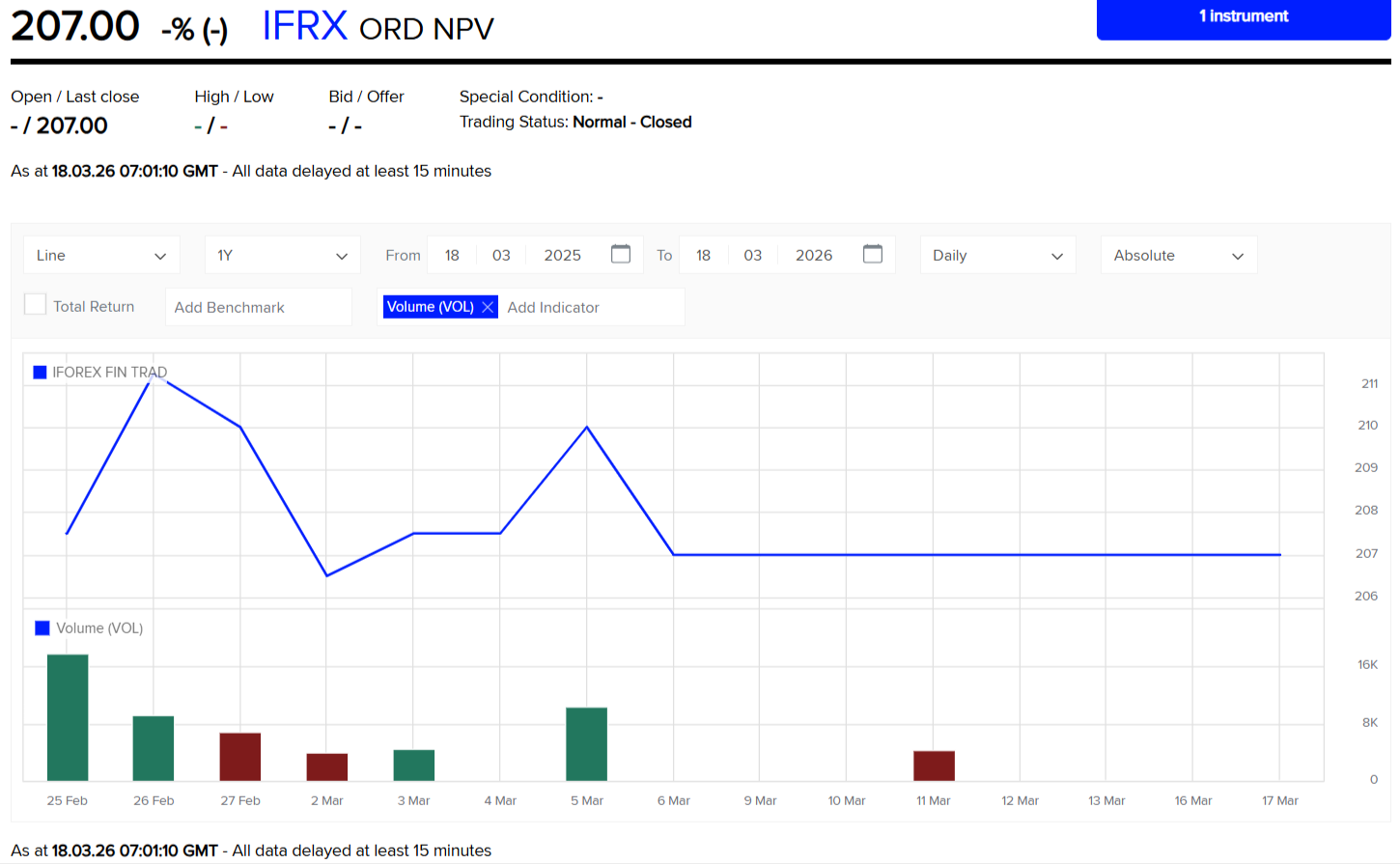
It has been two weeks since anyone moved the needle on iFOREX Financial Trading Holdings on the London Stock Exchange, and the silence is becoming hard to ignore.

The CFD broker, which listed on the LSE's Main Market on February 25 after an eight-month delay, is sitting at around 207 pence per share, roughly 6% above its 195p offer price, but that figure tells investors almost nothing useful.

A Free Float That's More Like a Free Freeze

The arithmetic here is straightforward. When iFOREX priced its IPO at 195 pence, it issued 4,487,179 new ordinary shares, representing just 20.2% of its total share capital. No existing shareholders sold down their stakes. The raise totaled £8.75 million against a company valuation of roughly £43.3 million.

That leaves only one-fifth of the company available to trade, and even within that slice, institutional investors who participated in the placing are typically under informal expectations not to flip quickly.

Founder Eyal Carmon, who holds 58.91% of the company post-listing and is selling nothing, has agreed to a 12-month lock-up, as have the company's directors and senior managers. The result is a stock with so little tradeable supply that a single motivated buyer or seller could move the price by a meaningful percentage, which also means most cautious investors simply won't touch it.
Source: LSE
Source: LSE

The Debut Pop That Quickly Went Quiet

Itai Sadeh, the CEO of the iForex Group

The first day of trading looked more promising. Shares opened above the offer price and quickly moved roughly 6% higher, driven by a small burst of post-IPO enthusiasm. CEO Itai Sadeh called the listing "a pivotal moment in iFOREX's evolution," and noted that the oversubscribed placing "reflects investor confidence in our strategy, solid fundamentals and scalable operating model."

But that momentum evaporated fast. Within days, volume dried up entirely. By the first week of March, the shares were effectively frozen. No analysts cover the stock. No major institutional holders have disclosed positions. And with a market cap of just over £46 million at current prices, the company sits well below the threshold that would attract meaningful attention from UK equity fund managers.

Financials That Didn't Exactly Build Excitement

The numbers published ahead of the listing didn't give investors much to work with, either. iFOREX reported 2025 revenue of $48.8 million, slightly below the $50.1 million recorded in 2024. Adjusted EBITDA for the year is expected to come in at around $4 million, down sharply from $9.7 million the previous year. Net profit for the first half of 2025 was just over $1.2 million, a 63.5% drop compared with the same period in 2024.

The company attributed some of the weakness to low market volatility during the third quarter and the prolonged uncertainty surrounding its IPO timeline. It also acknowledged in the prospectus that a "short-term revenue initiative" it tried during that difficult stretch "was ineffective and... promptly reversed." The prospectus added that "the Group has positive momentum into FY26," though that characterization comes from the company itself.

One structural concern that analysts flagged ahead of the listing remains unresolved: over 95% of iFOREX's revenue comes from its British Virgin Islands-regulated offshore entity, while its Cyprus-registered firm contributes the rest.

The broker operates primarily in Japan, India, and the Middle East, but holds no license in any of those markets, relying instead on reverse solicitation arrangements that regulators in those jurisdictions have increasingly questioned.

The eToro Contrast

The comparison to eToro is instructive, even if the two companies are playing in different leagues. When eToro finally completed its long-awaited US IPO last year, it came in at a $4 billion-plus valuation, was 10 times oversubscribed, and attracted significant institutional interest off the back of a crypto trading boom and surging retail engagement.

The stock has had its own struggles since listing. eToro posted record 2025 revenue of $868 million yet its shares have faced pressure amid broader market turbulence, but at least it has a market. Trades happen every day. Analysts write about it. Investors argue about it.

iFOREX, by contrast, completed an IPO more comparable in scale to a small regional listing. It raised less than $11 million in gross proceeds and trades on a market where the broader IPO pipeline has been sputtering for years.

The London Stock Exchange has been losing ground to New York as a listing destination for some time, and smaller listings on its Main Market often disappear from the radar within weeks of debut.

For iFOREX shares to start moving meaningfully, a few things would need to happen. The company would need to deliver financial results that exceed the underwhelming 2025 figures. It would need to secure at least one of the regulatory licenses it's targeting in Australia, the UAE, Malaysia, Chile, or the UK - progress on any of those fronts could serve as a genuine catalyst. And it would need to attract a market maker or analyst willing to put the stock in front of investors who weren't part of the original placing.

It has been two weeks since anyone moved the needle on iFOREX Financial Trading Holdings on the London Stock Exchange, and the silence is becoming hard to ignore.

The CFD broker, which listed on the LSE's Main Market on February 25 after an eight-month delay, is sitting at around 207 pence per share, roughly 6% above its 195p offer price, but that figure tells investors almost nothing useful.

A Free Float That's More Like a Free Freeze

The arithmetic here is straightforward. When iFOREX priced its IPO at 195 pence, it issued 4,487,179 new ordinary shares, representing just 20.2% of its total share capital. No existing shareholders sold down their stakes. The raise totaled £8.75 million against a company valuation of roughly £43.3 million.

That leaves only one-fifth of the company available to trade, and even within that slice, institutional investors who participated in the placing are typically under informal expectations not to flip quickly.

Founder Eyal Carmon, who holds 58.91% of the company post-listing and is selling nothing, has agreed to a 12-month lock-up, as have the company's directors and senior managers. The result is a stock with so little tradeable supply that a single motivated buyer or seller could move the price by a meaningful percentage, which also means most cautious investors simply won't touch it.

Source: LSE
Source: LSE

The Debut Pop That Quickly Went Quiet

Itai Sadeh, the CEO of the iForex Group

The first day of trading looked more promising. Shares opened above the offer price and quickly moved roughly 6% higher, driven by a small burst of post-IPO enthusiasm. CEO Itai Sadeh called the listing "a pivotal moment in iFOREX's evolution," and noted that the oversubscribed placing "reflects investor confidence in our strategy, solid fundamentals and scalable operating model."

But that momentum evaporated fast. Within days, volume dried up entirely. By the first week of March, the shares were effectively frozen. No analysts cover the stock. No major institutional holders have disclosed positions. And with a market cap of just over £46 million at current prices, the company sits well below the threshold that would attract meaningful attention from UK equity fund managers.

Financials That Didn't Exactly Build Excitement

The numbers published ahead of the listing didn't give investors much to work with, either. iFOREX reported 2025 revenue of $48.8 million, slightly below the $50.1 million recorded in 2024. Adjusted EBITDA for the year is expected to come in at around $4 million, down sharply from $9.7 million the previous year. Net profit for the first half of 2025 was just over $1.2 million, a 63.5% drop compared with the same period in 2024.

The company attributed some of the weakness to low market volatility during the third quarter and the prolonged uncertainty surrounding its IPO timeline. It also acknowledged in the prospectus that a "short-term revenue initiative" it tried during that difficult stretch "was ineffective and... promptly reversed." The prospectus added that "the Group has positive momentum into FY26," though that characterization comes from the company itself.

One structural concern that analysts flagged ahead of the listing remains unresolved: over 95% of iFOREX's revenue comes from its British Virgin Islands-regulated offshore entity, while its Cyprus-registered firm contributes the rest.

The broker operates primarily in Japan, India, and the Middle East, but holds no license in any of those markets, relying instead on reverse solicitation arrangements that regulators in those jurisdictions have increasingly questioned.

The eToro Contrast

The comparison to eToro is instructive, even if the two companies are playing in different leagues. When eToro finally completed its long-awaited US IPO last year, it came in at a $4 billion-plus valuation, was 10 times oversubscribed, and attracted significant institutional interest off the back of a crypto trading boom and surging retail engagement.

The stock has had its own struggles since listing. eToro posted record 2025 revenue of $868 million yet its shares have faced pressure amid broader market turbulence, but at least it has a market. Trades happen every day. Analysts write about it. Investors argue about it.

iFOREX, by contrast, completed an IPO more comparable in scale to a small regional listing. It raised less than $11 million in gross proceeds and trades on a market where the broader IPO pipeline has been sputtering for years.

The London Stock Exchange has been losing ground to New York as a listing destination for some time, and smaller listings on its Main Market often disappear from the radar within weeks of debut.

For iFOREX shares to start moving meaningfully, a few things would need to happen. The company would need to deliver financial results that exceed the underwhelming 2025 figures. It would need to secure at least one of the regulatory licenses it's targeting in Australia, the UAE, Malaysia, Chile, or the UK - progress on any of those fronts could serve as a genuine catalyst. And it would need to attract a market maker or analyst willing to put the stock in front of investors who weren't part of the original placing.

About the Author: Damian Chmiel
Damian Chmiel
  • 3340 Articles
  • 105 Followers
About the Author: Damian Chmiel
Damian Chmiel is a Senior Analyst & Editor at Finance Magnates with more than 15 years of experience in the CFD and online trading industry. Active as both a trader and journalist since 2010, he focuses on broker coverage, fintech innovation, and regulatory developments across Europe, the Middle East, and Asia. His work includes interviews with C-level leaders at major brokerages and fintech platforms, as well as co-authoring Finance Magnates’ quarterly industry benchmarking reports. Damian’s reporting is data-driven, market-aware, and grounded in direct industry engagement. His analysis and commentary have also been cited by external media outlets, including Investing.com, Binance, The Asset, Stockhead, and Dispatch. Education: MA in Finance and Accounting, Cracow University of Economics
  • 3340 Articles
  • 105 Followers

More from the Author

Retail FX

!"#$%&'()*+,-./0123456789:;<=>?@ABCDEFGHIJKLMNOPQRSTUVWXYZ[\]^_`abcdefghijklmnopqrstuvwxyz{|} !"#$%&'()*+,-./0123456789:;<=>?@ABCDEFGHIJKLMNOPQRSTUVWXYZ[\]^_`abcdefghijklmnopqrstuvwxyz{|}