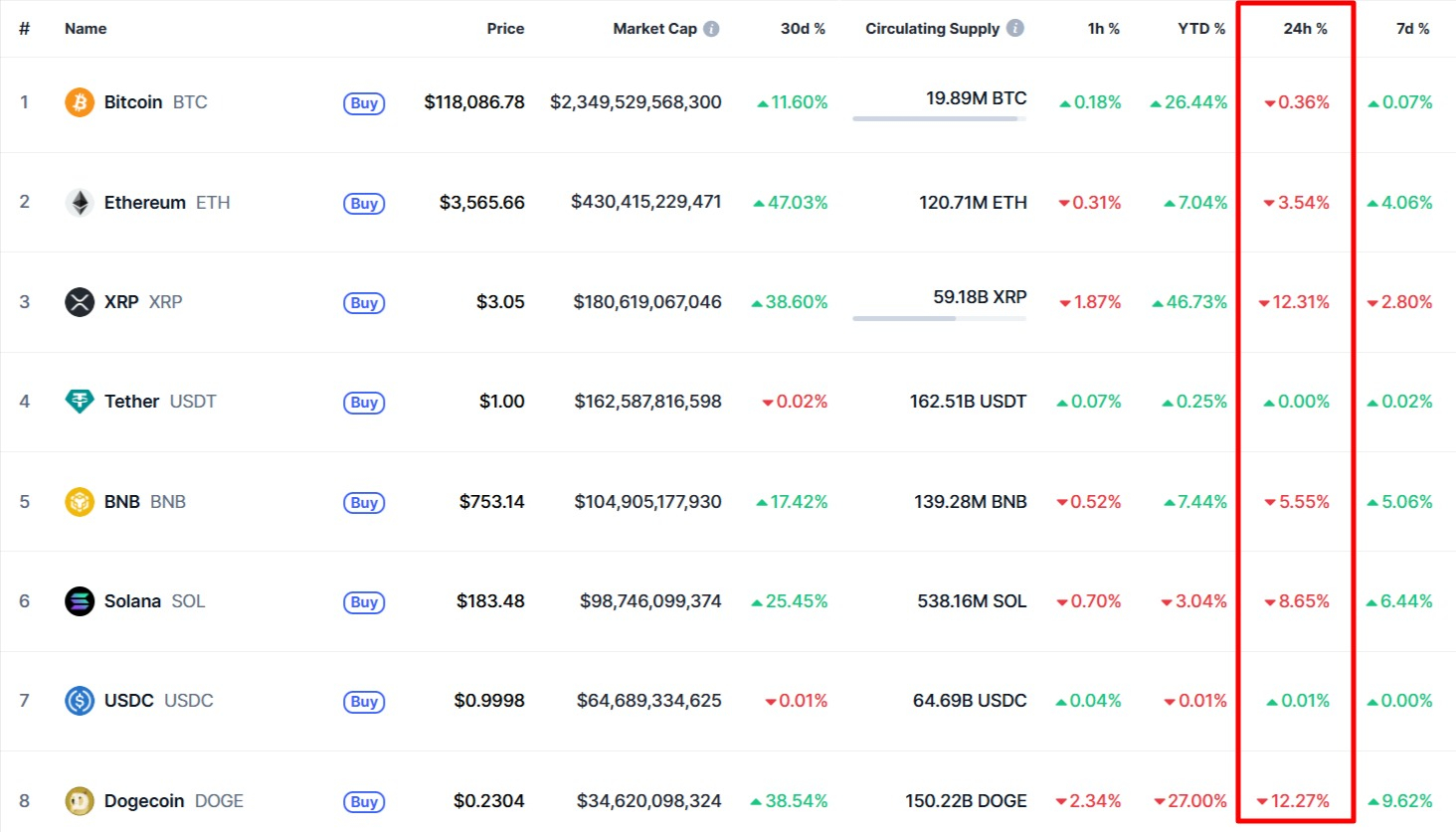
The cryptocurrency market experienced a significant 3.5% decline today.
Bitcoin retreats 2.3% to $117,241, Ethereum plunges over 6% to test $3,515 support, and XRP crashes 17% below the critical $3.00 threshold.
The massive selloff was driven by institutional liquidations exceeding previous correction levels across all major digital assets.
The digital
asset ecosystem is experiencing a dramatic correction as major cryptocurrencies
face intense selling pressure across the board. Bitcoin has retreated 2.3% to
test at $117,142, while Ethereum, XRP, and Dogecoin are suffering even steeper
losses in what traders are describing as a coordinated market selloff driven by
institutional profit-taking and technical breakdowns.
The
cryptocurrency market's current downturn reflects a perfect storm of factors, including massive validator exits from Ethereum's staking system, institutional
liquidations, and broader macroeconomic uncertainties that are triggering
risk-off behavior among digital asset investors. Why is crypto going down
today? Let’s check!
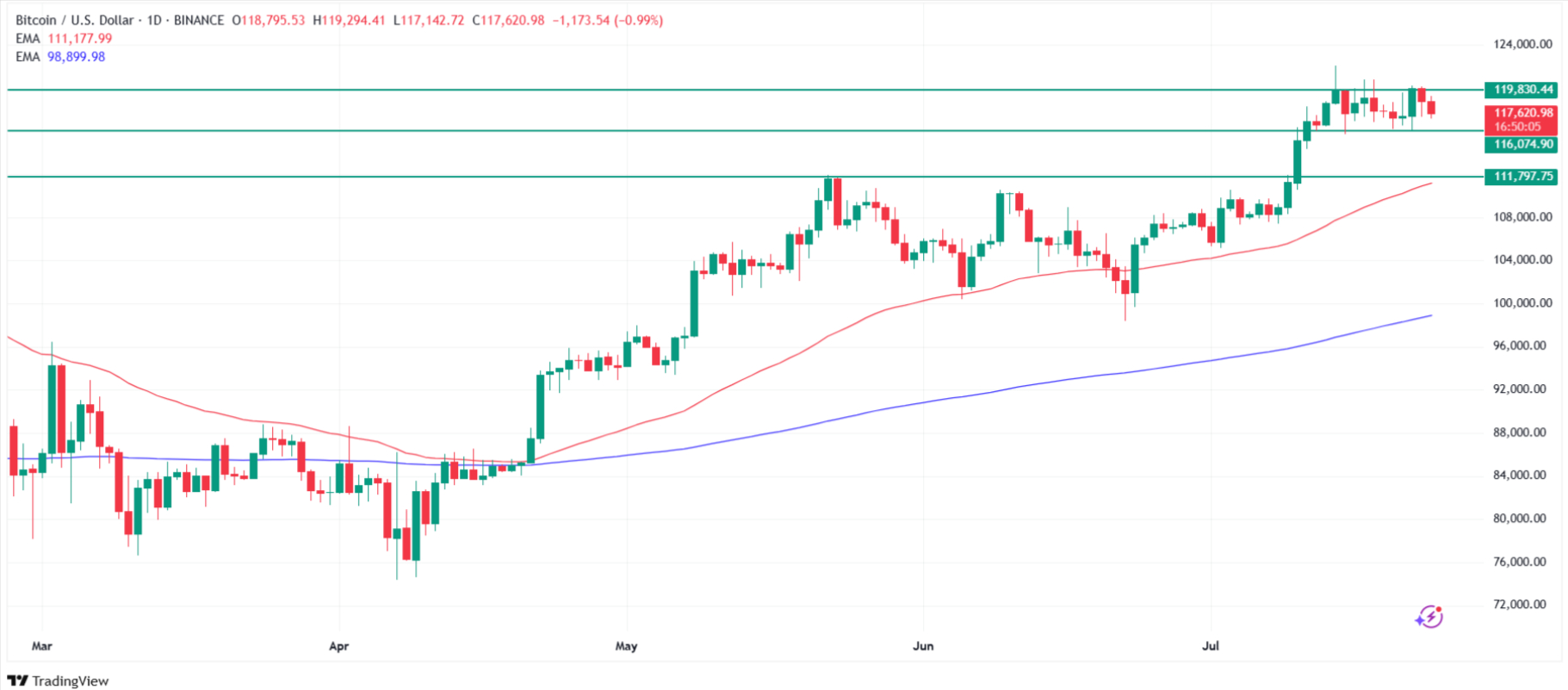
Bitcoin (BTC) price has
demonstrated resilience compared to its altcoin counterparts, declining a
modest 2.3% over the past two trading sessions. The world's largest
cryptocurrency dropped 1% on Wednesday before adding another 1.3% decline on
Thursday, testing intraday lows at $117,142 before recovering slightly to trade
at $117,241.
This
relatively contained decline showcases Bitcoin's position as a digital safe
haven during periods of cryptocurrency market stress. The asset's ability to
outperform altcoins during selloffs reinforces its status as the benchmark for
institutional cryptocurrency exposure and retail investor confidence.
Why is Bitcoin price going down today. Source: Tradingview.com
"We will see some continued profit taking at the upper end of this $110,000-$120,000 range," Paul Howard, Director at Wincent, commented for FinanceMagnates.com. "Volatility is still relatively low, trading around 40, and I believe this low volume environment will persist over the summer. Looking at September expiries, what I expect is a slower period over the next 6 weeks with policy makers away. I would be surprised if BTC breaks out higher and am of the view we consolidate around this band, whilst we can see some rotation and more favorable price moves in $ETH and some of the more speculative Altcoins."
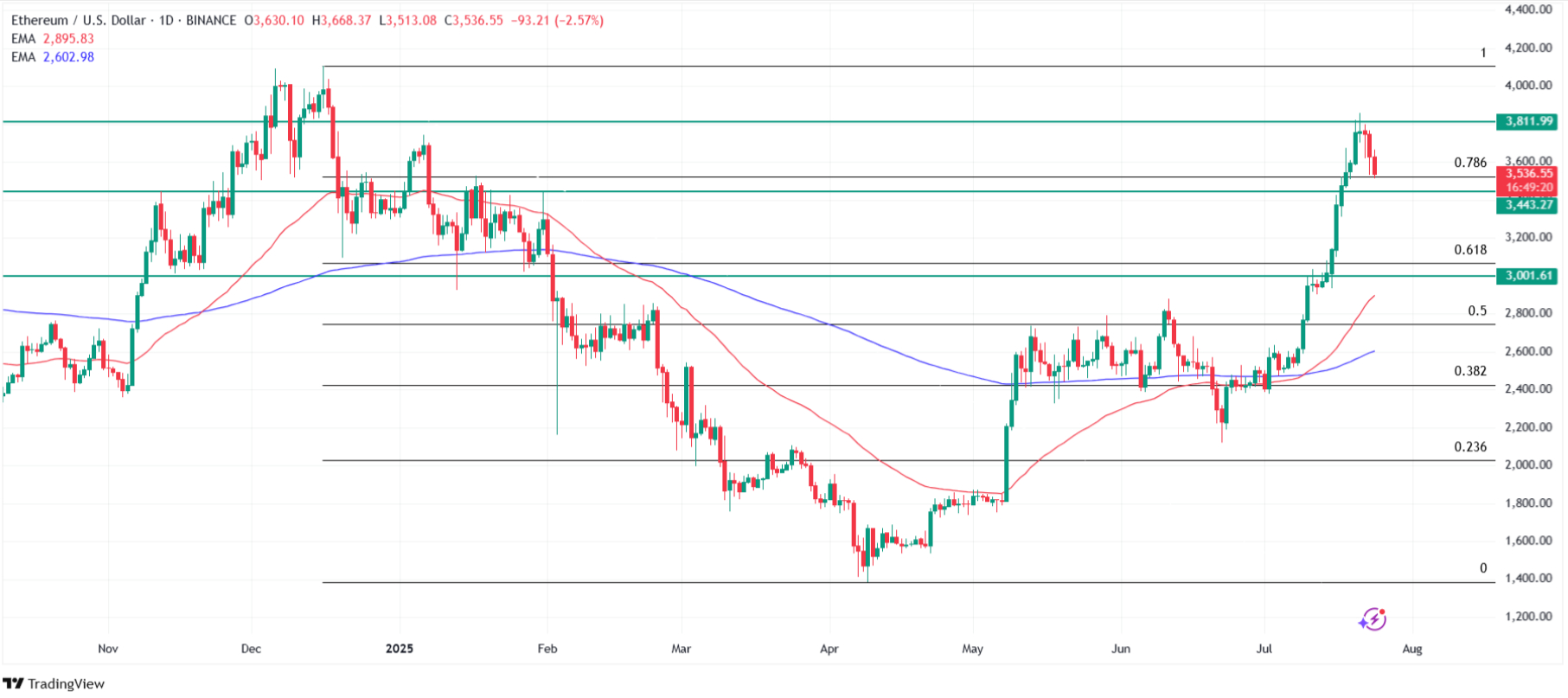
Ethereum (ETH) price has
experienced the most concerning fundamental developments, declining over 6% as
the network's validator exit queue reaches an 18-month high. The proof-of-stake
network currently has 644,330 ETH worth approximately $2.34 billion waiting to
unstake, with an 11-day exit queue representing the longest waiting period
since early 2024.
The massive
unstaking activity has pushed Ethereum down 3% on Wednesday followed by another
3% decline on Thursday, testing the crucial $3,515 support level, the lowest
price in over a week. This validator exodus raises questions about whether
large stakeholders are positioning for sales or simply optimizing their staking
strategies.
Why is Ethereum price going down today. Source: Tradingview.com
However, market dynamics remain complex as 390,000 ETH, worth around $1.2 billion, simultaneously wait in the entry queue. This suggests that while some
validators are exiting, others are positioning to enter the staking system,
creating a net unstaking amount of only 255,000 ETH.
The closest
support level currently stands at $3,443, the local highs from November 2024
and late January 2025.
XRP Crashes Through
Critical Support Levels
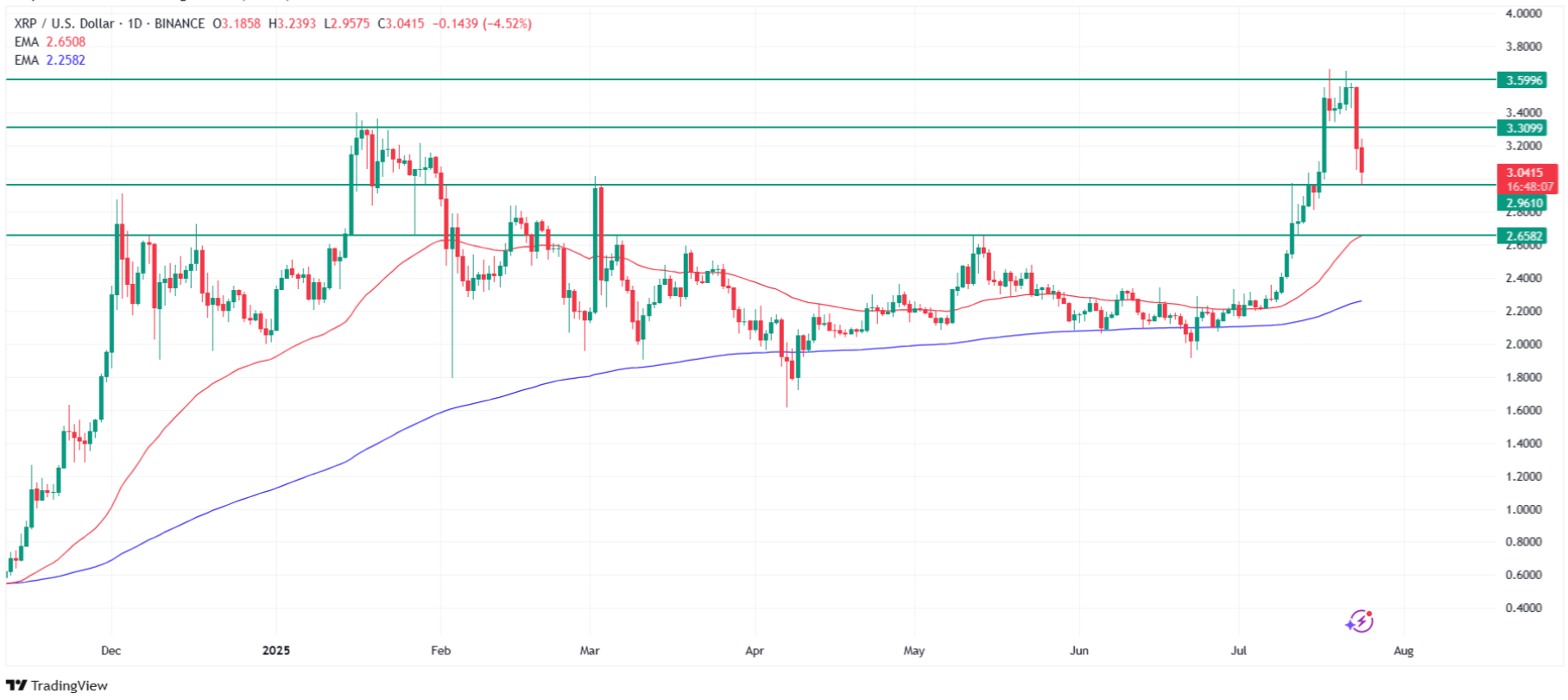
XRP price has suffered
one of the most severe decline among major cryptocurrencies, plummeting 17%
over two trading sessions. The digital asset fell over 10% on Wednesday before
adding another 7% decline on Thursday, testing the $2.9575 level and breaking
below the psychologically important $3.00 support zone.
Currently
trading at $2.9747, XRP's breakdown below the $3.00 threshold represents a
significant technical failure that could trigger additional algorithmic
selling. The asset's correlation with broader market movements has intensified
during this correction period, despite ongoing institutional adoption
initiatives.
In
my latest XRP technical analysis, I mentioned that a drop below $3.00 could
trigger a shift from bullish to bearish scenarios. The current downside target
is the 50-day EMA and the May 2025 high at around $2.60.
The sharp
decline occurred on elevated trading volumes, suggesting institutional
liquidations rather than retail panic selling. Technical indicators point to
potential further downside if XRP cannot quickly reclaim the $3.00 level, with
the next major support zone located around $2.75.
Why is XRP price going down today. Source: Tradingview.com
Trading
volumes exceeded 2.26 billion tokens during the selloff period, marking one of
the highest activity spikes in recent weeks. The massive volume suggests that
large holders are actively reducing their positions, creating sustained
downward pressure on the asset.
The asset's
extreme volatility during this correction highlights the inherent risks
associated with meme-based cryptocurrencies during broader market stress
periods. Institutional traders appear to be exiting speculative positions to
preserve capital amid uncertain market conditions.
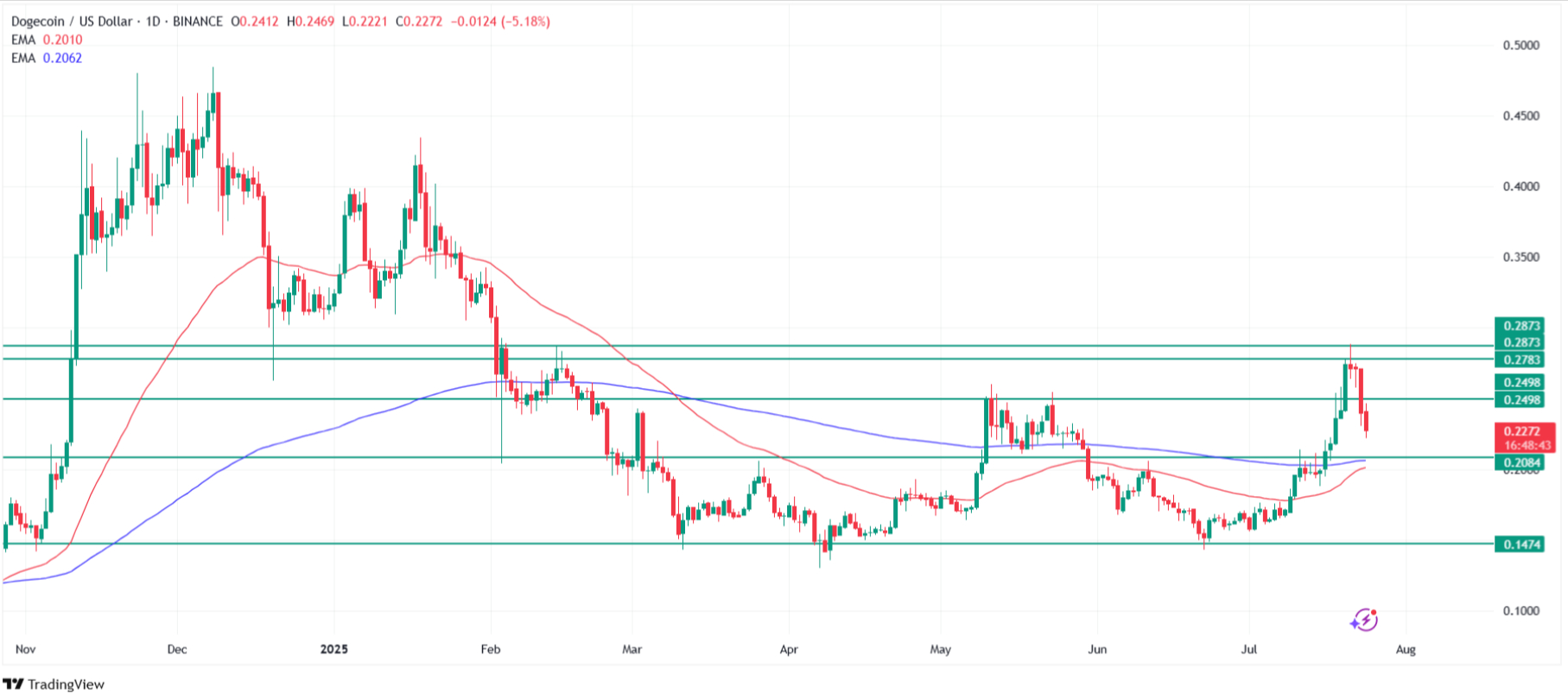
Why is Dogecoin price going down today. Source: Tradingview.com
The price
stalled at local highs around $0.28, from which it bounced and quickly returned
below the May resistance at $0.25. The current target is once again $0.20,
where both the 50- and 200-day EMAs converge.
Why Is Crypto Down Today?
Key Market Drivers
The
cryptocurrency market's current downturn stems from multiple interconnected
factors that have created a perfect storm of selling pressure across
digital assets. Here are the primary drivers behind today's market decline:
Market-Wide
Liquidations and Leverage Unwinding - Cascading liquidations have amplified
the selling pressure as over-leveraged positions face margin calls across the
cryptocurrency ecosystem. Institutional and retail traders who accumulated
positions during recent price advances are being forced into additional selling
pressure that extends beyond natural profit-taking activities
Ethereum
Validator Exit Crisis
- $2.34 billion worth of ETH is currently awaiting unstaking through the
validator exit queue, representing the longest waiting period in 18 months. The
validator exit queue has surged to 644,330 ETH with an 11-day wait time,
creating concerns about potential future selling pressure
Institutional
Portfolio Risk Management - Current market movements reflect sophisticated institutional
activity rather than retail panic selling, with coordinated declines
across Bitcoin, Ethereum, XRP, and Dogecoin, Large holders are actively
managing portfolio risk amid broader macroeconomic uncertainties, leading to
strategic position adjustments
Macroeconomic
and Geopolitical Pressures - Global trade tensions and hawkish policy tones have exacerbated
risk-off flows across cryptocurrency markets. Macroeconomic concerns are
triggering institutional repositioning away from higher-risk digital assets
toward more established cryptocurrencies
Speculative
Asset Rebalancing -
Dogecoin's extreme volatility reflects the risk-off sentiment affecting
speculative positions, with institutional traders reducing exposure to
meme-based assets. Investors are rotating from speculative cryptocurrencies
toward more established digital assets like Bitcoin and Ethereum during periods
of market stress
Why is crypto going down today? Source: CoinMarketCap.com
Crypto Market Outlook and
Price Predictions
Bitcoin
maintains its position as the institutional favorite with multiple Wall Street firms
publishing increasingly bullish forecasts for the remainder of 2025 and beyond:
Standard Chartered projects Bitcoin reaching $200,000 by year-end 2025,
representing one of the most aggressive mainstream forecasts from a major
banking institution
Ethereum's
prediction landscape reflects the network's fundamental technological
advantages and
growing institutional adoption through ETF vehicles: Mark Newton from Fundstrat
targets $4,000 by end of July 2025, with technical resistance levels identified
in the $4,200-$4,500 range. Tom Lee presents ambitious medium-term projections
of $10,000-$15,000 possible by year-end 2025, driven by ecosystem value growth.
XRP
demonstrates strong upside potential driven by regulatory developments and
institutional payment adoption: Standard Chartered maintains the most bullish
mainstream forecast, predicting XRP will reach $5.50 by end of 2025, marking a
potential new all-time high. Michaël Van de Poppe suggests a nearer-term retest
of $3.40 based on technical analysis and bullish momentum patterns
Dogecoin
faces the most challenging prediction environment among major cryptocurrencies, with wide
variance in analyst expectations: Crypto Daily forecasts a range between $0.156
minimum and $0.825 maximum by December 2025
Overall,
the outlook for the four cryptocurrencies covered in this article is strongly
bullish. For a deeper dive, check out my previous analyses of DOGE, XRP,
BTC, and ETH, where I break down expert forecasts for 2025 and beyond, along
with my own technical insights. Don’t miss the details if you're planning
your next move:
The
cryptocurrency market's current correction appears to be driven by
profit-taking activities and technical repositioning rather than fundamental
deterioration in the digital asset ecosystem. Historical patterns suggest that
such corrections often precede significant rallies, particularly when driven by
short-term factors rather than structural cryptocurrency issues.
Crypto News, Prices and
FAQ
Why Is Crypto Falling
Down?
The
cryptocurrency market is experiencing a severe correction driven by
unprecedented institutional position unwinding and technical breakdowns across
major networks. The primary catalyst has been Ethereum's validator crisis, with
$2.34 billion worth of ETH currently awaiting unstaking through an 18-month
high exit queue. This massive validator exodus has created cascading
liquidations exceeding $683 million across leveraged positions, while
algorithmic trading systems amplify selling pressure as key support levels
break down across Bitcoin, Ethereum, XRP, and Dogecoin.
Will Crypto Recover in
2025?
Recovery
prospects for 2025 appear more challenging than previous cycles due to
fundamental shifts in market structure. Unlike past corrections driven
primarily by retail speculation, the current decline reflects sophisticated
institutional repositioning and risk management protocols. However, the
continued growth in Ethereum's total validator count and the $1.2 billion entry
queue suggest that while some institutions are exiting, others are
strategically positioning for long-term opportunities. The key differentiator
will be whether current validator exits represent profit-taking or genuine loss
of confidence in proof-of-stake mechanisms.
Will Crypto Recover Soon?
Short-term
recovery faces significant headwinds from ongoing institutional deleveraging
and technical damage across major cryptocurrencies. The current correction
differs from typical pullbacks as it involves fundamental infrastructure
stress, particularly within Ethereum's staking ecosystem. Recovery timing
largely depends on the resolution of the validator exit queue and whether the
$2.34 billion in pending unstaking translates to actual selling pressure or
strategic repositioning. Technical indicators suggest that Bitcoin's relative
strength may provide market leadership, but altcoin recovery could lag
substantially.
Does Crypto Have a Future?
The
cryptocurrency ecosystem faces a critical evolution phase rather than an
existential crisis. Current market stress is exposing infrastructure
limitations and forcing necessary maturation in staking mechanisms,
institutional risk management, and market structure. While Ethereum's validator
dynamics create short-term uncertainty, the underlying proof-of-stake
transition represents a fundamental advancement in blockchain efficiency. The
simultaneous growth in both exit and entry queues indicates ongoing institutional
engagement rather than wholesale abandonment of cryptocurrency infrastructure.
Why is Bitcoin Going Down?
Bitcoin's
decline stems from its correlation breakdown with traditional safe-haven assets
during periods of crypto-specific stress. While Bitcoin has demonstrated
relative resilience compared to altcoins, declining only 2.3% versus
double-digit losses across Ethereum, XRP, and Dogecoin, it cannot escape the
gravitational pull of systematic cryptocurrency market deleveraging. The asset
faces pressure from institutional portfolio rebalancing as traders reduce
overall crypto exposure amid Ethereum's validator crisis and broader altcoin
weakness, despite maintaining its position as the preferred institutional
cryptocurrency during market stress periods.
The digital
asset ecosystem is experiencing a dramatic correction as major cryptocurrencies
face intense selling pressure across the board. Bitcoin has retreated 2.3% to
test at $117,142, while Ethereum, XRP, and Dogecoin are suffering even steeper
losses in what traders are describing as a coordinated market selloff driven by
institutional profit-taking and technical breakdowns.
The
cryptocurrency market's current downturn reflects a perfect storm of factors, including massive validator exits from Ethereum's staking system, institutional
liquidations, and broader macroeconomic uncertainties that are triggering
risk-off behavior among digital asset investors. Why is crypto going down
today? Let’s check!
Bitcoin (BTC) price has
demonstrated resilience compared to its altcoin counterparts, declining a
modest 2.3% over the past two trading sessions. The world's largest
cryptocurrency dropped 1% on Wednesday before adding another 1.3% decline on
Thursday, testing intraday lows at $117,142 before recovering slightly to trade
at $117,241.
This
relatively contained decline showcases Bitcoin's position as a digital safe
haven during periods of cryptocurrency market stress. The asset's ability to
outperform altcoins during selloffs reinforces its status as the benchmark for
institutional cryptocurrency exposure and retail investor confidence.
Why is Bitcoin price going down today. Source: Tradingview.com
"We will see some continued profit taking at the upper end of this $110,000-$120,000 range," Paul Howard, Director at Wincent, commented for FinanceMagnates.com. "Volatility is still relatively low, trading around 40, and I believe this low volume environment will persist over the summer. Looking at September expiries, what I expect is a slower period over the next 6 weeks with policy makers away. I would be surprised if BTC breaks out higher and am of the view we consolidate around this band, whilst we can see some rotation and more favorable price moves in $ETH and some of the more speculative Altcoins."
Ethereum (ETH) price has
experienced the most concerning fundamental developments, declining over 6% as
the network's validator exit queue reaches an 18-month high. The proof-of-stake
network currently has 644,330 ETH worth approximately $2.34 billion waiting to
unstake, with an 11-day exit queue representing the longest waiting period
since early 2024.
The massive
unstaking activity has pushed Ethereum down 3% on Wednesday followed by another
3% decline on Thursday, testing the crucial $3,515 support level, the lowest
price in over a week. This validator exodus raises questions about whether
large stakeholders are positioning for sales or simply optimizing their staking
strategies.
Why is Ethereum price going down today. Source: Tradingview.com
However, market dynamics remain complex as 390,000 ETH, worth around $1.2 billion, simultaneously wait in the entry queue. This suggests that while some
validators are exiting, others are positioning to enter the staking system,
creating a net unstaking amount of only 255,000 ETH.
The closest
support level currently stands at $3,443, the local highs from November 2024
and late January 2025.
XRP Crashes Through
Critical Support Levels
XRP price has suffered
one of the most severe decline among major cryptocurrencies, plummeting 17%
over two trading sessions. The digital asset fell over 10% on Wednesday before
adding another 7% decline on Thursday, testing the $2.9575 level and breaking
below the psychologically important $3.00 support zone.
Currently
trading at $2.9747, XRP's breakdown below the $3.00 threshold represents a
significant technical failure that could trigger additional algorithmic
selling. The asset's correlation with broader market movements has intensified
during this correction period, despite ongoing institutional adoption
initiatives.
In
my latest XRP technical analysis, I mentioned that a drop below $3.00 could
trigger a shift from bullish to bearish scenarios. The current downside target
is the 50-day EMA and the May 2025 high at around $2.60.
The sharp
decline occurred on elevated trading volumes, suggesting institutional
liquidations rather than retail panic selling. Technical indicators point to
potential further downside if XRP cannot quickly reclaim the $3.00 level, with
the next major support zone located around $2.75.
Why is XRP price going down today. Source: Tradingview.com
Trading
volumes exceeded 2.26 billion tokens during the selloff period, marking one of
the highest activity spikes in recent weeks. The massive volume suggests that
large holders are actively reducing their positions, creating sustained
downward pressure on the asset.
The asset's
extreme volatility during this correction highlights the inherent risks
associated with meme-based cryptocurrencies during broader market stress
periods. Institutional traders appear to be exiting speculative positions to
preserve capital amid uncertain market conditions.
Why is Dogecoin price going down today. Source: Tradingview.com
The price
stalled at local highs around $0.28, from which it bounced and quickly returned
below the May resistance at $0.25. The current target is once again $0.20,
where both the 50- and 200-day EMAs converge.
Why Is Crypto Down Today?
Key Market Drivers
The
cryptocurrency market's current downturn stems from multiple interconnected
factors that have created a perfect storm of selling pressure across
digital assets. Here are the primary drivers behind today's market decline:
Market-Wide
Liquidations and Leverage Unwinding - Cascading liquidations have amplified
the selling pressure as over-leveraged positions face margin calls across the
cryptocurrency ecosystem. Institutional and retail traders who accumulated
positions during recent price advances are being forced into additional selling
pressure that extends beyond natural profit-taking activities
Ethereum
Validator Exit Crisis
- $2.34 billion worth of ETH is currently awaiting unstaking through the
validator exit queue, representing the longest waiting period in 18 months. The
validator exit queue has surged to 644,330 ETH with an 11-day wait time,
creating concerns about potential future selling pressure
Institutional
Portfolio Risk Management - Current market movements reflect sophisticated institutional
activity rather than retail panic selling, with coordinated declines
across Bitcoin, Ethereum, XRP, and Dogecoin, Large holders are actively
managing portfolio risk amid broader macroeconomic uncertainties, leading to
strategic position adjustments
Macroeconomic
and Geopolitical Pressures - Global trade tensions and hawkish policy tones have exacerbated
risk-off flows across cryptocurrency markets. Macroeconomic concerns are
triggering institutional repositioning away from higher-risk digital assets
toward more established cryptocurrencies
Speculative
Asset Rebalancing -
Dogecoin's extreme volatility reflects the risk-off sentiment affecting
speculative positions, with institutional traders reducing exposure to
meme-based assets. Investors are rotating from speculative cryptocurrencies
toward more established digital assets like Bitcoin and Ethereum during periods
of market stress
Why is crypto going down today? Source: CoinMarketCap.com
Crypto Market Outlook and
Price Predictions
Bitcoin
maintains its position as the institutional favorite with multiple Wall Street firms
publishing increasingly bullish forecasts for the remainder of 2025 and beyond:
Standard Chartered projects Bitcoin reaching $200,000 by year-end 2025,
representing one of the most aggressive mainstream forecasts from a major
banking institution
Ethereum's
prediction landscape reflects the network's fundamental technological
advantages and
growing institutional adoption through ETF vehicles: Mark Newton from Fundstrat
targets $4,000 by end of July 2025, with technical resistance levels identified
in the $4,200-$4,500 range. Tom Lee presents ambitious medium-term projections
of $10,000-$15,000 possible by year-end 2025, driven by ecosystem value growth.
XRP
demonstrates strong upside potential driven by regulatory developments and
institutional payment adoption: Standard Chartered maintains the most bullish
mainstream forecast, predicting XRP will reach $5.50 by end of 2025, marking a
potential new all-time high. Michaël Van de Poppe suggests a nearer-term retest
of $3.40 based on technical analysis and bullish momentum patterns
Dogecoin
faces the most challenging prediction environment among major cryptocurrencies, with wide
variance in analyst expectations: Crypto Daily forecasts a range between $0.156
minimum and $0.825 maximum by December 2025
Overall,
the outlook for the four cryptocurrencies covered in this article is strongly
bullish. For a deeper dive, check out my previous analyses of DOGE, XRP,
BTC, and ETH, where I break down expert forecasts for 2025 and beyond, along
with my own technical insights. Don’t miss the details if you're planning
your next move:
The
cryptocurrency market's current correction appears to be driven by
profit-taking activities and technical repositioning rather than fundamental
deterioration in the digital asset ecosystem. Historical patterns suggest that
such corrections often precede significant rallies, particularly when driven by
short-term factors rather than structural cryptocurrency issues.
Crypto News, Prices and
FAQ
Why Is Crypto Falling
Down?
The
cryptocurrency market is experiencing a severe correction driven by
unprecedented institutional position unwinding and technical breakdowns across
major networks. The primary catalyst has been Ethereum's validator crisis, with
$2.34 billion worth of ETH currently awaiting unstaking through an 18-month
high exit queue. This massive validator exodus has created cascading
liquidations exceeding $683 million across leveraged positions, while
algorithmic trading systems amplify selling pressure as key support levels
break down across Bitcoin, Ethereum, XRP, and Dogecoin.
Will Crypto Recover in
2025?
Recovery
prospects for 2025 appear more challenging than previous cycles due to
fundamental shifts in market structure. Unlike past corrections driven
primarily by retail speculation, the current decline reflects sophisticated
institutional repositioning and risk management protocols. However, the
continued growth in Ethereum's total validator count and the $1.2 billion entry
queue suggest that while some institutions are exiting, others are
strategically positioning for long-term opportunities. The key differentiator
will be whether current validator exits represent profit-taking or genuine loss
of confidence in proof-of-stake mechanisms.
Will Crypto Recover Soon?
Short-term
recovery faces significant headwinds from ongoing institutional deleveraging
and technical damage across major cryptocurrencies. The current correction
differs from typical pullbacks as it involves fundamental infrastructure
stress, particularly within Ethereum's staking ecosystem. Recovery timing
largely depends on the resolution of the validator exit queue and whether the
$2.34 billion in pending unstaking translates to actual selling pressure or
strategic repositioning. Technical indicators suggest that Bitcoin's relative
strength may provide market leadership, but altcoin recovery could lag
substantially.
Does Crypto Have a Future?
The
cryptocurrency ecosystem faces a critical evolution phase rather than an
existential crisis. Current market stress is exposing infrastructure
limitations and forcing necessary maturation in staking mechanisms,
institutional risk management, and market structure. While Ethereum's validator
dynamics create short-term uncertainty, the underlying proof-of-stake
transition represents a fundamental advancement in blockchain efficiency. The
simultaneous growth in both exit and entry queues indicates ongoing institutional
engagement rather than wholesale abandonment of cryptocurrency infrastructure.
Why is Bitcoin Going Down?
Bitcoin's
decline stems from its correlation breakdown with traditional safe-haven assets
during periods of crypto-specific stress. While Bitcoin has demonstrated
relative resilience compared to altcoins, declining only 2.3% versus
double-digit losses across Ethereum, XRP, and Dogecoin, it cannot escape the
gravitational pull of systematic cryptocurrency market deleveraging. The asset
faces pressure from institutional portfolio rebalancing as traders reduce
overall crypto exposure amid Ethereum's validator crisis and broader altcoin
weakness, despite maintaining its position as the preferred institutional
cryptocurrency during market stress periods.
Damian Chmiel is a Senior Analyst & Editor at Finance Magnates with more than 15 years of experience in the CFD and online trading industry. Active as both a trader and journalist since 2010, he focuses on broker coverage, fintech innovation, and regulatory developments across Europe, the Middle East, and Asia.
His work includes interviews with C-level leaders at major brokerages and fintech platforms, as well as co-authoring Finance Magnates’ quarterly industry benchmarking reports. Damian’s reporting is data-driven, market-aware, and grounded in direct industry engagement. His analysis and commentary have also been cited by external media outlets, including Investing.com, Binance, The Asset, Stockhead, and Dispatch.
Education:
MA in Finance and Accounting, Cracow University of Economics
Inside the Prediction Markets: $1.6B Institutional Inflow Meets a Federal Crackdown
Featured Videos
FP Markets Winner Spotlight 🏆 | Global Broker of the Year 2025 #Trading #Broker #Innovation #Shorts
FP Markets Winner Spotlight 🏆 | Global Broker of the Year 2025 #Trading #Broker #Innovation #Shorts
FP Markets Winner Spotlight 🏆 | Global Broker of the Year 2025 #Trading #Broker #Innovation #Shorts
FP Markets Winner Spotlight 🏆 | Global Broker of the Year 2025 #Trading #Broker #Innovation #Shorts
FP Markets takes the spotlight as Global Broker of the Year 2025 at the Finance Magnates Awards.
Martin Stoilov, Head of Client Experience, shares that trust, innovation, and people played a key role in the company’s success, supported by a strong foundation of integrity and client-centricity.
Following this milestone, FP Markets continues to focus on growth, technology investment, and its core values of transparency and excellence.
👉 Be part of FM Awards 2026: https://awards.financemagnates.com/#nominate
FP Markets takes the spotlight as Global Broker of the Year 2025 at the Finance Magnates Awards.
Martin Stoilov, Head of Client Experience, shares that trust, innovation, and people played a key role in the company’s success, supported by a strong foundation of integrity and client-centricity.
Following this milestone, FP Markets continues to focus on growth, technology investment, and its core values of transparency and excellence.
👉 Be part of FM Awards 2026: https://awards.financemagnates.com/#nominate
FP Markets takes the spotlight as Global Broker of the Year 2025 at the Finance Magnates Awards.
Martin Stoilov, Head of Client Experience, shares that trust, innovation, and people played a key role in the company’s success, supported by a strong foundation of integrity and client-centricity.
Following this milestone, FP Markets continues to focus on growth, technology investment, and its core values of transparency and excellence.
👉 Be part of FM Awards 2026: https://awards.financemagnates.com/#nominate
FP Markets takes the spotlight as Global Broker of the Year 2025 at the Finance Magnates Awards.
Martin Stoilov, Head of Client Experience, shares that trust, innovation, and people played a key role in the company’s success, supported by a strong foundation of integrity and client-centricity.
Following this milestone, FP Markets continues to focus on growth, technology investment, and its core values of transparency and excellence.
👉 Be part of FM Awards 2026: https://awards.financemagnates.com/#nominate
In this video, we review @HolaPrimeMarketsOfficial, a multi-asset forex and CFDs broker offering different account types, trading platforms, and flexible trading conditions.
We cover the broker’s overall offering, including account options, trading environment, platforms like MT4 and MT5, and additional services such as managed accounts and fast withdrawals.
Watch the full video to see if Hola Prime Markets fits your trading needs.
📣 Stay up to date with the latest in finance and trading. Follow Finance Magnates for industry news, insights, and global event coverage.
Connect with us:
🔗 LinkedIn: /financemagnates
👍 Facebook: /financemagnates
📸 Instagram: https://www.instagram.com/financemagnates
🐦 X: https://x.com/financemagnates
🎥 TikTok: https://www.tiktok.com/tag/financemagnates
▶️ YouTube: /@financemagnates_official
#HolaPrime #ForexBroker #CFDTrading #FinanceMagnates #Trading #Forex #BrokerReview
In this video, we review @HolaPrimeMarketsOfficial, a multi-asset forex and CFDs broker offering different account types, trading platforms, and flexible trading conditions.
We cover the broker’s overall offering, including account options, trading environment, platforms like MT4 and MT5, and additional services such as managed accounts and fast withdrawals.
Watch the full video to see if Hola Prime Markets fits your trading needs.
📣 Stay up to date with the latest in finance and trading. Follow Finance Magnates for industry news, insights, and global event coverage.
Connect with us:
🔗 LinkedIn: /financemagnates
👍 Facebook: /financemagnates
📸 Instagram: https://www.instagram.com/financemagnates
🐦 X: https://x.com/financemagnates
🎥 TikTok: https://www.tiktok.com/tag/financemagnates
▶️ YouTube: /@financemagnates_official
#HolaPrime #ForexBroker #CFDTrading #FinanceMagnates #Trading #Forex #BrokerReview
In this video, we review @HolaPrimeMarketsOfficial, a multi-asset forex and CFDs broker offering different account types, trading platforms, and flexible trading conditions.
We cover the broker’s overall offering, including account options, trading environment, platforms like MT4 and MT5, and additional services such as managed accounts and fast withdrawals.
Watch the full video to see if Hola Prime Markets fits your trading needs.
📣 Stay up to date with the latest in finance and trading. Follow Finance Magnates for industry news, insights, and global event coverage.
Connect with us:
🔗 LinkedIn: /financemagnates
👍 Facebook: /financemagnates
📸 Instagram: https://www.instagram.com/financemagnates
🐦 X: https://x.com/financemagnates
🎥 TikTok: https://www.tiktok.com/tag/financemagnates
▶️ YouTube: /@financemagnates_official
#HolaPrime #ForexBroker #CFDTrading #FinanceMagnates #Trading #Forex #BrokerReview
In this video, we review @HolaPrimeMarketsOfficial, a multi-asset forex and CFDs broker offering different account types, trading platforms, and flexible trading conditions.
We cover the broker’s overall offering, including account options, trading environment, platforms like MT4 and MT5, and additional services such as managed accounts and fast withdrawals.
Watch the full video to see if Hola Prime Markets fits your trading needs.
📣 Stay up to date with the latest in finance and trading. Follow Finance Magnates for industry news, insights, and global event coverage.
Connect with us:
🔗 LinkedIn: /financemagnates
👍 Facebook: /financemagnates
📸 Instagram: https://www.instagram.com/financemagnates
🐦 X: https://x.com/financemagnates
🎥 TikTok: https://www.tiktok.com/tag/financemagnates
▶️ YouTube: /@financemagnates_official
#HolaPrime #ForexBroker #CFDTrading #FinanceMagnates #Trading #Forex #BrokerReview
In this video, we review @HolaPrimeMarketsOfficial, a multi-asset forex and CFDs broker offering different account types, trading platforms, and flexible trading conditions.
We cover the broker’s overall offering, including account options, trading environment, platforms like MT4 and MT5, and additional services such as managed accounts and fast withdrawals.
Watch the full video to see if Hola Prime Markets fits your trading needs.
📣 Stay up to date with the latest in finance and trading. Follow Finance Magnates for industry news, insights, and global event coverage.
Connect with us:
🔗 LinkedIn: /financemagnates
👍 Facebook: /financemagnates
📸 Instagram: https://www.instagram.com/financemagnates
🐦 X: https://x.com/financemagnates
🎥 TikTok: https://www.tiktok.com/tag/financemagnates
▶️ YouTube: /@financemagnates_official
#HolaPrime #ForexBroker #CFDTrading #FinanceMagnates #Trading #Forex #BrokerReview
In this video, we review @HolaPrimeMarketsOfficial, a multi-asset forex and CFDs broker offering different account types, trading platforms, and flexible trading conditions.
We cover the broker’s overall offering, including account options, trading environment, platforms like MT4 and MT5, and additional services such as managed accounts and fast withdrawals.
Watch the full video to see if Hola Prime Markets fits your trading needs.
📣 Stay up to date with the latest in finance and trading. Follow Finance Magnates for industry news, insights, and global event coverage.
Connect with us:
🔗 LinkedIn: /financemagnates
👍 Facebook: /financemagnates
📸 Instagram: https://www.instagram.com/financemagnates
🐦 X: https://x.com/financemagnates
🎥 TikTok: https://www.tiktok.com/tag/financemagnates
▶️ YouTube: /@financemagnates_official
#HolaPrime #ForexBroker #CFDTrading #FinanceMagnates #Trading #Forex #BrokerReview
Hola Prime Review: What You Need to Know | Full Breakdown by Finance Magnates
Hola Prime Review: What You Need to Know | Full Breakdown by Finance Magnates
Hola Prime Review: What You Need to Know | Full Breakdown by Finance Magnates
Hola Prime Review: What You Need to Know | Full Breakdown by Finance Magnates
Hola Prime Review: What You Need to Know | Full Breakdown by Finance Magnates
Hola Prime Review: What You Need to Know | Full Breakdown by Finance Magnates
In this video, we review @HolaPrime_Global, a proprietary trading firm offering evaluation programs and performance-based payouts in simulated market environments.
We cover how the challenge model works, including account types, profit splits (up to 95%), trading rules, and what it takes to reach a funded account. You’ll also learn about available platforms like MT4, MT5, cTrader, and more, along with insights into payouts, support, and trading conditions.
Watch the full video to see if Hola Prime fits your trading style.
📣 Stay up to date with the latest in finance and trading. Follow Finance Magnates for industry news, insights, and global event coverage.
Connect with us:
🔗 LinkedIn: /financemagnates
👍 Facebook: /financemagnates
📸 Instagram: https://www.instagram.com/financemagnates
🐦 X: https://x.com/financemagnates
🎥 TikTok: https://www.tiktok.com/tag/financemagnates
▶️ YouTube: /@financemagnates_official
#HolaPrime #PropFirm #Trading #FinanceMagnates #Forex #FuturesTrading #TradingReview #PropFirmReview
In this video, we review @HolaPrime_Global, a proprietary trading firm offering evaluation programs and performance-based payouts in simulated market environments.
We cover how the challenge model works, including account types, profit splits (up to 95%), trading rules, and what it takes to reach a funded account. You’ll also learn about available platforms like MT4, MT5, cTrader, and more, along with insights into payouts, support, and trading conditions.
Watch the full video to see if Hola Prime fits your trading style.
📣 Stay up to date with the latest in finance and trading. Follow Finance Magnates for industry news, insights, and global event coverage.
Connect with us:
🔗 LinkedIn: /financemagnates
👍 Facebook: /financemagnates
📸 Instagram: https://www.instagram.com/financemagnates
🐦 X: https://x.com/financemagnates
🎥 TikTok: https://www.tiktok.com/tag/financemagnates
▶️ YouTube: /@financemagnates_official
#HolaPrime #PropFirm #Trading #FinanceMagnates #Forex #FuturesTrading #TradingReview #PropFirmReview
In this video, we review @HolaPrime_Global, a proprietary trading firm offering evaluation programs and performance-based payouts in simulated market environments.
We cover how the challenge model works, including account types, profit splits (up to 95%), trading rules, and what it takes to reach a funded account. You’ll also learn about available platforms like MT4, MT5, cTrader, and more, along with insights into payouts, support, and trading conditions.
Watch the full video to see if Hola Prime fits your trading style.
📣 Stay up to date with the latest in finance and trading. Follow Finance Magnates for industry news, insights, and global event coverage.
Connect with us:
🔗 LinkedIn: /financemagnates
👍 Facebook: /financemagnates
📸 Instagram: https://www.instagram.com/financemagnates
🐦 X: https://x.com/financemagnates
🎥 TikTok: https://www.tiktok.com/tag/financemagnates
▶️ YouTube: /@financemagnates_official
#HolaPrime #PropFirm #Trading #FinanceMagnates #Forex #FuturesTrading #TradingReview #PropFirmReview
In this video, we review @HolaPrime_Global, a proprietary trading firm offering evaluation programs and performance-based payouts in simulated market environments.
We cover how the challenge model works, including account types, profit splits (up to 95%), trading rules, and what it takes to reach a funded account. You’ll also learn about available platforms like MT4, MT5, cTrader, and more, along with insights into payouts, support, and trading conditions.
Watch the full video to see if Hola Prime fits your trading style.
📣 Stay up to date with the latest in finance and trading. Follow Finance Magnates for industry news, insights, and global event coverage.
Connect with us:
🔗 LinkedIn: /financemagnates
👍 Facebook: /financemagnates
📸 Instagram: https://www.instagram.com/financemagnates
🐦 X: https://x.com/financemagnates
🎥 TikTok: https://www.tiktok.com/tag/financemagnates
▶️ YouTube: /@financemagnates_official
#HolaPrime #PropFirm #Trading #FinanceMagnates #Forex #FuturesTrading #TradingReview #PropFirmReview
In this video, we review @HolaPrime_Global, a proprietary trading firm offering evaluation programs and performance-based payouts in simulated market environments.
We cover how the challenge model works, including account types, profit splits (up to 95%), trading rules, and what it takes to reach a funded account. You’ll also learn about available platforms like MT4, MT5, cTrader, and more, along with insights into payouts, support, and trading conditions.
Watch the full video to see if Hola Prime fits your trading style.
📣 Stay up to date with the latest in finance and trading. Follow Finance Magnates for industry news, insights, and global event coverage.
Connect with us:
🔗 LinkedIn: /financemagnates
👍 Facebook: /financemagnates
📸 Instagram: https://www.instagram.com/financemagnates
🐦 X: https://x.com/financemagnates
🎥 TikTok: https://www.tiktok.com/tag/financemagnates
▶️ YouTube: /@financemagnates_official
#HolaPrime #PropFirm #Trading #FinanceMagnates #Forex #FuturesTrading #TradingReview #PropFirmReview
In this video, we review @HolaPrime_Global, a proprietary trading firm offering evaluation programs and performance-based payouts in simulated market environments.
We cover how the challenge model works, including account types, profit splits (up to 95%), trading rules, and what it takes to reach a funded account. You’ll also learn about available platforms like MT4, MT5, cTrader, and more, along with insights into payouts, support, and trading conditions.
Watch the full video to see if Hola Prime fits your trading style.
📣 Stay up to date with the latest in finance and trading. Follow Finance Magnates for industry news, insights, and global event coverage.
Connect with us:
🔗 LinkedIn: /financemagnates
👍 Facebook: /financemagnates
📸 Instagram: https://www.instagram.com/financemagnates
🐦 X: https://x.com/financemagnates
🎥 TikTok: https://www.tiktok.com/tag/financemagnates
▶️ YouTube: /@financemagnates_official
#HolaPrime #PropFirm #Trading #FinanceMagnates #Forex #FuturesTrading #TradingReview #PropFirmReview
Axi Winner Spotlight 🏆 | Global Most Innovative Broker 2025 #Innovation #Trading #Fintech #Broker
Axi Winner Spotlight 🏆 | Global Most Innovative Broker 2025 #Innovation #Trading #Fintech #Broker
Axi Winner Spotlight 🏆 | Global Most Innovative Broker 2025 #Innovation #Trading #Fintech #Broker
Axi Winner Spotlight 🏆 | Global Most Innovative Broker 2025 #Innovation #Trading #Fintech #Broker
Axi Winner Spotlight 🏆 | Global Most Innovative Broker 2025 #Innovation #Trading #Fintech #Broker
Axi Winner Spotlight 🏆 | Global Most Innovative Broker 2025 #Innovation #Trading #Fintech #Broker
Axi takes the spotlight at the Finance Magnates Awards, winning Global Most Innovative Broker 2025.
Olivia Xenofontos and Ivanna Openko share how the team will feel: proud, motivated, and ready to keep delivering.
They also describe the night as well-organized, focused, and enjoyable for all.
👉 Be part of FM Awards 2026.
Axi takes the spotlight at the Finance Magnates Awards, winning Global Most Innovative Broker 2025.
Olivia Xenofontos and Ivanna Openko share how the team will feel: proud, motivated, and ready to keep delivering.
They also describe the night as well-organized, focused, and enjoyable for all.
👉 Be part of FM Awards 2026.
Axi takes the spotlight at the Finance Magnates Awards, winning Global Most Innovative Broker 2025.
Olivia Xenofontos and Ivanna Openko share how the team will feel: proud, motivated, and ready to keep delivering.
They also describe the night as well-organized, focused, and enjoyable for all.
👉 Be part of FM Awards 2026.
Axi takes the spotlight at the Finance Magnates Awards, winning Global Most Innovative Broker 2025.
Olivia Xenofontos and Ivanna Openko share how the team will feel: proud, motivated, and ready to keep delivering.
They also describe the night as well-organized, focused, and enjoyable for all.
👉 Be part of FM Awards 2026.
Axi takes the spotlight at the Finance Magnates Awards, winning Global Most Innovative Broker 2025.
Olivia Xenofontos and Ivanna Openko share how the team will feel: proud, motivated, and ready to keep delivering.
They also describe the night as well-organized, focused, and enjoyable for all.
👉 Be part of FM Awards 2026.
Axi takes the spotlight at the Finance Magnates Awards, winning Global Most Innovative Broker 2025.
Olivia Xenofontos and Ivanna Openko share how the team will feel: proud, motivated, and ready to keep delivering.
They also describe the night as well-organized, focused, and enjoyable for all.
👉 Be part of FM Awards 2026.
Recognition that matters.
Built on transparency.
Driven by the industry.
The Finance Magnates Awards 2026.
Nominations are now open.
🔗 https://awards.financemagnates.com/?utm_source=SM&utm_medium=social&utm_campaign=recognition-matters
Recognition that matters.
Built on transparency.
Driven by the industry.
The Finance Magnates Awards 2026.
Nominations are now open.
🔗 https://awards.financemagnates.com/?utm_source=SM&utm_medium=social&utm_campaign=recognition-matters
Recognition that matters.
Built on transparency.
Driven by the industry.
The Finance Magnates Awards 2026.
Nominations are now open.
🔗 https://awards.financemagnates.com/?utm_source=SM&utm_medium=social&utm_campaign=recognition-matters
Recognition that matters.
Built on transparency.
Driven by the industry.
The Finance Magnates Awards 2026.
Nominations are now open.
🔗 https://awards.financemagnates.com/?utm_source=SM&utm_medium=social&utm_campaign=recognition-matters
Recognition that matters.
Built on transparency.
Driven by the industry.
The Finance Magnates Awards 2026.
Nominations are now open.
🔗 https://awards.financemagnates.com/?utm_source=SM&utm_medium=social&utm_campaign=recognition-matters
Recognition that matters.
Built on transparency.
Driven by the industry.
The Finance Magnates Awards 2026.
Nominations are now open.
🔗 https://awards.financemagnates.com/?utm_source=SM&utm_medium=social&utm_campaign=recognition-matters