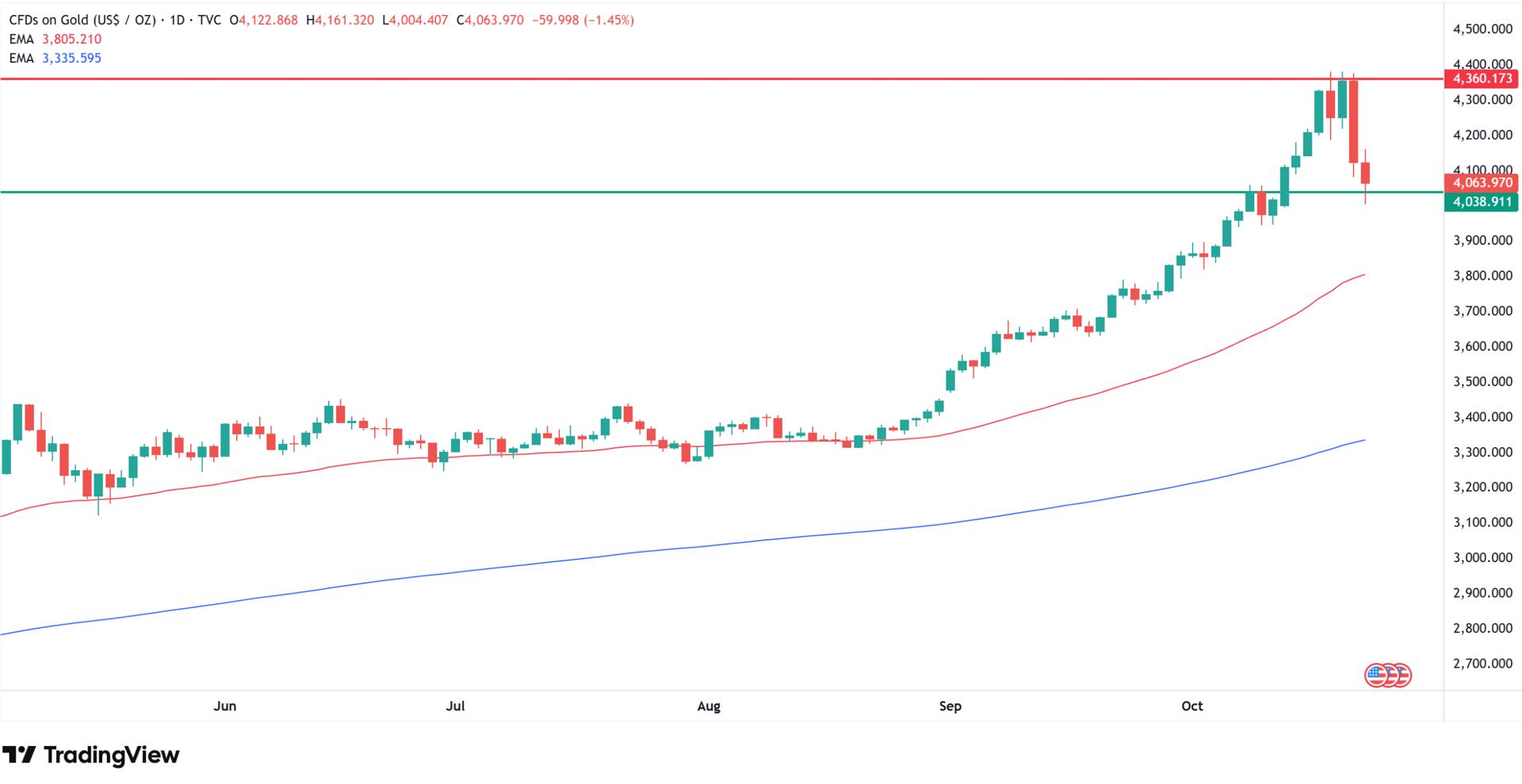
Gold price crashed 5-6% on October 21, 2025, in its worst single-day drop since August 2020.
Bitcoin simultaneously fell over 2% to $108,342, testing critical support at $108,000 as the gold-Bitcoin correlation of 0.85 triggered synchronized selling.
How low can Bitcoin and gold go? Read the article below to find out.
Why gold and Bitcoin prices are going down? Let's check the current technical analysis
Gold price experienced
its most severe single-day collapse in over five years this week, plunging more
than 5% from record highs and dragging Bitcoin (BTC) lower in a synchronized
selloff that erased billions in market capitalization.
The
precious metal fell from Monday's all-time peak of $4,381 per ounce to an
intraday low of $4,082, marking the steepest decline since August 2020’s 5.7%
crash. Bitcoin simultaneously dropped over 2%, falling from $110,000
levels to test critical support at $108,000 as the correlation between
digital and physical safe-haven assets reached 0.85.
Why Gold Price Is Crashing?
The gold
crash followed an unsustainable rally that saw
prices surge 60% throughout 2025 and 25% in just the previous two
months, creating what analysts described as "stratosphere" conditions
ripe for correction.
Standard
Chartered analyst Suki Cooper characterized the movement as a "technical
correction" after record-breaking precious metals inflows totaling
$34.2 billion over ten weeks pushed the market into severely overbought
territory. Bart Melek, global head of commodity strategy at TD Securities,
confirmed dealers were "realizing gains after a strong
rally" that proved unsustainable long-term.
Profit-taking
accelerated as
the US dollar index strengthened 0.4%, making gold more expensive for
international buyers and reducing its appeal against competing assets. The
timing coincided with renewed optimism over US-China trade negotiations, with
President Trump expressing confidence about reaching a deal with Chinese
President Xi Jinping at their scheduled meeting. This easing of geopolitical
tensions diminished safe-haven demand that had propelled gold to consecutive
record highs.
Physical
demand also weakened following the conclusion of the Diwali festival in India,
the world's second-largest gold consumer, removing a significant source of
buying pressure. Silver crashed even harder at 8.7% in its
worst single-day drop since February 2021, while platinum fell 5-7%,
confirming the broad-based precious metals correction.
Why Bitcoin Price Is Going
Down Today?
Bitcoin's
decline mirrored gold's weakness as the strengthening correlation
between the two assets, currently at 0.85, near the all-time high of 0.9
reached in April 2024, caused synchronized selling pressure. The cryptocurrency
ended Tuesday's session at $108,342, dropping over 2% and retesting local
support around the $108,000 level that coincides with late August lows and
marks the lower boundary of the months-long consolidation range.
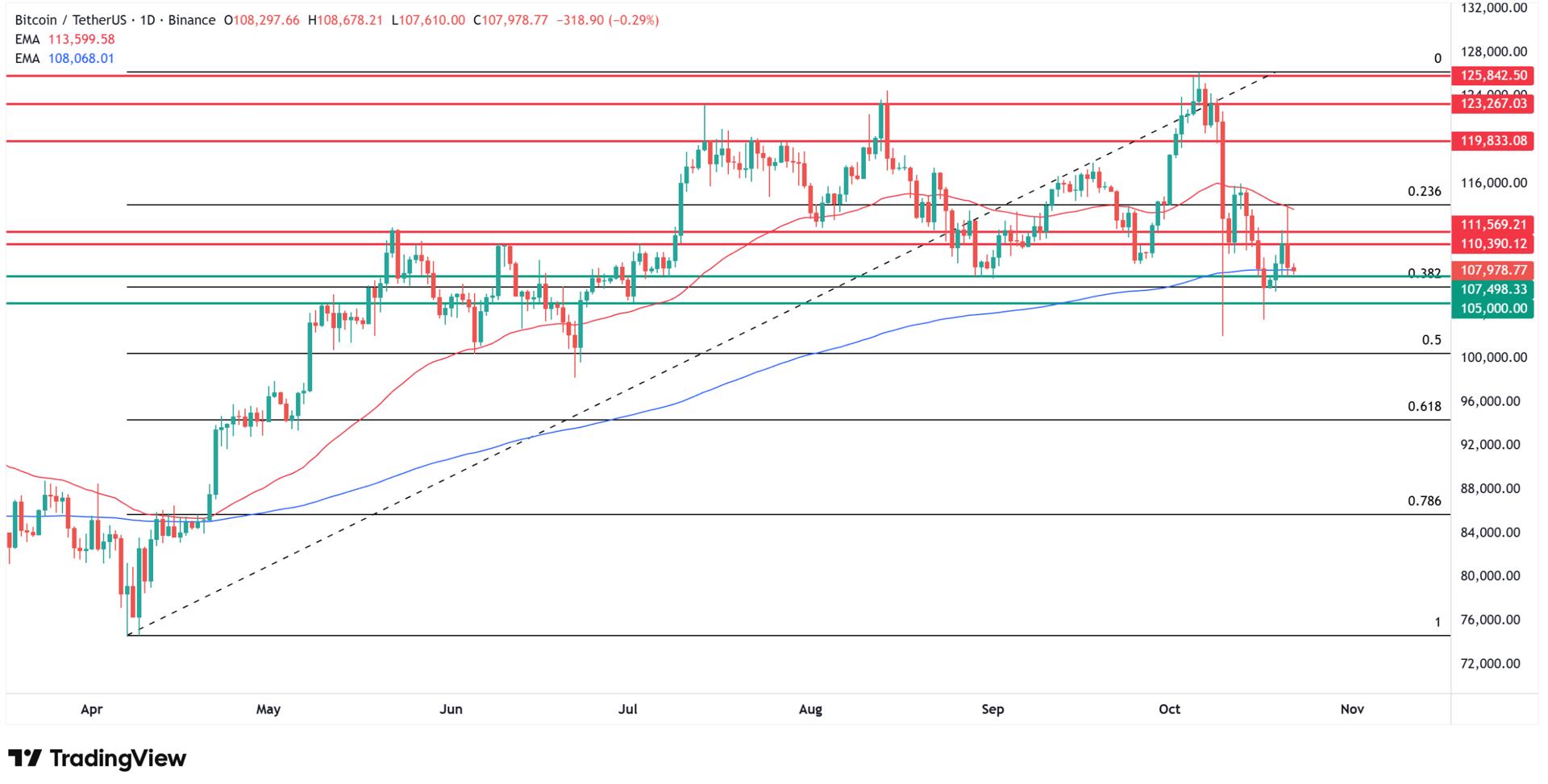
From my
technical analysis of Bitcoin's chart, the price attempted to strengthen
on Monday before ultimately pulling back sharply in direct reaction to
gold's crash. Bitcoin tested the critical support zone around $108,000,
which aligns with late August lows and represents the lower boundary of the
consolidation drawn since mid-October.
Importantly,
the 200-day exponential moving average continues to provide support,
meaning we remain technically in a bull trend. However, a breakdown below
this range would open the door to further declines and a test of the
$100,000 level, a major psychological support zone.
Why Bitcoin price is going down today? Source: Tradingview.com
Paul Howard
from Wincent noted that "many analysts follow technical trends
including M2 money supply, gold, stock2flow models plus other metrics as
ways to predict Bitcoin's next move. Arguably many now indicate a big
upswing and with so many leveraged longs and shorts liquidated, and a positive
global macro environment may see Bitcoin as a gold laggard". The
comment highlights how Bitcoin's underperformance relative to gold's
earlier rally may reverse following the liquidation cleanup.
Please also check my previous articles including Bitcoin and gold price predictions:
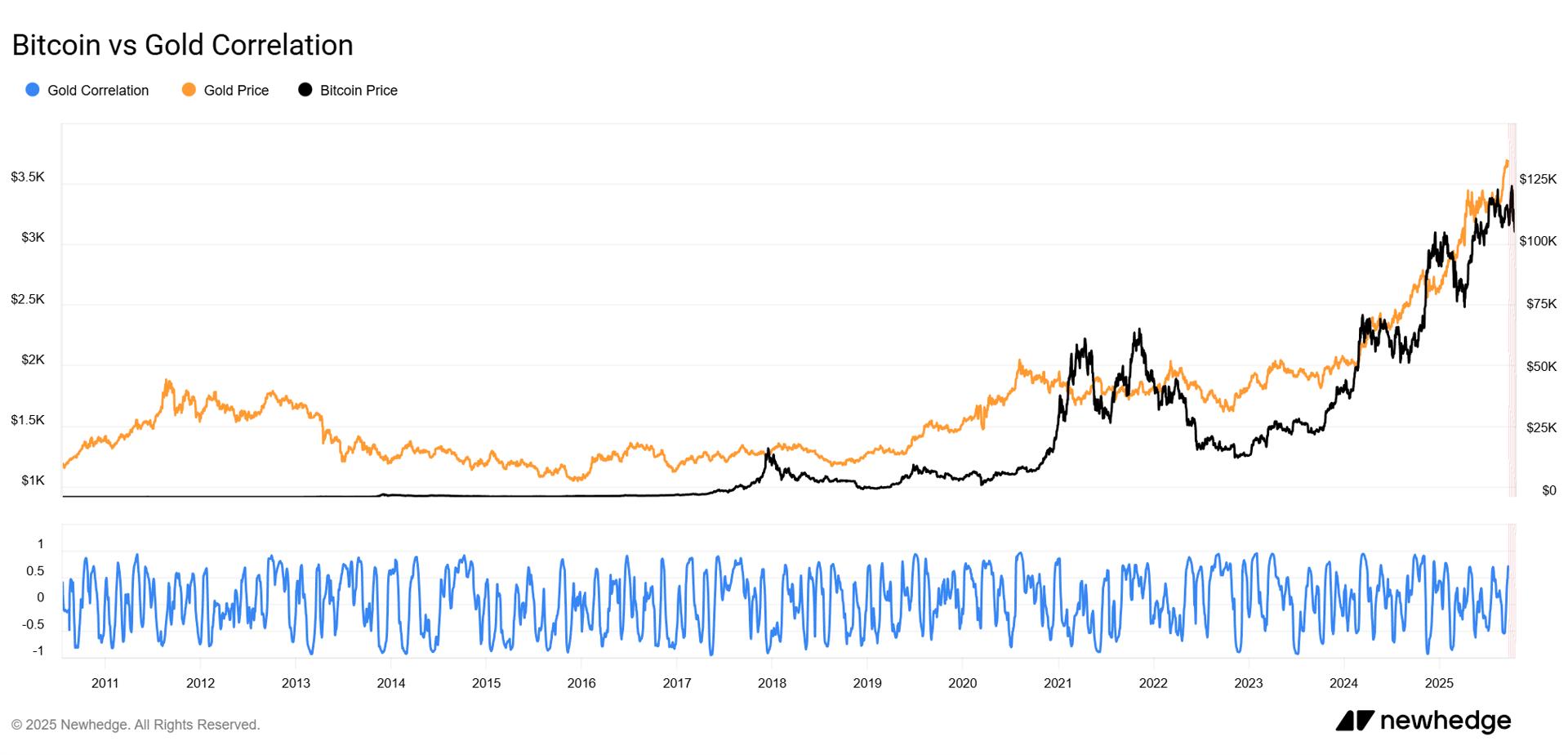
The
increasingly tight correlation between gold and Bitcoin, rising from
negative 0.8 in October 2021 to current levels of 0.85, explains why
both assets experienced simultaneous pressure.
Mostafa
Al-Mashita, Co-founder & Director of Sales and Trading at Secure
Digital Markets, provided exclusive analysis: "Gold's loss of neutrality
and Bitcoin's rise as a borderless asset mark a fundamental shift in
global value dynamics. The recent gold sell-off, though expected after an
extended rally, underscores how traditional havens are becoming tools
of policy rather than stores of neutrality".
Source: Newhedge.io
He
continued: "Nations like China, India, and Turkey are stockpiling gold
to reduce reliance on the US dollar, turning it into a geopolitical
instrument tied to state agendas. Bitcoin, though increasingly adopted by
institutions and states, remains structurally decentralized and resistant to
control. It signals economic independence while functioning as both a
volatile trading vehicle and a modern store of value. This isn't simply
gold versus Bitcoin; it's a broader reallocation of trust, with
governments asserting sovereignty through gold and individuals and institutions
seeking autonomy through Bitcoin".
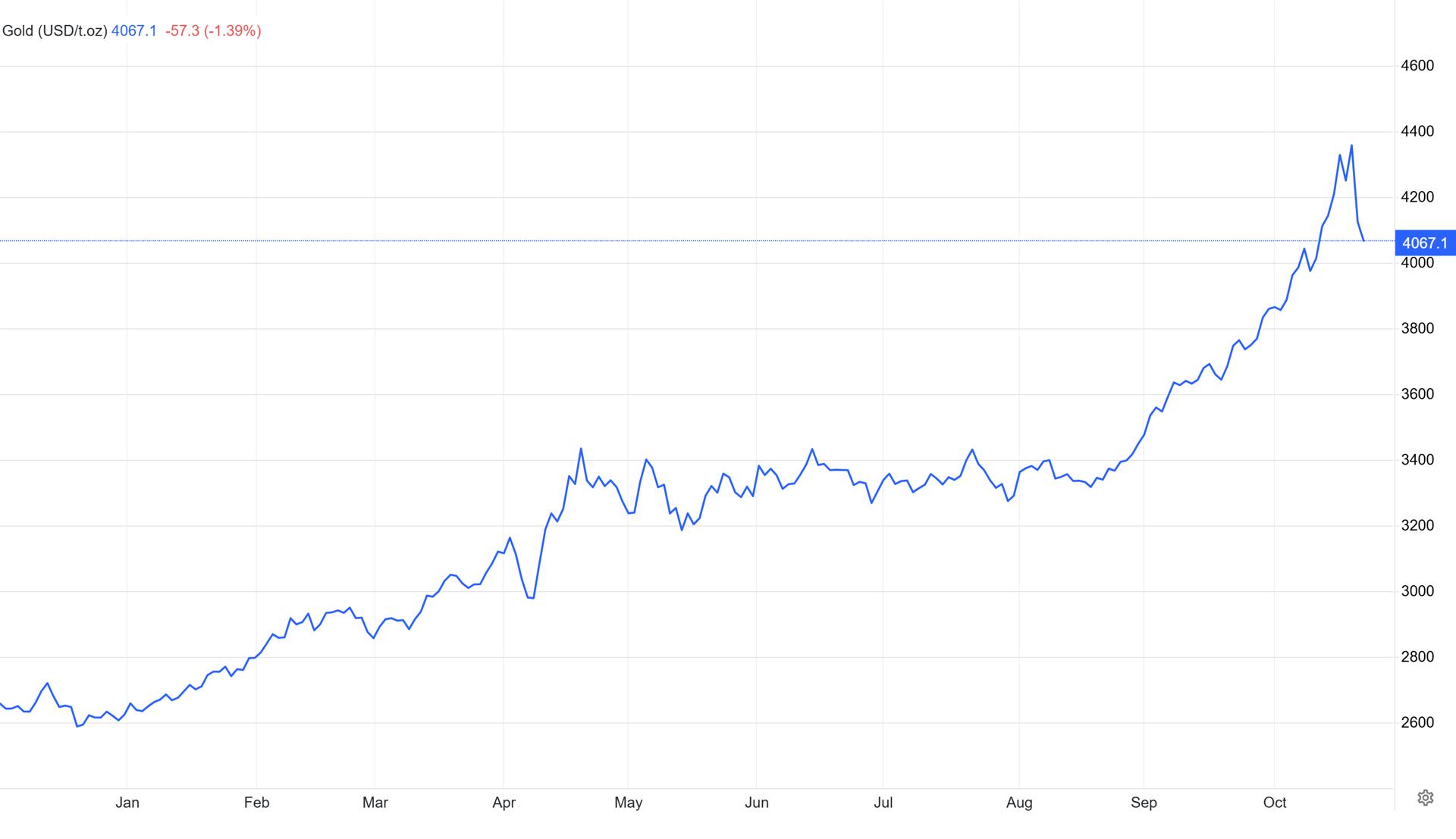
After
reaching new all-time highs in the daily chart, gold stalled at resistance
around $4,350 per ounce, which after several sessions of
accumulation triggered dynamic depreciation on Monday with a drop
exceeding 5% to $4,124 per ounce. According to my technical analysis, tuesday
brought continued declines of 1.5% and a test of the psychological $4,000
level. At the time of writing, the metal was changing hands at $4,062, bouncing
slightly from local support defined by the all-time highs from October
8-9.
Technical analysis of the gold chart. Source: Tradingview.com
Gold has
significantly more room for correction, and I would not rule out a descent
toward $3,400, the 200-day exponential moving average, before a
stronger rebound materializes. The $2.1 trillion in market
capitalization erased on Tuesday alone, equivalent to 55% of the entire
cryptocurrency market's value according to trader Peter Brandt, demonstrates
the magnitude of this correction.
Current price: $108,342 retesting critical
support zone
Key support: $108,000 coinciding with late
August lows and consolidation floor
Bull trend support: 200-day EMA maintaining
bullish structure
Psychological level: $100,000 major
support if current range breaks
Historical Crash
Comparison: Bitcoin, Gold and Silver
Event
Date
Decline
Recovery Time
Cause
Gold Crash
August 2020
-6.3%
3 months
Cyprus
crisis, Fed taper talk
Gold Crash
Oct 21, 2025
-5.6%
TBD
Profit-taking, dollar strength
Silver Crash
Feb 2021
-8.7%
6 weeks
Reddit squeeze unwind
Bitcoin Crash
Oct 10, 2025
-14%
2 weeks
Leverage liquidation
Gold Correction
Aug 2020
-5.0%
4 months
Post-COVID rally exhaustion
Bitcoin and Gold Price
Analysis, Frequently Asked Questions
Why did gold crash 5%
on October 21, 2025?
Gold
crashed 5-6% due to profit-taking after a 60% rally in 2025, combined with
a stronger US dollar, easing US-China trade tensions, and
technical correction from overbought conditions following $34.2 billion in
precious metals inflows over ten weeks.
When was the last time
gold fell this much in one day?
The last
time gold experienced a comparable or larger single-day decline was August 2020,
when it dropped 5.7% during the Cyprus banking crisis and Federal Reserve
tapering concerns.
Why is Bitcoin
falling with gold?
Bitcoin
fell alongside gold because the correlation between the two assets reached
0.85, near the all-time high of 0.9, causing synchronized selling
pressure as investors treated both as linked safe-haven assets.
Is the gold rally
over?
Analysts view
this as a technical correction rather than the end of the bull market,
with gold potentially correcting toward $3,400 (the 200-day EMA) before
resuming its uptrend, though the rally's pace needed to slow from unsustainable
levels.
Why Bitcoin is crashing?
Bitcoin
remains in a technical bull trend as long as the 200-day EMA
holds as support around $108,000, though a breakdown below this level
would open the path to testing $100,000 psychological support before
a potential recovery.
Gold price experienced
its most severe single-day collapse in over five years this week, plunging more
than 5% from record highs and dragging Bitcoin (BTC) lower in a synchronized
selloff that erased billions in market capitalization.
The
precious metal fell from Monday's all-time peak of $4,381 per ounce to an
intraday low of $4,082, marking the steepest decline since August 2020’s 5.7%
crash. Bitcoin simultaneously dropped over 2%, falling from $110,000
levels to test critical support at $108,000 as the correlation between
digital and physical safe-haven assets reached 0.85.
Why Gold Price Is Crashing?
The gold
crash followed an unsustainable rally that saw
prices surge 60% throughout 2025 and 25% in just the previous two
months, creating what analysts described as "stratosphere" conditions
ripe for correction.
Standard
Chartered analyst Suki Cooper characterized the movement as a "technical
correction" after record-breaking precious metals inflows totaling
$34.2 billion over ten weeks pushed the market into severely overbought
territory. Bart Melek, global head of commodity strategy at TD Securities,
confirmed dealers were "realizing gains after a strong
rally" that proved unsustainable long-term.
Profit-taking
accelerated as
the US dollar index strengthened 0.4%, making gold more expensive for
international buyers and reducing its appeal against competing assets. The
timing coincided with renewed optimism over US-China trade negotiations, with
President Trump expressing confidence about reaching a deal with Chinese
President Xi Jinping at their scheduled meeting. This easing of geopolitical
tensions diminished safe-haven demand that had propelled gold to consecutive
record highs.
Physical
demand also weakened following the conclusion of the Diwali festival in India,
the world's second-largest gold consumer, removing a significant source of
buying pressure. Silver crashed even harder at 8.7% in its
worst single-day drop since February 2021, while platinum fell 5-7%,
confirming the broad-based precious metals correction.
Why Bitcoin Price Is Going
Down Today?
Bitcoin's
decline mirrored gold's weakness as the strengthening correlation
between the two assets, currently at 0.85, near the all-time high of 0.9
reached in April 2024, caused synchronized selling pressure. The cryptocurrency
ended Tuesday's session at $108,342, dropping over 2% and retesting local
support around the $108,000 level that coincides with late August lows and
marks the lower boundary of the months-long consolidation range.
From my
technical analysis of Bitcoin's chart, the price attempted to strengthen
on Monday before ultimately pulling back sharply in direct reaction to
gold's crash. Bitcoin tested the critical support zone around $108,000,
which aligns with late August lows and represents the lower boundary of the
consolidation drawn since mid-October.
Importantly,
the 200-day exponential moving average continues to provide support,
meaning we remain technically in a bull trend. However, a breakdown below
this range would open the door to further declines and a test of the
$100,000 level, a major psychological support zone.
Why Bitcoin price is going down today? Source: Tradingview.com
Paul Howard
from Wincent noted that "many analysts follow technical trends
including M2 money supply, gold, stock2flow models plus other metrics as
ways to predict Bitcoin's next move. Arguably many now indicate a big
upswing and with so many leveraged longs and shorts liquidated, and a positive
global macro environment may see Bitcoin as a gold laggard". The
comment highlights how Bitcoin's underperformance relative to gold's
earlier rally may reverse following the liquidation cleanup.
Please also check my previous articles including Bitcoin and gold price predictions:
The
increasingly tight correlation between gold and Bitcoin, rising from
negative 0.8 in October 2021 to current levels of 0.85, explains why
both assets experienced simultaneous pressure.
Mostafa
Al-Mashita, Co-founder & Director of Sales and Trading at Secure
Digital Markets, provided exclusive analysis: "Gold's loss of neutrality
and Bitcoin's rise as a borderless asset mark a fundamental shift in
global value dynamics. The recent gold sell-off, though expected after an
extended rally, underscores how traditional havens are becoming tools
of policy rather than stores of neutrality".
Source: Newhedge.io
He
continued: "Nations like China, India, and Turkey are stockpiling gold
to reduce reliance on the US dollar, turning it into a geopolitical
instrument tied to state agendas. Bitcoin, though increasingly adopted by
institutions and states, remains structurally decentralized and resistant to
control. It signals economic independence while functioning as both a
volatile trading vehicle and a modern store of value. This isn't simply
gold versus Bitcoin; it's a broader reallocation of trust, with
governments asserting sovereignty through gold and individuals and institutions
seeking autonomy through Bitcoin".
After
reaching new all-time highs in the daily chart, gold stalled at resistance
around $4,350 per ounce, which after several sessions of
accumulation triggered dynamic depreciation on Monday with a drop
exceeding 5% to $4,124 per ounce. According to my technical analysis, tuesday
brought continued declines of 1.5% and a test of the psychological $4,000
level. At the time of writing, the metal was changing hands at $4,062, bouncing
slightly from local support defined by the all-time highs from October
8-9.
Technical analysis of the gold chart. Source: Tradingview.com
Gold has
significantly more room for correction, and I would not rule out a descent
toward $3,400, the 200-day exponential moving average, before a
stronger rebound materializes. The $2.1 trillion in market
capitalization erased on Tuesday alone, equivalent to 55% of the entire
cryptocurrency market's value according to trader Peter Brandt, demonstrates
the magnitude of this correction.
Current price: $108,342 retesting critical
support zone
Key support: $108,000 coinciding with late
August lows and consolidation floor
Bull trend support: 200-day EMA maintaining
bullish structure
Psychological level: $100,000 major
support if current range breaks
Historical Crash
Comparison: Bitcoin, Gold and Silver
Event
Date
Decline
Recovery Time
Cause
Gold Crash
August 2020
-6.3%
3 months
Cyprus
crisis, Fed taper talk
Gold Crash
Oct 21, 2025
-5.6%
TBD
Profit-taking, dollar strength
Silver Crash
Feb 2021
-8.7%
6 weeks
Reddit squeeze unwind
Bitcoin Crash
Oct 10, 2025
-14%
2 weeks
Leverage liquidation
Gold Correction
Aug 2020
-5.0%
4 months
Post-COVID rally exhaustion
Bitcoin and Gold Price
Analysis, Frequently Asked Questions
Why did gold crash 5%
on October 21, 2025?
Gold
crashed 5-6% due to profit-taking after a 60% rally in 2025, combined with
a stronger US dollar, easing US-China trade tensions, and
technical correction from overbought conditions following $34.2 billion in
precious metals inflows over ten weeks.
When was the last time
gold fell this much in one day?
The last
time gold experienced a comparable or larger single-day decline was August 2020,
when it dropped 5.7% during the Cyprus banking crisis and Federal Reserve
tapering concerns.
Why is Bitcoin
falling with gold?
Bitcoin
fell alongside gold because the correlation between the two assets reached
0.85, near the all-time high of 0.9, causing synchronized selling
pressure as investors treated both as linked safe-haven assets.
Is the gold rally
over?
Analysts view
this as a technical correction rather than the end of the bull market,
with gold potentially correcting toward $3,400 (the 200-day EMA) before
resuming its uptrend, though the rally's pace needed to slow from unsustainable
levels.
Why Bitcoin is crashing?
Bitcoin
remains in a technical bull trend as long as the 200-day EMA
holds as support around $108,000, though a breakdown below this level
would open the path to testing $100,000 psychological support before
a potential recovery.
Damian Chmiel is a Senior Analyst & Editor at Finance Magnates with more than 15 years of experience in the CFD and online trading industry. Active as both a trader and journalist since 2010, he focuses on broker coverage, fintech innovation, and regulatory developments across Europe, the Middle East, and Asia.
His work includes interviews with C-level leaders at major brokerages and fintech platforms, as well as co-authoring Finance Magnates’ quarterly industry benchmarking reports. Damian’s reporting is data-driven, market-aware, and grounded in direct industry engagement. His analysis and commentary have also been cited by external media outlets, including Investing.com, Binance, The Asset, Stockhead, and Dispatch.
Education:
MA in Finance and Accounting, Cracow University of Economics
Inside the Prediction Markets: $1.6B Institutional Inflow Meets a Federal Crackdown
Featured Videos
FP Markets Winner Spotlight 🏆 | Global Broker of the Year 2025 #Trading #Broker #Innovation #Shorts
FP Markets Winner Spotlight 🏆 | Global Broker of the Year 2025 #Trading #Broker #Innovation #Shorts
FP Markets Winner Spotlight 🏆 | Global Broker of the Year 2025 #Trading #Broker #Innovation #Shorts
FP Markets Winner Spotlight 🏆 | Global Broker of the Year 2025 #Trading #Broker #Innovation #Shorts
FP Markets takes the spotlight as Global Broker of the Year 2025 at the Finance Magnates Awards.
Martin Stoilov, Head of Client Experience, shares that trust, innovation, and people played a key role in the company’s success, supported by a strong foundation of integrity and client-centricity.
Following this milestone, FP Markets continues to focus on growth, technology investment, and its core values of transparency and excellence.
👉 Be part of FM Awards 2026: https://awards.financemagnates.com/#nominate
FP Markets takes the spotlight as Global Broker of the Year 2025 at the Finance Magnates Awards.
Martin Stoilov, Head of Client Experience, shares that trust, innovation, and people played a key role in the company’s success, supported by a strong foundation of integrity and client-centricity.
Following this milestone, FP Markets continues to focus on growth, technology investment, and its core values of transparency and excellence.
👉 Be part of FM Awards 2026: https://awards.financemagnates.com/#nominate
FP Markets takes the spotlight as Global Broker of the Year 2025 at the Finance Magnates Awards.
Martin Stoilov, Head of Client Experience, shares that trust, innovation, and people played a key role in the company’s success, supported by a strong foundation of integrity and client-centricity.
Following this milestone, FP Markets continues to focus on growth, technology investment, and its core values of transparency and excellence.
👉 Be part of FM Awards 2026: https://awards.financemagnates.com/#nominate
FP Markets takes the spotlight as Global Broker of the Year 2025 at the Finance Magnates Awards.
Martin Stoilov, Head of Client Experience, shares that trust, innovation, and people played a key role in the company’s success, supported by a strong foundation of integrity and client-centricity.
Following this milestone, FP Markets continues to focus on growth, technology investment, and its core values of transparency and excellence.
👉 Be part of FM Awards 2026: https://awards.financemagnates.com/#nominate
In this video, we review @HolaPrimeMarketsOfficial, a multi-asset forex and CFDs broker offering different account types, trading platforms, and flexible trading conditions.
We cover the broker’s overall offering, including account options, trading environment, platforms like MT4 and MT5, and additional services such as managed accounts and fast withdrawals.
Watch the full video to see if Hola Prime Markets fits your trading needs.
📣 Stay up to date with the latest in finance and trading. Follow Finance Magnates for industry news, insights, and global event coverage.
Connect with us:
🔗 LinkedIn: /financemagnates
👍 Facebook: /financemagnates
📸 Instagram: https://www.instagram.com/financemagnates
🐦 X: https://x.com/financemagnates
🎥 TikTok: https://www.tiktok.com/tag/financemagnates
▶️ YouTube: /@financemagnates_official
#HolaPrime #ForexBroker #CFDTrading #FinanceMagnates #Trading #Forex #BrokerReview
In this video, we review @HolaPrimeMarketsOfficial, a multi-asset forex and CFDs broker offering different account types, trading platforms, and flexible trading conditions.
We cover the broker’s overall offering, including account options, trading environment, platforms like MT4 and MT5, and additional services such as managed accounts and fast withdrawals.
Watch the full video to see if Hola Prime Markets fits your trading needs.
📣 Stay up to date with the latest in finance and trading. Follow Finance Magnates for industry news, insights, and global event coverage.
Connect with us:
🔗 LinkedIn: /financemagnates
👍 Facebook: /financemagnates
📸 Instagram: https://www.instagram.com/financemagnates
🐦 X: https://x.com/financemagnates
🎥 TikTok: https://www.tiktok.com/tag/financemagnates
▶️ YouTube: /@financemagnates_official
#HolaPrime #ForexBroker #CFDTrading #FinanceMagnates #Trading #Forex #BrokerReview
In this video, we review @HolaPrimeMarketsOfficial, a multi-asset forex and CFDs broker offering different account types, trading platforms, and flexible trading conditions.
We cover the broker’s overall offering, including account options, trading environment, platforms like MT4 and MT5, and additional services such as managed accounts and fast withdrawals.
Watch the full video to see if Hola Prime Markets fits your trading needs.
📣 Stay up to date with the latest in finance and trading. Follow Finance Magnates for industry news, insights, and global event coverage.
Connect with us:
🔗 LinkedIn: /financemagnates
👍 Facebook: /financemagnates
📸 Instagram: https://www.instagram.com/financemagnates
🐦 X: https://x.com/financemagnates
🎥 TikTok: https://www.tiktok.com/tag/financemagnates
▶️ YouTube: /@financemagnates_official
#HolaPrime #ForexBroker #CFDTrading #FinanceMagnates #Trading #Forex #BrokerReview
In this video, we review @HolaPrimeMarketsOfficial, a multi-asset forex and CFDs broker offering different account types, trading platforms, and flexible trading conditions.
We cover the broker’s overall offering, including account options, trading environment, platforms like MT4 and MT5, and additional services such as managed accounts and fast withdrawals.
Watch the full video to see if Hola Prime Markets fits your trading needs.
📣 Stay up to date with the latest in finance and trading. Follow Finance Magnates for industry news, insights, and global event coverage.
Connect with us:
🔗 LinkedIn: /financemagnates
👍 Facebook: /financemagnates
📸 Instagram: https://www.instagram.com/financemagnates
🐦 X: https://x.com/financemagnates
🎥 TikTok: https://www.tiktok.com/tag/financemagnates
▶️ YouTube: /@financemagnates_official
#HolaPrime #ForexBroker #CFDTrading #FinanceMagnates #Trading #Forex #BrokerReview
In this video, we review @HolaPrimeMarketsOfficial, a multi-asset forex and CFDs broker offering different account types, trading platforms, and flexible trading conditions.
We cover the broker’s overall offering, including account options, trading environment, platforms like MT4 and MT5, and additional services such as managed accounts and fast withdrawals.
Watch the full video to see if Hola Prime Markets fits your trading needs.
📣 Stay up to date with the latest in finance and trading. Follow Finance Magnates for industry news, insights, and global event coverage.
Connect with us:
🔗 LinkedIn: /financemagnates
👍 Facebook: /financemagnates
📸 Instagram: https://www.instagram.com/financemagnates
🐦 X: https://x.com/financemagnates
🎥 TikTok: https://www.tiktok.com/tag/financemagnates
▶️ YouTube: /@financemagnates_official
#HolaPrime #ForexBroker #CFDTrading #FinanceMagnates #Trading #Forex #BrokerReview
In this video, we review @HolaPrimeMarketsOfficial, a multi-asset forex and CFDs broker offering different account types, trading platforms, and flexible trading conditions.
We cover the broker’s overall offering, including account options, trading environment, platforms like MT4 and MT5, and additional services such as managed accounts and fast withdrawals.
Watch the full video to see if Hola Prime Markets fits your trading needs.
📣 Stay up to date with the latest in finance and trading. Follow Finance Magnates for industry news, insights, and global event coverage.
Connect with us:
🔗 LinkedIn: /financemagnates
👍 Facebook: /financemagnates
📸 Instagram: https://www.instagram.com/financemagnates
🐦 X: https://x.com/financemagnates
🎥 TikTok: https://www.tiktok.com/tag/financemagnates
▶️ YouTube: /@financemagnates_official
#HolaPrime #ForexBroker #CFDTrading #FinanceMagnates #Trading #Forex #BrokerReview
Hola Prime Review: What You Need to Know | Full Breakdown by Finance Magnates
Hola Prime Review: What You Need to Know | Full Breakdown by Finance Magnates
Hola Prime Review: What You Need to Know | Full Breakdown by Finance Magnates
Hola Prime Review: What You Need to Know | Full Breakdown by Finance Magnates
Hola Prime Review: What You Need to Know | Full Breakdown by Finance Magnates
Hola Prime Review: What You Need to Know | Full Breakdown by Finance Magnates
In this video, we review @HolaPrime_Global, a proprietary trading firm offering evaluation programs and performance-based payouts in simulated market environments.
We cover how the challenge model works, including account types, profit splits (up to 95%), trading rules, and what it takes to reach a funded account. You’ll also learn about available platforms like MT4, MT5, cTrader, and more, along with insights into payouts, support, and trading conditions.
Watch the full video to see if Hola Prime fits your trading style.
📣 Stay up to date with the latest in finance and trading. Follow Finance Magnates for industry news, insights, and global event coverage.
Connect with us:
🔗 LinkedIn: /financemagnates
👍 Facebook: /financemagnates
📸 Instagram: https://www.instagram.com/financemagnates
🐦 X: https://x.com/financemagnates
🎥 TikTok: https://www.tiktok.com/tag/financemagnates
▶️ YouTube: /@financemagnates_official
#HolaPrime #PropFirm #Trading #FinanceMagnates #Forex #FuturesTrading #TradingReview #PropFirmReview
In this video, we review @HolaPrime_Global, a proprietary trading firm offering evaluation programs and performance-based payouts in simulated market environments.
We cover how the challenge model works, including account types, profit splits (up to 95%), trading rules, and what it takes to reach a funded account. You’ll also learn about available platforms like MT4, MT5, cTrader, and more, along with insights into payouts, support, and trading conditions.
Watch the full video to see if Hola Prime fits your trading style.
📣 Stay up to date with the latest in finance and trading. Follow Finance Magnates for industry news, insights, and global event coverage.
Connect with us:
🔗 LinkedIn: /financemagnates
👍 Facebook: /financemagnates
📸 Instagram: https://www.instagram.com/financemagnates
🐦 X: https://x.com/financemagnates
🎥 TikTok: https://www.tiktok.com/tag/financemagnates
▶️ YouTube: /@financemagnates_official
#HolaPrime #PropFirm #Trading #FinanceMagnates #Forex #FuturesTrading #TradingReview #PropFirmReview
In this video, we review @HolaPrime_Global, a proprietary trading firm offering evaluation programs and performance-based payouts in simulated market environments.
We cover how the challenge model works, including account types, profit splits (up to 95%), trading rules, and what it takes to reach a funded account. You’ll also learn about available platforms like MT4, MT5, cTrader, and more, along with insights into payouts, support, and trading conditions.
Watch the full video to see if Hola Prime fits your trading style.
📣 Stay up to date with the latest in finance and trading. Follow Finance Magnates for industry news, insights, and global event coverage.
Connect with us:
🔗 LinkedIn: /financemagnates
👍 Facebook: /financemagnates
📸 Instagram: https://www.instagram.com/financemagnates
🐦 X: https://x.com/financemagnates
🎥 TikTok: https://www.tiktok.com/tag/financemagnates
▶️ YouTube: /@financemagnates_official
#HolaPrime #PropFirm #Trading #FinanceMagnates #Forex #FuturesTrading #TradingReview #PropFirmReview
In this video, we review @HolaPrime_Global, a proprietary trading firm offering evaluation programs and performance-based payouts in simulated market environments.
We cover how the challenge model works, including account types, profit splits (up to 95%), trading rules, and what it takes to reach a funded account. You’ll also learn about available platforms like MT4, MT5, cTrader, and more, along with insights into payouts, support, and trading conditions.
Watch the full video to see if Hola Prime fits your trading style.
📣 Stay up to date with the latest in finance and trading. Follow Finance Magnates for industry news, insights, and global event coverage.
Connect with us:
🔗 LinkedIn: /financemagnates
👍 Facebook: /financemagnates
📸 Instagram: https://www.instagram.com/financemagnates
🐦 X: https://x.com/financemagnates
🎥 TikTok: https://www.tiktok.com/tag/financemagnates
▶️ YouTube: /@financemagnates_official
#HolaPrime #PropFirm #Trading #FinanceMagnates #Forex #FuturesTrading #TradingReview #PropFirmReview
In this video, we review @HolaPrime_Global, a proprietary trading firm offering evaluation programs and performance-based payouts in simulated market environments.
We cover how the challenge model works, including account types, profit splits (up to 95%), trading rules, and what it takes to reach a funded account. You’ll also learn about available platforms like MT4, MT5, cTrader, and more, along with insights into payouts, support, and trading conditions.
Watch the full video to see if Hola Prime fits your trading style.
📣 Stay up to date with the latest in finance and trading. Follow Finance Magnates for industry news, insights, and global event coverage.
Connect with us:
🔗 LinkedIn: /financemagnates
👍 Facebook: /financemagnates
📸 Instagram: https://www.instagram.com/financemagnates
🐦 X: https://x.com/financemagnates
🎥 TikTok: https://www.tiktok.com/tag/financemagnates
▶️ YouTube: /@financemagnates_official
#HolaPrime #PropFirm #Trading #FinanceMagnates #Forex #FuturesTrading #TradingReview #PropFirmReview
In this video, we review @HolaPrime_Global, a proprietary trading firm offering evaluation programs and performance-based payouts in simulated market environments.
We cover how the challenge model works, including account types, profit splits (up to 95%), trading rules, and what it takes to reach a funded account. You’ll also learn about available platforms like MT4, MT5, cTrader, and more, along with insights into payouts, support, and trading conditions.
Watch the full video to see if Hola Prime fits your trading style.
📣 Stay up to date with the latest in finance and trading. Follow Finance Magnates for industry news, insights, and global event coverage.
Connect with us:
🔗 LinkedIn: /financemagnates
👍 Facebook: /financemagnates
📸 Instagram: https://www.instagram.com/financemagnates
🐦 X: https://x.com/financemagnates
🎥 TikTok: https://www.tiktok.com/tag/financemagnates
▶️ YouTube: /@financemagnates_official
#HolaPrime #PropFirm #Trading #FinanceMagnates #Forex #FuturesTrading #TradingReview #PropFirmReview
Axi Winner Spotlight 🏆 | Global Most Innovative Broker 2025 #Innovation #Trading #Fintech #Broker
Axi Winner Spotlight 🏆 | Global Most Innovative Broker 2025 #Innovation #Trading #Fintech #Broker
Axi Winner Spotlight 🏆 | Global Most Innovative Broker 2025 #Innovation #Trading #Fintech #Broker
Axi Winner Spotlight 🏆 | Global Most Innovative Broker 2025 #Innovation #Trading #Fintech #Broker
Axi Winner Spotlight 🏆 | Global Most Innovative Broker 2025 #Innovation #Trading #Fintech #Broker
Axi Winner Spotlight 🏆 | Global Most Innovative Broker 2025 #Innovation #Trading #Fintech #Broker
Axi takes the spotlight at the Finance Magnates Awards, winning Global Most Innovative Broker 2025.
Olivia Xenofontos and Ivanna Openko share how the team will feel: proud, motivated, and ready to keep delivering.
They also describe the night as well-organized, focused, and enjoyable for all.
👉 Be part of FM Awards 2026.
Axi takes the spotlight at the Finance Magnates Awards, winning Global Most Innovative Broker 2025.
Olivia Xenofontos and Ivanna Openko share how the team will feel: proud, motivated, and ready to keep delivering.
They also describe the night as well-organized, focused, and enjoyable for all.
👉 Be part of FM Awards 2026.
Axi takes the spotlight at the Finance Magnates Awards, winning Global Most Innovative Broker 2025.
Olivia Xenofontos and Ivanna Openko share how the team will feel: proud, motivated, and ready to keep delivering.
They also describe the night as well-organized, focused, and enjoyable for all.
👉 Be part of FM Awards 2026.
Axi takes the spotlight at the Finance Magnates Awards, winning Global Most Innovative Broker 2025.
Olivia Xenofontos and Ivanna Openko share how the team will feel: proud, motivated, and ready to keep delivering.
They also describe the night as well-organized, focused, and enjoyable for all.
👉 Be part of FM Awards 2026.
Axi takes the spotlight at the Finance Magnates Awards, winning Global Most Innovative Broker 2025.
Olivia Xenofontos and Ivanna Openko share how the team will feel: proud, motivated, and ready to keep delivering.
They also describe the night as well-organized, focused, and enjoyable for all.
👉 Be part of FM Awards 2026.
Axi takes the spotlight at the Finance Magnates Awards, winning Global Most Innovative Broker 2025.
Olivia Xenofontos and Ivanna Openko share how the team will feel: proud, motivated, and ready to keep delivering.
They also describe the night as well-organized, focused, and enjoyable for all.
👉 Be part of FM Awards 2026.
Recognition that matters.
Built on transparency.
Driven by the industry.
The Finance Magnates Awards 2026.
Nominations are now open.
🔗 https://awards.financemagnates.com/?utm_source=SM&utm_medium=social&utm_campaign=recognition-matters
Recognition that matters.
Built on transparency.
Driven by the industry.
The Finance Magnates Awards 2026.
Nominations are now open.
🔗 https://awards.financemagnates.com/?utm_source=SM&utm_medium=social&utm_campaign=recognition-matters
Recognition that matters.
Built on transparency.
Driven by the industry.
The Finance Magnates Awards 2026.
Nominations are now open.
🔗 https://awards.financemagnates.com/?utm_source=SM&utm_medium=social&utm_campaign=recognition-matters
Recognition that matters.
Built on transparency.
Driven by the industry.
The Finance Magnates Awards 2026.
Nominations are now open.
🔗 https://awards.financemagnates.com/?utm_source=SM&utm_medium=social&utm_campaign=recognition-matters
Recognition that matters.
Built on transparency.
Driven by the industry.
The Finance Magnates Awards 2026.
Nominations are now open.
🔗 https://awards.financemagnates.com/?utm_source=SM&utm_medium=social&utm_campaign=recognition-matters
Recognition that matters.
Built on transparency.
Driven by the industry.
The Finance Magnates Awards 2026.
Nominations are now open.
🔗 https://awards.financemagnates.com/?utm_source=SM&utm_medium=social&utm_campaign=recognition-matters