Gold price surged back above $5,000 on Wednesday, February 4, 2026, trading at $5,078 after Tuesday's stunning 6% rally, the strongest single-day gain in nearly two decades.
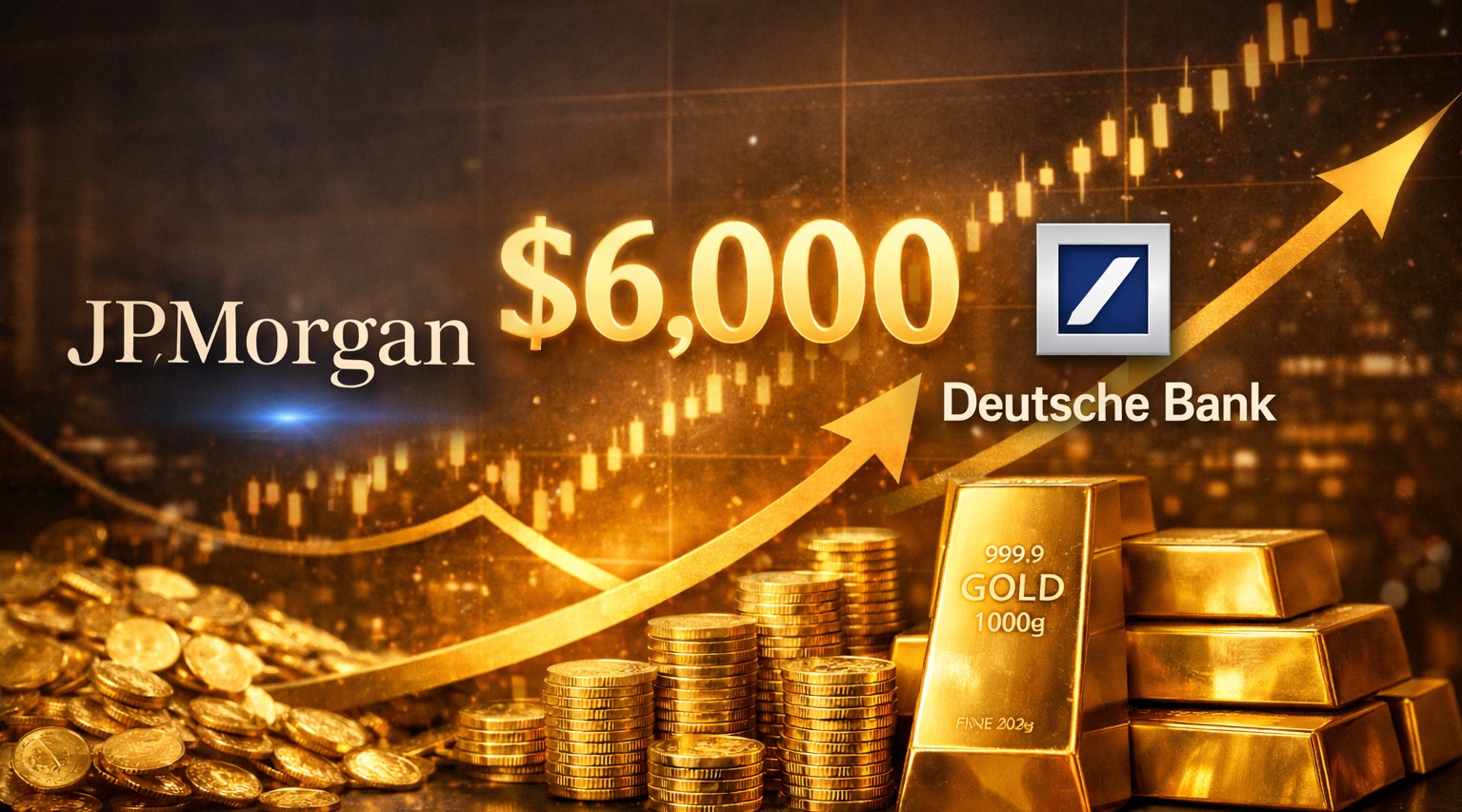
The dramatic recovery from Friday's historic crash to $4,400 prompted JPMorgan to issue its boldest gold forecast yet: $6,300 per ounce by year-end 2026. Deutsche Bank doubled down on its $6,000 target, calling it "achievable this year" despite the extreme volatility that saw gold drop from $5,608 to $4,400 in just hours.
In this article, I am answering the question why gold is surging, analyzing the XAU/USD chart and checking the newest gold price predictions from smart money.
Why Gold Price Is Going Up? 6% Gain Erases Panic
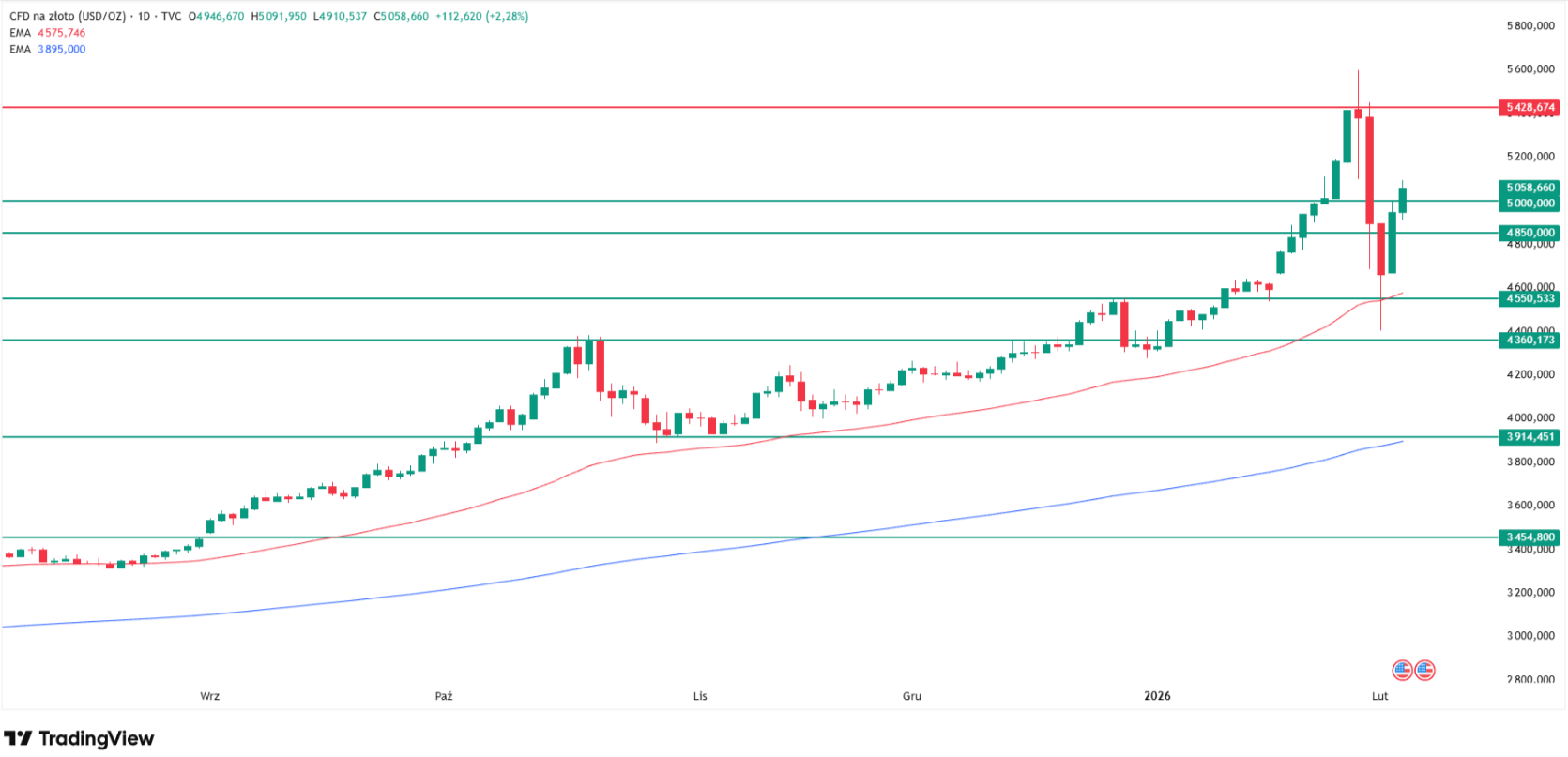
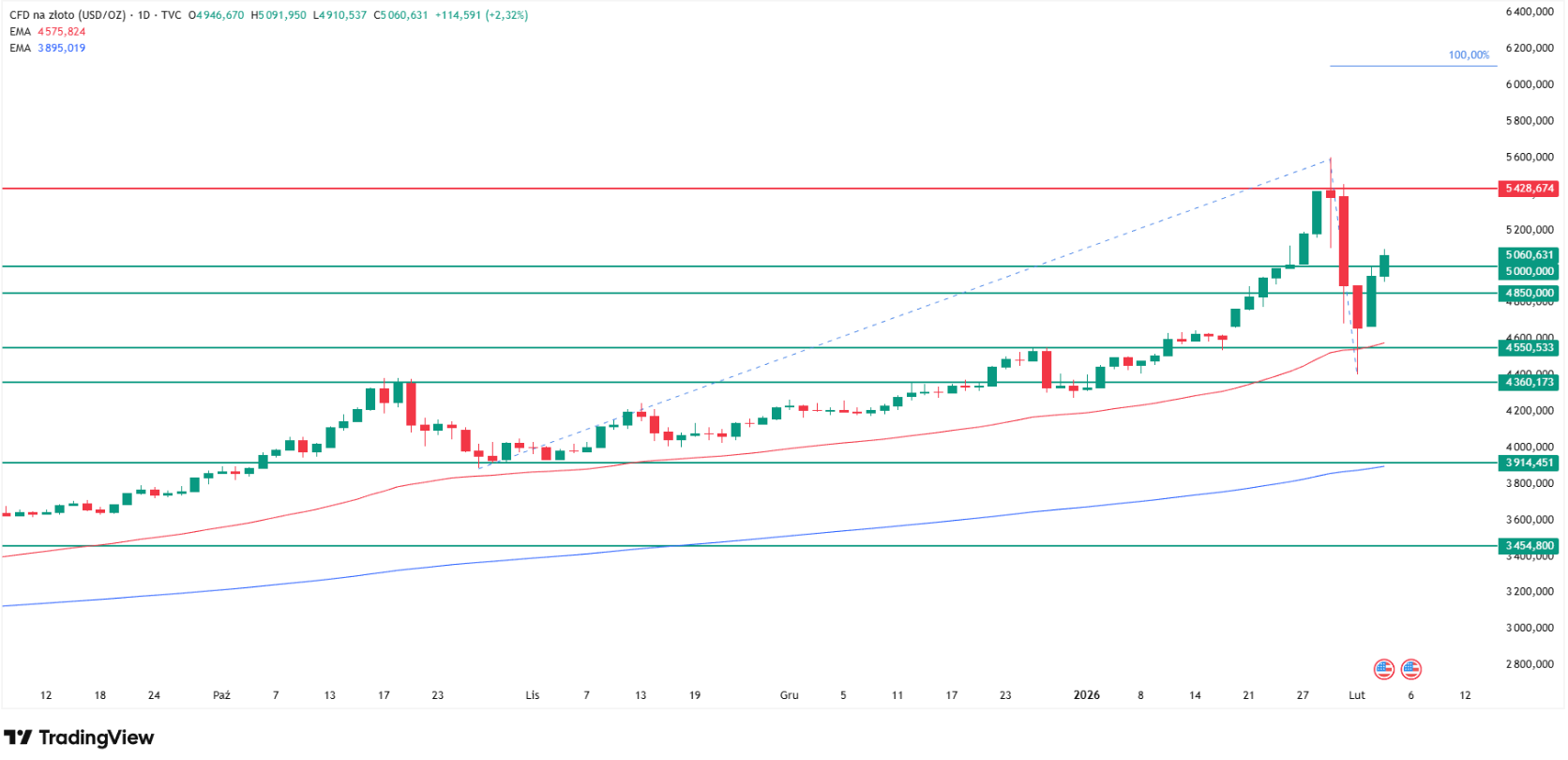
Almost no trace of last Friday's panic remains. Gold climbed 2.66% on Wednesday to $5,078, extending Tuesday's remarkable 6.94% surge that ranks among the strongest single-day gains in nearly 20 years. The recovery found perfect support at the 50-day exponential moving average around $4,550, which coincided with late December historical peaks, exactly as my technical analysis anticipated.
The violent swing from Friday's crash, when gold plunged 9.8% in its sharpest decline since 1983, to this week's explosive recovery demonstrates the yellow metal's resilience. From the $5,608 all-time high on January 28, gold fell to $4,400 in just hours before buyers stepped in aggressively. That $1,200 round-trip in less than a week represents extraordinary volatility even for precious metals markets.
Despite the turbulence, gold remains up 72.45% year-over-year and 10.18% over the past month, underscoring the secular bull market that major banks believe has further to run.
Follow me on X for more gold market analysis: @ChmielDk
Gold Price Prediction
JPMorgan's Boldest Call: $6,300 by Year-End
JPMorgan emerged as the most bullish major institution, projecting gold will reach $6,300 per ounce by the fourth quarter of 202m a 24% gain from current levels. The bank's conviction rests on structural forces it believes are "unexhausted."
"Even with the recent near-term volatility, we remain firmly bullishly convicted in gold over the medium-term on the back of a clean, structural, continued diversification trend that has further to run amid a still well-entrenched regime of real asset outperformance vs paper assets," JPMorgan stated in its Monday note.
- Volatile Gold Makes Brokers' Risks No Longer Around P&L, but About Balance-Sheet Protection
- Gold Price Prediction 2026: WGC Warns of 20% Crash Risk
- Why Gold Is Going Up? XAU Price Today Climbs for 7th Straight Session as Trump Weakens the Dollar
The investment bank now forecasts central bank gold purchases will reach 800 tons in 2026, maintaining the elevated pace that has supported prices since 2022. This represents approximately 26% of annual mine output, creating persistent structural demand that private investors cannot ignore.
Deutsche Bank: "$6,000 Doesn't Seem Extraordinary"
Deutsche Bank's Head of Metals Research Michael Hsueh maintained his $6,000 target despite Friday's chaos, characterizing the selloff as a "tactical move" rather than a "durable fundamental shift" in the market.
In a CNBC interview, Hsueh acknowledged the severity: "This extreme volatility was only the third such instance in the past 50 years, dating back to 1975," and conceded that "investors would be right to sort of question their basic assumptions here." Yet he remained steadfast.
"When we think about what the real fundamentals of gold are in particular, we don't think those fundamental interests from investors have changed," Hsueh explained, adding that structural shifts dating to 2010, when central banks became net buyers, remain intact. The pace of purchasing doubled in 2022, and last year brought the first net buying for gold ETFs in five years.
Hsueh pointed to new speculative dynamics from China, including silver ETFs showing unusually high premiums to NAV and the GFX PGM futures market that opened in late November. While these forces created "a strong speculative overlay that is distorting prices," he maintains they don't undermine the longer-term outlook.
Gold Price Prediction Table: $4,488 to $6,300 Range
Major banks have issued a wide range of 2026 gold forecasts, reflecting both bullish structural views and caution about elevated valuations:
Institution | 2026 Target | Timeframe | Forecast Date | Upside from $5,078 |
JPMorgan | $6,300 | Q4 2026 | Feb 2, 2026 | +24.1% |
UBS | $6,200 | Q1-Q3 2026 | Jan 29, 2026 | +22.1% |
Deutsche Bank | $6,000 | 2026 | Jan 26, 2026 | +18.2% |
Societe Generale | $6,000 | Year-end 2026 | Jan 26, 2026 | +18.2% |
Morgan Stanley | $5,700 | H2 2026 (bull case) | Jan 23, 2026 | +12.2% |
Goldman Sachs | Dec 2026 | Jan 22, 2026 | +6.3% | |
Citi Research | $5,000 | 0-3 months | Jan 13, 2026 | -1.5% |
Commerzbank | $4,800 | Mid-2026 | Jan 13, 2026 | -5.5% |
HSBC | $4,450 | Year-end 2026 | Jan 8, 2026 | -12.4% |
Standard Chartered | $4,488 | 2026 | Oct 13, 2025 | -11.6% |
Ron Paul | $20,000-$100,000 | Long-term | Jan 2026 | +294% to +1,869% |
The consensus among bullish banks centers around $6,000-6,300, while conservative forecasters like HSBC and Standard Chartered see limited upside or even downside from current levels. Former Congressman Ron Paul's $20,000-$100,000 prediction, based on his "fiat system dying" thesis, represents an extreme outlier.
Saxo Bank also projects $10,000 gold, suggesting a complete dollar collapse scenario that mainstream banks dismiss.
My chart below shows Fibonacci retracement levels measured from the September 2024 lows through the January 28, 2026 all-time high at $5,608, with extension levels indicating potential targets. The 100% Fibonacci extension projects to approximately $6,200 per ounce, demonstrating technical confluence with major bank forecasts.
Main Reasons Why Gold Is Surging
Geopolitical Premium: Iran Tensions Intensify
Konstantinos Chrysikos, Head of Customer Relationship Management at Kudotrade, attributes gold's recovery to renewed geopolitical risks that "remain a central pillar of support."
"Gold moved back above the key $ 5,000 per ounce level on Wednesday, extending its recovery after a sharp correction," Chrysikos noted. "The metal continued to attract dip buyers while geopolitical risks remain a central pillar of support."
Concerns in the Middle East intensified dramatically after US forces downed an Iranian drone near a carrier group, reinforcing gold's safe-haven appeal. While diplomatic channels with Iran remain open ahead of scheduled talks, Chrysikos emphasizes "the situation remains highly sensitive."
Eastern European tensions add another layer of support. "In Eastern Europe, markets are also navigating a fragile backdrop as Ukraine-US-Russia discussions are set to take place in Abu Dhabi, while tensions remain elevated on the ground," he explains.
The geopolitical premium has become embedded in gold pricing. Historical precedent shows gold rallying during Middle East crises, and the current Iran-US standoff, combined with ongoing Ukraine conflict, provides sustained support regardless of short-term technical factors.
Risk-Off Rotation: From Stocks to Hard Assets
Kathleen Brooks, research director at XTB, identifies a critical shift in investor behavior that's driving gold higher while equities struggle.
"Sentiment towards equities has soured today due to two factors," Brooks explains. "Firstly, renewed tensions between Iran and the US, after the US shot down an Iranian drone near one of its aircraft carriers. Secondly, the selloff in bitcoin on Tuesday has hit risk sentiment more broadly."
"The main crypto currency is testing the lows from April," Brooks notes. "Equities have not joined in the recovery rally in precious metals, and gold, silver and oil are all higher today. This is a sign that in the short term, growth stocks are getting sold off in favour of hard assets like commodities."
This divergence between equities and commodities signals a fundamental shift in risk appetite. When digital assets and growth stocks fall simultaneously while gold rallies, it reflects genuine fear rather than mere profit-taking. The pattern suggests institutional money is rotating into inflation hedges and geopolitical insurance.
Gold has dominated CFD trading volumes at major brokers like Axi, with the extreme volatility attracting both institutional and retail traders seeking to capture massive intraday swings.
Gold Technical Analysis: ATH Path Open If $5,000 Holds
From my technical perspective, gold's bounce from the 50 EMA at $4,550, perfectly aligned with December highs, validates the bullish structure remains intact. If gold maintains support above the critical $5,000 psychological level, the path to test all-time highs is open again.
Key Resistance: $5,415
The January 28 peak at $5,415 now serves as the first major resistance. Breaking above this level would signal the correction is complete and gold is resuming its assault on $6,000.
Critical Support: $5,000
Wednesday's close at $5,078 keeps gold comfortably above the $5,000 psychological threshold. This round number has attracted dip buyers aggressively, as evidenced by Tuesday's 6% rally and Wednesday's continued strength. As long as $5,000 holds, I remain constructive.
Downside Protection: $3,900-4,000 Zone
For those worried about renewed weakness, I emphasize that "gold still has a lot of room to fall before worrying about the long-term uptrend." The official technical boundary between downtrend and uptrend sits at $3,900-4,000, where the 200-day exponential moving average currently resides alongside early November lows.
Only a sustained break below this zone would invalidate the bull market and suggest something fundamental has changed. Given central bank buying, geopolitical tensions, and dollar weakness concerns, such a scenario seems remote.
Not everyone shares Wall Street's bullish conviction. In a provocative analysis, Scope Markets EU CEO warned that $6,000 gold price targets may be setting a retail trap, suggesting major banks could be distributing to retail investors at elevated levels.
FAQ, Gold price analysis
Why is gold surging today?
Gold surged to $5,078 on Wednesday, February 4, 2026, extending Tuesday's 6% rally (strongest in 20 years) after bouncing from the 50 EMA at $4,550. Geopolitical tensions intensified after US forces downed an Iranian drone near a carrier group, while central bank buying forecast at 800 tons for 2026 provides structural support.
How high can gold go in 2026?
JPMorgan projects gold reaching $6,300 by Q4 2026 (+24% from current $5,078), the most bullish major bank forecast. Deutsche Bank maintains its $6,000 target, calling it "achievable this year," while UBS sees $6,200.
What is the gold price prediction?
The consensus among bullish banks centers on $6,000-6,300 by year-end 2026, supported by 800 tons of forecast central bank buying and geopolitical tensions. Michael Hsueh (Deutsche Bank) notes recent volatility was "tactical" not "durable fundamental shift," maintaining that the $6,000 target "doesn't seem extraordinary or unachievable".
Should I buy gold now?
Yes, you should consider it. Gold at $5,078 sits 9.5% below its January 28 all-time high of $5,608 but well above the $4,400 crash low from Friday. Technical support at $5,000 psychological level is holding, with the 50 EMA at $4,550 providing secondary support.