
Bitcoin (BTC) traded at $71,937 on Monday, April 13, 2026, up 1.65% on the day after recovering from a Sunday plunge to $70,741 triggered by President Trump's order to blockade the Strait of Hormuz and the collapse of US-Iran peace talks.
The Monday bounce reverses the sharpest single-session drop in two weeks, but BTC still sits 43% below the October 6, 2025 all-time high of $126,198. WTI crude has surged past $104 a barrel, March CPI printed at 3.3% (the highest reading since May 2024), and the Federal Reserve is holding rates at 3.50% to 3.75%.
The next 48 hours hinge on whether $6 billion in clustered shorts above the market force a squeeze, or whether the macro stack drags BTC back toward $70,000. In this article I examine why Bitcoin price is going up, looking at BTC/USDT chart and checking the most up to date BTC price predictions.
Follow me on X for real-time market analysis: @ChmielDk
Why Is Bitcoin Surging Today? BTC Reclaims $72,000
The geopolitical shock is the dominant variable. President Trump ordered a US naval blockade of vessels moving through the Strait of Hormuz to Iranian ports on Sunday, April 12, after weekend peace talks collapsed. The reaction in oil was immediate and severe: WTI cleared $104 a barrel, a roughly 70% gain since January.
Adam Saville-Brown, Head of Commercial at Tesseract Group, frames the setup as an asymmetric risk profile rather than a directional call. "Bitcoin defended $70,000 this morning despite one of the sharpest geopolitical energy shocks in recent memory," he said. Saville-Brown points to roughly $6 billion in leveraged shorts clustered between $72,200 and $73,500 as the structural fragility in the tape. "In a range-bound market, that is not bearish conviction; it is fragility," he added.
- Bitcoin Price Prediction April 2026: Iran Ceasefire and $427M Short Squeeze Set Up BTC $80K Breakout Test
- How High Can Bitcoin Go? This New BTC Price Prediction Targets $240K
- How Low Can Bitcoin Go? After Worst Quarter Since 2018, BTC Price Predictions Remain Bearish
Oliver Carding, Head of Marketing at Tesseract Group, argues the original April bull case has not reversed but has been overwhelmed. "ETF flows are still net positive… but they are being overwhelmed by something else entirely," Carding said. He attributes the dislocation to a Bitcoin-Nasdaq correlation that hit 85% during the recent oil spikes, with the market currently pricing geopolitical tail risk above adoption fundamentals.
The drivers stacked into this morning's tape:
- WTI crude above $104 per barrel, up roughly 70% from January's ~$61
- March CPI at 3.3%, the highest since May 2024, driven by a 10.9% monthly surge in energy
- Federal Reserve holding at 3.50%–3.75% with consensus pricing only one cut for 2026
- BTC-Nasdaq correlation at 85% during oil spikes, suppressing the safe-haven bid
- $6 billion in leveraged shorts stacked between $72,200 and $73,500
Joel Kruger, Crypto Strategist at LMAX, sees early evidence of a basing process. "The crypto market is beginning to show signs of basing after several months of sustained downside pressure," Kruger said, flagging $76,000 in BTC and $2,400 in ETH as the levels that would confirm a structural shift on a sustained weekly close.
ETF Flows: BlackRock IBIT, Morgan Stanley MSBT and the Institutional Bid
The institutional bid has not disappeared, but it is no longer linear. Morgan Stanley launched its own spot Bitcoin ETF, the Morgan Stanley Bitcoin Trust (MSBT), on April 8 at a 0.14% fee, the lowest in the US market and 11 basis points below BlackRock's IBIT.
The week's flow data captures the tension between structural accumulation and tactical de-risking:
- MSBT day-one inflows: $30.6 million, the strongest first day for any Morgan Stanley ETF, with 430 BTC purchased
- MSBT day-two inflows: $14.9 million, ranking the launch in the top 1% of all ETF debuts of the past year
- BlackRock IBIT YTD inflows: $1.5 billion despite BTC falling from a 2026 peak near $97,000 to $72,100
- April 6 single-day total: $471 million across all spot BTC ETFs, the strongest in over a month
- MSBT debut day sector flows: $94 million in net outflows, with only IBIT and MSBT positive
- Distribution reach: Morgan Stanley's 16,000 advisors manage roughly $6.2 trillion in client assets
As I wrote in my April 2 analysis of JPMorgan's $240,000 long-term target, Q1 still absorbed $18.7 billion in net spot ETF inflows even as price fell. The structural bid is real. The question is whether it can outweigh a Fed on hold and oil at $104.
Bitcoin Technical Analysis: $62,500 to $75,000 Range Holds, 200 MA at $83,000 Is the Real Test
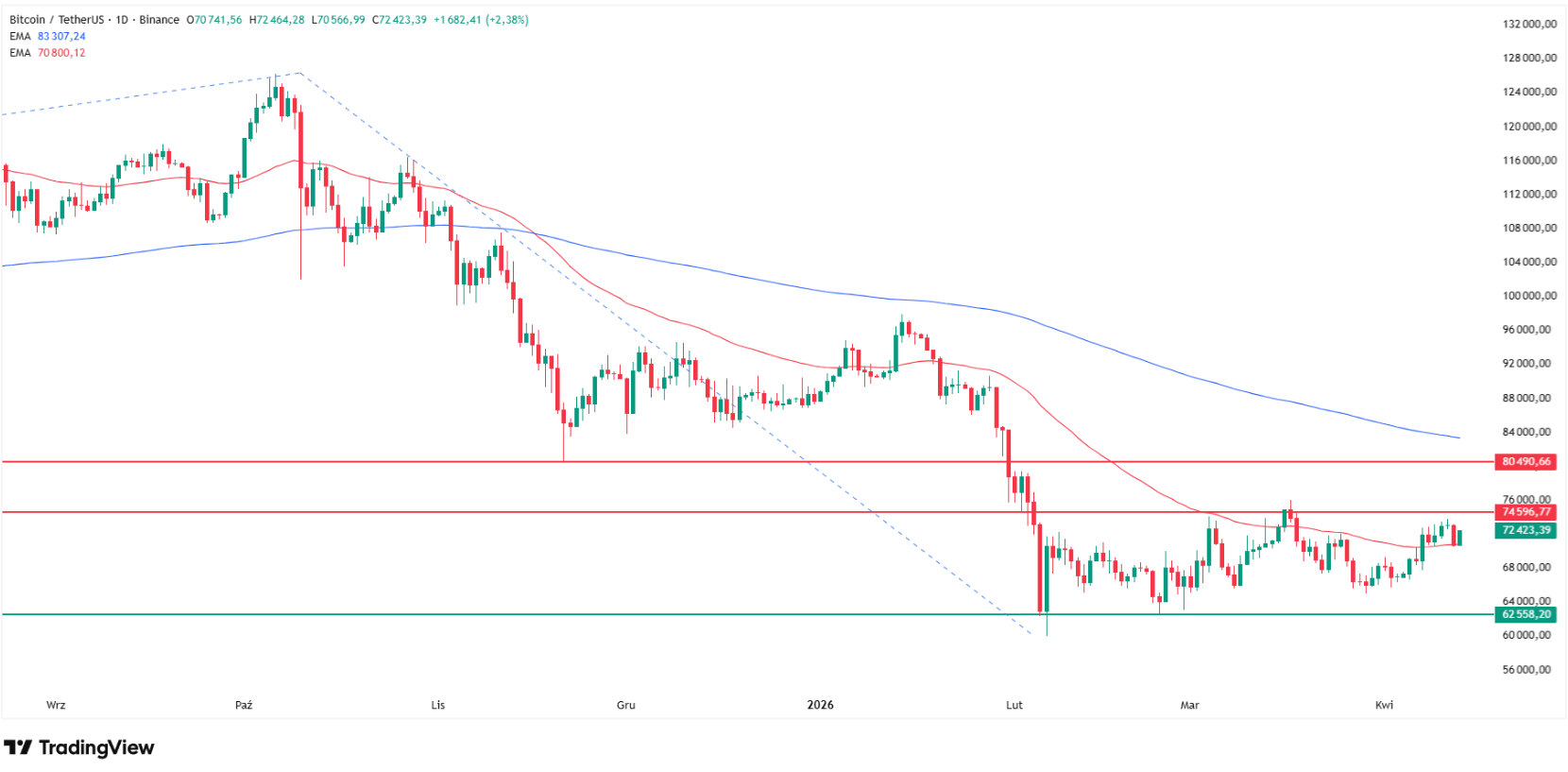
My chart shows nothing has changed structurally. Bitcoin is in its second consecutive month inside the same consolidation, at the lowest levels since November 2024. The lower bound at roughly $62,500 was set by the February lows and retested in early March. The upper bound near $75,000 was carved by the late-January lows and retested in mid-March. Price currently holds above the 50 MA, which is the only short-term positive on the daily timeframe.
Level | Type | Notes |
$62,500 | Major support | February low, retested early March; range floor |
$70,000 | Psychological support | Defended Sunday in real time during Hormuz news |
$75,000 | Range resistance | Late January lows, retested mid-March; first hurdle |
$80,000 | Key resistance | November 2025 lows; next major test above range |
$83,000 | 200 MA | Separates downtrend from uptrend; bull case starts here |
$94,000–$96,000 | Heavy resistance | December 2025 / January 2026 highs |
$123,000 | Final resistance | July 2025 highs and effective ATH on a closing basis |
Bitcoin has been below the 200 MA since November, which means the chart is formally in a bearish structure. From the current $71,937, BTC is roughly 15% below the moving average that would invalidate that bias. As I wrote in my March 24 analysis of the Bitcoin crash and the same range, only a sustained close back above the 200 MA gives bulls a credible attempt at the upper resistance ladder.
If $62,500 cracks on a daily close, my bear extension targets the $50,000–$52,000 August 2024 lows. If BTC can grind through $75,000 and then pierce $80,000, the path opens toward $94,000–$96,000 and the $100,000 psychological level above that.
Bitcoin Price Prediction: How High Can BTC Go in 2026?
The institutional forecast range remains extraordinarily wide. The FinanceMagnates.com report from January detailed the $75,000 to $225,000 spread that defined consensus at the start of the year. Three months of macro pressure have not narrowed it.
Source | Target | Notes |
Tesseract Group (Saville-Brown) | $75,000–$80,000 | Near-term squeeze if shorts at $72,200–$73,500 break |
LMAX (Joel Kruger) | $76,000 trigger | Sustained weekly close = structural shift confirmation |
Standard Chartered | $150,000 | End-2026; cut from $300,000 in December |
Bernstein | $150,000 | Late 2026; $200,000 by end-2027 |
Carol Alexander (Univ. Sussex) | $75,000–$150,000 | Center of gravity ~$110,000; institutional transition |
JPMorgan | $240,000–$266,000 | Long-term Fibonacci-extension target |
Canary Capital (McClurg) | $50,400 | "Bear leg" of four-year cycle, 60% drawdown |
As the FinanceMagnates.com report from December detailed, Standard Chartered cut its 2026 BTC target to $150,000 from a previous $300,000, and Bernstein converged on the same figure. The bull case from JPMorgan's $240,000 Fibonacci extension and the bear case from Canary Capital's $50,000 cycle target now span almost a full 5x range.
Saville-Brown's tactical view captures the asymmetry. "Bitcoin does not need a new bull case to rally. It just needs enough sustained spot demand to push the price into that band," he said, referring to the $72,200–$73,500 short cluster.
Bull case:
- $1.5B in YTD IBIT inflows and the MSBT distribution channel through 16,000 advisors
- $6 billion in shorts stacked overhead create mechanical liquidation fuel
- LMAX flags BTC outperforming gold over the past month, suggesting early base
- Any Hormuz de-escalation or oil retreat below $90 restores the April bull thesis
Bear case:
- Fed on hold at 3.50%–3.75% with only one cut priced for 2026
- CPI at 3.3% with energy doing the heavy lifting; inflation sticky
- 200 MA at $83,000 still ~15% away; trend formally bearish since November
- Sustained $105+ oil compresses risk allocation across the entire cycle
Bitcoin Pirce Analysis, FAQ
Why is Bitcoin surging today, April 13, 2026?
Bitcoin is up 1.65% to $71,937 on Monday after Sunday's drop to $70,741 on Trump's Strait of Hormuz blockade order. The bounce is technical: $6 billion in shorts clustered at $72,200–$73,500 created upside fragility, and spot demand absorbed enough Sunday selling to defend $70,000.
How high can Bitcoin go in 2026?
Institutional 2026 targets span $50,000 (Canary Capital) to $240,000 (JPMorgan Fibonacci extension). Standard Chartered and Bernstein both project $150,000. Tesseract Group sees a near-term squeeze to $75,000–$80,000. My technical view requires a close above the 200 MA at $83,000 before any bull case is credible.
Where is Bitcoin's key support and resistance?
Range support sits at $62,500 (February lows). Range resistance is $75,000 (late-January lows). The 200 MA at $83,000 is the line that separates the bear trend from a bull trend. Above that, the next heavy zone is $94,000–$96,000.
What does the Strait of Hormuz blockade mean for Bitcoin?
The blockade has pushed WTI crude past $104 and reinforced March CPI at 3.3%, the highest since May 2024. That keeps the Fed on hold at 3.50%–3.75%, tightening systemic liquidity. Bitcoin trades with an 85% Nasdaq correlation during oil spikes, which suppresses the safe-haven bid and ties price to risk-asset flows.
Are Bitcoin ETFs still attracting institutional money?
Yes, but unevenly. BlackRock's IBIT has pulled in $1.5 billion year-to-date. Morgan Stanley's MSBT debuted on April 8 with $30.6 million in day-one inflows at a 0.14% fee, the lowest in the market. The April 6 sector total hit $471 million in a single day, the strongest in over a month, though MSBT's debut day saw $94 million in net sector outflows.