VanEck predicts Bitcoin could reach $644,000 by the 2028 halving, representing 420% upside from current levels.
The newest Bitcoin price prediction assumes the cryptocurrency captures half of gold's store-of-value market cap as younger investors prefer digital assets.
In the past, the ETF issuer accurately predicted this year’s BTC peak and still targets a level of $180,000 for 2025.
VanEck's Matthew Sigel predicts Bitcoin price may rise more than 400% thanks to gold
Bitcoin
price (BTC)
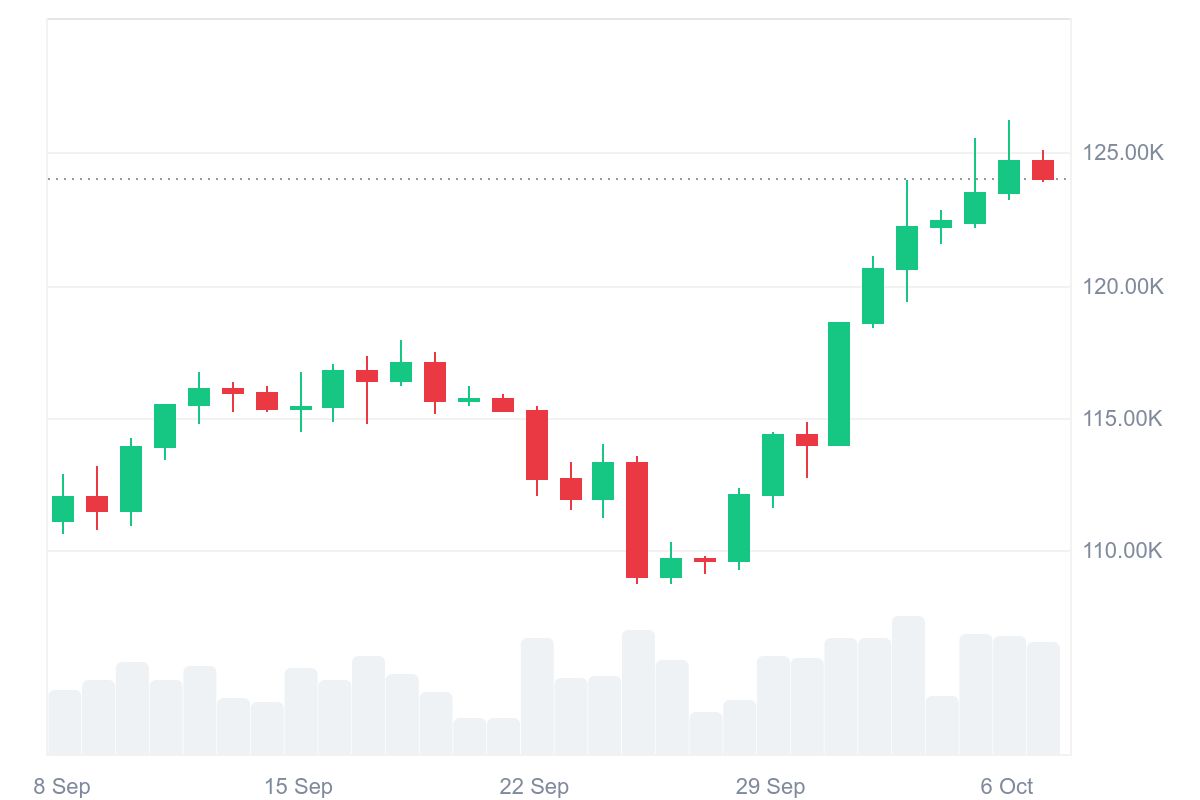
continues its historic rally, setting a fresh all-time high at $126,200 on
Monday before pulling back slightly to trade around $124,500 on Tuesday,
October 7, 2025. The cryptocurrency has surged nearly $20,000 in just
two weeks, yet Matthew Sigel from VanEck, who accurately predicted Bitcoin's
2025 peak, now suggests the digital asset could reach an "equivalent
value" of $644,000 by the next halving in 2028.
This bold
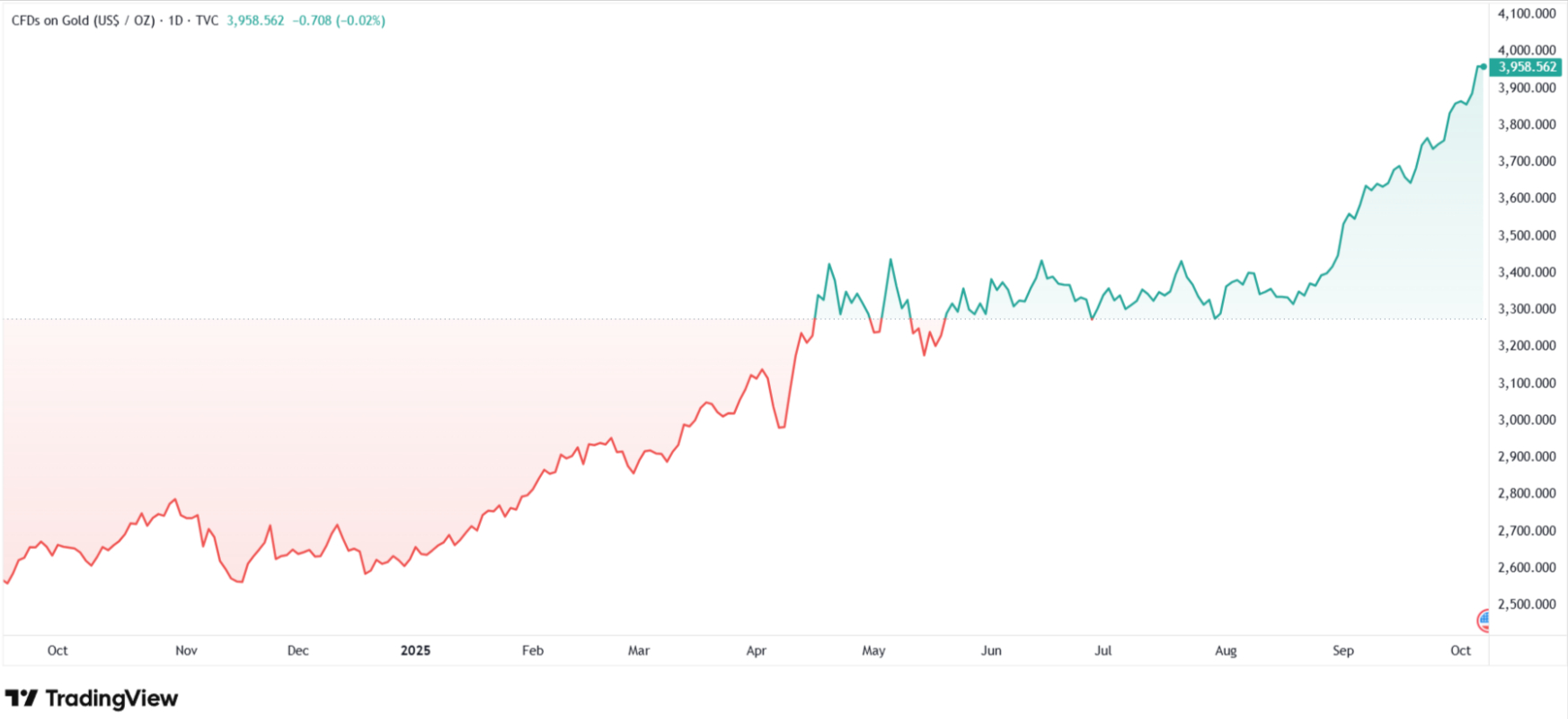
prediction comes as gold prices hit record highs near $4,000 per ounce,
creating a new benchmark for Bitcoin's potential market capitalization if it
captures half of gold's store-of-value demand.
In this
article, I am checking the current Bitcoin price today, analyzing the BTC/USDT
technical chart and reviewing the most up to date BTC price forecasts.
Bitcoin Price Today Stays
Under New All-Time High
Bitcoin's
price action on Monday, October 6, 2025, saw the cryptocurrency break through
previous resistance levels to
establish a new all-time high at $126,200. This marked the fifth
consecutive session of gains for the world's largest cryptocurrency by market
capitalization.
As of today
morning (Tuesday), Bitcoin trades at approximately $124,000, representing
a modest 0.7% pullback from the peak. The cryptocurrency has demonstrated
remarkable strength throughout October, gaining over 10% month-to-date and
continuing the historical "Uptober" pattern of strong Q4 performance.
“As was widely expected in Q4, a new all-time-high (ATH) was
set for BTC, buoyed by the prospect of US stimulus, seeing prices rally 10%
the past 9 days," Paul Howard, the Director at Wincent, commented for FinanceMagnates.com.
VanEck's $644K Bitcoin
Price Prediction Explained
Matthew
Sigel, head of digital assets research at VanEck, unveiled his latest Bitcoin
forecast on Monday, tying it directly to gold's historic rally. His thesis
centers on a generational shift in store-of-value preferences among
younger investors, particularly in emerging markets.
We’ve been saying Bitcoin should reach half of gold’s market cap after the next halving. Roughly half of gold’s value reflects its use as a store of value rather than industrial or jewelry demand, and surveys show younger consumers in emerging markets increasingly prefer Bitcoin…
— matthew sigel, recovering CFA (@matthew_sigel) October 7, 2025
At today's
record gold
price of approximately $3,960 per ounce, this implies an equivalent value
of $644,000 per BTC by the 2028 halving. This represents a potential
gain of 420% from current price levels, making it one of the most
bullish institutional forecasts in the cryptocurrency space.
In their
Mid-August 2025 Bitcoin ChainCheck report, VanEck analysts stated: "As
autumn approaches, several intertwined risks and opportunities emerge. Still,
we stick with our $180K BTC price target by year-end". This
prediction remains in play as Bitcoin trades at $124,000, requiring only
a 45% increase to reach the target with nearly three months remaining
in 2025.
Bitcoin Price Technical
Analysis
My Technical Analysis:
Caution Despite Bullish Setup
Bitcoin's
price has been rising for the fifth consecutive session, with Monday
establishing a new all-time high at $126,200. Although the cryptocurrency is
correcting by 0.7% on Tuesday, it still maintains very high levels at $123,800.
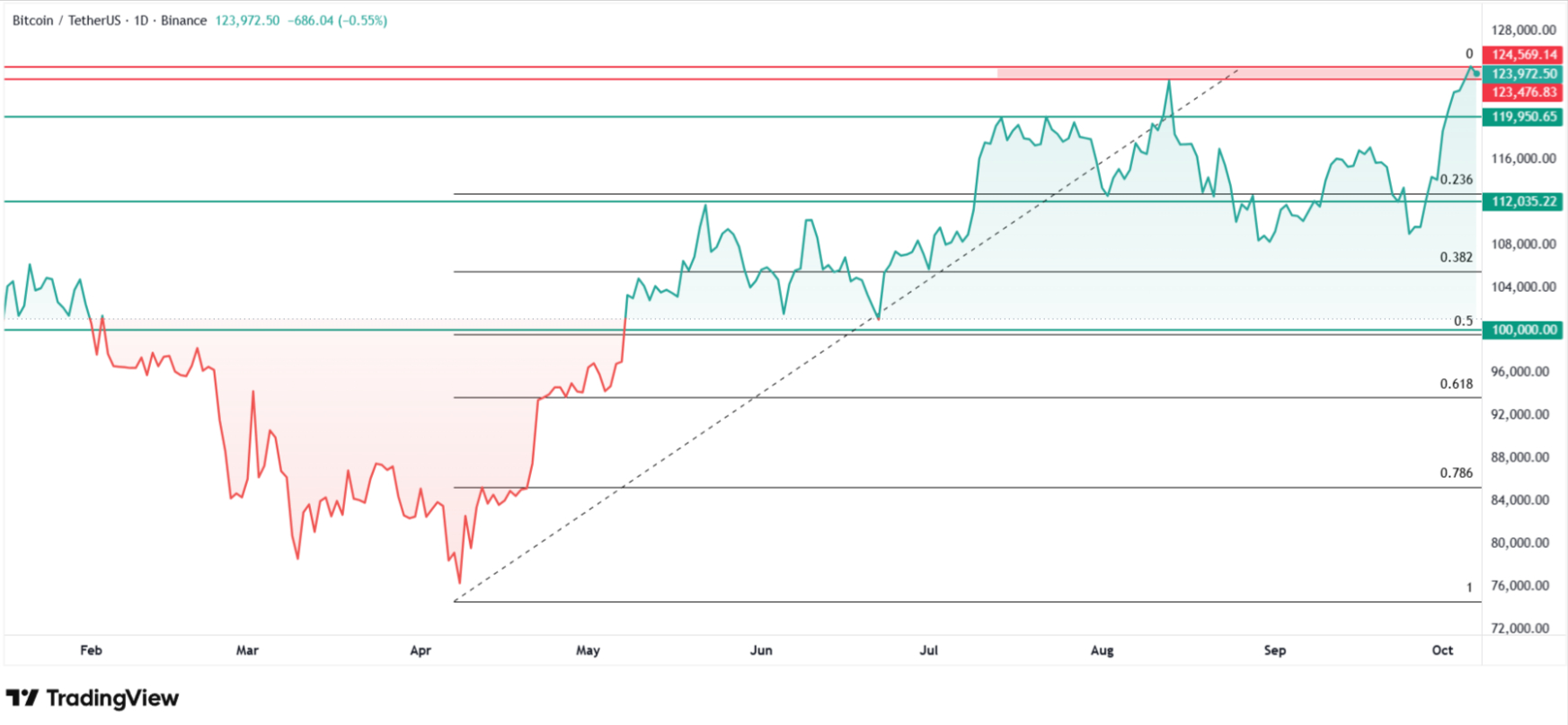
Based on my
technical analysis, the previous peaks from July and August continue to play
the role of significant resistance, which is difficult to break through and
enter a full-fledged phase of price discovery in previously unexplored areas of
the chart.
While I
personally believe that Bitcoin will continue to rise in the medium and long
term, after the recent strengthening of nearly $20,000 over the course of 2
weeks, I would not rule out some profit-taking from current levels. Such a
scenario could close the price, for example, around the $112,000 level, which
is the historical ATH from May of this year.
My technical analysis of the Bitcoin chart. Source: Tradingview.com
Wincent's Howard agree with my view, stating: "With trading volume falling sharply again and a number of large unlocks happening this week, we can expect a pullback next rather than a much quoted 'parabolic' ascension."
Key Technical Levels for
Bitcoin
Current
technical analysis reveals several critical price zones that traders are
monitoring closely:
Support Levels:
$123,000
(immediate support, 24-hour low)
$118,000 (previous
consolidation zone from late September)
$112,000 (psychological round
number and May 2025 peak)
Resistance Levels:
$126,200 (current all-time high
established October 6)
$130,000 (projected breakout
target based on bull flag pattern)
$135,000
(Q3 2025 analyst target zone)
The recent
price action has pushed Bitcoin's 30-day volatility to just 3.06%, one of
the lowest readings in years, suggesting that institutional participation has
matured the market significantly.
The
flagpole was established during the surge from $100,000 to $126,200, while the
current consolidation would form the flag component if prices stabilize in the
$120,000-$125,000 range. A confirmed breakout above $128,000 could propel
Bitcoin toward the $135,000-$140,000 zone by late Q4 2025.
On-balance
volume (OBV) indicators continue showing accumulation despite
sideways price action, mirroring the pattern seen before Bitcoin's previous
rally from $76,000 to $112,000 earlier in 2025. This hidden institutional
buying suggests that smart money remains bullish on Bitcoin's medium-term
prospects.
Why Bitcoin Is Surging?
Gold Rally Supports
Bitcoin's Bullish Case
Gold's
surge to nearly $4,000 per ounce has created a compelling framework
for understanding Bitcoin's potential upside. The precious metal has
gained 50% year-to-date, outperforming Bitcoin's gains during the same
period as investors sought safe-haven assets amid economic uncertainty.
However,
the demographic divide in store-of-value preferences reveals Bitcoin's
structural advantage. Younger investors in emerging markets increasingly view
Bitcoin as their preferred wealth preservation vehicle, while older generations
remain anchored to gold.
Key Drivers Behind Bitcoin’s 2025–2026 Momentum
Generational Wealth Transfer
Favors Bitcoin
– As baby boomers pass trillions to younger, tech-savvy heirs, a larger
share of inherited wealth is expected to move into Bitcoin instead of
gold.
Massive Upside Compared to Gold – With gold’s $10 trillion
store-of-value market and Bitcoin’s $2.4 trillion cap, even partial
substitution could push Bitcoin toward VanEck’s $644,000 target by 2028.
Institutional Adoption
Accelerates –
Nearly 60% of institutional investors now hold at least 10% of their
portfolios in digital assets, showing a clear shift from speculative to
strategic allocation.
Strong Spot Bitcoin ETF Inflows – ETFs like BlackRock’s
iShares Bitcoin Trust continue attracting significant capital, adding
billions in inflows and providing crucial price stability.
Corporate Treasuries Embrace
Bitcoin –
Firms now hold around $135 billion in Bitcoin, led by younger tech
companies using it as a treasury reserve asset.
Regulatory Clarity Boosts
Confidence –
The SEC’s softer stance and passage of the GENIUS Act have created a
clearer, more predictable environment for institutional investors.
Potential for State and Federal
Bitcoin Reserves
– VanEck expects the U.S. could treat Bitcoin as a strategic asset,
strengthening its institutional legitimacy.
Macro Tailwinds Support Growth – Rate cut expectations,
dollar weakness, and inflation fears are driving renewed demand for
Bitcoin as a hedge and liquidity beneficiary.
Federal Reserve Rate Cuts
Expected –
Markets anticipate rate reductions in late 2025, lowering the cost of
holding Bitcoin and increasing capital inflows.
Inflation and Dollar Debasement
Concerns –
High government debt and declining fiat value make Bitcoin’s fixed 21
million supply increasingly attractive as a long-term store of value.
Bitcoin Price Predictions
for Late 2025 and Beyond
Multiple
scenarios exist for Bitcoin's price trajectory through the remainder of 2025
and into subsequent years, depending on the interplay of technical,
fundamental, and macroeconomic factors.
Short-Term Outlook: $180K
by Year-End 2025
VanEck
maintains its prediction that Bitcoin will reach approximately $180,000 by
the end of 2025, requiring a 45% increase from current levels. This target
assumes continued ETF inflows, institutional adoption, and favorable
macroeconomic conditions through Q4 2025.
"At Wincent we have seen a pickup in OTC volumes lately where
counterparties can take these positions onto book rather than dumping in the
market. If that continues then we can expect less volatility and further price
ascension in the coming weeks and surely at least one more ATH reached before
the end of the year for BTC," Howard explained for FinanceMagnates.com
The firm
noted in September 2025 that Bitcoin's traditional four-year cycle remains
relevant, though institutional participation may dampen extreme volatility
compared to previous bull markets. A more measured appreciation would reflect
the asset's maturation while still delivering substantial returns.
Long-Term: $644K by 2028
Halving
VanEck's
most recent prediction targets $644,000 per Bitcoin by the next
halving event scheduled for 2028. This forecast assumes Bitcoin captures
approximately 50% of gold's store-of-value market capitalization as
generational wealth transfer accelerates and younger investors increasingly
prefer digital assets.
Even more
bullish long-term scenarios exist. VanEck's 2050 analysis suggests Bitcoin
could reach $2.9 million if adopted for 10% of global trade
settlement and 5% of domestic transactions, with central banks holding
approximately 2% of reserves in the cryptocurrency.
Comparative Analysis:
Bitcoin vs. Gold Performance
The
relationship between Bitcoin and gold has evolved significantly in 2025, with
both assets reaching record highs but gold temporarily outperforming the
cryptocurrency on a percentage basis.
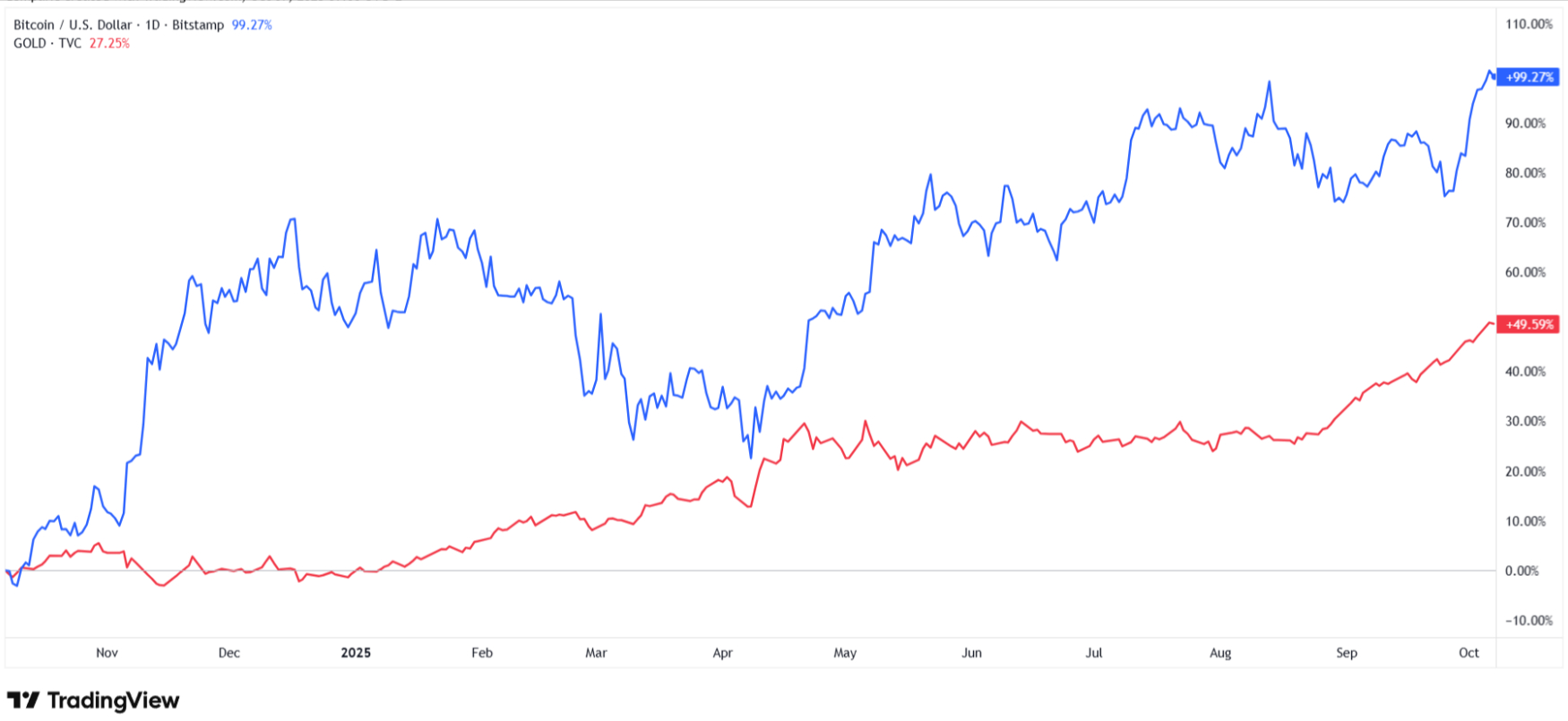
Year-to-Date Performance (2025):
Gold:
+50% (from $2,640 to $3,960)
Bitcoin:
+100% (from $62,000 to $124,000)
Bitcoin is giving investors way higher ROI than gold. Source: Tradingview.com
Despite
Bitcoin's superior annual performance, gold skeptic Peter Schiff noted that
Bitcoin remains approximately 15% below its record high when priced
in gold terms. Bitcoin would need to reach about $148,000 to match
its record high in gold-adjusted terms, according to Schiff's calculation.
However,
Bitcoin advocate Joe Consorti from custodian Theya countered that Bitcoin's
"fair value floor has been lifted to $1.34 million" with gold's
rise, suggesting the cryptocurrency remains dramatically undervalued relative
to its potential.
Key Risks and Bearish
Scenarios
Despite
overwhelmingly bullish technical and fundamental indicators, several risks
could derail Bitcoin's ascent toward VanEck's ambitious targets.
Profit-Taking After Rapid
Gains
As noted in
my technical analysis, Bitcoin's $20,000 surge in just two weeks
creates conditions for significant profit-taking. A correction to the $112,000-$115,000 range
(May 2025 all-time high) would represent healthy consolidation rather than
trend reversal, but could trigger cascading stop-losses if support fails.
Short-term
bearish scenarios include breakdown below $120,000, which could extend
losses toward $110,000 or even test the $100,000 psychological
support zone if ETF flows reverse or macroeconomic data surprises negatively.
Regulatory and
Geopolitical Risks
Upcoming
trade war deadlines, including EU retaliatory tariffs on July 14 and
expiration of China tariff pauses on August 12, could drive episodic
volatility in risk assets including Bitcoin. These geopolitical developments
remain unpredictable wildcards that could temporarily disrupt bullish momentum.
Additionally,
regulatory shifts, while currently favorable, could reverse if political winds
change or if major security breaches undermine confidence in cryptocurrency
infrastructure.
Bitcoin News FAQ
What is the biggest
problem with Bitcoin?
Bitcoin's
biggest problem is scalability and transaction costs. Processing transactions
takes approximately 10 minutes with median fees around $20, making it
cumbersome for everyday use. Additionally, price volatility undermines its
viability as a medium of exchange, and security vulnerabilities persist, with
over $2.17 billion stolen from cryptocurrency services in H1 2025 alone.
What is the biggest risk
to Bitcoin?
The biggest
risks include regulatory uncertainty, quantum computing threats to
cryptographic security, and custodial failures that could undermine
institutional trust. Security breaches remain significant, with 2025 on track
to exceed $4 billion in stolen funds. Additionally, mining centralization and
potential government crackdowns pose long-term threats to Bitcoin's
decentralized nature.
What if I invested $1,000
in Bitcoin 5 years ago?
A $1,000
investment in Bitcoin five years ago (October 2020, when BTC traded around
$11,000) would be worth approximately $11,318 today at current prices of
$124,500. This represents a 1,032% return, demonstrating Bitcoin's exceptional
performance despite volatility over the past half-decade.
Who controls Bitcoin?
Nobody
controls Bitcoin. It operates as a decentralized network maintained by
thousands of nodes worldwide. The protocol is governed by consensus among
miners, developers, and users, with no central authority able to unilaterally
change the rules. The "social layer" of Bitcoin users ultimately
determines protocol changes through community consensus, as demonstrated during
the 2017 block size debate.
Bitcoin
price (BTC)
continues its historic rally, setting a fresh all-time high at $126,200 on
Monday before pulling back slightly to trade around $124,500 on Tuesday,
October 7, 2025. The cryptocurrency has surged nearly $20,000 in just
two weeks, yet Matthew Sigel from VanEck, who accurately predicted Bitcoin's
2025 peak, now suggests the digital asset could reach an "equivalent
value" of $644,000 by the next halving in 2028.
This bold
prediction comes as gold prices hit record highs near $4,000 per ounce,
creating a new benchmark for Bitcoin's potential market capitalization if it
captures half of gold's store-of-value demand.
In this
article, I am checking the current Bitcoin price today, analyzing the BTC/USDT
technical chart and reviewing the most up to date BTC price forecasts.
Bitcoin Price Today Stays
Under New All-Time High
Bitcoin's
price action on Monday, October 6, 2025, saw the cryptocurrency break through
previous resistance levels to
establish a new all-time high at $126,200. This marked the fifth
consecutive session of gains for the world's largest cryptocurrency by market
capitalization.
As of today
morning (Tuesday), Bitcoin trades at approximately $124,000, representing
a modest 0.7% pullback from the peak. The cryptocurrency has demonstrated
remarkable strength throughout October, gaining over 10% month-to-date and
continuing the historical "Uptober" pattern of strong Q4 performance.
“As was widely expected in Q4, a new all-time-high (ATH) was
set for BTC, buoyed by the prospect of US stimulus, seeing prices rally 10%
the past 9 days," Paul Howard, the Director at Wincent, commented for FinanceMagnates.com.
VanEck's $644K Bitcoin
Price Prediction Explained
Matthew
Sigel, head of digital assets research at VanEck, unveiled his latest Bitcoin
forecast on Monday, tying it directly to gold's historic rally. His thesis
centers on a generational shift in store-of-value preferences among
younger investors, particularly in emerging markets.
We’ve been saying Bitcoin should reach half of gold’s market cap after the next halving. Roughly half of gold’s value reflects its use as a store of value rather than industrial or jewelry demand, and surveys show younger consumers in emerging markets increasingly prefer Bitcoin…
— matthew sigel, recovering CFA (@matthew_sigel) October 7, 2025
At today's
record gold
price of approximately $3,960 per ounce, this implies an equivalent value
of $644,000 per BTC by the 2028 halving. This represents a potential
gain of 420% from current price levels, making it one of the most
bullish institutional forecasts in the cryptocurrency space.
In their
Mid-August 2025 Bitcoin ChainCheck report, VanEck analysts stated: "As
autumn approaches, several intertwined risks and opportunities emerge. Still,
we stick with our $180K BTC price target by year-end". This
prediction remains in play as Bitcoin trades at $124,000, requiring only
a 45% increase to reach the target with nearly three months remaining
in 2025.
Bitcoin Price Technical
Analysis
My Technical Analysis:
Caution Despite Bullish Setup
Bitcoin's
price has been rising for the fifth consecutive session, with Monday
establishing a new all-time high at $126,200. Although the cryptocurrency is
correcting by 0.7% on Tuesday, it still maintains very high levels at $123,800.
Based on my
technical analysis, the previous peaks from July and August continue to play
the role of significant resistance, which is difficult to break through and
enter a full-fledged phase of price discovery in previously unexplored areas of
the chart.
While I
personally believe that Bitcoin will continue to rise in the medium and long
term, after the recent strengthening of nearly $20,000 over the course of 2
weeks, I would not rule out some profit-taking from current levels. Such a
scenario could close the price, for example, around the $112,000 level, which
is the historical ATH from May of this year.
My technical analysis of the Bitcoin chart. Source: Tradingview.com
Wincent's Howard agree with my view, stating: "With trading volume falling sharply again and a number of large unlocks happening this week, we can expect a pullback next rather than a much quoted 'parabolic' ascension."
Key Technical Levels for
Bitcoin
Current
technical analysis reveals several critical price zones that traders are
monitoring closely:
Support Levels:
$123,000
(immediate support, 24-hour low)
$118,000 (previous
consolidation zone from late September)
$112,000 (psychological round
number and May 2025 peak)
Resistance Levels:
$126,200 (current all-time high
established October 6)
$130,000 (projected breakout
target based on bull flag pattern)
$135,000
(Q3 2025 analyst target zone)
The recent
price action has pushed Bitcoin's 30-day volatility to just 3.06%, one of
the lowest readings in years, suggesting that institutional participation has
matured the market significantly.
The
flagpole was established during the surge from $100,000 to $126,200, while the
current consolidation would form the flag component if prices stabilize in the
$120,000-$125,000 range. A confirmed breakout above $128,000 could propel
Bitcoin toward the $135,000-$140,000 zone by late Q4 2025.
On-balance
volume (OBV) indicators continue showing accumulation despite
sideways price action, mirroring the pattern seen before Bitcoin's previous
rally from $76,000 to $112,000 earlier in 2025. This hidden institutional
buying suggests that smart money remains bullish on Bitcoin's medium-term
prospects.
Why Bitcoin Is Surging?
Gold Rally Supports
Bitcoin's Bullish Case
Gold's
surge to nearly $4,000 per ounce has created a compelling framework
for understanding Bitcoin's potential upside. The precious metal has
gained 50% year-to-date, outperforming Bitcoin's gains during the same
period as investors sought safe-haven assets amid economic uncertainty.
However,
the demographic divide in store-of-value preferences reveals Bitcoin's
structural advantage. Younger investors in emerging markets increasingly view
Bitcoin as their preferred wealth preservation vehicle, while older generations
remain anchored to gold.
Key Drivers Behind Bitcoin’s 2025–2026 Momentum
Generational Wealth Transfer
Favors Bitcoin
– As baby boomers pass trillions to younger, tech-savvy heirs, a larger
share of inherited wealth is expected to move into Bitcoin instead of
gold.
Massive Upside Compared to Gold – With gold’s $10 trillion
store-of-value market and Bitcoin’s $2.4 trillion cap, even partial
substitution could push Bitcoin toward VanEck’s $644,000 target by 2028.
Institutional Adoption
Accelerates –
Nearly 60% of institutional investors now hold at least 10% of their
portfolios in digital assets, showing a clear shift from speculative to
strategic allocation.
Strong Spot Bitcoin ETF Inflows – ETFs like BlackRock’s
iShares Bitcoin Trust continue attracting significant capital, adding
billions in inflows and providing crucial price stability.
Corporate Treasuries Embrace
Bitcoin –
Firms now hold around $135 billion in Bitcoin, led by younger tech
companies using it as a treasury reserve asset.
Regulatory Clarity Boosts
Confidence –
The SEC’s softer stance and passage of the GENIUS Act have created a
clearer, more predictable environment for institutional investors.
Potential for State and Federal
Bitcoin Reserves
– VanEck expects the U.S. could treat Bitcoin as a strategic asset,
strengthening its institutional legitimacy.
Macro Tailwinds Support Growth – Rate cut expectations,
dollar weakness, and inflation fears are driving renewed demand for
Bitcoin as a hedge and liquidity beneficiary.
Federal Reserve Rate Cuts
Expected –
Markets anticipate rate reductions in late 2025, lowering the cost of
holding Bitcoin and increasing capital inflows.
Inflation and Dollar Debasement
Concerns –
High government debt and declining fiat value make Bitcoin’s fixed 21
million supply increasingly attractive as a long-term store of value.
Bitcoin Price Predictions
for Late 2025 and Beyond
Multiple
scenarios exist for Bitcoin's price trajectory through the remainder of 2025
and into subsequent years, depending on the interplay of technical,
fundamental, and macroeconomic factors.
Short-Term Outlook: $180K
by Year-End 2025
VanEck
maintains its prediction that Bitcoin will reach approximately $180,000 by
the end of 2025, requiring a 45% increase from current levels. This target
assumes continued ETF inflows, institutional adoption, and favorable
macroeconomic conditions through Q4 2025.
"At Wincent we have seen a pickup in OTC volumes lately where
counterparties can take these positions onto book rather than dumping in the
market. If that continues then we can expect less volatility and further price
ascension in the coming weeks and surely at least one more ATH reached before
the end of the year for BTC," Howard explained for FinanceMagnates.com
The firm
noted in September 2025 that Bitcoin's traditional four-year cycle remains
relevant, though institutional participation may dampen extreme volatility
compared to previous bull markets. A more measured appreciation would reflect
the asset's maturation while still delivering substantial returns.
Long-Term: $644K by 2028
Halving
VanEck's
most recent prediction targets $644,000 per Bitcoin by the next
halving event scheduled for 2028. This forecast assumes Bitcoin captures
approximately 50% of gold's store-of-value market capitalization as
generational wealth transfer accelerates and younger investors increasingly
prefer digital assets.
Even more
bullish long-term scenarios exist. VanEck's 2050 analysis suggests Bitcoin
could reach $2.9 million if adopted for 10% of global trade
settlement and 5% of domestic transactions, with central banks holding
approximately 2% of reserves in the cryptocurrency.
Comparative Analysis:
Bitcoin vs. Gold Performance
The
relationship between Bitcoin and gold has evolved significantly in 2025, with
both assets reaching record highs but gold temporarily outperforming the
cryptocurrency on a percentage basis.
Year-to-Date Performance (2025):
Gold:
+50% (from $2,640 to $3,960)
Bitcoin:
+100% (from $62,000 to $124,000)
Bitcoin is giving investors way higher ROI than gold. Source: Tradingview.com
Despite
Bitcoin's superior annual performance, gold skeptic Peter Schiff noted that
Bitcoin remains approximately 15% below its record high when priced
in gold terms. Bitcoin would need to reach about $148,000 to match
its record high in gold-adjusted terms, according to Schiff's calculation.
However,
Bitcoin advocate Joe Consorti from custodian Theya countered that Bitcoin's
"fair value floor has been lifted to $1.34 million" with gold's
rise, suggesting the cryptocurrency remains dramatically undervalued relative
to its potential.
Key Risks and Bearish
Scenarios
Despite
overwhelmingly bullish technical and fundamental indicators, several risks
could derail Bitcoin's ascent toward VanEck's ambitious targets.
Profit-Taking After Rapid
Gains
As noted in
my technical analysis, Bitcoin's $20,000 surge in just two weeks
creates conditions for significant profit-taking. A correction to the $112,000-$115,000 range
(May 2025 all-time high) would represent healthy consolidation rather than
trend reversal, but could trigger cascading stop-losses if support fails.
Short-term
bearish scenarios include breakdown below $120,000, which could extend
losses toward $110,000 or even test the $100,000 psychological
support zone if ETF flows reverse or macroeconomic data surprises negatively.
Regulatory and
Geopolitical Risks
Upcoming
trade war deadlines, including EU retaliatory tariffs on July 14 and
expiration of China tariff pauses on August 12, could drive episodic
volatility in risk assets including Bitcoin. These geopolitical developments
remain unpredictable wildcards that could temporarily disrupt bullish momentum.
Additionally,
regulatory shifts, while currently favorable, could reverse if political winds
change or if major security breaches undermine confidence in cryptocurrency
infrastructure.
Bitcoin News FAQ
What is the biggest
problem with Bitcoin?
Bitcoin's
biggest problem is scalability and transaction costs. Processing transactions
takes approximately 10 minutes with median fees around $20, making it
cumbersome for everyday use. Additionally, price volatility undermines its
viability as a medium of exchange, and security vulnerabilities persist, with
over $2.17 billion stolen from cryptocurrency services in H1 2025 alone.
What is the biggest risk
to Bitcoin?
The biggest
risks include regulatory uncertainty, quantum computing threats to
cryptographic security, and custodial failures that could undermine
institutional trust. Security breaches remain significant, with 2025 on track
to exceed $4 billion in stolen funds. Additionally, mining centralization and
potential government crackdowns pose long-term threats to Bitcoin's
decentralized nature.
What if I invested $1,000
in Bitcoin 5 years ago?
A $1,000
investment in Bitcoin five years ago (October 2020, when BTC traded around
$11,000) would be worth approximately $11,318 today at current prices of
$124,500. This represents a 1,032% return, demonstrating Bitcoin's exceptional
performance despite volatility over the past half-decade.
Who controls Bitcoin?
Nobody
controls Bitcoin. It operates as a decentralized network maintained by
thousands of nodes worldwide. The protocol is governed by consensus among
miners, developers, and users, with no central authority able to unilaterally
change the rules. The "social layer" of Bitcoin users ultimately
determines protocol changes through community consensus, as demonstrated during
the 2017 block size debate.
Damian Chmiel is a Senior Analyst & Editor at Finance Magnates with more than 15 years of experience in the CFD and online trading industry. Active as both a trader and journalist since 2010, he focuses on broker coverage, fintech innovation, and regulatory developments across Europe, the Middle East, and Asia.
His work includes interviews with C-level leaders at major brokerages and fintech platforms, as well as co-authoring Finance Magnates’ quarterly industry benchmarking reports. Damian’s reporting is data-driven, market-aware, and grounded in direct industry engagement. His analysis and commentary have also been cited by external media outlets, including Investing.com, Binance, The Asset, Stockhead, and Dispatch.
Education:
MA in Finance and Accounting, Cracow University of Economics
Inside the Prediction Markets: $1.6B Institutional Inflow Meets a Federal Crackdown
Featured Videos
FP Markets Winner Spotlight 🏆 | Global Broker of the Year 2025 #Trading #Broker #Innovation #Shorts
FP Markets Winner Spotlight 🏆 | Global Broker of the Year 2025 #Trading #Broker #Innovation #Shorts
FP Markets Winner Spotlight 🏆 | Global Broker of the Year 2025 #Trading #Broker #Innovation #Shorts
FP Markets Winner Spotlight 🏆 | Global Broker of the Year 2025 #Trading #Broker #Innovation #Shorts
FP Markets takes the spotlight as Global Broker of the Year 2025 at the Finance Magnates Awards.
Martin Stoilov, Head of Client Experience, shares that trust, innovation, and people played a key role in the company’s success, supported by a strong foundation of integrity and client-centricity.
Following this milestone, FP Markets continues to focus on growth, technology investment, and its core values of transparency and excellence.
👉 Be part of FM Awards 2026: https://awards.financemagnates.com/#nominate
FP Markets takes the spotlight as Global Broker of the Year 2025 at the Finance Magnates Awards.
Martin Stoilov, Head of Client Experience, shares that trust, innovation, and people played a key role in the company’s success, supported by a strong foundation of integrity and client-centricity.
Following this milestone, FP Markets continues to focus on growth, technology investment, and its core values of transparency and excellence.
👉 Be part of FM Awards 2026: https://awards.financemagnates.com/#nominate
FP Markets takes the spotlight as Global Broker of the Year 2025 at the Finance Magnates Awards.
Martin Stoilov, Head of Client Experience, shares that trust, innovation, and people played a key role in the company’s success, supported by a strong foundation of integrity and client-centricity.
Following this milestone, FP Markets continues to focus on growth, technology investment, and its core values of transparency and excellence.
👉 Be part of FM Awards 2026: https://awards.financemagnates.com/#nominate
FP Markets takes the spotlight as Global Broker of the Year 2025 at the Finance Magnates Awards.
Martin Stoilov, Head of Client Experience, shares that trust, innovation, and people played a key role in the company’s success, supported by a strong foundation of integrity and client-centricity.
Following this milestone, FP Markets continues to focus on growth, technology investment, and its core values of transparency and excellence.
👉 Be part of FM Awards 2026: https://awards.financemagnates.com/#nominate
In this video, we review @HolaPrimeMarketsOfficial, a multi-asset forex and CFDs broker offering different account types, trading platforms, and flexible trading conditions.
We cover the broker’s overall offering, including account options, trading environment, platforms like MT4 and MT5, and additional services such as managed accounts and fast withdrawals.
Watch the full video to see if Hola Prime Markets fits your trading needs.
📣 Stay up to date with the latest in finance and trading. Follow Finance Magnates for industry news, insights, and global event coverage.
Connect with us:
🔗 LinkedIn: /financemagnates
👍 Facebook: /financemagnates
📸 Instagram: https://www.instagram.com/financemagnates
🐦 X: https://x.com/financemagnates
🎥 TikTok: https://www.tiktok.com/tag/financemagnates
▶️ YouTube: /@financemagnates_official
#HolaPrime #ForexBroker #CFDTrading #FinanceMagnates #Trading #Forex #BrokerReview
In this video, we review @HolaPrimeMarketsOfficial, a multi-asset forex and CFDs broker offering different account types, trading platforms, and flexible trading conditions.
We cover the broker’s overall offering, including account options, trading environment, platforms like MT4 and MT5, and additional services such as managed accounts and fast withdrawals.
Watch the full video to see if Hola Prime Markets fits your trading needs.
📣 Stay up to date with the latest in finance and trading. Follow Finance Magnates for industry news, insights, and global event coverage.
Connect with us:
🔗 LinkedIn: /financemagnates
👍 Facebook: /financemagnates
📸 Instagram: https://www.instagram.com/financemagnates
🐦 X: https://x.com/financemagnates
🎥 TikTok: https://www.tiktok.com/tag/financemagnates
▶️ YouTube: /@financemagnates_official
#HolaPrime #ForexBroker #CFDTrading #FinanceMagnates #Trading #Forex #BrokerReview
In this video, we review @HolaPrimeMarketsOfficial, a multi-asset forex and CFDs broker offering different account types, trading platforms, and flexible trading conditions.
We cover the broker’s overall offering, including account options, trading environment, platforms like MT4 and MT5, and additional services such as managed accounts and fast withdrawals.
Watch the full video to see if Hola Prime Markets fits your trading needs.
📣 Stay up to date with the latest in finance and trading. Follow Finance Magnates for industry news, insights, and global event coverage.
Connect with us:
🔗 LinkedIn: /financemagnates
👍 Facebook: /financemagnates
📸 Instagram: https://www.instagram.com/financemagnates
🐦 X: https://x.com/financemagnates
🎥 TikTok: https://www.tiktok.com/tag/financemagnates
▶️ YouTube: /@financemagnates_official
#HolaPrime #ForexBroker #CFDTrading #FinanceMagnates #Trading #Forex #BrokerReview
In this video, we review @HolaPrimeMarketsOfficial, a multi-asset forex and CFDs broker offering different account types, trading platforms, and flexible trading conditions.
We cover the broker’s overall offering, including account options, trading environment, platforms like MT4 and MT5, and additional services such as managed accounts and fast withdrawals.
Watch the full video to see if Hola Prime Markets fits your trading needs.
📣 Stay up to date with the latest in finance and trading. Follow Finance Magnates for industry news, insights, and global event coverage.
Connect with us:
🔗 LinkedIn: /financemagnates
👍 Facebook: /financemagnates
📸 Instagram: https://www.instagram.com/financemagnates
🐦 X: https://x.com/financemagnates
🎥 TikTok: https://www.tiktok.com/tag/financemagnates
▶️ YouTube: /@financemagnates_official
#HolaPrime #ForexBroker #CFDTrading #FinanceMagnates #Trading #Forex #BrokerReview
In this video, we review @HolaPrimeMarketsOfficial, a multi-asset forex and CFDs broker offering different account types, trading platforms, and flexible trading conditions.
We cover the broker’s overall offering, including account options, trading environment, platforms like MT4 and MT5, and additional services such as managed accounts and fast withdrawals.
Watch the full video to see if Hola Prime Markets fits your trading needs.
📣 Stay up to date with the latest in finance and trading. Follow Finance Magnates for industry news, insights, and global event coverage.
Connect with us:
🔗 LinkedIn: /financemagnates
👍 Facebook: /financemagnates
📸 Instagram: https://www.instagram.com/financemagnates
🐦 X: https://x.com/financemagnates
🎥 TikTok: https://www.tiktok.com/tag/financemagnates
▶️ YouTube: /@financemagnates_official
#HolaPrime #ForexBroker #CFDTrading #FinanceMagnates #Trading #Forex #BrokerReview
In this video, we review @HolaPrimeMarketsOfficial, a multi-asset forex and CFDs broker offering different account types, trading platforms, and flexible trading conditions.
We cover the broker’s overall offering, including account options, trading environment, platforms like MT4 and MT5, and additional services such as managed accounts and fast withdrawals.
Watch the full video to see if Hola Prime Markets fits your trading needs.
📣 Stay up to date with the latest in finance and trading. Follow Finance Magnates for industry news, insights, and global event coverage.
Connect with us:
🔗 LinkedIn: /financemagnates
👍 Facebook: /financemagnates
📸 Instagram: https://www.instagram.com/financemagnates
🐦 X: https://x.com/financemagnates
🎥 TikTok: https://www.tiktok.com/tag/financemagnates
▶️ YouTube: /@financemagnates_official
#HolaPrime #ForexBroker #CFDTrading #FinanceMagnates #Trading #Forex #BrokerReview
Hola Prime Review: What You Need to Know | Full Breakdown by Finance Magnates
Hola Prime Review: What You Need to Know | Full Breakdown by Finance Magnates
Hola Prime Review: What You Need to Know | Full Breakdown by Finance Magnates
Hola Prime Review: What You Need to Know | Full Breakdown by Finance Magnates
Hola Prime Review: What You Need to Know | Full Breakdown by Finance Magnates
Hola Prime Review: What You Need to Know | Full Breakdown by Finance Magnates
In this video, we review @HolaPrime_Global, a proprietary trading firm offering evaluation programs and performance-based payouts in simulated market environments.
We cover how the challenge model works, including account types, profit splits (up to 95%), trading rules, and what it takes to reach a funded account. You’ll also learn about available platforms like MT4, MT5, cTrader, and more, along with insights into payouts, support, and trading conditions.
Watch the full video to see if Hola Prime fits your trading style.
📣 Stay up to date with the latest in finance and trading. Follow Finance Magnates for industry news, insights, and global event coverage.
Connect with us:
🔗 LinkedIn: /financemagnates
👍 Facebook: /financemagnates
📸 Instagram: https://www.instagram.com/financemagnates
🐦 X: https://x.com/financemagnates
🎥 TikTok: https://www.tiktok.com/tag/financemagnates
▶️ YouTube: /@financemagnates_official
#HolaPrime #PropFirm #Trading #FinanceMagnates #Forex #FuturesTrading #TradingReview #PropFirmReview
In this video, we review @HolaPrime_Global, a proprietary trading firm offering evaluation programs and performance-based payouts in simulated market environments.
We cover how the challenge model works, including account types, profit splits (up to 95%), trading rules, and what it takes to reach a funded account. You’ll also learn about available platforms like MT4, MT5, cTrader, and more, along with insights into payouts, support, and trading conditions.
Watch the full video to see if Hola Prime fits your trading style.
📣 Stay up to date with the latest in finance and trading. Follow Finance Magnates for industry news, insights, and global event coverage.
Connect with us:
🔗 LinkedIn: /financemagnates
👍 Facebook: /financemagnates
📸 Instagram: https://www.instagram.com/financemagnates
🐦 X: https://x.com/financemagnates
🎥 TikTok: https://www.tiktok.com/tag/financemagnates
▶️ YouTube: /@financemagnates_official
#HolaPrime #PropFirm #Trading #FinanceMagnates #Forex #FuturesTrading #TradingReview #PropFirmReview
In this video, we review @HolaPrime_Global, a proprietary trading firm offering evaluation programs and performance-based payouts in simulated market environments.
We cover how the challenge model works, including account types, profit splits (up to 95%), trading rules, and what it takes to reach a funded account. You’ll also learn about available platforms like MT4, MT5, cTrader, and more, along with insights into payouts, support, and trading conditions.
Watch the full video to see if Hola Prime fits your trading style.
📣 Stay up to date with the latest in finance and trading. Follow Finance Magnates for industry news, insights, and global event coverage.
Connect with us:
🔗 LinkedIn: /financemagnates
👍 Facebook: /financemagnates
📸 Instagram: https://www.instagram.com/financemagnates
🐦 X: https://x.com/financemagnates
🎥 TikTok: https://www.tiktok.com/tag/financemagnates
▶️ YouTube: /@financemagnates_official
#HolaPrime #PropFirm #Trading #FinanceMagnates #Forex #FuturesTrading #TradingReview #PropFirmReview
In this video, we review @HolaPrime_Global, a proprietary trading firm offering evaluation programs and performance-based payouts in simulated market environments.
We cover how the challenge model works, including account types, profit splits (up to 95%), trading rules, and what it takes to reach a funded account. You’ll also learn about available platforms like MT4, MT5, cTrader, and more, along with insights into payouts, support, and trading conditions.
Watch the full video to see if Hola Prime fits your trading style.
📣 Stay up to date with the latest in finance and trading. Follow Finance Magnates for industry news, insights, and global event coverage.
Connect with us:
🔗 LinkedIn: /financemagnates
👍 Facebook: /financemagnates
📸 Instagram: https://www.instagram.com/financemagnates
🐦 X: https://x.com/financemagnates
🎥 TikTok: https://www.tiktok.com/tag/financemagnates
▶️ YouTube: /@financemagnates_official
#HolaPrime #PropFirm #Trading #FinanceMagnates #Forex #FuturesTrading #TradingReview #PropFirmReview
In this video, we review @HolaPrime_Global, a proprietary trading firm offering evaluation programs and performance-based payouts in simulated market environments.
We cover how the challenge model works, including account types, profit splits (up to 95%), trading rules, and what it takes to reach a funded account. You’ll also learn about available platforms like MT4, MT5, cTrader, and more, along with insights into payouts, support, and trading conditions.
Watch the full video to see if Hola Prime fits your trading style.
📣 Stay up to date with the latest in finance and trading. Follow Finance Magnates for industry news, insights, and global event coverage.
Connect with us:
🔗 LinkedIn: /financemagnates
👍 Facebook: /financemagnates
📸 Instagram: https://www.instagram.com/financemagnates
🐦 X: https://x.com/financemagnates
🎥 TikTok: https://www.tiktok.com/tag/financemagnates
▶️ YouTube: /@financemagnates_official
#HolaPrime #PropFirm #Trading #FinanceMagnates #Forex #FuturesTrading #TradingReview #PropFirmReview
In this video, we review @HolaPrime_Global, a proprietary trading firm offering evaluation programs and performance-based payouts in simulated market environments.
We cover how the challenge model works, including account types, profit splits (up to 95%), trading rules, and what it takes to reach a funded account. You’ll also learn about available platforms like MT4, MT5, cTrader, and more, along with insights into payouts, support, and trading conditions.
Watch the full video to see if Hola Prime fits your trading style.
📣 Stay up to date with the latest in finance and trading. Follow Finance Magnates for industry news, insights, and global event coverage.
Connect with us:
🔗 LinkedIn: /financemagnates
👍 Facebook: /financemagnates
📸 Instagram: https://www.instagram.com/financemagnates
🐦 X: https://x.com/financemagnates
🎥 TikTok: https://www.tiktok.com/tag/financemagnates
▶️ YouTube: /@financemagnates_official
#HolaPrime #PropFirm #Trading #FinanceMagnates #Forex #FuturesTrading #TradingReview #PropFirmReview
Axi Winner Spotlight 🏆 | Global Most Innovative Broker 2025 #Innovation #Trading #Fintech #Broker
Axi Winner Spotlight 🏆 | Global Most Innovative Broker 2025 #Innovation #Trading #Fintech #Broker
Axi Winner Spotlight 🏆 | Global Most Innovative Broker 2025 #Innovation #Trading #Fintech #Broker
Axi Winner Spotlight 🏆 | Global Most Innovative Broker 2025 #Innovation #Trading #Fintech #Broker
Axi Winner Spotlight 🏆 | Global Most Innovative Broker 2025 #Innovation #Trading #Fintech #Broker
Axi Winner Spotlight 🏆 | Global Most Innovative Broker 2025 #Innovation #Trading #Fintech #Broker
Axi takes the spotlight at the Finance Magnates Awards, winning Global Most Innovative Broker 2025.
Olivia Xenofontos and Ivanna Openko share how the team will feel: proud, motivated, and ready to keep delivering.
They also describe the night as well-organized, focused, and enjoyable for all.
👉 Be part of FM Awards 2026.
Axi takes the spotlight at the Finance Magnates Awards, winning Global Most Innovative Broker 2025.
Olivia Xenofontos and Ivanna Openko share how the team will feel: proud, motivated, and ready to keep delivering.
They also describe the night as well-organized, focused, and enjoyable for all.
👉 Be part of FM Awards 2026.
Axi takes the spotlight at the Finance Magnates Awards, winning Global Most Innovative Broker 2025.
Olivia Xenofontos and Ivanna Openko share how the team will feel: proud, motivated, and ready to keep delivering.
They also describe the night as well-organized, focused, and enjoyable for all.
👉 Be part of FM Awards 2026.
Axi takes the spotlight at the Finance Magnates Awards, winning Global Most Innovative Broker 2025.
Olivia Xenofontos and Ivanna Openko share how the team will feel: proud, motivated, and ready to keep delivering.
They also describe the night as well-organized, focused, and enjoyable for all.
👉 Be part of FM Awards 2026.
Axi takes the spotlight at the Finance Magnates Awards, winning Global Most Innovative Broker 2025.
Olivia Xenofontos and Ivanna Openko share how the team will feel: proud, motivated, and ready to keep delivering.
They also describe the night as well-organized, focused, and enjoyable for all.
👉 Be part of FM Awards 2026.
Axi takes the spotlight at the Finance Magnates Awards, winning Global Most Innovative Broker 2025.
Olivia Xenofontos and Ivanna Openko share how the team will feel: proud, motivated, and ready to keep delivering.
They also describe the night as well-organized, focused, and enjoyable for all.
👉 Be part of FM Awards 2026.
Recognition that matters.
Built on transparency.
Driven by the industry.
The Finance Magnates Awards 2026.
Nominations are now open.
🔗 https://awards.financemagnates.com/?utm_source=SM&utm_medium=social&utm_campaign=recognition-matters
Recognition that matters.
Built on transparency.
Driven by the industry.
The Finance Magnates Awards 2026.
Nominations are now open.
🔗 https://awards.financemagnates.com/?utm_source=SM&utm_medium=social&utm_campaign=recognition-matters
Recognition that matters.
Built on transparency.
Driven by the industry.
The Finance Magnates Awards 2026.
Nominations are now open.
🔗 https://awards.financemagnates.com/?utm_source=SM&utm_medium=social&utm_campaign=recognition-matters
Recognition that matters.
Built on transparency.
Driven by the industry.
The Finance Magnates Awards 2026.
Nominations are now open.
🔗 https://awards.financemagnates.com/?utm_source=SM&utm_medium=social&utm_campaign=recognition-matters
Recognition that matters.
Built on transparency.
Driven by the industry.
The Finance Magnates Awards 2026.
Nominations are now open.
🔗 https://awards.financemagnates.com/?utm_source=SM&utm_medium=social&utm_campaign=recognition-matters
Recognition that matters.
Built on transparency.
Driven by the industry.
The Finance Magnates Awards 2026.
Nominations are now open.
🔗 https://awards.financemagnates.com/?utm_source=SM&utm_medium=social&utm_campaign=recognition-matters