Two crypto experts predict Bitcoin reaching $135K, Ethereum hitting $5.2K, and Solana climbing to $280 by Q1 2026, driven by the Fed rate cuts.Sm
MEXC's Shawn Young forecasts Bitcoin price at $135,000, Ethereum price at $5,200, and Solana price at $280 following sustained Fed easing.
Wincent's Pual Howard also targets ambitious Bitcoin, Ethereum and Solana price predictions with Fed liquidity driving institutional accumulation surge.
Why is crypto going up today? Let's check current Bitcoin, Ethereum, XRP and Dogecoin prices
The Federal
Reserve's (Fed) imminent rate cut decision (Wednesday, September 17, 2025) has
positioned Bitcoin (BTC) price prediction, Ethereum (ETH) price
prediction, and Solana (SOL) price prediction at critical junctures,
with two experts forecasting significant upside potential driven by enhanced
market liquidity.
Leading
crypto analysts revealed to FinanceMagnates.com that they predict Bitcoin
price reaching $135,000, Ethereum price hitting $5,200,
and Solana price climbing to $280 by Q1 2026, contingent on sustained
monetary easing policies and favorable macroeconomic conditions.
Why Will Crypto Market
Surge? Federal Reserve Decision Sets Stage
With a 96%
probability of a 25 basis point rate cut priced into markets, the Federal
Reserve's September 17 decision represents a pivotal moment for cryptocurrency
valuations. Shawn Young, Chief Analyst at MEXC, emphasizes that while traders
have already priced in the initial cut, "sustained rate cuts would
ultimately fuel stronger liquidity" and drive cryptocurrencies toward
ambitious price targets by early 2026.
The Bitcoin
price prediction of $135,000 by Q1 2026 reflects the cryptocurrency's
established role as a macro hedge asset that typically benefits from increased
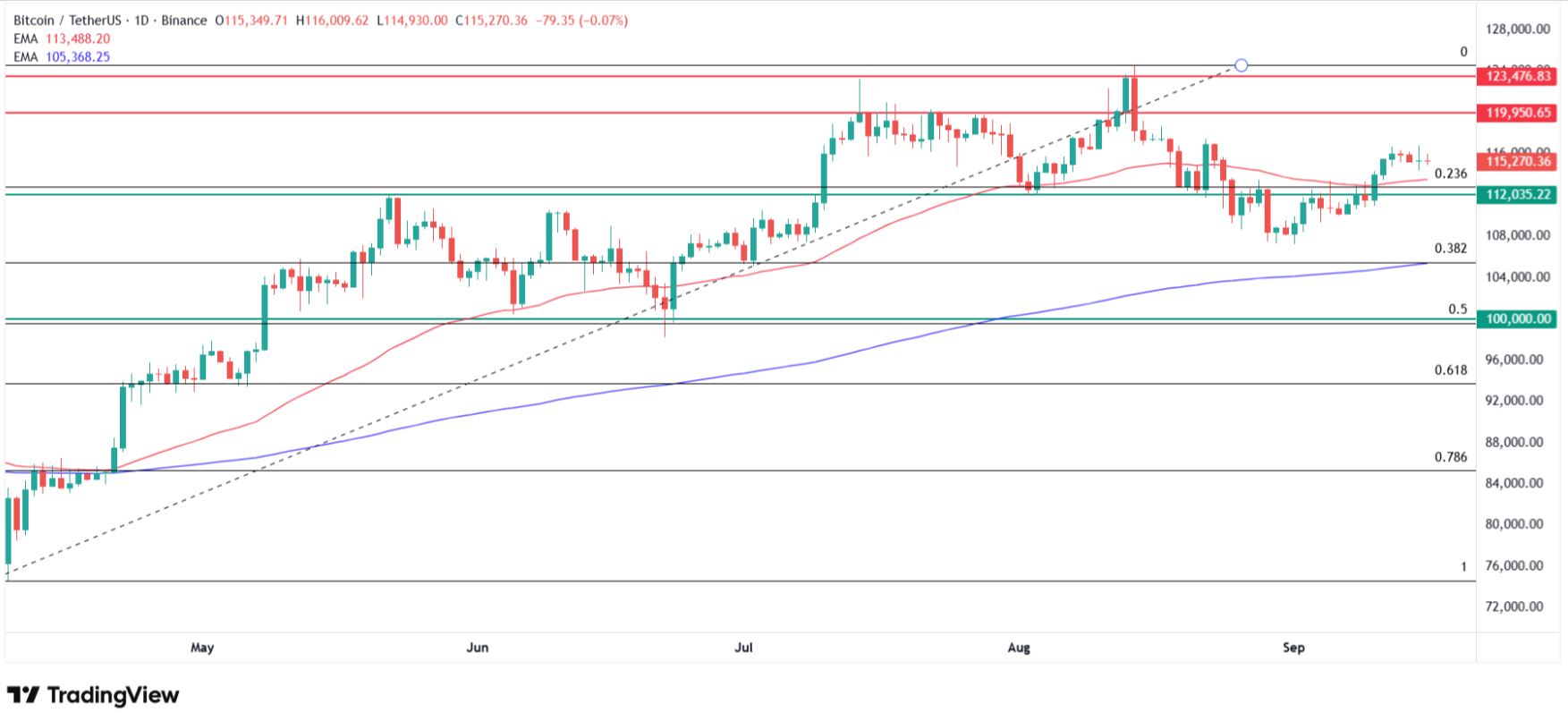
liquidity conditions. Current Bitcoin price levels around $115,373
position the cryptocurrency within striking distance of breaking through the
$120,000-$125,000 resistance zone that Young identifies as the near-term
bullish target.
Ethereum
price prediction models suggest the world's second-largest cryptocurrency
could reach $5,200 during the same timeframe, driven by institutional ETF flows
and continued DeFi ecosystem expansion. At current levels near $4,499, Ethereum
price appears well-positioned to benefit from the rotation into risk
assets that historically accompanies Federal Reserve easing cycles.
Bitcoin
price prediction fundamentals are reinforced by technical patterns
including the MACD golden cross formation that occurred in early September,
historically preceding 40% rallies within months. The convergence of this
bullish signal with Federal Reserve easing creates what analysts describe as
optimal conditions for sustained upward momentum toward the $135,000 target.
How high can Bitcoin price go? Source: Tradingview.com
Solana
price prediction of $280 by Q1 2026 reflects the blockchain's exceptional
ecosystem growth, with Total Value Locked (TVL) reaching record highs of $13
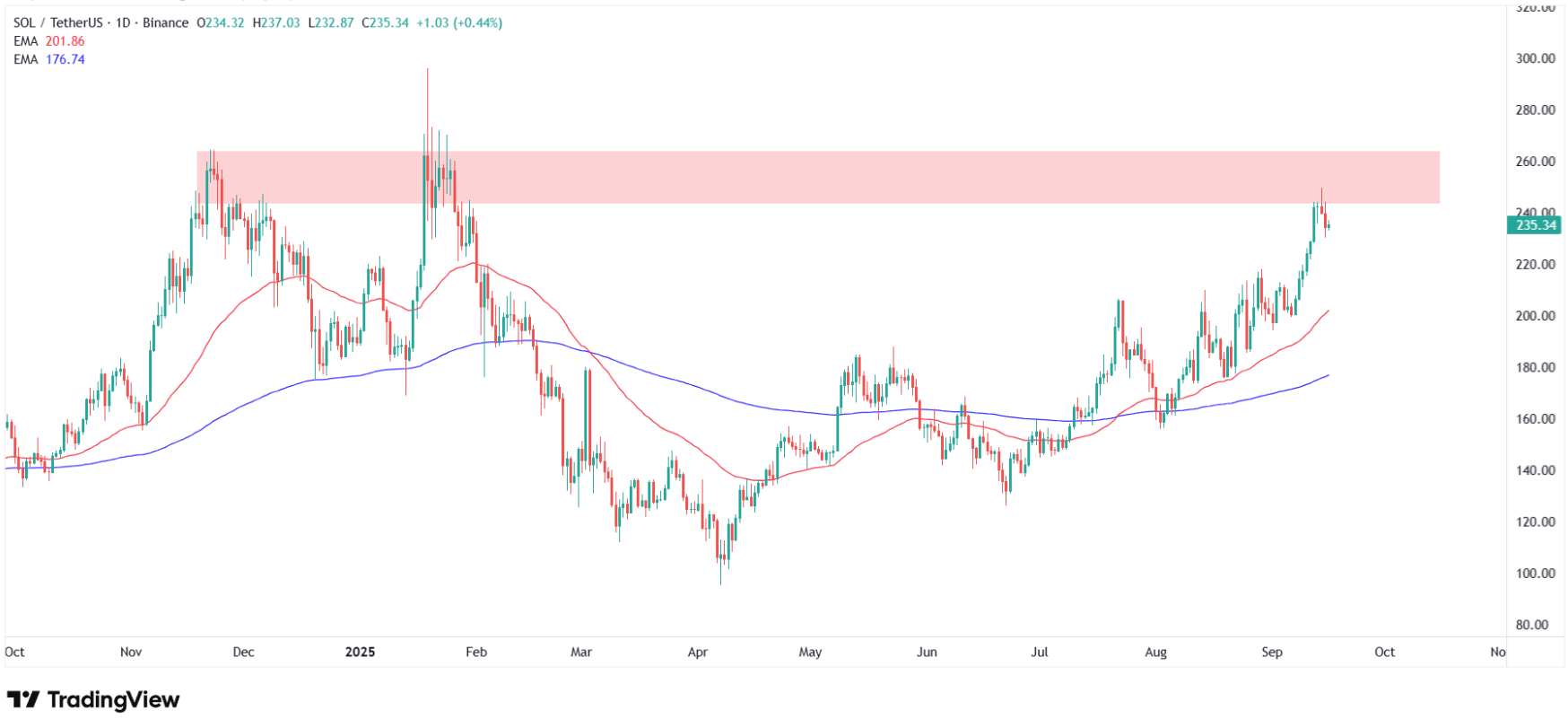
billion. Current Solana price at $235.24 has demonstrated remarkable
resilience, positioning the cryptocurrency to capitalize on increased risk
appetite that typically follows monetary easing cycles.
How high can Solana price go? Source: Tradingview.com
Young's
analysis highlights that Bitcoin price prediction scenarios range
from bearish retests of $107,000-$108,000 support zones to bullish breakouts
toward $120,000-$125,000 in the weeks following the Fed decision. The key
determinant will be whether the Federal Reserve provides dovish forward
guidance indicating additional rate cuts through 2026.
Paul
Howard, Director at Wincent, provides additional context supporting these Bitcoin
price prediction, Ethereum price prediction, and Solana price
prediction targets through institutional market observations. "Over
the past 6 months, observers have seen record low volatility for the crypto
markets," Howard notes, emphasizing that "institutional activity we
see across OTC channels re-enforces this."
Howard's
perspective aligns with the Q1 2026 timeframe but suggests potentially earlier
achievement of these targets, stating his "expectation is we continue to
see a low volatility environment with accumulation of the majors increasingly
through OTC blocks and large institutional counterparties." This
institutional accumulation pattern supports the fundamental thesis underlying
ambitious price predictions for all three cryptocurrencies.
The Bitcoin
price prediction framework benefits particularly from what analysts
estimate as $7 trillion in untapped crypto liquidity that could be unlocked
through Federal Reserve easing. Bloomberg Intelligence projects global
institutional crypto allocations reaching $1.2 trillion by 2026, providing
fundamental support for the $135,000 Bitcoin target.
Risk Scenarios and Market
Volatility Expectations
Despite
bullish Bitcoin price prediction, Ethereum price prediction,
and Solana price prediction scenarios, Young acknowledges significant
short-term risks that could impact these trajectories. "If the Fed
emphasizes that the ongoing inflation risk could weigh in on subsequent
rate-cut decisions, the pressure on altcoins could be particularly
intense," he warns.
Ethereum
price prediction models must account for potential ETF flow reversals if
hawkish Federal Reserve guidance dampens institutional risk appetite.
Similarly, Solana price prediction faces amplified volatility risks
as a high-beta asset that Young expects could experience "8-10% price
swings depending on whether risk appetite expands or contracts after the
announcement."
The analyst
community recognizes that achieving these ambitious price targets requires
sustained monetary easing rather than isolated rate cuts. Historical precedents
from 2023 show that delayed or insufficient easing can trigger significant
corrections, with some assets experiencing 15-25% declines when expectations
aren't met.
Risk Scenario Analysis
Scenario
Bitcoin Target
Ethereum Target
Solana Target
Probability
Bullish (Dovish Fed)
$135,000+
$5,200+
$280+
40%
Base Case
$120,000-$125,000
$4,800-$5,000
$250-$270
45%
Bearish (Hawkish Fed)
$107,000-$108,000
$3,800-$4,200
$200-$220
15%
Comparative Price
Prediction Analysis
Current
market positioning suggests differentiated risk-reward profiles across the
three major cryptocurrencies. Bitcoin price prediction models benefit
from the cryptocurrency's established institutional adoption and macro hedge
characteristics, providing relative stability during volatile periods.
Ethereum
price prediction scenarios incorporate both risks and opportunities from
increased institutional scrutiny through ETF products, with performance likely
serving as a proxy for broader altcoin sentiment. The blockchain's leadership
in DeFi and tokenization provides fundamental support for the $5,200 target.
Solana
price prediction represents the highest risk-reward proposition among the
three, with Young noting that high-beta assets like SOL typically experience
"amplified price swings" during periods of macroeconomic uncertainty.
However, the blockchain's rapidly expanding ecosystem and developer adoption
support the $280 projection under favorable conditions.
Frequently Asked Questions
What are the Bitcoin,
Ethereum, and Solana price predictions for 2026?
According
to crypto experts, Bitcoin could reach $135,000, Ethereum may hit $5,200, and
Solana could climb to $280 by Q1 2026. These predictions are based on sustained
Federal Reserve rate cuts driving increased liquidity into cryptocurrency
markets and continued institutional adoption across all three major digital
assets.
What factors could drive
Bitcoin to $135,000?
Bitcoin's
path to $135,000 depends on several key factors: sustained Federal Reserve rate
cuts creating increased liquidity, continued institutional ETF inflows,
Bitcoin's role as a macro hedge against inflation, technical breakout patterns
including MACD golden cross signals, and the cryptocurrency's established
position as digital gold among institutional investors.
Why do experts think
Ethereum could reach $5,200?
Ethereum's
$5,200 price prediction is supported by growing institutional ETF adoption,
continued dominance in decentralized finance (DeFi) ecosystems, network
upgrades improving scalability and efficiency, increasing tokenization of
real-world assets, and its position as the leading smart contract platform
attracting developer activity and institutional investment.
What makes Solana
different in reaching $280 by 2026?
Solana's
$280 target reflects its high-beta characteristics and rapid ecosystem growth,
with Total Value Locked (TVL) reaching record levels above $13 billion. The
blockchain's fast transaction speeds, low costs, and growing developer adoption
make it attractive for institutional use cases, though it faces higher
volatility risks as a newer ecosystem compared to Bitcoin and Ethereum.
How do Federal Reserve
rate cuts affect cryptocurrency prices?
Federal
Reserve rate cuts typically benefit cryptocurrencies by increasing market
liquidity, reducing borrowing costs, and encouraging investment in risk assets.
Lower interest rates make yield-generating traditional investments less
attractive, potentially driving capital toward cryptocurrencies as alternative
investments seeking higher returns in an environment of monetary easing.
The Federal
Reserve's (Fed) imminent rate cut decision (Wednesday, September 17, 2025) has
positioned Bitcoin (BTC) price prediction, Ethereum (ETH) price
prediction, and Solana (SOL) price prediction at critical junctures,
with two experts forecasting significant upside potential driven by enhanced
market liquidity.
Leading
crypto analysts revealed to FinanceMagnates.com that they predict Bitcoin
price reaching $135,000, Ethereum price hitting $5,200,
and Solana price climbing to $280 by Q1 2026, contingent on sustained
monetary easing policies and favorable macroeconomic conditions.
Why Will Crypto Market
Surge? Federal Reserve Decision Sets Stage
With a 96%
probability of a 25 basis point rate cut priced into markets, the Federal
Reserve's September 17 decision represents a pivotal moment for cryptocurrency
valuations. Shawn Young, Chief Analyst at MEXC, emphasizes that while traders
have already priced in the initial cut, "sustained rate cuts would
ultimately fuel stronger liquidity" and drive cryptocurrencies toward
ambitious price targets by early 2026.
The Bitcoin
price prediction of $135,000 by Q1 2026 reflects the cryptocurrency's
established role as a macro hedge asset that typically benefits from increased
liquidity conditions. Current Bitcoin price levels around $115,373
position the cryptocurrency within striking distance of breaking through the
$120,000-$125,000 resistance zone that Young identifies as the near-term
bullish target.
Ethereum
price prediction models suggest the world's second-largest cryptocurrency
could reach $5,200 during the same timeframe, driven by institutional ETF flows
and continued DeFi ecosystem expansion. At current levels near $4,499, Ethereum
price appears well-positioned to benefit from the rotation into risk
assets that historically accompanies Federal Reserve easing cycles.
Bitcoin
price prediction fundamentals are reinforced by technical patterns
including the MACD golden cross formation that occurred in early September,
historically preceding 40% rallies within months. The convergence of this
bullish signal with Federal Reserve easing creates what analysts describe as
optimal conditions for sustained upward momentum toward the $135,000 target.
How high can Bitcoin price go? Source: Tradingview.com
Solana
price prediction of $280 by Q1 2026 reflects the blockchain's exceptional
ecosystem growth, with Total Value Locked (TVL) reaching record highs of $13
billion. Current Solana price at $235.24 has demonstrated remarkable
resilience, positioning the cryptocurrency to capitalize on increased risk
appetite that typically follows monetary easing cycles.
How high can Solana price go? Source: Tradingview.com
Young's
analysis highlights that Bitcoin price prediction scenarios range
from bearish retests of $107,000-$108,000 support zones to bullish breakouts
toward $120,000-$125,000 in the weeks following the Fed decision. The key
determinant will be whether the Federal Reserve provides dovish forward
guidance indicating additional rate cuts through 2026.
Paul
Howard, Director at Wincent, provides additional context supporting these Bitcoin
price prediction, Ethereum price prediction, and Solana price
prediction targets through institutional market observations. "Over
the past 6 months, observers have seen record low volatility for the crypto
markets," Howard notes, emphasizing that "institutional activity we
see across OTC channels re-enforces this."
Howard's
perspective aligns with the Q1 2026 timeframe but suggests potentially earlier
achievement of these targets, stating his "expectation is we continue to
see a low volatility environment with accumulation of the majors increasingly
through OTC blocks and large institutional counterparties." This
institutional accumulation pattern supports the fundamental thesis underlying
ambitious price predictions for all three cryptocurrencies.
The Bitcoin
price prediction framework benefits particularly from what analysts
estimate as $7 trillion in untapped crypto liquidity that could be unlocked
through Federal Reserve easing. Bloomberg Intelligence projects global
institutional crypto allocations reaching $1.2 trillion by 2026, providing
fundamental support for the $135,000 Bitcoin target.
Risk Scenarios and Market
Volatility Expectations
Despite
bullish Bitcoin price prediction, Ethereum price prediction,
and Solana price prediction scenarios, Young acknowledges significant
short-term risks that could impact these trajectories. "If the Fed
emphasizes that the ongoing inflation risk could weigh in on subsequent
rate-cut decisions, the pressure on altcoins could be particularly
intense," he warns.
Ethereum
price prediction models must account for potential ETF flow reversals if
hawkish Federal Reserve guidance dampens institutional risk appetite.
Similarly, Solana price prediction faces amplified volatility risks
as a high-beta asset that Young expects could experience "8-10% price
swings depending on whether risk appetite expands or contracts after the
announcement."
The analyst
community recognizes that achieving these ambitious price targets requires
sustained monetary easing rather than isolated rate cuts. Historical precedents
from 2023 show that delayed or insufficient easing can trigger significant
corrections, with some assets experiencing 15-25% declines when expectations
aren't met.
Risk Scenario Analysis
Scenario
Bitcoin Target
Ethereum Target
Solana Target
Probability
Bullish (Dovish Fed)
$135,000+
$5,200+
$280+
40%
Base Case
$120,000-$125,000
$4,800-$5,000
$250-$270
45%
Bearish (Hawkish Fed)
$107,000-$108,000
$3,800-$4,200
$200-$220
15%
Comparative Price
Prediction Analysis
Current
market positioning suggests differentiated risk-reward profiles across the
three major cryptocurrencies. Bitcoin price prediction models benefit
from the cryptocurrency's established institutional adoption and macro hedge
characteristics, providing relative stability during volatile periods.
Ethereum
price prediction scenarios incorporate both risks and opportunities from
increased institutional scrutiny through ETF products, with performance likely
serving as a proxy for broader altcoin sentiment. The blockchain's leadership
in DeFi and tokenization provides fundamental support for the $5,200 target.
Solana
price prediction represents the highest risk-reward proposition among the
three, with Young noting that high-beta assets like SOL typically experience
"amplified price swings" during periods of macroeconomic uncertainty.
However, the blockchain's rapidly expanding ecosystem and developer adoption
support the $280 projection under favorable conditions.
Frequently Asked Questions
What are the Bitcoin,
Ethereum, and Solana price predictions for 2026?
According
to crypto experts, Bitcoin could reach $135,000, Ethereum may hit $5,200, and
Solana could climb to $280 by Q1 2026. These predictions are based on sustained
Federal Reserve rate cuts driving increased liquidity into cryptocurrency
markets and continued institutional adoption across all three major digital
assets.
What factors could drive
Bitcoin to $135,000?
Bitcoin's
path to $135,000 depends on several key factors: sustained Federal Reserve rate
cuts creating increased liquidity, continued institutional ETF inflows,
Bitcoin's role as a macro hedge against inflation, technical breakout patterns
including MACD golden cross signals, and the cryptocurrency's established
position as digital gold among institutional investors.
Why do experts think
Ethereum could reach $5,200?
Ethereum's
$5,200 price prediction is supported by growing institutional ETF adoption,
continued dominance in decentralized finance (DeFi) ecosystems, network
upgrades improving scalability and efficiency, increasing tokenization of
real-world assets, and its position as the leading smart contract platform
attracting developer activity and institutional investment.
What makes Solana
different in reaching $280 by 2026?
Solana's
$280 target reflects its high-beta characteristics and rapid ecosystem growth,
with Total Value Locked (TVL) reaching record levels above $13 billion. The
blockchain's fast transaction speeds, low costs, and growing developer adoption
make it attractive for institutional use cases, though it faces higher
volatility risks as a newer ecosystem compared to Bitcoin and Ethereum.
How do Federal Reserve
rate cuts affect cryptocurrency prices?
Federal
Reserve rate cuts typically benefit cryptocurrencies by increasing market
liquidity, reducing borrowing costs, and encouraging investment in risk assets.
Lower interest rates make yield-generating traditional investments less
attractive, potentially driving capital toward cryptocurrencies as alternative
investments seeking higher returns in an environment of monetary easing.
Damian Chmiel is a Senior Analyst & Editor at Finance Magnates with more than 15 years of experience in the CFD and online trading industry. Active as both a trader and journalist since 2010, he focuses on broker coverage, fintech innovation, and regulatory developments across Europe, the Middle East, and Asia.
His work includes interviews with C-level leaders at major brokerages and fintech platforms, as well as co-authoring Finance Magnates’ quarterly industry benchmarking reports. Damian’s reporting is data-driven, market-aware, and grounded in direct industry engagement. His analysis and commentary have also been cited by external media outlets, including Investing.com, Binance, The Asset, Stockhead, and Dispatch.
Education:
MA in Finance and Accounting, Cracow University of Economics
Inside the Prediction Markets: $1.6B Institutional Inflow Meets a Federal Crackdown
FP Markets Winner Spotlight 🏆 | Global Broker of the Year 2025 #Trading #Broker #Innovation #Shorts
FP Markets Winner Spotlight 🏆 | Global Broker of the Year 2025 #Trading #Broker #Innovation #Shorts
FP Markets takes the spotlight as Global Broker of the Year 2025 at the Finance Magnates Awards.
Martin Stoilov, Head of Client Experience, shares that trust, innovation, and people played a key role in the company’s success, supported by a strong foundation of integrity and client-centricity.
Following this milestone, FP Markets continues to focus on growth, technology investment, and its core values of transparency and excellence.
👉 Be part of FM Awards 2026: https://awards.financemagnates.com/#nominate
FP Markets takes the spotlight as Global Broker of the Year 2025 at the Finance Magnates Awards.
Martin Stoilov, Head of Client Experience, shares that trust, innovation, and people played a key role in the company’s success, supported by a strong foundation of integrity and client-centricity.
Following this milestone, FP Markets continues to focus on growth, technology investment, and its core values of transparency and excellence.
👉 Be part of FM Awards 2026: https://awards.financemagnates.com/#nominate
In this video, we review @HolaPrimeMarketsOfficial, a multi-asset forex and CFDs broker offering different account types, trading platforms, and flexible trading conditions.
We cover the broker’s overall offering, including account options, trading environment, platforms like MT4 and MT5, and additional services such as managed accounts and fast withdrawals.
Watch the full video to see if Hola Prime Markets fits your trading needs.
📣 Stay up to date with the latest in finance and trading. Follow Finance Magnates for industry news, insights, and global event coverage.
Connect with us:
🔗 LinkedIn: /financemagnates
👍 Facebook: /financemagnates
📸 Instagram: https://www.instagram.com/financemagnates
🐦 X: https://x.com/financemagnates
🎥 TikTok: https://www.tiktok.com/tag/financemagnates
▶️ YouTube: /@financemagnates_official
#HolaPrime #ForexBroker #CFDTrading #FinanceMagnates #Trading #Forex #BrokerReview
In this video, we review @HolaPrimeMarketsOfficial, a multi-asset forex and CFDs broker offering different account types, trading platforms, and flexible trading conditions.
We cover the broker’s overall offering, including account options, trading environment, platforms like MT4 and MT5, and additional services such as managed accounts and fast withdrawals.
Watch the full video to see if Hola Prime Markets fits your trading needs.
📣 Stay up to date with the latest in finance and trading. Follow Finance Magnates for industry news, insights, and global event coverage.
Connect with us:
🔗 LinkedIn: /financemagnates
👍 Facebook: /financemagnates
📸 Instagram: https://www.instagram.com/financemagnates
🐦 X: https://x.com/financemagnates
🎥 TikTok: https://www.tiktok.com/tag/financemagnates
▶️ YouTube: /@financemagnates_official
#HolaPrime #ForexBroker #CFDTrading #FinanceMagnates #Trading #Forex #BrokerReview
Hola Prime Review: What You Need to Know | Full Breakdown by Finance Magnates
Hola Prime Review: What You Need to Know | Full Breakdown by Finance Magnates
In this video, we review @HolaPrime_Global, a proprietary trading firm offering evaluation programs and performance-based payouts in simulated market environments.
We cover how the challenge model works, including account types, profit splits (up to 95%), trading rules, and what it takes to reach a funded account. You’ll also learn about available platforms like MT4, MT5, cTrader, and more, along with insights into payouts, support, and trading conditions.
Watch the full video to see if Hola Prime fits your trading style.
📣 Stay up to date with the latest in finance and trading. Follow Finance Magnates for industry news, insights, and global event coverage.
Connect with us:
🔗 LinkedIn: /financemagnates
👍 Facebook: /financemagnates
📸 Instagram: https://www.instagram.com/financemagnates
🐦 X: https://x.com/financemagnates
🎥 TikTok: https://www.tiktok.com/tag/financemagnates
▶️ YouTube: /@financemagnates_official
#HolaPrime #PropFirm #Trading #FinanceMagnates #Forex #FuturesTrading #TradingReview #PropFirmReview
In this video, we review @HolaPrime_Global, a proprietary trading firm offering evaluation programs and performance-based payouts in simulated market environments.
We cover how the challenge model works, including account types, profit splits (up to 95%), trading rules, and what it takes to reach a funded account. You’ll also learn about available platforms like MT4, MT5, cTrader, and more, along with insights into payouts, support, and trading conditions.
Watch the full video to see if Hola Prime fits your trading style.
📣 Stay up to date with the latest in finance and trading. Follow Finance Magnates for industry news, insights, and global event coverage.
Connect with us:
🔗 LinkedIn: /financemagnates
👍 Facebook: /financemagnates
📸 Instagram: https://www.instagram.com/financemagnates
🐦 X: https://x.com/financemagnates
🎥 TikTok: https://www.tiktok.com/tag/financemagnates
▶️ YouTube: /@financemagnates_official
#HolaPrime #PropFirm #Trading #FinanceMagnates #Forex #FuturesTrading #TradingReview #PropFirmReview
Axi Winner Spotlight 🏆 | Global Most Innovative Broker 2025 #Innovation #Trading #Fintech #Broker
Axi Winner Spotlight 🏆 | Global Most Innovative Broker 2025 #Innovation #Trading #Fintech #Broker
Axi takes the spotlight at the Finance Magnates Awards, winning Global Most Innovative Broker 2025.
Olivia Xenofontos and Ivanna Openko share how the team will feel: proud, motivated, and ready to keep delivering.
They also describe the night as well-organized, focused, and enjoyable for all.
👉 Be part of FM Awards 2026.
Axi takes the spotlight at the Finance Magnates Awards, winning Global Most Innovative Broker 2025.
Olivia Xenofontos and Ivanna Openko share how the team will feel: proud, motivated, and ready to keep delivering.
They also describe the night as well-organized, focused, and enjoyable for all.
👉 Be part of FM Awards 2026.
Recognition that matters.
Built on transparency.
Driven by the industry.
The Finance Magnates Awards 2026.
Nominations are now open.
🔗 https://awards.financemagnates.com/?utm_source=SM&utm_medium=social&utm_campaign=recognition-matters
Recognition that matters.
Built on transparency.
Driven by the industry.
The Finance Magnates Awards 2026.
Nominations are now open.
🔗 https://awards.financemagnates.com/?utm_source=SM&utm_medium=social&utm_campaign=recognition-matters