Geopolitical ‘resource nationalism,’ including China’s restrictions on silver, has reframed the metal as a strategic asset.
Beyond financial demand, silver consumption has continued to grow in industries such as solar power, electronics, and electric vehicles.
The broader outlook remains bullish, with investor forecasts seeing silver reaching $100 in the near term.
Silver’s latest surge has pushed the white metal into
uncharted territory, as political drama around the Federal Reserve, tighter
market rules and mounting supply tensions converge to send prices through
another record.
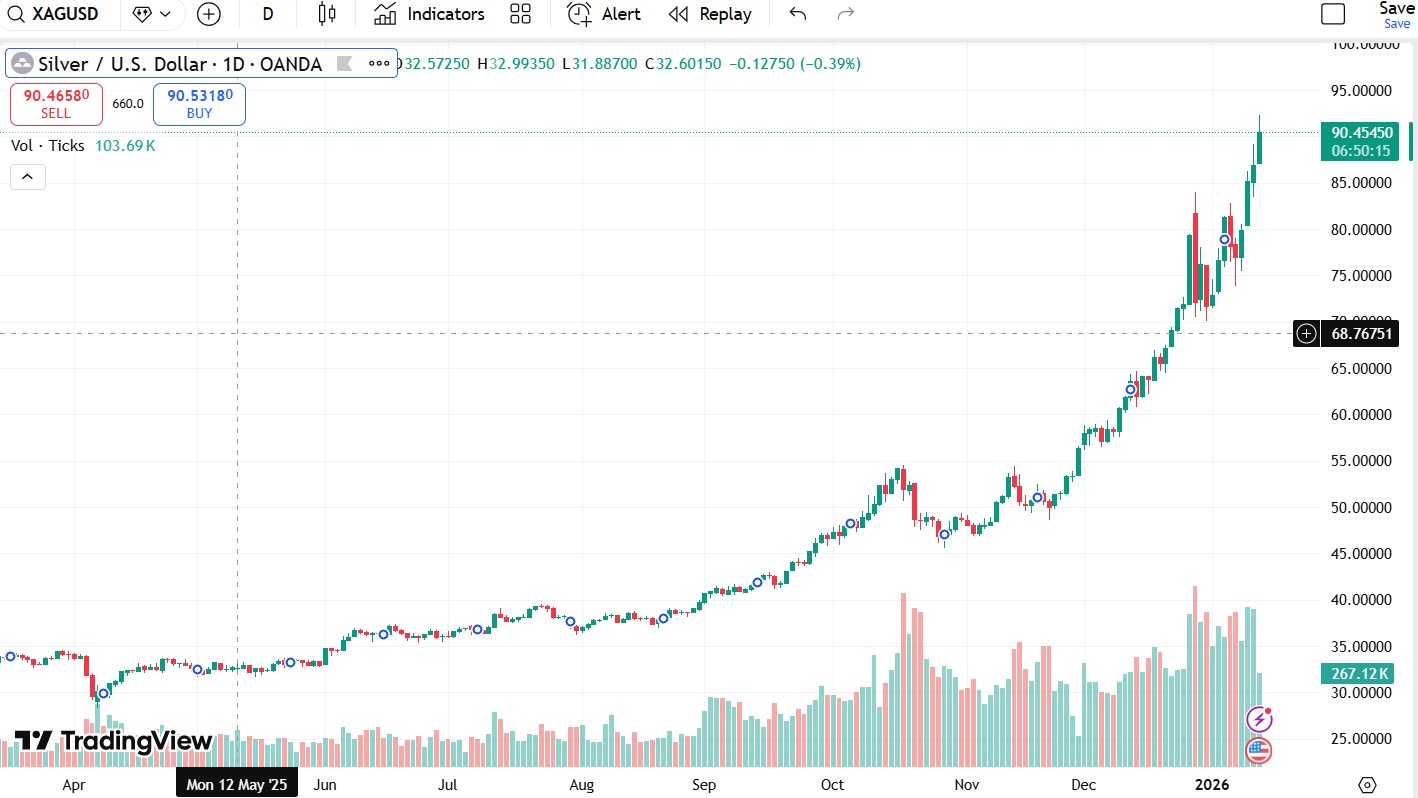
Wednesday trading saw silver power to a new all‑time
high of around $92 an ounce, building on a dramatic move the previous day that also
pulled gold to fresh peaks and amplified debate about how far this
precious‑metals cycle can run.
The latest move capped a sharp rally that began late
last year and accelerated after Federal Reserve Chair Jerome Powell disclosed
that the U.S. Department of Justice had served him subpoenas related to the
multibillion‑dollar renovation of the Fed’s headquarters and his testimony on
the project.
The Justice Department’s criminal investigation into
Powell and the renovation of the Fed’s Washington headquarters has injected
rare personal jeopardy into U.S. monetary policy.
With silver trading above $90 per oz right now, up another 5% tonight, I thought I would share an interesting chart showing the different silver mining stocks.
These are all of the silver mining stocks that call themselves "silver miners". but it shows what percentage of their… pic.twitter.com/L8KwSMDOMA
The operator framed the change as part of a normal
volatility review aimed at keeping collateral in line with risk, but the timing
highlighted concern over the scale of intraday swings in both silver and gold.
At the same time, according to EuropeanBusinessMagazine,
consumption in sectors such as solar power, electronics, photonics and electric
vehicles has expanded steadily. Manufacturers value silver for its conductivity
and reliability, and many applications offer few immediate substitutes at
scale.
Analysts argue that this industrial pull has turned
silver from a pure monetary hedge into a critical input for energy transition
and digital infrastructure, which keeps physical demand robust even when
financial flows waver.
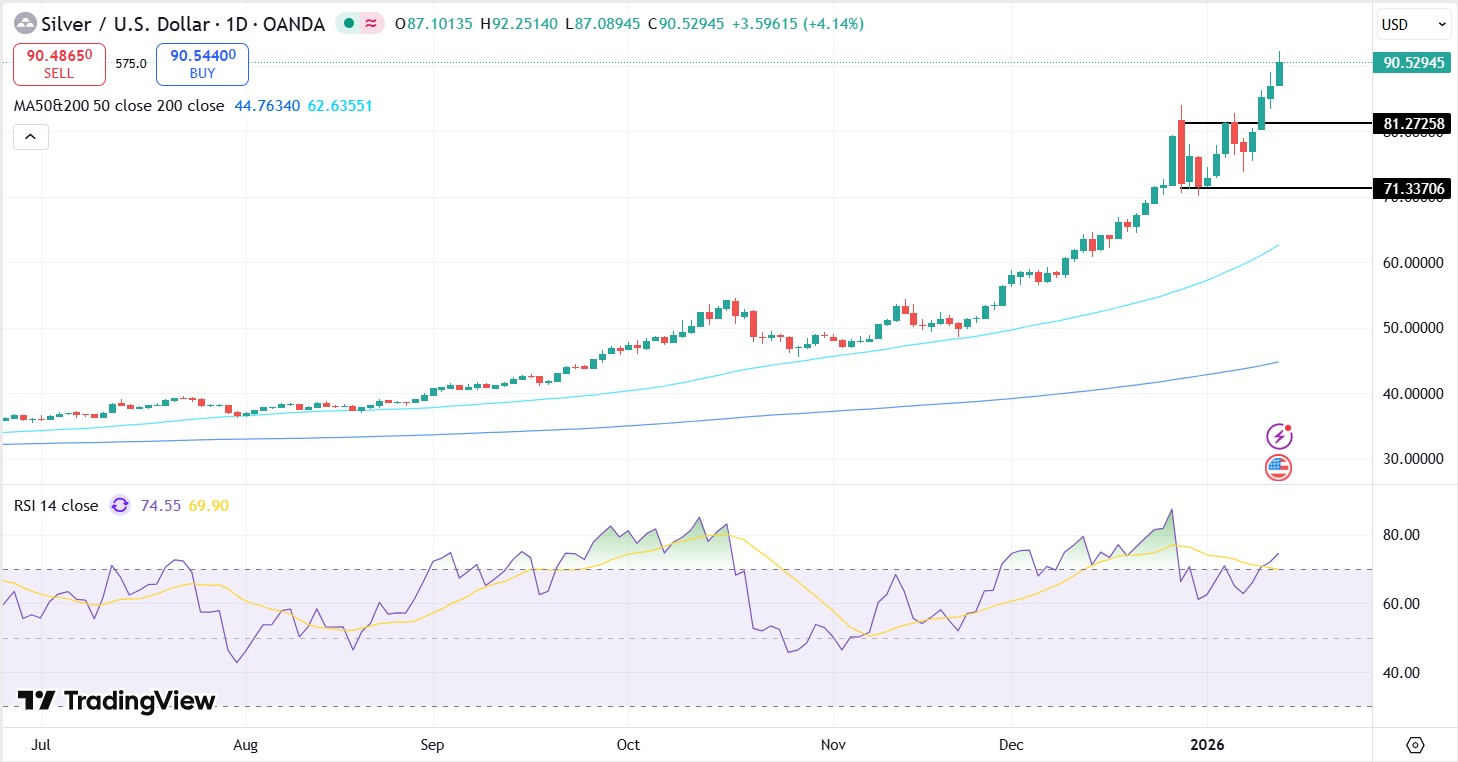
Silver’s 14‑day RSI is sitting deep in
overbought territory around the mid‑70s after the spike toward 90–91, confirming strong upside momentum but also flagging
elevated risk of a momentum pause or shake‑out rather than a fresh “value” entry.
On the intraday daily chart, the immediate level to to watch is $81, which act as the near-term support level. If the price goes beyond this level, the next support level to watch is at $71.
‘Resource Nationalism’ Reshapes Metals Flows
CNBC has spotlighted another theme that now sits
alongside safe‑haven flows and industrial deficits: “resource
nationalism.” Over the past two years, major powers have leaned more
aggressively on control of key commodities as a tool of economic influence. The
United States escalated tariffs and other trade barriers, while China responded
with tighter export controls on strategic materials, including rare earths and,
in late 2025, silver.
‘Resource nationalism’ could propel gold to $5,000 and silver to $100 this year, investors say https://t.co/OzT1iivZd7
China’s decision to restrict silver exports landed in
a market that already relied on the metal for high‑tech applications and
industrial production. The move reframed silver not only as a financial asset
but also as a strategic resource in the evolving trade confrontation between
Washington and Beijing.
In parallel, political flashpoints — from Russia’s
full‑scale invasion of Ukraine to debates over Venezuelan oil and even talk in
Washington about asserting more control over Greenland — reinforced the sense
that supply chains sit inside a broader geopolitical contest.
For retail traders, the challenge is less about identifying the target and more about execution: sizing, drawdown tolerance, and timing entries in volatile conditions. These execution-level questions are increasingly being addressed in live environments, including trader-focused sessions at Dubai’s Trading Festival, where strategies are dissected beyond headline price targets.
Ambitious Targets for $100 Silver
Against this backdrop, some money managers see scope
for much higher prices in the near term. Several investors argue that the same
combination of geopolitical tension, trade friction and constrained supply that
drove record gains in 2025 remains in place or has intensified.
Forecasts of $5,000 gold and $100 silver this year
rest on a few linked assumptions: that central banks maintain a dovish tilt,
that rate‑cut expectations remain in play, and that political shocks keep
investors on edge.
The Powell investigation has raised fresh questions
about the relationship between politics and monetary policy in the United
States. Concern that the Fed could face direct political interference, or that
its leadership could change course under pressure, feeds into a wider debate
about long‑term inflation risks and the credibility of U.S. institutions.
From @WSJopinion: DOJ’s criminal subpoena to Fed Chair Jerome Powell is a self-defeating fiasco. Picking a fight with the Fed—and the bond market—over an issue that voters will find confusing and irrelevant is lawfare for dummies.https://t.co/aRvWbY7f5G
Comments from some officials and market participants highlight unease over
whether rate‑cut cycles and unconventional measures will ultimately erode the
purchasing power of the dollar.
In response, a group of global central bankers,
including the heads of the European Central Bank and the Bank of England,
publicly expressed support for Powell and the Fed.
Geopolitics, Deficits and What Comes Next
For now, the forces pushing silver higher show little
sign of easing. Geopolitical friction between the United States and China still
drives policy choices around trade and access to strategic resources.
Supply deficits in the silver market persist, while
industrial demand continues to rise in sectors that underpin long‑term energy
and technology trends. The ongoing reassessment of central bank independence,
triggered in part by the Powell probe, keeps safe‑haven demand alive.
That mix leaves investors watching several levers at
once: the path of rate decisions, any shift in export controls, and whether
political tensions ease or intensify. If central banks stay dovish and
geopolitical risks remain elevated, both silver and gold could retain strong
support even after setting new records.
Silver’s latest surge has pushed the white metal into
uncharted territory, as political drama around the Federal Reserve, tighter
market rules and mounting supply tensions converge to send prices through
another record.
Wednesday trading saw silver power to a new all‑time
high of around $92 an ounce, building on a dramatic move the previous day that also
pulled gold to fresh peaks and amplified debate about how far this
precious‑metals cycle can run.
The latest move capped a sharp rally that began late
last year and accelerated after Federal Reserve Chair Jerome Powell disclosed
that the U.S. Department of Justice had served him subpoenas related to the
multibillion‑dollar renovation of the Fed’s headquarters and his testimony on
the project.
The Justice Department’s criminal investigation into
Powell and the renovation of the Fed’s Washington headquarters has injected
rare personal jeopardy into U.S. monetary policy.
With silver trading above $90 per oz right now, up another 5% tonight, I thought I would share an interesting chart showing the different silver mining stocks.
These are all of the silver mining stocks that call themselves "silver miners". but it shows what percentage of their… pic.twitter.com/L8KwSMDOMA
The operator framed the change as part of a normal
volatility review aimed at keeping collateral in line with risk, but the timing
highlighted concern over the scale of intraday swings in both silver and gold.
At the same time, according to EuropeanBusinessMagazine,
consumption in sectors such as solar power, electronics, photonics and electric
vehicles has expanded steadily. Manufacturers value silver for its conductivity
and reliability, and many applications offer few immediate substitutes at
scale.
Analysts argue that this industrial pull has turned
silver from a pure monetary hedge into a critical input for energy transition
and digital infrastructure, which keeps physical demand robust even when
financial flows waver.
Silver’s 14‑day RSI is sitting deep in
overbought territory around the mid‑70s after the spike toward 90–91, confirming strong upside momentum but also flagging
elevated risk of a momentum pause or shake‑out rather than a fresh “value” entry.
On the intraday daily chart, the immediate level to to watch is $81, which act as the near-term support level. If the price goes beyond this level, the next support level to watch is at $71.
‘Resource Nationalism’ Reshapes Metals Flows
CNBC has spotlighted another theme that now sits
alongside safe‑haven flows and industrial deficits: “resource
nationalism.” Over the past two years, major powers have leaned more
aggressively on control of key commodities as a tool of economic influence. The
United States escalated tariffs and other trade barriers, while China responded
with tighter export controls on strategic materials, including rare earths and,
in late 2025, silver.
‘Resource nationalism’ could propel gold to $5,000 and silver to $100 this year, investors say https://t.co/OzT1iivZd7
China’s decision to restrict silver exports landed in
a market that already relied on the metal for high‑tech applications and
industrial production. The move reframed silver not only as a financial asset
but also as a strategic resource in the evolving trade confrontation between
Washington and Beijing.
In parallel, political flashpoints — from Russia’s
full‑scale invasion of Ukraine to debates over Venezuelan oil and even talk in
Washington about asserting more control over Greenland — reinforced the sense
that supply chains sit inside a broader geopolitical contest.
For retail traders, the challenge is less about identifying the target and more about execution: sizing, drawdown tolerance, and timing entries in volatile conditions. These execution-level questions are increasingly being addressed in live environments, including trader-focused sessions at Dubai’s Trading Festival, where strategies are dissected beyond headline price targets.
Ambitious Targets for $100 Silver
Against this backdrop, some money managers see scope
for much higher prices in the near term. Several investors argue that the same
combination of geopolitical tension, trade friction and constrained supply that
drove record gains in 2025 remains in place or has intensified.
Forecasts of $5,000 gold and $100 silver this year
rest on a few linked assumptions: that central banks maintain a dovish tilt,
that rate‑cut expectations remain in play, and that political shocks keep
investors on edge.
The Powell investigation has raised fresh questions
about the relationship between politics and monetary policy in the United
States. Concern that the Fed could face direct political interference, or that
its leadership could change course under pressure, feeds into a wider debate
about long‑term inflation risks and the credibility of U.S. institutions.
From @WSJopinion: DOJ’s criminal subpoena to Fed Chair Jerome Powell is a self-defeating fiasco. Picking a fight with the Fed—and the bond market—over an issue that voters will find confusing and irrelevant is lawfare for dummies.https://t.co/aRvWbY7f5G
Comments from some officials and market participants highlight unease over
whether rate‑cut cycles and unconventional measures will ultimately erode the
purchasing power of the dollar.
In response, a group of global central bankers,
including the heads of the European Central Bank and the Bank of England,
publicly expressed support for Powell and the Fed.
Geopolitics, Deficits and What Comes Next
For now, the forces pushing silver higher show little
sign of easing. Geopolitical friction between the United States and China still
drives policy choices around trade and access to strategic resources.
Supply deficits in the silver market persist, while
industrial demand continues to rise in sectors that underpin long‑term energy
and technology trends. The ongoing reassessment of central bank independence,
triggered in part by the Powell probe, keeps safe‑haven demand alive.
That mix leaves investors watching several levers at
once: the path of rate decisions, any shift in export controls, and whether
political tensions ease or intensify. If central banks stay dovish and
geopolitical risks remain elevated, both silver and gold could retain strong
support even after setting new records.
Jared Kirui is an Editor at Finance Magnates with more than five years of experience in financial journalism. He covers online trading, fintech, payments, and crypto industries with a focus on companies, regulation and compliance, executive moves, trading technology, and market analysis.
His work has been featured in other media outlets, including Benzinga, ZyCrypto, The Distributed, and The Daily Hodl.
Education:
Bachelor of Commerce degree (Finance option), University of Nairobi
Inside the Prediction Markets: $1.6B Institutional Inflow Meets a Federal Crackdown
Featured Videos
FP Markets Winner Spotlight 🏆 | Global Broker of the Year 2025 #Trading #Broker #Innovation #Shorts
FP Markets Winner Spotlight 🏆 | Global Broker of the Year 2025 #Trading #Broker #Innovation #Shorts
FP Markets Winner Spotlight 🏆 | Global Broker of the Year 2025 #Trading #Broker #Innovation #Shorts
FP Markets Winner Spotlight 🏆 | Global Broker of the Year 2025 #Trading #Broker #Innovation #Shorts
FP Markets takes the spotlight as Global Broker of the Year 2025 at the Finance Magnates Awards.
Martin Stoilov, Head of Client Experience, shares that trust, innovation, and people played a key role in the company’s success, supported by a strong foundation of integrity and client-centricity.
Following this milestone, FP Markets continues to focus on growth, technology investment, and its core values of transparency and excellence.
👉 Be part of FM Awards 2026: https://awards.financemagnates.com/#nominate
FP Markets takes the spotlight as Global Broker of the Year 2025 at the Finance Magnates Awards.
Martin Stoilov, Head of Client Experience, shares that trust, innovation, and people played a key role in the company’s success, supported by a strong foundation of integrity and client-centricity.
Following this milestone, FP Markets continues to focus on growth, technology investment, and its core values of transparency and excellence.
👉 Be part of FM Awards 2026: https://awards.financemagnates.com/#nominate
FP Markets takes the spotlight as Global Broker of the Year 2025 at the Finance Magnates Awards.
Martin Stoilov, Head of Client Experience, shares that trust, innovation, and people played a key role in the company’s success, supported by a strong foundation of integrity and client-centricity.
Following this milestone, FP Markets continues to focus on growth, technology investment, and its core values of transparency and excellence.
👉 Be part of FM Awards 2026: https://awards.financemagnates.com/#nominate
FP Markets takes the spotlight as Global Broker of the Year 2025 at the Finance Magnates Awards.
Martin Stoilov, Head of Client Experience, shares that trust, innovation, and people played a key role in the company’s success, supported by a strong foundation of integrity and client-centricity.
Following this milestone, FP Markets continues to focus on growth, technology investment, and its core values of transparency and excellence.
👉 Be part of FM Awards 2026: https://awards.financemagnates.com/#nominate
In this video, we review @HolaPrimeMarketsOfficial, a multi-asset forex and CFDs broker offering different account types, trading platforms, and flexible trading conditions.
We cover the broker’s overall offering, including account options, trading environment, platforms like MT4 and MT5, and additional services such as managed accounts and fast withdrawals.
Watch the full video to see if Hola Prime Markets fits your trading needs.
📣 Stay up to date with the latest in finance and trading. Follow Finance Magnates for industry news, insights, and global event coverage.
Connect with us:
🔗 LinkedIn: /financemagnates
👍 Facebook: /financemagnates
📸 Instagram: https://www.instagram.com/financemagnates
🐦 X: https://x.com/financemagnates
🎥 TikTok: https://www.tiktok.com/tag/financemagnates
▶️ YouTube: /@financemagnates_official
#HolaPrime #ForexBroker #CFDTrading #FinanceMagnates #Trading #Forex #BrokerReview
In this video, we review @HolaPrimeMarketsOfficial, a multi-asset forex and CFDs broker offering different account types, trading platforms, and flexible trading conditions.
We cover the broker’s overall offering, including account options, trading environment, platforms like MT4 and MT5, and additional services such as managed accounts and fast withdrawals.
Watch the full video to see if Hola Prime Markets fits your trading needs.
📣 Stay up to date with the latest in finance and trading. Follow Finance Magnates for industry news, insights, and global event coverage.
Connect with us:
🔗 LinkedIn: /financemagnates
👍 Facebook: /financemagnates
📸 Instagram: https://www.instagram.com/financemagnates
🐦 X: https://x.com/financemagnates
🎥 TikTok: https://www.tiktok.com/tag/financemagnates
▶️ YouTube: /@financemagnates_official
#HolaPrime #ForexBroker #CFDTrading #FinanceMagnates #Trading #Forex #BrokerReview
In this video, we review @HolaPrimeMarketsOfficial, a multi-asset forex and CFDs broker offering different account types, trading platforms, and flexible trading conditions.
We cover the broker’s overall offering, including account options, trading environment, platforms like MT4 and MT5, and additional services such as managed accounts and fast withdrawals.
Watch the full video to see if Hola Prime Markets fits your trading needs.
📣 Stay up to date with the latest in finance and trading. Follow Finance Magnates for industry news, insights, and global event coverage.
Connect with us:
🔗 LinkedIn: /financemagnates
👍 Facebook: /financemagnates
📸 Instagram: https://www.instagram.com/financemagnates
🐦 X: https://x.com/financemagnates
🎥 TikTok: https://www.tiktok.com/tag/financemagnates
▶️ YouTube: /@financemagnates_official
#HolaPrime #ForexBroker #CFDTrading #FinanceMagnates #Trading #Forex #BrokerReview
In this video, we review @HolaPrimeMarketsOfficial, a multi-asset forex and CFDs broker offering different account types, trading platforms, and flexible trading conditions.
We cover the broker’s overall offering, including account options, trading environment, platforms like MT4 and MT5, and additional services such as managed accounts and fast withdrawals.
Watch the full video to see if Hola Prime Markets fits your trading needs.
📣 Stay up to date with the latest in finance and trading. Follow Finance Magnates for industry news, insights, and global event coverage.
Connect with us:
🔗 LinkedIn: /financemagnates
👍 Facebook: /financemagnates
📸 Instagram: https://www.instagram.com/financemagnates
🐦 X: https://x.com/financemagnates
🎥 TikTok: https://www.tiktok.com/tag/financemagnates
▶️ YouTube: /@financemagnates_official
#HolaPrime #ForexBroker #CFDTrading #FinanceMagnates #Trading #Forex #BrokerReview
In this video, we review @HolaPrimeMarketsOfficial, a multi-asset forex and CFDs broker offering different account types, trading platforms, and flexible trading conditions.
We cover the broker’s overall offering, including account options, trading environment, platforms like MT4 and MT5, and additional services such as managed accounts and fast withdrawals.
Watch the full video to see if Hola Prime Markets fits your trading needs.
📣 Stay up to date with the latest in finance and trading. Follow Finance Magnates for industry news, insights, and global event coverage.
Connect with us:
🔗 LinkedIn: /financemagnates
👍 Facebook: /financemagnates
📸 Instagram: https://www.instagram.com/financemagnates
🐦 X: https://x.com/financemagnates
🎥 TikTok: https://www.tiktok.com/tag/financemagnates
▶️ YouTube: /@financemagnates_official
#HolaPrime #ForexBroker #CFDTrading #FinanceMagnates #Trading #Forex #BrokerReview
In this video, we review @HolaPrimeMarketsOfficial, a multi-asset forex and CFDs broker offering different account types, trading platforms, and flexible trading conditions.
We cover the broker’s overall offering, including account options, trading environment, platforms like MT4 and MT5, and additional services such as managed accounts and fast withdrawals.
Watch the full video to see if Hola Prime Markets fits your trading needs.
📣 Stay up to date with the latest in finance and trading. Follow Finance Magnates for industry news, insights, and global event coverage.
Connect with us:
🔗 LinkedIn: /financemagnates
👍 Facebook: /financemagnates
📸 Instagram: https://www.instagram.com/financemagnates
🐦 X: https://x.com/financemagnates
🎥 TikTok: https://www.tiktok.com/tag/financemagnates
▶️ YouTube: /@financemagnates_official
#HolaPrime #ForexBroker #CFDTrading #FinanceMagnates #Trading #Forex #BrokerReview
Hola Prime Review: What You Need to Know | Full Breakdown by Finance Magnates
Hola Prime Review: What You Need to Know | Full Breakdown by Finance Magnates
Hola Prime Review: What You Need to Know | Full Breakdown by Finance Magnates
Hola Prime Review: What You Need to Know | Full Breakdown by Finance Magnates
Hola Prime Review: What You Need to Know | Full Breakdown by Finance Magnates
Hola Prime Review: What You Need to Know | Full Breakdown by Finance Magnates
In this video, we review @HolaPrime_Global, a proprietary trading firm offering evaluation programs and performance-based payouts in simulated market environments.
We cover how the challenge model works, including account types, profit splits (up to 95%), trading rules, and what it takes to reach a funded account. You’ll also learn about available platforms like MT4, MT5, cTrader, and more, along with insights into payouts, support, and trading conditions.
Watch the full video to see if Hola Prime fits your trading style.
📣 Stay up to date with the latest in finance and trading. Follow Finance Magnates for industry news, insights, and global event coverage.
Connect with us:
🔗 LinkedIn: /financemagnates
👍 Facebook: /financemagnates
📸 Instagram: https://www.instagram.com/financemagnates
🐦 X: https://x.com/financemagnates
🎥 TikTok: https://www.tiktok.com/tag/financemagnates
▶️ YouTube: /@financemagnates_official
#HolaPrime #PropFirm #Trading #FinanceMagnates #Forex #FuturesTrading #TradingReview #PropFirmReview
In this video, we review @HolaPrime_Global, a proprietary trading firm offering evaluation programs and performance-based payouts in simulated market environments.
We cover how the challenge model works, including account types, profit splits (up to 95%), trading rules, and what it takes to reach a funded account. You’ll also learn about available platforms like MT4, MT5, cTrader, and more, along with insights into payouts, support, and trading conditions.
Watch the full video to see if Hola Prime fits your trading style.
📣 Stay up to date with the latest in finance and trading. Follow Finance Magnates for industry news, insights, and global event coverage.
Connect with us:
🔗 LinkedIn: /financemagnates
👍 Facebook: /financemagnates
📸 Instagram: https://www.instagram.com/financemagnates
🐦 X: https://x.com/financemagnates
🎥 TikTok: https://www.tiktok.com/tag/financemagnates
▶️ YouTube: /@financemagnates_official
#HolaPrime #PropFirm #Trading #FinanceMagnates #Forex #FuturesTrading #TradingReview #PropFirmReview
In this video, we review @HolaPrime_Global, a proprietary trading firm offering evaluation programs and performance-based payouts in simulated market environments.
We cover how the challenge model works, including account types, profit splits (up to 95%), trading rules, and what it takes to reach a funded account. You’ll also learn about available platforms like MT4, MT5, cTrader, and more, along with insights into payouts, support, and trading conditions.
Watch the full video to see if Hola Prime fits your trading style.
📣 Stay up to date with the latest in finance and trading. Follow Finance Magnates for industry news, insights, and global event coverage.
Connect with us:
🔗 LinkedIn: /financemagnates
👍 Facebook: /financemagnates
📸 Instagram: https://www.instagram.com/financemagnates
🐦 X: https://x.com/financemagnates
🎥 TikTok: https://www.tiktok.com/tag/financemagnates
▶️ YouTube: /@financemagnates_official
#HolaPrime #PropFirm #Trading #FinanceMagnates #Forex #FuturesTrading #TradingReview #PropFirmReview
In this video, we review @HolaPrime_Global, a proprietary trading firm offering evaluation programs and performance-based payouts in simulated market environments.
We cover how the challenge model works, including account types, profit splits (up to 95%), trading rules, and what it takes to reach a funded account. You’ll also learn about available platforms like MT4, MT5, cTrader, and more, along with insights into payouts, support, and trading conditions.
Watch the full video to see if Hola Prime fits your trading style.
📣 Stay up to date with the latest in finance and trading. Follow Finance Magnates for industry news, insights, and global event coverage.
Connect with us:
🔗 LinkedIn: /financemagnates
👍 Facebook: /financemagnates
📸 Instagram: https://www.instagram.com/financemagnates
🐦 X: https://x.com/financemagnates
🎥 TikTok: https://www.tiktok.com/tag/financemagnates
▶️ YouTube: /@financemagnates_official
#HolaPrime #PropFirm #Trading #FinanceMagnates #Forex #FuturesTrading #TradingReview #PropFirmReview
In this video, we review @HolaPrime_Global, a proprietary trading firm offering evaluation programs and performance-based payouts in simulated market environments.
We cover how the challenge model works, including account types, profit splits (up to 95%), trading rules, and what it takes to reach a funded account. You’ll also learn about available platforms like MT4, MT5, cTrader, and more, along with insights into payouts, support, and trading conditions.
Watch the full video to see if Hola Prime fits your trading style.
📣 Stay up to date with the latest in finance and trading. Follow Finance Magnates for industry news, insights, and global event coverage.
Connect with us:
🔗 LinkedIn: /financemagnates
👍 Facebook: /financemagnates
📸 Instagram: https://www.instagram.com/financemagnates
🐦 X: https://x.com/financemagnates
🎥 TikTok: https://www.tiktok.com/tag/financemagnates
▶️ YouTube: /@financemagnates_official
#HolaPrime #PropFirm #Trading #FinanceMagnates #Forex #FuturesTrading #TradingReview #PropFirmReview
In this video, we review @HolaPrime_Global, a proprietary trading firm offering evaluation programs and performance-based payouts in simulated market environments.
We cover how the challenge model works, including account types, profit splits (up to 95%), trading rules, and what it takes to reach a funded account. You’ll also learn about available platforms like MT4, MT5, cTrader, and more, along with insights into payouts, support, and trading conditions.
Watch the full video to see if Hola Prime fits your trading style.
📣 Stay up to date with the latest in finance and trading. Follow Finance Magnates for industry news, insights, and global event coverage.
Connect with us:
🔗 LinkedIn: /financemagnates
👍 Facebook: /financemagnates
📸 Instagram: https://www.instagram.com/financemagnates
🐦 X: https://x.com/financemagnates
🎥 TikTok: https://www.tiktok.com/tag/financemagnates
▶️ YouTube: /@financemagnates_official
#HolaPrime #PropFirm #Trading #FinanceMagnates #Forex #FuturesTrading #TradingReview #PropFirmReview
Axi Winner Spotlight 🏆 | Global Most Innovative Broker 2025 #Innovation #Trading #Fintech #Broker
Axi Winner Spotlight 🏆 | Global Most Innovative Broker 2025 #Innovation #Trading #Fintech #Broker
Axi Winner Spotlight 🏆 | Global Most Innovative Broker 2025 #Innovation #Trading #Fintech #Broker
Axi Winner Spotlight 🏆 | Global Most Innovative Broker 2025 #Innovation #Trading #Fintech #Broker
Axi Winner Spotlight 🏆 | Global Most Innovative Broker 2025 #Innovation #Trading #Fintech #Broker
Axi Winner Spotlight 🏆 | Global Most Innovative Broker 2025 #Innovation #Trading #Fintech #Broker
Axi takes the spotlight at the Finance Magnates Awards, winning Global Most Innovative Broker 2025.
Olivia Xenofontos and Ivanna Openko share how the team will feel: proud, motivated, and ready to keep delivering.
They also describe the night as well-organized, focused, and enjoyable for all.
👉 Be part of FM Awards 2026.
Axi takes the spotlight at the Finance Magnates Awards, winning Global Most Innovative Broker 2025.
Olivia Xenofontos and Ivanna Openko share how the team will feel: proud, motivated, and ready to keep delivering.
They also describe the night as well-organized, focused, and enjoyable for all.
👉 Be part of FM Awards 2026.
Axi takes the spotlight at the Finance Magnates Awards, winning Global Most Innovative Broker 2025.
Olivia Xenofontos and Ivanna Openko share how the team will feel: proud, motivated, and ready to keep delivering.
They also describe the night as well-organized, focused, and enjoyable for all.
👉 Be part of FM Awards 2026.
Axi takes the spotlight at the Finance Magnates Awards, winning Global Most Innovative Broker 2025.
Olivia Xenofontos and Ivanna Openko share how the team will feel: proud, motivated, and ready to keep delivering.
They also describe the night as well-organized, focused, and enjoyable for all.
👉 Be part of FM Awards 2026.
Axi takes the spotlight at the Finance Magnates Awards, winning Global Most Innovative Broker 2025.
Olivia Xenofontos and Ivanna Openko share how the team will feel: proud, motivated, and ready to keep delivering.
They also describe the night as well-organized, focused, and enjoyable for all.
👉 Be part of FM Awards 2026.
Axi takes the spotlight at the Finance Magnates Awards, winning Global Most Innovative Broker 2025.
Olivia Xenofontos and Ivanna Openko share how the team will feel: proud, motivated, and ready to keep delivering.
They also describe the night as well-organized, focused, and enjoyable for all.
👉 Be part of FM Awards 2026.
Recognition that matters.
Built on transparency.
Driven by the industry.
The Finance Magnates Awards 2026.
Nominations are now open.
🔗 https://awards.financemagnates.com/?utm_source=SM&utm_medium=social&utm_campaign=recognition-matters
Recognition that matters.
Built on transparency.
Driven by the industry.
The Finance Magnates Awards 2026.
Nominations are now open.
🔗 https://awards.financemagnates.com/?utm_source=SM&utm_medium=social&utm_campaign=recognition-matters
Recognition that matters.
Built on transparency.
Driven by the industry.
The Finance Magnates Awards 2026.
Nominations are now open.
🔗 https://awards.financemagnates.com/?utm_source=SM&utm_medium=social&utm_campaign=recognition-matters
Recognition that matters.
Built on transparency.
Driven by the industry.
The Finance Magnates Awards 2026.
Nominations are now open.
🔗 https://awards.financemagnates.com/?utm_source=SM&utm_medium=social&utm_campaign=recognition-matters
Recognition that matters.
Built on transparency.
Driven by the industry.
The Finance Magnates Awards 2026.
Nominations are now open.
🔗 https://awards.financemagnates.com/?utm_source=SM&utm_medium=social&utm_campaign=recognition-matters
Recognition that matters.
Built on transparency.
Driven by the industry.
The Finance Magnates Awards 2026.
Nominations are now open.
🔗 https://awards.financemagnates.com/?utm_source=SM&utm_medium=social&utm_campaign=recognition-matters