Problems might crop up with the growth of your client base and orders.
Bloomberg
To the chief-dealer as a note:
I decided to address this article to the chief-dealers. I'm going to tell you that dealing is not that easy that there are many subtleties and many technical ways of solving certain tasks. Any dealer sooner or later faces certain problems that could be avoided.
However, the most dangerous thing is that often the problems come with the growth of the client’s base and the base of orders, when the workload increases and growth of the amount of customers’ marketing transactions increase the possible appearance of problems that were not noticeable on small client bases. The difficulty is that there are many disappointed customers, and it will not be possible to change anything quickly. Therefore, it is always necessary to put in advance the growth and choose technologies that consider all of both quoting and hedging.
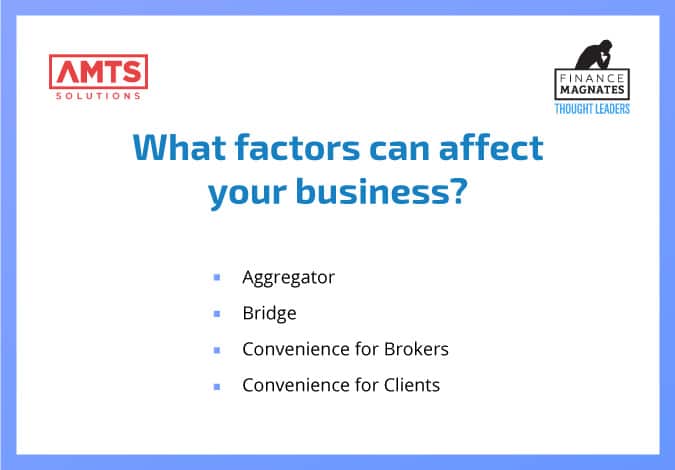
I will break all the features into 4 main sections (aggregator, bridge, convenience for the broker, convenience for clients) and describe them in the form of a short notes so readers can understand what technological ways can be used and how they can affect the business.
Aggregator
Markups - Different providers offer different trading conditions, some have a higher commission, in others it’s transferred into a spread, some execute better, others worse. Therefore, the only correct way to install the markups is to set different values on different providers to compensate for the difference in trading conditions, someone to increase the likelihood of falling into the top Book, someone to reduce it.
Priorities - Providers differ significantly in quality and in the adequacy index to regulate hedging processes, there may be a system of priorities and filters. If they do not exist, the process can become unmanageable.
Filtration - Filtering is a very large complex segment of any aggregator. Filtering can be an intellectual which means that it is related to the system of priority, and can be more straightforward and serve to filter out inadequate quotes and quotations with a wide spread. Without serious experience in dealing development it is difficult to find a balance between the absence of inadequate quotations on one hand and the stop of quoting on fast movements on the other.
Large volumes - A large customer volume that exceeds the volume of the first band of market depth can be processed in different ways. You can send everything to one provider, but you can split it into parts and send it to several. Each path has both pluses and minuses. Breakdown is more correct and logical way, but to collect the entire amount, and do it in the fastest possible time and without losses, you need a high-tech software.
Rejects - Rejects are quite common in the market. At news movements at some providers the quantity of rejects can be 95%. To ensure that customers do not feel this on themselves, we need a system of order delivery after the rejects, and preferably an intelligent one, which will not receive a reject after the reject increasing the execution time of the order.
Scalability and fault tolerance. No less important parameters of the aggregator. The correct system should not have restrictions on the number of providers, and they must be connected not only independently of each other, but preferably on different servers, so that problems with a provider do not affect the quotes flow or the system in general
Hedging - Hedging should be flexible. The bridge should allow the broker hedge not only individual clients or groups of customers, but also individual instruments. And a very serious advantage is the possibility of partial hedging, when customers or instruments are hedged with a certain coefficient, which can be either decreasing or increasing. It is also important that there is an opportunity to hedge various situations (manual hedging, automatic or, for example, hedging transactions made in MT Manager).
Stability of hedging - It is not uncommon for providers to refuse performance, to perform inadequately for a long time, to delay performance reports, to return unknown errors or to generate other non-standard situations. A normal bridge must contain protection against any negative situations.
Compatibility - The bridge should be able to work with other plug-ins, and it's good if it does not need a separate MT Server so that different technology providers can serve different types of accounts on the same server without forcing the broker to pay more.
Fault tolerance - For the bridge, this parameter is also very important. There are bridges that need to be periodically rebooted, otherwise they start to work inadequately. The correct bridge should be able to work for months, or even years, without rebooting. And in case of an unplanned restart or failure, it should not lose any data.
Flexible-Matching Data-Instruments aliases tool - Typically, brokers have their own requirements for the names of trading instruments, and the bridge should support the ability to call instruments in MT, regardless of how they are called in the system or from the provider.
Floating leverage - Many brokers practice shrinking the leverage to large customers, and often do so depending on the size of the deposit, which is wrong. It is more convenient for the broker and for the clients to reduce the leverage correctly, depending on the volume of open positions.
Reporting and logging system - For normal operation, there is a need in reporting and the ability to always obtain detailed information about any trading operation, with all the technical details and the exact time of each stage of execution accurate to milliseconds.
Quality support - Dealing technologies should be provided with operational 24-hour technical support, and preferably also with support for parsing customer claims both inside the company and in independent instances.
Convenience for customers
Quality - Of course, the main convenience for customers should be a stable quality execution, which depends on the profitability of the trader, on what Book he is in, or what trading strategy he is using. When using good technologies within the broker system, the execution is always qualitative and stable, and depends only on the quality of the external execution of the liquidity provider, with which you also have to be able to work.
Functionality -There are technologies that not only give customers stable and high-quality execution, but also significantly expand the available functionality. For example, AMTS Solutions offer broker clients services "Trade settings" and "Depth of a market". the settings of the trade can be read in the article "Everything for the client" (a link to the previous article). With the help of these tools, customers can protect themselves from many problems and increase trade efficiency.
Transparency - Customers tend to trust companies that are striving for transparency in their work. If the company offers customers Level 2, where the depth of the market is visible, or, for example, offers to see all the sizes of slippage at the opening and closing of orders (the function of trade settings from AMTS), the customer feels more secure and to some extent more professional. Clients find it more difficult to get away from such a broker to another where these services are not available.
Openness -This item I would like to relate directly to the company AMTS Solutions, which openly talks about how its technology is arranged, goes to a dialogue with broker clients, has its own branches on popular independent forums, and for each issue it is always ready to publicly disassemble any claim that enhances the reputation of not only AMTS, but brokers who use its technology.
Conclusion
AMTS Solutions has been developing software for dealing for more than 10 years, AMTS technologies have been tested by huge turnover in the largest companies. The quality of AMTS technology reflects the entire experience of many years of work in the forex industry. We will be happy to give an advise to brokers’ representatives, tell about our technological solutions and help you organize a qualitative and effective dealing, which will definitely affect the attraction of clients.
To the chief-dealer as a note:
I decided to address this article to the chief-dealers. I'm going to tell you that dealing is not that easy that there are many subtleties and many technical ways of solving certain tasks. Any dealer sooner or later faces certain problems that could be avoided.
However, the most dangerous thing is that often the problems come with the growth of the client’s base and the base of orders, when the workload increases and growth of the amount of customers’ marketing transactions increase the possible appearance of problems that were not noticeable on small client bases. The difficulty is that there are many disappointed customers, and it will not be possible to change anything quickly. Therefore, it is always necessary to put in advance the growth and choose technologies that consider all of both quoting and hedging.
I will break all the features into 4 main sections (aggregator, bridge, convenience for the broker, convenience for clients) and describe them in the form of a short notes so readers can understand what technological ways can be used and how they can affect the business.
Aggregator
Markups - Different providers offer different trading conditions, some have a higher commission, in others it’s transferred into a spread, some execute better, others worse. Therefore, the only correct way to install the markups is to set different values on different providers to compensate for the difference in trading conditions, someone to increase the likelihood of falling into the top Book, someone to reduce it.
Priorities - Providers differ significantly in quality and in the adequacy index to regulate hedging processes, there may be a system of priorities and filters. If they do not exist, the process can become unmanageable.
Filtration - Filtering is a very large complex segment of any aggregator. Filtering can be an intellectual which means that it is related to the system of priority, and can be more straightforward and serve to filter out inadequate quotes and quotations with a wide spread. Without serious experience in dealing development it is difficult to find a balance between the absence of inadequate quotations on one hand and the stop of quoting on fast movements on the other.
Large volumes - A large customer volume that exceeds the volume of the first band of market depth can be processed in different ways. You can send everything to one provider, but you can split it into parts and send it to several. Each path has both pluses and minuses. Breakdown is more correct and logical way, but to collect the entire amount, and do it in the fastest possible time and without losses, you need a high-tech software.
Rejects - Rejects are quite common in the market. At news movements at some providers the quantity of rejects can be 95%. To ensure that customers do not feel this on themselves, we need a system of order delivery after the rejects, and preferably an intelligent one, which will not receive a reject after the reject increasing the execution time of the order.
Scalability and fault tolerance. No less important parameters of the aggregator. The correct system should not have restrictions on the number of providers, and they must be connected not only independently of each other, but preferably on different servers, so that problems with a provider do not affect the quotes flow or the system in general
Hedging - Hedging should be flexible. The bridge should allow the broker hedge not only individual clients or groups of customers, but also individual instruments. And a very serious advantage is the possibility of partial hedging, when customers or instruments are hedged with a certain coefficient, which can be either decreasing or increasing. It is also important that there is an opportunity to hedge various situations (manual hedging, automatic or, for example, hedging transactions made in MT Manager).
Stability of hedging - It is not uncommon for providers to refuse performance, to perform inadequately for a long time, to delay performance reports, to return unknown errors or to generate other non-standard situations. A normal bridge must contain protection against any negative situations.
Compatibility - The bridge should be able to work with other plug-ins, and it's good if it does not need a separate MT Server so that different technology providers can serve different types of accounts on the same server without forcing the broker to pay more.
Fault tolerance - For the bridge, this parameter is also very important. There are bridges that need to be periodically rebooted, otherwise they start to work inadequately. The correct bridge should be able to work for months, or even years, without rebooting. And in case of an unplanned restart or failure, it should not lose any data.
Flexible-Matching Data-Instruments aliases tool - Typically, brokers have their own requirements for the names of trading instruments, and the bridge should support the ability to call instruments in MT, regardless of how they are called in the system or from the provider.
Floating leverage - Many brokers practice shrinking the leverage to large customers, and often do so depending on the size of the deposit, which is wrong. It is more convenient for the broker and for the clients to reduce the leverage correctly, depending on the volume of open positions.
Reporting and logging system - For normal operation, there is a need in reporting and the ability to always obtain detailed information about any trading operation, with all the technical details and the exact time of each stage of execution accurate to milliseconds.
Quality support - Dealing technologies should be provided with operational 24-hour technical support, and preferably also with support for parsing customer claims both inside the company and in independent instances.
Convenience for customers
Quality - Of course, the main convenience for customers should be a stable quality execution, which depends on the profitability of the trader, on what Book he is in, or what trading strategy he is using. When using good technologies within the broker system, the execution is always qualitative and stable, and depends only on the quality of the external execution of the liquidity provider, with which you also have to be able to work.
Functionality -There are technologies that not only give customers stable and high-quality execution, but also significantly expand the available functionality. For example, AMTS Solutions offer broker clients services "Trade settings" and "Depth of a market". the settings of the trade can be read in the article "Everything for the client" (a link to the previous article). With the help of these tools, customers can protect themselves from many problems and increase trade efficiency.
Transparency - Customers tend to trust companies that are striving for transparency in their work. If the company offers customers Level 2, where the depth of the market is visible, or, for example, offers to see all the sizes of slippage at the opening and closing of orders (the function of trade settings from AMTS), the customer feels more secure and to some extent more professional. Clients find it more difficult to get away from such a broker to another where these services are not available.
Openness -This item I would like to relate directly to the company AMTS Solutions, which openly talks about how its technology is arranged, goes to a dialogue with broker clients, has its own branches on popular independent forums, and for each issue it is always ready to publicly disassemble any claim that enhances the reputation of not only AMTS, but brokers who use its technology.
Conclusion
AMTS Solutions has been developing software for dealing for more than 10 years, AMTS technologies have been tested by huge turnover in the largest companies. The quality of AMTS technology reflects the entire experience of many years of work in the forex industry. We will be happy to give an advise to brokers’ representatives, tell about our technological solutions and help you organize a qualitative and effective dealing, which will definitely affect the attraction of clients.
Hantec Financial Nominated for Most Trusted Broker at UF AWARDS APAC 2026
Featured Videos
AvaTrade to Acquire Most of FXCM; NAGA Raises $8M
AvaTrade to Acquire Most of FXCM; NAGA Raises $8M
AvaTrade to Acquire Most of FXCM; NAGA Raises $8M
AvaTrade to Acquire Most of FXCM; NAGA Raises $8M
Today’s financial news recap covers AvaTrade agrees to acquire most of FXCM, NAGA secures eight million dollars in new financing, and Wise seeks a tax settlement in the UK.
Finance Magnates Daily Recap brings you the latest news from forex and CFD brokers, fintech, payments, cryptocurrency, digital assets, trading platforms, financial regulation and global markets.
Get the key company news, executive moves, deals, regulatory updates and market developments of the day, in just a few minutes. New episodes published every weekday.
Read more: https://www.financemagnates.com
#FinanceMagnates #ForexNews #FintechNews
Today’s financial news recap covers AvaTrade agrees to acquire most of FXCM, NAGA secures eight million dollars in new financing, and Wise seeks a tax settlement in the UK.
Finance Magnates Daily Recap brings you the latest news from forex and CFD brokers, fintech, payments, cryptocurrency, digital assets, trading platforms, financial regulation and global markets.
Get the key company news, executive moves, deals, regulatory updates and market developments of the day, in just a few minutes. New episodes published every weekday.
Read more: https://www.financemagnates.com
#FinanceMagnates #ForexNews #FintechNews
Today’s financial news recap covers AvaTrade agrees to acquire most of FXCM, NAGA secures eight million dollars in new financing, and Wise seeks a tax settlement in the UK.
Finance Magnates Daily Recap brings you the latest news from forex and CFD brokers, fintech, payments, cryptocurrency, digital assets, trading platforms, financial regulation and global markets.
Get the key company news, executive moves, deals, regulatory updates and market developments of the day, in just a few minutes. New episodes published every weekday.
Read more: https://www.financemagnates.com
#FinanceMagnates #ForexNews #FintechNews
Today’s financial news recap covers AvaTrade agrees to acquire most of FXCM, NAGA secures eight million dollars in new financing, and Wise seeks a tax settlement in the UK.
Finance Magnates Daily Recap brings you the latest news from forex and CFD brokers, fintech, payments, cryptocurrency, digital assets, trading platforms, financial regulation and global markets.
Get the key company news, executive moves, deals, regulatory updates and market developments of the day, in just a few minutes. New episodes published every weekday.
Read more: https://www.financemagnates.com
#FinanceMagnates #ForexNews #FintechNews
XTB Adds Overnight US Stock Trading; Nasdaq Ventures Invests in One Trading
XTB Adds Overnight US Stock Trading; Nasdaq Ventures Invests in One Trading
XTB Adds Overnight US Stock Trading; Nasdaq Ventures Invests in One Trading
XTB Adds Overnight US Stock Trading; Nasdaq Ventures Invests in One Trading
XTB Adds Overnight US Stock Trading; Nasdaq Ventures Invests in One Trading
XTB Adds Overnight US Stock Trading; Nasdaq Ventures Invests in One Trading
Today’s financial news recap covers XTB expands overnight US stock trading, Fortrade reports higher revenue, Nasdaq backs One Trading, and Vest Labs raises 13 million dollars.
Finance Magnates Daily Recap brings you the latest news from forex and CFD brokers, fintech, payments, cryptocurrency, digital assets, trading platforms, financial regulation and global markets.
Get the key company news, executive moves, deals, regulatory updates and market developments of the day, in just a few minutes. New episodes published every weekday.
Read more: https://www.financemagnates.com
#FinanceMagnates #ForexNews #FintechNews
Today’s financial news recap covers XTB expands overnight US stock trading, Fortrade reports higher revenue, Nasdaq backs One Trading, and Vest Labs raises 13 million dollars.
Finance Magnates Daily Recap brings you the latest news from forex and CFD brokers, fintech, payments, cryptocurrency, digital assets, trading platforms, financial regulation and global markets.
Get the key company news, executive moves, deals, regulatory updates and market developments of the day, in just a few minutes. New episodes published every weekday.
Read more: https://www.financemagnates.com
#FinanceMagnates #ForexNews #FintechNews
Today’s financial news recap covers XTB expands overnight US stock trading, Fortrade reports higher revenue, Nasdaq backs One Trading, and Vest Labs raises 13 million dollars.
Finance Magnates Daily Recap brings you the latest news from forex and CFD brokers, fintech, payments, cryptocurrency, digital assets, trading platforms, financial regulation and global markets.
Get the key company news, executive moves, deals, regulatory updates and market developments of the day, in just a few minutes. New episodes published every weekday.
Read more: https://www.financemagnates.com
#FinanceMagnates #ForexNews #FintechNews
Today’s financial news recap covers XTB expands overnight US stock trading, Fortrade reports higher revenue, Nasdaq backs One Trading, and Vest Labs raises 13 million dollars.
Finance Magnates Daily Recap brings you the latest news from forex and CFD brokers, fintech, payments, cryptocurrency, digital assets, trading platforms, financial regulation and global markets.
Get the key company news, executive moves, deals, regulatory updates and market developments of the day, in just a few minutes. New episodes published every weekday.
Read more: https://www.financemagnates.com
#FinanceMagnates #ForexNews #FintechNews
Today’s financial news recap covers XTB expands overnight US stock trading, Fortrade reports higher revenue, Nasdaq backs One Trading, and Vest Labs raises 13 million dollars.
Finance Magnates Daily Recap brings you the latest news from forex and CFD brokers, fintech, payments, cryptocurrency, digital assets, trading platforms, financial regulation and global markets.
Get the key company news, executive moves, deals, regulatory updates and market developments of the day, in just a few minutes. New episodes published every weekday.
Read more: https://www.financemagnates.com
#FinanceMagnates #ForexNews #FintechNews
Today’s financial news recap covers XTB expands overnight US stock trading, Fortrade reports higher revenue, Nasdaq backs One Trading, and Vest Labs raises 13 million dollars.
Finance Magnates Daily Recap brings you the latest news from forex and CFD brokers, fintech, payments, cryptocurrency, digital assets, trading platforms, financial regulation and global markets.
Get the key company news, executive moves, deals, regulatory updates and market developments of the day, in just a few minutes. New episodes published every weekday.
Read more: https://www.financemagnates.com
#FinanceMagnates #ForexNews #FintechNews
CMC Founder Downplays Volatility Hit; Devexperts Names CEO
CMC Founder Downplays Volatility Hit; Devexperts Names CEO
CMC Founder Downplays Volatility Hit; Devexperts Names CEO
CMC Founder Downplays Volatility Hit; Devexperts Names CEO
CMC Founder Downplays Volatility Hit; Devexperts Names CEO
CMC Founder Downplays Volatility Hit; Devexperts Names CEO
Today’s financial news recap covers low volatility pressures brokers, Devexperts names a new CEO, Saxo cuts onboarding time, and OKX reaches a 25 billion dollar valuation.
Finance Magnates Daily Recap brings you the latest news from forex and CFD brokers, fintech, payments, cryptocurrency, digital assets, trading platforms, financial regulation and global markets.
Get the key company news, executive moves, deals, regulatory updates and market developments of the day, in just a few minutes. New episodes published every weekday.
Read more: https://www.financemagnates.com
#FinanceMagnates #ForexNews #FintechNews
Today’s financial news recap covers low volatility pressures brokers, Devexperts names a new CEO, Saxo cuts onboarding time, and OKX reaches a 25 billion dollar valuation.
Finance Magnates Daily Recap brings you the latest news from forex and CFD brokers, fintech, payments, cryptocurrency, digital assets, trading platforms, financial regulation and global markets.
Get the key company news, executive moves, deals, regulatory updates and market developments of the day, in just a few minutes. New episodes published every weekday.
Read more: https://www.financemagnates.com
#FinanceMagnates #ForexNews #FintechNews
Today’s financial news recap covers low volatility pressures brokers, Devexperts names a new CEO, Saxo cuts onboarding time, and OKX reaches a 25 billion dollar valuation.
Finance Magnates Daily Recap brings you the latest news from forex and CFD brokers, fintech, payments, cryptocurrency, digital assets, trading platforms, financial regulation and global markets.
Get the key company news, executive moves, deals, regulatory updates and market developments of the day, in just a few minutes. New episodes published every weekday.
Read more: https://www.financemagnates.com
#FinanceMagnates #ForexNews #FintechNews
Today’s financial news recap covers low volatility pressures brokers, Devexperts names a new CEO, Saxo cuts onboarding time, and OKX reaches a 25 billion dollar valuation.
Finance Magnates Daily Recap brings you the latest news from forex and CFD brokers, fintech, payments, cryptocurrency, digital assets, trading platforms, financial regulation and global markets.
Get the key company news, executive moves, deals, regulatory updates and market developments of the day, in just a few minutes. New episodes published every weekday.
Read more: https://www.financemagnates.com
#FinanceMagnates #ForexNews #FintechNews
Today’s financial news recap covers low volatility pressures brokers, Devexperts names a new CEO, Saxo cuts onboarding time, and OKX reaches a 25 billion dollar valuation.
Finance Magnates Daily Recap brings you the latest news from forex and CFD brokers, fintech, payments, cryptocurrency, digital assets, trading platforms, financial regulation and global markets.
Get the key company news, executive moves, deals, regulatory updates and market developments of the day, in just a few minutes. New episodes published every weekday.
Read more: https://www.financemagnates.com
#FinanceMagnates #ForexNews #FintechNews
Today’s financial news recap covers low volatility pressures brokers, Devexperts names a new CEO, Saxo cuts onboarding time, and OKX reaches a 25 billion dollar valuation.
Finance Magnates Daily Recap brings you the latest news from forex and CFD brokers, fintech, payments, cryptocurrency, digital assets, trading platforms, financial regulation and global markets.
Get the key company news, executive moves, deals, regulatory updates and market developments of the day, in just a few minutes. New episodes published every weekday.
Read more: https://www.financemagnates.com
#FinanceMagnates #ForexNews #FintechNews
Today’s financial news recap covers Trade Nation buys FXCM's UK client book, Trading 212 reports higher revenue, the CFTC's move to allow perpetual index futures.
Finance Magnates Daily Recap brings you the latest news from forex and CFD brokers, fintech, payments, cryptocurrency, digital assets, trading platforms, financial regulation and global markets.
Get the key company news, executive moves, deals, regulatory updates and market developments of the day, in just a few minutes. New episodes published every weekday.
Read more: https://www.financemagnates.com
#FinanceMagnates #ForexNews #FintechNews
Today’s financial news recap covers Trade Nation buys FXCM's UK client book, Trading 212 reports higher revenue, the CFTC's move to allow perpetual index futures.
Finance Magnates Daily Recap brings you the latest news from forex and CFD brokers, fintech, payments, cryptocurrency, digital assets, trading platforms, financial regulation and global markets.
Get the key company news, executive moves, deals, regulatory updates and market developments of the day, in just a few minutes. New episodes published every weekday.
Read more: https://www.financemagnates.com
#FinanceMagnates #ForexNews #FintechNews
Today’s financial news recap covers Trade Nation buys FXCM's UK client book, Trading 212 reports higher revenue, the CFTC's move to allow perpetual index futures.
Finance Magnates Daily Recap brings you the latest news from forex and CFD brokers, fintech, payments, cryptocurrency, digital assets, trading platforms, financial regulation and global markets.
Get the key company news, executive moves, deals, regulatory updates and market developments of the day, in just a few minutes. New episodes published every weekday.
Read more: https://www.financemagnates.com
#FinanceMagnates #ForexNews #FintechNews
Today’s financial news recap covers Trade Nation buys FXCM's UK client book, Trading 212 reports higher revenue, the CFTC's move to allow perpetual index futures.
Finance Magnates Daily Recap brings you the latest news from forex and CFD brokers, fintech, payments, cryptocurrency, digital assets, trading platforms, financial regulation and global markets.
Get the key company news, executive moves, deals, regulatory updates and market developments of the day, in just a few minutes. New episodes published every weekday.
Read more: https://www.financemagnates.com
#FinanceMagnates #ForexNews #FintechNews
Today’s financial news recap covers Trade Nation buys FXCM's UK client book, Trading 212 reports higher revenue, the CFTC's move to allow perpetual index futures.
Finance Magnates Daily Recap brings you the latest news from forex and CFD brokers, fintech, payments, cryptocurrency, digital assets, trading platforms, financial regulation and global markets.
Get the key company news, executive moves, deals, regulatory updates and market developments of the day, in just a few minutes. New episodes published every weekday.
Read more: https://www.financemagnates.com
#FinanceMagnates #ForexNews #FintechNews
Today’s financial news recap covers Trade Nation buys FXCM's UK client book, Trading 212 reports higher revenue, the CFTC's move to allow perpetual index futures.
Finance Magnates Daily Recap brings you the latest news from forex and CFD brokers, fintech, payments, cryptocurrency, digital assets, trading platforms, financial regulation and global markets.
Get the key company news, executive moves, deals, regulatory updates and market developments of the day, in just a few minutes. New episodes published every weekday.
Read more: https://www.financemagnates.com
#FinanceMagnates #ForexNews #FintechNews
Your career isn’t a linear path.
Your career isn’t a linear path.
Your career isn’t a linear path.
Your career isn’t a linear path.
Your career isn’t a linear path.
Your career isn’t a linear path.
Roles change. Career goals change. Sometimes you want a completely new challenge.
But the skills and knowledge you build along the way can stay with you and give you something to build on.
For Jeff Patterson, that continued growth is key to long-term career development.
You bring the skills. FM Academy helps you build the knowledge.
#FMAcademy #FinanceMagnates #FinanceCareers #ProfessionalDevelopment #Fintech
Roles change. Career goals change. Sometimes you want a completely new challenge.
But the skills and knowledge you build along the way can stay with you and give you something to build on.
For Jeff Patterson, that continued growth is key to long-term career development.
You bring the skills. FM Academy helps you build the knowledge.
#FMAcademy #FinanceMagnates #FinanceCareers #ProfessionalDevelopment #Fintech
Roles change. Career goals change. Sometimes you want a completely new challenge.
But the skills and knowledge you build along the way can stay with you and give you something to build on.
For Jeff Patterson, that continued growth is key to long-term career development.
You bring the skills. FM Academy helps you build the knowledge.
#FMAcademy #FinanceMagnates #FinanceCareers #ProfessionalDevelopment #Fintech
Roles change. Career goals change. Sometimes you want a completely new challenge.
But the skills and knowledge you build along the way can stay with you and give you something to build on.
For Jeff Patterson, that continued growth is key to long-term career development.
You bring the skills. FM Academy helps you build the knowledge.
#FMAcademy #FinanceMagnates #FinanceCareers #ProfessionalDevelopment #Fintech
Roles change. Career goals change. Sometimes you want a completely new challenge.
But the skills and knowledge you build along the way can stay with you and give you something to build on.
For Jeff Patterson, that continued growth is key to long-term career development.
You bring the skills. FM Academy helps you build the knowledge.
#FMAcademy #FinanceMagnates #FinanceCareers #ProfessionalDevelopment #Fintech
Roles change. Career goals change. Sometimes you want a completely new challenge.
But the skills and knowledge you build along the way can stay with you and give you something to build on.
For Jeff Patterson, that continued growth is key to long-term career development.
You bring the skills. FM Academy helps you build the knowledge.
#FMAcademy #FinanceMagnates #FinanceCareers #ProfessionalDevelopment #Fintech