There’s only one way to distinguish yourself from your rivals – customer service.
Bloomberg
As a broker, offering competitive products is not sufficient to hit the market, or to improve your numbers. There are plenty of other brokers out there, and there’s only one way to distinguish yourself from your rivals – customer service.
You could acquire licenses from different regulatory bodies, design the picture-perfect website, offer packages to traders of all shapes and sizes, and provide trading platforms with easy-to-use interfaces; whatever you do, the quality of your customer service makes you a trader’s best dream or worst nightmare.
Most brokers think of having to attain the monthly target and still finding the time for their customers as a burden. In theory, the two concepts are not mutually exclusive; however, when costs start to accumulate, the customers are usually thrown under the bus.
As a result, your Head of Customer Service might reduce the time spent on customer service and direct follow-ups, and decide to shift the whole process to an unreliable automated solution.
Although maintaining a consistent communication with your client can be overwhelming and time-consuming, that doesn’t eliminate the possibility of a solution. Think of it this way, by listening to your clients you’ll earn their trust and loyalty.
You’re not only solving their current problems, but also building goodwill that could help you in the future. Resist the urge of favoring numbers over clients, adopt a proactive mindset, and think of customizing a solution that can process a large volume of client complaints in a time-efficient manner.
Faced with this dilemma at Amana Capital, we integrated our social corporate channels (Facebook Messenger, Twitter, Whatsapp, WeChat, etc.) with our corporate Helpdesk and CRM Systems to track it all; all forms of communication are logged and monitored.
If a client files a complaint or sends an inquiry, a ticket is opened, then closed once the issue is resolved or the query is answered. Furthermore, this integration allows clients to reach us easily and communicate with the client-service team directly from their personal devices.
Make Yourself Available
Although it sounds simple, one of the most important ways to stay ahead of other brokers is to be available to your customers. If they contact your customer service team for any inquiry, try to get back to them with a helpful response, as soon as possible. If you can stay on top of things and respond to customers quickly, they'll see you as a reliable and friendly partner.
An alternative to online chat is AI Chatbots; they are being adopted recently by banks on Wall Street, such as Bank of America who recently introduced chat-based assistant, Erica, Master Card who is employing Facebook’s chatbot, and others.
Be the Product
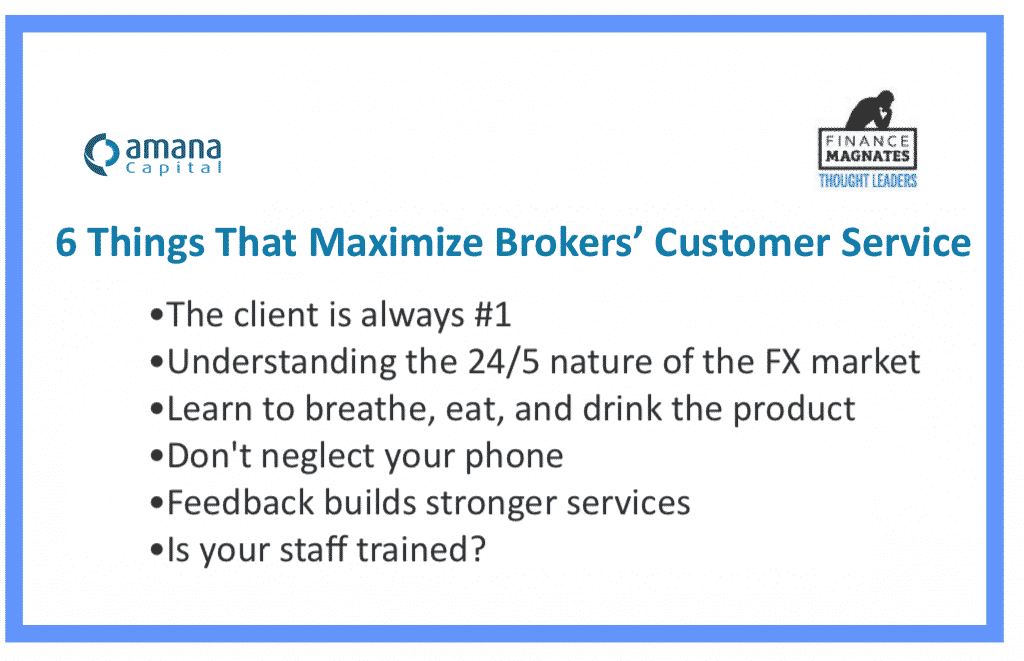
There’s nothing more shameful than a customer service agent not knowing how to answer a common inquiry about your brokerage services; any reluctant pause will reflect poorly on your brand’s credibility. Your customer service team should breathe, eat, and drink the product.
As a broker, you should be aware of the knowledge level of your employees as they should know the product inside out. If the customer asks a complex question, the agent can take the time to make a proper research and respond with full-rounded answer.
People often gain familiarity with experience, which is why continuous training is mandatory; especially for new hires. It will help them understand the product’s features and therefore know how to answer any question that might pop up.
Bloomberg
Watch the Phone
Email and text messaging are both common and practical gateways of communication. As noninvasive tools, they allow the client to check your message when it suits them, and enables your customer service team to handle inquires at their own pace.
Although email and text messaging are powerful tools, you shouldn’t underestimate the importance of phone communication. Live conversations are more dynamic and they present a unique opportunity to glean valuable data on the spot. Your customer service team will be building a strong bond with the user; one that is more solid than reaching them via email or text.
If you’re employing a phone answering machine, try to keep the hold time as minimal as you can, especially if the markets are experiencing a major event. Long waits will frustrate the customer who consequently might turn to the broker that beats you to the phone. On another note, make certain that your customer support team returns a client’s missed call.
Ask for Feedback
The best thing you could do to improve your brokerage services is to ask your clients for their feedback. What they say will confirm whether or not things need to be fixed. However, while some are eager to give feedback, most won't do so unless prompted. So, trigger them to share their thoughts!
First, make sure you create a short survey that could be triggered further to a live chat session, a phone call, or the resolving of a ticket. Keep it simple, fun, and easy. You could measure your team’s performance by using a happiness meter, or adding emojis to the form. Whatever you do, don’t build a survey that would take forever to complete.
If you don’t receive enough feedback, don’t take it as a negative sign. Your customers might be satisfied with the product and have nothing negative to say about it. If the customer is displeased, he/she will snag this opportunity to dish everything out!
Train Your Staff
Great customer service doesn't come randomly; it is the end-result of consistent training and deliberate action. As a broker, you need to make sure that your customer service team is trained at least once every quarter – no matter their level of expertise and competency.
Not only do your employees need to learn about the product to answer all common questions, but they also should be familiar with business etiquette and proper word usage.
You could review calls, track unsatisfied clients through your Helpdesk and CRM systems, analyze case studies, and keep your team up-to-date as per market news and updates. Doing so has helped us at Amana Capital in identifying our shortcomings and optimizing the quality of our customer service.
Excellent customer service is a critical part of any successful brokerage group, irrelevant of its popularity and size. Today, consumers are more community-oriented than they were before; one bad experience can spiral into a wave of endless complaints. Make every interaction with the customer a positive one, and you'll brighten the company's future.
As a broker, offering competitive products is not sufficient to hit the market, or to improve your numbers. There are plenty of other brokers out there, and there’s only one way to distinguish yourself from your rivals – customer service.
You could acquire licenses from different regulatory bodies, design the picture-perfect website, offer packages to traders of all shapes and sizes, and provide trading platforms with easy-to-use interfaces; whatever you do, the quality of your customer service makes you a trader’s best dream or worst nightmare.
Most brokers think of having to attain the monthly target and still finding the time for their customers as a burden. In theory, the two concepts are not mutually exclusive; however, when costs start to accumulate, the customers are usually thrown under the bus.
As a result, your Head of Customer Service might reduce the time spent on customer service and direct follow-ups, and decide to shift the whole process to an unreliable automated solution.
Although maintaining a consistent communication with your client can be overwhelming and time-consuming, that doesn’t eliminate the possibility of a solution. Think of it this way, by listening to your clients you’ll earn their trust and loyalty.
You’re not only solving their current problems, but also building goodwill that could help you in the future. Resist the urge of favoring numbers over clients, adopt a proactive mindset, and think of customizing a solution that can process a large volume of client complaints in a time-efficient manner.
Faced with this dilemma at Amana Capital, we integrated our social corporate channels (Facebook Messenger, Twitter, Whatsapp, WeChat, etc.) with our corporate Helpdesk and CRM Systems to track it all; all forms of communication are logged and monitored.
If a client files a complaint or sends an inquiry, a ticket is opened, then closed once the issue is resolved or the query is answered. Furthermore, this integration allows clients to reach us easily and communicate with the client-service team directly from their personal devices.
Make Yourself Available
Although it sounds simple, one of the most important ways to stay ahead of other brokers is to be available to your customers. If they contact your customer service team for any inquiry, try to get back to them with a helpful response, as soon as possible. If you can stay on top of things and respond to customers quickly, they'll see you as a reliable and friendly partner.
An alternative to online chat is AI Chatbots; they are being adopted recently by banks on Wall Street, such as Bank of America who recently introduced chat-based assistant, Erica, Master Card who is employing Facebook’s chatbot, and others.
Be the Product
There’s nothing more shameful than a customer service agent not knowing how to answer a common inquiry about your brokerage services; any reluctant pause will reflect poorly on your brand’s credibility. Your customer service team should breathe, eat, and drink the product.
As a broker, you should be aware of the knowledge level of your employees as they should know the product inside out. If the customer asks a complex question, the agent can take the time to make a proper research and respond with full-rounded answer.
People often gain familiarity with experience, which is why continuous training is mandatory; especially for new hires. It will help them understand the product’s features and therefore know how to answer any question that might pop up.
Bloomberg
Watch the Phone
Email and text messaging are both common and practical gateways of communication. As noninvasive tools, they allow the client to check your message when it suits them, and enables your customer service team to handle inquires at their own pace.
Although email and text messaging are powerful tools, you shouldn’t underestimate the importance of phone communication. Live conversations are more dynamic and they present a unique opportunity to glean valuable data on the spot. Your customer service team will be building a strong bond with the user; one that is more solid than reaching them via email or text.
If you’re employing a phone answering machine, try to keep the hold time as minimal as you can, especially if the markets are experiencing a major event. Long waits will frustrate the customer who consequently might turn to the broker that beats you to the phone. On another note, make certain that your customer support team returns a client’s missed call.
Ask for Feedback
The best thing you could do to improve your brokerage services is to ask your clients for their feedback. What they say will confirm whether or not things need to be fixed. However, while some are eager to give feedback, most won't do so unless prompted. So, trigger them to share their thoughts!
First, make sure you create a short survey that could be triggered further to a live chat session, a phone call, or the resolving of a ticket. Keep it simple, fun, and easy. You could measure your team’s performance by using a happiness meter, or adding emojis to the form. Whatever you do, don’t build a survey that would take forever to complete.
If you don’t receive enough feedback, don’t take it as a negative sign. Your customers might be satisfied with the product and have nothing negative to say about it. If the customer is displeased, he/she will snag this opportunity to dish everything out!
Train Your Staff
Great customer service doesn't come randomly; it is the end-result of consistent training and deliberate action. As a broker, you need to make sure that your customer service team is trained at least once every quarter – no matter their level of expertise and competency.
Not only do your employees need to learn about the product to answer all common questions, but they also should be familiar with business etiquette and proper word usage.
You could review calls, track unsatisfied clients through your Helpdesk and CRM systems, analyze case studies, and keep your team up-to-date as per market news and updates. Doing so has helped us at Amana Capital in identifying our shortcomings and optimizing the quality of our customer service.
Excellent customer service is a critical part of any successful brokerage group, irrelevant of its popularity and size. Today, consumers are more community-oriented than they were before; one bad experience can spiral into a wave of endless complaints. Make every interaction with the customer a positive one, and you'll brighten the company's future.
FP Markets Winner Spotlight 🏆 | Global Broker of the Year 2025 #Trading #Broker #Innovation #Shorts
FP Markets Winner Spotlight 🏆 | Global Broker of the Year 2025 #Trading #Broker #Innovation #Shorts
FP Markets Winner Spotlight 🏆 | Global Broker of the Year 2025 #Trading #Broker #Innovation #Shorts
FP Markets Winner Spotlight 🏆 | Global Broker of the Year 2025 #Trading #Broker #Innovation #Shorts
FP Markets takes the spotlight as Global Broker of the Year 2025 at the Finance Magnates Awards.
Martin Stoilov, Head of Client Experience, shares that trust, innovation, and people played a key role in the company’s success, supported by a strong foundation of integrity and client-centricity.
Following this milestone, FP Markets continues to focus on growth, technology investment, and its core values of transparency and excellence.
👉 Be part of FM Awards 2026: https://awards.financemagnates.com/#nominate
FP Markets takes the spotlight as Global Broker of the Year 2025 at the Finance Magnates Awards.
Martin Stoilov, Head of Client Experience, shares that trust, innovation, and people played a key role in the company’s success, supported by a strong foundation of integrity and client-centricity.
Following this milestone, FP Markets continues to focus on growth, technology investment, and its core values of transparency and excellence.
👉 Be part of FM Awards 2026: https://awards.financemagnates.com/#nominate
FP Markets takes the spotlight as Global Broker of the Year 2025 at the Finance Magnates Awards.
Martin Stoilov, Head of Client Experience, shares that trust, innovation, and people played a key role in the company’s success, supported by a strong foundation of integrity and client-centricity.
Following this milestone, FP Markets continues to focus on growth, technology investment, and its core values of transparency and excellence.
👉 Be part of FM Awards 2026: https://awards.financemagnates.com/#nominate
FP Markets takes the spotlight as Global Broker of the Year 2025 at the Finance Magnates Awards.
Martin Stoilov, Head of Client Experience, shares that trust, innovation, and people played a key role in the company’s success, supported by a strong foundation of integrity and client-centricity.
Following this milestone, FP Markets continues to focus on growth, technology investment, and its core values of transparency and excellence.
👉 Be part of FM Awards 2026: https://awards.financemagnates.com/#nominate
In this video, we review @HolaPrimeMarketsOfficial, a multi-asset forex and CFDs broker offering different account types, trading platforms, and flexible trading conditions.
We cover the broker’s overall offering, including account options, trading environment, platforms like MT4 and MT5, and additional services such as managed accounts and fast withdrawals.
Watch the full video to see if Hola Prime Markets fits your trading needs.
📣 Stay up to date with the latest in finance and trading. Follow Finance Magnates for industry news, insights, and global event coverage.
Connect with us:
🔗 LinkedIn: /financemagnates
👍 Facebook: /financemagnates
📸 Instagram: https://www.instagram.com/financemagnates
🐦 X: https://x.com/financemagnates
🎥 TikTok: https://www.tiktok.com/tag/financemagnates
▶️ YouTube: /@financemagnates_official
#HolaPrime #ForexBroker #CFDTrading #FinanceMagnates #Trading #Forex #BrokerReview
In this video, we review @HolaPrimeMarketsOfficial, a multi-asset forex and CFDs broker offering different account types, trading platforms, and flexible trading conditions.
We cover the broker’s overall offering, including account options, trading environment, platforms like MT4 and MT5, and additional services such as managed accounts and fast withdrawals.
Watch the full video to see if Hola Prime Markets fits your trading needs.
📣 Stay up to date with the latest in finance and trading. Follow Finance Magnates for industry news, insights, and global event coverage.
Connect with us:
🔗 LinkedIn: /financemagnates
👍 Facebook: /financemagnates
📸 Instagram: https://www.instagram.com/financemagnates
🐦 X: https://x.com/financemagnates
🎥 TikTok: https://www.tiktok.com/tag/financemagnates
▶️ YouTube: /@financemagnates_official
#HolaPrime #ForexBroker #CFDTrading #FinanceMagnates #Trading #Forex #BrokerReview
In this video, we review @HolaPrimeMarketsOfficial, a multi-asset forex and CFDs broker offering different account types, trading platforms, and flexible trading conditions.
We cover the broker’s overall offering, including account options, trading environment, platforms like MT4 and MT5, and additional services such as managed accounts and fast withdrawals.
Watch the full video to see if Hola Prime Markets fits your trading needs.
📣 Stay up to date with the latest in finance and trading. Follow Finance Magnates for industry news, insights, and global event coverage.
Connect with us:
🔗 LinkedIn: /financemagnates
👍 Facebook: /financemagnates
📸 Instagram: https://www.instagram.com/financemagnates
🐦 X: https://x.com/financemagnates
🎥 TikTok: https://www.tiktok.com/tag/financemagnates
▶️ YouTube: /@financemagnates_official
#HolaPrime #ForexBroker #CFDTrading #FinanceMagnates #Trading #Forex #BrokerReview
In this video, we review @HolaPrimeMarketsOfficial, a multi-asset forex and CFDs broker offering different account types, trading platforms, and flexible trading conditions.
We cover the broker’s overall offering, including account options, trading environment, platforms like MT4 and MT5, and additional services such as managed accounts and fast withdrawals.
Watch the full video to see if Hola Prime Markets fits your trading needs.
📣 Stay up to date with the latest in finance and trading. Follow Finance Magnates for industry news, insights, and global event coverage.
Connect with us:
🔗 LinkedIn: /financemagnates
👍 Facebook: /financemagnates
📸 Instagram: https://www.instagram.com/financemagnates
🐦 X: https://x.com/financemagnates
🎥 TikTok: https://www.tiktok.com/tag/financemagnates
▶️ YouTube: /@financemagnates_official
#HolaPrime #ForexBroker #CFDTrading #FinanceMagnates #Trading #Forex #BrokerReview
In this video, we review @HolaPrimeMarketsOfficial, a multi-asset forex and CFDs broker offering different account types, trading platforms, and flexible trading conditions.
We cover the broker’s overall offering, including account options, trading environment, platforms like MT4 and MT5, and additional services such as managed accounts and fast withdrawals.
Watch the full video to see if Hola Prime Markets fits your trading needs.
📣 Stay up to date with the latest in finance and trading. Follow Finance Magnates for industry news, insights, and global event coverage.
Connect with us:
🔗 LinkedIn: /financemagnates
👍 Facebook: /financemagnates
📸 Instagram: https://www.instagram.com/financemagnates
🐦 X: https://x.com/financemagnates
🎥 TikTok: https://www.tiktok.com/tag/financemagnates
▶️ YouTube: /@financemagnates_official
#HolaPrime #ForexBroker #CFDTrading #FinanceMagnates #Trading #Forex #BrokerReview
In this video, we review @HolaPrimeMarketsOfficial, a multi-asset forex and CFDs broker offering different account types, trading platforms, and flexible trading conditions.
We cover the broker’s overall offering, including account options, trading environment, platforms like MT4 and MT5, and additional services such as managed accounts and fast withdrawals.
Watch the full video to see if Hola Prime Markets fits your trading needs.
📣 Stay up to date with the latest in finance and trading. Follow Finance Magnates for industry news, insights, and global event coverage.
Connect with us:
🔗 LinkedIn: /financemagnates
👍 Facebook: /financemagnates
📸 Instagram: https://www.instagram.com/financemagnates
🐦 X: https://x.com/financemagnates
🎥 TikTok: https://www.tiktok.com/tag/financemagnates
▶️ YouTube: /@financemagnates_official
#HolaPrime #ForexBroker #CFDTrading #FinanceMagnates #Trading #Forex #BrokerReview
Hola Prime Review: What You Need to Know | Full Breakdown by Finance Magnates
Hola Prime Review: What You Need to Know | Full Breakdown by Finance Magnates
Hola Prime Review: What You Need to Know | Full Breakdown by Finance Magnates
Hola Prime Review: What You Need to Know | Full Breakdown by Finance Magnates
Hola Prime Review: What You Need to Know | Full Breakdown by Finance Magnates
Hola Prime Review: What You Need to Know | Full Breakdown by Finance Magnates
In this video, we review @HolaPrime_Global, a proprietary trading firm offering evaluation programs and performance-based payouts in simulated market environments.
We cover how the challenge model works, including account types, profit splits (up to 95%), trading rules, and what it takes to reach a funded account. You’ll also learn about available platforms like MT4, MT5, cTrader, and more, along with insights into payouts, support, and trading conditions.
Watch the full video to see if Hola Prime fits your trading style.
📣 Stay up to date with the latest in finance and trading. Follow Finance Magnates for industry news, insights, and global event coverage.
Connect with us:
🔗 LinkedIn: /financemagnates
👍 Facebook: /financemagnates
📸 Instagram: https://www.instagram.com/financemagnates
🐦 X: https://x.com/financemagnates
🎥 TikTok: https://www.tiktok.com/tag/financemagnates
▶️ YouTube: /@financemagnates_official
#HolaPrime #PropFirm #Trading #FinanceMagnates #Forex #FuturesTrading #TradingReview #PropFirmReview
In this video, we review @HolaPrime_Global, a proprietary trading firm offering evaluation programs and performance-based payouts in simulated market environments.
We cover how the challenge model works, including account types, profit splits (up to 95%), trading rules, and what it takes to reach a funded account. You’ll also learn about available platforms like MT4, MT5, cTrader, and more, along with insights into payouts, support, and trading conditions.
Watch the full video to see if Hola Prime fits your trading style.
📣 Stay up to date with the latest in finance and trading. Follow Finance Magnates for industry news, insights, and global event coverage.
Connect with us:
🔗 LinkedIn: /financemagnates
👍 Facebook: /financemagnates
📸 Instagram: https://www.instagram.com/financemagnates
🐦 X: https://x.com/financemagnates
🎥 TikTok: https://www.tiktok.com/tag/financemagnates
▶️ YouTube: /@financemagnates_official
#HolaPrime #PropFirm #Trading #FinanceMagnates #Forex #FuturesTrading #TradingReview #PropFirmReview
In this video, we review @HolaPrime_Global, a proprietary trading firm offering evaluation programs and performance-based payouts in simulated market environments.
We cover how the challenge model works, including account types, profit splits (up to 95%), trading rules, and what it takes to reach a funded account. You’ll also learn about available platforms like MT4, MT5, cTrader, and more, along with insights into payouts, support, and trading conditions.
Watch the full video to see if Hola Prime fits your trading style.
📣 Stay up to date with the latest in finance and trading. Follow Finance Magnates for industry news, insights, and global event coverage.
Connect with us:
🔗 LinkedIn: /financemagnates
👍 Facebook: /financemagnates
📸 Instagram: https://www.instagram.com/financemagnates
🐦 X: https://x.com/financemagnates
🎥 TikTok: https://www.tiktok.com/tag/financemagnates
▶️ YouTube: /@financemagnates_official
#HolaPrime #PropFirm #Trading #FinanceMagnates #Forex #FuturesTrading #TradingReview #PropFirmReview
In this video, we review @HolaPrime_Global, a proprietary trading firm offering evaluation programs and performance-based payouts in simulated market environments.
We cover how the challenge model works, including account types, profit splits (up to 95%), trading rules, and what it takes to reach a funded account. You’ll also learn about available platforms like MT4, MT5, cTrader, and more, along with insights into payouts, support, and trading conditions.
Watch the full video to see if Hola Prime fits your trading style.
📣 Stay up to date with the latest in finance and trading. Follow Finance Magnates for industry news, insights, and global event coverage.
Connect with us:
🔗 LinkedIn: /financemagnates
👍 Facebook: /financemagnates
📸 Instagram: https://www.instagram.com/financemagnates
🐦 X: https://x.com/financemagnates
🎥 TikTok: https://www.tiktok.com/tag/financemagnates
▶️ YouTube: /@financemagnates_official
#HolaPrime #PropFirm #Trading #FinanceMagnates #Forex #FuturesTrading #TradingReview #PropFirmReview
In this video, we review @HolaPrime_Global, a proprietary trading firm offering evaluation programs and performance-based payouts in simulated market environments.
We cover how the challenge model works, including account types, profit splits (up to 95%), trading rules, and what it takes to reach a funded account. You’ll also learn about available platforms like MT4, MT5, cTrader, and more, along with insights into payouts, support, and trading conditions.
Watch the full video to see if Hola Prime fits your trading style.
📣 Stay up to date with the latest in finance and trading. Follow Finance Magnates for industry news, insights, and global event coverage.
Connect with us:
🔗 LinkedIn: /financemagnates
👍 Facebook: /financemagnates
📸 Instagram: https://www.instagram.com/financemagnates
🐦 X: https://x.com/financemagnates
🎥 TikTok: https://www.tiktok.com/tag/financemagnates
▶️ YouTube: /@financemagnates_official
#HolaPrime #PropFirm #Trading #FinanceMagnates #Forex #FuturesTrading #TradingReview #PropFirmReview
In this video, we review @HolaPrime_Global, a proprietary trading firm offering evaluation programs and performance-based payouts in simulated market environments.
We cover how the challenge model works, including account types, profit splits (up to 95%), trading rules, and what it takes to reach a funded account. You’ll also learn about available platforms like MT4, MT5, cTrader, and more, along with insights into payouts, support, and trading conditions.
Watch the full video to see if Hola Prime fits your trading style.
📣 Stay up to date with the latest in finance and trading. Follow Finance Magnates for industry news, insights, and global event coverage.
Connect with us:
🔗 LinkedIn: /financemagnates
👍 Facebook: /financemagnates
📸 Instagram: https://www.instagram.com/financemagnates
🐦 X: https://x.com/financemagnates
🎥 TikTok: https://www.tiktok.com/tag/financemagnates
▶️ YouTube: /@financemagnates_official
#HolaPrime #PropFirm #Trading #FinanceMagnates #Forex #FuturesTrading #TradingReview #PropFirmReview
Axi Winner Spotlight 🏆 | Global Most Innovative Broker 2025 #Innovation #Trading #Fintech #Broker
Axi Winner Spotlight 🏆 | Global Most Innovative Broker 2025 #Innovation #Trading #Fintech #Broker
Axi Winner Spotlight 🏆 | Global Most Innovative Broker 2025 #Innovation #Trading #Fintech #Broker
Axi Winner Spotlight 🏆 | Global Most Innovative Broker 2025 #Innovation #Trading #Fintech #Broker
Axi Winner Spotlight 🏆 | Global Most Innovative Broker 2025 #Innovation #Trading #Fintech #Broker
Axi Winner Spotlight 🏆 | Global Most Innovative Broker 2025 #Innovation #Trading #Fintech #Broker
Axi takes the spotlight at the Finance Magnates Awards, winning Global Most Innovative Broker 2025.
Olivia Xenofontos and Ivanna Openko share how the team will feel: proud, motivated, and ready to keep delivering.
They also describe the night as well-organized, focused, and enjoyable for all.
👉 Be part of FM Awards 2026.
Axi takes the spotlight at the Finance Magnates Awards, winning Global Most Innovative Broker 2025.
Olivia Xenofontos and Ivanna Openko share how the team will feel: proud, motivated, and ready to keep delivering.
They also describe the night as well-organized, focused, and enjoyable for all.
👉 Be part of FM Awards 2026.
Axi takes the spotlight at the Finance Magnates Awards, winning Global Most Innovative Broker 2025.
Olivia Xenofontos and Ivanna Openko share how the team will feel: proud, motivated, and ready to keep delivering.
They also describe the night as well-organized, focused, and enjoyable for all.
👉 Be part of FM Awards 2026.
Axi takes the spotlight at the Finance Magnates Awards, winning Global Most Innovative Broker 2025.
Olivia Xenofontos and Ivanna Openko share how the team will feel: proud, motivated, and ready to keep delivering.
They also describe the night as well-organized, focused, and enjoyable for all.
👉 Be part of FM Awards 2026.
Axi takes the spotlight at the Finance Magnates Awards, winning Global Most Innovative Broker 2025.
Olivia Xenofontos and Ivanna Openko share how the team will feel: proud, motivated, and ready to keep delivering.
They also describe the night as well-organized, focused, and enjoyable for all.
👉 Be part of FM Awards 2026.
Axi takes the spotlight at the Finance Magnates Awards, winning Global Most Innovative Broker 2025.
Olivia Xenofontos and Ivanna Openko share how the team will feel: proud, motivated, and ready to keep delivering.
They also describe the night as well-organized, focused, and enjoyable for all.
👉 Be part of FM Awards 2026.
Recognition that matters.
Built on transparency.
Driven by the industry.
The Finance Magnates Awards 2026.
Nominations are now open.
🔗 https://awards.financemagnates.com/?utm_source=SM&utm_medium=social&utm_campaign=recognition-matters
Recognition that matters.
Built on transparency.
Driven by the industry.
The Finance Magnates Awards 2026.
Nominations are now open.
🔗 https://awards.financemagnates.com/?utm_source=SM&utm_medium=social&utm_campaign=recognition-matters
Recognition that matters.
Built on transparency.
Driven by the industry.
The Finance Magnates Awards 2026.
Nominations are now open.
🔗 https://awards.financemagnates.com/?utm_source=SM&utm_medium=social&utm_campaign=recognition-matters
Recognition that matters.
Built on transparency.
Driven by the industry.
The Finance Magnates Awards 2026.
Nominations are now open.
🔗 https://awards.financemagnates.com/?utm_source=SM&utm_medium=social&utm_campaign=recognition-matters
Recognition that matters.
Built on transparency.
Driven by the industry.
The Finance Magnates Awards 2026.
Nominations are now open.
🔗 https://awards.financemagnates.com/?utm_source=SM&utm_medium=social&utm_campaign=recognition-matters
Recognition that matters.
Built on transparency.
Driven by the industry.
The Finance Magnates Awards 2026.
Nominations are now open.
🔗 https://awards.financemagnates.com/?utm_source=SM&utm_medium=social&utm_campaign=recognition-matters