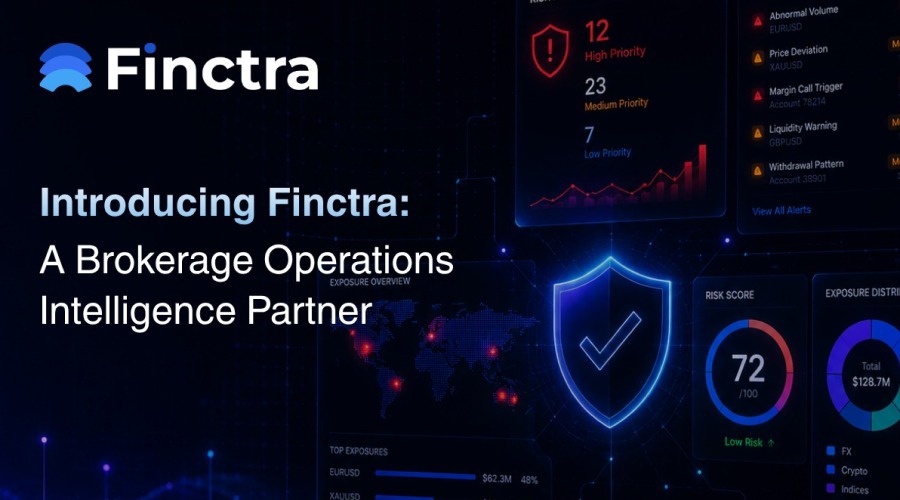
Introducing Finctra: A Brokerage Operations Intelligence Partner

Tuesday, 25/08/2026 | 05:39 GMT by Finctra
Disclaimer
  • Finctra positions itself as a connected infrastructure partner for brokers, market makers and fintech institutions, bringing risk management, liquidity connectivity and operational support together under one system rather than treating them as separate technology purchases.
Finctra

Brokerage operations have grown more complex than most back-office systems were built to handle. Firms now run multiple trading servers, connect to several liquidity providers, manage account structures across different jurisdictions, and are expected to do all of it while keeping exposure visible in real time and staying ahead of regulatory expectations.

For many brokers, the technology stack that once supported this work has become part of the problem: monitoring tools, execution infrastructure and reporting systems that were bought separately over time and that don't talk to each other particularly well.

That fragmentation carries a cost beyond inconvenience. When risk, execution and reporting systems sit apart from one another, operational risk tends to rise while transparency and scalability fall, gaps that become harder to close as a brokerage grows into new markets and account structures.

Finctra positions itself around that specific problem, describing the company as a Brokerage Operations Intelligence Partner built on a practical understanding of how brokerage teams actually operate day-to-day. Its focus sits deliberately broader than a single product category: risk control, liquidity infrastructure, platform administration and operational advisory are treated as parts of one connected offering, aimed at giving brokerage stakeholders more control and clearer information when making operational decisions.

At the centre of that offering is RiskGuard, a real-time risk monitoring system designed for institutional and multi-account trading environments. It tracks exposure thresholds across products, currencies and accounts, flags abnormal trading behaviour such as scalping or unusual reverse-position activity, and monitors pricing and connectivity for interruptions, with role-based permissions so different teams see the alerts relevant to them. For risk and dealing desks managing several trading groups at once, the aim is faster visibility into problems that might otherwise surface only after they've already caused damage.

RiskGuard forms one part of a broader picture. Finctra Hub serves as the operational layer that brings trading data, risk insights and business visibility together in one place, connecting real-time risk intelligence with the wider context behind it. Together, the two solutions reflect Finctra’s position as a Brokerage Operations Intelligence Partner: RiskGuard provides the immediate risk view, while Finctra Hub helps teams understand and act on it across the business.

Liquidity connectivity sits alongside that. Finctra Hub provides real-time position matching across multiple liquidity providers, giving brokers a consolidated view of their exposure regardless of where positions are held. By continuously reconciling positions across liquidity partners, brokers can identify mismatches, improve operational accuracy, and respond more quickly to changing market conditions. This extends the same level of operational visibility beyond internal risk management to the external liquidity layer, providing a single, consistent view of both broker exposure and liquidity provider positions instead of relying on separate systems and manual reconciliation.

That same picture extends into reporting. Rather than leaving teams to pull data from separate systems, Finctra's structured reporting is built to consolidate trading activity and operational KPIs into a single set of dashboards, with customisable views aligned to what different teams actually need to track. For senior management and business development leaders weighing decisions on new markets, partnerships, or liquidity relationships, having one consistent data view is intended to remove a layer of manual reconciliation that would otherwise slow those conversations down.

Day-to-day administration gets its own attention through Finctra's OpsCenter toolkit, built specifically for MT4 and MT5 environments. Bulk configuration management, change tracking, update verification and historical records are aimed at the kind of repetitive backend work, adjusting parameters across servers and checking that updates landed correctly, that consumes operational teams' time without appearing on any dashboard. It's a less visible part of brokerage operations than risk monitoring, but Finctra treats it as equally central to operational stability.

Taken together, the offering is built around a single argument: that brokerage operations run better when risk, liquidity, reporting and platform administration are managed as one connected system instead of a collection of point solutions bought and integrated separately over time. Finctra describes its ambition as being a long-term technical partner to the firms it works with, supporting their operations as they scale rather than solving a single problem and stepping back.

After the successful conclusion of Finctra’s appearance at the Wiki Finance Expo, their team will be headed to Hong Kong from the 7th-9th of October for iFX EXPO Asia. Finctra team members will be available to discuss RiskGuard, Finctra Hub, OpsCenter and the company's broader approach to brokerage operations intelligence. Further information is available at www.finctra.com, or by contacting the Finctra team directly to discuss operational and risk management requirements.

About Finctra

Finctra is a fintech infrastructure company providing system-level risk management, liquidity connectivity and operational support for brokers, market makers and fintech institutions. The company was established to address the operational complexity created by fragmented trading system architectures, and builds its offering around embedding risk control, monitoring and governance directly into brokerage operations rather than layering them on separately.

Brokerage operations have grown more complex than most back-office systems were built to handle. Firms now run multiple trading servers, connect to several liquidity providers, manage account structures across different jurisdictions, and are expected to do all of it while keeping exposure visible in real time and staying ahead of regulatory expectations.

For many brokers, the technology stack that once supported this work has become part of the problem: monitoring tools, execution infrastructure and reporting systems that were bought separately over time and that don't talk to each other particularly well.

That fragmentation carries a cost beyond inconvenience. When risk, execution and reporting systems sit apart from one another, operational risk tends to rise while transparency and scalability fall, gaps that become harder to close as a brokerage grows into new markets and account structures.

Finctra positions itself around that specific problem, describing the company as a Brokerage Operations Intelligence Partner built on a practical understanding of how brokerage teams actually operate day-to-day. Its focus sits deliberately broader than a single product category: risk control, liquidity infrastructure, platform administration and operational advisory are treated as parts of one connected offering, aimed at giving brokerage stakeholders more control and clearer information when making operational decisions.

At the centre of that offering is RiskGuard, a real-time risk monitoring system designed for institutional and multi-account trading environments. It tracks exposure thresholds across products, currencies and accounts, flags abnormal trading behaviour such as scalping or unusual reverse-position activity, and monitors pricing and connectivity for interruptions, with role-based permissions so different teams see the alerts relevant to them. For risk and dealing desks managing several trading groups at once, the aim is faster visibility into problems that might otherwise surface only after they've already caused damage.

RiskGuard forms one part of a broader picture. Finctra Hub serves as the operational layer that brings trading data, risk insights and business visibility together in one place, connecting real-time risk intelligence with the wider context behind it. Together, the two solutions reflect Finctra’s position as a Brokerage Operations Intelligence Partner: RiskGuard provides the immediate risk view, while Finctra Hub helps teams understand and act on it across the business.

Liquidity connectivity sits alongside that. Finctra Hub provides real-time position matching across multiple liquidity providers, giving brokers a consolidated view of their exposure regardless of where positions are held. By continuously reconciling positions across liquidity partners, brokers can identify mismatches, improve operational accuracy, and respond more quickly to changing market conditions. This extends the same level of operational visibility beyond internal risk management to the external liquidity layer, providing a single, consistent view of both broker exposure and liquidity provider positions instead of relying on separate systems and manual reconciliation.

That same picture extends into reporting. Rather than leaving teams to pull data from separate systems, Finctra's structured reporting is built to consolidate trading activity and operational KPIs into a single set of dashboards, with customisable views aligned to what different teams actually need to track. For senior management and business development leaders weighing decisions on new markets, partnerships, or liquidity relationships, having one consistent data view is intended to remove a layer of manual reconciliation that would otherwise slow those conversations down.

Day-to-day administration gets its own attention through Finctra's OpsCenter toolkit, built specifically for MT4 and MT5 environments. Bulk configuration management, change tracking, update verification and historical records are aimed at the kind of repetitive backend work, adjusting parameters across servers and checking that updates landed correctly, that consumes operational teams' time without appearing on any dashboard. It's a less visible part of brokerage operations than risk monitoring, but Finctra treats it as equally central to operational stability.

Taken together, the offering is built around a single argument: that brokerage operations run better when risk, liquidity, reporting and platform administration are managed as one connected system instead of a collection of point solutions bought and integrated separately over time. Finctra describes its ambition as being a long-term technical partner to the firms it works with, supporting their operations as they scale rather than solving a single problem and stepping back.

After the successful conclusion of Finctra’s appearance at the Wiki Finance Expo, their team will be headed to Hong Kong from the 7th-9th of October for iFX EXPO Asia. Finctra team members will be available to discuss RiskGuard, Finctra Hub, OpsCenter and the company's broader approach to brokerage operations intelligence. Further information is available at www.finctra.com, or by contacting the Finctra team directly to discuss operational and risk management requirements.

About Finctra

Finctra is a fintech infrastructure company providing system-level risk management, liquidity connectivity and operational support for brokers, market makers and fintech institutions. The company was established to address the operational complexity created by fragmented trading system architectures, and builds its offering around embedding risk control, monitoring and governance directly into brokerage operations rather than layering them on separately.

Disclaimer

Thought Leadership

!"#$%&'()*+,-./0123456789:;<=>?@ABCDEFGHIJKLMNOPQRSTUVWXYZ[\]^_`abcdefghijklmnopqrstuvwxyz{|} !"#$%&'()*+,-./0123456789:;<=>?@ABCDEFGHIJKLMNOPQRSTUVWXYZ[\]^_`abcdefghijklmnopqrstuvwxyz{|}