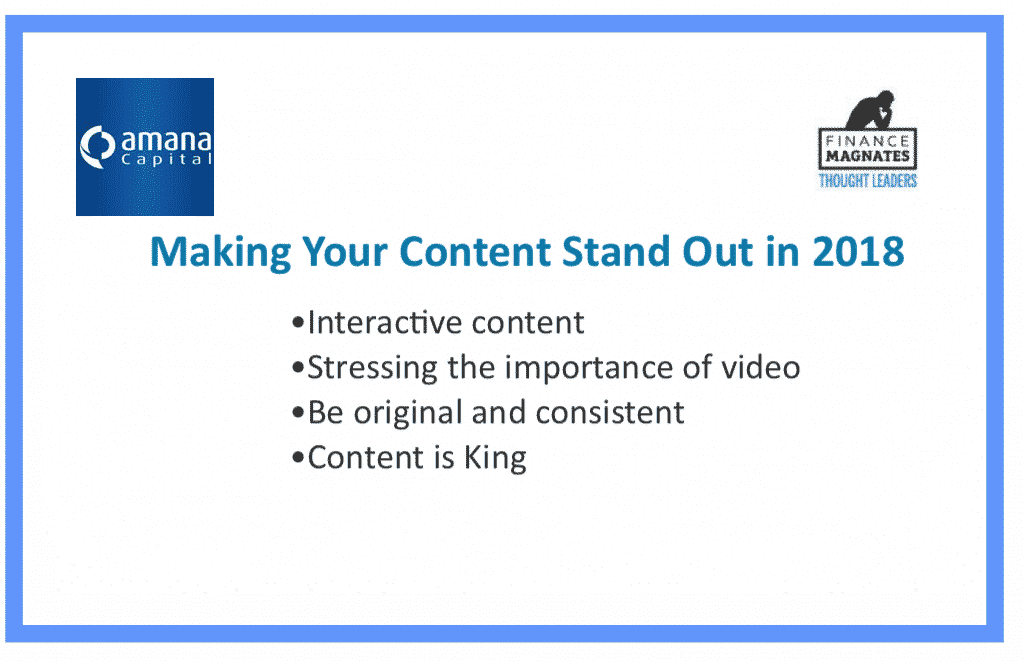
Content marketing will continue to play a significant role in driving customers and sales to your business.
FM
Content Marketing is not as stiff and menial as it used to be. Marketers are pulling all possible strings to transform their content from a rigid monologue to a conversational dialogue. Even if you’re offering the best financial products among your rivals, given the magnitude of content marketing, your product is not enough on its own, if you don’t employ content that strikes your users’ chords.
60 percent of today’s marketers reported that their content marketing strategies are more effective than the year before, compared to a 34 percent in 2016. In 2018, organizations of all shapes and sizes will multiply their efforts in generating quality content and setting up their development strategies; much more time will be spent on content marketing and on enhancing its targeting.
Making the effort
As a broker, you’ll have to make an effort as well, if you want to generate conversions. Content marketing will continue to play a significant role in driving customers and sales to your business. Your consumers are expecting valuable, unique, and original content that highlights how your product solves their problem.
With consistency, you'll create a credible digital brand, experience greater online visibility, achieve better social engagement, increase website visitors, and improve lead conversions. So, without further ado, here are four strong tactics for better content marketing in 2018.
Interactive Content Is the Future
Consumers are engaging differently with content, compared to five years ago. With so much text-based content on the web, people are looking for experiences that ease their understanding of your message. Thus, enters interactive content!
As we previously mentioned, your users favor dialogue marketing; they want you to listen to them. Interactive content such as quizzes, assessments, surveys, and polls, allows you to kill two birds with one stone – generate dialogue-driven content and learn about your users. They enhance user-experience and encourage readers to be more involved, all the while increasing average time spent on your website.
Let’s give you a simple example - as a broker, you can create an online quiz to test the “Trading Personality” of your users and aggregate insightful data about them. Your users will henceforth benefit from content that caters to their proper needs, challenges, or problems – this is called personalized marketing.
Video is a Must
If you're not using video in your content marketing strategy, you're missing out on a huge opportunity. Taking the US as an example, a whopping 85 percent of internet users watch videos online.
In 2017, videos have proven to be an indispensable tool to our content marketing strategy at Amana Capital; they enabled us to drive traffic, leads, and sales, and helped us build trust and humanize our brand.
On another note, here are a few video ideas you can use in your brokerage business:
Share your story – speak about the mission of your company, why it was brought to life, what makes you different than competitors, and what makes your team feel great about work each morning.
Highlight the top mistakes to avoid - what are the common blunders that traders can avoid, for instance? Share them in video and offer ways to help them avoid making these errors.
Show your process – well-executed, how-to videos that position you as an expert in your field. Keep these videos shorter than two minutes for maximum effect.
Original, Consistent Content is King
Our experience with content marketing at Amana has confirmed to us that consistent and original content is the most addictive. In fact, brands like Google, Apple, and Facebook are planning to invest big in original content in 2018, and it's important that you follow suit. Content is the fuel of your entire inbound marketing strategy.
It attracts new visitors to your social media channels and website, it converts followers into email subscribers, and it moves prospects into becoming buying customers. Developing and documenting your content marketing plan is crucial to remaining competitive and staying current in today's ever-evolving digital era.
So, make sure that you have content that appeals to each stage of the buyer's journey (i.e., the Awareness, Consideration, and Decision stage). Keep your eyes peeled and continually generate content that resonates with your user's interests.
Craft Unique Headlines & Call-to-Actions
70% of Facebook users read the headline before commenting on the story, and 59 percent of links shared on social media have never been clicked, according to the Washington Post. These alarming numbers reveal the importance of headlines in capturing attention, building awareness, and getting people to act.
However, if your headline gives the first impression about your content and determines whether the viewer will click to read, a proper Call-to-Action (CTA) tells your user what to do next. Your CTA can make the difference between someone simply liking your post, or clicking and sharing your content for greater engagement.
Some Final Notes to Remember
The tactics above are not sufficient on their own to achieve a fresh, intentional, and engaging content marketing strategy in 2018.
Based on our experience at Amana, content should cater to its audience’s culture. This helped us succeed in penetrating different markets around the world. Furthermore, content should be properly distributed across all channels. We know for a fact that traction cannot be realized within a fortnight, it requires a great deal of patience and time; so, you need to be consistent and perseverant about sharing it.
The bottom line is unless you provide your audience with relevant content and you distribute that content intensively on your platforms; your content marketing strategy won’t attain the impact you were aiming for.
Content Marketing is not as stiff and menial as it used to be. Marketers are pulling all possible strings to transform their content from a rigid monologue to a conversational dialogue. Even if you’re offering the best financial products among your rivals, given the magnitude of content marketing, your product is not enough on its own, if you don’t employ content that strikes your users’ chords.
60 percent of today’s marketers reported that their content marketing strategies are more effective than the year before, compared to a 34 percent in 2016. In 2018, organizations of all shapes and sizes will multiply their efforts in generating quality content and setting up their development strategies; much more time will be spent on content marketing and on enhancing its targeting.
Making the effort
As a broker, you’ll have to make an effort as well, if you want to generate conversions. Content marketing will continue to play a significant role in driving customers and sales to your business. Your consumers are expecting valuable, unique, and original content that highlights how your product solves their problem.
With consistency, you'll create a credible digital brand, experience greater online visibility, achieve better social engagement, increase website visitors, and improve lead conversions. So, without further ado, here are four strong tactics for better content marketing in 2018.
Interactive Content Is the Future
Consumers are engaging differently with content, compared to five years ago. With so much text-based content on the web, people are looking for experiences that ease their understanding of your message. Thus, enters interactive content!
As we previously mentioned, your users favor dialogue marketing; they want you to listen to them. Interactive content such as quizzes, assessments, surveys, and polls, allows you to kill two birds with one stone – generate dialogue-driven content and learn about your users. They enhance user-experience and encourage readers to be more involved, all the while increasing average time spent on your website.
Let’s give you a simple example - as a broker, you can create an online quiz to test the “Trading Personality” of your users and aggregate insightful data about them. Your users will henceforth benefit from content that caters to their proper needs, challenges, or problems – this is called personalized marketing.
Video is a Must
If you're not using video in your content marketing strategy, you're missing out on a huge opportunity. Taking the US as an example, a whopping 85 percent of internet users watch videos online.
In 2017, videos have proven to be an indispensable tool to our content marketing strategy at Amana Capital; they enabled us to drive traffic, leads, and sales, and helped us build trust and humanize our brand.
On another note, here are a few video ideas you can use in your brokerage business:
Share your story – speak about the mission of your company, why it was brought to life, what makes you different than competitors, and what makes your team feel great about work each morning.
Highlight the top mistakes to avoid - what are the common blunders that traders can avoid, for instance? Share them in video and offer ways to help them avoid making these errors.
Show your process – well-executed, how-to videos that position you as an expert in your field. Keep these videos shorter than two minutes for maximum effect.
Original, Consistent Content is King
Our experience with content marketing at Amana has confirmed to us that consistent and original content is the most addictive. In fact, brands like Google, Apple, and Facebook are planning to invest big in original content in 2018, and it's important that you follow suit. Content is the fuel of your entire inbound marketing strategy.
It attracts new visitors to your social media channels and website, it converts followers into email subscribers, and it moves prospects into becoming buying customers. Developing and documenting your content marketing plan is crucial to remaining competitive and staying current in today's ever-evolving digital era.
So, make sure that you have content that appeals to each stage of the buyer's journey (i.e., the Awareness, Consideration, and Decision stage). Keep your eyes peeled and continually generate content that resonates with your user's interests.
Craft Unique Headlines & Call-to-Actions
70% of Facebook users read the headline before commenting on the story, and 59 percent of links shared on social media have never been clicked, according to the Washington Post. These alarming numbers reveal the importance of headlines in capturing attention, building awareness, and getting people to act.
However, if your headline gives the first impression about your content and determines whether the viewer will click to read, a proper Call-to-Action (CTA) tells your user what to do next. Your CTA can make the difference between someone simply liking your post, or clicking and sharing your content for greater engagement.
Some Final Notes to Remember
The tactics above are not sufficient on their own to achieve a fresh, intentional, and engaging content marketing strategy in 2018.
Based on our experience at Amana, content should cater to its audience’s culture. This helped us succeed in penetrating different markets around the world. Furthermore, content should be properly distributed across all channels. We know for a fact that traction cannot be realized within a fortnight, it requires a great deal of patience and time; so, you need to be consistent and perseverant about sharing it.
The bottom line is unless you provide your audience with relevant content and you distribute that content intensively on your platforms; your content marketing strategy won’t attain the impact you were aiming for.
FP Markets Winner Spotlight 🏆 | Global Broker of the Year 2025 #Trading #Broker #Innovation #Shorts
FP Markets Winner Spotlight 🏆 | Global Broker of the Year 2025 #Trading #Broker #Innovation #Shorts
FP Markets Winner Spotlight 🏆 | Global Broker of the Year 2025 #Trading #Broker #Innovation #Shorts
FP Markets Winner Spotlight 🏆 | Global Broker of the Year 2025 #Trading #Broker #Innovation #Shorts
FP Markets takes the spotlight as Global Broker of the Year 2025 at the Finance Magnates Awards.
Martin Stoilov, Head of Client Experience, shares that trust, innovation, and people played a key role in the company’s success, supported by a strong foundation of integrity and client-centricity.
Following this milestone, FP Markets continues to focus on growth, technology investment, and its core values of transparency and excellence.
👉 Be part of FM Awards 2026: https://awards.financemagnates.com/#nominate
FP Markets takes the spotlight as Global Broker of the Year 2025 at the Finance Magnates Awards.
Martin Stoilov, Head of Client Experience, shares that trust, innovation, and people played a key role in the company’s success, supported by a strong foundation of integrity and client-centricity.
Following this milestone, FP Markets continues to focus on growth, technology investment, and its core values of transparency and excellence.
👉 Be part of FM Awards 2026: https://awards.financemagnates.com/#nominate
FP Markets takes the spotlight as Global Broker of the Year 2025 at the Finance Magnates Awards.
Martin Stoilov, Head of Client Experience, shares that trust, innovation, and people played a key role in the company’s success, supported by a strong foundation of integrity and client-centricity.
Following this milestone, FP Markets continues to focus on growth, technology investment, and its core values of transparency and excellence.
👉 Be part of FM Awards 2026: https://awards.financemagnates.com/#nominate
FP Markets takes the spotlight as Global Broker of the Year 2025 at the Finance Magnates Awards.
Martin Stoilov, Head of Client Experience, shares that trust, innovation, and people played a key role in the company’s success, supported by a strong foundation of integrity and client-centricity.
Following this milestone, FP Markets continues to focus on growth, technology investment, and its core values of transparency and excellence.
👉 Be part of FM Awards 2026: https://awards.financemagnates.com/#nominate
In this video, we review @HolaPrimeMarketsOfficial, a multi-asset forex and CFDs broker offering different account types, trading platforms, and flexible trading conditions.
We cover the broker’s overall offering, including account options, trading environment, platforms like MT4 and MT5, and additional services such as managed accounts and fast withdrawals.
Watch the full video to see if Hola Prime Markets fits your trading needs.
📣 Stay up to date with the latest in finance and trading. Follow Finance Magnates for industry news, insights, and global event coverage.
Connect with us:
🔗 LinkedIn: /financemagnates
👍 Facebook: /financemagnates
📸 Instagram: https://www.instagram.com/financemagnates
🐦 X: https://x.com/financemagnates
🎥 TikTok: https://www.tiktok.com/tag/financemagnates
▶️ YouTube: /@financemagnates_official
#HolaPrime #ForexBroker #CFDTrading #FinanceMagnates #Trading #Forex #BrokerReview
In this video, we review @HolaPrimeMarketsOfficial, a multi-asset forex and CFDs broker offering different account types, trading platforms, and flexible trading conditions.
We cover the broker’s overall offering, including account options, trading environment, platforms like MT4 and MT5, and additional services such as managed accounts and fast withdrawals.
Watch the full video to see if Hola Prime Markets fits your trading needs.
📣 Stay up to date with the latest in finance and trading. Follow Finance Magnates for industry news, insights, and global event coverage.
Connect with us:
🔗 LinkedIn: /financemagnates
👍 Facebook: /financemagnates
📸 Instagram: https://www.instagram.com/financemagnates
🐦 X: https://x.com/financemagnates
🎥 TikTok: https://www.tiktok.com/tag/financemagnates
▶️ YouTube: /@financemagnates_official
#HolaPrime #ForexBroker #CFDTrading #FinanceMagnates #Trading #Forex #BrokerReview
In this video, we review @HolaPrimeMarketsOfficial, a multi-asset forex and CFDs broker offering different account types, trading platforms, and flexible trading conditions.
We cover the broker’s overall offering, including account options, trading environment, platforms like MT4 and MT5, and additional services such as managed accounts and fast withdrawals.
Watch the full video to see if Hola Prime Markets fits your trading needs.
📣 Stay up to date with the latest in finance and trading. Follow Finance Magnates for industry news, insights, and global event coverage.
Connect with us:
🔗 LinkedIn: /financemagnates
👍 Facebook: /financemagnates
📸 Instagram: https://www.instagram.com/financemagnates
🐦 X: https://x.com/financemagnates
🎥 TikTok: https://www.tiktok.com/tag/financemagnates
▶️ YouTube: /@financemagnates_official
#HolaPrime #ForexBroker #CFDTrading #FinanceMagnates #Trading #Forex #BrokerReview
In this video, we review @HolaPrimeMarketsOfficial, a multi-asset forex and CFDs broker offering different account types, trading platforms, and flexible trading conditions.
We cover the broker’s overall offering, including account options, trading environment, platforms like MT4 and MT5, and additional services such as managed accounts and fast withdrawals.
Watch the full video to see if Hola Prime Markets fits your trading needs.
📣 Stay up to date with the latest in finance and trading. Follow Finance Magnates for industry news, insights, and global event coverage.
Connect with us:
🔗 LinkedIn: /financemagnates
👍 Facebook: /financemagnates
📸 Instagram: https://www.instagram.com/financemagnates
🐦 X: https://x.com/financemagnates
🎥 TikTok: https://www.tiktok.com/tag/financemagnates
▶️ YouTube: /@financemagnates_official
#HolaPrime #ForexBroker #CFDTrading #FinanceMagnates #Trading #Forex #BrokerReview
In this video, we review @HolaPrimeMarketsOfficial, a multi-asset forex and CFDs broker offering different account types, trading platforms, and flexible trading conditions.
We cover the broker’s overall offering, including account options, trading environment, platforms like MT4 and MT5, and additional services such as managed accounts and fast withdrawals.
Watch the full video to see if Hola Prime Markets fits your trading needs.
📣 Stay up to date with the latest in finance and trading. Follow Finance Magnates for industry news, insights, and global event coverage.
Connect with us:
🔗 LinkedIn: /financemagnates
👍 Facebook: /financemagnates
📸 Instagram: https://www.instagram.com/financemagnates
🐦 X: https://x.com/financemagnates
🎥 TikTok: https://www.tiktok.com/tag/financemagnates
▶️ YouTube: /@financemagnates_official
#HolaPrime #ForexBroker #CFDTrading #FinanceMagnates #Trading #Forex #BrokerReview
In this video, we review @HolaPrimeMarketsOfficial, a multi-asset forex and CFDs broker offering different account types, trading platforms, and flexible trading conditions.
We cover the broker’s overall offering, including account options, trading environment, platforms like MT4 and MT5, and additional services such as managed accounts and fast withdrawals.
Watch the full video to see if Hola Prime Markets fits your trading needs.
📣 Stay up to date with the latest in finance and trading. Follow Finance Magnates for industry news, insights, and global event coverage.
Connect with us:
🔗 LinkedIn: /financemagnates
👍 Facebook: /financemagnates
📸 Instagram: https://www.instagram.com/financemagnates
🐦 X: https://x.com/financemagnates
🎥 TikTok: https://www.tiktok.com/tag/financemagnates
▶️ YouTube: /@financemagnates_official
#HolaPrime #ForexBroker #CFDTrading #FinanceMagnates #Trading #Forex #BrokerReview
Hola Prime Review: What You Need to Know | Full Breakdown by Finance Magnates
Hola Prime Review: What You Need to Know | Full Breakdown by Finance Magnates
Hola Prime Review: What You Need to Know | Full Breakdown by Finance Magnates
Hola Prime Review: What You Need to Know | Full Breakdown by Finance Magnates
Hola Prime Review: What You Need to Know | Full Breakdown by Finance Magnates
Hola Prime Review: What You Need to Know | Full Breakdown by Finance Magnates
In this video, we review @HolaPrime_Global, a proprietary trading firm offering evaluation programs and performance-based payouts in simulated market environments.
We cover how the challenge model works, including account types, profit splits (up to 95%), trading rules, and what it takes to reach a funded account. You’ll also learn about available platforms like MT4, MT5, cTrader, and more, along with insights into payouts, support, and trading conditions.
Watch the full video to see if Hola Prime fits your trading style.
📣 Stay up to date with the latest in finance and trading. Follow Finance Magnates for industry news, insights, and global event coverage.
Connect with us:
🔗 LinkedIn: /financemagnates
👍 Facebook: /financemagnates
📸 Instagram: https://www.instagram.com/financemagnates
🐦 X: https://x.com/financemagnates
🎥 TikTok: https://www.tiktok.com/tag/financemagnates
▶️ YouTube: /@financemagnates_official
#HolaPrime #PropFirm #Trading #FinanceMagnates #Forex #FuturesTrading #TradingReview #PropFirmReview
In this video, we review @HolaPrime_Global, a proprietary trading firm offering evaluation programs and performance-based payouts in simulated market environments.
We cover how the challenge model works, including account types, profit splits (up to 95%), trading rules, and what it takes to reach a funded account. You’ll also learn about available platforms like MT4, MT5, cTrader, and more, along with insights into payouts, support, and trading conditions.
Watch the full video to see if Hola Prime fits your trading style.
📣 Stay up to date with the latest in finance and trading. Follow Finance Magnates for industry news, insights, and global event coverage.
Connect with us:
🔗 LinkedIn: /financemagnates
👍 Facebook: /financemagnates
📸 Instagram: https://www.instagram.com/financemagnates
🐦 X: https://x.com/financemagnates
🎥 TikTok: https://www.tiktok.com/tag/financemagnates
▶️ YouTube: /@financemagnates_official
#HolaPrime #PropFirm #Trading #FinanceMagnates #Forex #FuturesTrading #TradingReview #PropFirmReview
In this video, we review @HolaPrime_Global, a proprietary trading firm offering evaluation programs and performance-based payouts in simulated market environments.
We cover how the challenge model works, including account types, profit splits (up to 95%), trading rules, and what it takes to reach a funded account. You’ll also learn about available platforms like MT4, MT5, cTrader, and more, along with insights into payouts, support, and trading conditions.
Watch the full video to see if Hola Prime fits your trading style.
📣 Stay up to date with the latest in finance and trading. Follow Finance Magnates for industry news, insights, and global event coverage.
Connect with us:
🔗 LinkedIn: /financemagnates
👍 Facebook: /financemagnates
📸 Instagram: https://www.instagram.com/financemagnates
🐦 X: https://x.com/financemagnates
🎥 TikTok: https://www.tiktok.com/tag/financemagnates
▶️ YouTube: /@financemagnates_official
#HolaPrime #PropFirm #Trading #FinanceMagnates #Forex #FuturesTrading #TradingReview #PropFirmReview
In this video, we review @HolaPrime_Global, a proprietary trading firm offering evaluation programs and performance-based payouts in simulated market environments.
We cover how the challenge model works, including account types, profit splits (up to 95%), trading rules, and what it takes to reach a funded account. You’ll also learn about available platforms like MT4, MT5, cTrader, and more, along with insights into payouts, support, and trading conditions.
Watch the full video to see if Hola Prime fits your trading style.
📣 Stay up to date with the latest in finance and trading. Follow Finance Magnates for industry news, insights, and global event coverage.
Connect with us:
🔗 LinkedIn: /financemagnates
👍 Facebook: /financemagnates
📸 Instagram: https://www.instagram.com/financemagnates
🐦 X: https://x.com/financemagnates
🎥 TikTok: https://www.tiktok.com/tag/financemagnates
▶️ YouTube: /@financemagnates_official
#HolaPrime #PropFirm #Trading #FinanceMagnates #Forex #FuturesTrading #TradingReview #PropFirmReview
In this video, we review @HolaPrime_Global, a proprietary trading firm offering evaluation programs and performance-based payouts in simulated market environments.
We cover how the challenge model works, including account types, profit splits (up to 95%), trading rules, and what it takes to reach a funded account. You’ll also learn about available platforms like MT4, MT5, cTrader, and more, along with insights into payouts, support, and trading conditions.
Watch the full video to see if Hola Prime fits your trading style.
📣 Stay up to date with the latest in finance and trading. Follow Finance Magnates for industry news, insights, and global event coverage.
Connect with us:
🔗 LinkedIn: /financemagnates
👍 Facebook: /financemagnates
📸 Instagram: https://www.instagram.com/financemagnates
🐦 X: https://x.com/financemagnates
🎥 TikTok: https://www.tiktok.com/tag/financemagnates
▶️ YouTube: /@financemagnates_official
#HolaPrime #PropFirm #Trading #FinanceMagnates #Forex #FuturesTrading #TradingReview #PropFirmReview
In this video, we review @HolaPrime_Global, a proprietary trading firm offering evaluation programs and performance-based payouts in simulated market environments.
We cover how the challenge model works, including account types, profit splits (up to 95%), trading rules, and what it takes to reach a funded account. You’ll also learn about available platforms like MT4, MT5, cTrader, and more, along with insights into payouts, support, and trading conditions.
Watch the full video to see if Hola Prime fits your trading style.
📣 Stay up to date with the latest in finance and trading. Follow Finance Magnates for industry news, insights, and global event coverage.
Connect with us:
🔗 LinkedIn: /financemagnates
👍 Facebook: /financemagnates
📸 Instagram: https://www.instagram.com/financemagnates
🐦 X: https://x.com/financemagnates
🎥 TikTok: https://www.tiktok.com/tag/financemagnates
▶️ YouTube: /@financemagnates_official
#HolaPrime #PropFirm #Trading #FinanceMagnates #Forex #FuturesTrading #TradingReview #PropFirmReview
Axi Winner Spotlight 🏆 | Global Most Innovative Broker 2025 #Innovation #Trading #Fintech #Broker
Axi Winner Spotlight 🏆 | Global Most Innovative Broker 2025 #Innovation #Trading #Fintech #Broker
Axi Winner Spotlight 🏆 | Global Most Innovative Broker 2025 #Innovation #Trading #Fintech #Broker
Axi Winner Spotlight 🏆 | Global Most Innovative Broker 2025 #Innovation #Trading #Fintech #Broker
Axi Winner Spotlight 🏆 | Global Most Innovative Broker 2025 #Innovation #Trading #Fintech #Broker
Axi Winner Spotlight 🏆 | Global Most Innovative Broker 2025 #Innovation #Trading #Fintech #Broker
Axi takes the spotlight at the Finance Magnates Awards, winning Global Most Innovative Broker 2025.
Olivia Xenofontos and Ivanna Openko share how the team will feel: proud, motivated, and ready to keep delivering.
They also describe the night as well-organized, focused, and enjoyable for all.
👉 Be part of FM Awards 2026.
Axi takes the spotlight at the Finance Magnates Awards, winning Global Most Innovative Broker 2025.
Olivia Xenofontos and Ivanna Openko share how the team will feel: proud, motivated, and ready to keep delivering.
They also describe the night as well-organized, focused, and enjoyable for all.
👉 Be part of FM Awards 2026.
Axi takes the spotlight at the Finance Magnates Awards, winning Global Most Innovative Broker 2025.
Olivia Xenofontos and Ivanna Openko share how the team will feel: proud, motivated, and ready to keep delivering.
They also describe the night as well-organized, focused, and enjoyable for all.
👉 Be part of FM Awards 2026.
Axi takes the spotlight at the Finance Magnates Awards, winning Global Most Innovative Broker 2025.
Olivia Xenofontos and Ivanna Openko share how the team will feel: proud, motivated, and ready to keep delivering.
They also describe the night as well-organized, focused, and enjoyable for all.
👉 Be part of FM Awards 2026.
Axi takes the spotlight at the Finance Magnates Awards, winning Global Most Innovative Broker 2025.
Olivia Xenofontos and Ivanna Openko share how the team will feel: proud, motivated, and ready to keep delivering.
They also describe the night as well-organized, focused, and enjoyable for all.
👉 Be part of FM Awards 2026.
Axi takes the spotlight at the Finance Magnates Awards, winning Global Most Innovative Broker 2025.
Olivia Xenofontos and Ivanna Openko share how the team will feel: proud, motivated, and ready to keep delivering.
They also describe the night as well-organized, focused, and enjoyable for all.
👉 Be part of FM Awards 2026.
Recognition that matters.
Built on transparency.
Driven by the industry.
The Finance Magnates Awards 2026.
Nominations are now open.
🔗 https://awards.financemagnates.com/?utm_source=SM&utm_medium=social&utm_campaign=recognition-matters
Recognition that matters.
Built on transparency.
Driven by the industry.
The Finance Magnates Awards 2026.
Nominations are now open.
🔗 https://awards.financemagnates.com/?utm_source=SM&utm_medium=social&utm_campaign=recognition-matters
Recognition that matters.
Built on transparency.
Driven by the industry.
The Finance Magnates Awards 2026.
Nominations are now open.
🔗 https://awards.financemagnates.com/?utm_source=SM&utm_medium=social&utm_campaign=recognition-matters
Recognition that matters.
Built on transparency.
Driven by the industry.
The Finance Magnates Awards 2026.
Nominations are now open.
🔗 https://awards.financemagnates.com/?utm_source=SM&utm_medium=social&utm_campaign=recognition-matters
Recognition that matters.
Built on transparency.
Driven by the industry.
The Finance Magnates Awards 2026.
Nominations are now open.
🔗 https://awards.financemagnates.com/?utm_source=SM&utm_medium=social&utm_campaign=recognition-matters
Recognition that matters.
Built on transparency.
Driven by the industry.
The Finance Magnates Awards 2026.
Nominations are now open.
🔗 https://awards.financemagnates.com/?utm_source=SM&utm_medium=social&utm_campaign=recognition-matters