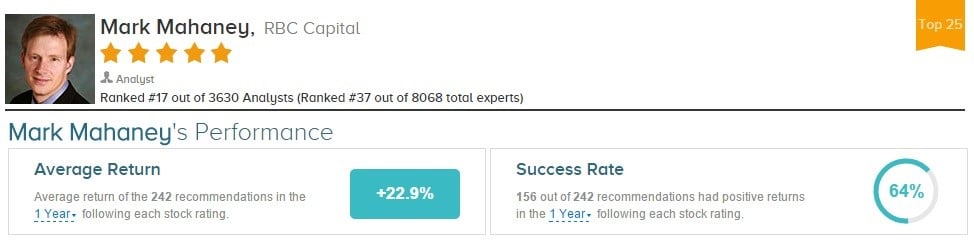
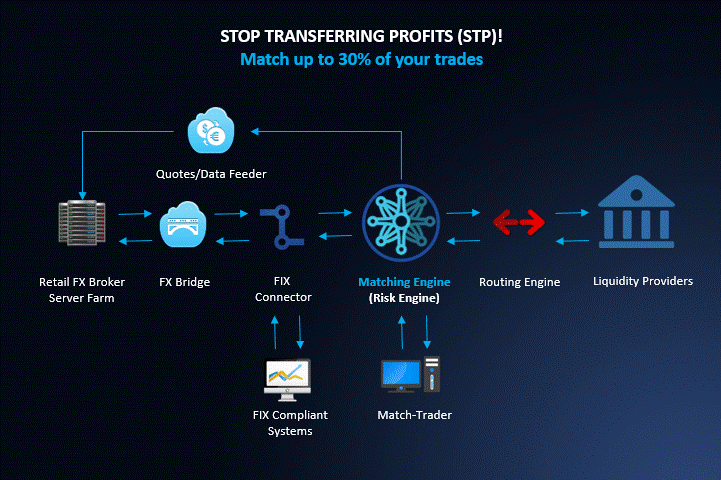
Brokers operating in the fragmented world of foreign exchange can benefit from a matching engine that re-uses liquidity. The new solution developed by Match-Trade aims to increase margins in a time when revenues are scarce.
An evolving trading environment has meant that firms offering margin products have had to adapt the way they manage and deal with client order flow, automated and algorithmic trading strategies have been spearheading this notion where brokers are directing client trades to liquidity providers, as opposed to internally managing the risk.
“The STP model has value for brokers, however through our matching engine, firms can take control of flow that would normally be passed onto Liquidity Providers (LPs), in this case orders are matched against other client orders and this generates spread income,” said a spokesperson for Match–Trade Technologies LLC in a telephone interview with Forex Magnates.
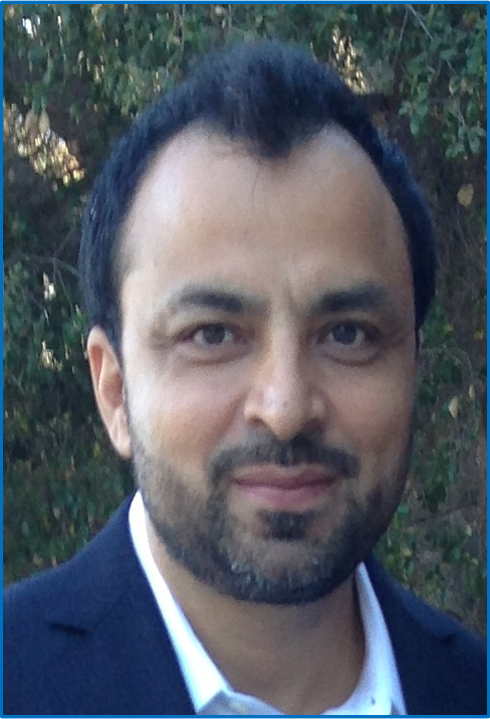
Users of Match-Trade can benefit from the numerous functionality the solution offers, this includes redirecting certain client orders back to the broker's order book, as well as creating a new pool of liquidity, thus opening up a new model for the broker where it acts as both a taker and provider. Imran Firoz, Managing Director of Match-Trade Technologies LLC, describes the advantages in an emailed statement to Forex Magnates: “Our matching engine technology allows STP forex brokers to have the opportunity to change from a liquidity taker to a liquidity provider when our Match-Trade System matches trades internally between the forex broker’s trading clients. STP forex brokers have their own ‘bottom-up’ liquidity when clients initiate limit or market orders based on the available margins in their respective accounts. Generally, all these orders are sent as market orders to LPs, when there are opportunities available during the trading session to match some of the limit orders of clients with limit/market orders of other clients.”
Internalizing client order flow is a common aspect of retail trading platforms that net the respective buy and sell orders, however firms are looking for advanced solutions that can create new revenue streams. MahiFX’s Compass, acts in a similar fashion whereby it allows firms to internalize activity. In addition, users of Compass, a solution for institutional players, has a number of modules, including price formation, visualization of trades, rates dissemination and algorithmic trading.
David Cooney, CEO of MahiFX, commented to the media: "Internalising flow, at the right rate, is key to increasing profitability and market share. But it's a tough puzzle. Assembling the teams to build an internal solution is expensive, and sometimes, where it has been attempted, the results have been less than hoped for. Compass provides a proven solution - the technology and advice on its operation - with minimal lead time and variable, performance based costs."

David Cooney
Match-Trade Technologies’ solution also addresses the notion of last look, faced by many participants in the FX markets, Mr. Firoz outlines the steps the matching engine takes when addressing the last look dilemma, he stated: “Our matching engine works according to a standard price/time priority algorithm, which means that at first an order with a better price will be matched. In cases where orders are at the same price, the one placed earlier will have priority in execution. Each limit order (e.g. buy limit at 1.2245 vol. 100.000) placed by the client is sent to the aggregated order book, which builds the forex brokers' own liquidity and thus reduces the spreads for the forex brokers' trading clients.
This means that trades can be executed at the forex brokers' clients prices and will not be passed on to the Liquidity Providers. If this limit order meets with other client orders (market or limit) the transaction will be executed by the Matching Engine, which will result in a transaction directly between two clients. So basically this is an ‘open look’ where trading clients can see the price/volume and execute.”
The way FX brokers manage their dealing operations has been a talking point during the past four years, a period where markets were choppy and traded in a range. Several FX brokers opted for a modest approach and limited the risk they took and consequently applied the non-dealing desk method and sent orders to their liquidity providers, however Carl Elsammak, an experienced trader who runs Kammas Trading, an outsourced risk management unit, believes firms who run a principal model (B-Book) can produce higher returns than the simple A-Book model. Mr. Elsammak stated in a comment to Forex Magnates: “It is my opinion that all brokers are better off running a B-Book regardless of higher or lower volume trends. This is particularly true as volumes drop. A proper B-Book process helps the bottom line of brokers to remain profitable through the difficult periods.
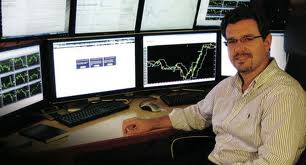
Carl Elsammak
The key to running a 'B-Book' is having a conservative strategy executed by an experienced team that predictably provides an enhanced return over STP at achievable reasonable levels.”
The FX markets face numerous challenges from market structures, regulators and the demands of its users, however the ongoing developments in technology and advancements in the way firms manage risk and perceive foreign exchange trading is creating a literate environment where participants look at progressing forward.
An evolving trading environment has meant that firms offering margin products have had to adapt the way they manage and deal with client order flow, automated and algorithmic trading strategies have been spearheading this notion where brokers are directing client trades to liquidity providers, as opposed to internally managing the risk.
“The STP model has value for brokers, however through our matching engine, firms can take control of flow that would normally be passed onto Liquidity Providers (LPs), in this case orders are matched against other client orders and this generates spread income,” said a spokesperson for Match–Trade Technologies LLC in a telephone interview with Forex Magnates.
Users of Match-Trade can benefit from the numerous functionality the solution offers, this includes redirecting certain client orders back to the broker's order book, as well as creating a new pool of liquidity, thus opening up a new model for the broker where it acts as both a taker and provider. Imran Firoz, Managing Director of Match-Trade Technologies LLC, describes the advantages in an emailed statement to Forex Magnates: “Our matching engine technology allows STP forex brokers to have the opportunity to change from a liquidity taker to a liquidity provider when our Match-Trade System matches trades internally between the forex broker’s trading clients. STP forex brokers have their own ‘bottom-up’ liquidity when clients initiate limit or market orders based on the available margins in their respective accounts. Generally, all these orders are sent as market orders to LPs, when there are opportunities available during the trading session to match some of the limit orders of clients with limit/market orders of other clients.”
Internalizing client order flow is a common aspect of retail trading platforms that net the respective buy and sell orders, however firms are looking for advanced solutions that can create new revenue streams. MahiFX’s Compass, acts in a similar fashion whereby it allows firms to internalize activity. In addition, users of Compass, a solution for institutional players, has a number of modules, including price formation, visualization of trades, rates dissemination and algorithmic trading.
David Cooney, CEO of MahiFX, commented to the media: "Internalising flow, at the right rate, is key to increasing profitability and market share. But it's a tough puzzle. Assembling the teams to build an internal solution is expensive, and sometimes, where it has been attempted, the results have been less than hoped for. Compass provides a proven solution - the technology and advice on its operation - with minimal lead time and variable, performance based costs."
David Cooney
Match-Trade Technologies’ solution also addresses the notion of last look, faced by many participants in the FX markets, Mr. Firoz outlines the steps the matching engine takes when addressing the last look dilemma, he stated: “Our matching engine works according to a standard price/time priority algorithm, which means that at first an order with a better price will be matched. In cases where orders are at the same price, the one placed earlier will have priority in execution. Each limit order (e.g. buy limit at 1.2245 vol. 100.000) placed by the client is sent to the aggregated order book, which builds the forex brokers' own liquidity and thus reduces the spreads for the forex brokers' trading clients.
This means that trades can be executed at the forex brokers' clients prices and will not be passed on to the Liquidity Providers. If this limit order meets with other client orders (market or limit) the transaction will be executed by the Matching Engine, which will result in a transaction directly between two clients. So basically this is an ‘open look’ where trading clients can see the price/volume and execute.”
The way FX brokers manage their dealing operations has been a talking point during the past four years, a period where markets were choppy and traded in a range. Several FX brokers opted for a modest approach and limited the risk they took and consequently applied the non-dealing desk method and sent orders to their liquidity providers, however Carl Elsammak, an experienced trader who runs Kammas Trading, an outsourced risk management unit, believes firms who run a principal model (B-Book) can produce higher returns than the simple A-Book model. Mr. Elsammak stated in a comment to Forex Magnates: “It is my opinion that all brokers are better off running a B-Book regardless of higher or lower volume trends. This is particularly true as volumes drop. A proper B-Book process helps the bottom line of brokers to remain profitable through the difficult periods.
Carl Elsammak
The key to running a 'B-Book' is having a conservative strategy executed by an experienced team that predictably provides an enhanced return over STP at achievable reasonable levels.”
The FX markets face numerous challenges from market structures, regulators and the demands of its users, however the ongoing developments in technology and advancements in the way firms manage risk and perceive foreign exchange trading is creating a literate environment where participants look at progressing forward.
ASX Faces $150M Capital Charge After Scathing Inquiry Finds Years of Neglect
Featured Videos
Executive Interview | Charlotte Bullock | Chief Product Officer, Bank of London | FMLS:25
In this interview, we sat down with Charlotte Bullock, Head of Product at The Bank of London, previously at SAP and now shaping product at one of the sector’s most ambitious new banking players.
Charlotte reflects on the Summit so far and talks about the culture inside fintech banks today. We look at the pressures that come with scaling, and how firms can hold onto the nimble approach that made them stand out early on.
We also cover the state of payments ahead of her appearance on the payments roundtable: the blockages financial firms face, the areas that still need fixing, and what a realistic solution looks like in 2026.
In this interview, we sat down with Charlotte Bullock, Head of Product at The Bank of London, previously at SAP and now shaping product at one of the sector’s most ambitious new banking players.
Charlotte reflects on the Summit so far and talks about the culture inside fintech banks today. We look at the pressures that come with scaling, and how firms can hold onto the nimble approach that made them stand out early on.
We also cover the state of payments ahead of her appearance on the payments roundtable: the blockages financial firms face, the areas that still need fixing, and what a realistic solution looks like in 2026.
In this interview, we sat down with Charlotte Bullock, Head of Product at The Bank of London, previously at SAP and now shaping product at one of the sector’s most ambitious new banking players.
Charlotte reflects on the Summit so far and talks about the culture inside fintech banks today. We look at the pressures that come with scaling, and how firms can hold onto the nimble approach that made them stand out early on.
We also cover the state of payments ahead of her appearance on the payments roundtable: the blockages financial firms face, the areas that still need fixing, and what a realistic solution looks like in 2026.
In this interview, we sat down with Charlotte Bullock, Head of Product at The Bank of London, previously at SAP and now shaping product at one of the sector’s most ambitious new banking players.
Charlotte reflects on the Summit so far and talks about the culture inside fintech banks today. We look at the pressures that come with scaling, and how firms can hold onto the nimble approach that made them stand out early on.
We also cover the state of payments ahead of her appearance on the payments roundtable: the blockages financial firms face, the areas that still need fixing, and what a realistic solution looks like in 2026.
In this conversation, we sit down with Drew Niv, CSO at ATFX Connect and one of the most influential figures in modern FX.
We speak about market structure, the institutional view on liquidity, and the sharp rise of prop trading, a sector Drew has been commenting on in recent months. Drew explains why he once dismissed prop trading, why his view changed, and what he now thinks the model means for brokers, clients and risk managers.
We explore subscription-fee dependency, the high reneging rate, and the long-term challenge: how brokers can build a more stable and honest version of the model. Drew also talks about the traffic advantage standalone prop firms have built and why brokers may still win in the long run if they take the right approach.
In this conversation, we sit down with Drew Niv, CSO at ATFX Connect and one of the most influential figures in modern FX.
We speak about market structure, the institutional view on liquidity, and the sharp rise of prop trading, a sector Drew has been commenting on in recent months. Drew explains why he once dismissed prop trading, why his view changed, and what he now thinks the model means for brokers, clients and risk managers.
We explore subscription-fee dependency, the high reneging rate, and the long-term challenge: how brokers can build a more stable and honest version of the model. Drew also talks about the traffic advantage standalone prop firms have built and why brokers may still win in the long run if they take the right approach.
In this conversation, we sit down with Drew Niv, CSO at ATFX Connect and one of the most influential figures in modern FX.
We speak about market structure, the institutional view on liquidity, and the sharp rise of prop trading, a sector Drew has been commenting on in recent months. Drew explains why he once dismissed prop trading, why his view changed, and what he now thinks the model means for brokers, clients and risk managers.
We explore subscription-fee dependency, the high reneging rate, and the long-term challenge: how brokers can build a more stable and honest version of the model. Drew also talks about the traffic advantage standalone prop firms have built and why brokers may still win in the long run if they take the right approach.
In this conversation, we sit down with Drew Niv, CSO at ATFX Connect and one of the most influential figures in modern FX.
We speak about market structure, the institutional view on liquidity, and the sharp rise of prop trading, a sector Drew has been commenting on in recent months. Drew explains why he once dismissed prop trading, why his view changed, and what he now thinks the model means for brokers, clients and risk managers.
We explore subscription-fee dependency, the high reneging rate, and the long-term challenge: how brokers can build a more stable and honest version of the model. Drew also talks about the traffic advantage standalone prop firms have built and why brokers may still win in the long run if they take the right approach.
In this conversation, we sit down with Drew Niv, CSO at ATFX Connect and one of the most influential figures in modern FX.
We speak about market structure, the institutional view on liquidity, and the sharp rise of prop trading, a sector Drew has been commenting on in recent months. Drew explains why he once dismissed prop trading, why his view changed, and what he now thinks the model means for brokers, clients and risk managers.
We explore subscription-fee dependency, the high reneging rate, and the long-term challenge: how brokers can build a more stable and honest version of the model. Drew also talks about the traffic advantage standalone prop firms have built and why brokers may still win in the long run if they take the right approach.
In this conversation, we sit down with Drew Niv, CSO at ATFX Connect and one of the most influential figures in modern FX.
We speak about market structure, the institutional view on liquidity, and the sharp rise of prop trading, a sector Drew has been commenting on in recent months. Drew explains why he once dismissed prop trading, why his view changed, and what he now thinks the model means for brokers, clients and risk managers.
We explore subscription-fee dependency, the high reneging rate, and the long-term challenge: how brokers can build a more stable and honest version of the model. Drew also talks about the traffic advantage standalone prop firms have built and why brokers may still win in the long run if they take the right approach.
Executive Interview | Remonda Z. Kirketerp Møller| CEO & Founder Muinmos | FMLS:25
In this interview, Remonda Z. Kirketerp Møller, founder of Muinmos, breaks down the state of AI in regtech and what responsible adoption really looks like for brokers. We talk about rising fragmentation, the pressures around compliance accuracy, and why most firms are still in the early stages of AI maturity.
Ramanda also shares insights on regulator sandboxes, shifting expectations around accountability, and the current reality of MiCA licensing and passporting in Europe.
A concise look at where compliance, onboarding, and AI-driven processes are heading next.
In this interview, Remonda Z. Kirketerp Møller, founder of Muinmos, breaks down the state of AI in regtech and what responsible adoption really looks like for brokers. We talk about rising fragmentation, the pressures around compliance accuracy, and why most firms are still in the early stages of AI maturity.
Ramanda also shares insights on regulator sandboxes, shifting expectations around accountability, and the current reality of MiCA licensing and passporting in Europe.
A concise look at where compliance, onboarding, and AI-driven processes are heading next.
In this interview, Remonda Z. Kirketerp Møller, founder of Muinmos, breaks down the state of AI in regtech and what responsible adoption really looks like for brokers. We talk about rising fragmentation, the pressures around compliance accuracy, and why most firms are still in the early stages of AI maturity.
Ramanda also shares insights on regulator sandboxes, shifting expectations around accountability, and the current reality of MiCA licensing and passporting in Europe.
A concise look at where compliance, onboarding, and AI-driven processes are heading next.
In this interview, Remonda Z. Kirketerp Møller, founder of Muinmos, breaks down the state of AI in regtech and what responsible adoption really looks like for brokers. We talk about rising fragmentation, the pressures around compliance accuracy, and why most firms are still in the early stages of AI maturity.
Ramanda also shares insights on regulator sandboxes, shifting expectations around accountability, and the current reality of MiCA licensing and passporting in Europe.
A concise look at where compliance, onboarding, and AI-driven processes are heading next.
In this interview, Remonda Z. Kirketerp Møller, founder of Muinmos, breaks down the state of AI in regtech and what responsible adoption really looks like for brokers. We talk about rising fragmentation, the pressures around compliance accuracy, and why most firms are still in the early stages of AI maturity.
Ramanda also shares insights on regulator sandboxes, shifting expectations around accountability, and the current reality of MiCA licensing and passporting in Europe.
A concise look at where compliance, onboarding, and AI-driven processes are heading next.
In this interview, Remonda Z. Kirketerp Møller, founder of Muinmos, breaks down the state of AI in regtech and what responsible adoption really looks like for brokers. We talk about rising fragmentation, the pressures around compliance accuracy, and why most firms are still in the early stages of AI maturity.
Ramanda also shares insights on regulator sandboxes, shifting expectations around accountability, and the current reality of MiCA licensing and passporting in Europe.
A concise look at where compliance, onboarding, and AI-driven processes are heading next.
In this conversation, we speak with Aydin Bonabi, CEO and co-founder of Surveill, a firm focused on fraud detection and AI-driven compliance tools for financial institutions.
We start with Aydin’s view of the Summit and the challenges brokers face as fraud tactics grow more complex. He explains how firms can stay ahead through real-time signals, data patterns, and early-stage detection.
We also talk about AI training and why compliance teams often struggle to keep models accurate, fair, and aligned with regulatory expectations. Aydin breaks down what “good” AI training looks like inside a financial environment, including the importance of clean data, domain expertise, and human oversight.
He closes with a clear message: fraud is scaling, and so must the tools that stop it.
In this conversation, we speak with Aydin Bonabi, CEO and co-founder of Surveill, a firm focused on fraud detection and AI-driven compliance tools for financial institutions.
We start with Aydin’s view of the Summit and the challenges brokers face as fraud tactics grow more complex. He explains how firms can stay ahead through real-time signals, data patterns, and early-stage detection.
We also talk about AI training and why compliance teams often struggle to keep models accurate, fair, and aligned with regulatory expectations. Aydin breaks down what “good” AI training looks like inside a financial environment, including the importance of clean data, domain expertise, and human oversight.
He closes with a clear message: fraud is scaling, and so must the tools that stop it.
In this conversation, we speak with Aydin Bonabi, CEO and co-founder of Surveill, a firm focused on fraud detection and AI-driven compliance tools for financial institutions.
We start with Aydin’s view of the Summit and the challenges brokers face as fraud tactics grow more complex. He explains how firms can stay ahead through real-time signals, data patterns, and early-stage detection.
We also talk about AI training and why compliance teams often struggle to keep models accurate, fair, and aligned with regulatory expectations. Aydin breaks down what “good” AI training looks like inside a financial environment, including the importance of clean data, domain expertise, and human oversight.
He closes with a clear message: fraud is scaling, and so must the tools that stop it.
In this conversation, we speak with Aydin Bonabi, CEO and co-founder of Surveill, a firm focused on fraud detection and AI-driven compliance tools for financial institutions.
We start with Aydin’s view of the Summit and the challenges brokers face as fraud tactics grow more complex. He explains how firms can stay ahead through real-time signals, data patterns, and early-stage detection.
We also talk about AI training and why compliance teams often struggle to keep models accurate, fair, and aligned with regulatory expectations. Aydin breaks down what “good” AI training looks like inside a financial environment, including the importance of clean data, domain expertise, and human oversight.
He closes with a clear message: fraud is scaling, and so must the tools that stop it.
In this conversation, we speak with Aydin Bonabi, CEO and co-founder of Surveill, a firm focused on fraud detection and AI-driven compliance tools for financial institutions.
We start with Aydin’s view of the Summit and the challenges brokers face as fraud tactics grow more complex. He explains how firms can stay ahead through real-time signals, data patterns, and early-stage detection.
We also talk about AI training and why compliance teams often struggle to keep models accurate, fair, and aligned with regulatory expectations. Aydin breaks down what “good” AI training looks like inside a financial environment, including the importance of clean data, domain expertise, and human oversight.
He closes with a clear message: fraud is scaling, and so must the tools that stop it.
In this conversation, we speak with Aydin Bonabi, CEO and co-founder of Surveill, a firm focused on fraud detection and AI-driven compliance tools for financial institutions.
We start with Aydin’s view of the Summit and the challenges brokers face as fraud tactics grow more complex. He explains how firms can stay ahead through real-time signals, data patterns, and early-stage detection.
We also talk about AI training and why compliance teams often struggle to keep models accurate, fair, and aligned with regulatory expectations. Aydin breaks down what “good” AI training looks like inside a financial environment, including the importance of clean data, domain expertise, and human oversight.
He closes with a clear message: fraud is scaling, and so must the tools that stop it.
Exness expands its presence in Africa: Inside our interview with Paul Margarites in Cape Town
Finance Magnates met with Paul Margarites, Exness regional commercial director for Sub-Saharan Africa, during a visit to the firm’s office opening in Cape Town. In this talk, led by Andrea Badiola Mateos, Co-CEO at Finance Magnates, Paul shares views on the South African trading space, local user behavior, mobile trends, regulation, team growth, and how Exness plans to grow in more markets across the region. @Exness
Read the article at: https://www.financemagnates.com/thought-leadership/exness-expands-its-presence-in-africa-inside-our-interview-with-paul-margarites/
#exness #financemagnates #exnesstrading #CFDtrading #tradeonline #africanews #capetown
Finance Magnates met with Paul Margarites, Exness regional commercial director for Sub-Saharan Africa, during a visit to the firm’s office opening in Cape Town. In this talk, led by Andrea Badiola Mateos, Co-CEO at Finance Magnates, Paul shares views on the South African trading space, local user behavior, mobile trends, regulation, team growth, and how Exness plans to grow in more markets across the region. @Exness
Read the article at: https://www.financemagnates.com/thought-leadership/exness-expands-its-presence-in-africa-inside-our-interview-with-paul-margarites/
#exness #financemagnates #exnesstrading #CFDtrading #tradeonline #africanews #capetown
Finance Magnates met with Paul Margarites, Exness regional commercial director for Sub-Saharan Africa, during a visit to the firm’s office opening in Cape Town. In this talk, led by Andrea Badiola Mateos, Co-CEO at Finance Magnates, Paul shares views on the South African trading space, local user behavior, mobile trends, regulation, team growth, and how Exness plans to grow in more markets across the region. @Exness
Read the article at: https://www.financemagnates.com/thought-leadership/exness-expands-its-presence-in-africa-inside-our-interview-with-paul-margarites/
#exness #financemagnates #exnesstrading #CFDtrading #tradeonline #africanews #capetown
Finance Magnates met with Paul Margarites, Exness regional commercial director for Sub-Saharan Africa, during a visit to the firm’s office opening in Cape Town. In this talk, led by Andrea Badiola Mateos, Co-CEO at Finance Magnates, Paul shares views on the South African trading space, local user behavior, mobile trends, regulation, team growth, and how Exness plans to grow in more markets across the region. @Exness
Read the article at: https://www.financemagnates.com/thought-leadership/exness-expands-its-presence-in-africa-inside-our-interview-with-paul-margarites/
#exness #financemagnates #exnesstrading #CFDtrading #tradeonline #africanews #capetown
Finance Magnates met with Paul Margarites, Exness regional commercial director for Sub-Saharan Africa, during a visit to the firm’s office opening in Cape Town. In this talk, led by Andrea Badiola Mateos, Co-CEO at Finance Magnates, Paul shares views on the South African trading space, local user behavior, mobile trends, regulation, team growth, and how Exness plans to grow in more markets across the region. @Exness
Read the article at: https://www.financemagnates.com/thought-leadership/exness-expands-its-presence-in-africa-inside-our-interview-with-paul-margarites/
#exness #financemagnates #exnesstrading #CFDtrading #tradeonline #africanews #capetown
Finance Magnates met with Paul Margarites, Exness regional commercial director for Sub-Saharan Africa, during a visit to the firm’s office opening in Cape Town. In this talk, led by Andrea Badiola Mateos, Co-CEO at Finance Magnates, Paul shares views on the South African trading space, local user behavior, mobile trends, regulation, team growth, and how Exness plans to grow in more markets across the region. @Exness
Read the article at: https://www.financemagnates.com/thought-leadership/exness-expands-its-presence-in-africa-inside-our-interview-with-paul-margarites/
#exness #financemagnates #exnesstrading #CFDtrading #tradeonline #africanews #capetown