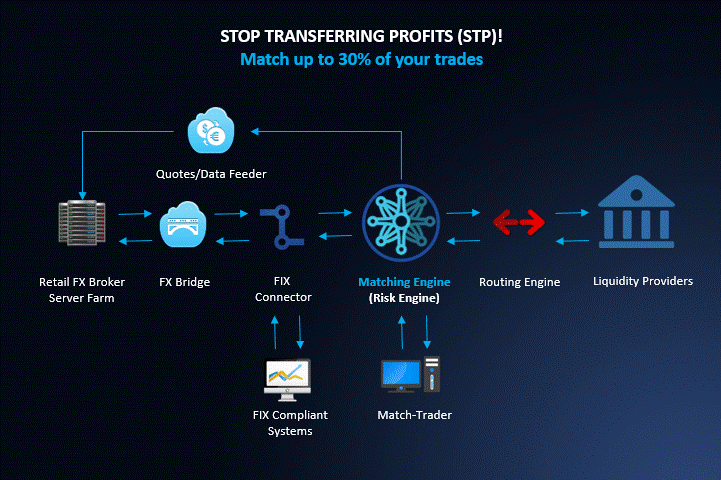
Brokers operating in the fragmented world of foreign exchange can benefit from a matching engine that re-uses liquidity. The new solution developed by Match-Trade aims to increase margins in a time when revenues are scarce.
An evolving trading environment has meant that firms offering margin products have had to adapt the way they manage and deal with client order flow, automated and algorithmic trading strategies have been spearheading this notion where brokers are directing client trades to liquidity providers, as opposed to internally managing the risk.
“The STP model has value for brokers, however through our matching engine, firms can take control of flow that would normally be passed onto Liquidity Providers (LPs), in this case orders are matched against other client orders and this generates spread income,” said a spokesperson for Match–Trade Technologies LLC in a telephone interview with Forex Magnates.
Users of Match-Trade can benefit from the numerous functionality the solution offers, this includes redirecting certain client orders back to the broker's order book, as well as creating a new pool of liquidity, thus opening up a new model for the broker where it acts as both a taker and provider. Imran Firoz, Managing Director of Match-Trade Technologies LLC, describes the advantages in an emailed statement to Forex Magnates: “Our matching engine technology allows STP forex brokers to have the opportunity to change from a liquidity taker to a liquidity provider when our Match-Trade System matches trades internally between the forex broker’s trading clients. STP forex brokers have their own ‘bottom-up’ liquidity when clients initiate limit or market orders based on the available margins in their respective accounts. Generally, all these orders are sent as market orders to LPs, when there are opportunities available during the trading session to match some of the limit orders of clients with limit/market orders of other clients.”
Internalizing client order flow is a common aspect of retail trading platforms that net the respective buy and sell orders, however firms are looking for advanced solutions that can create new revenue streams. MahiFX’s Compass, acts in a similar fashion whereby it allows firms to internalize activity. In addition, users of Compass, a solution for institutional players, has a number of modules, including price formation, visualization of trades, rates dissemination and algorithmic trading.
David Cooney, CEO of MahiFX, commented to the media: "Internalising flow, at the right rate, is key to increasing profitability and market share. But it's a tough puzzle. Assembling the teams to build an internal solution is expensive, and sometimes, where it has been attempted, the results have been less than hoped for. Compass provides a proven solution - the technology and advice on its operation - with minimal lead time and variable, performance based costs."
David Cooney
Match-Trade Technologies’ solution also addresses the notion of last look, faced by many participants in the FX markets, Mr. Firoz outlines the steps the matching engine takes when addressing the last look dilemma, he stated: “Our matching engine works according to a standard price/time priority algorithm, which means that at first an order with a better price will be matched. In cases where orders are at the same price, the one placed earlier will have priority in execution. Each limit order (e.g. buy limit at 1.2245 vol. 100.000) placed by the client is sent to the aggregated order book, which builds the forex brokers' own liquidity and thus reduces the spreads for the forex brokers' trading clients.
This means that trades can be executed at the forex brokers' clients prices and will not be passed on to the Liquidity Providers. If this limit order meets with other client orders (market or limit) the transaction will be executed by the Matching Engine, which will result in a transaction directly between two clients. So basically this is an ‘open look’ where trading clients can see the price/volume and execute.”
The way FX brokers manage their dealing operations has been a talking point during the past four years, a period where markets were choppy and traded in a range. Several FX brokers opted for a modest approach and limited the risk they took and consequently applied the non-dealing desk method and sent orders to their liquidity providers, however Carl Elsammak, an experienced trader who runs Kammas Trading, an outsourced risk management unit, believes firms who run a principal model (B-Book) can produce higher returns than the simple A-Book model. Mr. Elsammak stated in a comment to Forex Magnates: “It is my opinion that all brokers are better off running a B-Book regardless of higher or lower volume trends. This is particularly true as volumes drop. A proper B-Book process helps the bottom line of brokers to remain profitable through the difficult periods.
Carl Elsammak
The key to running a 'B-Book' is having a conservative strategy executed by an experienced team that predictably provides an enhanced return over STP at achievable reasonable levels.”
The FX markets face numerous challenges from market structures, regulators and the demands of its users, however the ongoing developments in technology and advancements in the way firms manage risk and perceive foreign exchange trading is creating a literate environment where participants look at progressing forward.
An evolving trading environment has meant that firms offering margin products have had to adapt the way they manage and deal with client order flow, automated and algorithmic trading strategies have been spearheading this notion where brokers are directing client trades to liquidity providers, as opposed to internally managing the risk.
“The STP model has value for brokers, however through our matching engine, firms can take control of flow that would normally be passed onto Liquidity Providers (LPs), in this case orders are matched against other client orders and this generates spread income,” said a spokesperson for Match–Trade Technologies LLC in a telephone interview with Forex Magnates.
Users of Match-Trade can benefit from the numerous functionality the solution offers, this includes redirecting certain client orders back to the broker's order book, as well as creating a new pool of liquidity, thus opening up a new model for the broker where it acts as both a taker and provider. Imran Firoz, Managing Director of Match-Trade Technologies LLC, describes the advantages in an emailed statement to Forex Magnates: “Our matching engine technology allows STP forex brokers to have the opportunity to change from a liquidity taker to a liquidity provider when our Match-Trade System matches trades internally between the forex broker’s trading clients. STP forex brokers have their own ‘bottom-up’ liquidity when clients initiate limit or market orders based on the available margins in their respective accounts. Generally, all these orders are sent as market orders to LPs, when there are opportunities available during the trading session to match some of the limit orders of clients with limit/market orders of other clients.”
Internalizing client order flow is a common aspect of retail trading platforms that net the respective buy and sell orders, however firms are looking for advanced solutions that can create new revenue streams. MahiFX’s Compass, acts in a similar fashion whereby it allows firms to internalize activity. In addition, users of Compass, a solution for institutional players, has a number of modules, including price formation, visualization of trades, rates dissemination and algorithmic trading.
David Cooney, CEO of MahiFX, commented to the media: "Internalising flow, at the right rate, is key to increasing profitability and market share. But it's a tough puzzle. Assembling the teams to build an internal solution is expensive, and sometimes, where it has been attempted, the results have been less than hoped for. Compass provides a proven solution - the technology and advice on its operation - with minimal lead time and variable, performance based costs."
David Cooney
Match-Trade Technologies’ solution also addresses the notion of last look, faced by many participants in the FX markets, Mr. Firoz outlines the steps the matching engine takes when addressing the last look dilemma, he stated: “Our matching engine works according to a standard price/time priority algorithm, which means that at first an order with a better price will be matched. In cases where orders are at the same price, the one placed earlier will have priority in execution. Each limit order (e.g. buy limit at 1.2245 vol. 100.000) placed by the client is sent to the aggregated order book, which builds the forex brokers' own liquidity and thus reduces the spreads for the forex brokers' trading clients.
This means that trades can be executed at the forex brokers' clients prices and will not be passed on to the Liquidity Providers. If this limit order meets with other client orders (market or limit) the transaction will be executed by the Matching Engine, which will result in a transaction directly between two clients. So basically this is an ‘open look’ where trading clients can see the price/volume and execute.”
The way FX brokers manage their dealing operations has been a talking point during the past four years, a period where markets were choppy and traded in a range. Several FX brokers opted for a modest approach and limited the risk they took and consequently applied the non-dealing desk method and sent orders to their liquidity providers, however Carl Elsammak, an experienced trader who runs Kammas Trading, an outsourced risk management unit, believes firms who run a principal model (B-Book) can produce higher returns than the simple A-Book model. Mr. Elsammak stated in a comment to Forex Magnates: “It is my opinion that all brokers are better off running a B-Book regardless of higher or lower volume trends. This is particularly true as volumes drop. A proper B-Book process helps the bottom line of brokers to remain profitable through the difficult periods.
Carl Elsammak
The key to running a 'B-Book' is having a conservative strategy executed by an experienced team that predictably provides an enhanced return over STP at achievable reasonable levels.”
The FX markets face numerous challenges from market structures, regulators and the demands of its users, however the ongoing developments in technology and advancements in the way firms manage risk and perceive foreign exchange trading is creating a literate environment where participants look at progressing forward.
GTC Prime Adds Centroid Bridge as Multi-Asset Liquidity Distribution Channel
Featured Videos
AvaTrade to Acquire Most of FXCM; NAGA Raises $8M
AvaTrade to Acquire Most of FXCM; NAGA Raises $8M
AvaTrade to Acquire Most of FXCM; NAGA Raises $8M
AvaTrade to Acquire Most of FXCM; NAGA Raises $8M
Today’s financial news recap covers AvaTrade agrees to acquire most of FXCM, NAGA secures eight million dollars in new financing, and Wise seeks a tax settlement in the UK.
Finance Magnates Daily Recap brings you the latest news from forex and CFD brokers, fintech, payments, cryptocurrency, digital assets, trading platforms, financial regulation and global markets.
Get the key company news, executive moves, deals, regulatory updates and market developments of the day, in just a few minutes. New episodes published every weekday.
Read more: https://www.financemagnates.com
#FinanceMagnates #ForexNews #FintechNews
Today’s financial news recap covers AvaTrade agrees to acquire most of FXCM, NAGA secures eight million dollars in new financing, and Wise seeks a tax settlement in the UK.
Finance Magnates Daily Recap brings you the latest news from forex and CFD brokers, fintech, payments, cryptocurrency, digital assets, trading platforms, financial regulation and global markets.
Get the key company news, executive moves, deals, regulatory updates and market developments of the day, in just a few minutes. New episodes published every weekday.
Read more: https://www.financemagnates.com
#FinanceMagnates #ForexNews #FintechNews
Today’s financial news recap covers AvaTrade agrees to acquire most of FXCM, NAGA secures eight million dollars in new financing, and Wise seeks a tax settlement in the UK.
Finance Magnates Daily Recap brings you the latest news from forex and CFD brokers, fintech, payments, cryptocurrency, digital assets, trading platforms, financial regulation and global markets.
Get the key company news, executive moves, deals, regulatory updates and market developments of the day, in just a few minutes. New episodes published every weekday.
Read more: https://www.financemagnates.com
#FinanceMagnates #ForexNews #FintechNews
Today’s financial news recap covers AvaTrade agrees to acquire most of FXCM, NAGA secures eight million dollars in new financing, and Wise seeks a tax settlement in the UK.
Finance Magnates Daily Recap brings you the latest news from forex and CFD brokers, fintech, payments, cryptocurrency, digital assets, trading platforms, financial regulation and global markets.
Get the key company news, executive moves, deals, regulatory updates and market developments of the day, in just a few minutes. New episodes published every weekday.
Read more: https://www.financemagnates.com
#FinanceMagnates #ForexNews #FintechNews
XTB Adds Overnight US Stock Trading; Nasdaq Ventures Invests in One Trading
XTB Adds Overnight US Stock Trading; Nasdaq Ventures Invests in One Trading
XTB Adds Overnight US Stock Trading; Nasdaq Ventures Invests in One Trading
XTB Adds Overnight US Stock Trading; Nasdaq Ventures Invests in One Trading
XTB Adds Overnight US Stock Trading; Nasdaq Ventures Invests in One Trading
XTB Adds Overnight US Stock Trading; Nasdaq Ventures Invests in One Trading
Today’s financial news recap covers XTB expands overnight US stock trading, Fortrade reports higher revenue, Nasdaq backs One Trading, and Vest Labs raises 13 million dollars.
Finance Magnates Daily Recap brings you the latest news from forex and CFD brokers, fintech, payments, cryptocurrency, digital assets, trading platforms, financial regulation and global markets.
Get the key company news, executive moves, deals, regulatory updates and market developments of the day, in just a few minutes. New episodes published every weekday.
Read more: https://www.financemagnates.com
#FinanceMagnates #ForexNews #FintechNews
Today’s financial news recap covers XTB expands overnight US stock trading, Fortrade reports higher revenue, Nasdaq backs One Trading, and Vest Labs raises 13 million dollars.
Finance Magnates Daily Recap brings you the latest news from forex and CFD brokers, fintech, payments, cryptocurrency, digital assets, trading platforms, financial regulation and global markets.
Get the key company news, executive moves, deals, regulatory updates and market developments of the day, in just a few minutes. New episodes published every weekday.
Read more: https://www.financemagnates.com
#FinanceMagnates #ForexNews #FintechNews
Today’s financial news recap covers XTB expands overnight US stock trading, Fortrade reports higher revenue, Nasdaq backs One Trading, and Vest Labs raises 13 million dollars.
Finance Magnates Daily Recap brings you the latest news from forex and CFD brokers, fintech, payments, cryptocurrency, digital assets, trading platforms, financial regulation and global markets.
Get the key company news, executive moves, deals, regulatory updates and market developments of the day, in just a few minutes. New episodes published every weekday.
Read more: https://www.financemagnates.com
#FinanceMagnates #ForexNews #FintechNews
Today’s financial news recap covers XTB expands overnight US stock trading, Fortrade reports higher revenue, Nasdaq backs One Trading, and Vest Labs raises 13 million dollars.
Finance Magnates Daily Recap brings you the latest news from forex and CFD brokers, fintech, payments, cryptocurrency, digital assets, trading platforms, financial regulation and global markets.
Get the key company news, executive moves, deals, regulatory updates and market developments of the day, in just a few minutes. New episodes published every weekday.
Read more: https://www.financemagnates.com
#FinanceMagnates #ForexNews #FintechNews
Today’s financial news recap covers XTB expands overnight US stock trading, Fortrade reports higher revenue, Nasdaq backs One Trading, and Vest Labs raises 13 million dollars.
Finance Magnates Daily Recap brings you the latest news from forex and CFD brokers, fintech, payments, cryptocurrency, digital assets, trading platforms, financial regulation and global markets.
Get the key company news, executive moves, deals, regulatory updates and market developments of the day, in just a few minutes. New episodes published every weekday.
Read more: https://www.financemagnates.com
#FinanceMagnates #ForexNews #FintechNews
Today’s financial news recap covers XTB expands overnight US stock trading, Fortrade reports higher revenue, Nasdaq backs One Trading, and Vest Labs raises 13 million dollars.
Finance Magnates Daily Recap brings you the latest news from forex and CFD brokers, fintech, payments, cryptocurrency, digital assets, trading platforms, financial regulation and global markets.
Get the key company news, executive moves, deals, regulatory updates and market developments of the day, in just a few minutes. New episodes published every weekday.
Read more: https://www.financemagnates.com
#FinanceMagnates #ForexNews #FintechNews
CMC Founder Downplays Volatility Hit; Devexperts Names CEO
CMC Founder Downplays Volatility Hit; Devexperts Names CEO
CMC Founder Downplays Volatility Hit; Devexperts Names CEO
CMC Founder Downplays Volatility Hit; Devexperts Names CEO
CMC Founder Downplays Volatility Hit; Devexperts Names CEO
CMC Founder Downplays Volatility Hit; Devexperts Names CEO
Today’s financial news recap covers low volatility pressures brokers, Devexperts names a new CEO, Saxo cuts onboarding time, and OKX reaches a 25 billion dollar valuation.
Finance Magnates Daily Recap brings you the latest news from forex and CFD brokers, fintech, payments, cryptocurrency, digital assets, trading platforms, financial regulation and global markets.
Get the key company news, executive moves, deals, regulatory updates and market developments of the day, in just a few minutes. New episodes published every weekday.
Read more: https://www.financemagnates.com
#FinanceMagnates #ForexNews #FintechNews
Today’s financial news recap covers low volatility pressures brokers, Devexperts names a new CEO, Saxo cuts onboarding time, and OKX reaches a 25 billion dollar valuation.
Finance Magnates Daily Recap brings you the latest news from forex and CFD brokers, fintech, payments, cryptocurrency, digital assets, trading platforms, financial regulation and global markets.
Get the key company news, executive moves, deals, regulatory updates and market developments of the day, in just a few minutes. New episodes published every weekday.
Read more: https://www.financemagnates.com
#FinanceMagnates #ForexNews #FintechNews
Today’s financial news recap covers low volatility pressures brokers, Devexperts names a new CEO, Saxo cuts onboarding time, and OKX reaches a 25 billion dollar valuation.
Finance Magnates Daily Recap brings you the latest news from forex and CFD brokers, fintech, payments, cryptocurrency, digital assets, trading platforms, financial regulation and global markets.
Get the key company news, executive moves, deals, regulatory updates and market developments of the day, in just a few minutes. New episodes published every weekday.
Read more: https://www.financemagnates.com
#FinanceMagnates #ForexNews #FintechNews
Today’s financial news recap covers low volatility pressures brokers, Devexperts names a new CEO, Saxo cuts onboarding time, and OKX reaches a 25 billion dollar valuation.
Finance Magnates Daily Recap brings you the latest news from forex and CFD brokers, fintech, payments, cryptocurrency, digital assets, trading platforms, financial regulation and global markets.
Get the key company news, executive moves, deals, regulatory updates and market developments of the day, in just a few minutes. New episodes published every weekday.
Read more: https://www.financemagnates.com
#FinanceMagnates #ForexNews #FintechNews
Today’s financial news recap covers low volatility pressures brokers, Devexperts names a new CEO, Saxo cuts onboarding time, and OKX reaches a 25 billion dollar valuation.
Finance Magnates Daily Recap brings you the latest news from forex and CFD brokers, fintech, payments, cryptocurrency, digital assets, trading platforms, financial regulation and global markets.
Get the key company news, executive moves, deals, regulatory updates and market developments of the day, in just a few minutes. New episodes published every weekday.
Read more: https://www.financemagnates.com
#FinanceMagnates #ForexNews #FintechNews
Today’s financial news recap covers low volatility pressures brokers, Devexperts names a new CEO, Saxo cuts onboarding time, and OKX reaches a 25 billion dollar valuation.
Finance Magnates Daily Recap brings you the latest news from forex and CFD brokers, fintech, payments, cryptocurrency, digital assets, trading platforms, financial regulation and global markets.
Get the key company news, executive moves, deals, regulatory updates and market developments of the day, in just a few minutes. New episodes published every weekday.
Read more: https://www.financemagnates.com
#FinanceMagnates #ForexNews #FintechNews
Today’s financial news recap covers Trade Nation buys FXCM's UK client book, Trading 212 reports higher revenue, the CFTC's move to allow perpetual index futures.
Finance Magnates Daily Recap brings you the latest news from forex and CFD brokers, fintech, payments, cryptocurrency, digital assets, trading platforms, financial regulation and global markets.
Get the key company news, executive moves, deals, regulatory updates and market developments of the day, in just a few minutes. New episodes published every weekday.
Read more: https://www.financemagnates.com
#FinanceMagnates #ForexNews #FintechNews
Today’s financial news recap covers Trade Nation buys FXCM's UK client book, Trading 212 reports higher revenue, the CFTC's move to allow perpetual index futures.
Finance Magnates Daily Recap brings you the latest news from forex and CFD brokers, fintech, payments, cryptocurrency, digital assets, trading platforms, financial regulation and global markets.
Get the key company news, executive moves, deals, regulatory updates and market developments of the day, in just a few minutes. New episodes published every weekday.
Read more: https://www.financemagnates.com
#FinanceMagnates #ForexNews #FintechNews
Today’s financial news recap covers Trade Nation buys FXCM's UK client book, Trading 212 reports higher revenue, the CFTC's move to allow perpetual index futures.
Finance Magnates Daily Recap brings you the latest news from forex and CFD brokers, fintech, payments, cryptocurrency, digital assets, trading platforms, financial regulation and global markets.
Get the key company news, executive moves, deals, regulatory updates and market developments of the day, in just a few minutes. New episodes published every weekday.
Read more: https://www.financemagnates.com
#FinanceMagnates #ForexNews #FintechNews
Today’s financial news recap covers Trade Nation buys FXCM's UK client book, Trading 212 reports higher revenue, the CFTC's move to allow perpetual index futures.
Finance Magnates Daily Recap brings you the latest news from forex and CFD brokers, fintech, payments, cryptocurrency, digital assets, trading platforms, financial regulation and global markets.
Get the key company news, executive moves, deals, regulatory updates and market developments of the day, in just a few minutes. New episodes published every weekday.
Read more: https://www.financemagnates.com
#FinanceMagnates #ForexNews #FintechNews
Today’s financial news recap covers Trade Nation buys FXCM's UK client book, Trading 212 reports higher revenue, the CFTC's move to allow perpetual index futures.
Finance Magnates Daily Recap brings you the latest news from forex and CFD brokers, fintech, payments, cryptocurrency, digital assets, trading platforms, financial regulation and global markets.
Get the key company news, executive moves, deals, regulatory updates and market developments of the day, in just a few minutes. New episodes published every weekday.
Read more: https://www.financemagnates.com
#FinanceMagnates #ForexNews #FintechNews
Today’s financial news recap covers Trade Nation buys FXCM's UK client book, Trading 212 reports higher revenue, the CFTC's move to allow perpetual index futures.
Finance Magnates Daily Recap brings you the latest news from forex and CFD brokers, fintech, payments, cryptocurrency, digital assets, trading platforms, financial regulation and global markets.
Get the key company news, executive moves, deals, regulatory updates and market developments of the day, in just a few minutes. New episodes published every weekday.
Read more: https://www.financemagnates.com
#FinanceMagnates #ForexNews #FintechNews
Your career isn’t a linear path.
Your career isn’t a linear path.
Your career isn’t a linear path.
Your career isn’t a linear path.
Your career isn’t a linear path.
Your career isn’t a linear path.
Roles change. Career goals change. Sometimes you want a completely new challenge.
But the skills and knowledge you build along the way can stay with you and give you something to build on.
For Jeff Patterson, that continued growth is key to long-term career development.
You bring the skills. FM Academy helps you build the knowledge.
#FMAcademy #FinanceMagnates #FinanceCareers #ProfessionalDevelopment #Fintech
Roles change. Career goals change. Sometimes you want a completely new challenge.
But the skills and knowledge you build along the way can stay with you and give you something to build on.
For Jeff Patterson, that continued growth is key to long-term career development.
You bring the skills. FM Academy helps you build the knowledge.
#FMAcademy #FinanceMagnates #FinanceCareers #ProfessionalDevelopment #Fintech
Roles change. Career goals change. Sometimes you want a completely new challenge.
But the skills and knowledge you build along the way can stay with you and give you something to build on.
For Jeff Patterson, that continued growth is key to long-term career development.
You bring the skills. FM Academy helps you build the knowledge.
#FMAcademy #FinanceMagnates #FinanceCareers #ProfessionalDevelopment #Fintech
Roles change. Career goals change. Sometimes you want a completely new challenge.
But the skills and knowledge you build along the way can stay with you and give you something to build on.
For Jeff Patterson, that continued growth is key to long-term career development.
You bring the skills. FM Academy helps you build the knowledge.
#FMAcademy #FinanceMagnates #FinanceCareers #ProfessionalDevelopment #Fintech
Roles change. Career goals change. Sometimes you want a completely new challenge.
But the skills and knowledge you build along the way can stay with you and give you something to build on.
For Jeff Patterson, that continued growth is key to long-term career development.
You bring the skills. FM Academy helps you build the knowledge.
#FMAcademy #FinanceMagnates #FinanceCareers #ProfessionalDevelopment #Fintech
Roles change. Career goals change. Sometimes you want a completely new challenge.
But the skills and knowledge you build along the way can stay with you and give you something to build on.
For Jeff Patterson, that continued growth is key to long-term career development.
You bring the skills. FM Academy helps you build the knowledge.
#FMAcademy #FinanceMagnates #FinanceCareers #ProfessionalDevelopment #Fintech