BIS Posts Updated OTC Derivatives Survey - $59 Trillion O/S In FX Forwards & Swaps
Thursday,07/11/2013|20:48GMTby
Andrew Saks McLeod
The Bank For International Settlements has today released detailed updates to its biannual and triennial survey on FX and OTC derivatives, in order to include data and statistics until the end of June 2013.
The Bank for International Settlements (BIS) has today released updates to the sets of statistics which it produces on a biannual and triennial basis relating to the derivatives market, much of which is specific to over-the-counter (OTC) products, which include figures until the end of July 2013.
In terms of aspects relating to the FX and OTC derivatives, the BIS has categorized the notional amounts outstanding and gross market values of OTC derivatives from its semiannual survey and from its triennial survey.
Semiannual Survey By Category
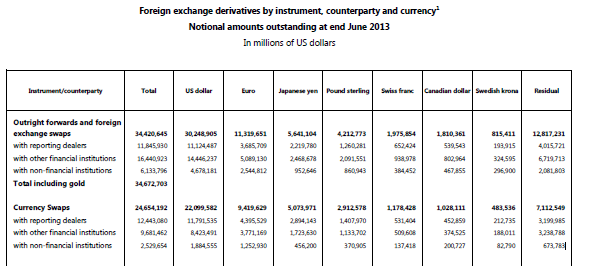
As of the end of June 2013, the total notional amount outstanding in outright forwards and FX Swaps by instrument, counterparty and currency stood at $34,672,703 million.
Source: Bank For International Settlements
Additionally, FX derivatives by instrument, counterparty and maturity was reported, with notional amounts outstanding at end June 2013 totalled $59,074,837 million in forwards and swaps, $10,172,599 million in FX options bought and $10,273,946 million in FX options sold, with an overall total of $14,045,719.
Highlights of the 2013 survey showed that trading in FX markets averaged $5.3 trillion per day in April 2013. This is up from $4.0 trillion in April 2010 and $3.3 trillion in April 2007. FX swaps were the most actively traded instruments in April 2013, at $2.2 trillion per day, followed by spot trading at $2.0 trillion.
The growth of foreign exchange trading was driven by financial institutions other than reporting dealers.
The 2013 survey collected a finer sectoral breakdown of these other institutions for the first time. Smaller banks (not participating in the survey as reporting dealers) accounted for 24% of turnover, institutional investors such as pension funds and insurance companies 11%, and hedge funds and proprietary trading firms another 11%.
Trading with non-financial customers, mainly corporations, contracted between the 2010 and 2013 surveys, reducing their share of global turnover to only 9%.
The US dollar remained the dominant vehicle currency; it was on one side of 87% of all trades in April 2013. The euro was the second most traded currency, but its share fell to 33% in April 2013 from 39% in April 2010.
The turnover of the Japanese yen increased significantly between the 2010 and 2013 surveys. So too did that of several emerging market currencies, and the Mexican peso and Chinese renminbi entered the list of the top 10 most traded currencies. Methodological changes in the 2013 survey ensured more complete coverage of activity in emerging market currencies.
Trading is increasingly concentrated in the largest financial centres. In April 2013, sales desks in the United Kingdom, the United States, Singapore and Japan intermediated 71% of foreign exchange trading, whereas in April 2010 their combined share was 66%.
Within the report, the BIS has produced detailed figures relating to notional amounts outstanding, by instrument, counterparty and currency, as well as notional amounts outstanding, by instrument, counterparty and remaining maturity, and gross market values, by instrument, counterparty and currency.
Subsequent to the updates in the survey, the statistics still demonstrate a very strong and dominant electronic trading industry in the Asia Pacific region, with Singapore settling a vast amount of institutional FX business.
A point of interest may arise in the next survey, as a dynamic is taking place whereby the strong start made to 2013 by a large number of industry participants is beginning to tail off as 2013 enters its final quarter.
The Bank for International Settlements (BIS) has today released updates to the sets of statistics which it produces on a biannual and triennial basis relating to the derivatives market, much of which is specific to over-the-counter (OTC) products, which include figures until the end of July 2013.
In terms of aspects relating to the FX and OTC derivatives, the BIS has categorized the notional amounts outstanding and gross market values of OTC derivatives from its semiannual survey and from its triennial survey.
Semiannual Survey By Category
As of the end of June 2013, the total notional amount outstanding in outright forwards and FX Swaps by instrument, counterparty and currency stood at $34,672,703 million.
Source: Bank For International Settlements
Additionally, FX derivatives by instrument, counterparty and maturity was reported, with notional amounts outstanding at end June 2013 totalled $59,074,837 million in forwards and swaps, $10,172,599 million in FX options bought and $10,273,946 million in FX options sold, with an overall total of $14,045,719.
Highlights of the 2013 survey showed that trading in FX markets averaged $5.3 trillion per day in April 2013. This is up from $4.0 trillion in April 2010 and $3.3 trillion in April 2007. FX swaps were the most actively traded instruments in April 2013, at $2.2 trillion per day, followed by spot trading at $2.0 trillion.
The growth of foreign exchange trading was driven by financial institutions other than reporting dealers.
The 2013 survey collected a finer sectoral breakdown of these other institutions for the first time. Smaller banks (not participating in the survey as reporting dealers) accounted for 24% of turnover, institutional investors such as pension funds and insurance companies 11%, and hedge funds and proprietary trading firms another 11%.
Trading with non-financial customers, mainly corporations, contracted between the 2010 and 2013 surveys, reducing their share of global turnover to only 9%.
The US dollar remained the dominant vehicle currency; it was on one side of 87% of all trades in April 2013. The euro was the second most traded currency, but its share fell to 33% in April 2013 from 39% in April 2010.
The turnover of the Japanese yen increased significantly between the 2010 and 2013 surveys. So too did that of several emerging market currencies, and the Mexican peso and Chinese renminbi entered the list of the top 10 most traded currencies. Methodological changes in the 2013 survey ensured more complete coverage of activity in emerging market currencies.
Trading is increasingly concentrated in the largest financial centres. In April 2013, sales desks in the United Kingdom, the United States, Singapore and Japan intermediated 71% of foreign exchange trading, whereas in April 2010 their combined share was 66%.
Within the report, the BIS has produced detailed figures relating to notional amounts outstanding, by instrument, counterparty and currency, as well as notional amounts outstanding, by instrument, counterparty and remaining maturity, and gross market values, by instrument, counterparty and currency.
Subsequent to the updates in the survey, the statistics still demonstrate a very strong and dominant electronic trading industry in the Asia Pacific region, with Singapore settling a vast amount of institutional FX business.
A point of interest may arise in the next survey, as a dynamic is taking place whereby the strong start made to 2013 by a large number of industry participants is beginning to tail off as 2013 enters its final quarter.
Singapore Independent Wealth Sector Has Less Than 10% Market Share, but Vast Room for Growth
FP Markets Winner Spotlight 🏆 | Global Broker of the Year 2025 #Trading #Broker #Innovation #Shorts
FP Markets Winner Spotlight 🏆 | Global Broker of the Year 2025 #Trading #Broker #Innovation #Shorts
FP Markets takes the spotlight as Global Broker of the Year 2025 at the Finance Magnates Awards.
Martin Stoilov, Head of Client Experience, shares that trust, innovation, and people played a key role in the company’s success, supported by a strong foundation of integrity and client-centricity.
Following this milestone, FP Markets continues to focus on growth, technology investment, and its core values of transparency and excellence.
👉 Be part of FM Awards 2026: https://awards.financemagnates.com/#nominate
FP Markets takes the spotlight as Global Broker of the Year 2025 at the Finance Magnates Awards.
Martin Stoilov, Head of Client Experience, shares that trust, innovation, and people played a key role in the company’s success, supported by a strong foundation of integrity and client-centricity.
Following this milestone, FP Markets continues to focus on growth, technology investment, and its core values of transparency and excellence.
👉 Be part of FM Awards 2026: https://awards.financemagnates.com/#nominate
In this video, we review @HolaPrimeMarketsOfficial, a multi-asset forex and CFDs broker offering different account types, trading platforms, and flexible trading conditions.
We cover the broker’s overall offering, including account options, trading environment, platforms like MT4 and MT5, and additional services such as managed accounts and fast withdrawals.
Watch the full video to see if Hola Prime Markets fits your trading needs.
📣 Stay up to date with the latest in finance and trading. Follow Finance Magnates for industry news, insights, and global event coverage.
Connect with us:
🔗 LinkedIn: /financemagnates
👍 Facebook: /financemagnates
📸 Instagram: https://www.instagram.com/financemagnates
🐦 X: https://x.com/financemagnates
🎥 TikTok: https://www.tiktok.com/tag/financemagnates
▶️ YouTube: /@financemagnates_official
#HolaPrime #ForexBroker #CFDTrading #FinanceMagnates #Trading #Forex #BrokerReview
In this video, we review @HolaPrimeMarketsOfficial, a multi-asset forex and CFDs broker offering different account types, trading platforms, and flexible trading conditions.
We cover the broker’s overall offering, including account options, trading environment, platforms like MT4 and MT5, and additional services such as managed accounts and fast withdrawals.
Watch the full video to see if Hola Prime Markets fits your trading needs.
📣 Stay up to date with the latest in finance and trading. Follow Finance Magnates for industry news, insights, and global event coverage.
Connect with us:
🔗 LinkedIn: /financemagnates
👍 Facebook: /financemagnates
📸 Instagram: https://www.instagram.com/financemagnates
🐦 X: https://x.com/financemagnates
🎥 TikTok: https://www.tiktok.com/tag/financemagnates
▶️ YouTube: /@financemagnates_official
#HolaPrime #ForexBroker #CFDTrading #FinanceMagnates #Trading #Forex #BrokerReview
Hola Prime Review: What You Need to Know | Full Breakdown by Finance Magnates
Hola Prime Review: What You Need to Know | Full Breakdown by Finance Magnates
In this video, we review @HolaPrime_Global, a proprietary trading firm offering evaluation programs and performance-based payouts in simulated market environments.
We cover how the challenge model works, including account types, profit splits (up to 95%), trading rules, and what it takes to reach a funded account. You’ll also learn about available platforms like MT4, MT5, cTrader, and more, along with insights into payouts, support, and trading conditions.
Watch the full video to see if Hola Prime fits your trading style.
📣 Stay up to date with the latest in finance and trading. Follow Finance Magnates for industry news, insights, and global event coverage.
Connect with us:
🔗 LinkedIn: /financemagnates
👍 Facebook: /financemagnates
📸 Instagram: https://www.instagram.com/financemagnates
🐦 X: https://x.com/financemagnates
🎥 TikTok: https://www.tiktok.com/tag/financemagnates
▶️ YouTube: /@financemagnates_official
#HolaPrime #PropFirm #Trading #FinanceMagnates #Forex #FuturesTrading #TradingReview #PropFirmReview
In this video, we review @HolaPrime_Global, a proprietary trading firm offering evaluation programs and performance-based payouts in simulated market environments.
We cover how the challenge model works, including account types, profit splits (up to 95%), trading rules, and what it takes to reach a funded account. You’ll also learn about available platforms like MT4, MT5, cTrader, and more, along with insights into payouts, support, and trading conditions.
Watch the full video to see if Hola Prime fits your trading style.
📣 Stay up to date with the latest in finance and trading. Follow Finance Magnates for industry news, insights, and global event coverage.
Connect with us:
🔗 LinkedIn: /financemagnates
👍 Facebook: /financemagnates
📸 Instagram: https://www.instagram.com/financemagnates
🐦 X: https://x.com/financemagnates
🎥 TikTok: https://www.tiktok.com/tag/financemagnates
▶️ YouTube: /@financemagnates_official
#HolaPrime #PropFirm #Trading #FinanceMagnates #Forex #FuturesTrading #TradingReview #PropFirmReview
Axi Winner Spotlight 🏆 | Global Most Innovative Broker 2025 #Innovation #Trading #Fintech #Broker
Axi Winner Spotlight 🏆 | Global Most Innovative Broker 2025 #Innovation #Trading #Fintech #Broker
Axi takes the spotlight at the Finance Magnates Awards, winning Global Most Innovative Broker 2025.
Olivia Xenofontos and Ivanna Openko share how the team will feel: proud, motivated, and ready to keep delivering.
They also describe the night as well-organized, focused, and enjoyable for all.
👉 Be part of FM Awards 2026.
Axi takes the spotlight at the Finance Magnates Awards, winning Global Most Innovative Broker 2025.
Olivia Xenofontos and Ivanna Openko share how the team will feel: proud, motivated, and ready to keep delivering.
They also describe the night as well-organized, focused, and enjoyable for all.
👉 Be part of FM Awards 2026.
Recognition that matters.
Built on transparency.
Driven by the industry.
The Finance Magnates Awards 2026.
Nominations are now open.
🔗 https://awards.financemagnates.com/?utm_source=SM&utm_medium=social&utm_campaign=recognition-matters
Recognition that matters.
Built on transparency.
Driven by the industry.
The Finance Magnates Awards 2026.
Nominations are now open.
🔗 https://awards.financemagnates.com/?utm_source=SM&utm_medium=social&utm_campaign=recognition-matters