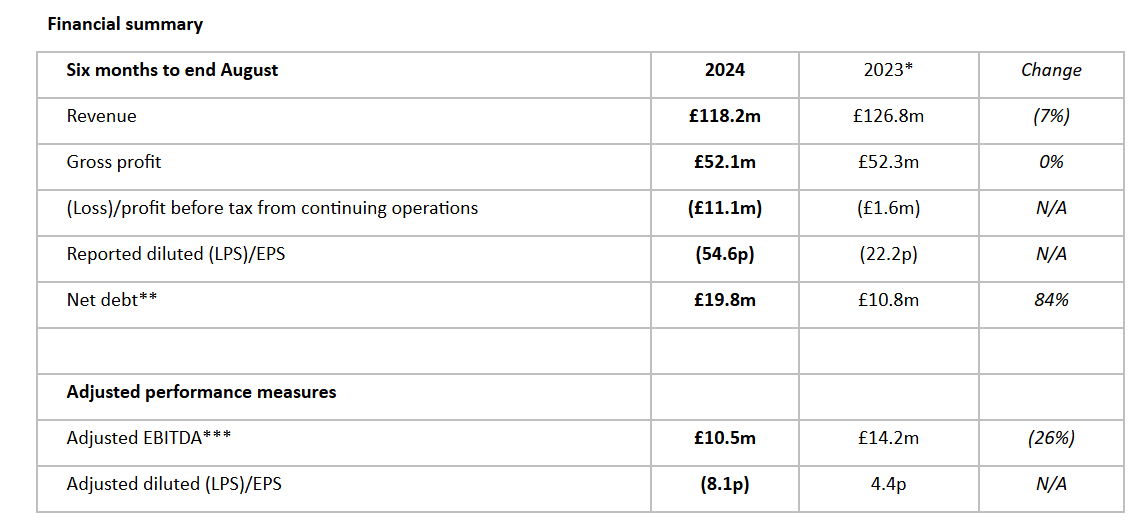
The company reports a challenging 6 months, with revenue down 7% to £118.2m and adjusted EBITDA falling 26% to £10.5m.
FD Technologies recently announced its plan to sell its First Derivative business to EPAM Systems for £230 million.
FD
Technologies (LSE: FDP) reported today (Tuesday) a 7% decline in revenue to
£118.2 million for the first half of fiscal year 2025 (H1 FY25), highlighting
ongoing challenges in its business transformation journey. The company's
financial results revealed mounting pressures on profitability despite stable
gross margins.
The
technology firm's adjusted EBITDA dropped 26% to £10.5 million, while net debt
increased significantly to £19.8 million, up 84% from the previous year's £10.8
million. The company's bottom line showed a widening loss before tax from
continuing operations of £11.1 million, compared to a £1.6 million loss in the
same period last year.
Despite the
revenue headwinds, FD Technologies maintained its gross profit relatively
stable at £52.1 million, demonstrating resilience in its core business margins.
The company acknowledged an expected churn rate of 8–10% in the current fiscal
year, with improvements anticipated in FY26 and beyond.
Source: FD Technologies
The
financial results reflect the company's ongoing strategic repositioning, with
reported diluted loss per share increasing to 54.6 pence, compared to 22.2
pence in the previous year. Adjusted earnings metrics also showed pressure,
with adjusted diluted loss per share at 8.1 pence, down from a positive 4.4
pence in the comparative period.
Revenue of the Sold First
Derivative Also Declines
FD
Technologies recently announced a plan to sell its First Derivative business to EPAM Systems for £230
million. The transaction, expected to close before year-end, is part of the
company's strategic move to concentrate on its high-growth KX division, which
specializes in real-time analytics and AI-driven solutions.
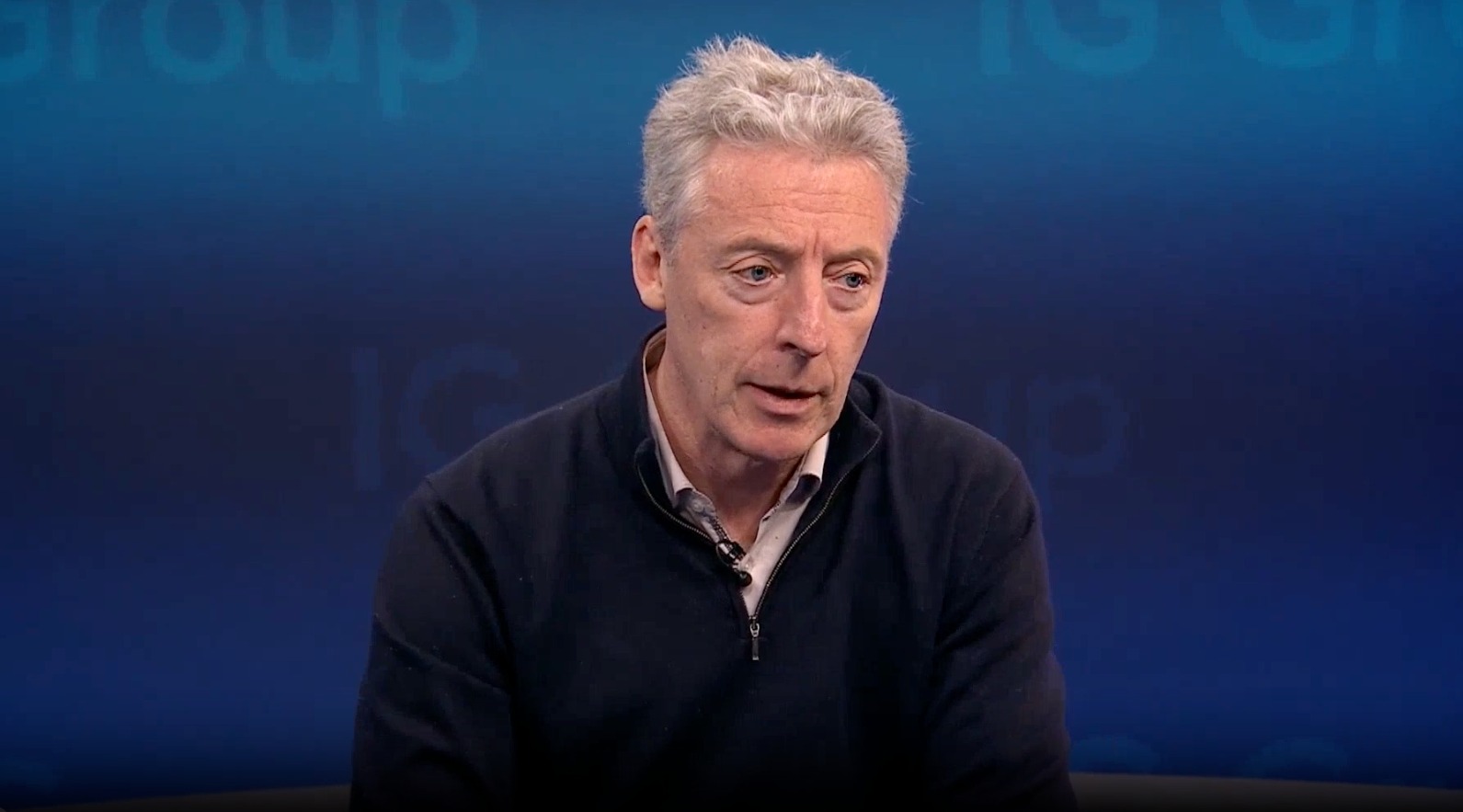
“We have
made significant strategic and operational progress in the first half, with the
divestment of First Derivative and strong execution in KX,” commented Seamus Keating, the
CEO of FD Technologies. “Following the completion of the sale of
First Derivative, we expect to return cash to shareholders, in line with our
disciplined approach to capital allocation, and KX will be a pure-play,
high-growth software.”
Meanwhile,
the KX division saw a 5% revenue growth, reaching £39.5 million. Its annual
contract value (ACV) also increased to £7.4 million, aligning with the
company's forecasted range of £6–8 million.
Regarding the fiscal year 2024, FD Technologies reported a total revenue of
£248.9 million. The KX division showcased robust performance, with revenue
increasing by 12% in constant currencies to £79 million. Recurring revenue
emerged as a key growth driver for KX, rising 19% year-over-year. This
recurring component now represents 86% of the division’s total revenue, up from
81% in the previous fiscal period, underscoring the division's growing reliance
on stable, long-term revenue streams.
FD
Technologies (LSE: FDP) reported today (Tuesday) a 7% decline in revenue to
£118.2 million for the first half of fiscal year 2025 (H1 FY25), highlighting
ongoing challenges in its business transformation journey. The company's
financial results revealed mounting pressures on profitability despite stable
gross margins.
The
technology firm's adjusted EBITDA dropped 26% to £10.5 million, while net debt
increased significantly to £19.8 million, up 84% from the previous year's £10.8
million. The company's bottom line showed a widening loss before tax from
continuing operations of £11.1 million, compared to a £1.6 million loss in the
same period last year.
Despite the
revenue headwinds, FD Technologies maintained its gross profit relatively
stable at £52.1 million, demonstrating resilience in its core business margins.
The company acknowledged an expected churn rate of 8–10% in the current fiscal
year, with improvements anticipated in FY26 and beyond.
Source: FD Technologies
The
financial results reflect the company's ongoing strategic repositioning, with
reported diluted loss per share increasing to 54.6 pence, compared to 22.2
pence in the previous year. Adjusted earnings metrics also showed pressure,
with adjusted diluted loss per share at 8.1 pence, down from a positive 4.4
pence in the comparative period.
Revenue of the Sold First
Derivative Also Declines
FD
Technologies recently announced a plan to sell its First Derivative business to EPAM Systems for £230
million. The transaction, expected to close before year-end, is part of the
company's strategic move to concentrate on its high-growth KX division, which
specializes in real-time analytics and AI-driven solutions.
“We have
made significant strategic and operational progress in the first half, with the
divestment of First Derivative and strong execution in KX,” commented Seamus Keating, the
CEO of FD Technologies. “Following the completion of the sale of
First Derivative, we expect to return cash to shareholders, in line with our
disciplined approach to capital allocation, and KX will be a pure-play,
high-growth software.”
Meanwhile,
the KX division saw a 5% revenue growth, reaching £39.5 million. Its annual
contract value (ACV) also increased to £7.4 million, aligning with the
company's forecasted range of £6–8 million.
Regarding the fiscal year 2024, FD Technologies reported a total revenue of
£248.9 million. The KX division showcased robust performance, with revenue
increasing by 12% in constant currencies to £79 million. Recurring revenue
emerged as a key growth driver for KX, rising 19% year-over-year. This
recurring component now represents 86% of the division’s total revenue, up from
81% in the previous fiscal period, underscoring the division's growing reliance
on stable, long-term revenue streams.
Damian Chmiel is a Senior Analyst & Editor at Finance Magnates with more than 15 years of experience in the CFD and online trading industry. Active as both a trader and journalist since 2010, he focuses on broker coverage, fintech innovation, and regulatory developments across Europe, the Middle East, and Asia.
His work includes interviews with C-level leaders at major brokerages and fintech platforms, as well as co-authoring Finance Magnates’ quarterly industry benchmarking reports. Damian’s reporting is data-driven, market-aware, and grounded in direct industry engagement. His analysis and commentary have also been cited by external media outlets, including Investing.com, Binance, The Asset, Stockhead, and Dispatch.
Education:
MA in Finance and Accounting, Cracow University of Economics
MetaTrader 5 Brokers Gain Direct Access to Vantage Liquidity via MetaQuotes’ Ultency
FP Markets Winner Spotlight 🏆 | Global Broker of the Year 2025 #Trading #Broker #Innovation #Shorts
FP Markets Winner Spotlight 🏆 | Global Broker of the Year 2025 #Trading #Broker #Innovation #Shorts
FP Markets takes the spotlight as Global Broker of the Year 2025 at the Finance Magnates Awards.
Martin Stoilov, Head of Client Experience, shares that trust, innovation, and people played a key role in the company’s success, supported by a strong foundation of integrity and client-centricity.
Following this milestone, FP Markets continues to focus on growth, technology investment, and its core values of transparency and excellence.
👉 Be part of FM Awards 2026: https://awards.financemagnates.com/#nominate
FP Markets takes the spotlight as Global Broker of the Year 2025 at the Finance Magnates Awards.
Martin Stoilov, Head of Client Experience, shares that trust, innovation, and people played a key role in the company’s success, supported by a strong foundation of integrity and client-centricity.
Following this milestone, FP Markets continues to focus on growth, technology investment, and its core values of transparency and excellence.
👉 Be part of FM Awards 2026: https://awards.financemagnates.com/#nominate
In this video, we review @HolaPrimeMarketsOfficial, a multi-asset forex and CFDs broker offering different account types, trading platforms, and flexible trading conditions.
We cover the broker’s overall offering, including account options, trading environment, platforms like MT4 and MT5, and additional services such as managed accounts and fast withdrawals.
Watch the full video to see if Hola Prime Markets fits your trading needs.
📣 Stay up to date with the latest in finance and trading. Follow Finance Magnates for industry news, insights, and global event coverage.
Connect with us:
🔗 LinkedIn: /financemagnates
👍 Facebook: /financemagnates
📸 Instagram: https://www.instagram.com/financemagnates
🐦 X: https://x.com/financemagnates
🎥 TikTok: https://www.tiktok.com/tag/financemagnates
▶️ YouTube: /@financemagnates_official
#HolaPrime #ForexBroker #CFDTrading #FinanceMagnates #Trading #Forex #BrokerReview
In this video, we review @HolaPrimeMarketsOfficial, a multi-asset forex and CFDs broker offering different account types, trading platforms, and flexible trading conditions.
We cover the broker’s overall offering, including account options, trading environment, platforms like MT4 and MT5, and additional services such as managed accounts and fast withdrawals.
Watch the full video to see if Hola Prime Markets fits your trading needs.
📣 Stay up to date with the latest in finance and trading. Follow Finance Magnates for industry news, insights, and global event coverage.
Connect with us:
🔗 LinkedIn: /financemagnates
👍 Facebook: /financemagnates
📸 Instagram: https://www.instagram.com/financemagnates
🐦 X: https://x.com/financemagnates
🎥 TikTok: https://www.tiktok.com/tag/financemagnates
▶️ YouTube: /@financemagnates_official
#HolaPrime #ForexBroker #CFDTrading #FinanceMagnates #Trading #Forex #BrokerReview
Hola Prime Review: What You Need to Know | Full Breakdown by Finance Magnates
Hola Prime Review: What You Need to Know | Full Breakdown by Finance Magnates
In this video, we review @HolaPrime_Global, a proprietary trading firm offering evaluation programs and performance-based payouts in simulated market environments.
We cover how the challenge model works, including account types, profit splits (up to 95%), trading rules, and what it takes to reach a funded account. You’ll also learn about available platforms like MT4, MT5, cTrader, and more, along with insights into payouts, support, and trading conditions.
Watch the full video to see if Hola Prime fits your trading style.
📣 Stay up to date with the latest in finance and trading. Follow Finance Magnates for industry news, insights, and global event coverage.
Connect with us:
🔗 LinkedIn: /financemagnates
👍 Facebook: /financemagnates
📸 Instagram: https://www.instagram.com/financemagnates
🐦 X: https://x.com/financemagnates
🎥 TikTok: https://www.tiktok.com/tag/financemagnates
▶️ YouTube: /@financemagnates_official
#HolaPrime #PropFirm #Trading #FinanceMagnates #Forex #FuturesTrading #TradingReview #PropFirmReview
In this video, we review @HolaPrime_Global, a proprietary trading firm offering evaluation programs and performance-based payouts in simulated market environments.
We cover how the challenge model works, including account types, profit splits (up to 95%), trading rules, and what it takes to reach a funded account. You’ll also learn about available platforms like MT4, MT5, cTrader, and more, along with insights into payouts, support, and trading conditions.
Watch the full video to see if Hola Prime fits your trading style.
📣 Stay up to date with the latest in finance and trading. Follow Finance Magnates for industry news, insights, and global event coverage.
Connect with us:
🔗 LinkedIn: /financemagnates
👍 Facebook: /financemagnates
📸 Instagram: https://www.instagram.com/financemagnates
🐦 X: https://x.com/financemagnates
🎥 TikTok: https://www.tiktok.com/tag/financemagnates
▶️ YouTube: /@financemagnates_official
#HolaPrime #PropFirm #Trading #FinanceMagnates #Forex #FuturesTrading #TradingReview #PropFirmReview
Axi Winner Spotlight 🏆 | Global Most Innovative Broker 2025 #Innovation #Trading #Fintech #Broker
Axi Winner Spotlight 🏆 | Global Most Innovative Broker 2025 #Innovation #Trading #Fintech #Broker
Axi takes the spotlight at the Finance Magnates Awards, winning Global Most Innovative Broker 2025.
Olivia Xenofontos and Ivanna Openko share how the team will feel: proud, motivated, and ready to keep delivering.
They also describe the night as well-organized, focused, and enjoyable for all.
👉 Be part of FM Awards 2026.
Axi takes the spotlight at the Finance Magnates Awards, winning Global Most Innovative Broker 2025.
Olivia Xenofontos and Ivanna Openko share how the team will feel: proud, motivated, and ready to keep delivering.
They also describe the night as well-organized, focused, and enjoyable for all.
👉 Be part of FM Awards 2026.
Recognition that matters.
Built on transparency.
Driven by the industry.
The Finance Magnates Awards 2026.
Nominations are now open.
🔗 https://awards.financemagnates.com/?utm_source=SM&utm_medium=social&utm_campaign=recognition-matters
Recognition that matters.
Built on transparency.
Driven by the industry.
The Finance Magnates Awards 2026.
Nominations are now open.
🔗 https://awards.financemagnates.com/?utm_source=SM&utm_medium=social&utm_campaign=recognition-matters